

Microsoft used its Build conference on June 2, 2026, to launch a new wave of AI agent tools across Microsoft Agent 365, Microsoft Foundry, GitHub, Visual Studio, and Windows, positioning agents as managed software workers rather than experimental chatbots bolted onto existing apps. The move is less about another Copilot demo than about plumbing: identity, observability, runtime, deployment, and policy. Microsoft is trying to make the agent era look administrable.
That matters because the industry has spent the last two years selling “agents” as if autonomy alone were the product. Build 2026 shows Microsoft’s counterargument: the real product is a controlled environment where agents can be created, assigned permissions, observed, audited, and shut down. For Windows users and IT departments, that is both the promise and the warning.
The most important Build announcement was not a single chatbot, model, or flashy consumer feature. It was Microsoft’s effort to turn agents into a category that can be governed like users, apps, and devices.
Microsoft Agent 365 is the clearest expression of that strategy. It gives agents enterprise-grade identity, observability, notifications, security controls, and governed access to Microsoft 365 data. In plain English, Microsoft wants every agent touching mail, calendars, Teams, SharePoint, or Office documents to have something closer to a badge, a job description, and an audit trail.
That framing is no accident. Enterprises are already worried about agent sprawl, the predictable moment when every department builds or buys a little automation worker with access to sensitive data. Microsoft is offering a registry and control plane before the mess gets completely out of hand.
The pitch will sound familiar to anyone who lived through mobile device management, SaaS identity integration, or shadow IT cleanups. First the tools spread, then admins discover them, then vendors sell centralized governance. Microsoft is trying to collapse that cycle into a product launch.
That is a more serious architecture than the “ask a bot to do a thing” demos that defined the early phase of generative AI. It also exposes how complicated agent software actually is. A useful agent needs model access, tool access, memory, routing, security policy, telemetry, and a way to recover when it does the wrong thing.
Microsoft is also emphasizing interoperability. Its documentation describes Agent 365 as something that can work with agents built outside the Microsoft ecosystem, including agents hosted on other clouds or built with non-Microsoft frameworks. That is strategically convenient: Microsoft would prefer to be the management layer even when it is not the only model provider or runtime.
This is classic Microsoft platform behavior. If the company cannot own every agent, it can still try to own the directory, policy layer, and developer workflow around them. For IT, that may be attractive. For competitors, it is a warning that “open” agent ecosystems can still become Microsoft-shaped once they enter the enterprise.
At Build, that direction became part of a broader platform narrative. Developers are no longer just being asked to use AI while they type. They are being asked to design systems in which AI agents perform tasks, call tools, coordinate workflows, and leave behind telemetry that other humans and systems can inspect.
That changes the economics of developer tooling. The old Copilot value proposition was productivity inside the editor. The new one is delegation outside the editor. If it works, a developer can hand off boring or bounded work. If it fails, the developer inherits a new review burden: understanding not just code, but the reasoning trail of a software agent.
Visual Studio and VS Code sit at the center of that transition. Microsoft’s Build messaging around custom Copilot agents, Agent Skills, MCP-connected tools, and Foundry integration points to a future where the IDE is not merely a place to write code. It becomes a console for instructing and supervising semi-autonomous coding systems.
The company’s Build material points to on-device small language models, expanded Windows AI APIs, and local agentic capabilities on capable hardware. That matters because cloud-only agents create latency, cost, privacy, and control issues. A local agent that can reason, call tools, and operate within Windows permissions is a very different proposition from a web chatbot.
Microsoft’s Aion model work fits into that story. A smaller local model will not replace frontier cloud systems for every task, but it can handle certain planning, tool-calling, and inference workloads without sending everything over the network. For enterprises, local execution may be the difference between an approved pilot and a blocked deployment.
The risk is that “Windows as an agent host” also makes the operating system more complex. Every local capability becomes another policy surface. Every agent that can read, write, automate, or invoke tools raises questions about consent, malware abuse, data leakage, and user comprehension.
That is the right instinct. If an agent can read a mailbox, post in Teams, edit a document, query SharePoint, or trigger a workflow, it should not be hiding behind a generic service account or piggybacking invisibly on a user token. The difference between “Alice did this” and “Alice’s approved procurement agent did this” is not bureaucratic pedantry. It is the difference between an auditable system and a forensic nightmare.
Observability is just as important. Microsoft is leaning on OpenTelemetry-style tracing so agent activity can be inspected across inference events, tool calls, and workflow steps. In the agent era, logs are not merely debugging material. They are evidence.
Still, the existence of a control plane does not guarantee good governance. Admins will need defaults that are conservative, interfaces that make agent permissions understandable, and reporting that separates meaningful risk from noise. Microsoft has built the nouns. The verbs still need to prove themselves in production.
Foundry’s importance is that it turns agent development into an engineering process rather than a prompt-writing exercise. Developers need evaluation, regression testing, model routing, grounding data, and safety policies. Enterprises need to know which model was used, which tool was invoked, which data was accessed, and why a given output appeared.
This is also where Microsoft’s model-neutral posture becomes useful. Foundry can present itself as a place where developers use Microsoft models, OpenAI models, open models, and third-party options under one operational umbrella. The company does not have to win every model benchmark if it can make itself the safest place to deploy whatever model wins this quarter.
That said, Foundry also risks becoming another sprawling Azure surface. The more Microsoft wraps agents in services, SDKs, registries, and admin portals, the more it must fight the traditional Azure problem: power at the cost of cognitive overhead. Build’s message is coherent, but coherence in a keynote is not the same as simplicity in a tenant.
But openness and platform capture can coexist. If Microsoft supports many frameworks but makes Agent 365 the preferred governance layer, Foundry the preferred deployment layer, GitHub the preferred development layer, and Windows the preferred local runtime, the ecosystem can be open in theory while Microsoft owns the most valuable intersections.
This is not necessarily bad for customers. Enterprises often prefer a large vendor to stitch together the pieces. They want procurement, support, compliance, and integration more than ideological purity. Microsoft is betting that the first generation of serious agent buyers will care less about agent romanticism and more about whether the thing can pass security review.
For independent developers, the calculation is different. Building on Microsoft’s stack may offer distribution and credibility, especially inside Microsoft 365. It may also mean designing around Microsoft’s assumptions about identity, policy, and workflow from day one.
A good agent UX must answer several questions quickly. What can this agent access? What can it change? Is it acting now or waiting? Did it complete the task or merely suggest an action? Who is responsible if it breaks something?
Microsoft’s history here is mixed. Windows has decades of permission dialogs, security prompts, notification surfaces, background tasks, scheduled jobs, and enterprise policy layers. Some are powerful. Many are ignored. If agents simply add more prompts and dashboards, users will click through and admins will drown in exceptions.
The company’s Build announcements suggest Microsoft understands the governance challenge. But the consumer and frontline-worker experience remains less clear. A well-managed agent in the Microsoft 365 admin center is one thing. A normal user being asked to trust an agent inside Outlook, Teams, Word, or Windows Explorer is another.
That means agent policy cannot be left solely to developer teams. Security, compliance, identity, endpoint management, records retention, and legal discovery all have a stake. An agent that summarizes a meeting is harmless until it stores regulated data in the wrong place. An agent that drafts code is useful until it introduces a dependency nobody reviewed. An agent that handles customer workflows is efficient until it cannot explain why it made a decision.
Microsoft’s governance-first pitch is therefore the right one for the enterprise market. But it also shifts responsibility onto customers. If Microsoft provides the registry and policy framework, organizations will be expected to use it. “We didn’t know these agents existed” will become a weaker excuse over time.
That sounds dismissive, but it is the opposite. Boring infrastructure is what lets risky technology become normal technology. Email became governable. Smartphones became manageable. Cloud workloads became auditable. Microsoft wants agents to pass through the same institutional filter.
The danger is overpromising autonomy before reliability catches up. Agent demos still tend to show clean tasks, well-structured environments, and forgiving outcomes. Real work is messier. Documents contradict each other. Permissions are inconsistent. APIs fail. Users give vague instructions. Models hallucinate. Tools time out. The agent must not only act; it must know when to stop.
That is why Microsoft’s most credible announcements are about constraints rather than freedom. Identity, policy, observability, evaluation, local execution, and admin control are not glamorous. They are the parts that decide whether agents become production software or remain conference theater.
That matters because the industry has spent the last two years selling “agents” as if autonomy alone were the product. Build 2026 shows Microsoft’s counterargument: the real product is a controlled environment where agents can be created, assigned permissions, observed, audited, and shut down. For Windows users and IT departments, that is both the promise and the warning.
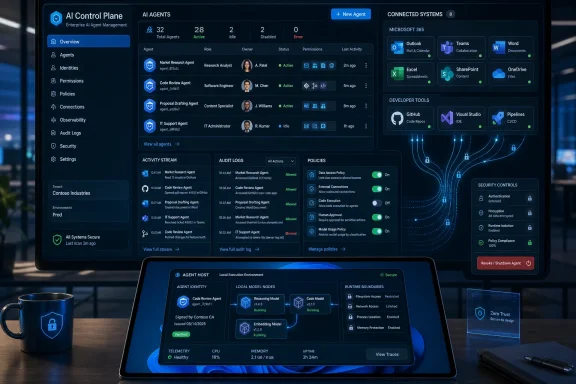 Microsoft Turns the Agent Hype Cycle Into an Admin Problem
The most important Build announcement was not a single chatbot, model, or flashy consumer feature. It was Microsoft’s effort to turn agents into a category that can be governed like users, apps, and devices.Microsoft Agent 365 is the clearest expression of that strategy. It gives agents enterprise-grade identity, observability, notifications, security controls, and governed access to Microsoft 365 data. In plain English, Microsoft wants every agent touching mail, calendars, Teams, SharePoint, or Office documents to have something closer to a badge, a job description, and an audit trail.
That framing is no accident. Enterprises are already worried about agent sprawl, the predictable moment when every department builds or buys a little automation worker with access to sensitive data. Microsoft is offering a registry and control plane before the mess gets completely out of hand.
The pitch will sound familiar to anyone who lived through mobile device management, SaaS identity integration, or shadow IT cleanups. First the tools spread, then admins discover them, then vendors sell centralized governance. Microsoft is trying to collapse that cycle into a product launch.
The New Stack Says Agents Are Infrastructure, Not Features
Microsoft’s agent story now spans several layers. Agent Framework is aimed at building and orchestrating agents in code. Microsoft Foundry is the platform for deploying, evaluating, grounding, and scaling them. Agent 365 wraps agents in identity and governance. GitHub and Visual Studio are where many of those agents will be authored.That is a more serious architecture than the “ask a bot to do a thing” demos that defined the early phase of generative AI. It also exposes how complicated agent software actually is. A useful agent needs model access, tool access, memory, routing, security policy, telemetry, and a way to recover when it does the wrong thing.
Microsoft is also emphasizing interoperability. Its documentation describes Agent 365 as something that can work with agents built outside the Microsoft ecosystem, including agents hosted on other clouds or built with non-Microsoft frameworks. That is strategically convenient: Microsoft would prefer to be the management layer even when it is not the only model provider or runtime.
This is classic Microsoft platform behavior. If the company cannot own every agent, it can still try to own the directory, policy layer, and developer workflow around them. For IT, that may be attractive. For competitors, it is a warning that “open” agent ecosystems can still become Microsoft-shaped once they enter the enterprise.
GitHub Copilot Moves From Pair Programmer to Delegated Worker
The developer angle remains central. Microsoft has been steadily pushing GitHub Copilot beyond autocomplete and chat into asynchronous work: agents that can take issues, inspect code, propose changes, and participate in pull-request workflows.At Build, that direction became part of a broader platform narrative. Developers are no longer just being asked to use AI while they type. They are being asked to design systems in which AI agents perform tasks, call tools, coordinate workflows, and leave behind telemetry that other humans and systems can inspect.
That changes the economics of developer tooling. The old Copilot value proposition was productivity inside the editor. The new one is delegation outside the editor. If it works, a developer can hand off boring or bounded work. If it fails, the developer inherits a new review burden: understanding not just code, but the reasoning trail of a software agent.
Visual Studio and VS Code sit at the center of that transition. Microsoft’s Build messaging around custom Copilot agents, Agent Skills, MCP-connected tools, and Foundry integration points to a future where the IDE is not merely a place to write code. It becomes a console for instructing and supervising semi-autonomous coding systems.
Windows Is Being Recast as an Agent Host
For WindowsForum readers, the Windows angle is the most consequential. Microsoft is not simply adding AI features to Windows; it is trying to make Windows a trusted platform for local and hybrid agent workloads.The company’s Build material points to on-device small language models, expanded Windows AI APIs, and local agentic capabilities on capable hardware. That matters because cloud-only agents create latency, cost, privacy, and control issues. A local agent that can reason, call tools, and operate within Windows permissions is a very different proposition from a web chatbot.
Microsoft’s Aion model work fits into that story. A smaller local model will not replace frontier cloud systems for every task, but it can handle certain planning, tool-calling, and inference workloads without sending everything over the network. For enterprises, local execution may be the difference between an approved pilot and a blocked deployment.
The risk is that “Windows as an agent host” also makes the operating system more complex. Every local capability becomes another policy surface. Every agent that can read, write, automate, or invoke tools raises questions about consent, malware abuse, data leakage, and user comprehension.
The Security Model Is the Product
Microsoft’s strongest argument is that agents need identity. An agent without identity is just automation with a vague owner. An agent with Entra-backed identity can be assigned permissions, monitored, constrained, and revoked.That is the right instinct. If an agent can read a mailbox, post in Teams, edit a document, query SharePoint, or trigger a workflow, it should not be hiding behind a generic service account or piggybacking invisibly on a user token. The difference between “Alice did this” and “Alice’s approved procurement agent did this” is not bureaucratic pedantry. It is the difference between an auditable system and a forensic nightmare.
Observability is just as important. Microsoft is leaning on OpenTelemetry-style tracing so agent activity can be inspected across inference events, tool calls, and workflow steps. In the agent era, logs are not merely debugging material. They are evidence.
Still, the existence of a control plane does not guarantee good governance. Admins will need defaults that are conservative, interfaces that make agent permissions understandable, and reporting that separates meaningful risk from noise. Microsoft has built the nouns. The verbs still need to prove themselves in production.
Foundry Becomes the Factory Floor
Microsoft Foundry is being positioned as the production environment for AI applications and agents. At Build, Microsoft emphasized runtime, tools, memory, grounding, observability, governance, model choice, and deployment paths. That is a long list because real agents are not a single API call.Foundry’s importance is that it turns agent development into an engineering process rather than a prompt-writing exercise. Developers need evaluation, regression testing, model routing, grounding data, and safety policies. Enterprises need to know which model was used, which tool was invoked, which data was accessed, and why a given output appeared.
This is also where Microsoft’s model-neutral posture becomes useful. Foundry can present itself as a place where developers use Microsoft models, OpenAI models, open models, and third-party options under one operational umbrella. The company does not have to win every model benchmark if it can make itself the safest place to deploy whatever model wins this quarter.
That said, Foundry also risks becoming another sprawling Azure surface. The more Microsoft wraps agents in services, SDKs, registries, and admin portals, the more it must fight the traditional Azure problem: power at the cost of cognitive overhead. Build’s message is coherent, but coherence in a keynote is not the same as simplicity in a tenant.
The Open Agentic Web Is Also a Land Grab
Microsoft is careful to talk about open protocols, agent interoperability, MCP, and support for agents built on other stacks. That language is important because developers are wary of being trapped inside another proprietary platform just as the agent ecosystem is forming.But openness and platform capture can coexist. If Microsoft supports many frameworks but makes Agent 365 the preferred governance layer, Foundry the preferred deployment layer, GitHub the preferred development layer, and Windows the preferred local runtime, the ecosystem can be open in theory while Microsoft owns the most valuable intersections.
This is not necessarily bad for customers. Enterprises often prefer a large vendor to stitch together the pieces. They want procurement, support, compliance, and integration more than ideological purity. Microsoft is betting that the first generation of serious agent buyers will care less about agent romanticism and more about whether the thing can pass security review.
For independent developers, the calculation is different. Building on Microsoft’s stack may offer distribution and credibility, especially inside Microsoft 365. It may also mean designing around Microsoft’s assumptions about identity, policy, and workflow from day one.
The User Experience Problem Has Not Been Solved
The hardest part of agents is not creating them. It is helping humans understand what they are allowed to do.A good agent UX must answer several questions quickly. What can this agent access? What can it change? Is it acting now or waiting? Did it complete the task or merely suggest an action? Who is responsible if it breaks something?
Microsoft’s history here is mixed. Windows has decades of permission dialogs, security prompts, notification surfaces, background tasks, scheduled jobs, and enterprise policy layers. Some are powerful. Many are ignored. If agents simply add more prompts and dashboards, users will click through and admins will drown in exceptions.
The company’s Build announcements suggest Microsoft understands the governance challenge. But the consumer and frontline-worker experience remains less clear. A well-managed agent in the Microsoft 365 admin center is one thing. A normal user being asked to trust an agent inside Outlook, Teams, Word, or Windows Explorer is another.
IT Departments Should Treat This as a New Endpoint Class
The practical implication for sysadmins is simple: agents should be managed like a new class of endpoint or workload. They are not just apps. They are not just scripts. They are autonomous or semi-autonomous actors that can combine user context, enterprise data, model reasoning, and tool execution.That means agent policy cannot be left solely to developer teams. Security, compliance, identity, endpoint management, records retention, and legal discovery all have a stake. An agent that summarizes a meeting is harmless until it stores regulated data in the wrong place. An agent that drafts code is useful until it introduces a dependency nobody reviewed. An agent that handles customer workflows is efficient until it cannot explain why it made a decision.
Microsoft’s governance-first pitch is therefore the right one for the enterprise market. But it also shifts responsibility onto customers. If Microsoft provides the registry and policy framework, organizations will be expected to use it. “We didn’t know these agents existed” will become a weaker excuse over time.
The Real Build Announcement Is a Bet on Trust
The agent tools announced at Build are not merely developer conveniences. They are Microsoft’s attempt to make agents boring enough to buy.That sounds dismissive, but it is the opposite. Boring infrastructure is what lets risky technology become normal technology. Email became governable. Smartphones became manageable. Cloud workloads became auditable. Microsoft wants agents to pass through the same institutional filter.
The danger is overpromising autonomy before reliability catches up. Agent demos still tend to show clean tasks, well-structured environments, and forgiving outcomes. Real work is messier. Documents contradict each other. Permissions are inconsistent. APIs fail. Users give vague instructions. Models hallucinate. Tools time out. The agent must not only act; it must know when to stop.
That is why Microsoft’s most credible announcements are about constraints rather than freedom. Identity, policy, observability, evaluation, local execution, and admin control are not glamorous. They are the parts that decide whether agents become production software or remain conference theater.
The Build 2026 Agent Stack Leaves IT With a Short Checklist
Microsoft’s message is ambitious, but the immediate lesson for Windows and Microsoft 365 shops is practical. Agents are coming through the same channels admins already manage: Entra, Microsoft 365, GitHub, Visual Studio, Azure, and Windows.- Organizations should inventory existing AI agents before adopting new ones, because unmanaged agents will become the next version of shadow IT.
- Developers should treat agent output as delegated work that still requires review, testing, and traceability.
- Security teams should insist on distinct agent identities rather than shared service accounts or invisible user-token delegation.
- Windows administrators should watch local agent capabilities closely, especially where on-device models gain file, app, or automation access.
- Procurement teams should evaluate agent platforms on governance, logging, and revocation controls, not just model quality or demo performance.
- End users should expect more agent surfaces inside Microsoft 365 and Windows, but the safest deployments will be the ones where permissions are visible and narrow.
References
- Primary source: readers.id
Published: 2026-06-02T20:42:10.228874
Loading…
www.readers.id - Related coverage: techradar.com
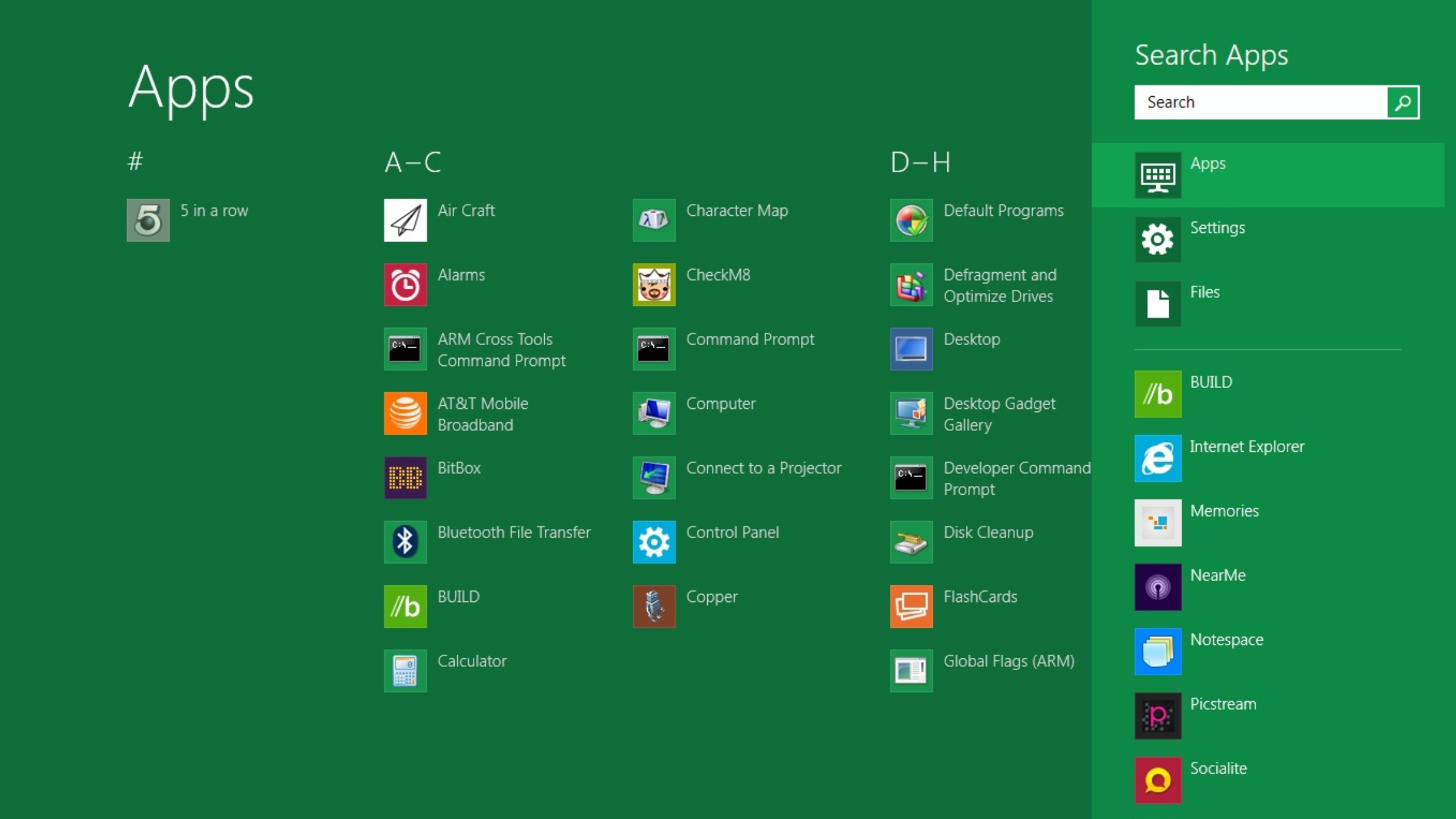
10 products that launched at Microsoft Build — and what happened to them
From Windows 8 to Copilot, here’s everything that was born at Buildwww.techradar.com
- Related coverage: windowscentral.com
Loading…
www.windowscentral.com - Related coverage: tomsguide.com
Loading…
www.tomsguide.com - Official source: news.microsoft.com
PHASE 2: with links/12:30 - Microsoft Build 2026
 news.microsoft.com
- Official source: blogs.microsoft.com
Microsoft Build 2025: The age of AI agents and building the open agentic web - The Official Microsoft Blog
TL;DR? Hear the news as an AI-generated audio overview made using Microsoft 365 Copilot. You can read the transcript here. We’ve entered the era of AI agents. Thanks to groundbreaking advancements in reasoning and memory, AI models are now more capable and efficient, and we’re seeing how AI... blogs.microsoft.com
- Official source: devblogs.microsoft.com

Microsoft Agent Framework at BUILD 2026 | Microsoft Agent Framework
Watch Microsoft Agent Framework sessions at Build 2026 (June 2–3). Explore multi-agent systems, agent harness patterns, observability, evals, and open-source governance. devblogs.microsoft.com
- Official source: developer.microsoft.com
Loading…
developer.microsoft.com - Official source: azure.microsoft.com
Loading…
azure.microsoft.com - Related coverage: redmondmag.com

Microsoft Uses Build 2026 To Put AI Agents at the Center of Windows -- Redmondmag.com
Microsoft used Build 2026 to position Windows as a platform for building and running AI agents, expanding its developer focus beyond AI-assisted apps and into agents that can act across local devices, cloud environments and enterprise systems. redmondmag.com
- Official source: blogs.windows.com

Build 2026: Furthering Windows as the trusted platform for development
Build is one of our favorite moments each year - a chance to connect with the global developer community and share what we’ve been building. Over the past year, we have connected with many developers pushing the boundaries of what’s possible on blogs.windows.com
- Official source: microsoft.com
Loading…
www.microsoft.com - Official source: cdn-dynmedia-1.microsoft.com
Loading…
cdn-dynmedia-1.microsoft.com - Official source: microsoft.github.io
Loading…
microsoft.github.io - Official source: techcommunity.microsoft.com
Loading…
techcommunity.microsoft.com
