

Microsoft used Build 2026 in San Francisco this week to extend the agentic AI platform it began sketching at Build 2025, pairing new cloud, web, Microsoft 365, Windows, GitHub, and Surface developer tools into a more complete stack for building AI agents. The important story is not that Microsoft suddenly discovered agents. It is that the company has spent a year trying to make agents less like demos and more like an operating model for software. Build 2026 only makes sense when read as the second act of Build 2025: the year Microsoft moved from describing the agentic web to packaging it.
The phrase “age of AI agents” did not arrive with this year’s keynote. Microsoft was already using that framing at Build 2025, when the company talked about an “open agentic web,” broad Model Context Protocol support, GitHub Copilot coding agents, Windows AI Foundry, Azure AI Foundry, Microsoft 365 Copilot Tuning, and multi-agent orchestration.
That matters because Microsoft’s Build 2026 story can look scattered if viewed as a collection of product announcements. There was hardware, there were models, there was Microsoft IQ, there was Web IQ, there was Scout, and there was the now-obligatory reminder that every developer is expected to become an AI developer. But the through line is simpler: Microsoft wants to own the infrastructure layer between models, enterprise data, operating systems, developer tools, and end users.
That is a more ambitious bet than shipping another chatbot. It is a bet that agents will need plumbing, memory, permissions, identity, connectors, orchestration, evaluation, deployment targets, and local compute. Microsoft’s advantage is not that it has the only models. It is that it has Windows, Azure, GitHub, Microsoft 365, Visual Studio Code, Teams, Entra, Intune, and a large enterprise base already trained to buy integration rather than assemble everything from scratch.
Build 2025 was where Microsoft named the architecture. Build 2026 was where it tried to prove the architecture can become a product line.
Microsoft’s decision to support MCP across GitHub, Copilot Studio, Dynamics 365, Azure AI Foundry, Semantic Kernel, and Windows 11 was therefore a strategic move disguised as plumbing. If agents are going to do real work, they need a disciplined way to reach into calendars, code repositories, databases, ticketing systems, file stores, line-of-business applications, and the web. Without that layer, “agentic” software becomes a brittle mess of one-off integrations.
The same logic applied to NLWeb, the project Microsoft introduced at Build 2025 as a way for websites to expose conversational interfaces to their own content. The comparison to HTML was intentionally grandiose, but the point was clear enough: Microsoft sees the web’s next phase as something agents can query, traverse, and act upon directly, not merely pages humans read through browsers.
That is why Build 2026’s renewed emphasis on grounding, context, and model choice does not feel like a pivot. It feels like Microsoft circling back to the unsolved problem from last year. If agents cannot reliably know where their information comes from, what they are allowed to do, and which tools they can invoke, then the agentic web remains a keynote phrase.
Microsoft is trying to make the boring parts of agents into standards before competitors make them into moats.
This is exactly where Microsoft’s enterprise footprint becomes strategically useful. A work agent that cannot understand Teams chats, Outlook commitments, SharePoint documents, OneDrive files, meetings, organizational structure, and permissions is mostly a novelty. A work agent that can understand those things while respecting governance is potentially a new interface for office work.
The key phrase is while respecting governance. Enterprise customers do not merely want agents that can find information. They want agents that can find the right information, avoid the wrong information, preserve access controls, leave audit trails, and avoid turning a productivity demo into a data-loss incident.
That makes Microsoft IQ less a single product than a positioning move. Microsoft is saying that context belongs inside the platform, not inside each individual agent. If that works, developers build against a richer substrate. If it fails, every agent becomes another bespoke integration project with its own retrieval logic, security assumptions, and failure modes.
The risk is that “IQ” becomes another Microsoft abstraction layered on top of earlier Microsoft abstractions. The company has a habit of naming platforms faster than customers can understand their boundaries. But the problem it is attacking is real: agents without trustworthy context are just chatbots with calendar access and better branding.
That move puts Microsoft in the middle of a larger fight over how the web is consumed by AI systems. Search engines indexed the web and sent humans to pages. AI agents may instead summarize, transact, and act on behalf of users, potentially reducing the need for a traditional page visit. Publishers, retailers, forums, and software vendors all have reasons to care about who controls that mediation layer.
For WindowsForum.com readers, this is not abstract. Communities like this one exist because humans still need durable explanations, troubleshooting threads, edge-case reports, and peer review. If agents become the front door to technical knowledge, the question becomes whether they amplify community expertise or strip-mine it into unattributed answers.
Microsoft’s NLWeb and Web IQ efforts suggest the company understands that the web needs an agent-readable interface, not just a crawler-readable one. But the economics remain unsettled. If agents become the default way users interact with web knowledge, site owners will demand control, visibility, and compensation structures that are not yet obvious.
The browser did not disappear at Build 2026. But Microsoft is plainly preparing for a world in which the browser is no longer the only meaningful interface to the web.
That is why GitHub Copilot’s evolution from autocomplete to chat to coding agent has been so important to Microsoft’s larger thesis. The coding environment lets Microsoft normalize the idea that an AI system can be assigned work, operate asynchronously, and return something reviewable. In developer terms, that is a manageable workflow. In enterprise terms, it is a preview of how agents may eventually handle broader knowledge work.
Build 2025’s GitHub Copilot coding agent announcement was therefore not just a developer feature. It was a behavioral experiment. Microsoft was training users to think of AI not as a text box but as a participant in a process.
Build 2026 continues that arc by emphasizing trust, native context, knowledge, and model choice. GitHub’s message is that developers do not merely need another framework for spinning up agents. They need confidence that the agent can use the right model, reach the right context, and operate inside a workflow that humans can inspect and control.
That is the hard part. The easy part is generating code. The hard part is knowing whether the code should exist, whether it solves the right problem, whether it introduces a security issue, and whether the organization can govern the process at scale.
That is a very different Surface story from the one Microsoft has told for much of the brand’s history. Surface began as Microsoft’s argument about what Windows hardware could be. The Dev Box is Microsoft arguing about where AI development should happen: not only in hyperscale cloud environments, but also on high-memory local machines that can run serious models near the developer.
The Surface Laptop Ultra, announced around Computex and tied into the same RTX Spark story, pushes that idea into mobile workstation territory. Microsoft is not merely refreshing the Surface line for the AI era. It is trying to show that Windows on Arm, NVIDIA acceleration, local model execution, and cloud-connected development can be part of one pipeline.
That is a practical concession as much as a strategic one. Cloud inference and training are powerful, but they are not always cheap, private, low-latency, or convenient. Developers working with sensitive data, experimental agents, or constant iteration may prefer a local-first workflow before moving workloads into Azure.
The old “developer box” was about compiling applications. The new one is about testing agents, running models, and simulating the increasingly messy boundary between local compute and cloud intelligence.
AI infrastructure is often invisible to end users. It lives in Azure regions, model catalogs, APIs, and admin portals. A compact machine on a desk is a more concrete statement. It tells developers that Microsoft expects some meaningful slice of agent development to happen on Windows hardware, close to the tools they already use.
The local angle also addresses three concerns that keep surfacing in enterprise AI deployments. The first is latency, because agents that must constantly round-trip to cloud services can feel slow or brittle. The second is cost, because heavy experimentation against hosted models can become expensive quickly. The third is data control, because not every organization wants every development-stage prompt, document, or workflow flowing through external services.
None of this means local AI replaces Azure. It means Microsoft wants Windows to become the edge of Azure’s AI platform. That is a familiar Microsoft move: make the client and the cloud mutually reinforcing, then sell the management story to enterprises.
If the Surface RTX Spark Dev Box succeeds, it will not be because every developer buys one. It will be because it helps define the reference shape of a Windows AI workstation.
That is both powerful and unsettling. Microsoft describes Scout as an agent that can understand how a user works, operate across tools like Teams and Outlook, and proactively handle tasks such as meeting preparation, scheduling conflicts, and routine work. That is exactly the kind of assistance knowledge workers have been promised for years, first by digital assistants, then by smart calendars, then by productivity suites, and now by agents.
The difference is that modern agents may actually have enough context and capability to do more than set reminders. If Scout can understand communications, documents, meetings, preferences, deadlines, and organizational norms, it can become a useful layer over work. But usefulness comes from access, and access is where the trust problem sharpens.
Users will want to know what Scout can see, what it remembers, what it changes, what it sends, and how easily it can be corrected. Administrators will want policy controls. Security teams will want logs and containment. Legal departments will want clarity on retention and discovery. Workers will want assurance that “helpful” does not become surveillance with a friendly icon.
Scout may be one of Build 2026’s most consequential announcements precisely because it moves agents from the developer platform into the daily rhythm of work. Microsoft has to prove that proactive assistance does not become proactive overreach.
This is why Microsoft keeps emphasizing trust, grounding, orchestration, and choice. The company knows that enterprises do not adopt platforms merely because a keynote demo is impressive. They adopt platforms when the compliance, identity, security, deployment, and management layers are credible enough for real use.
The advantage for Microsoft is that it already sells those layers. Entra, Intune, Defender, Purview, Azure, Microsoft 365, and GitHub Enterprise give the company a governance vocabulary that startups often lack. Microsoft can tell CIOs that agents are not a new unmanaged surface but an extension of the control plane they already use.
The danger is that agents create new classes of failure that old control planes were not designed to handle. A human with access to a file can misuse it. An agent with access to thousands of files can misuse them at machine speed, or combine them in ways that no single permission boundary anticipated. The governance story has to evolve beyond “the user had access” if agents are acting across systems.
That is where the next phase of enterprise AI will be fought. Model quality matters, but operational trust may matter more.
The old application model was comparatively straightforward. A program had a user interface, a data layer, permissions, and deployment targets. Agentic applications are messier. They may include prompts, model routing, retrieval pipelines, tool invocation, memory, evaluation systems, human approval loops, and multiple agents coordinating across services.
That changes what it means to be a Windows developer or an enterprise developer. It is no longer enough to know the API surface. Developers must understand how agents fail, how models hallucinate, how retrieval can mislead, how permissions propagate, and how to design workflows where humans remain meaningfully in control.
Microsoft’s pitch is that its stack will absorb much of that complexity. Azure AI Foundry, Windows AI Foundry, Semantic Kernel, Copilot Studio, GitHub, MCP, Microsoft IQ, and the Surface developer hardware all point toward a more integrated path. But integration is not the same as simplicity.
The developer who adopts Microsoft’s agentic stack is buying leverage. They are also buying into Microsoft’s assumptions about where agents are headed.
Microsoft wants the answer to be: all of the above, but through Microsoft’s stack.
That is why Build 2026 touched so many layers. Surface hardware gives developers a local target. Windows provides the client environment. GitHub captures software workflows. Azure provides model hosting and orchestration. Microsoft 365 supplies enterprise context. MCP and NLWeb gesture toward open infrastructure. Microsoft IQ and Web IQ attempt to ground agent behavior across private and public knowledge.
This is a classic platform-company maneuver. Microsoft is not trying to win by having one irresistible AI app. It is trying to make itself the place where many AI apps and agents become viable.
The open-standards rhetoric is important but should be read carefully. Microsoft benefits if agent infrastructure is open enough to attract developers and partners, but integrated enough that the best experience happens inside its ecosystem. That tension has defined Microsoft for decades.
The Surface RTX Spark Dev Box will draw attention because hardware is tangible. But the longer-term Windows story is software architecture. If Windows becomes a local agent host, a model execution environment, and a secure edge for enterprise AI, then Microsoft’s OS strategy becomes much more interesting than another round of Start menu arguments.
There are still obvious unknowns. Pricing for new hardware will shape adoption. Model licensing and availability will affect developer choices. Enterprise admins will need clearer controls. Users will need transparency. Publishers and site owners will need to understand how Web IQ and agentic discovery affect traffic and attribution.
Build 2026 did not answer all of those questions. It clarified that Microsoft is serious about making them Windows questions, Azure questions, GitHub questions, and Microsoft 365 questions rather than leaving them to someone else’s platform.
That does not mean the plan will work. Developers are rightly skeptical of platform churn, especially when every vendor claims to be defining the future. Microsoft has retired enough frameworks, renamed enough services, and repositioned enough AI products to make caution reasonable.
But the continuity between the two Build conferences is hard to miss. Microsoft is not merely chasing the AI news cycle week by week. It is building a layered argument that agents need infrastructure, and that Microsoft is uniquely positioned to provide it.
The question now is not whether Microsoft can announce an agentic platform. It clearly can. The question is whether developers, admins, and users find the platform trustworthy enough to let agents do real work.
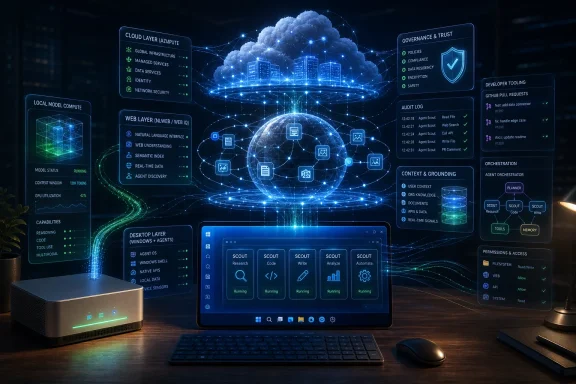 Microsoft Did Not Announce a New Strategy So Much as Admit the Old One Was Bigger Than It Looked
The phrase “age of AI agents” did not arrive with this year’s keynote. Microsoft was already using that framing at Build 2025, when the company talked about an “open agentic web,” broad Model Context Protocol support, GitHub Copilot coding agents, Windows AI Foundry, Azure AI Foundry, Microsoft 365 Copilot Tuning, and multi-agent orchestration.That matters because Microsoft’s Build 2026 story can look scattered if viewed as a collection of product announcements. There was hardware, there were models, there was Microsoft IQ, there was Web IQ, there was Scout, and there was the now-obligatory reminder that every developer is expected to become an AI developer. But the through line is simpler: Microsoft wants to own the infrastructure layer between models, enterprise data, operating systems, developer tools, and end users.
That is a more ambitious bet than shipping another chatbot. It is a bet that agents will need plumbing, memory, permissions, identity, connectors, orchestration, evaluation, deployment targets, and local compute. Microsoft’s advantage is not that it has the only models. It is that it has Windows, Azure, GitHub, Microsoft 365, Visual Studio Code, Teams, Entra, Intune, and a large enterprise base already trained to buy integration rather than assemble everything from scratch.
Build 2025 was where Microsoft named the architecture. Build 2026 was where it tried to prove the architecture can become a product line.
The Agentic Web Needed a Protocol Story Before It Needed More Hype
A year ago, Microsoft’s support for Model Context Protocol looked like one of those developer announcements that matters more in hindsight than in the keynote moment. MCP is not glamorous in the way a new device or a flashy AI assistant is glamorous. It is connective tissue: a way for models and agents to talk to tools, services, and data sources in a more standardized fashion.Microsoft’s decision to support MCP across GitHub, Copilot Studio, Dynamics 365, Azure AI Foundry, Semantic Kernel, and Windows 11 was therefore a strategic move disguised as plumbing. If agents are going to do real work, they need a disciplined way to reach into calendars, code repositories, databases, ticketing systems, file stores, line-of-business applications, and the web. Without that layer, “agentic” software becomes a brittle mess of one-off integrations.
The same logic applied to NLWeb, the project Microsoft introduced at Build 2025 as a way for websites to expose conversational interfaces to their own content. The comparison to HTML was intentionally grandiose, but the point was clear enough: Microsoft sees the web’s next phase as something agents can query, traverse, and act upon directly, not merely pages humans read through browsers.
That is why Build 2026’s renewed emphasis on grounding, context, and model choice does not feel like a pivot. It feels like Microsoft circling back to the unsolved problem from last year. If agents cannot reliably know where their information comes from, what they are allowed to do, and which tools they can invoke, then the agentic web remains a keynote phrase.
Microsoft is trying to make the boring parts of agents into standards before competitors make them into moats.
Microsoft IQ Is the New Name for an Old Enterprise Problem
Microsoft IQ, introduced at Build 2026 as a shared intelligence layer for agents, is Microsoft’s attempt to solve the context problem without pretending that raw model capability is enough. In plain language, Microsoft IQ is meant to help agents draw from relevant world knowledge and enterprise knowledge instead of answering from a generic statistical fog.This is exactly where Microsoft’s enterprise footprint becomes strategically useful. A work agent that cannot understand Teams chats, Outlook commitments, SharePoint documents, OneDrive files, meetings, organizational structure, and permissions is mostly a novelty. A work agent that can understand those things while respecting governance is potentially a new interface for office work.
The key phrase is while respecting governance. Enterprise customers do not merely want agents that can find information. They want agents that can find the right information, avoid the wrong information, preserve access controls, leave audit trails, and avoid turning a productivity demo into a data-loss incident.
That makes Microsoft IQ less a single product than a positioning move. Microsoft is saying that context belongs inside the platform, not inside each individual agent. If that works, developers build against a richer substrate. If it fails, every agent becomes another bespoke integration project with its own retrieval logic, security assumptions, and failure modes.
The risk is that “IQ” becomes another Microsoft abstraction layered on top of earlier Microsoft abstractions. The company has a habit of naming platforms faster than customers can understand their boundaries. But the problem it is attacking is real: agents without trustworthy context are just chatbots with calendar access and better branding.
Web IQ Shows Microsoft Still Wants the Web, Not Just the Enterprise
The newly announced Web IQ adds an important wrinkle to the story. Microsoft is not limiting its grounding ambitions to corporate data. It wants agents to connect to current information from the web as well, which is essential if agents are expected to answer questions, monitor changes, plan tasks, compare options, and make recommendations in real time.That move puts Microsoft in the middle of a larger fight over how the web is consumed by AI systems. Search engines indexed the web and sent humans to pages. AI agents may instead summarize, transact, and act on behalf of users, potentially reducing the need for a traditional page visit. Publishers, retailers, forums, and software vendors all have reasons to care about who controls that mediation layer.
For WindowsForum.com readers, this is not abstract. Communities like this one exist because humans still need durable explanations, troubleshooting threads, edge-case reports, and peer review. If agents become the front door to technical knowledge, the question becomes whether they amplify community expertise or strip-mine it into unattributed answers.
Microsoft’s NLWeb and Web IQ efforts suggest the company understands that the web needs an agent-readable interface, not just a crawler-readable one. But the economics remain unsettled. If agents become the default way users interact with web knowledge, site owners will demand control, visibility, and compensation structures that are not yet obvious.
The browser did not disappear at Build 2026. But Microsoft is plainly preparing for a world in which the browser is no longer the only meaningful interface to the web.
GitHub Is Where Microsoft Tests Whether Agents Can Be Coworkers
GitHub remains Microsoft’s most credible proving ground for agents because software development already produces the artifacts agents need: issues, pull requests, tests, logs, documentation, build pipelines, and version history. A coding agent can be judged more concretely than a general office assistant. Did the code compile? Did the tests pass? Did the pull request make sense? Did the review catch the problem?That is why GitHub Copilot’s evolution from autocomplete to chat to coding agent has been so important to Microsoft’s larger thesis. The coding environment lets Microsoft normalize the idea that an AI system can be assigned work, operate asynchronously, and return something reviewable. In developer terms, that is a manageable workflow. In enterprise terms, it is a preview of how agents may eventually handle broader knowledge work.
Build 2025’s GitHub Copilot coding agent announcement was therefore not just a developer feature. It was a behavioral experiment. Microsoft was training users to think of AI not as a text box but as a participant in a process.
Build 2026 continues that arc by emphasizing trust, native context, knowledge, and model choice. GitHub’s message is that developers do not merely need another framework for spinning up agents. They need confidence that the agent can use the right model, reach the right context, and operate inside a workflow that humans can inspect and control.
That is the hard part. The easy part is generating code. The hard part is knowing whether the code should exist, whether it solves the right problem, whether it introduces a security issue, and whether the organization can govern the process at scale.
Windows Is Becoming the Local Edge of Microsoft’s AI Platform
The Surface RTX Spark Dev Box was one of the clearest signs that Microsoft wants agentic development to happen locally as well as in the cloud. Announced at Build 2026, the compact developer PC uses NVIDIA RTX Spark silicon, offers 128GB of unified memory, and is aimed at developers running sustained AI workloads, local fine-tuning, and agentic pipelines.That is a very different Surface story from the one Microsoft has told for much of the brand’s history. Surface began as Microsoft’s argument about what Windows hardware could be. The Dev Box is Microsoft arguing about where AI development should happen: not only in hyperscale cloud environments, but also on high-memory local machines that can run serious models near the developer.
The Surface Laptop Ultra, announced around Computex and tied into the same RTX Spark story, pushes that idea into mobile workstation territory. Microsoft is not merely refreshing the Surface line for the AI era. It is trying to show that Windows on Arm, NVIDIA acceleration, local model execution, and cloud-connected development can be part of one pipeline.
That is a practical concession as much as a strategic one. Cloud inference and training are powerful, but they are not always cheap, private, low-latency, or convenient. Developers working with sensitive data, experimental agents, or constant iteration may prefer a local-first workflow before moving workloads into Azure.
The old “developer box” was about compiling applications. The new one is about testing agents, running models, and simulating the increasingly messy boundary between local compute and cloud intelligence.
The Hardware Is Really About Trust, Cost, and Latency
It is tempting to view the Surface RTX Spark Dev Box as a niche toy for AI enthusiasts with generous budgets. That may be how many consumers see it, especially with pricing still one of the obvious missing pieces. But for Microsoft, the device plays a more strategic role: it makes the agentic stack visible.AI infrastructure is often invisible to end users. It lives in Azure regions, model catalogs, APIs, and admin portals. A compact machine on a desk is a more concrete statement. It tells developers that Microsoft expects some meaningful slice of agent development to happen on Windows hardware, close to the tools they already use.
The local angle also addresses three concerns that keep surfacing in enterprise AI deployments. The first is latency, because agents that must constantly round-trip to cloud services can feel slow or brittle. The second is cost, because heavy experimentation against hosted models can become expensive quickly. The third is data control, because not every organization wants every development-stage prompt, document, or workflow flowing through external services.
None of this means local AI replaces Azure. It means Microsoft wants Windows to become the edge of Azure’s AI platform. That is a familiar Microsoft move: make the client and the cloud mutually reinforcing, then sell the management story to enterprises.
If the Surface RTX Spark Dev Box succeeds, it will not be because every developer buys one. It will be because it helps define the reference shape of a Windows AI workstation.
Scout Is the Most Personal Part of the Stack, and Therefore the Riskiest
Scout, Microsoft’s always-on personal work agent announced at Build 2026, is where the company’s platform argument becomes intimate. A coding agent can live in a repository. An enterprise agent can live in a workflow. A personal work agent lives in the user’s day.That is both powerful and unsettling. Microsoft describes Scout as an agent that can understand how a user works, operate across tools like Teams and Outlook, and proactively handle tasks such as meeting preparation, scheduling conflicts, and routine work. That is exactly the kind of assistance knowledge workers have been promised for years, first by digital assistants, then by smart calendars, then by productivity suites, and now by agents.
The difference is that modern agents may actually have enough context and capability to do more than set reminders. If Scout can understand communications, documents, meetings, preferences, deadlines, and organizational norms, it can become a useful layer over work. But usefulness comes from access, and access is where the trust problem sharpens.
Users will want to know what Scout can see, what it remembers, what it changes, what it sends, and how easily it can be corrected. Administrators will want policy controls. Security teams will want logs and containment. Legal departments will want clarity on retention and discovery. Workers will want assurance that “helpful” does not become surveillance with a friendly icon.
Scout may be one of Build 2026’s most consequential announcements precisely because it moves agents from the developer platform into the daily rhythm of work. Microsoft has to prove that proactive assistance does not become proactive overreach.
The Enterprise Buyer Is Hearing a Governance Pitch Beneath the AI Pitch
Microsoft’s Build messaging is aimed at developers, but the enterprise buyer is never far offstage. Every agent demo raises procurement questions. Who owns the data? Which model was used? Can output be evaluated? Can an action be reversed? Can an administrator disable a connector? Can a regulated company prove what happened after the fact?This is why Microsoft keeps emphasizing trust, grounding, orchestration, and choice. The company knows that enterprises do not adopt platforms merely because a keynote demo is impressive. They adopt platforms when the compliance, identity, security, deployment, and management layers are credible enough for real use.
The advantage for Microsoft is that it already sells those layers. Entra, Intune, Defender, Purview, Azure, Microsoft 365, and GitHub Enterprise give the company a governance vocabulary that startups often lack. Microsoft can tell CIOs that agents are not a new unmanaged surface but an extension of the control plane they already use.
The danger is that agents create new classes of failure that old control planes were not designed to handle. A human with access to a file can misuse it. An agent with access to thousands of files can misuse them at machine speed, or combine them in ways that no single permission boundary anticipated. The governance story has to evolve beyond “the user had access” if agents are acting across systems.
That is where the next phase of enterprise AI will be fought. Model quality matters, but operational trust may matter more.
Developers Are Being Asked to Build for a Moving Target
For developers, Build 2026 presents both an opportunity and a burden. Microsoft is offering more tools, more models, more local hardware, more integration points, and more ways to reach users through Windows, GitHub, Azure, the web, and Microsoft 365. But it is also asking developers to build for a platform whose boundaries are still forming.The old application model was comparatively straightforward. A program had a user interface, a data layer, permissions, and deployment targets. Agentic applications are messier. They may include prompts, model routing, retrieval pipelines, tool invocation, memory, evaluation systems, human approval loops, and multiple agents coordinating across services.
That changes what it means to be a Windows developer or an enterprise developer. It is no longer enough to know the API surface. Developers must understand how agents fail, how models hallucinate, how retrieval can mislead, how permissions propagate, and how to design workflows where humans remain meaningfully in control.
Microsoft’s pitch is that its stack will absorb much of that complexity. Azure AI Foundry, Windows AI Foundry, Semantic Kernel, Copilot Studio, GitHub, MCP, Microsoft IQ, and the Surface developer hardware all point toward a more integrated path. But integration is not the same as simplicity.
The developer who adopts Microsoft’s agentic stack is buying leverage. They are also buying into Microsoft’s assumptions about where agents are headed.
The Real Competition Is for the Default Agent Runtime
Microsoft’s agentic strategy should not be read only as a fight with Google, OpenAI, Anthropic, Amazon, or Apple over model quality. The deeper contest is about the default runtime for agents. Where do agents live? How do they get context? Which identity system do they use? Which tool registry do they trust? Which operating system gives them local capabilities? Which cloud scales them? Which productivity suite supplies the work graph?Microsoft wants the answer to be: all of the above, but through Microsoft’s stack.
That is why Build 2026 touched so many layers. Surface hardware gives developers a local target. Windows provides the client environment. GitHub captures software workflows. Azure provides model hosting and orchestration. Microsoft 365 supplies enterprise context. MCP and NLWeb gesture toward open infrastructure. Microsoft IQ and Web IQ attempt to ground agent behavior across private and public knowledge.
This is a classic platform-company maneuver. Microsoft is not trying to win by having one irresistible AI app. It is trying to make itself the place where many AI apps and agents become viable.
The open-standards rhetoric is important but should be read carefully. Microsoft benefits if agent infrastructure is open enough to attract developers and partners, but integrated enough that the best experience happens inside its ecosystem. That tension has defined Microsoft for decades.
The Windows Community Should Watch the Edges, Not Just the Keynotes
For Windows enthusiasts and IT pros, the most interesting parts of this story will not necessarily be the keynote demos. They will be the edge cases: how agents behave under least-privilege access, how local models perform on real hardware, how Windows handles background agent tasks, how Copilot features interact with enterprise policy, and how much of this stack remains useful outside Microsoft 365-heavy organizations.The Surface RTX Spark Dev Box will draw attention because hardware is tangible. But the longer-term Windows story is software architecture. If Windows becomes a local agent host, a model execution environment, and a secure edge for enterprise AI, then Microsoft’s OS strategy becomes much more interesting than another round of Start menu arguments.
There are still obvious unknowns. Pricing for new hardware will shape adoption. Model licensing and availability will affect developer choices. Enterprise admins will need clearer controls. Users will need transparency. Publishers and site owners will need to understand how Web IQ and agentic discovery affect traffic and attribution.
Build 2026 did not answer all of those questions. It clarified that Microsoft is serious about making them Windows questions, Azure questions, GitHub questions, and Microsoft 365 questions rather than leaving them to someone else’s platform.
The Year Between Build 2025 and Build 2026 Is the Story Microsoft Wants Developers to Notice
The most concrete lesson from this year’s Build is that Microsoft is operating on a multi-year plan. Build 2025 introduced the vocabulary: agents, MCP, NLWeb, AI Foundry, Copilot coding agents, orchestration, and an open agentic web. Build 2026 tried to turn that vocabulary into a stack with hardware, grounding layers, personal agents, model choice, and deeper developer tooling.That does not mean the plan will work. Developers are rightly skeptical of platform churn, especially when every vendor claims to be defining the future. Microsoft has retired enough frameworks, renamed enough services, and repositioned enough AI products to make caution reasonable.
But the continuity between the two Build conferences is hard to miss. Microsoft is not merely chasing the AI news cycle week by week. It is building a layered argument that agents need infrastructure, and that Microsoft is uniquely positioned to provide it.
The question now is not whether Microsoft can announce an agentic platform. It clearly can. The question is whether developers, admins, and users find the platform trustworthy enough to let agents do real work.
The Build 2026 Bet Comes Down to What Developers Actually Ship
Microsoft’s case is strongest when it stays practical: agents need context, tools, governance, local compute, and deployment paths. The company’s weakness is that its story can become so broad that it sounds like everything is part of the agentic web simply because Microsoft says it is.- Build 2026 is best understood as a continuation of Build 2025, not a fresh pivot.
- Microsoft is trying to turn agents from standalone demos into a managed platform spanning GitHub, Azure, Windows, Microsoft 365, and Surface.
- Model Context Protocol, NLWeb, Microsoft IQ, and Web IQ are the connective tissue in Microsoft’s agentic web strategy.
- Surface RTX Spark Dev Box and Surface Laptop Ultra show that Microsoft sees local AI development as part of the platform, not a side quest.
- Scout will test whether users trust Microsoft enough to let an always-on agent operate inside the daily flow of work.
- The biggest unanswered question is whether developers will build durable software on this stack or wait for the standards and economics to settle.
References
- Primary source: Windows Central
Published: 2026-06-05T14:10:30.459418
Build 2026 only makes sense if you remember Build 2025: a look back at the groundwork of the "age of AI agents" | Windows Central
Microsoft’s latest announcements build directly on the architecture it introduced a year ago.www.windowscentral.com - Related coverage: tomshardware.com
- Related coverage: axios.com
Microsoft debuts Nvidia-powered Microsoft Surface Ultra laptop
Microsoft is trying again to redefine the PC for the AI era.www.axios.com
- Related coverage: techradar.com
Could Microsoft kill the web browser at Build? Everything developers need to know about the NLWeb Protocol | TechRadar
Making every website queryable by AI agentswww.techradar.com - Official source: microsoft.com
Surface RTX Spark Dev Box: The new dev box | Microsoft Surface
Discover the new Surface RTX Spark Dev Box built for developers. Small enough to sit on your desktop. Powerful enough to create the future. Right out of the box.www.microsoft.com - Official source: blogs.microsoft.com
Microsoft Build 2025: The age of AI agents and building the open agentic web - The Official Microsoft Blog
TL;DR? Hear the news as an AI-generated audio overview made using Microsoft 365 Copilot. You can read the transcript here. We’ve entered the era of AI agents. Thanks to groundbreaking advancements in reasoning and memory, AI models are now more capable and efficient, and we’re seeing how...blogs.microsoft.com
- Official source: blogs.windows.com
Building the next generation of devices for developers: Surface RTX Spark Dev Box
Software developers are some of the most ambitious makers we serve. They push devices harder, ask more of their tools and expect their environment to help define the pace of modern software creation. Development today means longer runninblogs.windows.com - Official source: news.microsoft.com
Microsoft Build en directo
El lugar donde seguir en tiempo real las últimas noticias a medida que se anuncien desde el Microsoft Build, los días 2 y 3 de junio de 2026.news.microsoft.com - Related coverage: tomsguide.com
Biggest Microsoft Build 2026 announcements — agentic AI, RTX Spark Dev Box, GitHub Copilot app, new MAI models, and more | Tom's Guide
All the big news from Microsoft's AI-focused eventwww.tomsguide.com - Related coverage: notebookcheck.net
Microsoft reveals new Mac Studio rival with Nvidia RTX Spark and 128 GB RAM - Notebookcheck News
Microsoft has revealed a new Surface-branded device featuring the Nvidia RTX Spark chipset. Arriving a day after the Surface Laptop Ultra, the Surface RTX Spark Dev Box is a mini-PC with 128 GB of RAM and more ports than its laptop counterpart. www.notebookcheck.net
- Related coverage: visualstudiomagazine.com
Microsoft Heralds 'Age of AI Agents' at Build 2025 -- Visual Studio Magazine
Microsoft ushers in a new era at Build 2025, unveiling a wave of AI-powered agents designed to transform software development, supercharge productivity, and redefine the future of coding.visualstudiomagazine.com - Related coverage: msblogs.thesourcemediaassets.com
Transcript Audio Overview Microsoft Build 2025 The age of AI agents and building the open agentic web
PDF documentmsblogs.thesourcemediaassets.com
- Related coverage: newsroom.workday.com
Workday and Microsoft to Deliver Unified AI Agent Experience for the Enterprise - Sep 16, 2025
PDF documentnewsroom.workday.com
