

Microsoft used Build 2026 in San Francisco to expand Microsoft Foundry with hosted agent runtimes, reusable toolboxes, managed memory, Foundry IQ grounding, new MAI models, observability, and governance features aimed at moving enterprise AI agents from prototypes into production. The announcement matters because Microsoft is no longer pitching Foundry as merely another model catalog or Azure wrapper around chat completions. It is trying to make Foundry the control plane for agentic software: the place where code, data, identity, tools, policies, evaluations, and deployment meet. For WindowsForum readers, the story is not that Microsoft has another AI brand; it is that Redmond is turning agents into infrastructure.
The last two years of enterprise AI have produced a familiar pattern. A developer wires a model to a few tools, builds an impressive internal demo, then discovers that the hard parts are not the prompt or even the model. The hard parts are state, permissions, retrieval, observability, cost, evaluation, lifecycle management, and the sheer awkwardness of letting probabilistic software touch real business systems.
Microsoft’s Build 2026 Foundry announcements are a direct answer to that gap. The company’s phrase — “AI app and agent factory” — is marketing language, but the underlying direction is concrete. Foundry is being positioned as a managed production environment for agents, not simply a place to select GPT, Claude, Llama, Phi, or one of Microsoft’s own models.
That distinction matters. A model endpoint answers. An agent acts. Once software can call tools, read business data, maintain memory, schedule work, and publish into Microsoft Teams or Microsoft 365 Copilot, the platform surrounding the model becomes as important as the model itself.
This is where Microsoft has a structural advantage. It already owns the identity layer for many enterprises through Entra ID, the productivity surface through Microsoft 365, the developer relationship through GitHub and Visual Studio Code, and the cloud substrate through Azure. Foundry is Microsoft’s attempt to stitch those assets into a single agent platform before the agent ecosystem fragments into incompatible runtimes, orchestration frameworks, retrieval stacks, and governance tools.
Microsoft is supporting both a stateful Responses API and a lighter invocations protocol, which is a pragmatic signal. Some teams want OpenAI-compatible interaction patterns; others want a pass-through runtime where they control request and response structure. By supporting both, Microsoft is trying to avoid forcing every agent workload into the same abstraction.
The reference to long-running agents such as OpenClaw and Hermes also points to a more realistic view of enterprise automation. Many useful agents will not be single-turn chatbots. They will watch queues, triage tickets, reconcile files, produce daily reports, route tasks, or keep context over hours and days. Those workloads need durable state, execution isolation, retry logic, files, traces, and policy boundaries.
The public preview of routines adds another clue. Scheduled agents are boring in the best possible way. They move the conversation from “ask a chatbot to do something” toward “let a managed service run operational work on a cadence,” which is how IT departments actually automate.
Foundry Toolboxes are Microsoft’s answer. In public preview, they provide a managed endpoint for tools, skills, Model Context Protocol clients, and enterprise data integrations. Tools can be registered once, then discovered by agents at runtime rather than manually wired into every agent implementation.
That sounds mundane until you imagine the alternative. Without a central tool layer, every team invents its own pattern for exposing Jira, ServiceNow, SharePoint, GitHub, internal APIs, SQL databases, ticketing systems, and line-of-business applications. The result is duplicated glue code, inconsistent authentication, uneven logging, and a governance headache.
Tool search is especially important. One of the less glamorous problems in agent design is that giving a model too many tools can degrade behavior. The model must reason not only about the task, but also about which tool among many is appropriate. Microsoft’s claim that Foundry can select a smaller set of relevant tools for each task is exactly the kind of platform intervention enterprises will need if agents are to operate beyond toy examples.
The direct publishing path into Teams and Microsoft 365 Copilot is equally strategic. Microsoft does not want Foundry agents living only in developer portals. It wants them surfaced where employees already work, inheriting identity, permissions, and policy along the way. That turns Teams and Copilot into distribution channels for internal software, with Foundry as the backend factory.
This is more than remembering that a user prefers concise answers. Procedural memory aims to capture how work gets done: the steps, preferences, corrections, and workflows that emerge over time. If it works, it gives agents a way to become less brittle without every improvement requiring a developer to rewrite instructions or update code.
Microsoft says early Tau-bench results show meaningful task-success improvements when procedural memory is enabled, at near-baseline cost. Benchmarks in this area should be treated cautiously, especially because agent performance often varies sharply by task design, tool reliability, and evaluation method. Still, the direction is sensible: persistent memory will be a requirement for agents that perform recurring work rather than one-off chats.
The risk is that memory is also governance dynamite. A system that extracts facts and procedures from conversations, stores them, and retrieves them later must answer hard questions about retention, inspection, deletion, sensitivity labels, tenant boundaries, and user expectations. Microsoft’s emphasis on identifiers such as Entra ID, managed storage, and retention controls is not decorative; it is the price of admission.
For administrators, memory will become one of the first places to look when an agent behaves strangely. Was the model wrong, the retrieval bad, the tool call malformed, or the stored procedure stale? Production-grade agents will need a debugging story that treats memory as observable state, not invisible magic.
Foundry IQ is Microsoft’s attempt to make grounding a shared service. The Build 2026 announcements describe a knowledge layer that unifies Work IQ, Fabric IQ, Azure SQL, file search, and other sources behind a single retrieval endpoint. Serverless Foundry IQ is in public preview, multi-source knowledge bases are generally available, and Microsoft Web IQ adds live web grounding with low-latency claims and zero data retention guarantees.
The enterprise appeal is obvious. If every agent team builds its own RAG stack, the organization ends up with inconsistent answers, duplicated indexes, uneven permission enforcement, and no central way to reason about data exposure. A shared retrieval layer lets Microsoft argue that grounding should be governed like identity or networking: centrally managed, policy-aware, and reusable.
There is also a Microsoft 365 angle. Work IQ draws from organizational signals and Microsoft 365 data, while Fabric IQ speaks to structured business data. Foundry IQ then becomes the developer-facing knowledge layer for agents. Together, the “IQ” branding is Microsoft’s way of saying that context is no longer a feature of individual apps; it is a horizontal layer across Copilot Studio, Microsoft 365 Copilot, GitHub, Azure, and Foundry.
The challenge will be trust. Retrieval systems fail in less theatrical ways than models do. They return plausible but incomplete context, stale documents, or permission-trimmed fragments that change the answer. Foundry IQ may reduce custom plumbing, but it will not eliminate the need for careful evaluation, source inspection, and incident response when agents act on partial knowledge.
The first-party MAI models matter because they show Microsoft trying to reduce total dependence on partner models, even as it continues to rely heavily on the broader frontier ecosystem. Enterprises may not care whose model wins a benchmark as much as they care whether the platform gives them routing, logging, access control, regional availability, indemnity posture, pricing predictability, and governance.
Fireworks AI on Foundry reaching general availability fits the same pattern. Microsoft is not saying every workload should run on a Microsoft model. It is saying the enterprise should consume models through Foundry so access controls, observability, and logging remain consistent. That is a platform play, not a model beauty contest.
Managed Compute in Foundry Models takes this further by addressing regional GPU constraints and specialized workloads such as fine-tuning and Microsoft’s “Frontier Tuning.” The claim that Frontier Tuning can be much more cost-efficient than directly using a very large frontier model for tasks like technical documentation generation is plausible in the abstract, though customers will need to test it against their own quality bars. The real point is that Microsoft wants model selection, tuning, routing, and deployment to become knobs inside the Foundry control plane.
This is also where lock-in becomes subtle. Microsoft can credibly say it supports multiple models and frameworks, and that is valuable. But the more an organization leans on Foundry IQ, Toolboxes, hosted agents, memory, evaluations, Entra integration, and publishing into Microsoft 365, the more the operational center of gravity shifts to Azure.
Foundry’s observability story spans traces, evaluations, production monitoring, and framework-agnostic support. Microsoft says teams can keep LangChain, LangGraph, Semantic Kernel, the Microsoft Agent Framework, OpenAI SDK-based code, or custom frameworks while still sending traces and evaluation signals into Foundry. That is the right posture because the agent framework market is still fluid.
The important phrase is not “dashboard.” It is continuous evaluation. Enterprises do not need one-time benchmark screenshots; they need to know whether agent behavior is degrading as tools change, documents update, users shift workflows, or models are upgraded. Evaluation needs to become part of CI/CD, release gates, and production monitoring.
This is familiar territory for IT pros. Nobody serious deploys a microservice without logs, metrics, rollback plans, security review, and operational ownership. Microsoft’s own secure agent process guidance leans into the same analogy: treat agents like software services, map their touchpoints, scope their permissions, trace their behavior, and test them continuously.
The twist is that agent failures can be socially and operationally ambiguous. A traditional service returns a 500 error. An agent may produce a confident but incomplete summary, route a ticket to the wrong team, or invoke a tool in the wrong sequence. Foundry’s tracing tools will be judged not by how attractive their visualizations are, but by whether they help administrators reconstruct the chain of reasoning and action quickly enough to contain damage.
That segmentation makes sense, but it also reveals Microsoft’s challenge. Enterprises do not organize neatly around product tiers. A departmental agent might start in Copilot Studio, require a custom tool, move into Foundry, publish back to Teams, and depend on Microsoft 365 permissions, Fabric data, and Azure monitoring. The seams matter.
If Microsoft executes well, those seams become gradients. A lightweight internal helper can begin life in Copilot, graduate to Copilot Studio, and eventually become a Foundry-hosted production agent without being rebuilt from scratch. If Microsoft executes poorly, organizations will face yet another maze of overlapping portals, licensing boundaries, connector limitations, and governance exceptions.
For Windows and Microsoft 365 administrators, this is not merely a developer story. Agents published into Teams and Copilot will become part of the everyday workplace surface. Users will not necessarily know which backend produced the agent, which model it uses, which retrieval layer grounded it, or which tool invocation caused an action. Admins will need inventory, policy, approval flows, and incident visibility across all tiers.
That makes Foundry’s integration with identity and policy more than a checkbox. The enterprise agent problem is not “can we build one?” It is “can we know what has been built, who can use it, what it can touch, how it behaves, and how to shut it down?”
But platform maturity does not automatically produce organizational maturity. Many companies are still figuring out who owns agents. Is an HR onboarding agent owned by HR, IT, security, the data team, or the application development group? Who approves new tool access? Who audits memory? Who evaluates whether an agent’s output is merely inaccurate or operationally unsafe?
The analogy to microservices is useful but incomplete. Microservices introduced distributed systems complexity; agents introduce distributed judgment. They do not just move data between APIs. They interpret intent, retrieve context, decide among tools, and sometimes take action on behalf of users. That raises the bar for governance.
Microsoft’s advantage is that it can embed controls into systems enterprises already use. Entra ID, Microsoft Purview, Azure Monitor, Teams, Microsoft 365 Copilot, GitHub, and Fabric can all become part of the agent lifecycle. The danger is that customers may mistake platform-integrated governance for governance itself.
A company can have excellent tools and still deploy badly scoped agents with vague success criteria and poor accountability. Foundry can make the right patterns easier, but it cannot decide which business processes should be automated, which risks are acceptable, or when a human approval step is non-negotiable.
Microsoft is betting that enterprises will not want a pile of disconnected agent experiments. They will want a managed factory where agents can be built by different teams but governed through shared services. Foundry is the company’s bid to become that factory.
The practical implications are already clear:
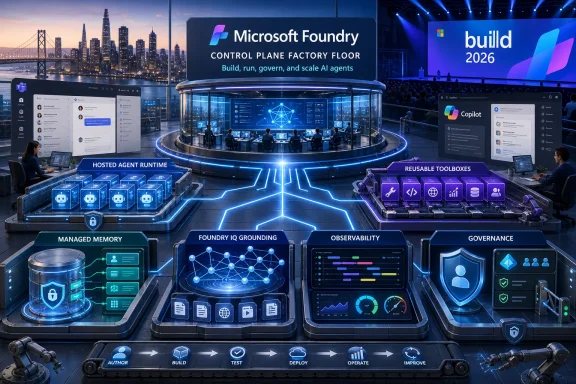 Microsoft Wants Foundry to Be the Factory Floor, Not the Demo Booth
The last two years of enterprise AI have produced a familiar pattern. A developer wires a model to a few tools, builds an impressive internal demo, then discovers that the hard parts are not the prompt or even the model. The hard parts are state, permissions, retrieval, observability, cost, evaluation, lifecycle management, and the sheer awkwardness of letting probabilistic software touch real business systems.Microsoft’s Build 2026 Foundry announcements are a direct answer to that gap. The company’s phrase — “AI app and agent factory” — is marketing language, but the underlying direction is concrete. Foundry is being positioned as a managed production environment for agents, not simply a place to select GPT, Claude, Llama, Phi, or one of Microsoft’s own models.
That distinction matters. A model endpoint answers. An agent acts. Once software can call tools, read business data, maintain memory, schedule work, and publish into Microsoft Teams or Microsoft 365 Copilot, the platform surrounding the model becomes as important as the model itself.
This is where Microsoft has a structural advantage. It already owns the identity layer for many enterprises through Entra ID, the productivity surface through Microsoft 365, the developer relationship through GitHub and Visual Studio Code, and the cloud substrate through Azure. Foundry is Microsoft’s attempt to stitch those assets into a single agent platform before the agent ecosystem fragments into incompatible runtimes, orchestration frameworks, retrieval stacks, and governance tools.
The Runtime Is the Real Announcement
The flashiest AI announcements usually involve new models, but the more consequential Foundry news is the runtime. Hosted agents in Foundry Agent Service give developers managed, sandboxed sessions with state, file-system access, framework flexibility, and long-running execution patterns. That is the sort of plumbing that turns an agent from a weekend experiment into something an enterprise might actually run.Microsoft is supporting both a stateful Responses API and a lighter invocations protocol, which is a pragmatic signal. Some teams want OpenAI-compatible interaction patterns; others want a pass-through runtime where they control request and response structure. By supporting both, Microsoft is trying to avoid forcing every agent workload into the same abstraction.
The reference to long-running agents such as OpenClaw and Hermes also points to a more realistic view of enterprise automation. Many useful agents will not be single-turn chatbots. They will watch queues, triage tickets, reconcile files, produce daily reports, route tasks, or keep context over hours and days. Those workloads need durable state, execution isolation, retry logic, files, traces, and policy boundaries.
The public preview of routines adds another clue. Scheduled agents are boring in the best possible way. They move the conversation from “ask a chatbot to do something” toward “let a managed service run operational work on a cadence,” which is how IT departments actually automate.
Toolboxes Try to Civilize the Agent Tool Sprawl
Tool use is where agents become useful, and where they become dangerous. Every serious agent platform must answer the same question: how does the model discover and invoke capabilities without turning each application into a bespoke knot of credentials, functions, schemas, and one-off integrations?Foundry Toolboxes are Microsoft’s answer. In public preview, they provide a managed endpoint for tools, skills, Model Context Protocol clients, and enterprise data integrations. Tools can be registered once, then discovered by agents at runtime rather than manually wired into every agent implementation.
That sounds mundane until you imagine the alternative. Without a central tool layer, every team invents its own pattern for exposing Jira, ServiceNow, SharePoint, GitHub, internal APIs, SQL databases, ticketing systems, and line-of-business applications. The result is duplicated glue code, inconsistent authentication, uneven logging, and a governance headache.
Tool search is especially important. One of the less glamorous problems in agent design is that giving a model too many tools can degrade behavior. The model must reason not only about the task, but also about which tool among many is appropriate. Microsoft’s claim that Foundry can select a smaller set of relevant tools for each task is exactly the kind of platform intervention enterprises will need if agents are to operate beyond toy examples.
The direct publishing path into Teams and Microsoft 365 Copilot is equally strategic. Microsoft does not want Foundry agents living only in developer portals. It wants them surfaced where employees already work, inheriting identity, permissions, and policy along the way. That turns Teams and Copilot into distribution channels for internal software, with Foundry as the backend factory.
Memory Moves From App Feature to Platform Primitive
Memory is one of the most overloaded terms in AI, but Microsoft’s Foundry approach is notable because it treats memory as a platform service rather than an application afterthought. Foundry Agent Service now includes procedural, user, and session memory, with procedural memory introduced at Build as the agent’s ability to improve how it performs work across runs.This is more than remembering that a user prefers concise answers. Procedural memory aims to capture how work gets done: the steps, preferences, corrections, and workflows that emerge over time. If it works, it gives agents a way to become less brittle without every improvement requiring a developer to rewrite instructions or update code.
Microsoft says early Tau-bench results show meaningful task-success improvements when procedural memory is enabled, at near-baseline cost. Benchmarks in this area should be treated cautiously, especially because agent performance often varies sharply by task design, tool reliability, and evaluation method. Still, the direction is sensible: persistent memory will be a requirement for agents that perform recurring work rather than one-off chats.
The risk is that memory is also governance dynamite. A system that extracts facts and procedures from conversations, stores them, and retrieves them later must answer hard questions about retention, inspection, deletion, sensitivity labels, tenant boundaries, and user expectations. Microsoft’s emphasis on identifiers such as Entra ID, managed storage, and retention controls is not decorative; it is the price of admission.
For administrators, memory will become one of the first places to look when an agent behaves strangely. Was the model wrong, the retrieval bad, the tool call malformed, or the stored procedure stale? Production-grade agents will need a debugging story that treats memory as observable state, not invisible magic.
Foundry IQ Is Microsoft’s Bet Against RAG Sprawl
Retrieval-augmented generation became the enterprise AI default because models need business context. The downside is that every team started building its own retrieval pipeline: chunking documents, embedding text, syncing permissions, refreshing indexes, adding filters, wrapping search APIs, and hoping the whole thing stayed aligned with the source systems.Foundry IQ is Microsoft’s attempt to make grounding a shared service. The Build 2026 announcements describe a knowledge layer that unifies Work IQ, Fabric IQ, Azure SQL, file search, and other sources behind a single retrieval endpoint. Serverless Foundry IQ is in public preview, multi-source knowledge bases are generally available, and Microsoft Web IQ adds live web grounding with low-latency claims and zero data retention guarantees.
The enterprise appeal is obvious. If every agent team builds its own RAG stack, the organization ends up with inconsistent answers, duplicated indexes, uneven permission enforcement, and no central way to reason about data exposure. A shared retrieval layer lets Microsoft argue that grounding should be governed like identity or networking: centrally managed, policy-aware, and reusable.
There is also a Microsoft 365 angle. Work IQ draws from organizational signals and Microsoft 365 data, while Fabric IQ speaks to structured business data. Foundry IQ then becomes the developer-facing knowledge layer for agents. Together, the “IQ” branding is Microsoft’s way of saying that context is no longer a feature of individual apps; it is a horizontal layer across Copilot Studio, Microsoft 365 Copilot, GitHub, Azure, and Foundry.
The challenge will be trust. Retrieval systems fail in less theatrical ways than models do. They return plausible but incomplete context, stale documents, or permission-trimmed fragments that change the answer. Foundry IQ may reduce custom plumbing, but it will not eliminate the need for careful evaluation, source inspection, and incident response when agents act on partial knowledge.
Microsoft’s Model Catalog Is Becoming a Governance Wrapper
Foundry’s model story has two tracks. One is breadth: access to models from OpenAI, Anthropic, Meta, Mistral, Cohere, and others through Azure-aligned controls. The other is Microsoft’s own growing family of MAI models, including MAI Thinking 1 for chat and reasoning, MAI Image 2.5 for image generation and editing, MAI Transcribe 2 for speech-to-text, and MAI Voice 2 for multilingual text-to-speech with voice cloning.The first-party MAI models matter because they show Microsoft trying to reduce total dependence on partner models, even as it continues to rely heavily on the broader frontier ecosystem. Enterprises may not care whose model wins a benchmark as much as they care whether the platform gives them routing, logging, access control, regional availability, indemnity posture, pricing predictability, and governance.
Fireworks AI on Foundry reaching general availability fits the same pattern. Microsoft is not saying every workload should run on a Microsoft model. It is saying the enterprise should consume models through Foundry so access controls, observability, and logging remain consistent. That is a platform play, not a model beauty contest.
Managed Compute in Foundry Models takes this further by addressing regional GPU constraints and specialized workloads such as fine-tuning and Microsoft’s “Frontier Tuning.” The claim that Frontier Tuning can be much more cost-efficient than directly using a very large frontier model for tasks like technical documentation generation is plausible in the abstract, though customers will need to test it against their own quality bars. The real point is that Microsoft wants model selection, tuning, routing, and deployment to become knobs inside the Foundry control plane.
This is also where lock-in becomes subtle. Microsoft can credibly say it supports multiple models and frameworks, and that is valuable. But the more an organization leans on Foundry IQ, Toolboxes, hosted agents, memory, evaluations, Entra integration, and publishing into Microsoft 365, the more the operational center of gravity shifts to Azure.
Observability Is Where the Demo Meets the Postmortem
Microsoft’s Build message repeatedly returns to tracing and evaluation, and for good reason. Agents are software systems with nondeterministic components, which means the old “it failed, check the logs” model is not enough. A production incident might involve a weak prompt, a bad retrieved document, a missing permission, a tool timeout, an unexpected model behavior, or an agent-to-agent handoff gone wrong.Foundry’s observability story spans traces, evaluations, production monitoring, and framework-agnostic support. Microsoft says teams can keep LangChain, LangGraph, Semantic Kernel, the Microsoft Agent Framework, OpenAI SDK-based code, or custom frameworks while still sending traces and evaluation signals into Foundry. That is the right posture because the agent framework market is still fluid.
The important phrase is not “dashboard.” It is continuous evaluation. Enterprises do not need one-time benchmark screenshots; they need to know whether agent behavior is degrading as tools change, documents update, users shift workflows, or models are upgraded. Evaluation needs to become part of CI/CD, release gates, and production monitoring.
This is familiar territory for IT pros. Nobody serious deploys a microservice without logs, metrics, rollback plans, security review, and operational ownership. Microsoft’s own secure agent process guidance leans into the same analogy: treat agents like software services, map their touchpoints, scope their permissions, trace their behavior, and test them continuously.
The twist is that agent failures can be socially and operationally ambiguous. A traditional service returns a 500 error. An agent may produce a confident but incomplete summary, route a ticket to the wrong team, or invoke a tool in the wrong sequence. Foundry’s tracing tools will be judged not by how attractive their visualizations are, but by whether they help administrators reconstruct the chain of reasoning and action quickly enough to contain damage.
The Copilot Stack Now Has a Three-Tier Shape
The broader Microsoft agent story is settling into three layers. Microsoft 365 Copilot Agent Builder gives information workers a low-friction way to create simple agents inside the productivity environment. Copilot Studio gives business teams and power users more visual tooling, connectors, and process automation. Foundry is the code-first platform for developers and IT teams building advanced agents with custom logic, deeper retrieval, managed runtime, evaluations, and governance.That segmentation makes sense, but it also reveals Microsoft’s challenge. Enterprises do not organize neatly around product tiers. A departmental agent might start in Copilot Studio, require a custom tool, move into Foundry, publish back to Teams, and depend on Microsoft 365 permissions, Fabric data, and Azure monitoring. The seams matter.
If Microsoft executes well, those seams become gradients. A lightweight internal helper can begin life in Copilot, graduate to Copilot Studio, and eventually become a Foundry-hosted production agent without being rebuilt from scratch. If Microsoft executes poorly, organizations will face yet another maze of overlapping portals, licensing boundaries, connector limitations, and governance exceptions.
For Windows and Microsoft 365 administrators, this is not merely a developer story. Agents published into Teams and Copilot will become part of the everyday workplace surface. Users will not necessarily know which backend produced the agent, which model it uses, which retrieval layer grounded it, or which tool invocation caused an action. Admins will need inventory, policy, approval flows, and incident visibility across all tiers.
That makes Foundry’s integration with identity and policy more than a checkbox. The enterprise agent problem is not “can we build one?” It is “can we know what has been built, who can use it, what it can touch, how it behaves, and how to shut it down?”
The Platform Is Maturing Faster Than the Operating Model
Microsoft’s Build 2026 Foundry release feels like an inflection point because the product pieces now resemble a production platform. Runtime, tools, memory, grounding, models, observability, and governance are the right categories. They map to real operational needs rather than AI demo theater.But platform maturity does not automatically produce organizational maturity. Many companies are still figuring out who owns agents. Is an HR onboarding agent owned by HR, IT, security, the data team, or the application development group? Who approves new tool access? Who audits memory? Who evaluates whether an agent’s output is merely inaccurate or operationally unsafe?
The analogy to microservices is useful but incomplete. Microservices introduced distributed systems complexity; agents introduce distributed judgment. They do not just move data between APIs. They interpret intent, retrieve context, decide among tools, and sometimes take action on behalf of users. That raises the bar for governance.
Microsoft’s advantage is that it can embed controls into systems enterprises already use. Entra ID, Microsoft Purview, Azure Monitor, Teams, Microsoft 365 Copilot, GitHub, and Fabric can all become part of the agent lifecycle. The danger is that customers may mistake platform-integrated governance for governance itself.
A company can have excellent tools and still deploy badly scoped agents with vague success criteria and poor accountability. Foundry can make the right patterns easier, but it cannot decide which business processes should be automated, which risks are acceptable, or when a human approval step is non-negotiable.
The Foundry Bet Comes Down to Control, Not Chat
The most important Build 2026 Foundry announcements are not the ones that sound most futuristic. They are the ones that make agents governable, inspectable, repeatable, and deployable inside real organizations. That is why the runtime, Toolboxes, Foundry IQ, memory, and observability matter more than any single model addition.Microsoft is betting that enterprises will not want a pile of disconnected agent experiments. They will want a managed factory where agents can be built by different teams but governed through shared services. Foundry is the company’s bid to become that factory.
The practical implications are already clear:
- Developers should treat Foundry as a production agent platform, not merely as a model catalog with Azure branding.
- Administrators should expect Teams and Microsoft 365 Copilot to become distribution surfaces for agents built elsewhere in the Microsoft stack.
- Security teams should scrutinize Toolboxes, memory, and grounding layers because those are where agent permissions and data exposure become operationally real.
- Architects should watch whether Foundry’s framework-agnostic claims hold up in practice for LangGraph, Semantic Kernel, Microsoft Agent Framework, OpenAI SDK-based code, and custom runtimes.
- Business owners should define measurable outcomes and failure boundaries before treating scheduled or long-running agents as autonomous coworkers.
- Enterprises already invested in Microsoft 365, Azure, GitHub, and Fabric will find Foundry increasingly difficult to ignore, even if they continue using non-Microsoft frontier models.
References
- Primary source: infoq.com
Published: 2026-06-09T08:01:15.526177
Microsoft Foundry Adds Runtime, Tooling, and Governance for Production Agents - InfoQ
Microsoft used their Build 2026 event to announce new functionality for Microsoft Foundry. Citing Foundry as "the place where AI agents move from experiments to production systems," in a blog post, Niwww.infoq.com
- Related coverage: tomsguide.com
Biggest Microsoft Build 2026 announcements — agentic AI, RTX Spark Dev Box, GitHub Copilot app, new MAI models, and more | Tom's Guide
All the big news from Microsoft's AI-focused eventwww.tomsguide.com - Related coverage: windowscentral.com
Build 2026 only makes sense if you remember Build 2025: a look back at the groundwork of the "age of AI agents" | Windows Central
Microsoft’s latest announcements build directly on the architecture it introduced a year ago.www.windowscentral.com - Related coverage: techradar.com
Microsoft Build 2026 — all the news and updates as it happened | TechRadar
Everything we saw at Microsoft Build 2026www.techradar.com - Official source: devblogs.microsoft.com
Build and run agents at scale with Microsoft Foundry at Build 2026 | Microsoft Foundry Blog
Learn how Microsoft Foundry helps developers build, deploy, and operate production-ready agents with Agent Framework, Toolboxes, hosted agents, Microsoft 365 distribution, observability, and agent optimization.devblogs.microsoft.com - Official source: learn.microsoft.com
What is Microsoft Foundry Agent Service? - Microsoft Foundry | Microsoft Learn
Learn about Microsoft Foundry Agent Service capabilities, agent types, tools, and runtime features for building AI agents.learn.microsoft.com
- Official source: azure.microsoft.com
Foundry Agent Service | Microsoft Azure
Use Foundry Agent Service to design, deploy, and scale AI agents securely. Create enterprise-grade AI agents to automate complex business processes.azure.microsoft.com
- Official source: blogs.microsoft.com
Microsoft Build 2026: Be yourself at work - The Official Microsoft Blog
Platforms shift when developers build. We explore, choose tools, dream, create. This platform shift comes with more information than ever, ready at your fingertips. This shift, it’s about building fast AND THEN: it’s about building, operating, optimizing and observing. Securing your...blogs.microsoft.com - Official source: cdn-dynmedia-1.microsoft.com
- Related coverage: isg.sitefinity.cloud
MSFT Blueprint 2026
Business people join puzzle pieces in office. Concept of teamwork and partnership. double exposure with light effectsisg.sitefinity.cloud
- Official source: marketingassets.microsoft.com
MS-Azure_logo_horiz_c-white_rgb
A football player gets ready to hiking a football.marketingassets.microsoft.com
