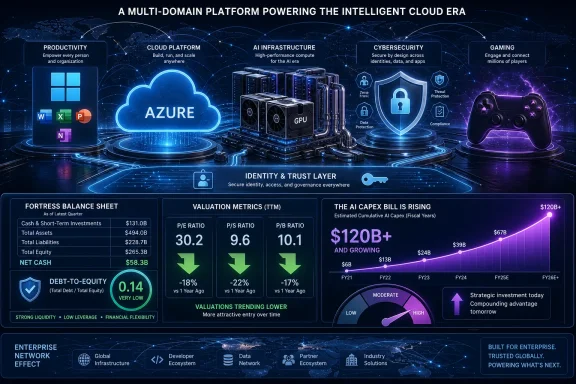
Benzinga’s automated competitor analysis, published July 6, 2026, argues that Microsoft looks financially stronger than a software peer group because its debt-to-equity ratio is just 0.14 while its profitability metrics dwarf smaller rivals. The numbers are real enough to be useful, but the conclusion is too tidy. Microsoft is not merely a “software industry” stock with a clean balance sheet; it is the operating system, productivity suite, cloud platform, AI infrastructure landlord, gaming publisher, developer-toolchain owner, and enterprise identity layer rolled into one. That makes the company harder to compare — and more dangerous to summarize — than a table of ratios suggests.
Benzinga’s comparison puts Microsoft’s price-to-earnings ratio at 23.26, its price-to-book ratio at 7.0, and its price-to-sales ratio at 9.15, all below the peer averages in the table. On the surface, that reads like a classic value setup: a dominant company trading below its group on headline multiples while producing far more EBITDA and gross profit than almost everyone around it.
But that framing depends heavily on the peer group. Benzinga’s list mixes Microsoft with Oracle, Palo Alto Networks, Fortinet, ServiceNow, Check Point, UiPath, Dolby, Teradata, BlackBerry, and several smaller or more specialized software names. That makes the “software industry” look mathematically coherent while being strategically messy.
Microsoft’s real competitive set changes depending on which part of the company is under the microscope. In cloud, it competes with Amazon Web Services and Google Cloud. In productivity software, it competes with Google Workspace, Slack, Zoom, Notion, and a long tail of vertical SaaS tools. In security, it competes with Palo Alto Networks, CrowdStrike, Fortinet, SentinelOne, Okta, and others. In AI infrastructure, it is in the same capital-spending arms race as Amazon, Alphabet, Meta, and Nvidia’s customer ecosystem.
That is why a low multiple against a basket of “software” names can mislead. Microsoft may look cheap compared with high-growth cybersecurity or automation firms, but it also carries the investment demands of a hyperscale infrastructure company. The market is not just pricing Windows, Office, and Azure revenue; it is pricing whether Microsoft can convert an enormous AI buildout into durable cash flows before depreciation, power costs, and competitive pressure chew into margins.
But the modern Microsoft risk profile is not defined by debt in the old industrial sense. It is defined by capital allocation. The company can borrow less than peers and still commit itself to a vast infrastructure cycle whose economic return will be judged over years, not quarters.
Microsoft’s own investor materials for fiscal 2026 show why. In its fiscal third quarter, the company reported revenue of $82.9 billion, up 18 percent year over year, with Microsoft Cloud revenue of $54.5 billion, up 29 percent. Azure and other cloud services revenue grew 40 percent, according to Microsoft’s earnings release, and the company’s gross margin reached $56.1 billion for the quarter.
Those are not weak-company numbers. They are the numbers of a platform business that still has meaningful momentum at extraordinary scale. Yet Microsoft also disclosed that Microsoft Cloud gross margin percentage declined to 66 percent, driven by continued investments in AI infrastructure and growing AI product usage, partly offset by efficiency gains in Azure and Microsoft 365 Commercial cloud.
That is the tension the debt ratio cannot capture. Microsoft’s balance sheet is conservative, but its operating strategy is aggressive. The company is not borrowing itself into trouble; it is spending from strength in a race where every hyperscaler fears being underbuilt more than being temporarily overbuilt.
The shift is visible in margin language. Microsoft says cloud gross margin pressure is coming from AI infrastructure and AI product usage. That is a polite way of saying the company must put enormous amounts of capital into data centers, GPUs, networking, storage, and power before it can collect enough revenue to justify the buildout.
This does not make Microsoft weak. It makes Microsoft different from the Microsoft many investors still think they own. The company’s most important growth engine is increasingly tied to physical constraints: chips, electricity, cooling, land, data-center permitting, fiber, and supply chains.
That matters for Windows users and enterprise IT because the AI buildout is not an abstract Wall Street story. It is already shaping product design. Copilot is being embedded into Microsoft 365, Windows, GitHub, Security, Dynamics, and Azure. The company’s strategy is to make AI consumption a default layer across the stack, not a standalone novelty.
If that works, Microsoft can defend its premium enterprise pricing and deepen lock-in across identity, productivity, development, and cloud. If it does not, the company will have built a more expensive version of its cloud business while customers remain selective about paying for AI features they do not fully trust or use.
ServiceNow, Palo Alto Networks, Fortinet, Check Point, and Qualys are serious companies. They are not Microsoft analogues. They compete with fragments of Microsoft, not with the whole machine.
The more revealing comparison is not Microsoft versus “software.” It is Microsoft versus the handful of companies that can spend tens of billions of dollars annually on cloud and AI infrastructure while still reporting huge profits. Amazon has AWS and retail cash-flow dynamics. Alphabet has Google Cloud, Search, YouTube, and its own AI stack. Meta has advertising cash flow and its own AI infrastructure ambitions. Oracle has become a more relevant cloud infrastructure player than skeptics once expected. Nvidia, though not a cloud provider in the same way, sits at the center of the accelerator economy that makes all these plans possible.
Against that crowd, Microsoft’s low leverage is helpful but not decisive. What matters is distribution. Microsoft has the enterprise relationships, developer ecosystem, security footprint, and productivity surface area to push AI tools into daily workflows. That is a formidable advantage, and it is why Microsoft’s AI story has more substance than a speculative app-layer startup.
But distribution can also hide weak adoption signals. Enterprises may buy bundled access, run pilots, or accept Copilot as part of a licensing negotiation without transforming their workflows overnight. The hard question is not whether Microsoft can sell AI. It is whether customers will use enough of it, often enough, at a high enough price, to make the infrastructure cycle look brilliant in hindsight.
Return on equity can be distorted by capital structure, buybacks, one-time effects, and peer composition. A smaller company with a strange balance sheet can show a high ROE without being remotely comparable to Microsoft’s earnings quality. Conversely, a giant reinvesting heavily in cloud and AI infrastructure can look less efficient at a moment when it is deliberately absorbing costs to protect future relevance.
Still, the metric should not be waved away. Microsoft’s valuation assumes that today’s investments will support tomorrow’s earnings power. If the company’s equity base grows while returns compress, investors will eventually notice.
The key is separating temporary reinvestment from structural margin reset. Microsoft argues, through its earnings commentary, that AI infrastructure spending is necessary to meet demand and position the company for the next platform shift. Skeptics see a different possibility: AI may become a costly feature race in which customers expect capability improvements but resist paying enough to preserve historical software margins.
That debate will not be settled by a single quarter’s ROE. It will be settled by renewal cycles, Copilot attach rates, Azure consumption patterns, developer adoption, and whether Microsoft can convert AI usage into profit rather than just engagement.
The personal computing segment still gives Microsoft leverage over device makers, enterprises, gamers, developers, and consumers. Windows is the place where Microsoft can normalize Copilot, promote Edge and Bing services, integrate identity controls, surface Microsoft 365 value, and nudge users toward cloud-backed workflows. Even when Windows is not the profit engine it once was, it is still a strategic front door.
That helps explain why Microsoft’s AI strategy keeps showing up in Windows features that sometimes feel ahead of user demand. The company is not merely adding convenience. It is trying to make the operating system a client for cloud intelligence, with local silicon, cloud models, and Microsoft accounts stitched together into one experience.
For administrators, that creates a familiar Microsoft bargain. The integration can be useful, manageable, and secure when it fits an organization’s architecture. It can also feel like another layer of policy decisions, licensing complexity, telemetry questions, and user-training overhead.
The financial story and the endpoint story are connected. Microsoft needs AI features to become normal enough that enterprises renew and expand. Enterprises need Microsoft to prove that those features improve productivity without creating governance chaos. The next few years of Windows and Microsoft 365 will be shaped by that negotiation.
That puts Microsoft into direct competition with some of the companies that appear in Benzinga’s table. Palo Alto Networks, Fortinet, Check Point, Qualys, and others sell into markets where Microsoft is increasingly present. Defender, Entra, Sentinel, Purview, Intune, and related products form a security stack that appeals to customers trying to consolidate vendors.
The bullish view is straightforward: Microsoft can bundle security into existing enterprise agreements and reduce procurement friction. In a world of tool sprawl, a “good enough and already integrated” security suite can be very persuasive.
The bearish view is equally familiar to security teams. Monoculture creates risk. A Microsoft-heavy environment can simplify management, but it can also concentrate exposure when identity, email, endpoint, collaboration, and cloud controls depend on one vendor’s ecosystem.
This is where Microsoft’s financial strength intersects with practical IT judgment. The company can out-invest many rivals, but it cannot simply buy trust. Every security incident, every confusing admin-center change, and every licensing reshuffle affects whether customers see Microsoft as a strategic partner or an unavoidable tax.
If AI becomes a utility layer that every business consumes through Microsoft 365, Azure, GitHub, and security products, today’s Microsoft could look underpriced. The company would have turned its installed base into a consumption engine, using AI to lift average revenue per user and deepen cloud dependence. In that world, the current capex cycle becomes the cost of securing the next decade.
If AI becomes a feature customers expect but do not richly monetize, the story changes. Microsoft would still be a superb business, but one with heavier infrastructure costs, more margin pressure, and a less obviously software-like cash-flow profile. The multiple investors are willing to pay for that business may be lower, even if revenue keeps growing.
The truth may land between those poles. Microsoft will almost certainly monetize AI in some areas, especially developer tools, cloud services, security operations, and high-value enterprise workflows. It may struggle in others, particularly where users perceive AI as a bundled convenience rather than a paid productivity revolution.
That unevenness matters. Microsoft is so large that success does not require every Copilot button to become a gold mine. But it does require enough high-value workloads to justify the infrastructure intensity now being built into the company’s model.
But automation tends to flatten context. It can identify that Microsoft’s revenue growth is below a peer average inflated by smaller or unusual companies. It cannot easily explain why 18.3 percent growth at Microsoft’s scale may be more impressive than much higher growth at a far smaller company. It can flag low ROE. It cannot decide whether that reflects inefficiency, reinvestment, or denominator quirks.
This is the recurring problem with ratio-driven coverage of mega-cap technology. The companies have become too broad for simple sector averages. Microsoft is not a pure software company, not merely a cloud provider, not simply an AI beneficiary, and not only an operating-system vendor. It is a platform conglomerate whose products reinforce one another.
That complexity is precisely why the company deserves scrutiny. When Microsoft performs well, its scale can make the business look inevitable. But inevitability is not an investment thesis. It is a mood, and moods change when margins compress or customers push back.
That optionality gives Microsoft room to absorb mistakes. A smaller AI software company may need one product to define its future. Microsoft can test AI across dozens of surfaces and let the strongest use cases carry the economics.
But optionality also creates management risk. The more Microsoft pushes AI everywhere, the more it risks product clutter, administrative fatigue, and user skepticism. The company must avoid turning Copilot into the new Clippy in enterprise clothing: omnipresent, technically impressive, and not always wanted.
The best version of Microsoft’s strategy is quiet usefulness. AI that summarizes meetings accurately, writes code safely, detects threats faster, automates drudgery, and respects governance will sell. AI that feels bolted onto every interface because the capex bill needs a story will irritate users and alarm admins.
 The Spreadsheet Says Microsoft Is Cheap, but the Business Says Something Stranger
Benzinga’s comparison puts Microsoft’s price-to-earnings ratio at 23.26, its price-to-book ratio at 7.0, and its price-to-sales ratio at 9.15, all below the peer averages in the table. On the surface, that reads like a classic value setup: a dominant company trading below its group on headline multiples while producing far more EBITDA and gross profit than almost everyone around it.But that framing depends heavily on the peer group. Benzinga’s list mixes Microsoft with Oracle, Palo Alto Networks, Fortinet, ServiceNow, Check Point, UiPath, Dolby, Teradata, BlackBerry, and several smaller or more specialized software names. That makes the “software industry” look mathematically coherent while being strategically messy.
Microsoft’s real competitive set changes depending on which part of the company is under the microscope. In cloud, it competes with Amazon Web Services and Google Cloud. In productivity software, it competes with Google Workspace, Slack, Zoom, Notion, and a long tail of vertical SaaS tools. In security, it competes with Palo Alto Networks, CrowdStrike, Fortinet, SentinelOne, Okta, and others. In AI infrastructure, it is in the same capital-spending arms race as Amazon, Alphabet, Meta, and Nvidia’s customer ecosystem.
That is why a low multiple against a basket of “software” names can mislead. Microsoft may look cheap compared with high-growth cybersecurity or automation firms, but it also carries the investment demands of a hyperscale infrastructure company. The market is not just pricing Windows, Office, and Azure revenue; it is pricing whether Microsoft can convert an enormous AI buildout into durable cash flows before depreciation, power costs, and competitive pressure chew into margins.
Debt Is the Least Interesting Risk on Microsoft’s Balance Sheet
The debt-to-equity ratio is the cleanest part of the Benzinga story. A 0.14 figure says Microsoft is not leaning heavily on debt to fund its business, and that matters in a higher-rate environment where weaker software companies can find themselves punished for refinancing risk. Compared with companies carrying more leverage or thinner cash generation, Microsoft’s balance sheet remains a weapon.But the modern Microsoft risk profile is not defined by debt in the old industrial sense. It is defined by capital allocation. The company can borrow less than peers and still commit itself to a vast infrastructure cycle whose economic return will be judged over years, not quarters.
Microsoft’s own investor materials for fiscal 2026 show why. In its fiscal third quarter, the company reported revenue of $82.9 billion, up 18 percent year over year, with Microsoft Cloud revenue of $54.5 billion, up 29 percent. Azure and other cloud services revenue grew 40 percent, according to Microsoft’s earnings release, and the company’s gross margin reached $56.1 billion for the quarter.
Those are not weak-company numbers. They are the numbers of a platform business that still has meaningful momentum at extraordinary scale. Yet Microsoft also disclosed that Microsoft Cloud gross margin percentage declined to 66 percent, driven by continued investments in AI infrastructure and growing AI product usage, partly offset by efficiency gains in Azure and Microsoft 365 Commercial cloud.
That is the tension the debt ratio cannot capture. Microsoft’s balance sheet is conservative, but its operating strategy is aggressive. The company is not borrowing itself into trouble; it is spending from strength in a race where every hyperscaler fears being underbuilt more than being temporarily overbuilt.
AI Has Turned Microsoft Into a Capital-Intensive Software Company
For decades, the dream version of Microsoft was a software business with near-magical economics: write code once, sell it globally, let licensing and enterprise renewals do the compounding. That model still exists inside Microsoft 365, Windows, SQL Server, and parts of Dynamics. But AI has pushed the company toward a different kind of economics, one closer to infrastructure than pure software.The shift is visible in margin language. Microsoft says cloud gross margin pressure is coming from AI infrastructure and AI product usage. That is a polite way of saying the company must put enormous amounts of capital into data centers, GPUs, networking, storage, and power before it can collect enough revenue to justify the buildout.
This does not make Microsoft weak. It makes Microsoft different from the Microsoft many investors still think they own. The company’s most important growth engine is increasingly tied to physical constraints: chips, electricity, cooling, land, data-center permitting, fiber, and supply chains.
That matters for Windows users and enterprise IT because the AI buildout is not an abstract Wall Street story. It is already shaping product design. Copilot is being embedded into Microsoft 365, Windows, GitHub, Security, Dynamics, and Azure. The company’s strategy is to make AI consumption a default layer across the stack, not a standalone novelty.
If that works, Microsoft can defend its premium enterprise pricing and deepen lock-in across identity, productivity, development, and cloud. If it does not, the company will have built a more expensive version of its cloud business while customers remain selective about paying for AI features they do not fully trust or use.
The Peer Group Flatters Microsoft and Obscures Its Real Rivals
Benzinga’s table shows Microsoft with EBITDA of $50.28 billion and gross profit of $56.06 billion, compared with peer averages of $0.95 billion and $1.51 billion. That comparison is accurate in one narrow sense and almost absurd in another. Microsoft is so much larger than many of the companies in the table that the comparison becomes less about efficiency and more about gravitational force.ServiceNow, Palo Alto Networks, Fortinet, Check Point, and Qualys are serious companies. They are not Microsoft analogues. They compete with fragments of Microsoft, not with the whole machine.
The more revealing comparison is not Microsoft versus “software.” It is Microsoft versus the handful of companies that can spend tens of billions of dollars annually on cloud and AI infrastructure while still reporting huge profits. Amazon has AWS and retail cash-flow dynamics. Alphabet has Google Cloud, Search, YouTube, and its own AI stack. Meta has advertising cash flow and its own AI infrastructure ambitions. Oracle has become a more relevant cloud infrastructure player than skeptics once expected. Nvidia, though not a cloud provider in the same way, sits at the center of the accelerator economy that makes all these plans possible.
Against that crowd, Microsoft’s low leverage is helpful but not decisive. What matters is distribution. Microsoft has the enterprise relationships, developer ecosystem, security footprint, and productivity surface area to push AI tools into daily workflows. That is a formidable advantage, and it is why Microsoft’s AI story has more substance than a speculative app-layer startup.
But distribution can also hide weak adoption signals. Enterprises may buy bundled access, run pilots, or accept Copilot as part of a licensing negotiation without transforming their workflows overnight. The hard question is not whether Microsoft can sell AI. It is whether customers will use enough of it, often enough, at a high enough price, to make the infrastructure cycle look brilliant in hindsight.
Low ROE Is a Warning, but Not the One the Table Implies
Benzinga flags Microsoft’s return on equity at 7.89 percent, below the peer average of 14.81 percent, and suggests potential inefficiency in utilizing equity to generate profits. That is the kind of sentence automated financial copy produces when a metric falls on the wrong side of an average. It is not necessarily the best interpretation.Return on equity can be distorted by capital structure, buybacks, one-time effects, and peer composition. A smaller company with a strange balance sheet can show a high ROE without being remotely comparable to Microsoft’s earnings quality. Conversely, a giant reinvesting heavily in cloud and AI infrastructure can look less efficient at a moment when it is deliberately absorbing costs to protect future relevance.
Still, the metric should not be waved away. Microsoft’s valuation assumes that today’s investments will support tomorrow’s earnings power. If the company’s equity base grows while returns compress, investors will eventually notice.
The key is separating temporary reinvestment from structural margin reset. Microsoft argues, through its earnings commentary, that AI infrastructure spending is necessary to meet demand and position the company for the next platform shift. Skeptics see a different possibility: AI may become a costly feature race in which customers expect capability improvements but resist paying enough to preserve historical software margins.
That debate will not be settled by a single quarter’s ROE. It will be settled by renewal cycles, Copilot attach rates, Azure consumption patterns, developer adoption, and whether Microsoft can convert AI usage into profit rather than just engagement.
Windows Is No Longer the Center, but It Is Still the Doorway
For WindowsForum readers, the temptation is to read Microsoft financial analysis as something happening far away from the desktop. That would be a mistake. Windows may no longer be the company’s dominant growth engine, but it remains one of the most important distribution points in technology.The personal computing segment still gives Microsoft leverage over device makers, enterprises, gamers, developers, and consumers. Windows is the place where Microsoft can normalize Copilot, promote Edge and Bing services, integrate identity controls, surface Microsoft 365 value, and nudge users toward cloud-backed workflows. Even when Windows is not the profit engine it once was, it is still a strategic front door.
That helps explain why Microsoft’s AI strategy keeps showing up in Windows features that sometimes feel ahead of user demand. The company is not merely adding convenience. It is trying to make the operating system a client for cloud intelligence, with local silicon, cloud models, and Microsoft accounts stitched together into one experience.
For administrators, that creates a familiar Microsoft bargain. The integration can be useful, manageable, and secure when it fits an organization’s architecture. It can also feel like another layer of policy decisions, licensing complexity, telemetry questions, and user-training overhead.
The financial story and the endpoint story are connected. Microsoft needs AI features to become normal enough that enterprises renew and expand. Enterprises need Microsoft to prove that those features improve productivity without creating governance chaos. The next few years of Windows and Microsoft 365 will be shaped by that negotiation.
Security Is the Hidden Competitor Story
One of the oddities of software peer analysis is that Microsoft is often compared with cybersecurity companies as though security were just another segment. In reality, security is one of Microsoft’s most important wedge businesses. The company has used its control over identity, endpoint management, productivity, and cloud infrastructure to become a security vendor of enormous scale.That puts Microsoft into direct competition with some of the companies that appear in Benzinga’s table. Palo Alto Networks, Fortinet, Check Point, Qualys, and others sell into markets where Microsoft is increasingly present. Defender, Entra, Sentinel, Purview, Intune, and related products form a security stack that appeals to customers trying to consolidate vendors.
The bullish view is straightforward: Microsoft can bundle security into existing enterprise agreements and reduce procurement friction. In a world of tool sprawl, a “good enough and already integrated” security suite can be very persuasive.
The bearish view is equally familiar to security teams. Monoculture creates risk. A Microsoft-heavy environment can simplify management, but it can also concentrate exposure when identity, email, endpoint, collaboration, and cloud controls depend on one vendor’s ecosystem.
This is where Microsoft’s financial strength intersects with practical IT judgment. The company can out-invest many rivals, but it cannot simply buy trust. Every security incident, every confusing admin-center change, and every licensing reshuffle affects whether customers see Microsoft as a strategic partner or an unavoidable tax.
The Valuation Argument Depends on Whether AI Becomes Utility or Upsell
Benzinga’s automated takeaway says Microsoft’s PE, PB, and PS ratios indicate undervaluation compared with peers. That may be true within the selected group, but it skips the harder question: undervalued relative to what future?If AI becomes a utility layer that every business consumes through Microsoft 365, Azure, GitHub, and security products, today’s Microsoft could look underpriced. The company would have turned its installed base into a consumption engine, using AI to lift average revenue per user and deepen cloud dependence. In that world, the current capex cycle becomes the cost of securing the next decade.
If AI becomes a feature customers expect but do not richly monetize, the story changes. Microsoft would still be a superb business, but one with heavier infrastructure costs, more margin pressure, and a less obviously software-like cash-flow profile. The multiple investors are willing to pay for that business may be lower, even if revenue keeps growing.
The truth may land between those poles. Microsoft will almost certainly monetize AI in some areas, especially developer tools, cloud services, security operations, and high-value enterprise workflows. It may struggle in others, particularly where users perceive AI as a bundled convenience rather than a paid productivity revolution.
That unevenness matters. Microsoft is so large that success does not require every Copilot button to become a gold mine. But it does require enough high-value workloads to justify the infrastructure intensity now being built into the company’s model.
The Automated Article Gets the Numbers Right and the Story Half Right
The Benzinga piece is useful because it captures a real contrast: Microsoft has a strong balance sheet, lower leverage than many peers, huge gross profit, and a valuation that does not look extreme against some software comparables. Those facts should not be dismissed just because the article was generated by an automated content engine.But automation tends to flatten context. It can identify that Microsoft’s revenue growth is below a peer average inflated by smaller or unusual companies. It cannot easily explain why 18.3 percent growth at Microsoft’s scale may be more impressive than much higher growth at a far smaller company. It can flag low ROE. It cannot decide whether that reflects inefficiency, reinvestment, or denominator quirks.
This is the recurring problem with ratio-driven coverage of mega-cap technology. The companies have become too broad for simple sector averages. Microsoft is not a pure software company, not merely a cloud provider, not simply an AI beneficiary, and not only an operating-system vendor. It is a platform conglomerate whose products reinforce one another.
That complexity is precisely why the company deserves scrutiny. When Microsoft performs well, its scale can make the business look inevitable. But inevitability is not an investment thesis. It is a mood, and moods change when margins compress or customers push back.
Redmond’s Real Advantage Is Optionality
The strongest argument for Microsoft is not that its debt-to-equity ratio is low. It is that the company has more ways to win than almost any competitor in technology. Azure can grow. Microsoft 365 can raise revenue per user. GitHub can become a deeper AI development platform. Security can keep consolidating enterprise spend. LinkedIn can benefit from business identity and advertising. Gaming can contribute content and consumer reach. Windows can remain the managed endpoint layer for the enterprise.That optionality gives Microsoft room to absorb mistakes. A smaller AI software company may need one product to define its future. Microsoft can test AI across dozens of surfaces and let the strongest use cases carry the economics.
But optionality also creates management risk. The more Microsoft pushes AI everywhere, the more it risks product clutter, administrative fatigue, and user skepticism. The company must avoid turning Copilot into the new Clippy in enterprise clothing: omnipresent, technically impressive, and not always wanted.
The best version of Microsoft’s strategy is quiet usefulness. AI that summarizes meetings accurately, writes code safely, detects threats faster, automates drudgery, and respects governance will sell. AI that feels bolted onto every interface because the capex bill needs a story will irritate users and alarm admins.
The Numbers IT Pros Should Watch Next
Microsoft’s ratio story is only the opening move. The more important test is whether the company can sustain growth while proving that AI infrastructure spending improves the economics of the whole platform. For WindowsForum readers, the most relevant signals will show up not only in earnings releases, but also in admin centers, licensing renewals, endpoint policy, and the day-to-day usefulness of Copilot across the Microsoft stack.- Microsoft’s low debt-to-equity ratio supports the view that the company is investing from financial strength rather than borrowing its way through the AI cycle.
- The company’s cloud growth remains the central pillar of the bullish case, especially with Azure and other cloud services revenue growing 40 percent in Microsoft’s fiscal third quarter.
- Margin pressure from AI infrastructure is the most important counterweight to the growth story because it tests whether Microsoft can preserve software-like profitability.
- Peer comparisons that exclude Amazon, Alphabet, and other hyperscale AI spenders understate the real competitive battlefield.
- Windows still matters because it gives Microsoft a distribution layer for Copilot, identity, management, and cloud-connected services.
- Enterprise adoption, not product announcements, will decide whether Microsoft’s AI spending becomes a durable advantage or a drag on free-cash-flow expectations.
References
- Primary source: Benzinga
Published: 2026-07-06T09:59:14.025692
Competitor Analysis: Evaluating Microsoft And Competitors In Software Industry - Microsoft (NASDAQ:MSFT) - Benzinga
In today's fast-paced and highly competitive business world, it is crucial for investors and industry followers to conduct comprehensive company evaluations. In this article, we will delve into an extensive industrywww.benzinga.com - Official source: microsoft.com
FY26 Q3 - Performance - Investor Relations - Microsoft
FY26 Q3 - Performance - Investor Relations - Microsoftwww.microsoft.com
- Related coverage: tomshardware.com
Microsoft follows Nvidia's lead, surpasses $4 trillion market capitalization on soaring demand for cloud services, multi-front AI endeavors | Tom's Hardware
AI and Azure drive Microsoft's market cap.www.tomshardware.com - Related coverage: mungomash.com

Microsoft Financials — revenue, segment split, Azure growth, AI capex, and capital returns
Microsoft's annual revenue (live from SEC EDGAR XBRL) plus per-FY three-segment split (Productivity & Business Processes / Intelligent Cloud / More Personal Computing), Azure YoY growth rate, AI capex trajectory, R&D, buybacks and dividends, and the major-acquisitions roster — every chart point...
mungomash.com
- Related coverage: techradar.com
Microsoft forced to up AI spending by $25 billion to cover hardware price rises — says it 'remains confident in the return on these investments' | TechRadar
Microsoft capex is being hit by rising priceswww.techradar.com - Related coverage: windowscentral.com
Everyone has an opinion on Microsoft’s spending, but the real story is what the numbers say about its position | Windows Central
Microsoft beat expectations again, but investors want proof that rising AI spending will deliver real profit down the road.www.windowscentral.com
- Related coverage: annualreports.ai