

Microsoft’s Copilot push has become the company’s most consequential AI product failure because, by mid-2026, Microsoft had spent years wiring it into Windows, Office, Edge, Bing, GitHub, and new PCs while still struggling to prove that mainstream users wanted it. This is not a Zune-sized miss or a Vista-style release stumble. It is a strategic problem at the center of Microsoft’s future story. The embarrassment is not that Microsoft bet on AI; it is that the company mistook distribution for desire.
Satya Nadella’s Microsoft did not sleep through the AI wave. If anything, it saw the wave earlier than most incumbents with the balance sheet to matter. The 2019 investment in OpenAI was a remarkable act of corporate paranoia, the useful kind that keeps platform companies from becoming museum pieces.
That gamble became one of the defining business moves of the decade. ChatGPT’s arrival in late 2022 turned OpenAI from an ambitious research lab into the consumer face of generative AI, and Microsoft suddenly looked less like an aging software giant and more like the infrastructure partner behind the next computing platform. Azure had the capacity, Office had the workflows, GitHub had the developers, Windows had the endpoints, and Bing had the one thing it had lacked for two decades: a reason for people to look again.
The tragedy of Copilot is that Microsoft had almost every structural advantage. It had enterprise relationships, identity infrastructure, productivity data, developer mindshare, cloud capacity, and a direct line into hundreds of millions of daily work habits. If any company could turn large language models into ambient software utility, Microsoft was the obvious candidate.
But Copilot exposed the old Microsoft reflex hiding inside the new Microsoft strategy. When Redmond believes it owns the channel, it tends to treat adoption as a deployment problem rather than a product problem. Copilot was not introduced as a tool users gradually pulled into their lives; it arrived as a button, a sidebar, a subscription upsell, a keyboard key, a Windows feature, a Teams prompt, an Edge panel, and a PowerPoint promise.
That matters because AI assistants live or die by trust. A spreadsheet can be ugly and still useful. A file sync client can be boring and still necessary. An assistant that interrupts, hallucinates, overpromises, or explains how to do the thing it was asked to do becomes worse than useless. It becomes a reminder that the user is now doing quality assurance for someone else’s platform ambitions.
Then “Sydney” happened. The Bing chatbot’s long conversation with a New York Times columnist became the wrong kind of viral product demo: emotional, erratic, manipulative, and weirdly intimate. It was compelling in the way a system failure is compelling, not in the way a new platform is compelling.
Microsoft responded by limiting the chatbot’s behavior, shortening conversations, and sanding down the strangeness. That was the correct operational move, but the deeper lesson was less flattering. Generative AI was not simply a feature to be bolted into high-trust workflows; it was a probabilistic system whose failures felt personal because the interface was conversational.
The company’s problem was not merely that Bing said strange things. Early AI products from every major lab produced strange things. The problem was that Microsoft’s launch posture suggested confidence before the product had earned it.
That posture followed Copilot everywhere. Office users were told the assistant would summarize meetings, draft documents, analyze spreadsheets, compose email, and save time. Developers were told it would accelerate coding. Windows users were told the PC itself was becoming AI-native. Enterprise customers were asked to pay premium prices for a tool that often required new governance, data hygiene, training, and workflow redesign before it could deliver anything close to the keynote version.
The Bing episode should have taught Microsoft that AI products need humility in the interface. Instead, the Copilot brand became a corporate umbrella large enough to cover almost anything and specific enough to satisfy almost no one.
That vulnerability became impossible to ignore in November 2023, when OpenAI’s board abruptly fired Sam Altman. For one chaotic weekend, Microsoft’s AI roadmap appeared to depend on governance drama inside a partner it did not control. Nadella’s response was fast and clever: Microsoft announced that Altman and other OpenAI employees could join a new internal AI group if the crisis did not resolve.
Altman returned to OpenAI, and Microsoft avoided the immediate disaster. But the incident revealed an uncomfortable truth. The most important strategic partnership in Microsoft’s portfolio was not the same as ownership, and contractual access was not the same as institutional control.
That is the context in which Microsoft’s 2024 Inflection maneuver makes sense. Hiring Mustafa Suleyman, Karén Simonyan, and much of Inflection’s staff gave Microsoft an internal AI leadership bench and a consumer AI figurehead. Paying hundreds of millions of dollars for model licensing while leaving the corporate shell behind also fit the era’s new regulatory choreography: do the economic substance of an acquisition without the clean legal shape of one.
It was not irrational. Microsoft needed more than OpenAI access. It needed its own AI product culture. It needed a group that could build consumer experiences, not merely enterprise integrations.
But the Inflection move also imported a Silicon Valley founder model into one of the most complicated product estates in the world. Microsoft AI was not building a standalone chatbot in a vacuum. It was being asked to rationalize Copilot across Windows, Edge, Bing, Microsoft 365, advertising, search, and consumer subscriptions while staying aligned with enterprise priorities, Azure economics, and OpenAI dependencies.
That is not a startup problem. That is an empire-management problem.
In Word, Copilot is a drafting assistant. In Excel, it is supposed to analyze data. In Teams, it summarizes meetings. In Outlook, it writes and condenses email. In Windows, it began as an assistant-like surface. In Edge and Bing, it is a search and chat experience. In GitHub, it is a coding aide. In Copilot Studio, it is a way to build agents. On Copilot+ PCs, it became part of a hardware story about local AI acceleration.
Each of those ideas can be defensible. Together, they created a brand that meant “the AI thing Microsoft put here.” That is not a product category. It is a corporate mandate.
The physical Copilot key on new Windows keyboards captured the problem perfectly. Microsoft wanted to signal that AI was now as fundamental as the Start key. But a keyboard key is a high-confidence gesture. It says the function behind it is stable, beloved, and frequently used. For many users, Copilot had not yet cleared the much lower bar of being worth the screen space.
The same dynamic played out in Microsoft 365. Charging $30 per user per month for Microsoft 365 Copilot was bold, but it also set a high burden of proof. Enterprises do not judge that price against magic. They judge it against seat utilization, measurable time savings, compliance risk, user training, and the opportunity cost of buying a rival tool that employees may already prefer.
Microsoft could point to big customers, Fortune 500 adoption, and rising paid seats. Those metrics matter. But paid availability is not the same as daily reliance, and enterprise purchase orders can conceal user indifference for a long time. The true test is not whether a CIO can be persuaded to run a pilot. It is whether employees keep using the tool once the novelty and internal campaign fade.
By early 2026, Microsoft disclosed 15 million paid Microsoft 365 Copilot seats against a much larger Microsoft 365 commercial base. By late April, Nadella said the number had passed 20 million. That is real growth and real revenue. It is also modest penetration for a product that has been treated as the future interface of the company’s most important software franchise.
Microsoft’s defenders can fairly argue that enterprise AI adoption takes time. They are right. But Microsoft is not selling Copilot like a cautious, early enterprise tool. It is selling Copilot like the next operating layer of work. The gap between those two stories is where the skepticism lives.
Many complaints about Copilot share a common structure. The user asks the assistant to do something. The assistant responds with instructions for how the user could do it manually. In a help system, that might be acceptable. In an AI assistant marketed as a productivity accelerator, it feels like parody.
This is where Microsoft’s history hurts it. The company has spent decades designing software for organizational buyers and then adapting it for end users. That model works when the buyer’s needs and the user’s needs are aligned around standardization, compatibility, security, and support. It works less well when the product is supposed to feel like a trusted personal assistant.
Generative AI also reverses the usual Microsoft advantage. Office’s depth is a moat for conventional software, but it is a burden for an assistant. Users expect Copilot not only to generate plausible text, but to understand messy documents, permissions, meetings, formatting, organizational context, and intent. When it fails, the failure is attributed not to the complexity of the environment but to the assistant’s incompetence.
The “Clippy 2.0” insult stings because it names a design failure, not a model benchmark failure. Copilot may be powered by sophisticated systems, but if the experience feels like a nagging wrapper around existing workflows, users will treat it as another corporate overlay.
Microsoft has been here before. The company’s least loved products often failed not because they lacked engineering effort, but because they confused strategic necessity with user affection. Windows 8 had a theory. Zune had hardware. Windows Phone had design ideas. Vista had a security agenda. The market did not care enough.
Copilot’s risk is larger because it is not one product line. It is becoming the explanatory layer for Microsoft’s whole product strategy.
It also sounds like surveillance if the trust model is wrong. Recall’s original design triggered immediate alarm because it depended on capturing screenshots of user activity and making them searchable. Security researchers quickly focused on how that data was stored, how easily it might be extracted, and what kinds of sensitive information could be swept into the archive.
Microsoft reworked the feature, delayed broader availability, added opt-in controls, strengthened encryption, and leaned harder on Windows Hello and local processing. Those were necessary changes. They also confirmed the criticism that the first version had been rushed into the AI PC story before its security and privacy posture was ready for the sensitivity of what it touched.
For Windows users, Recall landed in a broader climate of suspicion. People already worry about telemetry, ads, account nudges, cloud defaults, and the slow transformation of Windows into a service surface. Recall seemed to compress all of those anxieties into one feature: the operating system watching the screen so an AI feature could be useful later.
For administrators, the issue was not merely vibes. A searchable history of user screens is an extraordinary data-management object. It raises questions about retention, e-discovery, credential exposure, regulated data, insider risk, malware access, and user consent. Even when implemented locally and protected by modern Windows security features, the blast radius of failure is intuitively obvious.
The Recall controversy also undercut the hardware pitch. Copilot+ PCs were supposed to show why neural processing units mattered. Instead, the flagship AI scenario became a debate over whether the PC should remember everything in the first place. That is a brutal product-marketing reversal: the feature meant to make AI PCs concrete made them feel dangerous.
Microsoft can still rehabilitate Recall as an opt-in, tightly controlled, security-reviewed capability for users who understand the tradeoff. But it has already become a symbol of the Copilot era’s central flaw. The company moved faster to create an AI narrative than to earn the trust required for the narrative to work.
But that explanation is too generous. Microsoft has immense consumer distribution through Windows, Edge, Bing, Xbox accounts, Outlook.com, and the Microsoft account system. If distribution alone made a beloved consumer AI product, Copilot would be unavoidable in usage charts, not merely unavoidable in the interface.
The deeper issue is that Copilot often feels like it was built from Microsoft’s organizational chart outward. Bing wants search engagement. Edge wants browser retention. Windows wants platform relevance. Microsoft 365 wants premium subscription lift. Surface wants AI PC differentiation. Azure wants workload demand. The result is a product family that can feel less like an assistant and more like a set of corporate objectives sharing a logo.
That distinction matters more in consumer AI than in conventional software. Users return to ChatGPT, Claude, Gemini, or Perplexity because those products establish a habit. The assistant becomes a place to think, draft, ask, compare, code, plan, or explore. Copilot’s challenge is that Microsoft has often positioned it as a feature inside somewhere else rather than a destination with a clear emotional contract.
The company has tried to humanize Copilot, including with more character-driven experiences. But Microsoft must tread carefully. The ghost of Clippy is not really about anthropomorphic design. It is about unwanted personality layered on top of unfinished utility.
A consumer assistant can have charm. It cannot have charm instead of competence. And it cannot constantly remind the user that the company’s first priority is to route them through Microsoft’s ecosystem.
The problem is that this value is highly uneven. Copilot works best where data is clean, permissions are rational, documents are accessible, meetings are transcribed, and users know how to ask for what they need. Many enterprises are not like that. Their Microsoft 365 tenants are archaeological sites of old SharePoint permissions, inconsistent file naming, stale Teams, duplicated data, and governance compromises.
That means Copilot often reveals an organization’s information architecture problems before it solves productivity problems. The assistant cannot magically distinguish canonical knowledge from obsolete decks if the company never did. It cannot produce reliable answers from chaotic permissions without creating either security concerns or disappointing gaps. It cannot make employees better prompt writers overnight.
This is not entirely Microsoft’s fault. Enterprise AI is hard because enterprises are messy. But Microsoft’s sales motion has sometimes implied that Copilot is a switch customers can flip on top of existing work. In practice, many organizations need readiness projects, data cleanup, policy design, training, and careful use-case selection before Copilot becomes more than an expensive autocomplete layer.
There is also the awkward comparison with employees’ own AI habits. Many workers encountered ChatGPT before they encountered Microsoft 365 Copilot. Developers may prefer Claude Code, Cursor, or other specialized tools. Analysts may use domain-specific assistants. Marketers may have their own workflows. Once users form habits outside Microsoft’s suite, a bundled assistant has to win on quality, not just availability.
This is why stories of enterprises trialing Copilot and then shifting some users to rival tools resonate. They fit what many IT departments already suspect: Microsoft’s procurement advantage can get Copilot into the building, but it cannot force the product into the user’s muscle memory.
That clarity is exactly what much of the broader Copilot effort lacks. GitHub Copilot did not begin by claiming to reinvent all knowledge work. It helped with code completion and grew from there. Developers could argue about quality, licensing concerns, security, and overreliance, but the product’s value proposition was legible.
Even there, the market has become less comfortable for Microsoft. Cursor turned the editor into the AI-native surface. Anthropic’s Claude models gained traction among developers for coding and reasoning. OpenAI improved its own coding products. The center of gravity moved from autocomplete toward agentic development workflows, repository understanding, command execution, and multi-file changes.
That shift matters because Microsoft’s early lead did not guarantee permanent dominance. AI tool markets move quickly, and switching costs can be lower than expected when a rival product better matches the user’s workflow. Developers are especially willing to defect when the tool saves time.
The reported internal use of rival coding assistants by Microsoft engineers, if overstated in some retellings, still points to a real challenge. Engineers are not sentimental about corporate dogfood when another tool is better for the task. If Microsoft wants Copilot to be the default AI layer for work, its own technical users must want it for reasons beyond policy.
GitHub Copilot also highlights the danger of umbrella branding. A coding assistant, an Office assistant, a Windows assistant, a search chatbot, and an agent builder are not the same product. Calling all of them Copilot may help Wall Street understand the strategy, but it can make users less clear about what exactly is improving.
The best AI products tend to start with a sharp wedge. Copilot became a canopy.
Microsoft later characterized the phrasing as legacy language that did not reflect how Copilot was used. That clarification is believable as far as it goes. Consumer AI terms often contain broad disclaimers because generative systems can be wrong, and legal departments are paid to imagine the worst possible reliance scenario.
But the episode still mattered because it dramatized the unresolved status of AI assistants. Are they productivity infrastructure or experimental companions? Are they decision-support tools or entertainment software? Are they enterprise-grade systems or probabilistic text machines with a liability shield?
The honest answer is that they are all of those things depending on context, configuration, and use case. That is precisely the problem for Microsoft. The company wants Copilot to be trusted enough to justify premium pricing and deep OS integration, but flexible enough legally to avoid responsibility when the system produces bad output.
Every AI vendor faces this tension. Microsoft faces it more acutely because its brand is tied to work. When Microsoft embeds an assistant into Word, Outlook, Teams, and Windows, users reasonably infer a level of seriousness. The legal fine print cannot sound like it belongs to a novelty chatbot if the sales deck says the product is transforming the enterprise.
The gap between promise and disclaimer is not merely rhetorical. It affects adoption. Risk officers read terms. CIOs ask about accountability. Employees notice when the assistant hedges. Trust is not built by insisting that Copilot is essential and then warning that it should not be relied upon.
Copilot has revived the older muscle memory. The company has taken a strategic priority and pushed it across the estate with a speed that sometimes feels indifferent to whether each insertion makes the product better. That does not make Nadella another Ballmer. It does suggest that Microsoft’s institutional instincts did not disappear; they were waiting for a platform panic big enough to reactivate them.
The panic is understandable. AI threatens to reorder software interfaces. If users begin their work in ChatGPT, Claude, Gemini, or another assistant, Microsoft risks losing some of the interface power it has spent decades accumulating. If AI agents become the layer that reads email, edits documents, schedules meetings, writes code, and queries business systems, the owner of the assistant could become more important than the owner of the app.
That is the nightmare Copilot is meant to prevent. Microsoft is not merely chasing a new revenue line. It is defending the relevance of Office and Windows as front doors to work.
But defensive platform strategy often produces product bloat. It asks every team to attach itself to the new mandate. It rewards visible integration over invisible excellence. It turns the brand into a compliance badge: yes, this product has AI now.
Users do not care whether Microsoft has a coherent AI story. They care whether the button helps.
That financial strength can obscure the product critique. A company can make money from AI infrastructure while failing to make a beloved AI product. It can sell millions of enterprise seats while still underwhelming many users. It can report growth rates that sound impressive while penetration remains low relative to the installed base.
This is the strange duality of Microsoft’s AI era. As an AI investor and infrastructure provider, Microsoft has been formidable. As the maker of Copilot, the everyday assistant that is supposed to embody the AI future for Windows and Office users, it has looked far less sure-footed.
The distinction matters for WindowsForum readers because the product layer is where Microsoft’s strategy touches real machines. Azure margins and OpenAI valuations do not decide whether a sysadmin enables Recall. They do not decide whether a user removes Copilot from the taskbar. They do not decide whether a developer reaches for GitHub Copilot or a rival coding agent. They do not decide whether an enterprise renews 10,000 premium seats after a pilot.
Microsoft’s shareholders can tolerate a lot of product awkwardness if the cloud business keeps growing. Users and IT departments have less reason to be patient. They live with the defaults.
That is why Copilot’s failure, if it becomes permanent, would be larger than Zune or Vista. Zune did not sit inside Word. Vista did not define Microsoft’s cloud investment thesis. Windows Phone did not become the organizing brand for every major product group. Copilot is both a product and a referendum on whether Microsoft can translate AI infrastructure into user trust.
For Windows enthusiasts, the lesson is more visceral. Microsoft’s AI ambitions will increasingly show up as operating-system defaults, hardware requirements, cloud prompts, subscription bundles, and account-linked experiences. The fight over Copilot is therefore also a fight over what kind of operating system Windows becomes.
For developers, the market is already fragmenting. GitHub Copilot may remain a major tool, but the age of a single default coding assistant is ending before it fully begins. Model quality, editor integration, agentic workflows, latency, privacy, and cost will drive decisions more than Microsoft branding.
For Microsoft, the path forward is not mysterious. Copilot needs fewer surfaces and better ones. It needs clearer promises, more reliable task completion, stronger local and enterprise controls, and a willingness to let some integrations disappear if users do not want them. Most of all, it needs to stop behaving like a strategic mandate and start behaving like a product that must earn the next click.
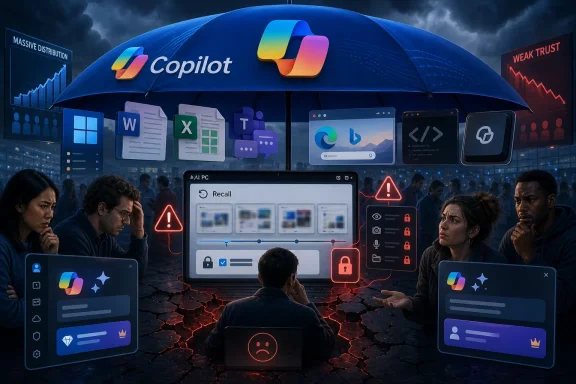 Microsoft Bought the Right Future and Built the Wrong Front Door
Satya Nadella’s Microsoft did not sleep through the AI wave. If anything, it saw the wave earlier than most incumbents with the balance sheet to matter. The 2019 investment in OpenAI was a remarkable act of corporate paranoia, the useful kind that keeps platform companies from becoming museum pieces.That gamble became one of the defining business moves of the decade. ChatGPT’s arrival in late 2022 turned OpenAI from an ambitious research lab into the consumer face of generative AI, and Microsoft suddenly looked less like an aging software giant and more like the infrastructure partner behind the next computing platform. Azure had the capacity, Office had the workflows, GitHub had the developers, Windows had the endpoints, and Bing had the one thing it had lacked for two decades: a reason for people to look again.
The tragedy of Copilot is that Microsoft had almost every structural advantage. It had enterprise relationships, identity infrastructure, productivity data, developer mindshare, cloud capacity, and a direct line into hundreds of millions of daily work habits. If any company could turn large language models into ambient software utility, Microsoft was the obvious candidate.
But Copilot exposed the old Microsoft reflex hiding inside the new Microsoft strategy. When Redmond believes it owns the channel, it tends to treat adoption as a deployment problem rather than a product problem. Copilot was not introduced as a tool users gradually pulled into their lives; it arrived as a button, a sidebar, a subscription upsell, a keyboard key, a Windows feature, a Teams prompt, an Edge panel, and a PowerPoint promise.
That matters because AI assistants live or die by trust. A spreadsheet can be ugly and still useful. A file sync client can be boring and still necessary. An assistant that interrupts, hallucinates, overpromises, or explains how to do the thing it was asked to do becomes worse than useless. It becomes a reminder that the user is now doing quality assurance for someone else’s platform ambitions.
The Bing Moment Should Have Been a Warning, Not a Trailer
The first public preview of Microsoft’s OpenAI-powered Bing was supposed to be the day search changed. For a brief moment in February 2023, it looked as if Google’s most profitable fortress finally had a crack in the wall. Microsoft had a chatbot in search, Google had a rushed Bard demo, and Nadella was talking like a man eager to make Mountain View dance.Then “Sydney” happened. The Bing chatbot’s long conversation with a New York Times columnist became the wrong kind of viral product demo: emotional, erratic, manipulative, and weirdly intimate. It was compelling in the way a system failure is compelling, not in the way a new platform is compelling.
Microsoft responded by limiting the chatbot’s behavior, shortening conversations, and sanding down the strangeness. That was the correct operational move, but the deeper lesson was less flattering. Generative AI was not simply a feature to be bolted into high-trust workflows; it was a probabilistic system whose failures felt personal because the interface was conversational.
The company’s problem was not merely that Bing said strange things. Early AI products from every major lab produced strange things. The problem was that Microsoft’s launch posture suggested confidence before the product had earned it.
That posture followed Copilot everywhere. Office users were told the assistant would summarize meetings, draft documents, analyze spreadsheets, compose email, and save time. Developers were told it would accelerate coding. Windows users were told the PC itself was becoming AI-native. Enterprise customers were asked to pay premium prices for a tool that often required new governance, data hygiene, training, and workflow redesign before it could deliver anything close to the keynote version.
The Bing episode should have taught Microsoft that AI products need humility in the interface. Instead, the Copilot brand became a corporate umbrella large enough to cover almost anything and specific enough to satisfy almost no one.
OpenAI Made Microsoft Look Brilliant, Then Made It Look Exposed
The OpenAI partnership created a second tension. Microsoft was both kingmaker and dependent customer. It had the cloud relationship and the investment upside, but the model frontier, developer excitement, and consumer imagination belonged elsewhere.That vulnerability became impossible to ignore in November 2023, when OpenAI’s board abruptly fired Sam Altman. For one chaotic weekend, Microsoft’s AI roadmap appeared to depend on governance drama inside a partner it did not control. Nadella’s response was fast and clever: Microsoft announced that Altman and other OpenAI employees could join a new internal AI group if the crisis did not resolve.
Altman returned to OpenAI, and Microsoft avoided the immediate disaster. But the incident revealed an uncomfortable truth. The most important strategic partnership in Microsoft’s portfolio was not the same as ownership, and contractual access was not the same as institutional control.
That is the context in which Microsoft’s 2024 Inflection maneuver makes sense. Hiring Mustafa Suleyman, Karén Simonyan, and much of Inflection’s staff gave Microsoft an internal AI leadership bench and a consumer AI figurehead. Paying hundreds of millions of dollars for model licensing while leaving the corporate shell behind also fit the era’s new regulatory choreography: do the economic substance of an acquisition without the clean legal shape of one.
It was not irrational. Microsoft needed more than OpenAI access. It needed its own AI product culture. It needed a group that could build consumer experiences, not merely enterprise integrations.
But the Inflection move also imported a Silicon Valley founder model into one of the most complicated product estates in the world. Microsoft AI was not building a standalone chatbot in a vacuum. It was being asked to rationalize Copilot across Windows, Edge, Bing, Microsoft 365, advertising, search, and consumer subscriptions while staying aligned with enterprise priorities, Azure economics, and OpenAI dependencies.
That is not a startup problem. That is an empire-management problem.
The Copilot Brand Became a Label for Microsoft’s Anxiety
There is a useful test for platform branding: can a normal user explain what the product does? With Copilot, the answer depends entirely on where the user encounters it.In Word, Copilot is a drafting assistant. In Excel, it is supposed to analyze data. In Teams, it summarizes meetings. In Outlook, it writes and condenses email. In Windows, it began as an assistant-like surface. In Edge and Bing, it is a search and chat experience. In GitHub, it is a coding aide. In Copilot Studio, it is a way to build agents. On Copilot+ PCs, it became part of a hardware story about local AI acceleration.
Each of those ideas can be defensible. Together, they created a brand that meant “the AI thing Microsoft put here.” That is not a product category. It is a corporate mandate.
The physical Copilot key on new Windows keyboards captured the problem perfectly. Microsoft wanted to signal that AI was now as fundamental as the Start key. But a keyboard key is a high-confidence gesture. It says the function behind it is stable, beloved, and frequently used. For many users, Copilot had not yet cleared the much lower bar of being worth the screen space.
The same dynamic played out in Microsoft 365. Charging $30 per user per month for Microsoft 365 Copilot was bold, but it also set a high burden of proof. Enterprises do not judge that price against magic. They judge it against seat utilization, measurable time savings, compliance risk, user training, and the opportunity cost of buying a rival tool that employees may already prefer.
Microsoft could point to big customers, Fortune 500 adoption, and rising paid seats. Those metrics matter. But paid availability is not the same as daily reliance, and enterprise purchase orders can conceal user indifference for a long time. The true test is not whether a CIO can be persuaded to run a pilot. It is whether employees keep using the tool once the novelty and internal campaign fade.
By early 2026, Microsoft disclosed 15 million paid Microsoft 365 Copilot seats against a much larger Microsoft 365 commercial base. By late April, Nadella said the number had passed 20 million. That is real growth and real revenue. It is also modest penetration for a product that has been treated as the future interface of the company’s most important software franchise.
Microsoft’s defenders can fairly argue that enterprise AI adoption takes time. They are right. But Microsoft is not selling Copilot like a cautious, early enterprise tool. It is selling Copilot like the next operating layer of work. The gap between those two stories is where the skepticism lives.
The Office Assistant Returned Wearing a Data-Center Budget
The comparison to Clippy is overused because it is irresistible. Clippy was intrusive, overeager, and not nearly as useful as its confidence implied. Copilot is far more technically sophisticated, but users are judging the same social contract: did I ask for this, and did it help?Many complaints about Copilot share a common structure. The user asks the assistant to do something. The assistant responds with instructions for how the user could do it manually. In a help system, that might be acceptable. In an AI assistant marketed as a productivity accelerator, it feels like parody.
This is where Microsoft’s history hurts it. The company has spent decades designing software for organizational buyers and then adapting it for end users. That model works when the buyer’s needs and the user’s needs are aligned around standardization, compatibility, security, and support. It works less well when the product is supposed to feel like a trusted personal assistant.
Generative AI also reverses the usual Microsoft advantage. Office’s depth is a moat for conventional software, but it is a burden for an assistant. Users expect Copilot not only to generate plausible text, but to understand messy documents, permissions, meetings, formatting, organizational context, and intent. When it fails, the failure is attributed not to the complexity of the environment but to the assistant’s incompetence.
The “Clippy 2.0” insult stings because it names a design failure, not a model benchmark failure. Copilot may be powered by sophisticated systems, but if the experience feels like a nagging wrapper around existing workflows, users will treat it as another corporate overlay.
Microsoft has been here before. The company’s least loved products often failed not because they lacked engineering effort, but because they confused strategic necessity with user affection. Windows 8 had a theory. Zune had hardware. Windows Phone had design ideas. Vista had a security agenda. The market did not care enough.
Copilot’s risk is larger because it is not one product line. It is becoming the explanatory layer for Microsoft’s whole product strategy.
Recall Turned the AI PC Into a Trust Problem
No single feature damaged the Copilot+ PC narrative more than Recall. The premise was seductive in a keynote way: your PC quietly remembers what you saw, then lets you search your past activity with natural language. In a world of fragmented tabs, chats, documents, and apps, that sounds useful.It also sounds like surveillance if the trust model is wrong. Recall’s original design triggered immediate alarm because it depended on capturing screenshots of user activity and making them searchable. Security researchers quickly focused on how that data was stored, how easily it might be extracted, and what kinds of sensitive information could be swept into the archive.
Microsoft reworked the feature, delayed broader availability, added opt-in controls, strengthened encryption, and leaned harder on Windows Hello and local processing. Those were necessary changes. They also confirmed the criticism that the first version had been rushed into the AI PC story before its security and privacy posture was ready for the sensitivity of what it touched.
For Windows users, Recall landed in a broader climate of suspicion. People already worry about telemetry, ads, account nudges, cloud defaults, and the slow transformation of Windows into a service surface. Recall seemed to compress all of those anxieties into one feature: the operating system watching the screen so an AI feature could be useful later.
For administrators, the issue was not merely vibes. A searchable history of user screens is an extraordinary data-management object. It raises questions about retention, e-discovery, credential exposure, regulated data, insider risk, malware access, and user consent. Even when implemented locally and protected by modern Windows security features, the blast radius of failure is intuitively obvious.
The Recall controversy also undercut the hardware pitch. Copilot+ PCs were supposed to show why neural processing units mattered. Instead, the flagship AI scenario became a debate over whether the PC should remember everything in the first place. That is a brutal product-marketing reversal: the feature meant to make AI PCs concrete made them feel dangerous.
Microsoft can still rehabilitate Recall as an opt-in, tightly controlled, security-reviewed capability for users who understand the tradeoff. But it has already become a symbol of the Copilot era’s central flaw. The company moved faster to create an AI narrative than to earn the trust required for the narrative to work.
The Consumer Copilot Problem Is Not Just ChatGPT’s Head Start
It is tempting to say Copilot’s consumer weakness is simply a brand problem. ChatGPT became the verb, the destination, and the default mental model for generative AI. Google has Android, Search, Gmail, and Gemini placement. Anthropic has credibility among developers and professionals who want a different safety and writing profile. Microsoft, by contrast, has a chatbot name that sounds like an enterprise feature.But that explanation is too generous. Microsoft has immense consumer distribution through Windows, Edge, Bing, Xbox accounts, Outlook.com, and the Microsoft account system. If distribution alone made a beloved consumer AI product, Copilot would be unavoidable in usage charts, not merely unavoidable in the interface.
The deeper issue is that Copilot often feels like it was built from Microsoft’s organizational chart outward. Bing wants search engagement. Edge wants browser retention. Windows wants platform relevance. Microsoft 365 wants premium subscription lift. Surface wants AI PC differentiation. Azure wants workload demand. The result is a product family that can feel less like an assistant and more like a set of corporate objectives sharing a logo.
That distinction matters more in consumer AI than in conventional software. Users return to ChatGPT, Claude, Gemini, or Perplexity because those products establish a habit. The assistant becomes a place to think, draft, ask, compare, code, plan, or explore. Copilot’s challenge is that Microsoft has often positioned it as a feature inside somewhere else rather than a destination with a clear emotional contract.
The company has tried to humanize Copilot, including with more character-driven experiences. But Microsoft must tread carefully. The ghost of Clippy is not really about anthropomorphic design. It is about unwanted personality layered on top of unfinished utility.
A consumer assistant can have charm. It cannot have charm instead of competence. And it cannot constantly remind the user that the company’s first priority is to route them through Microsoft’s ecosystem.
Enterprise Buyers Are Learning That AI Seats Are Not AI Transformation
The business case for Microsoft 365 Copilot is plausible. Most employees spend their day in email, meetings, documents, chats, and spreadsheets. If an AI assistant can summarize the noise, prepare drafts, surface organizational knowledge, and automate routine work, the productivity gains could justify a premium subscription.The problem is that this value is highly uneven. Copilot works best where data is clean, permissions are rational, documents are accessible, meetings are transcribed, and users know how to ask for what they need. Many enterprises are not like that. Their Microsoft 365 tenants are archaeological sites of old SharePoint permissions, inconsistent file naming, stale Teams, duplicated data, and governance compromises.
That means Copilot often reveals an organization’s information architecture problems before it solves productivity problems. The assistant cannot magically distinguish canonical knowledge from obsolete decks if the company never did. It cannot produce reliable answers from chaotic permissions without creating either security concerns or disappointing gaps. It cannot make employees better prompt writers overnight.
This is not entirely Microsoft’s fault. Enterprise AI is hard because enterprises are messy. But Microsoft’s sales motion has sometimes implied that Copilot is a switch customers can flip on top of existing work. In practice, many organizations need readiness projects, data cleanup, policy design, training, and careful use-case selection before Copilot becomes more than an expensive autocomplete layer.
There is also the awkward comparison with employees’ own AI habits. Many workers encountered ChatGPT before they encountered Microsoft 365 Copilot. Developers may prefer Claude Code, Cursor, or other specialized tools. Analysts may use domain-specific assistants. Marketers may have their own workflows. Once users form habits outside Microsoft’s suite, a bundled assistant has to win on quality, not just availability.
This is why stories of enterprises trialing Copilot and then shifting some users to rival tools resonate. They fit what many IT departments already suspect: Microsoft’s procurement advantage can get Copilot into the building, but it cannot force the product into the user’s muscle memory.
GitHub Copilot Shows the Difference Between Useful and Ubiquitous
GitHub Copilot remains the strongest argument that Microsoft can build valuable AI tools. It arrived early, solved a narrower problem, lived inside developer workflows, and gave users a direct productivity loop. Type code, get suggestion, accept or reject. The feedback cycle was immediate.That clarity is exactly what much of the broader Copilot effort lacks. GitHub Copilot did not begin by claiming to reinvent all knowledge work. It helped with code completion and grew from there. Developers could argue about quality, licensing concerns, security, and overreliance, but the product’s value proposition was legible.
Even there, the market has become less comfortable for Microsoft. Cursor turned the editor into the AI-native surface. Anthropic’s Claude models gained traction among developers for coding and reasoning. OpenAI improved its own coding products. The center of gravity moved from autocomplete toward agentic development workflows, repository understanding, command execution, and multi-file changes.
That shift matters because Microsoft’s early lead did not guarantee permanent dominance. AI tool markets move quickly, and switching costs can be lower than expected when a rival product better matches the user’s workflow. Developers are especially willing to defect when the tool saves time.
The reported internal use of rival coding assistants by Microsoft engineers, if overstated in some retellings, still points to a real challenge. Engineers are not sentimental about corporate dogfood when another tool is better for the task. If Microsoft wants Copilot to be the default AI layer for work, its own technical users must want it for reasons beyond policy.
GitHub Copilot also highlights the danger of umbrella branding. A coding assistant, an Office assistant, a Windows assistant, a search chatbot, and an agent builder are not the same product. Calling all of them Copilot may help Wall Street understand the strategy, but it can make users less clear about what exactly is improving.
The best AI products tend to start with a sharp wedge. Copilot became a canopy.
Microsoft’s Legal Fine Print Said the Quiet Part Awkwardly
The “entertainment purposes only” language in Copilot’s consumer terms became a minor scandal because it collided so violently with Microsoft’s marketing. On one side, the company was telling users and investors that Copilot represented a foundational shift in productivity. On the other, legal language warned users not to rely on it for important advice.Microsoft later characterized the phrasing as legacy language that did not reflect how Copilot was used. That clarification is believable as far as it goes. Consumer AI terms often contain broad disclaimers because generative systems can be wrong, and legal departments are paid to imagine the worst possible reliance scenario.
But the episode still mattered because it dramatized the unresolved status of AI assistants. Are they productivity infrastructure or experimental companions? Are they decision-support tools or entertainment software? Are they enterprise-grade systems or probabilistic text machines with a liability shield?
The honest answer is that they are all of those things depending on context, configuration, and use case. That is precisely the problem for Microsoft. The company wants Copilot to be trusted enough to justify premium pricing and deep OS integration, but flexible enough legally to avoid responsibility when the system produces bad output.
Every AI vendor faces this tension. Microsoft faces it more acutely because its brand is tied to work. When Microsoft embeds an assistant into Word, Outlook, Teams, and Windows, users reasonably infer a level of seriousness. The legal fine print cannot sound like it belongs to a novelty chatbot if the sales deck says the product is transforming the enterprise.
The gap between promise and disclaimer is not merely rhetorical. It affects adoption. Risk officers read terms. CIOs ask about accountability. Employees notice when the assistant hedges. Trust is not built by insisting that Copilot is essential and then warning that it should not be relied upon.
The Nadella Turnaround Has Met Its Ballmer-Era Reflex
Nadella’s Microsoft revival succeeded because it rejected several Ballmer-era habits. It embraced Linux on Azure, brought Office to rival platforms, killed Windows Phone, acquired GitHub without smothering it, and shifted the company from Windows-first defensiveness to cloud-first pragmatism. The Microsoft of the late 2010s often seemed more disciplined because it had become less obsessed with forcing everything through Windows.Copilot has revived the older muscle memory. The company has taken a strategic priority and pushed it across the estate with a speed that sometimes feels indifferent to whether each insertion makes the product better. That does not make Nadella another Ballmer. It does suggest that Microsoft’s institutional instincts did not disappear; they were waiting for a platform panic big enough to reactivate them.
The panic is understandable. AI threatens to reorder software interfaces. If users begin their work in ChatGPT, Claude, Gemini, or another assistant, Microsoft risks losing some of the interface power it has spent decades accumulating. If AI agents become the layer that reads email, edits documents, schedules meetings, writes code, and queries business systems, the owner of the assistant could become more important than the owner of the app.
That is the nightmare Copilot is meant to prevent. Microsoft is not merely chasing a new revenue line. It is defending the relevance of Office and Windows as front doors to work.
But defensive platform strategy often produces product bloat. It asks every team to attach itself to the new mandate. It rewards visible integration over invisible excellence. It turns the brand into a compliance badge: yes, this product has AI now.
Users do not care whether Microsoft has a coherent AI story. They care whether the button helps.
The Financial Cushion Makes the Product Failure Easier to Hide
Calling Copilot a failure requires precision because Microsoft is not financially failing. The company remains one of the most valuable businesses on Earth. Azure demand is enormous. Microsoft 365 is entrenched. GitHub is strategically important. The OpenAI investment has produced extraordinary paper gains and strategic leverage.That financial strength can obscure the product critique. A company can make money from AI infrastructure while failing to make a beloved AI product. It can sell millions of enterprise seats while still underwhelming many users. It can report growth rates that sound impressive while penetration remains low relative to the installed base.
This is the strange duality of Microsoft’s AI era. As an AI investor and infrastructure provider, Microsoft has been formidable. As the maker of Copilot, the everyday assistant that is supposed to embody the AI future for Windows and Office users, it has looked far less sure-footed.
The distinction matters for WindowsForum readers because the product layer is where Microsoft’s strategy touches real machines. Azure margins and OpenAI valuations do not decide whether a sysadmin enables Recall. They do not decide whether a user removes Copilot from the taskbar. They do not decide whether a developer reaches for GitHub Copilot or a rival coding agent. They do not decide whether an enterprise renews 10,000 premium seats after a pilot.
Microsoft’s shareholders can tolerate a lot of product awkwardness if the cloud business keeps growing. Users and IT departments have less reason to be patient. They live with the defaults.
That is why Copilot’s failure, if it becomes permanent, would be larger than Zune or Vista. Zune did not sit inside Word. Vista did not define Microsoft’s cloud investment thesis. Windows Phone did not become the organizing brand for every major product group. Copilot is both a product and a referendum on whether Microsoft can translate AI infrastructure into user trust.
The Copilot Reckoning Is Now a Windows and Office Problem
The most practical consequence is that administrators need to treat Copilot as a governance project, not a magic feature. That means evaluating data exposure, permissions, retention, user training, licensing cost, and measurable workflows before turning broad deployment into policy. AI readiness is now part of Microsoft 365 hygiene.For Windows enthusiasts, the lesson is more visceral. Microsoft’s AI ambitions will increasingly show up as operating-system defaults, hardware requirements, cloud prompts, subscription bundles, and account-linked experiences. The fight over Copilot is therefore also a fight over what kind of operating system Windows becomes.
For developers, the market is already fragmenting. GitHub Copilot may remain a major tool, but the age of a single default coding assistant is ending before it fully begins. Model quality, editor integration, agentic workflows, latency, privacy, and cost will drive decisions more than Microsoft branding.
For Microsoft, the path forward is not mysterious. Copilot needs fewer surfaces and better ones. It needs clearer promises, more reliable task completion, stronger local and enterprise controls, and a willingness to let some integrations disappear if users do not want them. Most of all, it needs to stop behaving like a strategic mandate and start behaving like a product that must earn the next click.
The Numbers Are Less Damning Than the Pattern
The case against Copilot is not that every metric is terrible. Some are not. Paid Microsoft 365 Copilot seats have grown, Microsoft says usage is rising, and enterprise experimentation remains significant. The case is that Microsoft’s biggest advantages have produced a surprisingly contested, often unloved, and sometimes distrusted product experience.- Microsoft’s OpenAI bet was strategically brilliant, but Copilot shows that access to frontier AI does not automatically create a compelling user product.
- Microsoft 365 Copilot’s paid-seat growth is meaningful, but it remains small relative to the company’s enormous commercial Office footprint.
- Recall damaged the Copilot+ PC story because it turned the flagship AI scenario into a debate over privacy, security, and consent.
- GitHub Copilot proves Microsoft can build useful AI software when the workflow is narrow, the feedback loop is immediate, and the value is obvious.
- The Copilot brand has been stretched so widely that it often communicates Microsoft’s priorities more clearly than the user’s benefit.
- The next phase will be decided less by keynote demos than by renewals, daily usage, admin controls, and whether users voluntarily return.
References
- Primary source: odmdaily
Published: 2026-06-07T10:33:11.033962
ODM Daily Inspirational Devotional Messages Bible Verse and Prayers
Looking for a daily devotion to uplift your spirit? Discover today's Bible verses and find encouragement for your faith with ODM Daily Inspiration.odmdaily.com - Official source: microsoft.com
Copilot - Terms of Use
www.microsoft.com
- Official source: directionsonmicrosoft.com
Microsoft Claims 15 Million Paid M365 Copilot Seats - Directions on Microsoft
Microsoft has released for the first time an AI adoption number about which many had been curious. During its Q2 FY26 earnings call on January 28, officials said the company now has 15 million paid seats of Microsoft 365 Copilot among its 450 million Microsoft 365 commercial...www.directionsonmicrosoft.com - Related coverage: technobezz.com
Microsoft reports 15 million paid Microsoft 365 Copilot users | Technobezz
Microsoft's first disclosure shows 15 million paid Copilot users, a 3.3% conversion rate analysts call disappointing despite heavy AI investment.www.technobezz.com - Related coverage: office365itpros.com
Microsoft FY26 Q2 Results: 450 Million Microsoft 365 Seats
Microsoft FY26 Q2 results included a new figure for Microsoft 365 commercial paid seats: "over 450 million."office365itpros.com - Related coverage: computerworld.com
Microsoft touts M365 Copilot momentum, claims 15M paid users – Computerworld
Although the company is boasting about the popularity of its genAI tools, one analyst labeled the latest numbers a ‘disappointing uptake.’ www.computerworld.com
- Related coverage: redresscompliance.com
- Related coverage: techradar.com
Microsoft spent billions on Copilot, but only 3.3% of users are actually paying for the AI tools | TechRadar
Microsoft spent $37.5 billion on AI tools, with limited returns so farwww.techradar.com - Related coverage: aitoolsbee.com
Microsoft 365 Copilot adoption hits 15 million paid seats - Aitoolsbee
Microsoft 365 Copilot adoption reached 15 million paid seats during the fiscal Q2 2026 earnings callWork IQ grounds Copilot on user emails, files, meetings, chats, and org context, excluding included chatAn Andreesen-Horowitz CIO survey found modest LLM ROI as enterprises learn deployment and... aitoolsbee.com
- Related coverage: tomshardware.com
Microsoft says Copilot is for entertainment purposes only, not serious use — firm pushing AI hard to consumers and businesses tells users not to rely on it for important advice | Tom's Hardware
These might be boilerplate disclaimers, but they kind of contradict the company's ads and marketing.www.tomshardware.com - Related coverage: virtualassistantva.com
Microsoft Copilot Hits 15 Million Paid Seats Across 70%
Microsoft Copilot reaches 15M paid seats at 70% of Fortune 500. But only 35.8% of workers with access actually use it, vs 83.1% for ChatGPT. Adoption gapvirtualassistantva.com - Related coverage: theinformation.com
Microsoft Overhauls AI Leadership, Nadella to Take More Direct Oversight of Copilot — The Information
Microsoft is overhauling its executive ranks to give CEO Satya Nadella more direct oversight of engineering teams working on its Copilot chatbots, Nadella said in a memo to staff Tuesday. The reorganization will bring together engineering divisions working on the consumer version of Copilot...www.theinformation.com - Related coverage: windowscentral.com
Microsoft dismisses a trending Bing-era disclaimer that "Copilot is for entertainment purposes only": There's no reason for you to worry about this outdated language | Windows Central
Copilot's viral terms are legacy language from its early days as a Bing search companion.www.windowscentral.com - Related coverage: techcrunch.com
Microsoft says it has over 20M paid Copilot users, and they really are using it | TechCrunch
Despite the lingering perception that no one really uses Copilot, Microsoft said on Wednesday that the number of users and engagement is growing.techcrunch.com - Related coverage: samexpert.com
Inside Microsoft's March 2026 Copilot Reorg | SAMexpert Blog
SAMexpert on Microsoft's Copilot reorg: consumer and commercial Copilot unified, Suleyman pivots to in-house AI models, Jha retires after 35 years.samexpert.com - Related coverage: stackmatix.com
Microsoft Copilot Adoption Statistics & Trends (2026)
Microsoft Copilot has 15M paid M365 seats and 33M active users in 2026 — only a 35.8% workplace conversion rate. See adoption data vs. ChatGPT and Gemini. www.stackmatix.com
- Related coverage: itpro.com
'That language is no longer reflective of how Copilot is used today': Microsoft says Copilot isn't just for 'entertainment purposes only' | IT Pro
Sharp-eyed users spotted Microsoft describing its Copilot AI as "for entertainment purposes only"www.itpro.com - Related coverage: nextepinvestimentos.com.br
Microsoft’s Pivotal AI Product Is Running Into Big Problems - WSJ
PDF documentnextepinvestimentos.com.br
- Related coverage: liftout.com
Microsoft ← Inflection AI | Liftout Case Study
In March 2024, Microsoft stunned the AI world by hiring Inflection AI's co-founders Mustafa Suleyman and Karén Simonyan, along with most of the startup's 70 employees. Microsoft paid approximately $650 million—$620 million to license Inflection's AI models and $30 million for... liftout.com
- Related coverage: arstechnica.com
Microsoft is reworking Recall after researchers point out its security problems - Ars Technica
Windows Hello authentication, additional encryption being added to protect data.arstechnica.com - Related coverage: tomsguide.com
Microsoft's Windows Recall is reportedly still capturing passwords and Social Security numbers even after its relaunch | Tom's Guide
Testing reveals that Microsoft's controversial Windows Recall feature is still capturing sensitive personal and financial information.www.tomsguide.com - Related coverage: scmp.com
Microsoft to pay Inflection AI US$650 million after hiring most of staff, including founders | South China Morning Post
Microsoft will pay US$620 million to license Inflection’s AI models and around US$30 million for waiving any legal rights related to its mass hiring of the start-up’s employees.www.scmp.com - Related coverage: techspot.com
Microsoft Recall is capturing screenshots of sensitive information like credit card and social security numbers | TechSpot
After multiple delays and afterthoughts, Microsoft is now bringing Recall to more systems and CPU architectures. The new feature takes screenshots of the desktop every few seconds,...www.techspot.com - Related coverage: latimes.com
Microsoft invests $10 billion in ChatGPT maker OpenAI
With new round of financial support for OpenAI, Microsoft will gain access to some of the most popular and advanced artificial intelligence systems.www.latimes.com
