

Microsoft Clarity’s AI Citations dashboard now exposes the grounding queries that Microsoft’s AI systems use to retrieve and cite web pages, giving site owners a rare look at how Copilot-era search turns conversational prompts into source-selection signals. That is more than another SEO metric with a shiny acronym attached. It is the first mainstream, free-ish window into the machinery between “an AI answered my question” and “why did it cite that page?” The catch is just as important: this is Microsoft’s window, and the view is shaped by Bing, Copilot, and Microsoft’s own retrieval stack.
For two years, publishers and SEOs have been trying to reverse-engineer AI visibility with a flashlight and a spreadsheet. They queried ChatGPT, Gemini, Perplexity, Copilot, AI Overviews, and half a dozen specialist tools, then counted citations like medieval monks tallying omens. The results were useful, but they were also simulated: a marketer pretending to be a user, asking prompts the user may never ask, in an interface whose behavior changes by model, account state, region, and day.
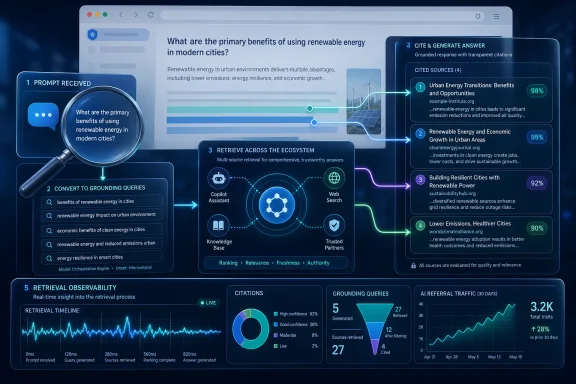
Clarity’s new Citation dashboard matters because it shifts the frame from synthetic testing to observed behavior inside a live AI retrieval system. Microsoft says the dashboard shows page citations, share of authority, AI referral traffic, cited pages, and the grounding queries used before an AI answer is generated. That last phrase is the breakthrough and the trap.
A grounding query is not necessarily the user’s prompt. It is the machine’s translation of the user’s messy request into something a search index can act on. In classic search, the query was the user’s language; in AI search, the visible prompt may be only the opening move, while the system rewrites, decomposes, and fans it out into retrievable fragments.
That makes Clarity less like Google Analytics and more like an oscilloscope attached to a new kind of search engine. It does not merely tell you that someone arrived from an AI assistant. It shows some of the terms the AI used to decide whether your page belonged in the answer at all.
AI answers complicate that bargain by moving the decisive action upstream of the click. A page can influence an answer without receiving traffic. A brand can be cited, summarized, paraphrased, or ignored entirely inside the answer box. In that world, click-through rate is no longer the whole market; it is the visible remainder after the assistant has already done some of the reading on the user’s behalf.
This is why grounding queries are so valuable. They sit at the junction where user intent becomes retrieval intent. If a user asks, “What analytics tool can show where AI assistants cite my site?” the system may ground that answer through phrases such as “AI citation dashboard,” “grounding queries,” “Microsoft Clarity AI Visibility,” or “track AI referrals.” The winning page is not simply the one that matches the prompt. It is the one that matches the system’s translation of the prompt.
That distinction should make WindowsForum readers sit up, even if they are not professional SEOs. The same pattern is spreading across enterprise search, Microsoft 365 Copilot, Windows-integrated assistants, developer tools, support portals, and internal knowledge bases. The retrieval layer is becoming the new front door to information, and the documents that survive that layer are the documents written in a way machines can confidently slice, rank, and cite.
The signal is strongest precisely because it is not pretending to be universal. Clarity’s AI citation reporting is tied to Microsoft’s AI surfaces and infrastructure, including Copilot-style answers and Bing-linked retrieval. That makes it narrower than the total AI web, but also more concrete than third-party tools that scrape public interfaces and infer visibility from repeated prompt tests.
In practical terms, Clarity is not giving publishers a direct feed of how ChatGPT, Gemini, Perplexity, Claude, or Google AI Overviews choose sources. Those systems may use different indexes, ranking layers, model policies, freshness signals, safety filters, and personalization mechanisms. Even where they share broad retrieval-augmented architecture, they do not share Microsoft’s logs.
But the Bing dependency does not make the data useless. It makes it bounded. A thermometer is not useless because it measures one room rather than the whole building; it becomes useless only if you pretend the reading applies everywhere. Clarity gives site owners a grounded, ecosystem-specific measurement of AI citation behavior, and that is already more than the industry had for most of the AI search era.
The Search Engine Journal example is instructive because the reported pattern was stark: a site with tens of thousands of Copilot citations had strong Bing visibility for nearly all tracked grounding queries, while Google visibility was absent for those same phrases. That does not prove Bing ranking is the only cause of Copilot citation. It does show that Microsoft’s AI citation layer is deeply entangled with Microsoft’s search index, which should surprise absolutely no one and still be taken seriously.
This is the irony at the center of Clarity’s new usefulness. The same ecosystem that many publishers considered secondary has become one of the clearest places to observe AI search behavior. Microsoft does not need to win classic search share outright for Bing-derived data to matter. It only needs its retrieval layer to influence enough AI interactions that the patterns become commercially meaningful.
That is already happening in subtle ways. Copilot is not just a website. It is a brand Microsoft has stretched across Windows, Edge, Bing, Microsoft 365, GitHub, security tooling, and enterprise workflows. Each surface may behave differently, but the strategic direction is obvious: Microsoft wants AI assistance to be a layer across work and browsing, not a destination users consciously choose once a day.
For IT pros, this should sound familiar. The platform vendor that controls identity, productivity software, browser defaults, endpoint management, and cloud services rarely needs to win a single consumer popularity contest to shape behavior. Microsoft can make telemetry matter by making the telemetry adjacent to workflows people already use.
Traditional keyword research asks what humans type. Grounding-query analysis asks what the machine searches after it has interpreted what humans asked. Sometimes those two are close. Often they are not.
That difference explains why apparently plain pages can outperform heavily optimized ones. An AI system looking for a citation wants extractable claims, topical fit, clear entity relationships, and enough authority to avoid embarrassment. It may prefer a concise, well-structured explainer over a sprawling SEO page built to satisfy every possible variation of a keyword.
This does not mean headings, lists, tables, and direct answers are magic charms. It means that structure now has a second audience. Humans need a page to be readable; retrieval systems need it to be chunkable. The best pages increasingly do both without turning into sterile answer farms.
There is also a risk here. Once marketers see grounding queries, some will try to stuff pages with machine-facing phrases the way an earlier generation stuffed footers with city names. That may work briefly in low-quality corners of the web, but it misunderstands the direction of travel. AI systems do not just retrieve text; they evaluate whether the retrieved text can support an answer. Pages that are clear, specific, internally consistent, and externally trusted are better positioned than pages that merely echo query fragments.
But the comparison becomes dangerous if it turns into a one-to-one translation theory. Copilot and Gemini may both retrieve web content, but they do not necessarily retrieve the same content, weight the same sources, or cite with the same philosophy. Google’s search stack is not Bing with a different logo. Microsoft’s integration with OpenAI models does not make Copilot behave like ChatGPT in every context. Perplexity, Claude-connected search experiences, ChatGPT Search, and Google AI Mode each sit behind different product incentives and ranking assumptions.
This is why Clarity should be treated as a lab environment, not as a universal oracle. It can show that a page is legible to one serious AI retrieval ecosystem. It cannot prove that the page will be cited everywhere else.
Still, labs matter. If your page consistently wins citations for relevant grounding queries in Copilot, it is evidence that the page has some combination of retrievability, authority, and answer-supporting structure. Those attributes are not Microsoft-exclusive. They are also the attributes most AI answer systems are likely to value, even if they discover and weight them differently.
Both reactions can be true. AI assistants reduce friction by summarizing the web, and in doing so they can reduce the incentive to visit the web. Citation dashboards do not solve that economic tension. They merely make part of it visible.
Clarity’s inclusion of AI referral traffic alongside citations is therefore important. The two numbers tell different stories. Citations measure presence inside answers; referrals measure users who still clicked through. A site with rising citations and flat referrals may be gaining influence but not traffic. A site with modest citations and strong referrals may be cited in contexts where users need deeper detail, downloads, pricing, troubleshooting, or trust verification.
This distinction matters for Windows-focused publishers, software vendors, MSPs, and documentation teams. If Copilot cites your Windows deployment guide but users do not click, your guide may still be shaping admin behavior. If it cites your troubleshooting page and users click through, that suggests the answer needed operational depth the assistant could not or would not compress.
Analytics teams will need to stop treating non-click visibility as vapor. They will also need to avoid pretending every citation has equal value. A citation in a throwaway answer is not the same as a citation that supports a high-intent procurement query or a security remediation workflow.
This is particularly relevant for WindowsForum’s audience because technical content is often closer to retrieval-ready than lifestyle content. A page explaining a Windows update failure, an Intune policy conflict, a BitLocker recovery scenario, or a PowerShell remediation step has natural entities, constraints, symptoms, and procedures. If written well, it gives an AI system exactly what it needs to support a grounded answer.
The danger is that the new AI optimization industry will bury that simple truth under acronyms. GEO, AEO, LLMO, AI visibility, answer optimization: the names matter less than the underlying document discipline. Can the page be crawled? Is the main answer obvious? Are claims supported? Are headings descriptive? Does the page distinguish between versions, dates, platforms, and prerequisites? Is the content specific enough to be useful without being so fragmented that it loses context?
Those are not exotic AI tricks. They are the fundamentals of publishing for users who arrive through machines.
If a page performs well in Bing but never appears in grounding queries, something is mismatched. The topic may not be one that Copilot grounds often. The page may be too promotional, too vague, too thin, or too hard to extract. It may answer a human query but fail to provide the kind of concise, attributable claim an AI answer needs.
The reverse is also useful. If a page earns AI citations for grounding queries you never intentionally targeted, the retrieval system is telling you how it understands your authority. That can expose emerging demand before it appears in conventional keyword tools. It can also reveal uncomfortable brand associations, stale coverage, or pages that have become accidental canonical references for topics you no longer want to own.
This is where the dashboard becomes strategic rather than decorative. The work is not simply “make more pages like the cited pages.” It is to understand why the cited pages were useful to the retrieval system and whether that usefulness aligns with the publisher’s goals.
For enterprise teams, the same logic applies internally. If Microsoft 365 Copilot or a similar assistant repeatedly retrieves one policy document and ignores another, the lesson may be about document structure, metadata, permissions, freshness, or trust. AI visibility is not just a marketing issue. It is becoming an information-governance issue.
But the power imbalance remains. Microsoft decides what is measured, how it is defined, which surfaces are included, how long the data is retained, and how much detail site owners get. Publishers can see traces of the retrieval process, not the process itself.
There are also privacy and competitive considerations. Grounding queries are aggregated and system-generated, not raw user prompts, which is sensible. But the more AI platforms expose retrieval telemetry, the more they will need to balance publisher usefulness against user privacy, anti-spam controls, and the risk of adversarial optimization.
Search engines learned this lesson the hard way. Every useful webmaster signal becomes a target for manipulation. If grounding-query data becomes central to AI optimization, bad actors will use it to generate pages that mimic citation-worthy structure without offering real authority. The systems will respond with more opacity, more trust weighting, and more platform-controlled interpretation.
That cycle does not make the data pointless. It means we are watching the early phase of a new measurement regime, before the incentives have fully hardened.
That creates a strange inversion. Microsoft, the smaller traditional search player, can win goodwill by exposing data from its AI retrieval layer. Google, the larger search gatekeeper, faces more pressure because its AI answers can affect publisher traffic at a much larger scale. The more Google asks publishers to accept AI-mediated search as the future, the harder it becomes to justify keeping AI citation reporting blurry.
For Microsoft, this is also competitive positioning. Clarity has always been an appealing product because it offers behavioral analytics without the same price barrier as many commercial tools. Adding AI visibility turns it into a wedge product for the AI search era. A webmaster who installs Clarity to see heatmaps may now also look at AI citations, then Bing Webmaster Tools, then Microsoft’s broader search and advertising stack.
That does not make the feature cynical. It makes it strategic. Microsoft is using transparency as a product advantage in a market where opacity has become a grievance.
The better response is slower and more durable. Compare cited pages with uncited pages. Look at the grounding queries that repeatedly trigger your content. Check whether the cited page actually answers the query cleanly. Examine whether the answer appears near the top, whether the page uses consistent terminology, whether important facts are buried in narrative padding, and whether the page distinguishes current information from outdated material.
For technical sites, versioning may become a major differentiator. AI systems hate ambiguity when they are trying to answer operational questions. A page that says “Windows 11 24H2” clearly, separates Home from Pro from Enterprise, and names relevant Microsoft 365 or Intune prerequisites is more useful than a page that gestures at “new Windows versions” in generic terms.
The same is true for dates. AI answer systems are increasingly asked time-sensitive questions: latest updates, current compatibility, active vulnerabilities, recent policy changes. Pages that make publication dates, update dates, affected versions, and superseded advice obvious are more likely to support reliable answers. Pages that hide those details invite either mis-citation or exclusion.
But it also warns against the fantasy of a single AI ranking. There is no universal AI results page. There are many assistants, many retrieval systems, many indexes, and many answer policies. A site can be strong in Copilot, invisible in Gemini, present in Perplexity, and inconsistently cited in ChatGPT Search. The old habit of treating Google ranking as the master scoreboard will not transfer neatly.
That fragmentation may be frustrating, but it is also an opportunity. Smaller publishers that cannot win every competitive Google query may find niches where their technical specificity or topical authority makes them useful to AI retrieval systems. Conversely, large sites that coasted on domain strength may discover that vague, bloated pages are poor citation material when an assistant needs a crisp supporting source.
The winners will not be the sites that merely “optimize for AI.” They will be the sites that understand which AI ecosystem they are measuring, what kind of retrieval behavior the data exposes, and how that behavior maps to their actual audience.
 Microsoft Just Put a Search Console Peephole Into the AI Answer Machine
For two years, publishers and SEOs have been trying to reverse-engineer AI visibility with a flashlight and a spreadsheet. They queried ChatGPT, Gemini, Perplexity, Copilot, AI Overviews, and half a dozen specialist tools, then counted citations like medieval monks tallying omens. The results were useful, but they were also simulated: a marketer pretending to be a user, asking prompts the user may never ask, in an interface whose behavior changes by model, account state, region, and day.Clarity’s new Citation dashboard matters because it shifts the frame from synthetic testing to observed behavior inside a live AI retrieval system. Microsoft says the dashboard shows page citations, share of authority, AI referral traffic, cited pages, and the grounding queries used before an AI answer is generated. That last phrase is the breakthrough and the trap.
A grounding query is not necessarily the user’s prompt. It is the machine’s translation of the user’s messy request into something a search index can act on. In classic search, the query was the user’s language; in AI search, the visible prompt may be only the opening move, while the system rewrites, decomposes, and fans it out into retrievable fragments.
That makes Clarity less like Google Analytics and more like an oscilloscope attached to a new kind of search engine. It does not merely tell you that someone arrived from an AI assistant. It shows some of the terms the AI used to decide whether your page belonged in the answer at all.
The Old SEO Bargain Is Being Rewritten in the Retrieval Layer
The familiar bargain of web search was crude but legible. A publisher produced a page, a crawler indexed it, an algorithm ranked it, and users clicked or did not click. Search Console and Bing Webmaster Tools gave site owners enough telemetry to argue with themselves productively: impressions, clicks, ranking positions, crawl errors, and queries.AI answers complicate that bargain by moving the decisive action upstream of the click. A page can influence an answer without receiving traffic. A brand can be cited, summarized, paraphrased, or ignored entirely inside the answer box. In that world, click-through rate is no longer the whole market; it is the visible remainder after the assistant has already done some of the reading on the user’s behalf.
This is why grounding queries are so valuable. They sit at the junction where user intent becomes retrieval intent. If a user asks, “What analytics tool can show where AI assistants cite my site?” the system may ground that answer through phrases such as “AI citation dashboard,” “grounding queries,” “Microsoft Clarity AI Visibility,” or “track AI referrals.” The winning page is not simply the one that matches the prompt. It is the one that matches the system’s translation of the prompt.
That distinction should make WindowsForum readers sit up, even if they are not professional SEOs. The same pattern is spreading across enterprise search, Microsoft 365 Copilot, Windows-integrated assistants, developer tools, support portals, and internal knowledge bases. The retrieval layer is becoming the new front door to information, and the documents that survive that layer are the documents written in a way machines can confidently slice, rank, and cite.
Bing Is the Strength of the Signal and the Source of the Bias
The uncomfortable question raised by Search Engine Journal’s report is the right one: if Clarity is a Microsoft tool, does the data matter for sites whose audiences do not live in the Bing ecosystem? The answer is yes, but not in the way dashboard vendors usually want to imply.The signal is strongest precisely because it is not pretending to be universal. Clarity’s AI citation reporting is tied to Microsoft’s AI surfaces and infrastructure, including Copilot-style answers and Bing-linked retrieval. That makes it narrower than the total AI web, but also more concrete than third-party tools that scrape public interfaces and infer visibility from repeated prompt tests.
In practical terms, Clarity is not giving publishers a direct feed of how ChatGPT, Gemini, Perplexity, Claude, or Google AI Overviews choose sources. Those systems may use different indexes, ranking layers, model policies, freshness signals, safety filters, and personalization mechanisms. Even where they share broad retrieval-augmented architecture, they do not share Microsoft’s logs.
But the Bing dependency does not make the data useless. It makes it bounded. A thermometer is not useless because it measures one room rather than the whole building; it becomes useless only if you pretend the reading applies everywhere. Clarity gives site owners a grounded, ecosystem-specific measurement of AI citation behavior, and that is already more than the industry had for most of the AI search era.
The Search Engine Journal example is instructive because the reported pattern was stark: a site with tens of thousands of Copilot citations had strong Bing visibility for nearly all tracked grounding queries, while Google visibility was absent for those same phrases. That does not prove Bing ranking is the only cause of Copilot citation. It does show that Microsoft’s AI citation layer is deeply entangled with Microsoft’s search index, which should surprise absolutely no one and still be taken seriously.
The Industry Ignored Bing Until Bing Became the AI Lab
For years, Bing was treated by many SEOs as the place you checked after the Google work was done, if you checked it at all. That made sense in a traffic world where Google dominated commercial search attention. It makes less sense in a world where Microsoft has turned Bing’s index into one of the major retrieval backends for consumer AI answers, browser experiences, and Windows-adjacent assistance.This is the irony at the center of Clarity’s new usefulness. The same ecosystem that many publishers considered secondary has become one of the clearest places to observe AI search behavior. Microsoft does not need to win classic search share outright for Bing-derived data to matter. It only needs its retrieval layer to influence enough AI interactions that the patterns become commercially meaningful.
That is already happening in subtle ways. Copilot is not just a website. It is a brand Microsoft has stretched across Windows, Edge, Bing, Microsoft 365, GitHub, security tooling, and enterprise workflows. Each surface may behave differently, but the strategic direction is obvious: Microsoft wants AI assistance to be a layer across work and browsing, not a destination users consciously choose once a day.
For IT pros, this should sound familiar. The platform vendor that controls identity, productivity software, browser defaults, endpoint management, and cloud services rarely needs to win a single consumer popularity contest to shape behavior. Microsoft can make telemetry matter by making the telemetry adjacent to workflows people already use.
Grounding Queries Are Not Keywords With a New Hat
The lazy interpretation of grounding queries is that they are just keywords renamed for the AI era. That interpretation will produce bad strategy. A grounding query is a retrieval artifact, not necessarily a market-facing phrase, and its value lies in what it reveals about the AI system’s decomposition of intent.Traditional keyword research asks what humans type. Grounding-query analysis asks what the machine searches after it has interpreted what humans asked. Sometimes those two are close. Often they are not.
That difference explains why apparently plain pages can outperform heavily optimized ones. An AI system looking for a citation wants extractable claims, topical fit, clear entity relationships, and enough authority to avoid embarrassment. It may prefer a concise, well-structured explainer over a sprawling SEO page built to satisfy every possible variation of a keyword.
This does not mean headings, lists, tables, and direct answers are magic charms. It means that structure now has a second audience. Humans need a page to be readable; retrieval systems need it to be chunkable. The best pages increasingly do both without turning into sterile answer farms.
There is also a risk here. Once marketers see grounding queries, some will try to stuff pages with machine-facing phrases the way an earlier generation stuffed footers with city names. That may work briefly in low-quality corners of the web, but it misunderstands the direction of travel. AI systems do not just retrieve text; they evaluate whether the retrieved text can support an answer. Pages that are clear, specific, internally consistent, and externally trusted are better positioned than pages that merely echo query fragments.
The Copilot-Gemini Comparison Is Useful Until It Becomes Too Neat
Search Engine Journal frames the issue partly through a Copilot-versus-Gemini comparison: Microsoft’s assistant uses a query translator, Bing index search, and OpenAI models, while Google’s stack uses Google Search and Gemini models. Broadly, that is the right mental model. Both systems use retrieval to ground answers rather than relying only on a model’s pre-trained memory.But the comparison becomes dangerous if it turns into a one-to-one translation theory. Copilot and Gemini may both retrieve web content, but they do not necessarily retrieve the same content, weight the same sources, or cite with the same philosophy. Google’s search stack is not Bing with a different logo. Microsoft’s integration with OpenAI models does not make Copilot behave like ChatGPT in every context. Perplexity, Claude-connected search experiences, ChatGPT Search, and Google AI Mode each sit behind different product incentives and ranking assumptions.
This is why Clarity should be treated as a lab environment, not as a universal oracle. It can show that a page is legible to one serious AI retrieval ecosystem. It cannot prove that the page will be cited everywhere else.
Still, labs matter. If your page consistently wins citations for relevant grounding queries in Copilot, it is evidence that the page has some combination of retrievability, authority, and answer-supporting structure. Those attributes are not Microsoft-exclusive. They are also the attributes most AI answer systems are likely to value, even if they discover and weight them differently.
The New Metric Is Influence Without the Visit
The most destabilizing idea in AI citation reporting is that influence can now be measured separately from traffic. A page may be used to answer a user’s question, shape their buying decision, or establish a brand as authoritative without producing a session in analytics. For publishers trained to optimize for clicks, that feels like theft. For platform companies, it looks like a better user experience.Both reactions can be true. AI assistants reduce friction by summarizing the web, and in doing so they can reduce the incentive to visit the web. Citation dashboards do not solve that economic tension. They merely make part of it visible.
Clarity’s inclusion of AI referral traffic alongside citations is therefore important. The two numbers tell different stories. Citations measure presence inside answers; referrals measure users who still clicked through. A site with rising citations and flat referrals may be gaining influence but not traffic. A site with modest citations and strong referrals may be cited in contexts where users need deeper detail, downloads, pricing, troubleshooting, or trust verification.
This distinction matters for Windows-focused publishers, software vendors, MSPs, and documentation teams. If Copilot cites your Windows deployment guide but users do not click, your guide may still be shaping admin behavior. If it cites your troubleshooting page and users click through, that suggests the answer needed operational depth the assistant could not or would not compress.
Analytics teams will need to stop treating non-click visibility as vapor. They will also need to avoid pretending every citation has equal value. A citation in a throwaway answer is not the same as a citation that supports a high-intent procurement query or a security remediation workflow.
Microsoft’s Dashboard Rewards the Kind of Pages IT Pros Already Prefer
The best news for serious technical publishers is that AI citation systems appear to reward many habits that good documentation teams already practice. Clear scope, direct claims, precise headings, tables where they help, short definitions, and pages that answer one coherent problem are not gimmicks. They are good information architecture.This is particularly relevant for WindowsForum’s audience because technical content is often closer to retrieval-ready than lifestyle content. A page explaining a Windows update failure, an Intune policy conflict, a BitLocker recovery scenario, or a PowerShell remediation step has natural entities, constraints, symptoms, and procedures. If written well, it gives an AI system exactly what it needs to support a grounded answer.
The danger is that the new AI optimization industry will bury that simple truth under acronyms. GEO, AEO, LLMO, AI visibility, answer optimization: the names matter less than the underlying document discipline. Can the page be crawled? Is the main answer obvious? Are claims supported? Are headings descriptive? Does the page distinguish between versions, dates, platforms, and prerequisites? Is the content specific enough to be useful without being so fragmented that it loses context?
Those are not exotic AI tricks. They are the fundamentals of publishing for users who arrive through machines.
The Gap Report May Be More Valuable Than the Citation Count
Citation counts are seductive because they move. They invite dashboards, leaderboards, and executive slides. But the more actionable part of Clarity may be the gap between what your site ranks for and what AI systems use it for.If a page performs well in Bing but never appears in grounding queries, something is mismatched. The topic may not be one that Copilot grounds often. The page may be too promotional, too vague, too thin, or too hard to extract. It may answer a human query but fail to provide the kind of concise, attributable claim an AI answer needs.
The reverse is also useful. If a page earns AI citations for grounding queries you never intentionally targeted, the retrieval system is telling you how it understands your authority. That can expose emerging demand before it appears in conventional keyword tools. It can also reveal uncomfortable brand associations, stale coverage, or pages that have become accidental canonical references for topics you no longer want to own.
This is where the dashboard becomes strategic rather than decorative. The work is not simply “make more pages like the cited pages.” It is to understand why the cited pages were useful to the retrieval system and whether that usefulness aligns with the publisher’s goals.
For enterprise teams, the same logic applies internally. If Microsoft 365 Copilot or a similar assistant repeatedly retrieves one policy document and ignores another, the lesson may be about document structure, metadata, permissions, freshness, or trust. AI visibility is not just a marketing issue. It is becoming an information-governance issue.
The Privacy and Power Questions Are Still Waiting Offstage
It is tempting to celebrate AI citation telemetry as a win for publishers, and in one narrow sense it is. More visibility is better than less visibility. A dashboard that shows how content participates in AI answers is better than a black box that absorbs the web and returns prose.But the power imbalance remains. Microsoft decides what is measured, how it is defined, which surfaces are included, how long the data is retained, and how much detail site owners get. Publishers can see traces of the retrieval process, not the process itself.
There are also privacy and competitive considerations. Grounding queries are aggregated and system-generated, not raw user prompts, which is sensible. But the more AI platforms expose retrieval telemetry, the more they will need to balance publisher usefulness against user privacy, anti-spam controls, and the risk of adversarial optimization.
Search engines learned this lesson the hard way. Every useful webmaster signal becomes a target for manipulation. If grounding-query data becomes central to AI optimization, bad actors will use it to generate pages that mimic citation-worthy structure without offering real authority. The systems will respond with more opacity, more trust weighting, and more platform-controlled interpretation.
That cycle does not make the data pointless. It means we are watching the early phase of a new measurement regime, before the incentives have fully hardened.
Google’s Silence Makes Microsoft Look Generous
One reason Clarity’s move feels larger than the feature itself is that Google has been far less forthcoming with equivalent AI answer telemetry. Google controls the dominant search ecosystem and is rapidly expanding AI Overviews and AI Mode, yet publishers still have limited visibility into when their pages are used in generated answers as distinct from classic search impressions.That creates a strange inversion. Microsoft, the smaller traditional search player, can win goodwill by exposing data from its AI retrieval layer. Google, the larger search gatekeeper, faces more pressure because its AI answers can affect publisher traffic at a much larger scale. The more Google asks publishers to accept AI-mediated search as the future, the harder it becomes to justify keeping AI citation reporting blurry.
For Microsoft, this is also competitive positioning. Clarity has always been an appealing product because it offers behavioral analytics without the same price barrier as many commercial tools. Adding AI visibility turns it into a wedge product for the AI search era. A webmaster who installs Clarity to see heatmaps may now also look at AI citations, then Bing Webmaster Tools, then Microsoft’s broader search and advertising stack.
That does not make the feature cynical. It makes it strategic. Microsoft is using transparency as a product advantage in a market where opacity has become a grievance.
The Practical Play Is Boring, Which Is Usually a Good Sign
The worst response to Clarity’s grounding queries would be panic optimization. Site owners should not rewrite entire content libraries around a few dozen machine-generated terms. Nor should they assume that Copilot citations are a proxy for all AI visibility.The better response is slower and more durable. Compare cited pages with uncited pages. Look at the grounding queries that repeatedly trigger your content. Check whether the cited page actually answers the query cleanly. Examine whether the answer appears near the top, whether the page uses consistent terminology, whether important facts are buried in narrative padding, and whether the page distinguishes current information from outdated material.
For technical sites, versioning may become a major differentiator. AI systems hate ambiguity when they are trying to answer operational questions. A page that says “Windows 11 24H2” clearly, separates Home from Pro from Enterprise, and names relevant Microsoft 365 or Intune prerequisites is more useful than a page that gestures at “new Windows versions” in generic terms.
The same is true for dates. AI answer systems are increasingly asked time-sensitive questions: latest updates, current compatibility, active vulnerabilities, recent policy changes. Pages that make publication dates, update dates, affected versions, and superseded advice obvious are more likely to support reliable answers. Pages that hide those details invite either mis-citation or exclusion.
The First Real AI SEO Dashboard Is Also a Warning Label
Clarity’s Citation dashboard is arriving at a moment when “AI visibility” is becoming a budget line. Agencies are selling it, executives are asking about it, and publishers are trying to decide whether a citation without a click has economic value. The dashboard gives that conversation some badly needed instrumentation.But it also warns against the fantasy of a single AI ranking. There is no universal AI results page. There are many assistants, many retrieval systems, many indexes, and many answer policies. A site can be strong in Copilot, invisible in Gemini, present in Perplexity, and inconsistently cited in ChatGPT Search. The old habit of treating Google ranking as the master scoreboard will not transfer neatly.
That fragmentation may be frustrating, but it is also an opportunity. Smaller publishers that cannot win every competitive Google query may find niches where their technical specificity or topical authority makes them useful to AI retrieval systems. Conversely, large sites that coasted on domain strength may discover that vague, bloated pages are poor citation material when an assistant needs a crisp supporting source.
The winners will not be the sites that merely “optimize for AI.” They will be the sites that understand which AI ecosystem they are measuring, what kind of retrieval behavior the data exposes, and how that behavior maps to their actual audience.
The Clarity Signal Belongs in the Toolkit, Not on the Throne
Clarity’s new data is useful because it is concrete, but it is not complete. That distinction should guide how publishers, admins, and marketers use it over the next year.- Clarity’s grounding queries show how Microsoft-linked AI systems translate user intent into retrievable search terms before citing web content.
- Strong Copilot citation performance should be treated as evidence of Microsoft ecosystem visibility, not proof of equivalent performance in Gemini, ChatGPT, Perplexity, or Google AI Overviews.
- Bing visibility appears to matter materially for Copilot citations, so ignoring Bing is increasingly hard to defend for sites that care about AI discovery.
- The most transferable lesson is structural: pages that are clear, specific, current, and easy to extract are better suited to AI retrieval across ecosystems.
- Citation counts should be analyzed alongside AI referral traffic, because influence inside an answer and visits to a website are now separate outcomes.
- The most valuable work is comparing cited and uncited pages to identify gaps in structure, topical coverage, authority, and machine-readable clarity.
References
- Primary source: Search Engine Journal
Published: Thu, 21 May 2026 09:00:49 GMT
Microsoft Clarity Now Shows Grounding Queries Behind AI Citations
Clarity shows which grounding queries pull your content into Copilot. The patterns surface insights worth acting on, even for non-Bing SEOs.www.searchenginejournal.com - Official source: learn.microsoft.com
Citation dashboard overview | Microsoft Learn
Overview of the Citation dashboard in Microsoft Clarity AI Visibility.learn.microsoft.com - Official source: clarity.microsoft.com
5 KPIs for an AI-Mediated Web - Understand your customers | Microsoft Clarity Blog
Discover the top KPIs for an AI-mediated web, from AI referrals to forward-looking recommendations shaping influence before clicks happen.clarity.microsoft.com - Related coverage: buttonblock.com
Microsoft Clarity AI Citations Dashboard: Free Small-Business AI Measurement (2026) | Button Block
Microsoft Clarity just rolled out a free AI citations dashboard. Here is what it shows, how to install it in 10 minutes, and where it fits next to GA4's new AI Assistant channel. buttonblock.com
- Related coverage: clarity.kosgis.com
AIによる引用(Citations)機能が Microsoft Clarity で正式リリース(和訳+α) | Microsoft Clarity 研究
はい、ごめんください。Microsoft Clarity(クラリティ)大好きコスギです。この記事は Microsoft...clarity.kosgis.com - Official source: adoption.microsoft.com
- Related coverage: s4-clarity-lib.readthedocs.io
- Official source: microsoft.com
- Related coverage: rootandbranchgroup.com
