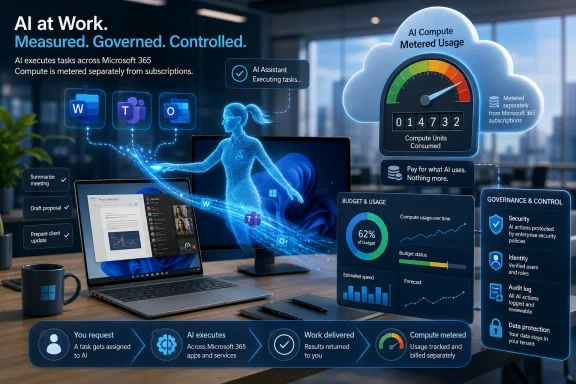
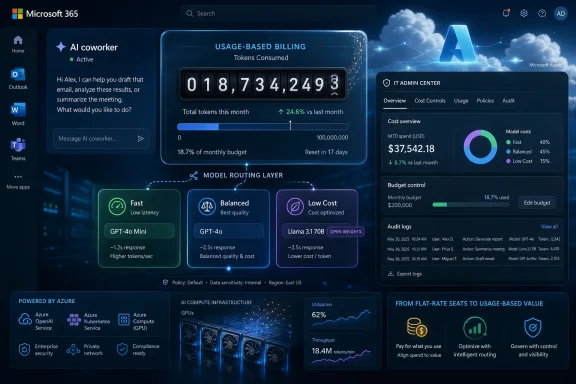
Microsoft on Tuesday, June 16, 2026, expanded Copilot Cowork, an enterprise AI agent for Microsoft 365, with usage-based pricing that charges companies for each task according to the compute consumed while still requiring a paid Microsoft 365 Copilot subscription. The move turns Microsoft’s familiar seat-license economics into something closer to cloud metering, and that is the real news. Copilot Cowork is not merely another AI feature tucked into Office; it is a test case for whether the productivity suite can survive the economics of agentic AI without abandoning the predictability that made it enterprise software’s safest purchase order.
The timing is not accidental. AI agents are expensive because they do not behave like autocomplete, search, or even a normal chatbot session. They loop, plan, retrieve, call tools, revise their own work, and sometimes keep running long after the user has walked away. Microsoft’s pitch is productivity; its pricing model is the admission that productivity now has a meter attached.
For roughly two decades, Microsoft’s commercial magic trick has been turning Office into a predictable subscription machine. Companies paid per user, finance departments modeled annual cost, procurement negotiated bundles, and IT departments worried more about deployment than unit economics. Microsoft 365 Copilot already stretched that model with a premium per-user add-on, but Copilot Cowork pushes it into a more volatile category: software that keeps spending money while it works.
That is why the “pay-as-you-go” label matters more than the product name. Microsoft is telling customers that some AI work no longer fits neatly inside a flat monthly fee. If one employee asks an agent to summarize a meeting thread and another asks it to compare thousands of documents, those two users may look identical in a license table while consuming radically different amounts of compute.
The company’s gasoline metaphor is revealing. You are not buying unlimited driving; you are filling the tank. That framing gives Microsoft cover to say it is aligning price with cost, but it also changes the customer’s psychology. A worker who once thought of Office as a fixed utility may now have to think like a cloud engineer, aware that each useful automation carries a hidden consumption trail.
This is not unprecedented for Microsoft as a whole. Azure customers have long lived with meters, budgets, resource groups, and bill shock. What is new is the migration of that cloud logic into the daily productivity layer where most employees, managers, and even many administrators are accustomed to the opposite: stable, boring, per-seat software.
Copilot Cowork belongs to a different category. It is Microsoft’s version of agentic AI: software that can accept an assignment, reason across workplace data, and act through connected applications such as Word, Excel, Outlook, calendars, documents, and internal knowledge stores. The sales pitch is delegation rather than prompting. The user does not merely ask for a paragraph; the user hands off work.
That shift is more than branding. An agent may read many files, generate intermediate plans, call models repeatedly, evaluate outputs, and produce multiple artifacts before presenting a result. A single “task” can be a bundle of searches, summaries, transformations, and model calls. In cloud terms, the agent is not a feature; it is a workload.
Microsoft’s examples make the economics obvious. Comparing nearly 4,000 documents in a few hours sounds impressive because it is the kind of drudgery that would otherwise consume human time. It also sounds expensive because the machine has to ingest, reason over, and synthesize a large corpus. The better the agent becomes at doing real work, the harder it becomes to pretend every user should cost the same.
That is the central tension now entering Microsoft 365. The most valuable AI features are precisely the ones least compatible with unlimited use. Microsoft can sell cheap certainty or expensive autonomy, but it cannot easily sell both at enterprise scale.
From Microsoft’s point of view, this makes sense. The Copilot license buys access to the integrated experience, enterprise data protection, administrative controls, and the broader Microsoft 365 AI surface. The meter pays for the incremental compute that an autonomous agent burns through. That distinction is clean enough in a product brief.
For customers, it may feel less elegant. Microsoft 365 Copilot has already required organizations to justify a premium monthly cost on top of existing Microsoft 365 plans. If the most ambitious agentic features now sit behind an additional usage meter, the value proposition becomes more complicated. IT leaders will have to explain not only who gets Copilot, but what those users are allowed to make it do.
The danger for Microsoft is that Copilot becomes perceived as a platform of toll gates. Chat may be included here, advanced agents may be included there, some capabilities may require a certain license, and the most compute-heavy tasks may consume credits or draw directly against a billing profile. That can be rational architecture and still feel like a maze.
The opportunity is equally clear. If Copilot Cowork saves hours of legal review, finance analysis, sales preparation, or administrative work, usage-based pricing may be easier to defend than another blanket per-seat uplift. The customer can tie spending to activity. But that only works if Microsoft gives administrators enough transparency to trust the bill before it arrives.
Those controls are not a footnote. They are the difference between an agent platform that enterprises can pilot and one they will quarantine. Usage-based pricing is familiar to cloud teams, but Microsoft 365 is deployed across entire companies, including departments that have never had to think about tokens, model classes, or compute tiers. The meter has to be governed before it can be democratized.
Admins will need policies for who can run long tasks, which data sources agents can access, which models they can use, and how spending limits map to business value. That is a governance problem as much as a billing problem. A cap that is too low makes the product useless; a cap that is too high invites surprise invoices.
There is also a cultural adjustment. Employees may begin optimizing their work around the perceived cost of asking the agent to do something. Managers may approve some automations and discourage others. Teams may start treating AI tasks like cloud jobs, with power users learning which model is “good enough” and which one is too expensive for routine work.
That may sound bureaucratic, but it is also how serious enterprise technology becomes real. The era of “just ask the AI” is giving way to a more sober question: which AI, for which task, at what cost, under whose budget?
This is not merely a technical detail. In the old Office world, users chose fonts, templates, macros, and maybe whether to save locally or to OneDrive. In the agentic Office world, organizations may choose between models with different cost, latency, reasoning ability, data handling characteristics, and reliability profiles. The model becomes part of the workflow design.
That gives Microsoft a new lever. It can steer mundane tasks toward cheaper models while reserving expensive frontier systems for high-value work. It can offer administrators a menu of trade-offs and claim that customers retain control. It can also protect margins by making sure not every request hits the most costly model in the catalog.
But model choice also introduces a quality-control problem. If one department uses a cheaper model for spreadsheet analysis and another uses a frontier model for the same work, results may differ. If an agent fails because a low-cost model misunderstood context, the savings may be illusory. Enterprises will need to learn a new discipline: not just prompt engineering, but model budgeting.
The likely end state is not a single “best” AI assistant. It is a tiered labor system inside software: small models for routine drafting, stronger models for synthesis, frontier models for ambiguous or high-risk work, and administrative policies deciding who may use what. Microsoft is not just changing pricing. It is introducing class structure into the AI workplace.
The comparison is imperfect but instructive. Developers are unusually technical users, yet even they reacted sharply when the billable unit changed beneath workflows they had already normalized. If programmers can be surprised by AI credit burn, ordinary Microsoft 365 users will need much clearer guardrails.
GitHub also shows why agentic tools strain subscriptions. A conventional code-completion tool can be priced like productivity software. An autonomous coding agent that explores a codebase, edits files, runs tests, reads errors, revises changes, and repeats the cycle looks much more like a compute job. The same pattern applies to office work.
Microsoft’s challenge is to avoid importing the worst part of cloud billing into Microsoft 365: the moment when usefulness and fear become correlated. If the most capable agentic workflows are also the ones most likely to trigger spending anxiety, employees may underuse the product. Enterprises do not buy productivity software so workers can hesitate before clicking “run.”
That is why transparency matters more than marketing. Before Copilot Cowork becomes a daily tool, users and admins need to know what a task is likely to cost, whether the selected model is appropriate, and when a request is about to move from routine automation into expensive computation. “Trust us” is not a billing interface.
Strategically, that is the right move. If Microsoft tied every advanced agentic feature to one frontier model provider, it would expose itself to cost pressure, capacity constraints, and product dependency. A multi-model Copilot lets Microsoft arbitrage capability and price while presenting one administrative surface to customers.
It also gives Microsoft a way to answer the uncomfortable question raised by agent pricing: why should customers trust Microsoft as the broker? The answer is not that Microsoft owns the best model in every category. The answer is that Microsoft owns the work graph: identity, documents, email, calendars, Teams, SharePoint, OneDrive, Purview, Entra, Intune, and the administrative nervous system of corporate computing.
That is where Copilot Cowork becomes more defensible. A standalone agent can be clever, but Microsoft’s agent can sit inside the permissions, compliance, and collaboration fabric where work already happens. The company is betting that enterprises will tolerate metered AI if the agent arrives with the governance scaffolding they already use.
Still, the multi-model story raises trust questions of its own. Customers will want to know where data goes, which model handled which task, how logs are retained, whether outputs are reproducible, and how Microsoft evaluates model behavior. In regulated industries, “the agent chose a model” will not be an acceptable audit answer.
That changes the role of Windows and Microsoft 365 in the enterprise stack. The PC used to be the center of productivity because it was where the user ran tools. Cloud collaboration made documents and conversations ambient. Agentic AI now threatens to make the user’s direct manipulation less central still. The worker delegates; the system executes.
For Windows enthusiasts, this may feel oddly distant because Copilot Cowork is a Microsoft 365 enterprise story, not a Start menu story. But the same economic and architectural pattern will shape the Windows ecosystem. As agents become more capable, the local device becomes one endpoint in a broader orchestration layer spanning identity, storage, policy, and cloud compute.
That is why Microsoft’s pricing shift matters beyond Copilot Cowork itself. If the agent is the new unit of work, then compute consumption becomes part of everyday productivity. The old boundary between “using Office” and “running a cloud workload” begins to blur. Every delegated task is a tiny cloud job wearing an Office badge.
This may ultimately reshape software procurement. Companies will buy fewer static tools and more governed capacities for autonomous work. Instead of asking how many users need an app, they will ask how many tasks a business process should delegate, what those tasks are worth, and what level of model intelligence they require.
That matters in mundane office work as much as in high-stakes decisions. A meeting brief that omits a crucial email can mislead an executive. A spreadsheet built from misunderstood assumptions can spread through a finance process. A document comparison can miss a contractual change that a human reviewer would have flagged. The price meter is only one part of the risk surface.
Microsoft will almost certainly emphasize human oversight, administrative controls, and enterprise data protections. Those are necessary, but they do not erase the operational burden. Organizations adopting Copilot Cowork will need review practices, audit trails, escalation paths, and norms for when agent-produced work is acceptable.
There is also the risk of invisible inequality inside the workplace. If departments with larger budgets can use stronger models more often, they may get better analysis and faster outputs. If cost controls throttle lower-priority teams, the productivity gains from AI may concentrate where the organization is already better resourced. Metered AI can make efficiency measurable, but it can also make access political.
The best enterprises will treat Copilot Cowork less like a magic assistant and more like a new class of managed worker. It needs permissions, budgets, supervision, logs, and performance expectations. That sounds less exciting than Silicon Valley’s agent rhetoric, but it is the version that can survive contact with real companies.
The old SaaS model thrived because marginal usage was relatively cheap. Once a user had a license, sending more email, opening more documents, or spending more hours in Excel did not meaningfully change the vendor’s cost structure. AI reverses that assumption. Every complex prompt may consume scarce accelerator time, and every long-running agent task may compound that cost.
Microsoft’s advantage is that it can normalize this transition inside enterprise software. Customers already accept Azure meters; now Microsoft can bring similar mechanics into Microsoft 365 with more familiar controls. The company does not need every customer to love the shift. It needs them to accept that serious AI work cannot be bundled as if it were spellcheck.
But acceptance will depend on whether Microsoft can make metering feel fair. Customers will tolerate paying for value. They will not tolerate opaque consumption, unpredictable invoices, or pricing that appears designed to force constant plan upgrades. The next phase of Copilot will be judged as much by its billing telemetry as by its demos.
For administrators, the practical work begins before broad rollout. Copilot Cowork should be piloted with budgets, logging, user education, and task classification from day one. The worst approach is to turn it on broadly and discover after the fact which workflows are expensive.
The timing is not accidental. AI agents are expensive because they do not behave like autocomplete, search, or even a normal chatbot session. They loop, plan, retrieve, call tools, revise their own work, and sometimes keep running long after the user has walked away. Microsoft’s pitch is productivity; its pricing model is the admission that productivity now has a meter attached.
 Microsoft Moves Office From Seats to Consumption
For roughly two decades, Microsoft’s commercial magic trick has been turning Office into a predictable subscription machine. Companies paid per user, finance departments modeled annual cost, procurement negotiated bundles, and IT departments worried more about deployment than unit economics. Microsoft 365 Copilot already stretched that model with a premium per-user add-on, but Copilot Cowork pushes it into a more volatile category: software that keeps spending money while it works.That is why the “pay-as-you-go” label matters more than the product name. Microsoft is telling customers that some AI work no longer fits neatly inside a flat monthly fee. If one employee asks an agent to summarize a meeting thread and another asks it to compare thousands of documents, those two users may look identical in a license table while consuming radically different amounts of compute.
The company’s gasoline metaphor is revealing. You are not buying unlimited driving; you are filling the tank. That framing gives Microsoft cover to say it is aligning price with cost, but it also changes the customer’s psychology. A worker who once thought of Office as a fixed utility may now have to think like a cloud engineer, aware that each useful automation carries a hidden consumption trail.
This is not unprecedented for Microsoft as a whole. Azure customers have long lived with meters, budgets, resource groups, and bill shock. What is new is the migration of that cloud logic into the daily productivity layer where most employees, managers, and even many administrators are accustomed to the opposite: stable, boring, per-seat software.
Agentic AI Breaks the Old Copilot Bargain
The first wave of Copilot was sold as assistance. It drafted text, summarized documents, generated slides, and answered questions inside the user’s workflow. That model could plausibly fit inside a subscription because each interaction was bounded by the user’s attention and the interface itself.Copilot Cowork belongs to a different category. It is Microsoft’s version of agentic AI: software that can accept an assignment, reason across workplace data, and act through connected applications such as Word, Excel, Outlook, calendars, documents, and internal knowledge stores. The sales pitch is delegation rather than prompting. The user does not merely ask for a paragraph; the user hands off work.
That shift is more than branding. An agent may read many files, generate intermediate plans, call models repeatedly, evaluate outputs, and produce multiple artifacts before presenting a result. A single “task” can be a bundle of searches, summaries, transformations, and model calls. In cloud terms, the agent is not a feature; it is a workload.
Microsoft’s examples make the economics obvious. Comparing nearly 4,000 documents in a few hours sounds impressive because it is the kind of drudgery that would otherwise consume human time. It also sounds expensive because the machine has to ingest, reason over, and synthesize a large corpus. The better the agent becomes at doing real work, the harder it becomes to pretend every user should cost the same.
That is the central tension now entering Microsoft 365. The most valuable AI features are precisely the ones least compatible with unlimited use. Microsoft can sell cheap certainty or expensive autonomy, but it cannot easily sell both at enterprise scale.
The Copilot Subscription Becomes a Cover Charge
Microsoft’s new model has an awkward wrinkle: Copilot Cowork still requires a paid Microsoft 365 Copilot subscription. In practice, that means customers are not choosing between subscription pricing and metered pricing. They are paying the subscription as a cover charge and then paying again when the agent does substantial work.From Microsoft’s point of view, this makes sense. The Copilot license buys access to the integrated experience, enterprise data protection, administrative controls, and the broader Microsoft 365 AI surface. The meter pays for the incremental compute that an autonomous agent burns through. That distinction is clean enough in a product brief.
For customers, it may feel less elegant. Microsoft 365 Copilot has already required organizations to justify a premium monthly cost on top of existing Microsoft 365 plans. If the most ambitious agentic features now sit behind an additional usage meter, the value proposition becomes more complicated. IT leaders will have to explain not only who gets Copilot, but what those users are allowed to make it do.
The danger for Microsoft is that Copilot becomes perceived as a platform of toll gates. Chat may be included here, advanced agents may be included there, some capabilities may require a certain license, and the most compute-heavy tasks may consume credits or draw directly against a billing profile. That can be rational architecture and still feel like a maze.
The opportunity is equally clear. If Copilot Cowork saves hours of legal review, finance analysis, sales preparation, or administrative work, usage-based pricing may be easier to defend than another blanket per-seat uplift. The customer can tie spending to activity. But that only works if Microsoft gives administrators enough transparency to trust the bill before it arrives.
Finance Departments Are Now Copilot Stakeholders
The immediate audience for Copilot Cowork is not just the enthusiastic knowledge worker. It is the CFO, the procurement office, the cloud cost team, and the Microsoft 365 administrator who will be asked why a department suddenly burned through its AI budget. Microsoft appears to know this, which is why the service is disabled by default and includes spending controls by employee, team, or department.Those controls are not a footnote. They are the difference between an agent platform that enterprises can pilot and one they will quarantine. Usage-based pricing is familiar to cloud teams, but Microsoft 365 is deployed across entire companies, including departments that have never had to think about tokens, model classes, or compute tiers. The meter has to be governed before it can be democratized.
Admins will need policies for who can run long tasks, which data sources agents can access, which models they can use, and how spending limits map to business value. That is a governance problem as much as a billing problem. A cap that is too low makes the product useless; a cap that is too high invites surprise invoices.
There is also a cultural adjustment. Employees may begin optimizing their work around the perceived cost of asking the agent to do something. Managers may approve some automations and discourage others. Teams may start treating AI tasks like cloud jobs, with power users learning which model is “good enough” and which one is too expensive for routine work.
That may sound bureaucratic, but it is also how serious enterprise technology becomes real. The era of “just ask the AI” is giving way to a more sober question: which AI, for which task, at what cost, under whose budget?
Model Choice Becomes the New Office Setting
One of the most important parts of Microsoft’s plan is model choice. At general availability, Copilot Cowork reportedly runs on Anthropic models, including Opus and Sonnet variants, while some customers on frontier tiers may get access to more advanced OpenAI models. Microsoft is also preparing a cheaper Cowork-specific model for everyday tasks.This is not merely a technical detail. In the old Office world, users chose fonts, templates, macros, and maybe whether to save locally or to OneDrive. In the agentic Office world, organizations may choose between models with different cost, latency, reasoning ability, data handling characteristics, and reliability profiles. The model becomes part of the workflow design.
That gives Microsoft a new lever. It can steer mundane tasks toward cheaper models while reserving expensive frontier systems for high-value work. It can offer administrators a menu of trade-offs and claim that customers retain control. It can also protect margins by making sure not every request hits the most costly model in the catalog.
But model choice also introduces a quality-control problem. If one department uses a cheaper model for spreadsheet analysis and another uses a frontier model for the same work, results may differ. If an agent fails because a low-cost model misunderstood context, the savings may be illusory. Enterprises will need to learn a new discipline: not just prompt engineering, but model budgeting.
The likely end state is not a single “best” AI assistant. It is a tiered labor system inside software: small models for routine drafting, stronger models for synthesis, frontier models for ambiguous or high-risk work, and administrative policies deciding who may use what. Microsoft is not just changing pricing. It is introducing class structure into the AI workplace.
GitHub Was the Warning Shot
Microsoft does not have to imagine the backlash to usage-based AI pricing. It has already seen it through GitHub Copilot, which moved to usage-based billing in early June 2026. Developers quickly began comparing old subscription expectations with new token-based realities, and some reported that heavy agentic workflows consumed credits far faster than expected.The comparison is imperfect but instructive. Developers are unusually technical users, yet even they reacted sharply when the billable unit changed beneath workflows they had already normalized. If programmers can be surprised by AI credit burn, ordinary Microsoft 365 users will need much clearer guardrails.
GitHub also shows why agentic tools strain subscriptions. A conventional code-completion tool can be priced like productivity software. An autonomous coding agent that explores a codebase, edits files, runs tests, reads errors, revises changes, and repeats the cycle looks much more like a compute job. The same pattern applies to office work.
Microsoft’s challenge is to avoid importing the worst part of cloud billing into Microsoft 365: the moment when usefulness and fear become correlated. If the most capable agentic workflows are also the ones most likely to trigger spending anxiety, employees may underuse the product. Enterprises do not buy productivity software so workers can hesitate before clicking “run.”
That is why transparency matters more than marketing. Before Copilot Cowork becomes a daily tool, users and admins need to know what a task is likely to cost, whether the selected model is appropriate, and when a request is about to move from routine automation into expensive computation. “Trust us” is not a billing interface.
Microsoft’s Multi-Model Strategy Is Becoming Visible
Copilot began life in the public imagination as Microsoft’s wrapper around OpenAI. That was always too simple, but Copilot Cowork makes the simplification untenable. Microsoft is increasingly positioning Copilot as a multi-model enterprise layer, able to route work across OpenAI, Anthropic, Microsoft-built models, and potentially other systems hosted under Azure controls.Strategically, that is the right move. If Microsoft tied every advanced agentic feature to one frontier model provider, it would expose itself to cost pressure, capacity constraints, and product dependency. A multi-model Copilot lets Microsoft arbitrage capability and price while presenting one administrative surface to customers.
It also gives Microsoft a way to answer the uncomfortable question raised by agent pricing: why should customers trust Microsoft as the broker? The answer is not that Microsoft owns the best model in every category. The answer is that Microsoft owns the work graph: identity, documents, email, calendars, Teams, SharePoint, OneDrive, Purview, Entra, Intune, and the administrative nervous system of corporate computing.
That is where Copilot Cowork becomes more defensible. A standalone agent can be clever, but Microsoft’s agent can sit inside the permissions, compliance, and collaboration fabric where work already happens. The company is betting that enterprises will tolerate metered AI if the agent arrives with the governance scaffolding they already use.
Still, the multi-model story raises trust questions of its own. Customers will want to know where data goes, which model handled which task, how logs are retained, whether outputs are reproducible, and how Microsoft evaluates model behavior. In regulated industries, “the agent chose a model” will not be an acceptable audit answer.
The Productivity Suite Becomes an Operating System for Labor
The most interesting implication of Copilot Cowork is not that Microsoft found a new way to charge for AI. It is that Microsoft 365 is drifting from a suite of applications toward an operating system for white-collar labor. Word, Excel, Outlook, and Teams are no longer just places where humans make artifacts. They are becoming environments where software workers act on behalf of humans.That changes the role of Windows and Microsoft 365 in the enterprise stack. The PC used to be the center of productivity because it was where the user ran tools. Cloud collaboration made documents and conversations ambient. Agentic AI now threatens to make the user’s direct manipulation less central still. The worker delegates; the system executes.
For Windows enthusiasts, this may feel oddly distant because Copilot Cowork is a Microsoft 365 enterprise story, not a Start menu story. But the same economic and architectural pattern will shape the Windows ecosystem. As agents become more capable, the local device becomes one endpoint in a broader orchestration layer spanning identity, storage, policy, and cloud compute.
That is why Microsoft’s pricing shift matters beyond Copilot Cowork itself. If the agent is the new unit of work, then compute consumption becomes part of everyday productivity. The old boundary between “using Office” and “running a cloud workload” begins to blur. Every delegated task is a tiny cloud job wearing an Office badge.
This may ultimately reshape software procurement. Companies will buy fewer static tools and more governed capacities for autonomous work. Instead of asking how many users need an app, they will ask how many tasks a business process should delegate, what those tasks are worth, and what level of model intelligence they require.
The Risk Is Not Just Cost, but Accountability
The obvious criticism of usage-based pricing is bill shock. The deeper concern is accountability. When an agent acts independently for hours, the organization must understand not only what it cost, but what it did, what information it accessed, what assumptions it made, and which human remains responsible for the result.That matters in mundane office work as much as in high-stakes decisions. A meeting brief that omits a crucial email can mislead an executive. A spreadsheet built from misunderstood assumptions can spread through a finance process. A document comparison can miss a contractual change that a human reviewer would have flagged. The price meter is only one part of the risk surface.
Microsoft will almost certainly emphasize human oversight, administrative controls, and enterprise data protections. Those are necessary, but they do not erase the operational burden. Organizations adopting Copilot Cowork will need review practices, audit trails, escalation paths, and norms for when agent-produced work is acceptable.
There is also the risk of invisible inequality inside the workplace. If departments with larger budgets can use stronger models more often, they may get better analysis and faster outputs. If cost controls throttle lower-priority teams, the productivity gains from AI may concentrate where the organization is already better resourced. Metered AI can make efficiency measurable, but it can also make access political.
The best enterprises will treat Copilot Cowork less like a magic assistant and more like a new class of managed worker. It needs permissions, budgets, supervision, logs, and performance expectations. That sounds less exciting than Silicon Valley’s agent rhetoric, but it is the version that can survive contact with real companies.
The Meter Is Now Part of the Microsoft 365 Roadmap
Microsoft’s move signals where the rest of the market is headed. Anthropic, Google, Amazon, GitHub, OpenAI, and other AI platform vendors are all wrestling with the same fact: frontier AI usage is not evenly distributed, and the heaviest users can destroy the economics of flat-rate plans. Agentic systems intensify that pressure because they turn open-ended reasoning into a product feature.The old SaaS model thrived because marginal usage was relatively cheap. Once a user had a license, sending more email, opening more documents, or spending more hours in Excel did not meaningfully change the vendor’s cost structure. AI reverses that assumption. Every complex prompt may consume scarce accelerator time, and every long-running agent task may compound that cost.
Microsoft’s advantage is that it can normalize this transition inside enterprise software. Customers already accept Azure meters; now Microsoft can bring similar mechanics into Microsoft 365 with more familiar controls. The company does not need every customer to love the shift. It needs them to accept that serious AI work cannot be bundled as if it were spellcheck.
But acceptance will depend on whether Microsoft can make metering feel fair. Customers will tolerate paying for value. They will not tolerate opaque consumption, unpredictable invoices, or pricing that appears designed to force constant plan upgrades. The next phase of Copilot will be judged as much by its billing telemetry as by its demos.
For administrators, the practical work begins before broad rollout. Copilot Cowork should be piloted with budgets, logging, user education, and task classification from day one. The worst approach is to turn it on broadly and discover after the fact which workflows are expensive.
The Billable Agent Era Has Arrived Inside Office
Microsoft’s Copilot Cowork launch is best understood as the moment agentic AI stopped being a demo category and became a line item in the productivity budget. The important details are concrete, and they point in one direction: more autonomy, more metering, and more administrative scrutiny.- Copilot Cowork requires a paid Microsoft 365 Copilot subscription, but its autonomous tasks are billed separately based on usage.
- Microsoft is disabling the service by default and giving organizations spending controls by employee, team, or department.
- The economics are driven by agentic workloads that can run for long periods, inspect large document sets, and call AI models repeatedly.
- Model choice will become a cost-management tool, with cheaper models handling routine work and frontier models reserved for harder tasks.
- GitHub Copilot’s recent usage-based billing backlash is a warning that customers need clear estimates, caps, and billing visibility before habits form.
- The strategic shift is bigger than one product because Microsoft is moving the logic of cloud consumption into the core Microsoft 365 experience.
References
- Primary source: The Hindu
Published: Wed, 17 Jun 2026 05:40:43 GMT
Microsoft launches AI agent with pay-as-you-go pricing - The Hindu
Microsoft is changing how it charges for its software for the first time in two decades, moving to bill customers with a pay-as-you-go model each time they use its new AI agent.www.thehindu.com - Related coverage: axios.com
Microsoft explores DeepSeek for Copilot Cowork
Microsoft will also shift to usage-based pricing for the enterprise agent.www.axios.com
- Official source: learn.microsoft.com
Microsoft 365 Copilot Pay-as-You-Go Service Overview | Microsoft Learn
Learn how to set up Microsoft 365 Copilot pay-as-you-go billing, allocate costs, and manage usage. Get started quickly and optimize your organization's AI spend.learn.microsoft.com - Official source: news.microsoft.com
Copilot Cowork ist jetzt allgemein verfügbar - Source EMEA
 news.microsoft.com
- Official source: microsoft.com
Your request has been blocked. This could be due to several reasons.
www.microsoft.com
- Related coverage: windowscentral.com
This is Microsoft's new "Copilot Cowork": An experiment with Anthropic's Claude AI models that plans and delegates your work | Windows Central
Microsoft ships Copilot Cowork to its Frontier program.www.windowscentral.com
- Related coverage: aguidetocloud.com
Microsoft Copilot Cowork — New 2026 Pricing Guide
Microsoft Copilot Cowork pricing in plain English — the new two-part model (Copilot seat + Copilot Credits), what drives cost, and how to manage it.www.aguidetocloud.com - Official source: support.microsoft.com
How Copilot Chat works with and without a Microsoft 365 Copilot license | Microsoft Support
Discover the differences between Microsoft 365 Copilot Chat and Microsoft 365 Copilot — explore features available with and without a license. support.microsoft.com
- Related coverage: tomshardware.com
Github Copilot customers report up to 100-fold price hikes — AI sticker shock bites as Microsoft switches to usage-based pricing | Tom's Hardware
The AI investment chickens have come home to roost.www.tomshardware.com - Related coverage: techradar.com
Microsoft spent billions on Copilot, but only 3.3% of users are actually paying for the AI tools | TechRadar
Microsoft spent $37.5 billion on AI tools, with limited returns so farwww.techradar.com - Official source: cdn-dynmedia-1.microsoft.com
- Official source: fpc.microsoft.com