

A July 8, 2026 Forbes analysis from Moor Insights sizes up Microsoft Copilot Cowork, Amazon Quick, and Claude Cowork as the first serious enterprise agentic assistants, concluding that Microsoft and Amazon have credible Gen One entries but unresolved gaps around memory, pricing, governance, and interoperability. The piece matters because it treats these products not as smarter chatbots, but as the first draft of a new knowledge-work control layer. If Copilot was Microsoft’s attempt to put AI into Office, Copilot Cowork is the more ambitious attempt to make Microsoft 365 itself an agentic workspace. The question for Windows shops is no longer whether AI assistants will arrive; it is whether IT can govern them before they become the next unmanaged platform.
The most important shift in the Forbes/Moor Insights analysis is not the naming of winners and laggards. It is the framing: enterprise agentic assistants are being judged as infrastructure, not as novelty software.
That is a higher bar than the one applied to the first generation of workplace copilots. A chatbot can answer questions, summarize documents, or draft emails. An agentic assistant is expected to plan across applications, remember context, use tools, invoke workflows, and take action with enough continuity that the employee begins to treat it as an operating layer for work.
That is why Claude Cowork appears in the analysis as the benchmark rather than as just another competitor. According to the Forbes piece, Claude Cowork put the agentic architecture behind Claude Code into a desktop app, gave it access to a designated local folder, and allowed users to extend it with “skills” and custom MCP connectors. That combination gave power users something closer to a programmable colleague than a static assistant.
But the same traits that make Claude Cowork compelling for power users make it difficult to scale across a conventional enterprise. Local folder access, hand-built context, custom connectors, and maintained skills reward the kind of employee who already curates a personal knowledge system. The author describes his own “second brain” as living in Obsidian, which is telling: the workflow assumes a level of intentional information gardening that most employees will not perform and most CIOs will not want to govern one user at a time.
Microsoft and Amazon are betting that the enterprise version of this market will not be won by the most configurable tool. It will be won by the assistant that captures most of the value of a power-user setup while removing the setup burden and adding the governance controls that corporate IT requires.
That is the central tension of Gen One. The products need to be capable enough to feel agentic, but bounded enough to be deployable. They need memory, but not a privacy nightmare. They need context, but not uncontrolled data exfiltration. They need extensibility, but not the return of ungoverned macros, scripts, shadow SaaS, and citizen-developer sprawl under a shinier AI label.
The phrase “Claude-ification of the enterprise” captures the market response. Large software vendors are not merely adding AI sidebars. They are building look-alike desktop or workspace agents that borrow from the Claude Cowork pattern: persistent assistant, tool access, context, connectors, and a path toward delegated work.
Claude Cowork’s strength is its closeness to the user’s actual working material. A designated local folder gives the assistant a concrete operating zone. Skills and custom MCP connectors let users expand what the assistant can do. The result is powerful precisely because it is not trapped inside a single vendor’s default application graph.
That openness is also the ceiling. In a large organization, local context is messy. Users put regulated data in the wrong place, duplicate stale versions, forget what a connector can see, and abandon carefully designed workflows when the next urgent project arrives. The more capable the assistant becomes, the more every rough edge in that personal setup becomes a governance risk.
The enterprise answer is therefore not simply “give everyone Claude Cowork.” It is to rebuild the useful parts of the model inside a managed plane: provisioning, policy, data protection, memory controls, approved connectors, and cost tracking. That is where Microsoft Copilot Cowork and Amazon Quick enter the story.
The comparison also explains why Windows administrators should care. On Windows desktops, agentic assistants will not look like traditional line-of-business apps. They will sit beside the user, observe work patterns, reach into productivity suites, pull from stores of files and notes, and increasingly mediate workflows. That makes them closer to endpoint-adjacent infrastructure than ordinary software.
That positioning is exactly what makes it powerful. Microsoft does not need to recreate the enterprise desktop from scratch. It already owns a massive share of the knowledge-work substrate: identity, email, calendar, documents, collaboration, compliance tooling, and administrative controls. Copilot Cowork’s natural advantage is that it can sit inside the Microsoft 365 environment where many organizations already store the work.
The Forbes analysis identifies Copilot Cowork as strongest on flexibility and data protection. On model choice, the product can route between Claude and OpenAI models depending on entitlement, with a Copilot Cowork-specific model on the way. That is a meaningful distinction because enterprise AI buyers increasingly do not want one model relationship to become an architectural prison.
Microsoft also claims 30% to 40% consumption savings versus Claude when using the Microsoft 365 connector. The Forbes author treats that as plausible because Microsoft owns more of the stack, but stops short of accepting it as proven without real-world customer financials. That is the right posture. AI consumption economics are especially vulnerable to vendor-friendly math because task complexity, retry behavior, connector use, and user adoption can change the bill dramatically.
The more strategic point is that Microsoft is trying to convert Microsoft 365’s incumbency into agentic leverage. If the assistant can operate across Microsoft 365 applications with lower friction, better policy inheritance, and cheaper consumption through the Microsoft 365 connector, then the productivity suite becomes not just a place where work happens but the default action surface for AI.
For WindowsForum readers, that matters because it changes how Microsoft 365 should be evaluated. A tenant is no longer merely a bundle of apps and storage. It is becoming the permissioned environment in which agents will read, reason, and act. The assistant inherits the quality of the tenant: its identity hygiene, data labels, access boundaries, retention rules, and connector discipline.
Those choices are not incidental. They are the enterprise bargain in its purest form: Microsoft gives administrators a contained, provisioned experience with familiar governance controls, but it does not offer the same local-file intimacy that makes power-user tools feel so capable. For many CIOs, that is not a flaw. It is the reason the product can be discussed seriously.
A cloud-only design means Microsoft can keep the assistant inside a managed service boundary. No local file system means fewer unpredictable interactions with unmanaged folders, personal caches, and endpoint-specific storage habits. Provisioning through Agent 365 and Work IQ gives Microsoft a backend control plane rather than relying on each user’s desktop configuration.
But the cost is real. Many knowledge workers do not live entirely inside cleanly governed cloud repositories. They have local drafts, exported CSVs, niche application outputs, screenshots, downloaded PDFs, and project folders that never quite make it into the sanctioned information architecture. A cloud-only assistant may be safer, but it may also be less aware of the messy reality of work.
That gap creates a predictable split in user sentiment. Security teams and Microsoft 365 administrators may prefer the contained model. Power users who have tasted local agentic workflows may see it as constrained. Business leaders may ask why the enterprise product costs more yet appears to do less in certain hands-on scenarios.
The answer is that enterprise software often sells control first and magic second. Copilot Cowork’s pitch is not that it will be the most liberating assistant for a technically sophisticated individual. It is that it can deliver agentic automation across Microsoft 365 without forcing the organization to bless an open-ended tool running across local files and arbitrary connectors.
That distinction may sound architectural, but it reveals a strategic difference. Microsoft’s advantage is the surrounding Microsoft 365 estate, so it can place the assistant inside a broader administrative and productivity platform. Amazon’s advantage is its cloud and AI platform credibility, so Quick has to make more of the enterprise-assistant experience feel coherent inside the product.
The Forbes piece credits Quick with treating memory and the personal context store as two separate constructs. That is one of the most important product decisions in the category. Memory and context are often blurred in AI marketing, but they are not the same thing.
Memory is agent-managed. It learns from sessions, artifacts, work patterns, and recurring interactions. A personal context store is user-controlled, more like a curated database of relevant material. Quick’s personal knowledge graph serves as the agent-managed memory, learning the user’s role, priorities, and relationships across sessions. Connected knowledge bases give users a curated store for files and external sources.
That separation is crucial because it maps to how enterprises will need to govern these systems. Agent memory raises questions about inference, profiling, worker privacy, and explainability. Context stores raise questions about data classification, source reliability, access control, and lifecycle management. Treating them as separate constructs gives administrators and product designers a better chance of applying the right controls to each.
The Forbes analysis also notes that AWS-cited deployments are planned across more than 100,000 seats at some customers. That is a large enough commitment to suggest that Quick is not merely a lab curiosity. But the article also withholds comparative usability judgment because the author had hands-on time with Quick but not yet with Copilot Cowork. That caveat matters. Enterprise AI demos can look deceptively similar until real users run real workflows through them.
Claude Cowork represents the power-user model. It is closest to the local, configurable, extensible assistant that rewards users who build and maintain their own context. Its ceiling is high, but its enterprise manageability is harder.
Microsoft Copilot Cowork represents the suite-native governance model. It bets that the safest and most scalable place for enterprise agents is inside Microsoft 365, backed by Agent 365 and Work IQ, with model choice between Claude and OpenAI models depending on entitlement and a Copilot Cowork-specific model on the way.
Amazon Quick represents the product-centric enterprise assistant. It centralizes provisioning in the product, separates memory from context, uses a personal knowledge graph for agent-managed memory, and offers connected knowledge bases for user-curated files and external sources.
The table understates one larger point: each design solves a different political problem inside the enterprise. Claude Cowork solves the expert user’s need for leverage. Microsoft solves the CIO’s need for governance inside an existing suite. Amazon solves the platform buyer’s need for a more explicit memory-and-context architecture.
That means procurement decisions will not be purely technical. They will reflect where an organization believes work should live, who should control the assistant, how much local autonomy is tolerable, and whether AI cost should be absorbed into a productivity-suite strategy or managed as a cloud consumption discipline.
March 2026 — Microsoft announced Copilot Cowork with Anthropic’s help.
June 2026 — Microsoft made Copilot Cowork generally available.
July 8, 2026 — Forbes published the Moor Insights analysis sizing up Microsoft Copilot Cowork, Amazon Quick, and Claude Cowork as early enterprise agentic assistants.
A chatbot with no memory is a transaction. An assistant with memory becomes a relationship. The longer it works with a user, the more valuable it can become — and, as the Forbes author notes, the harder it becomes to replace.
That creates an enterprise lock-in problem hiding inside a productivity feature. If a user’s agent learns their role, priorities, relationships, recurring tasks, project history, and preferred artifacts, then switching assistants becomes more like changing operating systems than changing apps. The user does not merely lose an interface. They lose accumulated working context.
The Forbes piece argues that vendors need mechanisms to make memory, context stores, and artifacts mobile. It compares this need to MCP making tools portable. That analogy is useful because tool portability solved one layer of the agent problem: how assistants connect to capabilities. Memory portability is harder because it concerns what the assistant has learned about a person and their work.
For enterprises, the question becomes who owns the employee’s agentic memory. Is it the user, the employer, the vendor, or some governed container that can move between assistants? What happens when an employee changes roles, leaves the company, moves to another department, or invokes privacy rights under a local regulation? What happens when an agent’s memory contains inferred priorities or relationship maps that the employee never explicitly wrote down?
Amazon Quick’s separation of a personal knowledge graph and connected knowledge bases is one attempt to make this architecture legible. Microsoft’s story is less clear in the Forbes analysis, at least for personal context. Claude Cowork’s power-user approach is more direct but less enterprise-contained.
This is why “second brain” language is both compelling and dangerous. A second brain sounds empowering when it belongs to an individual. It sounds like a compliance review waiting to happen when deployed across a multinational workforce without clear retention, mobility, inspection, and deletion controls.
Copilot Cowork is the cleanest example because its pricing structure is explicitly layered: a Microsoft 365 Copilot license plus consumption charges on top. That does not make it unreasonable. In fact, for many enterprises, layered pricing may be acceptable if the product reduces shadow AI, improves productivity, and uses existing Microsoft 365 governance. But it does make planning harder.
Consumption pricing is especially tricky for agentic assistants because the unit of value is not always obvious. A short user request might trigger multiple tool calls, cross-app retrieval, model routing, retries, summarization, and workflow actions. A long prompt might be cheap if it stays inside a narrow context. The invoice does not necessarily map cleanly to the employee’s perception of effort.
Microsoft’s claimed 30% to 40% consumption savings versus Claude when using the Microsoft 365 connector is therefore important but not decisive. The Forbes author’s caution is the point: customers need to see those savings in their own financial analyses before treating them as fact. A connector advantage in one workflow can disappear in another if the assistant requires more calls, more retries, or more expensive model routing.
Amazon Quick faces the same broader challenge even though the source analysis emphasizes its architecture more than its pricing specifics. The more useful an agent becomes, the more employees will delegate to it. The more they delegate, the more consumption volatility appears. Success can become the source of budget pain.
For IT leaders, the practical response is to treat cost governance as part of the pilot design, not as a procurement afterthought. A pilot that measures satisfaction but not task-level consumption is incomplete. A rollout that enables broad use without spending thresholds, reporting, and workflow analysis is asking finance to discover the architecture after the invoice arrives.
That criticism deserves more attention than it usually gets. A human approval step sounds reassuring in a vendor deck. In production, it can become a rubber stamp if the approver lacks the context to understand the risk, the authority to challenge the recommendation, or the time to inspect the chain of reasoning.
Agentic assistants make this worse because the action may be the result of multiple hidden steps. An assistant might retrieve documents, summarize a policy, prepare a response, update a record, route a task, and ask for approval only at the end. If the human sees only the final recommendation, the loop is ceremonial.
Meaningful intervention requires infrastructure. The approver needs to see what data was used, what tools were invoked, what policy applies, what changed since the last approval, what confidence or uncertainty exists, and what the blast radius of approval might be. That is not a checkbox. It is an observability and workflow-design problem.
This is where Windows and Microsoft 365 administrators should resist simplistic rollout narratives. If Copilot Cowork or any comparable assistant can act across applications, then approval workflows must be tested as workflows, not slogans. Who gets alerted? What do they see? Can they reject, modify, or escalate? Is the decision logged? Can an auditor reconstruct the chain later?
The answer cannot be “the user approved it” if the user had no meaningful way to evaluate it. Enterprises learned this lesson with access approvals, phishing prompts, macro warnings, and endless security dialogs. Users click through prompts that interrupt their work unless the prompt is specific, contextual, and consequential.
This is the issue that will matter most in multi-vendor enterprises. A Microsoft-heavy organization may still run AWS workloads, Salesforce workflows, ServiceNow processes, industry-specific applications, and custom internal systems. An Amazon-centered cloud strategy may still depend on Microsoft 365 for everyday knowledge work. No serious enterprise is a single-vendor fairy tale.
In theory, agents should hand work to one another across boundaries. A Microsoft 365 assistant might coordinate with an AWS-oriented assistant that understands cloud operations. A support agent might pass structured context to a finance agent. A project-management assistant might invoke a domain-specific model maintained by a business unit.
In practice, every hand-off is a trust problem. What context is shared? Which agent is authoritative? How are permissions translated? Which audit log records the decision? What happens when two agents disagree? How does the organization prevent one assistant from becoming a laundering mechanism for data that another assistant should not see?
MCP helps make tools portable, but tool access is not the same as workflow interoperability. A connector can expose a capability. It does not automatically define shared memory, delegated authority, policy inheritance, or accountability across vendors.
That is why Gen One assistants will likely deepen existing platform gravity before they produce true cross-vendor fluidity. Microsoft will be strongest where Microsoft 365 is the system of work. Amazon will be strongest where AWS-centered architecture and product-level assistant design matter. Claude Cowork will remain attractive where individual expertise and local configurability trump centralized governance.
Enterprises should assume lock-in by default and negotiate accordingly. If memory, context stores, skills, connectors, and workflow artifacts cannot move, then the assistant is not just a tool. It is an accumulating dependency.
Agentic assistants could intensify that pattern because they make automation easier to create and harder to see. A spreadsheet macro announces itself as a file with code. A no-code workflow usually lives in a platform inventory. An agentic instruction, skill, connector, or memory-driven behavior may be more diffuse.
The encouraging sign, according to the Forbes analysis, is that AI can help police what AI builders are doing through agent simulation, anomaly detection, and better observability. That is the right direction. If agents can generate workflows, other agents may be needed to test, monitor, and stress them.
Agent simulation could help organizations understand how an assistant behaves before exposing it to real users or sensitive systems. Anomaly detection could flag unusual access patterns, unexpected connector use, or behavior that deviates from established workflow norms. Better observability could make agent activity inspectable rather than mystical.
But none of that is automatic. Observability has to be designed into the deployment. Simulation has to be tied to policy. Anomaly detection has to produce actionable findings rather than another alert stream that administrators learn to ignore.
This is where Microsoft’s governance story may appeal to existing Windows and Microsoft 365 shops, while Amazon’s product-level memory architecture may appeal to teams seeking a cleaner conceptual model. In both cases, however, the burden remains on the enterprise to define what acceptable agent behavior looks like.
Copilot Cowork’s cloud-only design and lack of local file system access may reduce some endpoint risks, but it does not remove the endpoint from the story. The user still initiates work from a Windows device. The assistant still interacts with the user’s applications and organizational data. The quality of the experience still depends on identity, device trust, access policy, and the hygiene of the underlying Microsoft 365 environment.
Organizations with messy permissions will get messy agents. If too many users can access too many SharePoint sites, Teams channels, mailboxes, or shared documents, an assistant may simply make that overexposure more usable. AI does not fix broken access models; it can accelerate their consequences.
The same applies to data quality. An agent that retrieves stale policies, duplicate project files, conflicting spreadsheets, and unlabeled sensitive documents may produce polished nonsense. The assistant’s tone may be confident even when the enterprise substrate is chaotic.
That is why readiness work matters. Before asking whether Copilot Cowork, Quick, or Claude Cowork is “better,” IT leaders should ask whether their environment is ready for any assistant to reason across it. The uncomfortable answer in many organizations will be no.
Centralized provisioning determines whether agents, skills, flows, and artifacts can be distributed and version-controlled. Without it, every successful pilot risks becoming an island. With it, administrators at least have a path to scale.
Memory and personal context stores determine whether the assistant improves over time without becoming an ungoverned surveillance layer. The distinction between agent-managed memory and user-controlled context is not academic. It shapes privacy reviews, retention policies, discovery obligations, and employee trust.
Flexibility determines whether the organization can adapt as models, connectors, and domain-specific AI systems evolve. Microsoft’s current model choice between Claude and OpenAI models, depending on entitlement, is notable here. The forthcoming Copilot Cowork-specific model also suggests that vendors will tune models for the assistant layer itself, not merely plug general models into enterprise shells.
Data protection determines whether the assistant leaves pilot purgatory. Security, sovereignty, language guardrails, and worker-privacy protections are not post-launch features. They are the permission structure for deployment.
This is where the first generation’s limitations become useful. They show what must be asked before the market hardens. Can memory move? Can context stores be exported? Can connectors be audited? Can costs be predicted? Can approvals be reconstructed? Can one vendor’s agent safely hand work to another’s?
If the answer is no, the organization is not buying an assistant. It is accepting a dependency and hoping the vendor’s roadmap catches up.
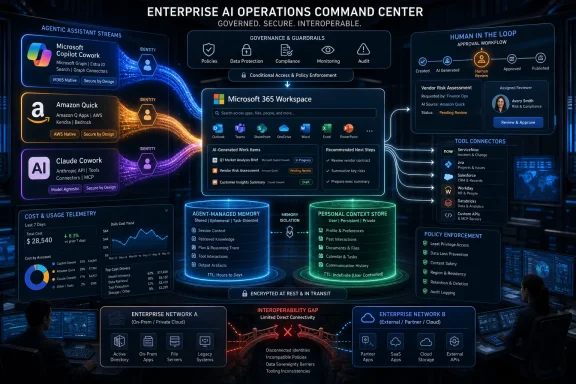 Enterprise AI Is Moving From Prompt Box to Work Surface
The most important shift in the Forbes/Moor Insights analysis is not the naming of winners and laggards. It is the framing: enterprise agentic assistants are being judged as infrastructure, not as novelty software.That is a higher bar than the one applied to the first generation of workplace copilots. A chatbot can answer questions, summarize documents, or draft emails. An agentic assistant is expected to plan across applications, remember context, use tools, invoke workflows, and take action with enough continuity that the employee begins to treat it as an operating layer for work.
That is why Claude Cowork appears in the analysis as the benchmark rather than as just another competitor. According to the Forbes piece, Claude Cowork put the agentic architecture behind Claude Code into a desktop app, gave it access to a designated local folder, and allowed users to extend it with “skills” and custom MCP connectors. That combination gave power users something closer to a programmable colleague than a static assistant.
But the same traits that make Claude Cowork compelling for power users make it difficult to scale across a conventional enterprise. Local folder access, hand-built context, custom connectors, and maintained skills reward the kind of employee who already curates a personal knowledge system. The author describes his own “second brain” as living in Obsidian, which is telling: the workflow assumes a level of intentional information gardening that most employees will not perform and most CIOs will not want to govern one user at a time.
Microsoft and Amazon are betting that the enterprise version of this market will not be won by the most configurable tool. It will be won by the assistant that captures most of the value of a power-user setup while removing the setup burden and adding the governance controls that corporate IT requires.
That is the central tension of Gen One. The products need to be capable enough to feel agentic, but bounded enough to be deployable. They need memory, but not a privacy nightmare. They need context, but not uncontrolled data exfiltration. They need extensibility, but not the return of ungoverned macros, scripts, shadow SaaS, and citizen-developer sprawl under a shinier AI label.
Claude Cowork Sets the Bar by Showing What Enterprises Cannot Simply Copy
The Forbes analysis starts with Claude Cowork for a reason. It is the clearest example of what an agentic assistant can feel like when the user is technically capable, highly motivated, and willing to maintain the surrounding system.The phrase “Claude-ification of the enterprise” captures the market response. Large software vendors are not merely adding AI sidebars. They are building look-alike desktop or workspace agents that borrow from the Claude Cowork pattern: persistent assistant, tool access, context, connectors, and a path toward delegated work.
Claude Cowork’s strength is its closeness to the user’s actual working material. A designated local folder gives the assistant a concrete operating zone. Skills and custom MCP connectors let users expand what the assistant can do. The result is powerful precisely because it is not trapped inside a single vendor’s default application graph.
That openness is also the ceiling. In a large organization, local context is messy. Users put regulated data in the wrong place, duplicate stale versions, forget what a connector can see, and abandon carefully designed workflows when the next urgent project arrives. The more capable the assistant becomes, the more every rough edge in that personal setup becomes a governance risk.
The enterprise answer is therefore not simply “give everyone Claude Cowork.” It is to rebuild the useful parts of the model inside a managed plane: provisioning, policy, data protection, memory controls, approved connectors, and cost tracking. That is where Microsoft Copilot Cowork and Amazon Quick enter the story.
The comparison also explains why Windows administrators should care. On Windows desktops, agentic assistants will not look like traditional line-of-business apps. They will sit beside the user, observe work patterns, reach into productivity suites, pull from stores of files and notes, and increasingly mediate workflows. That makes them closer to endpoint-adjacent infrastructure than ordinary software.
Microsoft Turns Microsoft 365 Into the Agent’s Home Field
Microsoft Copilot Cowork is the most direct enterprise response described in the Forbes analysis. Announced in March with Anthropic’s help and made generally available in June, Copilot Cowork brings agentic, cross-app automation into Microsoft 365.That positioning is exactly what makes it powerful. Microsoft does not need to recreate the enterprise desktop from scratch. It already owns a massive share of the knowledge-work substrate: identity, email, calendar, documents, collaboration, compliance tooling, and administrative controls. Copilot Cowork’s natural advantage is that it can sit inside the Microsoft 365 environment where many organizations already store the work.
The Forbes analysis identifies Copilot Cowork as strongest on flexibility and data protection. On model choice, the product can route between Claude and OpenAI models depending on entitlement, with a Copilot Cowork-specific model on the way. That is a meaningful distinction because enterprise AI buyers increasingly do not want one model relationship to become an architectural prison.
Microsoft also claims 30% to 40% consumption savings versus Claude when using the Microsoft 365 connector. The Forbes author treats that as plausible because Microsoft owns more of the stack, but stops short of accepting it as proven without real-world customer financials. That is the right posture. AI consumption economics are especially vulnerable to vendor-friendly math because task complexity, retry behavior, connector use, and user adoption can change the bill dramatically.
The more strategic point is that Microsoft is trying to convert Microsoft 365’s incumbency into agentic leverage. If the assistant can operate across Microsoft 365 applications with lower friction, better policy inheritance, and cheaper consumption through the Microsoft 365 connector, then the productivity suite becomes not just a place where work happens but the default action surface for AI.
For WindowsForum readers, that matters because it changes how Microsoft 365 should be evaluated. A tenant is no longer merely a bundle of apps and storage. It is becoming the permissioned environment in which agents will read, reason, and act. The assistant inherits the quality of the tenant: its identity hygiene, data labels, access boundaries, retention rules, and connector discipline.
Microsoft’s Trade-Off Is Control Over Local Power
The Forbes analysis is equally clear about Copilot Cowork’s limitations. It is cloud-only, has no local file system, and has an unclear story for personal context. Its pricing is layered, requiring a Microsoft 365 Copilot license plus consumption charges on top.Those choices are not incidental. They are the enterprise bargain in its purest form: Microsoft gives administrators a contained, provisioned experience with familiar governance controls, but it does not offer the same local-file intimacy that makes power-user tools feel so capable. For many CIOs, that is not a flaw. It is the reason the product can be discussed seriously.
A cloud-only design means Microsoft can keep the assistant inside a managed service boundary. No local file system means fewer unpredictable interactions with unmanaged folders, personal caches, and endpoint-specific storage habits. Provisioning through Agent 365 and Work IQ gives Microsoft a backend control plane rather than relying on each user’s desktop configuration.
But the cost is real. Many knowledge workers do not live entirely inside cleanly governed cloud repositories. They have local drafts, exported CSVs, niche application outputs, screenshots, downloaded PDFs, and project folders that never quite make it into the sanctioned information architecture. A cloud-only assistant may be safer, but it may also be less aware of the messy reality of work.
That gap creates a predictable split in user sentiment. Security teams and Microsoft 365 administrators may prefer the contained model. Power users who have tasted local agentic workflows may see it as constrained. Business leaders may ask why the enterprise product costs more yet appears to do less in certain hands-on scenarios.
The answer is that enterprise software often sells control first and magic second. Copilot Cowork’s pitch is not that it will be the most liberating assistant for a technically sophisticated individual. It is that it can deliver agentic automation across Microsoft 365 without forcing the organization to bless an open-ended tool running across local files and arbitrary connectors.
Amazon Quick Takes the Product-Centric Route
Amazon Quick, AWS’s entry, represents a different philosophy. According to the Forbes analysis, AWS shipped Quick in late 2025 and continues to extend it. Where Microsoft leans on a backend platform, Amazon centralizes provisioning inside Quick itself.That distinction may sound architectural, but it reveals a strategic difference. Microsoft’s advantage is the surrounding Microsoft 365 estate, so it can place the assistant inside a broader administrative and productivity platform. Amazon’s advantage is its cloud and AI platform credibility, so Quick has to make more of the enterprise-assistant experience feel coherent inside the product.
The Forbes piece credits Quick with treating memory and the personal context store as two separate constructs. That is one of the most important product decisions in the category. Memory and context are often blurred in AI marketing, but they are not the same thing.
Memory is agent-managed. It learns from sessions, artifacts, work patterns, and recurring interactions. A personal context store is user-controlled, more like a curated database of relevant material. Quick’s personal knowledge graph serves as the agent-managed memory, learning the user’s role, priorities, and relationships across sessions. Connected knowledge bases give users a curated store for files and external sources.
That separation is crucial because it maps to how enterprises will need to govern these systems. Agent memory raises questions about inference, profiling, worker privacy, and explainability. Context stores raise questions about data classification, source reliability, access control, and lifecycle management. Treating them as separate constructs gives administrators and product designers a better chance of applying the right controls to each.
The Forbes analysis also notes that AWS-cited deployments are planned across more than 100,000 seats at some customers. That is a large enough commitment to suggest that Quick is not merely a lab curiosity. But the article also withholds comparative usability judgment because the author had hands-on time with Quick but not yet with Copilot Cowork. That caveat matters. Enterprise AI demos can look deceptively similar until real users run real workflows through them.
The First Generation Is Already Splitting Into Three Models
The emerging market is not one product category so much as three competing assumptions about how agentic work should be packaged.Claude Cowork represents the power-user model. It is closest to the local, configurable, extensible assistant that rewards users who build and maintain their own context. Its ceiling is high, but its enterprise manageability is harder.
Microsoft Copilot Cowork represents the suite-native governance model. It bets that the safest and most scalable place for enterprise agents is inside Microsoft 365, backed by Agent 365 and Work IQ, with model choice between Claude and OpenAI models depending on entitlement and a Copilot Cowork-specific model on the way.
Amazon Quick represents the product-centric enterprise assistant. It centralizes provisioning in the product, separates memory from context, uses a personal knowledge graph for agent-managed memory, and offers connected knowledge bases for user-curated files and external sources.
| Product | Core bet | Provisioning model | Memory and context | Flexibility | Main trade-off |
|---|---|---|---|---|---|
| Claude Cowork | Power-user agentic desktop | User-configured around local workflows | Designated local folder plus user-maintained context | Skills and custom MCP connectors | Powerful but harder to standardize for most employees |
| Microsoft Copilot Cowork | Agentic automation inside Microsoft 365 | Backend platforms: Agent 365 and Work IQ | Cloud-only, no local file system, personal context story unclear | Claude and OpenAI models depending on entitlement; Copilot Cowork-specific model forthcoming | Strong governance, but less local-file power and layered pricing |
| Amazon Quick | Enterprise assistant built into its own product experience | Centralized inside Quick itself | Personal knowledge graph plus connected knowledge bases | Expected to evolve toward broader model choice, according to the Forbes author’s hope | Promising structure, but comparative usability remains unproven |
That means procurement decisions will not be purely technical. They will reflect where an organization believes work should live, who should control the assistant, how much local autonomy is tolerable, and whether AI cost should be absorbed into a productivity-suite strategy or managed as a cloud consumption discipline.
Timeline
Late 2025 — AWS shipped Amazon Quick, its entry in the enterprise agentic assistant category.March 2026 — Microsoft announced Copilot Cowork with Anthropic’s help.
June 2026 — Microsoft made Copilot Cowork generally available.
July 8, 2026 — Forbes published the Moor Insights analysis sizing up Microsoft Copilot Cowork, Amazon Quick, and Claude Cowork as early enterprise agentic assistants.
The Real Contest Is Over Memory, Not Chat
The Forbes analysis is strongest when it separates ordinary AI assistant features from the infrastructure required to make agents useful over time. The most important of those is memory.A chatbot with no memory is a transaction. An assistant with memory becomes a relationship. The longer it works with a user, the more valuable it can become — and, as the Forbes author notes, the harder it becomes to replace.
That creates an enterprise lock-in problem hiding inside a productivity feature. If a user’s agent learns their role, priorities, relationships, recurring tasks, project history, and preferred artifacts, then switching assistants becomes more like changing operating systems than changing apps. The user does not merely lose an interface. They lose accumulated working context.
The Forbes piece argues that vendors need mechanisms to make memory, context stores, and artifacts mobile. It compares this need to MCP making tools portable. That analogy is useful because tool portability solved one layer of the agent problem: how assistants connect to capabilities. Memory portability is harder because it concerns what the assistant has learned about a person and their work.
For enterprises, the question becomes who owns the employee’s agentic memory. Is it the user, the employer, the vendor, or some governed container that can move between assistants? What happens when an employee changes roles, leaves the company, moves to another department, or invokes privacy rights under a local regulation? What happens when an agent’s memory contains inferred priorities or relationship maps that the employee never explicitly wrote down?
Amazon Quick’s separation of a personal knowledge graph and connected knowledge bases is one attempt to make this architecture legible. Microsoft’s story is less clear in the Forbes analysis, at least for personal context. Claude Cowork’s power-user approach is more direct but less enterprise-contained.
This is why “second brain” language is both compelling and dangerous. A second brain sounds empowering when it belongs to an individual. It sounds like a compliance review waiting to happen when deployed across a multinational workforce without clear retention, mobility, inspection, and deletion controls.
Pricing Is the Governance Problem Finance Will Actually Notice
AI pricing has a way of turning architecture into budget shock. The Forbes analysis calls out pricing as one of the Gen One gaps because per-user licenses, consumption fees, and variable task costs make spend hard to forecast.Copilot Cowork is the cleanest example because its pricing structure is explicitly layered: a Microsoft 365 Copilot license plus consumption charges on top. That does not make it unreasonable. In fact, for many enterprises, layered pricing may be acceptable if the product reduces shadow AI, improves productivity, and uses existing Microsoft 365 governance. But it does make planning harder.
Consumption pricing is especially tricky for agentic assistants because the unit of value is not always obvious. A short user request might trigger multiple tool calls, cross-app retrieval, model routing, retries, summarization, and workflow actions. A long prompt might be cheap if it stays inside a narrow context. The invoice does not necessarily map cleanly to the employee’s perception of effort.
Microsoft’s claimed 30% to 40% consumption savings versus Claude when using the Microsoft 365 connector is therefore important but not decisive. The Forbes author’s caution is the point: customers need to see those savings in their own financial analyses before treating them as fact. A connector advantage in one workflow can disappear in another if the assistant requires more calls, more retries, or more expensive model routing.
Amazon Quick faces the same broader challenge even though the source analysis emphasizes its architecture more than its pricing specifics. The more useful an agent becomes, the more employees will delegate to it. The more they delegate, the more consumption volatility appears. Success can become the source of budget pain.
For IT leaders, the practical response is to treat cost governance as part of the pilot design, not as a procurement afterthought. A pilot that measures satisfaction but not task-level consumption is incomplete. A rollout that enables broad use without spending thresholds, reporting, and workflow analysis is asking finance to discover the architecture after the invoice arrives.
“Human in the Loop” Is Not a Control If the Human Is Guessing
The Forbes analysis takes direct aim at one of the laziest phrases in enterprise AI: “human in the loop.” The author argues that it is too often a notification that can be ignored rather than an effective control point.That criticism deserves more attention than it usually gets. A human approval step sounds reassuring in a vendor deck. In production, it can become a rubber stamp if the approver lacks the context to understand the risk, the authority to challenge the recommendation, or the time to inspect the chain of reasoning.
Agentic assistants make this worse because the action may be the result of multiple hidden steps. An assistant might retrieve documents, summarize a policy, prepare a response, update a record, route a task, and ask for approval only at the end. If the human sees only the final recommendation, the loop is ceremonial.
Meaningful intervention requires infrastructure. The approver needs to see what data was used, what tools were invoked, what policy applies, what changed since the last approval, what confidence or uncertainty exists, and what the blast radius of approval might be. That is not a checkbox. It is an observability and workflow-design problem.
This is where Windows and Microsoft 365 administrators should resist simplistic rollout narratives. If Copilot Cowork or any comparable assistant can act across applications, then approval workflows must be tested as workflows, not slogans. Who gets alerted? What do they see? Can they reject, modify, or escalate? Is the decision logged? Can an auditor reconstruct the chain later?
The answer cannot be “the user approved it” if the user had no meaningful way to evaluate it. Enterprises learned this lesson with access approvals, phishing prompts, macro warnings, and endless security dialogs. Users click through prompts that interrupt their work unless the prompt is specific, contextual, and consequential.
Interoperability Is the Dream; Lock-In Is the Default
The Forbes analysis identifies cross-vendor interoperability as another Gen One gap. Standards like A2A look good on paper, it notes, but production hand-offs between agents from different vendors remain largely unproven.This is the issue that will matter most in multi-vendor enterprises. A Microsoft-heavy organization may still run AWS workloads, Salesforce workflows, ServiceNow processes, industry-specific applications, and custom internal systems. An Amazon-centered cloud strategy may still depend on Microsoft 365 for everyday knowledge work. No serious enterprise is a single-vendor fairy tale.
In theory, agents should hand work to one another across boundaries. A Microsoft 365 assistant might coordinate with an AWS-oriented assistant that understands cloud operations. A support agent might pass structured context to a finance agent. A project-management assistant might invoke a domain-specific model maintained by a business unit.
In practice, every hand-off is a trust problem. What context is shared? Which agent is authoritative? How are permissions translated? Which audit log records the decision? What happens when two agents disagree? How does the organization prevent one assistant from becoming a laundering mechanism for data that another assistant should not see?
MCP helps make tools portable, but tool access is not the same as workflow interoperability. A connector can expose a capability. It does not automatically define shared memory, delegated authority, policy inheritance, or accountability across vendors.
That is why Gen One assistants will likely deepen existing platform gravity before they produce true cross-vendor fluidity. Microsoft will be strongest where Microsoft 365 is the system of work. Amazon will be strongest where AWS-centered architecture and product-level assistant design matter. Claude Cowork will remain attractive where individual expertise and local configurability trump centralized governance.
Enterprises should assume lock-in by default and negotiate accordingly. If memory, context stores, skills, connectors, and workflow artifacts cannot move, then the assistant is not just a tool. It is an accumulating dependency.
Sprawl Is Coming Back Wearing an AI Badge
The Forbes analysis closes its gap list with sprawl and evaluation, and that may be the most familiar risk of all. The same no-code ease that drives adoption can recreate the old citizen-developer problems: security drift, abandoned workflows, duplicated logic, undocumented dependencies, and technical debt that nobody owns.Agentic assistants could intensify that pattern because they make automation easier to create and harder to see. A spreadsheet macro announces itself as a file with code. A no-code workflow usually lives in a platform inventory. An agentic instruction, skill, connector, or memory-driven behavior may be more diffuse.
The encouraging sign, according to the Forbes analysis, is that AI can help police what AI builders are doing through agent simulation, anomaly detection, and better observability. That is the right direction. If agents can generate workflows, other agents may be needed to test, monitor, and stress them.
Agent simulation could help organizations understand how an assistant behaves before exposing it to real users or sensitive systems. Anomaly detection could flag unusual access patterns, unexpected connector use, or behavior that deviates from established workflow norms. Better observability could make agent activity inspectable rather than mystical.
But none of that is automatic. Observability has to be designed into the deployment. Simulation has to be tied to policy. Anomaly detection has to produce actionable findings rather than another alert stream that administrators learn to ignore.
This is where Microsoft’s governance story may appeal to existing Windows and Microsoft 365 shops, while Amazon’s product-level memory architecture may appeal to teams seeking a cleaner conceptual model. In both cases, however, the burden remains on the enterprise to define what acceptable agent behavior looks like.
Action checklist for admins
- Inventory where knowledge work actually lives before piloting an agentic assistant: Microsoft 365, local folders, cloud drives, line-of-business apps, exported files, and external knowledge sources.
- Decide whether local file access is acceptable, restricted, or off-limits for your organization’s first agentic rollout.
- Separate evaluation of memory from evaluation of personal context stores; they create different privacy, retention, and access-control risks.
- Require cost telemetry during pilots, especially for products with per-user licensing plus consumption charges.
- Test approval workflows with real scenarios to confirm that “human in the loop” controls give approvers enough context to make meaningful decisions.
- Build an exit plan for memory, context stores, connectors, skills, and workflow artifacts before a single assistant becomes deeply embedded.
Windows Shops Should Read This as a Platform Warning
For WindowsForum’s audience, the immediate temptation is to treat this as a cloud productivity story. That is too narrow. Agentic assistants will land in the same organizations that already struggle with endpoint management, identity hygiene, shadow IT, data labeling, browser extensions, SaaS permissions, and Teams sprawl.Copilot Cowork’s cloud-only design and lack of local file system access may reduce some endpoint risks, but it does not remove the endpoint from the story. The user still initiates work from a Windows device. The assistant still interacts with the user’s applications and organizational data. The quality of the experience still depends on identity, device trust, access policy, and the hygiene of the underlying Microsoft 365 environment.
Organizations with messy permissions will get messy agents. If too many users can access too many SharePoint sites, Teams channels, mailboxes, or shared documents, an assistant may simply make that overexposure more usable. AI does not fix broken access models; it can accelerate their consequences.
The same applies to data quality. An agent that retrieves stale policies, duplicate project files, conflicting spreadsheets, and unlabeled sensitive documents may produce polished nonsense. The assistant’s tone may be confident even when the enterprise substrate is chaotic.
That is why readiness work matters. Before asking whether Copilot Cowork, Quick, or Claude Cowork is “better,” IT leaders should ask whether their environment is ready for any assistant to reason across it. The uncomfortable answer in many organizations will be no.
The Enterprise Assistant Buyer Now Has to Think Like an Architect
The Forbes/Moor Insights framework identifies four capabilities that separate serious enterprise assistants from souped-up chatbots: centralized provisioning, memory and personal context stores, flexibility, and data protection. That is a useful starting point because it forces buyers to evaluate the operating model, not just the demo.Centralized provisioning determines whether agents, skills, flows, and artifacts can be distributed and version-controlled. Without it, every successful pilot risks becoming an island. With it, administrators at least have a path to scale.
Memory and personal context stores determine whether the assistant improves over time without becoming an ungoverned surveillance layer. The distinction between agent-managed memory and user-controlled context is not academic. It shapes privacy reviews, retention policies, discovery obligations, and employee trust.
Flexibility determines whether the organization can adapt as models, connectors, and domain-specific AI systems evolve. Microsoft’s current model choice between Claude and OpenAI models, depending on entitlement, is notable here. The forthcoming Copilot Cowork-specific model also suggests that vendors will tune models for the assistant layer itself, not merely plug general models into enterprise shells.
Data protection determines whether the assistant leaves pilot purgatory. Security, sovereignty, language guardrails, and worker-privacy protections are not post-launch features. They are the permission structure for deployment.
This is where the first generation’s limitations become useful. They show what must be asked before the market hardens. Can memory move? Can context stores be exported? Can connectors be audited? Can costs be predicted? Can approvals be reconstructed? Can one vendor’s agent safely hand work to another’s?
If the answer is no, the organization is not buying an assistant. It is accepting a dependency and hoping the vendor’s roadmap catches up.
The Practical Read for 2026 Rollouts
The most concrete lesson from the Forbes analysis is that Microsoft and Amazon have credible first entries, but neither eliminates the need for disciplined deployment. The products are serious enough to pilot and limited enough to demand guardrails.- Microsoft Copilot Cowork is the most natural fit for Microsoft 365-centered organizations that value governance, model choice, and cross-app automation over local-file power.
- Amazon Quick is notable for separating agent-managed memory from user-curated context through a personal knowledge graph and connected knowledge bases.
- Claude Cowork remains the power-user benchmark, especially for users willing to maintain local context, skills, and custom MCP connectors.
- Cost forecasting remains immature because licenses, consumption charges, and task variability do not map neatly to headcount.
- “Human in the loop” should be treated as a workflow-control design problem, not a reassuring phrase.
- Memory portability and cross-vendor interoperability are unresolved enough that lock-in should be assumed during procurement.
References
- Primary source: Forbes
Published: 2026-07-08T15:50:08.451567
Sizing Up The First Generation Of Enterprise Agentic Assistants
Agentic assistants are changing knowledge work through a “Claude-ification” trend that is now coming to desktop agents for non-coders. But significant gaps remain.www.forbes.com
