

Microsoft’s latest Copilot research update is less about a flashy consumer-facing gimmick and more about a strategic shift in how enterprise AI is built. The new Critique and Council features are designed to make Copilot better at research by using multiple models in structured roles instead of relying on a single model to do everything. That matters because the biggest weakness in workplace AI has never been speed; it has been confidence without verification. If Microsoft’s approach works as advertised, it could mark a meaningful step toward more reliable AI workflows inside Microsoft 365.
For the past two years, the AI industry has largely treated “one prompt, one answer” as the default interaction model. That was fine for drafting emails, summarizing notes, and answering straightforward questions, but it quickly showed limits when users asked for deeper research, cross-checking, or multi-step reasoning. Microsoft’s new Copilot direction reflects a broader realization that serious work needs separation of duties: one model to generate, another to critique, and sometimes a third to compare.
This is not happening in a vacuum. Microsoft has spent much of 2025 and early 2026 turning Copilot from a chat box into an agentic platform with Researcher, tasks, workflows, and more structured orchestration. The company has also publicly emphasized that Copilot is evolving from a system that answers questions into one that can execute multi-step work with user control points. That framing is important because it reveals the real goal: not just better summaries, but a more credible operating layer for knowledge work.
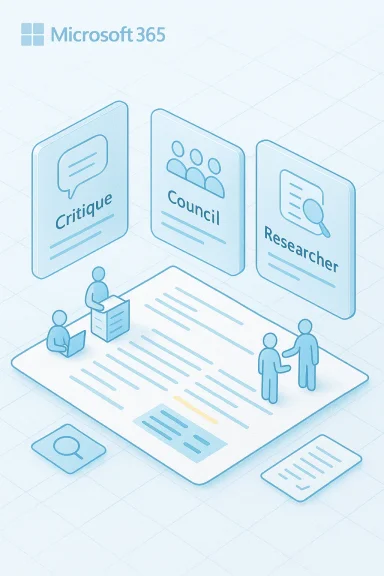
Against that backdrop, Critique and Council look like the next logical move. Critique is the more editorial of the two, pairing a generator with a reviewer that checks sources, weak claims, and structure. Council is more like a panel discussion, where two models answer the same prompt independently before a judge model reconciles the differences. The immediate appeal is obvious: if one model misses an angle, another may catch it; if one produces a thin answer, the second can force rigor.
What makes the feature set especially interesting is the model-agnostic posture Microsoft is leaning into. The company’s own communications and related Copilot updates show an increasing willingness to orchestrate Anthropic and OpenAI models together when that produces better outcomes. That is a notable industry signal. Instead of insisting that a single model family should win every task, Microsoft is betting that the best product experience may come from coordination rather than model purity.
That evolution mirrors what users have learned the hard way. Single-model systems are fast, but they can be overconfident, inconsistent, or shallow when the task demands nuance. A research workflow needs source selection, claim testing, structural review, and sometimes contradiction analysis. Microsoft’s answer is to push Copilot toward a pipeline model, where the machine is less like a chatbot and more like a small editorial desk.
The timing is also politically and commercially smart. Microsoft has been positioning Copilot as the AI layer for Microsoft 365, while also showcasing enterprise safety, governance, and controlled deployment. The company’s internal and public messaging around Copilot adoption repeatedly stresses trust, communication, and practical workplace value. That is why a feature like Critique fits so neatly into the product story: it addresses the most common complaint about AI in the enterprise, which is not that it is unavailable, but that it is not dependable enough for high-stakes work.
This is also a response to the industry’s broader benchmarking problem. Benchmarks can show gains in controlled environments, but customers care about whether the final output is usable. Microsoft says it evaluated Critique on the DRACO benchmark, a set of 100 complex research tasks, and reported improvements in depth, presentation quality, and factual accuracy. The broader significance is not the number itself, but the fact that Microsoft is trying to measure a workflow architecture rather than a single model’s raw intelligence.
The point is not just to make the report prettier. It is to make the content more defensible. When a reviewer model checks a draft, it can press on missing evidence, vague claims, weak transitions, and coverage gaps. In practical terms, that means the final output should be less likely to contain the kind of polished but hollow prose that often passes as “good enough” in many AI systems.
Microsoft’s description of the system suggests that it is trying to optimize for both analytical rigor and readability. That matters because workplace users do not only want facts; they want the facts presented in a form they can share with leadership, clients, or teammates. If Critique can genuinely improve that transition from raw findings to polished deliverable, it may become one of Copilot’s most valuable enterprise features.
It also creates a softer version of editorial independence. The reviewer can challenge the writer without needing a human to manually ask for every correction. In a newsroom or analyst team, that kind of internal tension is what produces stronger copy. Microsoft appears to be trying to bottle that workflow into a repeatable AI pattern.
That matters because not every problem is best solved by one model “correcting” another. Sometimes the right move is to preserve competing interpretations long enough to inspect them. Council seems designed for precisely that kind of task: when the user wants not only an answer, but also an understanding of where different models agree, disagree, or emphasize different angles.
In practice, Council could be especially useful for ambiguous, policy-heavy, or strategy-oriented research. A single answer can hide uncertainty, while a comparison format can make uncertainty visible. That is a subtle but important shift, because mature enterprise workflows often care less about a neat single verdict and more about the range of plausible interpretations.
This approach also has a trust benefit. Users who are skeptical of AI often want to know not just what the system said, but whether the system considered alternatives. Council offers a way to show the work, at least in part. That could be particularly compelling for researchers, consultants, and policy teams who need to defend their reasoning rather than simply provide a conclusion.
Benchmarks are useful, but they are not reality. They can measure whether a system performs well on a defined task set, yet they cannot fully capture how messy real enterprise research becomes when documents are incomplete, requests are ambiguous, or the answer depends on context hidden inside a company’s own data. Even so, a benchmark win matters because it shows the architecture is promising enough to outperform simpler single-model baselines in controlled settings.
The more interesting question is whether the gain is durable under pressure. A model that looks better on benchmarked research tasks may still struggle when users ask follow-up questions, need citations from internal documents, or require judgment under uncertainty. That is why Critique should be seen as a step forward, not a finish line.
That is an important distinction because AI product quality is often determined less by heroic benchmark performance and more by the rate of annoying failures. If Critique reduces the number of weak claims, missing sections, and odd structural jumps, it may be more valuable than a headline score suggests. If not, the feature will still be impressive, but only in the abstract.
This matters competitively because Microsoft is in the middle of an arms race with Google, OpenAI-native products, and an expanding ecosystem of enterprise AI vendors. Each wants to own the productivity layer. Microsoft’s advantage is distribution through Microsoft 365, but distribution alone is not enough if the AI experience feels generic. Multi-model orchestration gives Microsoft a way to differentiate Copilot as a serious work engine rather than just another chat interface.
There is also a subtle strategic hedge here. By orchestrating models from different frontier labs, Microsoft reduces the risk of tying its entire enterprise story to a single model family. That is commercially smart. It allows the company to optimize for task quality and customer trust rather than ideological purity about one model stack.
That shift would benefit Microsoft’s platform strategy, because Copilot is already embedded in the apps where work happens. If the AI layer becomes an orchestration layer, Microsoft can make the case that productivity software should not just host AI but coordinate it. That is a more durable competitive position than selling a single chatbot experience.
For consumers, the value proposition is less immediate. Most casual users want fast answers, not multi-step research pipelines. That does not mean the features are irrelevant outside the enterprise, but it does mean their impact will likely be indirect at first. Consumers may eventually benefit from the same orchestration ideas as the underlying Copilot experience improves, but the headline use case is clearly workplace productivity.
There is also an organizational psychology angle. Enterprise users are more likely to forgive extra steps if those steps produce trust. Consumer users are more likely to abandon a feature if it feels slower than simply asking a direct question. Microsoft will need to balance sophistication with usability if it wants these tools to scale beyond power users.
That is why this update could matter most in organizations with formal review chains. The more a company depends on structured sign-off, the more value it will place on AI that can self-check before a human even sees the output.
The best opportunities are not just technical; they are operational. If Microsoft can make Critique and Council default behaviors for difficult research tasks, Copilot could become meaningfully more valuable than a generic chatbot.
There is also a cost and complexity problem. More models, more orchestration, and more review steps can mean more latency, more resource use, and more opportunities for failure in edge cases.
If the company keeps building in this direction, the next wave of Copilot innovation may look less like a series of chat improvements and more like a set of specialized roles working in concert. That is where the product starts to resemble a digital staff rather than a chatbot, and that shift could redefine the expectations buyers have for enterprise AI.
Source: news9live.com Microsoft Copilot Critique and Council AI features explained
 Overview
For the past two years, the AI industry has largely treated “one prompt, one answer” as the default interaction model. That was fine for drafting emails, summarizing notes, and answering straightforward questions, but it quickly showed limits when users asked for deeper research, cross-checking, or multi-step reasoning. Microsoft’s new Copilot direction reflects a broader realization that serious work needs separation of duties: one model to generate, another to critique, and sometimes a third to compare.This is not happening in a vacuum. Microsoft has spent much of 2025 and early 2026 turning Copilot from a chat box into an agentic platform with Researcher, tasks, workflows, and more structured orchestration. The company has also publicly emphasized that Copilot is evolving from a system that answers questions into one that can execute multi-step work with user control points. That framing is important because it reveals the real goal: not just better summaries, but a more credible operating layer for knowledge work.
Against that backdrop, Critique and Council look like the next logical move. Critique is the more editorial of the two, pairing a generator with a reviewer that checks sources, weak claims, and structure. Council is more like a panel discussion, where two models answer the same prompt independently before a judge model reconciles the differences. The immediate appeal is obvious: if one model misses an angle, another may catch it; if one produces a thin answer, the second can force rigor.
What makes the feature set especially interesting is the model-agnostic posture Microsoft is leaning into. The company’s own communications and related Copilot updates show an increasing willingness to orchestrate Anthropic and OpenAI models together when that produces better outcomes. That is a notable industry signal. Instead of insisting that a single model family should win every task, Microsoft is betting that the best product experience may come from coordination rather than model purity.
Background
Microsoft has been laying the groundwork for this transition for months. Earlier Copilot updates emphasized agentic task execution, enterprise governance, and research features that could pull from internal and external sources. The company’s February 2026 Copilot update also highlighted a growing split between creation workflows and in-app editing workflows, which reinforced the idea that different stages of work need different AI behaviors. In other words, Microsoft has been steadily decomposing the “assistant” into a series of more specialized capabilities.That evolution mirrors what users have learned the hard way. Single-model systems are fast, but they can be overconfident, inconsistent, or shallow when the task demands nuance. A research workflow needs source selection, claim testing, structural review, and sometimes contradiction analysis. Microsoft’s answer is to push Copilot toward a pipeline model, where the machine is less like a chatbot and more like a small editorial desk.
The timing is also politically and commercially smart. Microsoft has been positioning Copilot as the AI layer for Microsoft 365, while also showcasing enterprise safety, governance, and controlled deployment. The company’s internal and public messaging around Copilot adoption repeatedly stresses trust, communication, and practical workplace value. That is why a feature like Critique fits so neatly into the product story: it addresses the most common complaint about AI in the enterprise, which is not that it is unavailable, but that it is not dependable enough for high-stakes work.
Why multi-model orchestration matters
The rise of multi-model orchestration is partly technical and partly behavioral. Technically, different models have different strengths: one may be better at synthesis, another at spotting missing context, another at comparing alternatives. Behaviorally, humans already work this way. We draft, review, edit, and compare sources before we publish. Microsoft is effectively translating that editorial process into software.This is also a response to the industry’s broader benchmarking problem. Benchmarks can show gains in controlled environments, but customers care about whether the final output is usable. Microsoft says it evaluated Critique on the DRACO benchmark, a set of 100 complex research tasks, and reported improvements in depth, presentation quality, and factual accuracy. The broader significance is not the number itself, but the fact that Microsoft is trying to measure a workflow architecture rather than a single model’s raw intelligence.
- Generation alone is no longer enough for serious research.
- Review layers can expose weak evidence and missing angles.
- Comparison workflows help surface disagreement instead of hiding it.
- Enterprise buyers care more about consistency than novelty.
- Structured AI is becoming more important than merely conversational AI.
What Critique is designed to do
Critique is best understood as an AI drafting system with an embedded editor. One model handles task planning, information gathering, and the first pass at the report. A second model then reviews that output using rubric-based evaluation, checking whether the answer is well sourced, complete, and logically organized. That design mimics a professional publishing workflow, which is why it feels intuitively familiar even if the underlying implementation is highly complex.The point is not just to make the report prettier. It is to make the content more defensible. When a reviewer model checks a draft, it can press on missing evidence, vague claims, weak transitions, and coverage gaps. In practical terms, that means the final output should be less likely to contain the kind of polished but hollow prose that often passes as “good enough” in many AI systems.
Microsoft’s description of the system suggests that it is trying to optimize for both analytical rigor and readability. That matters because workplace users do not only want facts; they want the facts presented in a form they can share with leadership, clients, or teammates. If Critique can genuinely improve that transition from raw findings to polished deliverable, it may become one of Copilot’s most valuable enterprise features.
A reviewer model changes the product dynamic
A reviewer layer is more than a quality-control trick. It changes the entire product dynamic by making the AI answer less final and more iterative. The first model can take risks and generate breadth, while the second can force discipline and structure. That split is especially useful in research, where the cost of missing an angle is often higher than the cost of spending an extra few seconds reviewing.It also creates a softer version of editorial independence. The reviewer can challenge the writer without needing a human to manually ask for every correction. In a newsroom or analyst team, that kind of internal tension is what produces stronger copy. Microsoft appears to be trying to bottle that workflow into a repeatable AI pattern.
- First model: gathers and drafts.
- Second model: critiques and revises.
- Final output: more structured and evidence-aware.
- Net effect: fewer weak claims slipping through.
- Editorial discipline becomes part of the model stack.
Why Council is different
Council takes a more pluralistic approach. Instead of one model drafting and another critiquing, two models work in parallel on the same prompt and produce separate reports. A judge model then compares the outputs, identifies overlap and divergence, and produces a final synthesis. Conceptually, this is a lot closer to getting multiple expert opinions before making a decision.That matters because not every problem is best solved by one model “correcting” another. Sometimes the right move is to preserve competing interpretations long enough to inspect them. Council seems designed for precisely that kind of task: when the user wants not only an answer, but also an understanding of where different models agree, disagree, or emphasize different angles.
In practice, Council could be especially useful for ambiguous, policy-heavy, or strategy-oriented research. A single answer can hide uncertainty, while a comparison format can make uncertainty visible. That is a subtle but important shift, because mature enterprise workflows often care less about a neat single verdict and more about the range of plausible interpretations.
Comparison as a feature
The real innovation in Council is not parallelism by itself. It is the decision to make disagreement a first-class output. When two models produce different reports, the final synthesis can identify where each system is strong, where evidence is thin, and which framing appears more robust. That is useful in domains where nuance matters more than certainty.This approach also has a trust benefit. Users who are skeptical of AI often want to know not just what the system said, but whether the system considered alternatives. Council offers a way to show the work, at least in part. That could be particularly compelling for researchers, consultants, and policy teams who need to defend their reasoning rather than simply provide a conclusion.
- Parallel generation increases diversity of answers.
- A judge model can highlight why outputs differ.
- Visible disagreement can improve user trust.
- The synthesis can reduce model monoculture.
- Council is especially suited to complex or contested topics.
The DRACO benchmark and Microsoft’s claims
Microsoft says Critique was tested using the DRACO benchmark, which includes 100 complex research tasks across multiple domains. The company claims improvements in analytical depth, presentation quality, and factual accuracy, with an overall gain of about 13.88 percent over competing systems. Those are strong claims, and they deserve careful reading.Benchmarks are useful, but they are not reality. They can measure whether a system performs well on a defined task set, yet they cannot fully capture how messy real enterprise research becomes when documents are incomplete, requests are ambiguous, or the answer depends on context hidden inside a company’s own data. Even so, a benchmark win matters because it shows the architecture is promising enough to outperform simpler single-model baselines in controlled settings.
The more interesting question is whether the gain is durable under pressure. A model that looks better on benchmarked research tasks may still struggle when users ask follow-up questions, need citations from internal documents, or require judgment under uncertainty. That is why Critique should be seen as a step forward, not a finish line.
What benchmark wins do and do not prove
A benchmark can tell us that Microsoft’s orchestration approach has technical merit. It cannot, by itself, prove that every enterprise user will get better outcomes. The real test will be whether Copilot produces reports that people are willing to circulate without extensive cleanup.That is an important distinction because AI product quality is often determined less by heroic benchmark performance and more by the rate of annoying failures. If Critique reduces the number of weak claims, missing sections, and odd structural jumps, it may be more valuable than a headline score suggests. If not, the feature will still be impressive, but only in the abstract.
- Benchmarks validate architecture.
- Real workflows validate usefulness.
- User trust depends on fewer corrections.
- The gap between lab and enterprise still matters.
- Performance gains must translate into everyday reliability.
Why Microsoft is pushing multi-model AI now
Microsoft’s Copilot strategy increasingly reflects a broader industry truth: one model is not always the best tool for every step of knowledge work. The company has been moving toward agentic AI, workflow decomposition, and more explicit control points for users. Critique and Council fit that direction perfectly because they show AI becoming modular instead of monolithic.This matters competitively because Microsoft is in the middle of an arms race with Google, OpenAI-native products, and an expanding ecosystem of enterprise AI vendors. Each wants to own the productivity layer. Microsoft’s advantage is distribution through Microsoft 365, but distribution alone is not enough if the AI experience feels generic. Multi-model orchestration gives Microsoft a way to differentiate Copilot as a serious work engine rather than just another chat interface.
There is also a subtle strategic hedge here. By orchestrating models from different frontier labs, Microsoft reduces the risk of tying its entire enterprise story to a single model family. That is commercially smart. It allows the company to optimize for task quality and customer trust rather than ideological purity about one model stack.
Competitive implications
The competitive implications are significant. If Microsoft can prove that multi-model orchestration produces better research outputs, other vendors will be pressured to adopt similar patterns. That could turn the market away from “which model is smartest” and toward “which platform composes the best system.”That shift would benefit Microsoft’s platform strategy, because Copilot is already embedded in the apps where work happens. If the AI layer becomes an orchestration layer, Microsoft can make the case that productivity software should not just host AI but coordinate it. That is a more durable competitive position than selling a single chatbot experience.
- Microsoft gains a product-level differentiator.
- Rivals may need to match orchestration, not just model quality.
- Enterprise buyers may favor systems that show their work.
- Multi-model design could become a new baseline.
- Copilot’s value rises if it feels editorial, not merely generative.
Enterprise impact versus consumer impact
For enterprises, the appeal is straightforward. Critique and Council promise better research quality, more defensible outputs, and workflows that align with how teams already validate important work. In regulated industries, consulting, finance, public sector, and internal strategy teams, that can make a real difference. The ability to compare outputs or review them through a rubric may reduce the amount of human cleanup required before a document is shared.For consumers, the value proposition is less immediate. Most casual users want fast answers, not multi-step research pipelines. That does not mean the features are irrelevant outside the enterprise, but it does mean their impact will likely be indirect at first. Consumers may eventually benefit from the same orchestration ideas as the underlying Copilot experience improves, but the headline use case is clearly workplace productivity.
There is also an organizational psychology angle. Enterprise users are more likely to forgive extra steps if those steps produce trust. Consumer users are more likely to abandon a feature if it feels slower than simply asking a direct question. Microsoft will need to balance sophistication with usability if it wants these tools to scale beyond power users.
Who benefits most
The first adopters are likely to be people who already live inside documents, decks, and reports. They are the ones who feel AI shortcomings most acutely because their work is judged by detail, not flair. For them, a second-pass reviewer is not a nice-to-have; it is the difference between a usable draft and a liability.That is why this update could matter most in organizations with formal review chains. The more a company depends on structured sign-off, the more value it will place on AI that can self-check before a human even sees the output.
- Strategy teams benefit from deeper synthesis.
- Legal-adjacent workflows benefit from more caution.
- Research-heavy roles benefit from source scrutiny.
- Consumer users may see indirect gains later.
- Trust is the enterprise selling point.
Strengths and Opportunities
Microsoft’s move is strong because it aligns product design with how real work gets done. It also creates room for Copilot to stand out in a crowded market where many assistants still behave like polished autocomplete.The best opportunities are not just technical; they are operational. If Microsoft can make Critique and Council default behaviors for difficult research tasks, Copilot could become meaningfully more valuable than a generic chatbot.
- Better alignment with editorial and analytical workflows.
- More defensible outputs for internal sharing.
- A chance to reduce hallucination risk through review.
- Stronger differentiation inside Microsoft 365.
- Better fit for enterprise governance and review culture.
- More visible reasoning for users who want transparency.
- A path toward richer multi-agent workflows later.
Risks and Concerns
The biggest risk is false confidence. If the system produces a polished report, users may assume the underlying facts are solid even when the chain of evidence is incomplete. That risk is worse, not better, when the output looks professionally edited.There is also a cost and complexity problem. More models, more orchestration, and more review steps can mean more latency, more resource use, and more opportunities for failure in edge cases.
- Slower response times may frustrate users.
- More orchestration can mean more places for errors.
- Users may trust polished outputs too much.
- Multi-model systems can still converge on the same mistake.
- Enterprise admins may want clearer controls and governance.
- Feature complexity could overwhelm casual users.
- Model disagreement may confuse users if not explained well.
Looking Ahead
The real test for Critique and Council is not whether they sound smart in a demo, but whether they become the kind of features people rely on daily without thinking about the plumbing underneath. If that happens, Microsoft will have done something important: it will have made AI feel less like a prompt response engine and more like a managed research process. That is a much more credible vision for workplace AI.If the company keeps building in this direction, the next wave of Copilot innovation may look less like a series of chat improvements and more like a set of specialized roles working in concert. That is where the product starts to resemble a digital staff rather than a chatbot, and that shift could redefine the expectations buyers have for enterprise AI.
- Watch for broader rollout details and tenant controls.
- Watch for whether the features become available beyond research workflows.
- Watch for benchmark follow-up against real enterprise tasks.
- Watch for user feedback on speed versus accuracy.
- Watch for rivals adopting similar multi-model patterns.
Source: news9live.com Microsoft Copilot Critique and Council AI features explained
Last edited:
