

Microsoft is taking another big step in its enterprise AI strategy, and Hong Kong is one of the first markets to feel the impact. At the Microsoft AI Tour in Hong Kong on April 22, 2026, the company framed the next phase of Copilot adoption as a shift from experimentation to Frontier Success—a model where AI agents are embedded into daily operations, governed centrally, and expected to deliver measurable business outcomes. The announcement matters not just because it introduces new capabilities, but because it signals how Microsoft now wants enterprises to think about AI: not as a side project, but as operating infrastructure.
For much of the last two years, the dominant corporate AI story has been pilot programs, isolated proofs of concept, and cautiously scoped trials. Microsoft’s Hong Kong message suggests that phase is giving way to something more ambitious and much more consequential: agentic AI at scale. In that framing, AI agents are no longer assistants on the edge of the workflow; they are participants inside core processes, with defined permissions, controls, and accountability.
This is also a useful clue about where Microsoft believes the market is heading. The company has been pushing a broader Frontier Transformation narrative since at least its January 27, 2026 guidance from Judson Althoff, which described the next evolution of AI as one centered on business outcomes rather than experimentation. By March 9, Microsoft had crystallized that into the Frontier Suite concept and tied it directly to general availability of Agent 365 and the next wave of Microsoft 365 Copilot features. Hong Kong is now a regional showcase for that strategy.
The local significance is easy to understand. Hong Kong is a dense, highly regulated business environment with strong financial services, retail, logistics, and insurance sectors. Those are exactly the kinds of organizations that need AI to be productive without becoming unpredictable. Microsoft’s pitch is that it can provide both: Intelligence + Trust, a phrase the company has leaned on repeatedly as it extends Copilot into governed enterprise deployment.
That combination is why this announcement goes beyond product marketing. It is a statement about enterprise operating design. Microsoft is trying to sell the idea that the winners of the next AI phase will not simply be the organizations with the best prompts, but the ones that can embed agents into the business safely, consistently, and at scale.
The naming matters because it reflects a broader repositioning. Microsoft is not presenting Copilot as a standalone productivity feature anymore; it is folding Copilot into an enterprise-grade bundle that ties AI capabilities to the security and compliance stack customers already depend on. That bundle approach is meant to reduce the friction between enthusiasm for AI and fear of unmanaged agents. It is also an attempt to standardize how organizations buy, deploy, and govern these capabilities.
That is a powerful promise, but it also raises the bar. Context-aware automation is only useful if the underlying context is accurate, current, and appropriately scoped. If Work IQ works as described, it could meaningfully improve relevance and reduce hallucination-prone guesswork. If it is too shallow or too broad, it risks becoming another layer of complexity with limited practical payoff. That tension is central to the entire Frontier pitch.
That is a crucial shift. Every major platform wave eventually creates governance problems, and agentic AI is no exception. Microsoft’s answer is to make governance itself part of the product story. That should appeal to CIOs and CISOs who have been waiting for a way to allow experimentation without losing visibility into what AI is doing with corporate data.
Microsoft also said it has been part of Hong Kong’s technology and business community for 35 years. That historical claim is more than corporate nostalgia; it is an argument for trust continuity. Microsoft is implying that the same enterprise relationships that supported earlier waves of Windows, Office, cloud, and security modernization can now be extended into AI-era operating models.
That matters because many firms have already moved past the novelty stage. Once employees have had a taste of AI assistance, management starts asking a harder question: how do we turn individual productivity gains into process redesign? Microsoft’s answer is to focus on systems, not demos. That is a much more serious enterprise sales motion.
That means the market test in Hong Kong will be unusually revealing. If Microsoft can show that agentic workflows improve productivity without creating governance headaches, it strengthens the company’s enterprise AI narrative everywhere. If not, the Frontier story risks being seen as an expensive way to package familiar productivity tooling with a new label.
Insurance is one of the best candidates for agentic AI because it is document-heavy, workflow-heavy, and deeply dependent on repeatable decisions. If Microsoft’s tooling can reduce manual effort and speed up routine processes without compromising accuracy, the gains could be material. That makes AIA a useful reference customer for a market that wants proof, not promises.
That said, claims automation is also where enterprises must be the most careful. A small error in intake or classification can cascade into delays, disputes, or compliance issues. Microsoft’s insistence on embedded governance is not just a marketing flourish here; it is a necessary condition for adoption. In regulated sectors, trust is the product.
But citizen development also introduces sprawl. The more people build agents, the more organizations need a central registry and governance model. That is exactly why Agent 365 is strategically important: it is Microsoft’s answer to the chaos that success can create.
Retail is an especially interesting test case because it combines front-office creativity with back-office discipline. AI-generated marketing content is the most visible part of the story, but the operational value likely comes from better product discovery, better associate support, and faster feedback loops between customer behavior and merchandising decisions. Microsoft’s pitch is that the same AI stack can help with both.
The opportunity is not just customer-facing. Employee-focused applications, such as in-store support, can reduce the time staff spend searching for information or improvising answers. In retail, a few minutes saved at the point of customer interaction can matter more than a fancy demo in a boardroom. That is where enterprise AI either earns its keep or fades away.
Yet the same feature can create governance risk if it is not tightly reviewed. Retail brands care deeply about consistency, tone, and legal review. That is why Microsoft keeps returning to the notion of enterprise-grade privacy and human judgment remaining in control.
This is not subtle. Microsoft’s March announcement already positioned Microsoft 365 E7: The Frontier Suite as a single solution that brings together Microsoft 365 E5, Microsoft 365 Copilot, Agent 365, and Work IQ. The Hong Kong announcement simply localizes that strategy and shows how Microsoft intends to take it to market.
This is also a competitive move against point solutions. Smaller AI vendors may offer sharper functionality in a narrow slice of the market, but they often cannot match the trust stack, identity integration, or administrative reach of Microsoft’s ecosystem. The Frontier Suite is designed to make that ecosystem advantage more explicit.
At the same time, the company must avoid making the suite feel like mandatory tax on AI usage. If buyers view Frontier as the only safe way to use Copilot at scale, that can be powerful. If they view it as an expensive license stack with unclear incremental value, adoption could stall. Commercial clarity will matter as much as technical capability.
Microsoft is clearly trying to get ahead of the inevitable agent sprawl problem. Once employees can create or deploy agents across the business, organizations need to know what exists, who owns it, what data it touches, and how it behaves. Without that, agentic AI becomes another shadow-IT problem, only faster and more dangerous.
This is where enterprise trust becomes operational rather than philosophical. Controls need to be built into identity, permissions, logging, and workflow handoffs. Microsoft’s security blog makes clear that Agent 365 is intended to fit into the existing Microsoft security ecosystem, which suggests the company understands that governance cannot live in a separate dashboard that nobody checks.
This is also why Microsoft’s integration of governance with Microsoft 365 and Entra matters. It allows the company to present AI as an extension of existing control models rather than a parallel universe. For CIOs, that is probably more persuasive than a standalone AI management promise.
The company’s real advantage is not just Copilot. It is the fact that Microsoft already sits inside the productivity layer, the identity layer, the security layer, and increasingly the agent layer. When those pieces are bundled coherently, rivals have to compete against a whole operating environment, not a single app.
That does not mean Microsoft automatically wins. Point solutions can still outperform on speed, flexibility, or niche functionality. But Microsoft’s Frontier framing shifts the conversation from isolated feature quality to enterprise adoption readiness, which is a more favorable battlefield for a large platform vendor. That is a very Microsoft move.
That could reshape buying decisions. CIOs may increasingly choose solutions not because they have the most advanced agent, but because they can prove the best control plane around the agent. In enterprise software, that distinction often matters more than raw model performance.
The opportunity is bigger than Hong Kong. If the Frontier model works in a sophisticated, compliance-sensitive market, it can likely be adapted across Asia and beyond. Microsoft is also positioning itself to monetize not just AI usage, but the management layer that makes AI usage scalable.
There is also the risk of overpromising on agent autonomy. Agentic AI can be powerful, but it is also easy to oversell. Organizations will expect agents to be reliable under messy real-world conditions, and they will be unforgiving if AI makes mistakes in customer-facing or regulated workflows.
The citizen developer angle carries its own danger. More users building more agents is good for speed, but only if the governance plane keeps up. Without discipline, the very flexibility that makes agentic AI attractive can become the source of the next governance headache. Success can create its own mess.
The May 1, 2026 general availability date for Microsoft 365 E7: The Frontier Suite in Hong Kong will be an important milestone, but it will not be the end of the story. The real question is whether organizations can operationalize the stack in a way that improves speed, accuracy, and control at the same time. That is the standard Microsoft has set for itself.
What to watch next:
Source: Microsoft Source From AI experiments to Frontier Success: Microsoft Brings Agentic AI to Hong Kong Organizations - Source Asia
 Overview
For much of the last two years, the dominant corporate AI story has been pilot programs, isolated proofs of concept, and cautiously scoped trials. Microsoft’s Hong Kong message suggests that phase is giving way to something more ambitious and much more consequential: agentic AI at scale. In that framing, AI agents are no longer assistants on the edge of the workflow; they are participants inside core processes, with defined permissions, controls, and accountability.This is also a useful clue about where Microsoft believes the market is heading. The company has been pushing a broader Frontier Transformation narrative since at least its January 27, 2026 guidance from Judson Althoff, which described the next evolution of AI as one centered on business outcomes rather than experimentation. By March 9, Microsoft had crystallized that into the Frontier Suite concept and tied it directly to general availability of Agent 365 and the next wave of Microsoft 365 Copilot features. Hong Kong is now a regional showcase for that strategy.
The local significance is easy to understand. Hong Kong is a dense, highly regulated business environment with strong financial services, retail, logistics, and insurance sectors. Those are exactly the kinds of organizations that need AI to be productive without becoming unpredictable. Microsoft’s pitch is that it can provide both: Intelligence + Trust, a phrase the company has leaned on repeatedly as it extends Copilot into governed enterprise deployment.
That combination is why this announcement goes beyond product marketing. It is a statement about enterprise operating design. Microsoft is trying to sell the idea that the winners of the next AI phase will not simply be the organizations with the best prompts, but the ones that can embed agents into the business safely, consistently, and at scale.
What Microsoft Is Actually Announcing
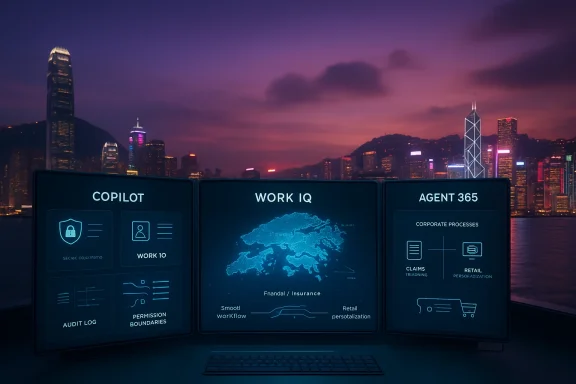
The headline item in Hong Kong is the arrival of Wave 3 of Microsoft Copilot, delivered through Microsoft 365 E7: The Frontier Suite, which Microsoft says will generally be available in Hong Kong on May 1, 2026. The company says the suite brings together Microsoft 365 Copilot, Work IQ, and Agent 365, along with enterprise security, identity, and agent governance. That combination is the clearest evidence yet that Microsoft wants AI adoption to be understood as a platform and control-plane problem, not just a chat interface upgrade.The naming matters because it reflects a broader repositioning. Microsoft is not presenting Copilot as a standalone productivity feature anymore; it is folding Copilot into an enterprise-grade bundle that ties AI capabilities to the security and compliance stack customers already depend on. That bundle approach is meant to reduce the friction between enthusiasm for AI and fear of unmanaged agents. It is also an attempt to standardize how organizations buy, deploy, and govern these capabilities.
The role of Work IQ
Microsoft’s description of Work IQ is especially important. The company positions it as the layer that gives Copilot and agents context about how people collaborate, what they work on, and how decisions are made. In practical terms, that means Microsoft is trying to move beyond generic AI behavior and into a model where agents can act with awareness of organizational context.That is a powerful promise, but it also raises the bar. Context-aware automation is only useful if the underlying context is accurate, current, and appropriately scoped. If Work IQ works as described, it could meaningfully improve relevance and reduce hallucination-prone guesswork. If it is too shallow or too broad, it risks becoming another layer of complexity with limited practical payoff. That tension is central to the entire Frontier pitch.
The role of Agent 365
The other centerpiece is Agent 365, which Microsoft describes in official documentation as the control plane for AI agents. The documentation says it gives organizations a complete view of the agents used across the tenant, including registered and shadow agents, and lets IT teams apply access controls, monitoring, interoperability, and security protections. In other words, Microsoft is not just helping people build agents; it is helping enterprises police the growing sprawl of agents.That is a crucial shift. Every major platform wave eventually creates governance problems, and agentic AI is no exception. Microsoft’s answer is to make governance itself part of the product story. That should appeal to CIOs and CISOs who have been waiting for a way to allow experimentation without losing visibility into what AI is doing with corporate data.
- Copilot is becoming a broader workflow layer.
- Work IQ is the context engine.
- Agent 365 is the governance layer.
- E7 / Frontier Suite is the commercial wrapper that ties them together.
Why Hong Kong Matters
Hong Kong is not merely a symbolic venue. It is a city where international finance, retail, insurance, and professional services collide with strict operating requirements and strong expectations around data handling. That makes it a useful proving ground for enterprise AI that has to be both useful and controlled. Microsoft’s Hong Kong messaging therefore reads as a regional template for markets where governance is not optional.Microsoft also said it has been part of Hong Kong’s technology and business community for 35 years. That historical claim is more than corporate nostalgia; it is an argument for trust continuity. Microsoft is implying that the same enterprise relationships that supported earlier waves of Windows, Office, cloud, and security modernization can now be extended into AI-era operating models.
A market already primed for Copilot
The company described Hong Kong as one of Asia’s most active Copilot markets, which fits the city’s high concentration of knowledge work. In a market where time savings and decision speed are valuable, Copilot’s promise is easy to explain. The harder task is proving that AI can do more than accelerate document drafting or summarize meetings; Microsoft’s Frontier language is designed to move buyers toward that deeper level of value.That matters because many firms have already moved past the novelty stage. Once employees have had a taste of AI assistance, management starts asking a harder question: how do we turn individual productivity gains into process redesign? Microsoft’s answer is to focus on systems, not demos. That is a much more serious enterprise sales motion.
Why regulation changes the equation
Hong Kong’s regulated sectors will not tolerate loose, ad hoc AI deployments for long. They want traceability, auditability, identity management, and the ability to constrain access by role and risk. Agent 365’s registry, access control, and monitoring features are aimed precisely at that challenge.That means the market test in Hong Kong will be unusually revealing. If Microsoft can show that agentic workflows improve productivity without creating governance headaches, it strengthens the company’s enterprise AI narrative everywhere. If not, the Frontier story risks being seen as an expensive way to package familiar productivity tooling with a new label.
AIA and the Insurance Use Case
Microsoft highlighted AIA as one of the first local pioneers on this journey, and the use cases it described are telling. According to Microsoft, AIA is applying the platform to product training, lead management, knowledge access, automated claims processing, customer self-service, and a citizen developer program built with Copilot Studio. Those are not cosmetic use cases; they point directly at operational scale.Insurance is one of the best candidates for agentic AI because it is document-heavy, workflow-heavy, and deeply dependent on repeatable decisions. If Microsoft’s tooling can reduce manual effort and speed up routine processes without compromising accuracy, the gains could be material. That makes AIA a useful reference customer for a market that wants proof, not promises.
Why claims processing is the real prize
Among the use cases Microsoft listed, automated claims processing is probably the most important. Claims work is where insurers feel friction most acutely, and it is also where errors become expensive fast. If AI can help route, triage, summarize, and accelerate that work while preserving human oversight, the business case becomes much easier to defend.That said, claims automation is also where enterprises must be the most careful. A small error in intake or classification can cascade into delays, disputes, or compliance issues. Microsoft’s insistence on embedded governance is not just a marketing flourish here; it is a necessary condition for adoption. In regulated sectors, trust is the product.
Citizen development and scale
The mention of a citizen developer program is equally important. Microsoft has spent years pushing low-code and no-code ideas through Power Platform and Copilot Studio, and agentic AI gives that story fresh momentum. If business users can safely create or adapt agents for bounded tasks, organizations can expand automation without waiting for central IT to build everything.But citizen development also introduces sprawl. The more people build agents, the more organizations need a central registry and governance model. That is exactly why Agent 365 is strategically important: it is Microsoft’s answer to the chaos that success can create.
- Product training can be accelerated through retrieval and task-specific guidance.
- Lead management can be standardized with AI-assisted prioritization.
- Claims processing can be streamlined if controls are strong.
- Customer self-service can improve response times and reduce queue pressure.
- Citizen developer programs can widen automation without overloading IT.
AS Watson Group and Retail Personalization
Microsoft also singled out AS Watson Group, describing its Retail HK businesses as using Microsoft Copilot and AI capabilities across its O+O, or Offline plus Online, model. The use cases include product discovery, skin analysis, in-store personalization, employee support, and AI-generated marketing content. That is a broad mix, but it makes sense for a retailer trying to align customer insight with operational execution.Retail is an especially interesting test case because it combines front-office creativity with back-office discipline. AI-generated marketing content is the most visible part of the story, but the operational value likely comes from better product discovery, better associate support, and faster feedback loops between customer behavior and merchandising decisions. Microsoft’s pitch is that the same AI stack can help with both.
O+O is a useful AI proving ground
AS Watson’s O+O model is relevant because it requires a unified view across channels that are often separated by data, process, and culture. Agentic AI can help bridge those silos by turning fragmented signals into more actionable workflows. If Microsoft’s tools can help a retailer understand what is happening online and in-store as one operational system, the result could be meaningful gains in conversion and service quality.The opportunity is not just customer-facing. Employee-focused applications, such as in-store support, can reduce the time staff spend searching for information or improvising answers. In retail, a few minutes saved at the point of customer interaction can matter more than a fancy demo in a boardroom. That is where enterprise AI either earns its keep or fades away.
Marketing content and the human bottleneck
AI-generated marketing content is now one of the most common enterprise AI use cases, but it is still easy to underestimate its strategic value. At scale, the bottleneck is not producing one campaign asset; it is producing many localized, channel-specific, policy-compliant assets quickly. Microsoft’s Copilot story is that it can help teams get more output without sacrificing alignment.Yet the same feature can create governance risk if it is not tightly reviewed. Retail brands care deeply about consistency, tone, and legal review. That is why Microsoft keeps returning to the notion of enterprise-grade privacy and human judgment remaining in control.
- Better customer discovery can raise basket value and engagement.
- In-store personalization can make AI tangible to shoppers.
- Associate support can improve service speed.
- Marketing automation can expand campaign velocity.
- Cross-team collaboration can improve when data and context are shared.
The Frontier Suite as a Commercial Strategy
Microsoft’s announcement is also a pricing and packaging move. By bundling AI capabilities with enterprise security and identity into a more defined suite, the company is trying to make AI procurement feel less like an experimental add-on and more like a standard enterprise purchase. That reduces uncertainty for buyers and gives Microsoft a cleaner upsell path.This is not subtle. Microsoft’s March announcement already positioned Microsoft 365 E7: The Frontier Suite as a single solution that brings together Microsoft 365 E5, Microsoft 365 Copilot, Agent 365, and Work IQ. The Hong Kong announcement simply localizes that strategy and shows how Microsoft intends to take it to market.
Why packaging matters more than branding
Enterprise software buyers do not just buy features; they buy procurement simplicity, governance confidence, and implementation certainty. Microsoft understands that AI adoption is often blocked by internal objections from security, legal, finance, and risk teams. By putting AI inside a broader enterprise bundle, Microsoft lowers the number of separate decisions a customer has to make.This is also a competitive move against point solutions. Smaller AI vendors may offer sharper functionality in a narrow slice of the market, but they often cannot match the trust stack, identity integration, or administrative reach of Microsoft’s ecosystem. The Frontier Suite is designed to make that ecosystem advantage more explicit.
The business model behind agentic AI
Agentic AI is expensive to govern properly, which creates an opening for Microsoft to monetize the supporting layers, not just the model access itself. The more organizations depend on agents for workflow execution, the more they need registries, controls, analytics, and security boundaries. That gives Microsoft a durable platform play rather than a one-time feature release.At the same time, the company must avoid making the suite feel like mandatory tax on AI usage. If buyers view Frontier as the only safe way to use Copilot at scale, that can be powerful. If they view it as an expensive license stack with unclear incremental value, adoption could stall. Commercial clarity will matter as much as technical capability.
Trust, Governance, and the Real Challenge of Agents
The strongest part of Microsoft’s narrative is also the most necessary: AI agents can only become enterprise infrastructure if they are governed like enterprise infrastructure. Agent 365’s documentation emphasizes registry, access control, visualization, interoperability, and security. That is the language of operations, not hype.Microsoft is clearly trying to get ahead of the inevitable agent sprawl problem. Once employees can create or deploy agents across the business, organizations need to know what exists, who owns it, what data it touches, and how it behaves. Without that, agentic AI becomes another shadow-IT problem, only faster and more dangerous.
Human judgment remains the boundary
Microsoft’s Hong Kong messaging repeatedly returns to the phrase that human judgment remains firmly in control. That is an important reassurance, but it also sets a high standard. If the AI can act, then the organization must define exactly where it may act, when it must ask for help, and how exceptions are handled.This is where enterprise trust becomes operational rather than philosophical. Controls need to be built into identity, permissions, logging, and workflow handoffs. Microsoft’s security blog makes clear that Agent 365 is intended to fit into the existing Microsoft security ecosystem, which suggests the company understands that governance cannot live in a separate dashboard that nobody checks.
Security is now a product feature
The security implications are broader than agent permissions. Agents create data, consume data, and may expose data in ways that legacy systems were not designed to handle. Microsoft’s own documentation says Agent 365 is built to protect against oversharing, leaks, and risky agent behavior. That is a reminder that enterprise AI is as much about minimizing new exposure as it is about increasing output.This is also why Microsoft’s integration of governance with Microsoft 365 and Entra matters. It allows the company to present AI as an extension of existing control models rather than a parallel universe. For CIOs, that is probably more persuasive than a standalone AI management promise.
- Registry helps uncover shadow agents.
- Access control limits blast radius.
- Visualization helps spot behavior drift.
- Interoperability ties agents to work context.
- Security reduces the risk of data leakage and compromise.
Competitive Implications
Microsoft’s move puts pressure on every company selling enterprise AI. The message is simple: if the market is moving from experimentation to execution, then the winning platforms will be the ones that can combine model access, context, workflow integration, identity, and governance. That is a tall order, and it plays directly to Microsoft’s strengths.The company’s real advantage is not just Copilot. It is the fact that Microsoft already sits inside the productivity layer, the identity layer, the security layer, and increasingly the agent layer. When those pieces are bundled coherently, rivals have to compete against a whole operating environment, not a single app.
Pressure on point solutions
For specialized AI vendors, the challenge is differentiation. Many can build excellent point products for writing, search, process automation, or customer service. What they often cannot match is Microsoft’s end-to-end enterprise story, especially in large organizations that prefer fewer vendors and tighter integration.That does not mean Microsoft automatically wins. Point solutions can still outperform on speed, flexibility, or niche functionality. But Microsoft’s Frontier framing shifts the conversation from isolated feature quality to enterprise adoption readiness, which is a more favorable battlefield for a large platform vendor. That is a very Microsoft move.
Pressure on cloud and AI ecosystems
The announcement also has broader platform implications. As agents become a mainstream enterprise layer, cloud providers and AI vendors will be forced to explain how their systems handle governance, observability, and permissioning. Microsoft is trying to turn those concerns into product requirements that it already satisfies.That could reshape buying decisions. CIOs may increasingly choose solutions not because they have the most advanced agent, but because they can prove the best control plane around the agent. In enterprise software, that distinction often matters more than raw model performance.
Strengths and Opportunities
Microsoft’s Hong Kong announcement has several clear strengths. It gives enterprise buyers a concrete framework, it ties AI to governance instead of treating governance as an afterthought, and it shows real use cases in regulated and customer-facing sectors. Just as importantly, it makes the transition from pilots to operations feel achievable rather than abstract.The opportunity is bigger than Hong Kong. If the Frontier model works in a sophisticated, compliance-sensitive market, it can likely be adapted across Asia and beyond. Microsoft is also positioning itself to monetize not just AI usage, but the management layer that makes AI usage scalable.
- Enterprise trust is built into the narrative from the start.
- Work IQ could improve the relevance of AI actions.
- Agent 365 addresses governance and visibility head-on.
- Regional localization strengthens the case for global rollout.
- Regulated industries have tangible use cases already.
- Citizen development may unlock broader internal adoption.
- Bundled packaging simplifies procurement and deployment.
Risks and Concerns
The biggest risk is that the Frontier story becomes too complex for buyers to absorb. Microsoft is layering in new terminology, new packaging, and multiple control concepts at once, and not every customer will immediately understand the difference between Copilot, Work IQ, Agent 365, and the Frontier Suite. If the story is not explained clearly, the market may default to confusion.There is also the risk of overpromising on agent autonomy. Agentic AI can be powerful, but it is also easy to oversell. Organizations will expect agents to be reliable under messy real-world conditions, and they will be unforgiving if AI makes mistakes in customer-facing or regulated workflows.
Adoption friction in the real world
Even if the technology works, enterprise adoption can stall on procurement, change management, and risk review. Security teams will want visibility. Legal teams will want boundaries. Business teams will want fast wins. Those pressures can slow rollout, especially when organizations are trying to move from a handful of pilots to broad operational use.The citizen developer angle carries its own danger. More users building more agents is good for speed, but only if the governance plane keeps up. Without discipline, the very flexibility that makes agentic AI attractive can become the source of the next governance headache. Success can create its own mess.
- Complex messaging may confuse buyers.
- Overreliance on autonomy can produce costly errors.
- Governance overhead may slow deployment.
- Shadow agents could reappear if controls lag.
- Licensing cost may limit broad adoption.
- Data quality issues could weaken Work IQ outcomes.
- Compliance sensitivity is especially high in Hong Kong.
Looking Ahead
The next meaningful test will be whether Hong Kong customers move quickly from announcement to deployment. If AIA, AS Watson, and similar organizations can show measurable business gains, Microsoft will have a strong reference narrative for the rest of Asia. If progress is slower, the market may conclude that agentic AI still needs more time, even if the platform story is technically compelling.The May 1, 2026 general availability date for Microsoft 365 E7: The Frontier Suite in Hong Kong will be an important milestone, but it will not be the end of the story. The real question is whether organizations can operationalize the stack in a way that improves speed, accuracy, and control at the same time. That is the standard Microsoft has set for itself.
What to watch next:
- Whether more Hong Kong enterprises name specific production use cases.
- How quickly Agent 365 becomes part of standard IT governance.
- Whether Work IQ proves useful beyond Microsoft’s own examples.
- How competitors respond with their own governance-first AI bundles.
- Whether Microsoft expands the Frontier model further across Asia.
Source: Microsoft Source From AI experiments to Frontier Success: Microsoft Brings Agentic AI to Hong Kong Organizations - Source Asia
