Microsoft's latest earnings cycle forced an unvarnished conversation about the cost of leading an AI-driven future: strong top-line performance and accelerating Copilot adoption collided with unprecedented capital spending, and investors demanded clarity on when—or whether—that spending will translate into sustainable long-term profits.
Microsoft reported a sequence of strong quarterly results across late 2025 and early 2026, with management using the earnings calls to position Copilot-family products as the linchpin of the company’s AI strategy. At the same time, the company’s capital expenditures (capex) surged to levels that have unsettled the market, with Microsoft devoting tens of billions more this fiscal year to GPUs, CPUs, data-center buildouts, and other AI infrastructure than in the recent past. The net effect: robust revenue and profit metrics alongside an investor backlash focused squarely on the oxygen-thirsty economics of large-scale AI infrastructure.
This article unpacks the numbers, reconciles conflicting public reports, scrutinizes Nadella’s public defense of the strategy, and lays out the practical, financial, and ethical trade-offs Microsoft faces as it attempts to turn Copilots into durable profit centers.
It’s important to be precise about timing: Microsoft’s October 29, 2025 press release for the quarter ended September 30, 2025 (fiscal Q1 FY26) reported a different revenue figure—about $77.7 billion—so some public writeups that conflate the two quarters mix metrics across reporting periods. I flag that because investor reactions and management commentary are often anchored to specific quarter-to-quarter trends; conflating quarters can obscure whether growth is accelerating or slowing.
From a journalistic perspective, the story is not “Microsoft is right” or “Microsoft is wrong.” It’s about a multi‑year transformation where the outcome will be decided by execution: delivering reliable, high‑value Copilot experiences; keeping infrastructure costs efficient; managing supplier and regulatory risks; and proving that the new revenue streams can sustain a high fixed‑cost base. If Microsoft proves that its Copilots deliver unique business value at scale, the capex will look prescient. If not, the company’s financials will have to absorb the weight of an expensive bet.
For readers and IT decision‑makers, the most useful posture is pragmatic optimism: watch the conversion metrics (paid seats → retained seats, RPO → revenue, and new AI margin trends), demand proof points for vertical Copilot value, and expect a protracted transition rather than an immediate payoff.
If Microsoft manages those levers well, history suggests the company’s prior large infrastructure bets will look like a warm-up. If not, the market will continue to test whether an AI‑first infrastructure pivot was the right allocation of capital at the pace chosen.
Source: Bitcoin world Microsoft Copilot AI Adoption Soars as Nadella Confronts Investor Fears Over Massive Spending
 Background
Microsoft reported a sequence of strong quarterly results across late 2025 and early 2026, with management using the earnings calls to position Copilot-family products as the linchpin of the company’s AI strategy. At the same time, the company’s capital expenditures (capex) surged to levels that have unsettled the market, with Microsoft devoting tens of billions more this fiscal year to GPUs, CPUs, data-center buildouts, and other AI infrastructure than in the recent past. The net effect: robust revenue and profit metrics alongside an investor backlash focused squarely on the oxygen-thirsty economics of large-scale AI infrastructure. This article unpacks the numbers, reconciles conflicting public reports, scrutinizes Nadella’s public defense of the strategy, and lays out the practical, financial, and ethical trade-offs Microsoft faces as it attempts to turn Copilots into durable profit centers.
Overview of the numbers: what Microsoft actually reported
Revenue and profit — the headline picture
Microsoft’s fiscal numbers across the relevant late‑2025/early‑2026 reporting window show powerful growth driven by cloud and AI. For the quarter ended December 31, 2025 (Microsoft’s fiscal Q2 FY26), the company reported revenue of roughly $81.3 billion and operating income in the high‑$30 billions. These figures reflect continued strength in Azure and AI-related services and help explain why leadership is comfortable continuing aggressive infrastructure investments.It’s important to be precise about timing: Microsoft’s October 29, 2025 press release for the quarter ended September 30, 2025 (fiscal Q1 FY26) reported a different revenue figure—about $77.7 billion—so some public writeups that conflate the two quarters mix metrics across reporting periods. I flag that because investor reactions and management commentary are often anchored to specific quarter-to-quarter trends; conflating quarters can obscure whether growth is accelerating or slowing.
Capital expenditures — the scale that spooked investors
Microsoft disclosed capex of roughly $34.9 billion in fiscal Q1 FY26 and about $37.5 billion in fiscal Q2 FY26, which together total approximately $72.4 billion for the first half of the fiscal year. To put that in context, Microsoft spent about $88.2 billion on capital projects in the prior fiscal year—so the company spent nearly as much in six months as it did in the previous 12. That pace, and its upward trajectory, is the core reason markets reacted poorly even when revenue and earnings were strong.Copilot adoption metrics — the growth story
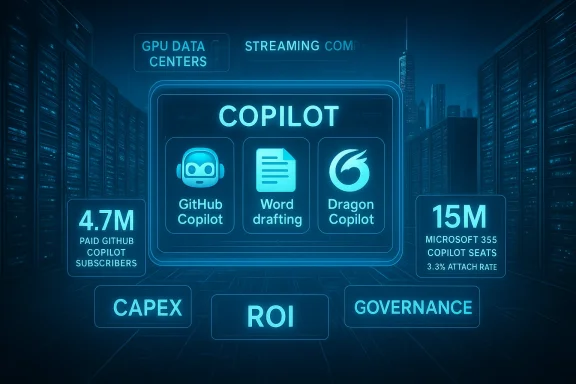
Microsoft’s management emphasized Copilot adoption across consumer and enterprise products as evidence that the company’s AI investments are translating into real user demand:- GitHub Copilot: Management reported about 4.7 million paid subscribers, a roughly 75% year‑over‑year increase, with individual Copilot Pro+ subscriptions rising significantly quarter‑over‑quarter. These are paid subscribers, separate from broader user counts that include free tiers and trials.
- Microsoft 365 Copilot: The company said 15 million paid seats have been purchased by organizations for employees, out of a base of roughly 450 million paid Microsoft 365 seats. Seat growth and large corporate buys were emphasized as signs of enterprise traction.
- Consumer Copilots and other vertical Copilots (e.g., Dragon Copilot for healthcare): Nadella claimed consumer Copilot daily usage had grown nearly 3x year‑over‑year, and Microsoft highlighted specific vertical adoption metrics—Dragon Copilot being available to about 100,000 medical providers and recording roughly 21 million patient encounters during the quarter, a three‑fold year‑over‑year increase. Management framed these as proof points that Copilots are shifting from experimental features to mission‑critical tools in regulated industries.
Why investors reacted: the core debate
The ROI timing problem
Investors do not dispute the possibility that AI is transformative; they question the timeline and margin dynamics. The debate centers on whether Microsoft will earn appropriate returns on the capital it is deploying—and how long that will take. Large upfront capex buys (data centers, GPUs, networking, and power infrastructure) have long depreciation cycles and are especially costly when combined with multi‑year commitments to partners and research organizations. The market’s core question: will the new AI‑driven revenue streams be large and recurring enough to offset the enormous upfront spending?Supply vs. demand realities
Microsoft’s executives repeatedly said demand outstrips supply: new equipment reaches immediate utilization, and customers are booking capacity ahead for the life of the assets. That helps justify capex in the company’s framework, because pre‑booked capacity (reflected in RPO, remaining performance obligations) implies future revenue streams. But from an investor standpoint, that only matters if billed revenue growth (and margins) eventually scale with the investment; a backlog can be encouraging yet insufficient if operational or competitive frictions delay monetization. Microsoft’s RPO balance did see dramatic growth in recent reports—a sign of future revenue, but not a guarantee of margin recovery.Market sentiment and risk appetite
Wall Street’s reaction was mixed: some analysts emphasized the long history of Microsoft investing big, then winning (the cloud pivot in the 2010s is the canonical example). Others pointed out that Azure and M365 growth rates in the latest period were just shy of some expectations—enough to amplify worries about capex intensity. The combination of high capex and slightly softer growth rates is the proximate cause of the sell‑off: investors often prefer a clearer line between capital deployment and near‑term margin expansion.Dissecting Nadella’s defense: what management said, and what it means
Management’s core claims
Satya Nadella and CFO Amy Hood anchored their defense on several interconnected claims:- Demand exceeds current capacity: new AI hardware is nearly fully utilized on deployment, and customers are booking capacity for long time horizons.
- Pre‑booked capacity equals future revenue: capacity sold or reserved today creates a revenue stream over the useful life of the infrastructure, and Microsoft is seeing that manifested in its RPO figures.
- Copilot adoption validates the product strategy: accelerating paid seats and subscriber growth across GitHub Copilot, Microsoft 365 Copilot, and vertical Copilots should translate into expanding monetization opportunities.
Plausibility and limits
Each claim is plausible, but each also contains risk.- Demand outpacing supply is consistent with the broader industry: major model providers and hyperscalers are competing for constrained GPUs, and leading organizations often pre‑book capacity. But supply constraints can also mask demand saturation: if a business appears constrained, demand appears artificially higher than it would be at price/availability equilibrium. Investors worry Microsoft might be building a capacity footprint that is bigger than the eventual, sustainably monetizable demand. Market reporting suggests this is exactly the tension analysts were reacting to.
- RPOs are a forward indicator, but they’re not identical to cash or margins. A high RPO figure is excellent for revenue visibility but doesn’t necessarily imply that the associated revenue will be high‑margin AI inferencing or that long‑term operating margins will improve enough to offset the balance sheet and depreciation impacts of capex. Microsoft’s public filings and analyst commentary emphasize that nuance.
- Copilot adoption is a genuine strength: paid subscriber growth and seat buys are meaningful signals, especially for GitHub and Microsoft 365. But the company’s consumer Copilot metrics are presented as relative growth without absolute daily counts, and many enterprise deals are still early in their lifecycle. Conversion of paid seats into recurring high‑margin revenue streams, upsell potential, and retention will be the essential metrics to watch.
Competitive context: how Microsoft compares
Key competitors and positioning
Microsoft is not alone in the AI infrastructure race. Amazon Web Services (AWS) and Google Cloud are investing heavily, and specialized firms and spot‑market providers are growing in niches. Microsoft’s advantages include:- Deep enterprise relationships and an installed base across productivity, cloud, and developer tools.
- Strategic partnership with OpenAI and early access to high‑capability models and co‑development opportunities.
- Integrated product strategy that ties Copilot experiences across Windows, Office, Azure, GitHub, and vertical applications.
Differentiators and vulnerabilities
Differentiators:- Copilot breadth: Microsoft’s Copilot family covers consumer, developer, enterprise productivity, and regulated verticals (healthcare). Paid subscriber growth in GitHub and paid seats in M365 are tangible differentiators.
- Capex intensity and margin pressure: large upfront investment increases fixed costs and raises the breakeven bar for new AI revenue.
- Concentration risk with OpenAI: a powerful partner, but one that could also tilt bargaining dynamics and create dependency.
- Regulatory and geopolitical risk: AI governance, export controls on advanced chips, and energy policy can all affect deployment timelines and costs. (More on regulation below.)
Technical and operational constraints: can Microsoft scale efficiently?
Hardware, power, and cooling
Training and inferencing at scale require specialized hardware (GPUs and increasingly, custom accelerators), large power envelopes, and sophisticated cooling. These requirements are capital‑intensive and have environmental implications. Microsoft has committed to ambitious sustainability goals—carbon negative by 2030, water positive, and 100% renewable procurement targets—but scaling AI data centers while meeting those goals remains engineering and procurement heavy lifting. Microsoft’s sustainability reporting and public engineering blogs document progress and experimentation (e.g., new materials, renewable PPAs, and water‑efficient cooling), but the challenge is nontrivial and will influence capex and operational costs across the next decade.Supply chain and chips
GPU supply and the evolution of chip architectures are critical variables. Microsoft and other hyperscalers are buying in enormous volumes, sometimes partnering with specialist cloud partners and chip vendors. Any disruption—geopolitical export controls, manufacturing constraints, or competitive bidding for the newest architectures—can inflate costs or delay capacity rollouts, making short‑term ROI projections fragile. Reports from industry observers and analysts note that chip scarcity is part of the reason hyperscalers accelerated purchases, which in turn drove higher capex this fiscal year.Strategic implications and scenarios
Bull case: Copilots become sticky, high‑value products
In the optimistic scenario, Copilots become an indispensable, integrated layer for business operations. Enterprise adoption scales, renewal rates are strong, upsells into analytics and vertical AI solutions increase average revenue per user (ARPU), and inferencing services (higher‑margin than basic cloud compute) command premium pricing. Under this outcome, early capex becomes a long‑term advantage: Microsoft’s scale, integrated stack, and OpenAI partnership create durable enterprise lock‑in and margin expansion. Evidence supporting this view includes rapid paid subscriber growth in GitHub Copilot and meaningful enterprise seat purchases for Microsoft 365 Copilot.Bear case: supply‑driven growth masks demand fatigue
The pessimistic scenario sees supply constraints creating artificial demand signals; companies buy capacity or seats because they fear being left behind, not because they have immediate, high‑value use cases. Competition intensifies, pricing for inferencing commoditizes, and the margin lift expected from AI monetization fails to materialize quickly enough to offset depreciation and financing costs on new infrastructure. If some vertical Copilots struggle with regulatory or integration hurdles (healthcare documentation being sensitive to accuracy and compliance), the monetization path can be longer and bumpier than management projects. Market reaction to large capex is essentially pricing in this risk.Most likely: a mixed, multi‑year transition
A realistic middle path is that Microsoft wins many enterprise use cases and creates significant AI revenue streams, but the timeline stretches over multiple years. Some Copilot offerings will scale fast (developer tooling, large enterprise seat deals), while regulated verticals and consumer monetization lag. The company’s massive RPO backlog and strong paid metrics argue in favor of eventual revenue realization, but investors will demand clearer evidence of margin expansion and efficient capital deployment before sentiment normalizes.Risks beyond finance: regulation, ethics, and sustainability
- Regulatory scrutiny: Governments are actively debating AI governance—privacy, model safety, liability, and export controls on advanced compute. These could alter how models are trained, where servers are located, and what data can be used, all affecting costs and time-to-market.
- Model correctness and product risk: Copilots that assist in legal, medical, or financial settings make mistakes at non‑zero rates. Product maturity, verification workflows, and liability frameworks will determine whether vertical Copilots can scale rapidly and profitably. Dragon Copilot’s growth is promising, but clinical adoption demands rigorous validation and compliance.
- Sustainability constraints: Energy and water usage, and the embodied emissions in building materials, are real constraints. Microsoft’s sustainability roadmap is ambitious and innovative, but meeting those goals while rapidly expanding compute capacity is operationally demanding and costly.
What to watch next — the metrics that will determine whether capex was worth it
Investors and observers should focus on a short list of high‑signal metrics in upcoming quarters:- Azure AI and Azure infrastructure margins and their trajectory.
- Renewal rates and net retention for Microsoft 365 Copilot seats (do enterprises keep and expand usage?).
- Paid subscriber growth and ARPU for GitHub Copilot and related developer services.
- RPO conversion rates into recognized revenue and associated gross margins.
- Capex pacing and cash flow from operations—can Microsoft sustain the capex cadence while maintaining investment-grade financials?
- Progress on sustainability targets tied to new data center builds (renewable energy contracts, water intensity improvements).
Bottom line: a bold bet, but not an irrational one
Microsoft’s strategy is audacious: build the global AI infrastructure that supports a new generation of integrated Copilot products, and leverage its enormous enterprise footprint to convert those products into recurring revenue streams. The company’s paid‑subscriber figures for GitHub Copilot and seat purchases for Microsoft 365 Copilot are real signals of monetizable demand. At the same time, the scale and speed of capital deployment have raised legitimate investor questions about timing, margins, and concentration risk around major partners.From a journalistic perspective, the story is not “Microsoft is right” or “Microsoft is wrong.” It’s about a multi‑year transformation where the outcome will be decided by execution: delivering reliable, high‑value Copilot experiences; keeping infrastructure costs efficient; managing supplier and regulatory risks; and proving that the new revenue streams can sustain a high fixed‑cost base. If Microsoft proves that its Copilots deliver unique business value at scale, the capex will look prescient. If not, the company’s financials will have to absorb the weight of an expensive bet.
Practical takeaways for IT professionals and CIOs
- Treat Copilots as strategic tools with real productivity upside, but evaluate pilots on measurable ROI: time saved, accuracy, error rates, and compliance overhead.
- Demand clear SLAs and pricing transparency for AI inferencing services—capacity and price volatility are real risks in early markets.
- Prioritize vendor‑agnostic architectures where possible: multi‑cloud or hybrid strategies and the ability to port workloads mitigate concentration risk.
- Track sustainability commitments: power, cooling, and water usage will increasingly be procurement criteria for enterprise cloud contracts.
Final assessment
Microsoft has assembled many of the right pieces—scale, enterprise relationships, product breadth, and partner models—to be a dominant force in cloud and generative AI. The headline Copilot adoption numbers are meaningful and should not be dismissed. However, the market’s reaction is a sobering reminder: scale alone doesn’t guarantee profit. The next several quarters will be decisive in proving whether Microsoft’s massive, fast‑paced capex can be turned into high‑margin, repeatable revenue that justifies the investment.For readers and IT decision‑makers, the most useful posture is pragmatic optimism: watch the conversion metrics (paid seats → retained seats, RPO → revenue, and new AI margin trends), demand proof points for vertical Copilot value, and expect a protracted transition rather than an immediate payoff.
If Microsoft manages those levers well, history suggests the company’s prior large infrastructure bets will look like a warm-up. If not, the market will continue to test whether an AI‑first infrastructure pivot was the right allocation of capital at the pace chosen.
Source: Bitcoin world Microsoft Copilot AI Adoption Soars as Nadella Confronts Investor Fears Over Massive Spending