

Microsoft’s Copilot is no longer just a helper for writing emails and summarizing web pages — it’s being shaped into a full shopping platform that can compare prices, track deals, surface cashback, and even complete purchases inside the Copilot interface, folding browser-era shopping tools into an AI-first, conversational commerce experience. The shift consolidates Edge’s legacy shopping features into Copilot in Edge and extends them with native in‑chat checkout and merchant-facing “Brand Agents,” a move Microsoft positions as a convenience and conversion play but one that carries important privacy, merchant, and market implications.
Microsoft’s shopping features have historically been scattered across Edge UI elements — the blue shopping tag, price-tracking widgets, and cashback flyouts. Over the last year the company has consolidated these capabilities into the Copilot surface inside Edge and the standalone Copilot app, centralizing discovery, comparison, price‑tracking, review summarization, and cashback signals into a single, conversational pane. The rollout has been staged and region-gated, with the United States prioritized for initial availability. This consolidation grew into a more ambitious commerce strategy: Copilot Checkout — a native checkout widget surfaced directly in Copilot conversations — plus merchant toolsets (Brand Agents and Copilot Studio templates) that let stores feed product catalogs and ship brand‑voiced shopping agents. Microsoft showcased the commerce direction publicly at retail industry events and documentation pages and framed it as part of a broader “agentic commerce” push: letting AI agents not only recommend but also execute transactions in a controlled, protocol-driven way.
Finally, several vendor claims about conversion uplift and discovery efficiency should be treated as early signals rather than proven outcomes. Independent verification and merchant-specific A/B testing will be required to validate Microsoft’s performance claims. For now, Copilot’s shopping experience is an important and credible entry into agentic commerce — a feature set that will shape how many users browse and buy — but it will require careful governance and ongoing scrutiny from privacy advocates, merchants, and customers to ensure the convenience it promises does not come at an unacceptable cost.
Microsoft’s Copilot shopping push marks a significant step in the platformization of e‑commerce inside conversational AI: it brings helpful, time-saving features for shoppers and new discovery channels for merchants, but it also raises operational and privacy questions that deserve measured attention as the rollout scales.
Source: Thurrott.com Microsoft Copilot Shopping experience - Thurrott.com
 Background
Microsoft’s shopping features have historically been scattered across Edge UI elements — the blue shopping tag, price-tracking widgets, and cashback flyouts. Over the last year the company has consolidated these capabilities into the Copilot surface inside Edge and the standalone Copilot app, centralizing discovery, comparison, price‑tracking, review summarization, and cashback signals into a single, conversational pane. The rollout has been staged and region-gated, with the United States prioritized for initial availability. This consolidation grew into a more ambitious commerce strategy: Copilot Checkout — a native checkout widget surfaced directly in Copilot conversations — plus merchant toolsets (Brand Agents and Copilot Studio templates) that let stores feed product catalogs and ship brand‑voiced shopping agents. Microsoft showcased the commerce direction publicly at retail industry events and documentation pages and framed it as part of a broader “agentic commerce” push: letting AI agents not only recommend but also execute transactions in a controlled, protocol-driven way. Overview of the new Copilot shopping experience
What Microsoft has merged into Copilot
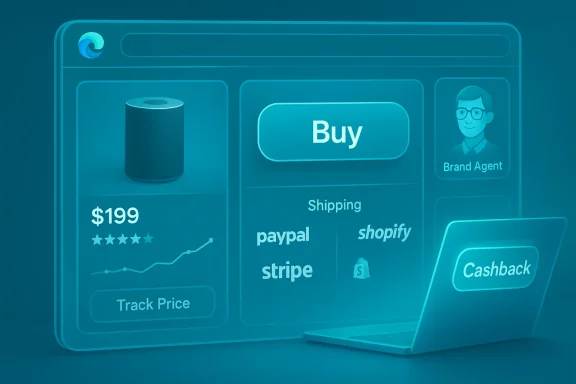
- Price comparison: Copilot pulls pricing from multiple retailers and presents side‑by‑side comparisons in a product card when you visit supported product pages.
- Price history: Interactive charts show historical pricing trends so shoppers can judge if a current price is genuinely low or just a fleeting discount.
- Price tracking / alerts: Users can set target prices and have Copilot notify them when items reach the desired threshold.
- Product insights / review summaries: Copilot digests and summarizes review content, highlighting pros, cons, and aggregated sentiment to speed decision-making.
- Microsoft Cashback: The assistant flags merchant-funded cashback offers and provides activation and redemption flows; Microsoft documents PayPal as a redemption and payout mechanism for cashback in supported markets.
Copilot Mode: the proactive shopping agent
When users opt into Copilot Mode, Microsoft allows the assistant to act more assertively: scanning open tabs (with explicit permission), nudging users at checkout if a lower price or cashback signal exists on another tab, and surfacing deal prompts in the address bar and Copilot pane. This proactive behavior is opt‑in and gated by permission settings, yet it marks a fundamental shift from a passive helper to an assistant that can interrupt or steer the checkout flow. Microsoft documents this as a convenience feature but the privacy and UX consequences are material and deserve scrutiny.Copilot Checkout and Brand Agents: moving to in-chat purchases
Copilot Checkout allows users to complete a purchase without leaving the Copilot surface. A “Buy” action opens a native checkout widget inside the chat UI where shoppers can select shipping, provide payment details via integrated partners, and confirm orders. At launch Microsoft is working with payment and commerce partners such as PayPal, Stripe, and Shopify and has named early retail partners and pilot merchants including Urban Outfitters, Anthropologie, Ashley Furniture, and select Etsy sellers. Microsoft positions merchants as the merchant of record — meaning retailers continue to own fulfillment, returns, and customer service — while Copilot handles the conversational surface and orchestration. Brand Agents are prebuilt, brand‑voiced assistants merchants can deploy across Copilot surfaces and store pages — trained on product catalogs and configured through Copilot Studio templates to reflect brand tone, inventory rules, and return policies. The stated goal is higher engagement and faster conversion for merchants that opt into these tools.How it works under the hood
Three architectural layers
Microsoft’s public descriptions and partner docs describe Copilot Checkout and merchant integration as built on three coordinated layers:- Catalog ingestion and normalization: Merchants provide machine‑readable product feeds (SKUs, GTINs, inventory, images). Copilot queries canonical product records to avoid hallucination and ensure recommendations map to real merchant SKUs.
- Conversational orchestration: Copilot interprets intent, asks clarifying questions (size, color, delivery window), and maintains an auditable trace linking recommendations to product records. This is intended to preserve provenance for each suggestion.
- Delegated / tokenized checkout: Copilot requests a short‑lived checkout session or payment token from the merchant’s payment provider (Stripe, PayPal, Shopify). The PSP completes settlement and fraud checks while the merchant remains the merchant of record. This reduces Copilot’s exposure to raw card data and positions Copilot as an orchestrator rather than a payments processor.
Permissions and page context
Proactive features that scan open tabs and make checkout nudges are protected behind explicit permissions. Microsoft’s support pages and blog posts make clear these behaviors are opt‑in and can be toggled via Edge settings, Page Context permissions, and account controls. However, enabling deeper context for convenience does increase the surface area for data Microsoft and partner services can use to personalize shopping and conversion prompts.What’s new for shoppers — practical walkthrough
- Update Microsoft Edge to the latest build and sign in with a Microsoft account. Some Copilot shopping features require account sign-in and the most recent Edge version.
- Click the Copilot icon in the Edge sidebar while on a supported product page. A product card will appear showing price, retailer, ratings, and price history.
- Use “Track Price” to set a price target and receive notifications. Choose email or in‑app alerts based on preference.
- When a cashback opportunity exists, follow Copilot’s guided activation steps. Microsoft documents that cashback payouts in supported markets use PayPal for redemption.
- If in‑chat purchasing is available for a product, use “Buy” to open the native checkout widget inside Copilot and complete the order using supported payment partners.
Strengths and immediate benefits
- Reduced friction and faster decision-to-purchase flow. Consolidating discovery, comparison, review summarization, and checkout in one conversational surface reduces tab-hopping and form-filling. Microsoft frames this as compressing the funnel and improving conversion rates for merchants.
- Built-in price intelligence. Price history charts and tracking alerts help users time purchases more effectively, which is an immediate benefit for deal‑seeking shoppers.
- Integrated cashback and incentives. Surfacing cashback opportunities inside the shopping flow reduces the need for browser extensions or coupon sites; for users who value cashback, embedding redemption steps can be a meaningful UX improvement.
- Merchant tooling and brand control. Brand Agents and catalog enrichment templates give merchants structured ways to participate in the Copilot ecosystem while retaining control of inventory, pricing, and fulfillment. That makes Copilot an attractive discovery surface for merchants with good catalog hygiene.
- Platform reach. Microsoft’s distribution across Edge, Windows, Bing, and the standalone Copilot app gives the company a built-in audience to scale commerce features faster than many standalone commerce agents.
Risks, unanswered questions, and potential downsides
Privacy and data control
Proactive features that scan open tabs and use page context to make checkout nudges can be useful, but they increase how much browsing context the assistant may access. Even if these behaviors are opt‑in, the practical trade-off is between convenience and the scope of contextual data shared with Microsoft and partner services. Users and administrators should carefully review Page Context and Copilot Mode permissions before enabling proactive behaviors. Microsoft documents these opt‑ins, but the real‑world telemetry around what data is used for personalization vs. logged for product improvement is not exhaustively published.Merchant economics and discoverability
Microsoft asserts merchants remain the merchant of record, but inserting Copilot as a discovery and checkout surface changes where purchase decisions happen and who captures first‑party signals. Merchants will need to evaluate how revenue attribution, fees, and customer data access are handled in practice. Automatic Shopify enrollment claims and tokenized checkout mechanics give Microsoft reach, but merchants should validate conversion attribution, data feeds, and any platform fees against their own metrics. Public announcements promise merchant control, but the operational reality will vary by PSP and integration.Accuracy, hallucination, and provenance risks
Conversational agents can hallucinate or produce recommendations that don’t map cleanly to merchant inventory. Microsoft mitigates this with catalog ingestion and canonical product feeds, but the quality of merchant data will be the limiting factor. When Copilot recommends products or summarizes reviews, users and merchants should expect occasional mismatches and verify key specs before purchase. Microsoft’s emphasis on structured product feeds shows an awareness of this risk, but merchant catalog completeness and feed freshness are critical.Competition and platform concentration
Embedding in-chat checkout across platforms concentrates buying behavior within a few large ecosystems. Microsoft, OpenAI (via ChatGPT), Google, and others are racing to own the in‑assistant purchase moment. For shoppers this may increase convenience; for the broader market it could entrench platform intermediaries and shift bargaining power away from smaller, independent merchants unless open protocols and merchant-friendly terms prevail. Microsoft’s stated use of protocols and multiple PSP partners is a positive signal, but regulatory and competitive scrutiny could follow as marketplaces evolve.Unverifiable or vendor-claimed metrics
Microsoft and partner materials include vendor-friendly statistics about conversion lift and compressed funnels (for example, claims about reducing the path to purchase by a notable percentage). These are worth treating as vendor claims until validated by independent measurement. Early press coverage repeats Microsoft’s framing of improved conversion metrics, but merchants and analysts should treat these as hypotheses to be tested with real-world A/B experiments.How this compares to other players
This is part of a broader industry trend where AI agents become transaction surfaces rather than just discovery tools. OpenAI’s Instant Checkout and other vendor implementations demonstrated the viability of in‑chat payments, and Google has also been integrating shopping capabilities into AI search and assistant modes. Microsoft’s differentiator is distribution (Edge + Windows + Copilot family) and an explicit partner approach with PSPs (PayPal, Stripe, Shopify) and merchant tooling. That said, each platform is converging on similar primitives: canonical product feeds, tokenized or delegated checkout, and protocol-driven agent/merchant communication.Recommendations for users and administrators
- For everyday shoppers: enable Copilot shopping features selectively. Use Copilot Mode only if you accept the convenience trade-off of granting page context permissions. Verify price comparisons and merchant details before finalizing purchases, especially on high-value items.
- For privacy-conscious users: keep proactive features disabled. Use Copilot for reactive queries (ask for comparisons and summaries) without granting the assistant persistent page‑context permissions. Review Microsoft account and Edge privacy settings that control shared browsing context.
- For merchants: evaluate the merchant onboarding flow, data feed requirements, and how conversions and customer data will be shared. Test Brand Agent templates in a controlled pilot to validate attribution, returns handling, and customer experience before broad rollout. Monitor merchant-of-record commitments in contracts or partner documentation.
- For IT administrators: treat Copilot Mode and in‑browser commerce features as configurable items in enterprise-managed environments. Ensure enterprise policies cover what data can be exposed to Copilot and whether Copilot’s proactive behaviors are enabled for managed devices.
Final analysis: strategic upside vs. real-world friction
Microsoft’s Copilot shopping consolidation and Copilot Checkout are logical evolutions: shopping is inherently transactional, repetitive, and monetizable, and reducing friction to convert intent into purchase is a natural business objective for platform owners. The product brings real usability wins — unified price history, conversational follow-ups, built‑in cashback, and native checkout can save shoppers time and reduce friction, and they create a promising discovery surface for merchants who adopt the tooling. However, the practical success of the initiative depends on operational details that are not yet fully visible in public documentation: the quality and freshness of merchant feeds, the reliability of cashback payouts (users have historically reported occasional redemption hiccups), the exact contractual and data terms merchants will face, and how much user privacy is meaningfully protected when proactive Copilot behaviors are enabled. Microsoft’s documentation and partner announcements outline protective controls and emphasize opt-in permissions, but real-world telemetry and merchant experiments will determine whether the convenience gains outweigh the trade-offs.Finally, several vendor claims about conversion uplift and discovery efficiency should be treated as early signals rather than proven outcomes. Independent verification and merchant-specific A/B testing will be required to validate Microsoft’s performance claims. For now, Copilot’s shopping experience is an important and credible entry into agentic commerce — a feature set that will shape how many users browse and buy — but it will require careful governance and ongoing scrutiny from privacy advocates, merchants, and customers to ensure the convenience it promises does not come at an unacceptable cost.
Microsoft’s Copilot shopping push marks a significant step in the platformization of e‑commerce inside conversational AI: it brings helpful, time-saving features for shoppers and new discovery channels for merchants, but it also raises operational and privacy questions that deserve measured attention as the rollout scales.
Source: Thurrott.com Microsoft Copilot Shopping experience - Thurrott.com
