

The short, verifiable punchline from recent reporting is this: for practical privacy in an enterprise setting, Microsoft Copilot (when deployed inside a managed Microsoft 365 tenant) currently presents the clearest path to the least intrusive data collection model; for consumer-grade use the picture is mixed and depends on product tier, settings, and geography. This conclusion emerges from side‑by‑side reads of app-store privacy summaries, vendor privacy policies, and independent reporting that aggregated those sources into a comparability frame.
The conversation about which AI chatbot “collects the least data” is not a single binary question; it’s multidimensional. Vendors differ across at least four axes that materially change risk and exposure:
Strengths
Actionable next steps for organizations and Windows users are straightforward: prefer enterprise contracts for sensitive work, use browser interfaces for casual needs, disable history when necessary, and consider local/enclave or self‑hosted models for absolute confidentiality. These steps reduce the real exposure surface that matters in a world where vendor policies, litigation, and national laws can change retention and access expectations overnight.
(Where vendor claims about costs, model internals, or market impacts are important to your decision, treat those statements as unverified until an independent audit or regulatory filing confirms them.
Source: The Economic Times Which AI chatbot collects the least data: Which AI chatbot collects the least data? Here's a report comparing ChatGPT, Copilot, Gemini, DeepSeek & Qwen - The Economic Times
 Background
The conversation about which AI chatbot “collects the least data” is not a single binary question; it’s multidimensional. Vendors differ across at least four axes that materially change risk and exposure:- the number and types of declared data categories (device IDs, precise location, photos, contacts, browsing history),
- whether conversational inputs are used to train foundation models or retained for long periods,
- whether human reviewers may access user content for quality/safety, and
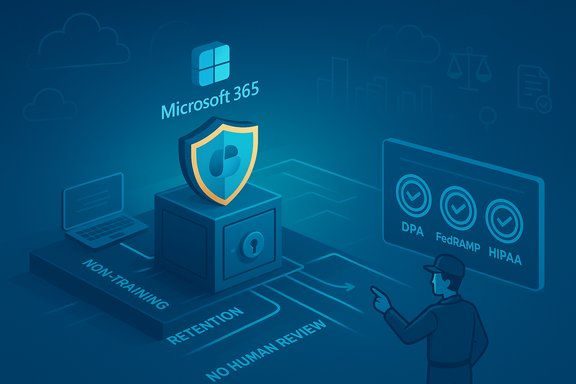
- contractual and jurisdictional controls available to enterprise customers (data residency, FedRAMP/HIPAA/SOC compliance, and explicit non‑training clauses).
Overview: how analysts measured “data collection”
Short of performing forensic network captures on every client, most public comparative work uses a reproducible, defensible method:- Pull declared categories from App Store / Play Store privacy labels (device identifiers, location, camera, contacts, browsing).
- Read the vendor’s public privacy and product documentation to determine training, retention, and reviewer policies.
- Check enterprise offerings and contractual protections (DPA, BAA, FedRAMP, regional data residency).
- Cross‑reference independent reporting and regulatory actions that illuminate practice vs promise.
Vendor-by-vendor analysis
Microsoft Copilot — least intrusive for enterprise data (by design)
Microsoft’s public documentation and enterprise materials make a clear, consistent claim: Copilot for Microsoft 365 uses tenant‑scoped data to generate contextual responses and does not feed customers’ in‑tenant prompts and documents into the foundation‑model training corpus. That separation is central to Copilot’s product positioning for business users and is reinforced by admin controls and retention tooling exposed through Microsoft Purview. Strengths- Tenant isolation and contractual guarantees: enterprise customers can obtain explicit non‑training commitments and contractual DPAs that align with regulatory frameworks such as FedRAMP, HIPAA, and SOC.
- Admin governance: organizations can use retention policies and discovery tools to control Copilot interaction logs.
- Reduced surface from mobile sensors when Copilot is used inside Microsoft 365 rather than a standalone mobile assistant.
- Vendor coupling: the privacy win is practical only if the organization accepts Microsoft ecosystem lock‑in and codifies protections in contract. The protections are strongest inside a managed tenant—consumer Copilot experiences can have different defaults.
- Telemetry and diagnostic data: functional telemetry and diagnostic logs still exist for service operation and abuse monitoring; these are typically governed by enterprise contracts but are present in operational flows.
OpenAI ChatGPT — consumer convenience with training exposure caveats
OpenAI’s consumer ChatGPT historically used conversations as a source of improvement unless users opted out; enterprise and API channels were explicitly separated and not used for training by default. Recent regulatory developments and litigation also complicate retention expectations for consumer tiers. Strengths- Controls and opt‑outs: ChatGPT offers data controls where users can disable “Improve the model” and clear history; enterprise offerings (ChatGPT Enterprise/API) provide contractual non‑training protections.
- Mature product ecosystem with broad use cases and tooling.
- Default consumer posture: casual users should assume consumer prompts may be used in model improvement workflows unless explicitly in a no‑training enterprise tier.
- Regulatory and legal retention: court orders and regulatory actions (for example, fines and investigatory findings reported in Europe) have compelled longer or indefinite retention of specific records in some cases; that changes the practical deletion guarantees for consumer content.
Google Gemini — highest declared telemetry; transparent controls
Google’s Gemini (formerly Bard) stands out in app‑store label aggregates for declaring a wide range of data types—often including precise location, contacts, photos/media, browsing/search history, and more. Google is explicit that human reviewers may access chat content for quality and safety and that users should disable history if they do not want their content subject to review. Google also provides activity deletion controls and configurable retention windows. Strengths- Feature set and controls: Gemini’s multimodal capabilities are powerful, and Google exposes account‑level controls for retention and deletion.
- Transparency about human review: Google documents reviewer use and retention windows, which is better than silence or obfuscation.
- Large declared attack surface: the number and sensitivity of declared categories raise exposure—the more types of data collected, the larger the accidental disclosure or legal/regulatory surface.
- Human review: explicit disclosure of reviewers increases risk when users submit secrets; disabling history is required to limit reviewer exposure.
DeepSeek — aggressive collection, jurisdictional complications, and security red flags
DeepSeek — a fast‑growing entrant — has been flagged by multiple independent reviewers and regulators for aggressive data use, opaque practices, and technical security lapses. Independent reporting has documented incidents of exposed backend storage containing chat logs, API keys, and internal metadata, and several national authorities have imposed bans or inquiries into the product because of transfers of user data to servers under different legal regimes. These are not trivial operational observations; they change the threat model for sensitive data. Strengths- Competitive price-to-performance: DeepSeek’s market proposition has attracted rapid adoption in some regions.
- Data transfers and jurisdictional risk: regulators in multiple countries have voiced concern about cross‑border transfers and potential access under local laws.
- Security incidents: independent researchers disclosed a configuration that exposed large amounts of internal data and chat logs, worsening trust.
Qwen (Alibaba) — terse app labels, lengthier policies, and regional considerations
Alibaba’s Qwen family (including Qwen Chat and API variants) sometimes appears in app‑store summaries as collecting limited categories (device ID, interactions), but full privacy policies and product terms contain more detailed data‑use language. That mismatch between short labels and exhaustive legal terms is the exact reason app‑store summaries can be misleading; the full policy should govern risk assessments. Qwen’s model family is technically capable and increasingly open‑weight in some releases, but regional legal frameworks and platform integration choices are the real privacy determinants.Strengths
- Technical capability: Qwen models are competitive and available via Alibaba Cloud APIs and ancillary tools.
- App label vs policy gap: short summaries understate full‑policy terms; always read the full privacy policy to confirm how conversational data may be used or retained.
- Jurisdictional exposure: like other China‑region offerings, legal access regimes and cross‑border transfer rules can increase risk for certain classes of data.
Cross‑cutting findings and verification notes
- App‑store privacy labels are a useful first pass, but they are vendor self‑reported and not independently audited. Analysts must cross‑check labels with the full privacy policy and product documentation.
- Enterprise offerings materially change risk. Vendor statements that “we don’t use customer data to train” are often true only inside enterprise or paid tiers with contractual terms. For example, OpenAI’s enterprise/API promises differ from its consumer web app defaults; Microsoft’s Copilot offers tenant‑scoped non‑training in enterprise settings. Cross‑checking both product pages and enterprise DPAs is essential.
- Human review remains a systemic risk. Several vendors disclose that human reviewers may access conversations in specific circumstances; turning off history or upgrading to enterprise plans reduces this exposure in many products.
- Regulatory actions matter. The European and national privacy regulators’ investigations and fines (for example, recent enforcement against OpenAI) change the effective guarantees vendors can offer, and they underscore that legal events can force vendors to retain or produce records for investigations or litigation.
- Several vendor claims about model internals, training costs, or “how much data it would take to replicate X” are marketing statements unless backed by an independent audit. Treat those as vendor assertions.
Practical checklist for Windows users and IT teams
- For regulated or proprietary workloads, insist on enterprise contracts with explicit:
- non‑training clauses for your tenant data,
- non‑human‑review guarantees (or strict reviewer access rules),
- data residency commitments (if required by law), and
- a DPA and BAA if HIPAA or other protection regimes apply.
- Prefer browser/web interfaces over mobile apps for consumer scenarios to reduce device‑sensor telemetry (camera, fine GPS, contacts) unless the app’s mobile permissions are strictly required. App‑store labels frequently show mobile apps request broader sensors than web clients.
- Disable chat history when offered and avoid submitting PII, credentials, health records, or regulated material to consumer chatbots. If the product documents human reviewing, disabling history is the immediate mitigation for consumer users.
- Use enterprise offerings (Copilot enterprise, ChatGPT Enterprise, Gemini for Workspace) when you must process sensitive business data; verify contractual terms before enabling AI features on production data.
- Consider on‑device or self‑hosted models (local runtimes, Ollama, or open‑weight models) when absolute confidentiality is required and the organization can tolerate maintenance and capability tradeoffs. Local inference eliminates remote human review and cloud retention risks.
Critical analysis — strengths, gaps, and systemic risks
Strengths across the market- Enterprise controls have matured quickly; Microsoft’s tenant model and Google’s account controls show the industry can design governance features that materially reduce exposure.
- App labels vs policy mismatch: some offerings list minimal categories in their short app summaries while their legal policies include broader processing terms; this mismatch is a recurring problem with consumer app governance.
- Human review transparency: disclosure is improving, but the presence of human review—even when anonymized—remains an uncontrolled vector unless disabled by user settings or excluded by contract.
- Jurisdictional exposure for non‑US vendors alters the threat model dramatically for regulated sectors; “least data collected” in one country may not mean the same thing under another legal regime. DeepSeek and other China‑region entrants illustrate how legal access rules can become the dominant risk factor.
- Litigation and enforcement can force retention that overrides normal deletion flows. Recent regulatory actions demonstrate that even platforms with deletion mechanics may be compelled to preserve data for legal purposes.
Conclusion
The empirical, cross‑checked evidence supports a conditional but actionable headline: Microsoft Copilot—used inside a managed Microsoft 365 tenant with appropriate contractual protections—represents the clearest practical route to minimizing data collection and training exposure among mainstream AI chatbots. For consumer users, there is no single “most private” bot—privacy posture depends on default product tier, user controls (history on/off), and the jurisdiction in which the service operates. Google’s Gemini declares the broadest telemetry footprint among mainstream mobile/chat clients but pairs that with transparent controls. OpenAI’s consumer ChatGPT offers convenience and controls but historically used conversational data to improve models unless enterprise terms change that contractually. DeepSeek and some regional entrants raise additional geopolitical and security concerns that make them riskier for regulated workloads.Actionable next steps for organizations and Windows users are straightforward: prefer enterprise contracts for sensitive work, use browser interfaces for casual needs, disable history when necessary, and consider local/enclave or self‑hosted models for absolute confidentiality. These steps reduce the real exposure surface that matters in a world where vendor policies, litigation, and national laws can change retention and access expectations overnight.
(Where vendor claims about costs, model internals, or market impacts are important to your decision, treat those statements as unverified until an independent audit or regulatory filing confirms them.
Source: The Economic Times Which AI chatbot collects the least data: Which AI chatbot collects the least data? Here's a report comparing ChatGPT, Copilot, Gemini, DeepSeek & Qwen - The Economic Times
