

On May 28, 2026, Microsoft published a customer story describing how Whakarongorau Aotearoa, New Zealand’s national telehealth provider, is using Microsoft Copilot Studio, Microsoft 365 Copilot, and Azure-based AI agents to reduce wait-time friction across mental health, family violence, and support services. The important part is not that another healthcare organization has “adopted AI.” It is that Whakarongorau is putting AI in one of the hardest places to deploy it responsibly: the fragile first minutes before a distressed person reaches a trained human. That makes this a useful test case for Microsoft’s broader Copilot argument—and a reminder that the future of AI in care will be judged less by model cleverness than by operational discipline.
The enterprise AI market has spent the last two years trying to make chatbots sound grander than they are. Every product is an “agent,” every workflow is “autonomous,” and every vendor deck promises a productivity revolution that somehow begins with summarizing meetings. Whakarongorau’s deployment is more grounded, and therefore more interesting.
The organization runs free, 24/7 telehealth services across New Zealand, including Healthline, the 1737 mental health line, Quitline, and services connected to family violence and sexual harm support. Microsoft says Whakarongorau supported more than 700,000 people last year across more than 1.1 million contacts. That scale matters because the problem is not abstract digital transformation; it is the practical reality of too many vulnerable people arriving at once and not enough trained humans being instantly available.
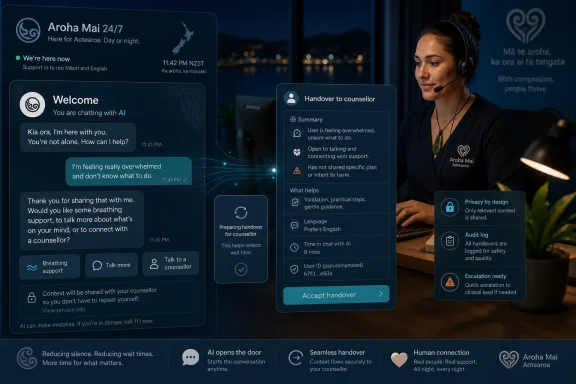
The customer story focuses on an AI service called “Welcome,” built using Microsoft’s AI stack and connected to Copilot Studio-style agent work. Welcome greets people who contact the 1737 SMS service or Women’s Refuge webchat, gathers initial context, and keeps the person engaged while they wait for a counsellor. When the counsellor joins, the human does not begin from a cold start.
That is a modest brief, but it is also a serious one. The agent is not being sold as a therapist, diagnostician, or replacement clinician. It is being used as a front-door continuity layer—a way to turn a queue from silence into a structured handoff.
Microsoft’s story says at-risk contacts—people seeking support who may be at risk of harming themselves or others—have nearly doubled in five years. It also says mental health contacts now take 50 percent longer on average. Those two pressures compound: more urgent contacts, each requiring more time, flowing into systems that still depend on trained professionals who cannot be infinitely scaled.
That is why Welcome is not merely a chatbot feature. Its purpose is to reduce abandonment at the most precarious point in the interaction. The first response tells the person they have arrived somewhere, the waiting period becomes conversational rather than silent, and the eventual counsellor receives context before beginning support.
For IT pros, this is the kind of problem AI is actually well suited to attack. Not “replace the expert,” but “remove the dead air around the expert.” Not “make clinical judgment,” but “collect, route, summarize, and preserve context so the trained human can spend more time doing the work only a trained human should do.”
That distinction is critical. The safer framing for AI in frontline care is not “AI as clinician,” but AI as intake infrastructure. The agent can ask bounded questions, collect essential information, identify context, and maintain engagement. It should not improvise therapy, speculate about risk, or present itself as a human.
Whakarongorau’s approach appears to reflect that boundary. People are told whether they are interacting with AI or a human. Confidentiality, privacy, and auditability are described as non-negotiable. The design process was shaped by Te Korowai, a framework grounded in Te Ao Māori values, including manaakitanga—upholding dignity and wellbeing—and whanaungatanga, the practice of building connection, trust, and belonging.
That cultural and ethical layer is not a soft add-on. It is operational risk management. In sensitive services, the system’s tone, timing, disclosure, escalation paths, and data handling are all part of care quality. The AI does not become safer merely because Microsoft says Copilot Studio has responsible AI controls; it becomes safer when the deploying organization narrows its job and designs around the people most likely to be harmed by mistakes.
Whakarongorau is using that stack in several ways. One agent helps staff search across hundreds of clinical, non-clinical, and technical policies. Microsoft says roughly 30 percent of the organization uses it. Microsoft 365 Copilot has been adopted across support teams, with the customer story claiming 97 percent of licensed users use it daily.
The reported productivity gains are the sort Microsoft loves to foreground: back-office tasks that once took a week now take an hour, frontline notes can be summarized automatically, and staff share prompts and tips internally. Those numbers should be read as customer-reported outcomes, not a universal benchmark. But they illustrate Microsoft’s larger strategy clearly enough.
The company does not want Copilot to be just a button in Word. It wants Copilot to become a configurable layer across business process, employee knowledge, and customer-facing service. In that framing, Welcome is not an isolated healthcare bot. It is a demonstration of how Microsoft wants organizations to stitch together knowledge retrieval, intake, summarization, compliance controls, and human handoff into one AI-mediated workflow.
Welcome’s purpose, at least as described, is not to keep people away from counsellors. It is to keep them connected long enough to reach one. That difference should shape how administrators evaluate similar systems.
A bad deployment would celebrate fewer human interactions even if vulnerable people disengaged. A better deployment would ask whether more people stayed in the channel, whether counsellors received useful context, whether risk escalation improved, whether users understood they were interacting with AI, and whether the system reduced emotional and administrative load on staff.
This is where Microsoft’s story has wider relevance beyond New Zealand. Many public-sector and healthcare organizations face the same contradiction: demand is rising, staff are stretched, and the services most in need of modernization are often the least tolerant of careless automation. AI cannot solve workforce scarcity by magic, but it can change the shape of work around scarce expertise.
That means identity, role-based access, logging, audit retention, data residency, endpoint security, prompt governance, and incident response all matter. It also means the organization needs a lifecycle for agents: who owns them, who approves changes, who reviews failures, who tests escalation paths, and who can shut them down when something goes wrong.
The hardest governance issue may be content drift. Traditional workflows fail in familiar ways: an API times out, a queue backs up, a database becomes unavailable. Generative systems can fail more ambiguously. They can sound confident while being wrong, infer where they should not infer, or respond appropriately in testing and unpredictably in edge cases.
Microsoft’s documentation around Copilot Studio emphasizes grounding, access controls, content safety, auditing, and responsible AI practices. Those controls are necessary. They are not sufficient by themselves. In high-stakes environments, the operational culture around the tool is as important as the platform features inside it.
A good handoff should preserve the user’s own words where appropriate, distinguish observed facts from generated summaries, flag uncertainty, and make clear what the AI did and did not ask. It should not launder a messy conversation into false certainty. In a clinical-adjacent setting, “clean” summaries can be dangerous if they erase ambiguity.
This is a broader point for any organization deploying agents into human workflows. The output is not valuable because it is generated quickly. It is valuable only if the next human in the chain can use it safely.
That means interface design matters as much as model choice. Counsellors need context without cognitive overload. Supervisors need audit trails without drowning in telemetry. Users need reassurance without deception. The agent’s success depends on whether all three groups can understand what happened.
Whakarongorau gives Microsoft a stronger narrative. It shows Copilot and Azure AI operating inside an organization with real demand pressure, public-service obligations, and emotionally sensitive contacts. It also gives Microsoft a chance to argue that enterprise AI’s future lies in controlled agents rather than open-ended chat.
That argument is commercially convenient. Copilot Studio, Microsoft 365 Copilot, Azure, Power Platform, Entra, Purview, and Dynamics-adjacent workflows all become more valuable when customers believe agents need a governed platform rather than a standalone bot. Microsoft is not just selling intelligence; it is selling the management plane around intelligence.
For customers, that can be either reassuring or constraining. The integrated Microsoft stack may reduce procurement and governance complexity for organizations already deep in Microsoft 365 and Azure. It can also increase platform dependency, licensing exposure, and architectural lock-in. The tradeoff is not unique to AI, but AI raises the stakes because these systems increasingly sit in live service delivery rather than back-office experimentation.
Whakarongorau’s deployment suggests one workable answer: disclose the machine, limit its authority, design with frontline staff and affected communities, keep humans responsible for care, and use automation to reduce silence rather than replace judgment. That is not a perfect formula, but it is a better starting point than the industry’s frequent obsession with agent autonomy.
The involvement of external lived-experience voices, as described by Microsoft, is also important. AI systems built for vulnerable users should not be designed only by product teams, executives, and compliance officers. They need input from people who understand how systems feel when approached from a position of fear, trauma, confusion, or urgency.
This is where health and social-service AI should diverge from ordinary enterprise automation. The question is not simply whether the workflow becomes faster. It is whether the person seeking help experiences the system as more reachable, more respectful, and less likely to drop them in a gap.
For administrators, the question is shifting from “Should we allow Copilot?” to “Which workflows are appropriate for AI, under what controls, and with which human review model?” That is a more mature conversation—and a more difficult one.
Whakarongorau’s case also underscores the unevenness of AI value. A generic assistant that writes meeting notes may save minutes. An agent that reduces abandonment in a crisis-adjacent queue could change the effective capacity of a service. The same underlying technology can be trivial or consequential depending on where it is inserted.
That is why IT leaders should resist both extremes: the vendor fantasy that AI agents are plug-and-play transformation engines, and the reflexive dismissal that all chatbots are dressed-up autocomplete. The real question is whether a narrowly scoped agent can improve a specific workflow with measurable safeguards. In this case, the answer appears plausibly yes—but only because the scope is narrow and the human boundary is explicit.
 Microsoft’s Strongest AI Story Is Not the Flashiest One
The enterprise AI market has spent the last two years trying to make chatbots sound grander than they are. Every product is an “agent,” every workflow is “autonomous,” and every vendor deck promises a productivity revolution that somehow begins with summarizing meetings. Whakarongorau’s deployment is more grounded, and therefore more interesting.The organization runs free, 24/7 telehealth services across New Zealand, including Healthline, the 1737 mental health line, Quitline, and services connected to family violence and sexual harm support. Microsoft says Whakarongorau supported more than 700,000 people last year across more than 1.1 million contacts. That scale matters because the problem is not abstract digital transformation; it is the practical reality of too many vulnerable people arriving at once and not enough trained humans being instantly available.
The customer story focuses on an AI service called “Welcome,” built using Microsoft’s AI stack and connected to Copilot Studio-style agent work. Welcome greets people who contact the 1737 SMS service or Women’s Refuge webchat, gathers initial context, and keeps the person engaged while they wait for a counsellor. When the counsellor joins, the human does not begin from a cold start.
That is a modest brief, but it is also a serious one. The agent is not being sold as a therapist, diagnostician, or replacement clinician. It is being used as a front-door continuity layer—a way to turn a queue from silence into a structured handoff.
The Queue Is the Product Nobody Wants to Talk About
In consumer software, latency is an annoyance. In crisis-adjacent care, latency is part of the service. A person who has taken years to build up the courage to send a message may not wait patiently through a blank screen, a dead channel, or a vague “someone will be with you shortly.”Microsoft’s story says at-risk contacts—people seeking support who may be at risk of harming themselves or others—have nearly doubled in five years. It also says mental health contacts now take 50 percent longer on average. Those two pressures compound: more urgent contacts, each requiring more time, flowing into systems that still depend on trained professionals who cannot be infinitely scaled.
That is why Welcome is not merely a chatbot feature. Its purpose is to reduce abandonment at the most precarious point in the interaction. The first response tells the person they have arrived somewhere, the waiting period becomes conversational rather than silent, and the eventual counsellor receives context before beginning support.
For IT pros, this is the kind of problem AI is actually well suited to attack. Not “replace the expert,” but “remove the dead air around the expert.” Not “make clinical judgment,” but “collect, route, summarize, and preserve context so the trained human can spend more time doing the work only a trained human should do.”
The Guardrails Are the Story, Not the Decoration
The obvious risk in a deployment like this is overreach. A bot that mishandles a routine password reset creates a ticket. A bot that mishandles a distressed person can create harm. Microsoft’s customer story is careful to say Welcome does not diagnose, counsel, treat, or provide clinical advice.That distinction is critical. The safer framing for AI in frontline care is not “AI as clinician,” but AI as intake infrastructure. The agent can ask bounded questions, collect essential information, identify context, and maintain engagement. It should not improvise therapy, speculate about risk, or present itself as a human.
Whakarongorau’s approach appears to reflect that boundary. People are told whether they are interacting with AI or a human. Confidentiality, privacy, and auditability are described as non-negotiable. The design process was shaped by Te Korowai, a framework grounded in Te Ao Māori values, including manaakitanga—upholding dignity and wellbeing—and whanaungatanga, the practice of building connection, trust, and belonging.
That cultural and ethical layer is not a soft add-on. It is operational risk management. In sensitive services, the system’s tone, timing, disclosure, escalation paths, and data handling are all part of care quality. The AI does not become safer merely because Microsoft says Copilot Studio has responsible AI controls; it becomes safer when the deploying organization narrows its job and designs around the people most likely to be harmed by mistakes.
Copilot Studio Moves From Office Helper to Service Fabric
For WindowsForum readers, the Microsoft product angle is familiar but worth separating from the marketing haze. Copilot Studio is Microsoft’s low-code and pro-code environment for building agents that can operate across channels, use organizational data, and connect to workflows. Microsoft 365 Copilot is the more visible productivity layer sitting inside apps like Teams, Outlook, Word, and Excel. Azure provides the infrastructure and AI services underneath more customized deployments.Whakarongorau is using that stack in several ways. One agent helps staff search across hundreds of clinical, non-clinical, and technical policies. Microsoft says roughly 30 percent of the organization uses it. Microsoft 365 Copilot has been adopted across support teams, with the customer story claiming 97 percent of licensed users use it daily.
The reported productivity gains are the sort Microsoft loves to foreground: back-office tasks that once took a week now take an hour, frontline notes can be summarized automatically, and staff share prompts and tips internally. Those numbers should be read as customer-reported outcomes, not a universal benchmark. But they illustrate Microsoft’s larger strategy clearly enough.
The company does not want Copilot to be just a button in Word. It wants Copilot to become a configurable layer across business process, employee knowledge, and customer-facing service. In that framing, Welcome is not an isolated healthcare bot. It is a demonstration of how Microsoft wants organizations to stitch together knowledge retrieval, intake, summarization, compliance controls, and human handoff into one AI-mediated workflow.
The Healthcare Lesson Is That AI Should Shrink the Distance to Humans
The AI industry often talks about “deflection” as a success metric: how many contacts can be handled without a human. That metric has its place in retail support, password resets, parcel tracking, and internal help desks. In mental health and family violence services, the better metric may be connection rather than deflection.Welcome’s purpose, at least as described, is not to keep people away from counsellors. It is to keep them connected long enough to reach one. That difference should shape how administrators evaluate similar systems.
A bad deployment would celebrate fewer human interactions even if vulnerable people disengaged. A better deployment would ask whether more people stayed in the channel, whether counsellors received useful context, whether risk escalation improved, whether users understood they were interacting with AI, and whether the system reduced emotional and administrative load on staff.
This is where Microsoft’s story has wider relevance beyond New Zealand. Many public-sector and healthcare organizations face the same contradiction: demand is rising, staff are stretched, and the services most in need of modernization are often the least tolerant of careless automation. AI cannot solve workforce scarcity by magic, but it can change the shape of work around scarce expertise.
The Administrator’s Burden Does Not Disappear
For sysadmins and IT leaders, deployments like this are inspiring and uncomfortable in equal measure. They show what modern Microsoft cloud tooling can do, but they also expand the administrative perimeter. Once an AI agent becomes part of a service pathway, it must be governed like production infrastructure, not treated like an experiment.That means identity, role-based access, logging, audit retention, data residency, endpoint security, prompt governance, and incident response all matter. It also means the organization needs a lifecycle for agents: who owns them, who approves changes, who reviews failures, who tests escalation paths, and who can shut them down when something goes wrong.
The hardest governance issue may be content drift. Traditional workflows fail in familiar ways: an API times out, a queue backs up, a database becomes unavailable. Generative systems can fail more ambiguously. They can sound confident while being wrong, infer where they should not infer, or respond appropriately in testing and unpredictably in edge cases.
Microsoft’s documentation around Copilot Studio emphasizes grounding, access controls, content safety, auditing, and responsible AI practices. Those controls are necessary. They are not sufficient by themselves. In high-stakes environments, the operational culture around the tool is as important as the platform features inside it.
The Human Handoff Becomes the New Critical Interface
The most consequential design point in Welcome is the handoff. If the AI gathers context but the counsellor cannot trust, parse, or act on it, the system merely moves friction from one place to another. If the summary is too thin, it wastes time. If it is too assertive, it risks biasing the human.A good handoff should preserve the user’s own words where appropriate, distinguish observed facts from generated summaries, flag uncertainty, and make clear what the AI did and did not ask. It should not launder a messy conversation into false certainty. In a clinical-adjacent setting, “clean” summaries can be dangerous if they erase ambiguity.
This is a broader point for any organization deploying agents into human workflows. The output is not valuable because it is generated quickly. It is valuable only if the next human in the chain can use it safely.
That means interface design matters as much as model choice. Counsellors need context without cognitive overload. Supervisors need audit trails without drowning in telemetry. Users need reassurance without deception. The agent’s success depends on whether all three groups can understand what happened.
Microsoft Gets a Better Case Study Than a Demo Reel
Microsoft has produced plenty of Copilot stories that amount to familiar productivity theatre: faster emails, shorter meetings, better summaries, fewer manual searches. Those are useful, but they rarely settle the deeper question of whether generative AI can improve consequential services rather than merely polish office work.Whakarongorau gives Microsoft a stronger narrative. It shows Copilot and Azure AI operating inside an organization with real demand pressure, public-service obligations, and emotionally sensitive contacts. It also gives Microsoft a chance to argue that enterprise AI’s future lies in controlled agents rather than open-ended chat.
That argument is commercially convenient. Copilot Studio, Microsoft 365 Copilot, Azure, Power Platform, Entra, Purview, and Dynamics-adjacent workflows all become more valuable when customers believe agents need a governed platform rather than a standalone bot. Microsoft is not just selling intelligence; it is selling the management plane around intelligence.
For customers, that can be either reassuring or constraining. The integrated Microsoft stack may reduce procurement and governance complexity for organizations already deep in Microsoft 365 and Azure. It can also increase platform dependency, licensing exposure, and architectural lock-in. The tradeoff is not unique to AI, but AI raises the stakes because these systems increasingly sit in live service delivery rather than back-office experimentation.
The Responsible AI Debate Is Moving Out of the Lab
It is easy to talk about responsible AI in abstract terms: fairness, transparency, accountability, privacy, safety. It is harder to decide what those words mean when a distressed person sends a text at 2 a.m. and the first reply comes from a machine.Whakarongorau’s deployment suggests one workable answer: disclose the machine, limit its authority, design with frontline staff and affected communities, keep humans responsible for care, and use automation to reduce silence rather than replace judgment. That is not a perfect formula, but it is a better starting point than the industry’s frequent obsession with agent autonomy.
The involvement of external lived-experience voices, as described by Microsoft, is also important. AI systems built for vulnerable users should not be designed only by product teams, executives, and compliance officers. They need input from people who understand how systems feel when approached from a position of fear, trauma, confusion, or urgency.
This is where health and social-service AI should diverge from ordinary enterprise automation. The question is not simply whether the workflow becomes faster. It is whether the person seeking help experiences the system as more reachable, more respectful, and less likely to drop them in a gap.
The WindowsForum Angle Is the Enterprise Reality Behind the Headline
Although the story is not about Windows in the narrow desktop sense, it sits squarely inside the world many WindowsForum readers manage every day. Microsoft’s AI push is no longer confined to consumer Copilot prompts or Windows 11 taskbar debates. It is becoming part of identity, productivity, service delivery, compliance, endpoint strategy, and cloud architecture.For administrators, the question is shifting from “Should we allow Copilot?” to “Which workflows are appropriate for AI, under what controls, and with which human review model?” That is a more mature conversation—and a more difficult one.
Whakarongorau’s case also underscores the unevenness of AI value. A generic assistant that writes meeting notes may save minutes. An agent that reduces abandonment in a crisis-adjacent queue could change the effective capacity of a service. The same underlying technology can be trivial or consequential depending on where it is inserted.
That is why IT leaders should resist both extremes: the vendor fantasy that AI agents are plug-and-play transformation engines, and the reflexive dismissal that all chatbots are dressed-up autocomplete. The real question is whether a narrowly scoped agent can improve a specific workflow with measurable safeguards. In this case, the answer appears plausibly yes—but only because the scope is narrow and the human boundary is explicit.
The Practical Read From Whakarongorau’s Copilot Bet
The lesson from Whakarongorau is not that every support line should rush to put an AI greeter in front of vulnerable users. It is that AI becomes more defensible when it is used to preserve human connection rather than simulate it.- Welcome is designed to keep people engaged while they wait for a counsellor, not to replace counselling or provide clinical advice.
- The most important technical feature may be the handoff, because collected context only matters if the human recipient can trust and use it safely.
- Copilot Studio’s enterprise value is strongest when agents are bounded by governance, identity, auditability, and organizational data controls.
- Microsoft’s customer story shows productivity gains in both frontline and back-office work, but those gains should be treated as deployment-specific rather than universal.
- The deployment’s ethical framing, including transparency about AI interaction and culturally grounded design, is central to the risk model rather than peripheral branding.
- For IT teams, agent lifecycle management is now part of production operations, including ownership, testing, monitoring, escalation, and shutdown procedures.
References
- Primary source: Microsoft
Published: Fri, 29 May 2026 01:13:15 GMT
Whakarongorau uses Copilot Studio for faster, more connected telehealth care | Microsoft Customer Stories
With Copilot and AI agents, New Zealand’s telehealth provider is cutting admin time, enhancing mental health support and freeing up staff to focus on direct care.www.microsoft.com
