

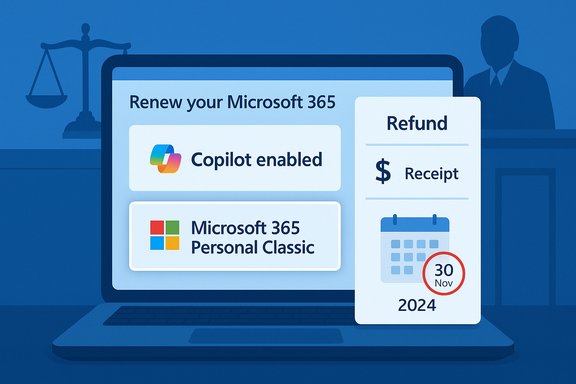
Microsoft’s attempt to defuse an Australian consumer-protection complaint by apologising and offering refunds has had the opposite effect: the company’s admission and remedial offer have sharpened the regulator’s allegations, broadened public scrutiny, and handed the Australian Competition and Consumer Commission (ACCC) a richer evidentiary record to pursue its Federal Court case.
Background
Microsoft integrated its generative‑AI assistant, Copilot, into consumer Microsoft 365 Personal and Family subscriptions and adjusted prices for those plans. In Australia the headline retail changes were substantial: Microsoft 365 Personal rose from A$109 to A$159 and Microsoft 365 Family from A$139 to A$179, moves that caught regulatory attention because many customers were on auto‑renewal.The ACCC alleges Microsoft’s targeted renewal communications gave a misleading binary choice — accept Copilot and pay the higher renewal price, or cancel — while a materially different option, the Microsoft 365 Personal/Family Classic plans (which preserved pre‑increase pricing and omitted Copilot), was effectively hidden inside a cancellation flow and not disclosed contemporaneously. The regulator estimates roughly 2.7 million Australian subscribers could be affected and commenced Federal Court proceedings seeking declarations, injunctions, consumer redress and penalties.
Microsoft responded with a public apology to affected subscribers in Australia and New Zealand, instructions on how to switch back to the Classic plans, and a refund program that offers eligible customers the price difference for qualifying renewals — a move designed to remediate consumer harm quickly. The company says refunds will apply from the first renewal after 30 November 2024 for subscribers who switch to Classic before 31 December 2025, and that refunds will be processed to the payment method used within 30 days of eligibility.
Why the refund offer looks like an apology — and why that matters
Microsoft’s customer-facing message acknowledged it “fell short” in communicating subscription alternatives and set out three options: stay on the Copilot-enabled plan, switch to Microsoft 365 Classic at the prior price (and claim a refund), or cancel. On its face, this looks like a sensible customer-relief package: acknowledgement, a tangible remedy, and an operational mechanism to make victims whole.But from a regulatory and litigation perspective, the apology and refund offer have three counterintuitive effects:
- They increase the visibility of the very omission the ACCC alleges, making the regulator’s narrative and evidence more concrete to customers and observers.
- They generate operational records — who received the outreach, who switched, how many refunds were processed, refund amounts and timestamps — that may be usable in court. Microsoft’s remedial actions thus create documentary trails that can corroborate (or complicate) the ACCC’s claims.
- They amplify reputational damage because a corporate apology is publicly perceived as an admission of fault, even when it is expressed as “we could have been clearer.” That optics problem can influence public debate, media coverage and possibly judicial impressions.
The legal theory at the centre of the ACCC case
The ACCC’s claim turns on omissions and choice architecture rather than on Microsoft’s right to change products or prices. Under Australian Consumer Law, an omission of material information that is likely to mislead a reasonable consumer can be actionable. The ACCC’s case is therefore framed as an allegation that the renewal communications (emails and public blog posts) conveyed an incomplete set of options at the critical decision point for auto‑renewing customers — effectively steering customers toward higher-priced AI-enabled plans.Key factual elements the ACCC has highlighted include:
- Targeted renewal emails sent to auto‑renewing subscribers that, according to the ACCC, presented a binary alternative: accept Copilot and the higher price, or cancel.
- Evidence (screenshots and account‑flow captures) showing the Classic plan only surfaced when a consumer initiated the cancellation flow — meaning ordinary renewers likely never saw it.
- The ACCC’s estimate of the affected cohort, which it puts at about 2.7 million Australians. That figure anchors the scale of the alleged harm while remaining the regulator’s estimate pending judicial findings.
What’s verifiable and what remains uncertain
Verifiable claims (publicly accessible and corroborated by multiple outlets and Microsoft’s own messaging):- Microsoft publicly apologised to affected subscribers and published instructions about switching to Microsoft 365 Classic and claiming refunds.
- Microsoft described the refund eligibility window (first renewal after 30 November 2024; switch to Classic before 31 December 2025) and the mechanics for processing refunds.
- The ACCC initiated Federal Court proceedings alleging misleading conduct related to the Copilot rollout and renewal communications.
- The precise number of customers who were actually charged the higher price and subsequently eligible for refunds remains a live operational metric that Microsoft has not fully disclosed. The 2.7 million number is the ACCC’s estimate and should be treated as such until judicial fact-finding or company disclosure confirms it.
- Industry‑reported estimates of total monetary exposure (headline figures quoted in some media pieces) are speculative until the Court orders redress or Microsoft reports aggregate refund totals.
- Operational details of refunds in complex billing scenarios (multi-currency accounts, third‑party resellers, regional tax treatments) are not yet publicly audited. Those operational frictions will matter in practice and in any enforcement outcome.
Why UX and “choice architecture” are now legal issues
The ACCC’s action reframes certain product-design choices as potential compliance failures. If an alternative that materially affects price and functionality is discoverable only through an exit path — a cancellation flow — regulators will increasingly view that as functionally equivalent to concealment. The debate is less about whether companies can change prices or introduce AI features and more about how they inform existing customers at the precise moment they must decide whether to accept an automatic renewal.Design‑oriented regulatory scrutiny will focus on three core elements:
- Visibility: Are materially different plan alternatives shown prominently at the point of renewal?
- Clarity: Do communications plainly explain feature and price differences so customers can make an informed choice?
- Accessibility: Is moving between plans straightforward or does it require counter‑intuitive steps that only the most motivated customers will take?
Practical consequences: for Microsoft customers
Immediate, practical guidance for affected Microsoft 365 subscribers in Australia (drawn from Microsoft’s outreach and the regulator’s complaint):- Check email inboxes and account renewal notices for any Microsoft message outlining options for Microsoft 365. Microsoft’s communications are the first place to confirm eligibility for the Classic plan and refunds.
- If you prefer the older price and feature set, switch to Microsoft 365 Personal/Family Classic before Microsoft’s stated deadline (the company has communicated a switching cutoff) to preserve refund eligibility.
- Keep documentation: save screenshots of renewal notices, the Microsoft account flow, confirmation pages, and receipts. If the ACCC or the Courts require evidence, these materials will be important.
- Track refunds: Microsoft has said refunds will be processed to the original payment method within ~30 days of the switch; if that does not occur, escalate through Microsoft support and retain records for any regulatory complaints.
Practical consequences: for product teams and subscription businesses
This episode delivers several concrete product and legal lessons:- Treat renewal notices and automatic-renewal communications as legal touchpoints, not marketing collateral. Legal and compliance review should be mandatory before sending notices that affect recurring billing.
- Make all materially different alternatives discoverable at the point of decision. Avoid burying a legacy or lower‑cost option in an exit or cancellation flow.
- Maintain audit trails of communication variants and UX experiments. Internal records — timestamps, A/B group allocations, rendered screens — will become key evidence in any later regulatory inquiry.
- Consider opt‑in or grandfathering approaches when adding monetised AI capabilities to existing subscriptions to avoid surprise price changes for long‑standing customers.
Strengths and weaknesses in Microsoft’s response
A balanced assessment of Microsoft’s handling to date:Strengths
- Rapid remediation: Microsoft moved quickly to contact affected customers, apologise, and outline a concrete remedy, which reduces immediate consumer outcry and can limit short‑term damage.
- Operational simplicity (if executed well): Automating refunds to the payment method on file and providing a clear SKU-switch path minimises friction for customers who want to revert.
- Public acknowledgement: The apology, even if carefully worded, signals responsiveness and a willingness to correct communication mistakes.
- Perception of concealment: Burying a lower‑cost option inside a cancellation flow looks like deliberate obfuscation, regardless of intent, and that perception intensifies regulatory scrutiny and media criticism.
- Remedies don’t erase litigation risk: Microsoft’s voluntary refund program does not preclude the ACCC from seeking broader remedies, including penalties and injunctive relief that could require systemic changes.
- Operational friction can undercut the remedy: If refunds are processed slowly, or if links and account pages misdirect users (reports of greyed‑out buttons and wrong SKUs have already surfaced), the remedial program may perform poorly in practice and harm Microsoft’s position.
Wider implications: precedent, regulation and the monetisation of AI
This case is more than a dispute between one regulator and one vendor; it is a potential precedent for how democracies regulate the monetisation of AI inside subscription products. Regulators elsewhere will watch the Federal Court proceedings for signals about disclosure expectations for AI upgrades, and product teams globally will likely revisit default behaviours when integrating monetised AI features. Potential systemic implications include:- Firms may shift toward explicit opt‑in architectures for paid AI features rather than default inclusion with price increases.
- Regulators may insist that legacy or cheaper alternatives be conspicuously displayed in renewal communications.
- Enforcement actions may expand to other jurisdictions where auto‑renewal and default settings are ubiquitous, increasing the compliance burden for global subscription services.
What to watch next
Key milestones and signals that will determine the case’s trajectory:- Federal Court timetable and discovery: How readily the ACCC gains access to internal Microsoft communications, A/B test logs, and UX telemetry will be decisive. Discovery could reveal whether the placement of the Classic option was intentional or an oversight.
- Operational data from Microsoft’s remedy: The rate of plan switches, the number and value of refunds processed, and reports of processing friction will be material and publicly reported. Those metrics can bolster or weaken the ACCC’s view of the scale of harm.
- Regulatory echo: Other consumer-protection agencies and competition authorities will watch closely; any public statements or inquiries in other jurisdictions will indicate whether the issue becomes a global enforcement theme.
Final assessment
Microsoft’s refund offer was a necessary tactical move to limit immediate consumer harm and to demonstrate responsiveness. However, it was also strategically risky: by publicising the Classic option and the price differential, Microsoft increased the visibility of the alleged omission, generated documentary evidence via remediation logs, and amplified reputational damage. The episode crystallises a new battleground in digital consumer protection — the intersection of subscription UX, dark‑pattern risks, and the monetisation of AI capabilities.For customers, the practical takeaway is to review renewal notices, preserve receipts and screenshots, and follow Microsoft’s switching instructions if they want a refund. For product and legal teams, the lesson is stark and operational: treat renewal UX as a legal obligation, not a marketing opportunity. The Federal Court proceedings in Australia will not only resolve this dispute but will also shape how subscription businesses worldwide present AI upgrades to loyal customers.
The case is ongoing. The ACCC’s figures and industry estimates should be treated cautiously until the Court determines factual findings or the parties disclose definitive remediation totals; meanwhile, the broader regulatory and design lessons are clear and urgent.
Source: The Age https://www.theage.com.au/business/...ears-to-backfire-20251105-p5n83b.html?ref=rss
