

Microsoft Copilot’s rewrite capability has become one of the clearest examples of how generative AI is moving from novelty to daily utility. Microsoft’s official product guidance now describes Copilot as a tool that can draft emails, adjust length and tone, and rewrite selected sections inside Outlook and other Microsoft 365 surfaces, which fits the company’s long-running vision of AI as a productivity layer rather than a separate app. That shift matters because rewriting is not just a cosmetic convenience; it changes how fast people can communicate, how confidently they can communicate, and how much time they spend revising what they already know how to say.
Microsoft first introduced Microsoft 365 Copilot in March 2023, positioning it as a whole new way to work across Word, Excel, PowerPoint, Outlook, and Teams. In the months that followed, the company pushed Copilot deeper into enterprise workflows, then broadened the experience under the simpler Microsoft Copilot brand so users could encounter the assistant across Microsoft 365, Windows, Edge, and the web. That branding evolution matters because rewrite features are only powerful when they are embedded where people already compose, edit, and send messages.
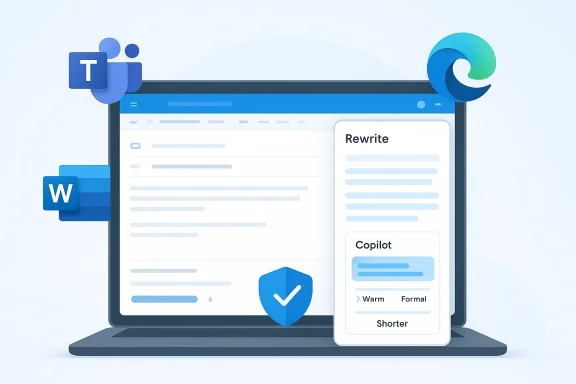
The rewrite use case is deceptively simple. A user types a rough email, selects a tone or refinement option, and asks Copilot to make the message shorter, warmer, more formal, or more compelling. Microsoft’s documentation for email composition and release notes now explicitly highlight rewriting as a core capability, not an experimental afterthought. In practice, that places Copilot in direct competition with grammar tools, writing assistants, and standalone AI chat products that have been chasing the same “draft faster, edit less” promise.
What makes the 2026 conversation different is that Copilot is no longer being pitched only as a typing aid. Microsoft has been moving toward a broader agentic model, in which Copilot can draft, refine, and eventually help complete work with less back-and-forth. That broader direction is visible in the company’s recent Copilot updates and leadership framing, which emphasize a connected stack spanning the Copilot experience, the Copilot platform, Microsoft 365 apps, and the underlying AI models. The rewrite feature sits at the center of that strategy because it is the everyday behavior that teaches users to trust the system.
At the same time, Microsoft’s own guidance reminds enterprises that Copilot inherits permissions and data boundaries rather than bypassing them. That is a major point for business buyers because the value of rewrite assistance is closely tied to access, compliance, and governance. If the assistant can safely work inside the content an employee is already allowed to use, then rewriting becomes a low-friction entry point for broader AI adoption.
Microsoft’s current Copilot guidance shows that rewrite is now part of a broader composition workflow rather than a standalone command. In Outlook-style scenarios, users can ask Copilot to draft a message, adjust the tone, or rewrite only part of the content. That makes the tool especially relevant for professionals who spend hours softening blunt messages, shortening long explanations, or rewording customer-facing replies so they sound polished instead of rushed.
That also changes the economics of communication. Instead of spending ten minutes refining a message, an employee can spend ten seconds generating a workable version and then five seconds checking whether the result matches the intent. The productivity gain is not just faster typing; it is faster decision-making around language, which is a quieter but more important form of efficiency. That distinction is easy to miss, but it is the real business story.
The company’s early Copilot announcements emphasized help with meeting summaries, document generation, and content creation across Microsoft 365. Since then, Microsoft has expanded the experience so that Copilot feels less like a novelty and more like a utility embedded into the workflow. Rewrite features fit perfectly into that transition because they are frequent, lightweight, and easy to understand.
This is especially true in roles where language is part of the deliverable. Customer support agents, account managers, recruiters, HR teams, and internal communications staff all spend time balancing clarity with diplomacy. A rewrite engine that can reframe a message in a more formal tone, a warmer tone, or a more concise tone becomes a force multiplier in those workflows.
Microsoft has already used Copilot case studies to argue that AI can reduce administrative friction and accelerate routine knowledge work. Even when exact productivity numbers vary by role and implementation, the directional effect is clear: if rewriting becomes instantaneous, then employees can spend more time on substantive decisions and less on phrasing. That is where the ROI story becomes credible.
Competitors such as Grammarly, Google’s AI writing experiences, and standalone chatbot tools all attack pieces of the same problem. But Microsoft can connect rewrite to identity, document context, meeting history, and enterprise permissions in ways that point solutions often cannot. That makes the rewrite feature less of a one-off utility and more of an ecosystem hook.
The company is also benefiting from a moment in the market when enterprises increasingly want fewer tools, not more. If Copilot can handle rewriting inside Outlook, Word, Teams, and other Microsoft apps, buyers may prefer that over adding another vendor to their stack. The result is a competitive moat built not just on AI quality, but on workflow consolidation.
For consumers, Copilot rewrite is about confidence and speed. For enterprises, it becomes a governance issue as much as a productivity feature. Microsoft’s enterprise guidance stresses security and privacy inheritance, commercial data protection, and the fact that Copilot works within existing permissions. That makes rewrite easier to adopt in controlled environments, but it also raises the bar for administrators.
The enterprise case is also more valuable because it can be measured. If a team uses Copilot to reduce response times, improve consistency, or lower rework, that has operational implications. Consumer use is helpful, but enterprise use is where the rewrite feature becomes part of budget justification and software standardization.
The challenge is not just whether the model is secure. It is whether the surrounding workflow is safe, auditable, and appropriately permissioned. Microsoft’s support and Learn materials show that data may be processed outside a local region in some scenarios and that organizations need to understand feature-specific terms. That does not make Copilot unusable; it makes careful governance unavoidable.
Microsoft’s enterprise posture is built around the idea that users remain in control and should review, fact-check, and fine-tune AI-generated content. That principle is especially important for rewriting because the best text is often not the most fluent text; it is the text that says exactly what the author intends. Fluency without accountability is not enough.
The company’s pricing and packaging strategy reinforces that view. Microsoft has separated consumer, business, and enterprise experiences, with deeper integration and more governance typically reserved for the paid tiers. That segmentation allows the company to spread awareness broadly while keeping the most valuable capabilities attached to Microsoft 365 licensing.
There is also an expansion effect. If rewrite becomes part of daily email work, then Copilot stops being an occasional assistant and becomes a routine dependency. Routine dependency is what software vendors dream about, because it is the difference between an experiment and a recurring business line.
A final concern is strategic. Microsoft wants Copilot to feel ubiquitous, but ubiquity can turn into complexity if users cannot tell which version they are using, what it can access, and what it is allowed to do. In an AI product, clarity of capability is almost as important as capability itself.
The key question is whether rewrite remains a convenience feature or becomes part of a larger communication system. If Microsoft can tie it more tightly to meeting context, document history, customer data, and enterprise policy, then rewrite could evolve from “make this sound better” into “make this fit the situation better.” That would move the feature from editing to judgment, which is where the real value lies.
Source: blockchain.news Microsoft Copilot Rewrite Feature: Latest 2026 Update and Business Impact Analysis | AI News Detail
 Overview
Microsoft first introduced Microsoft 365 Copilot in March 2023, positioning it as a whole new way to work across Word, Excel, PowerPoint, Outlook, and Teams. In the months that followed, the company pushed Copilot deeper into enterprise workflows, then broadened the experience under the simpler Microsoft Copilot brand so users could encounter the assistant across Microsoft 365, Windows, Edge, and the web. That branding evolution matters because rewrite features are only powerful when they are embedded where people already compose, edit, and send messages.The rewrite use case is deceptively simple. A user types a rough email, selects a tone or refinement option, and asks Copilot to make the message shorter, warmer, more formal, or more compelling. Microsoft’s documentation for email composition and release notes now explicitly highlight rewriting as a core capability, not an experimental afterthought. In practice, that places Copilot in direct competition with grammar tools, writing assistants, and standalone AI chat products that have been chasing the same “draft faster, edit less” promise.
What makes the 2026 conversation different is that Copilot is no longer being pitched only as a typing aid. Microsoft has been moving toward a broader agentic model, in which Copilot can draft, refine, and eventually help complete work with less back-and-forth. That broader direction is visible in the company’s recent Copilot updates and leadership framing, which emphasize a connected stack spanning the Copilot experience, the Copilot platform, Microsoft 365 apps, and the underlying AI models. The rewrite feature sits at the center of that strategy because it is the everyday behavior that teaches users to trust the system.
At the same time, Microsoft’s own guidance reminds enterprises that Copilot inherits permissions and data boundaries rather than bypassing them. That is a major point for business buyers because the value of rewrite assistance is closely tied to access, compliance, and governance. If the assistant can safely work inside the content an employee is already allowed to use, then rewriting becomes a low-friction entry point for broader AI adoption.
The Rewrite Feature in Context
The rewrite feature is best understood as the bridge between old-school writing support and modern generative AI. Traditional editors could catch typos and suggest grammar fixes, but Copilot can reshape tone, compress a message, or make a draft more persuasive while preserving intent. That is a meaningful qualitative jump, because it turns editing from a mechanical cleanup task into a contextual communication decision.Microsoft’s current Copilot guidance shows that rewrite is now part of a broader composition workflow rather than a standalone command. In Outlook-style scenarios, users can ask Copilot to draft a message, adjust the tone, or rewrite only part of the content. That makes the tool especially relevant for professionals who spend hours softening blunt messages, shortening long explanations, or rewording customer-facing replies so they sound polished instead of rushed.
Why rewriting matters more than it sounds
A rewrite tool is valuable because workplace communication is full of friction that looks small but adds up. People often know what they mean but struggle to package it in the right tone for a manager, customer, supplier, or colleague. Copilot reduces that effort by offering a first-pass transformation that users can then accept, tweak, or reject.That also changes the economics of communication. Instead of spending ten minutes refining a message, an employee can spend ten seconds generating a workable version and then five seconds checking whether the result matches the intent. The productivity gain is not just faster typing; it is faster decision-making around language, which is a quieter but more important form of efficiency. That distinction is easy to miss, but it is the real business story.
- Rewrite reduces time spent on first drafts.
- It makes tone changes accessible to non-writers.
- It lowers the cost of professional polish.
- It helps users adapt the same message for different audiences.
- It supports faster iteration in customer communication.
Microsoft’s Product Strategy
Microsoft is not treating rewrite as a side feature; it is folding it into a larger platform narrative. Copilot is increasingly presented as the AI layer across Microsoft’s productivity estate, and message rewriting is one of the simplest ways to demonstrate value inside that stack. That is smart product design because it gives users an immediate “aha” moment without requiring them to learn advanced prompts or build custom agents.The company’s early Copilot announcements emphasized help with meeting summaries, document generation, and content creation across Microsoft 365. Since then, Microsoft has expanded the experience so that Copilot feels less like a novelty and more like a utility embedded into the workflow. Rewrite features fit perfectly into that transition because they are frequent, lightweight, and easy to understand.
From assistant to platform
The real strategic shift is from “ask a chatbot” to “use a platform that understands your work.” Microsoft’s recent positioning around Copilot experience, Copilot platform, Microsoft 365 apps, and AI models suggests a layered model where the rewrite function is just one interface on top of deeper context and governance. That means the business value comes not just from generating text, but from generating text that is grounded in a user’s actual work environment.- Copilot becomes more valuable when embedded, not isolated.
- Rewrite is the easiest feature to sell internally.
- Platform depth creates stickiness across Microsoft 365.
- Contextual rewriting is more useful than generic paraphrasing.
- Integration raises switching costs for customers.
Business Impact on Productivity
For businesses, the rewrite feature is most valuable when it trims the invisible labor that surrounds communication. Employees do not just write emails; they draft, reread, soften, shorten, and re-send them. Copilot compresses that cycle and, at scale, even small savings can translate into measurable productivity gains across sales, support, operations, and leadership teams.This is especially true in roles where language is part of the deliverable. Customer support agents, account managers, recruiters, HR teams, and internal communications staff all spend time balancing clarity with diplomacy. A rewrite engine that can reframe a message in a more formal tone, a warmer tone, or a more concise tone becomes a force multiplier in those workflows.
Where the time savings show up
The most obvious savings are in first drafts and revisions. The less obvious savings are in reduced cognitive load, because users no longer have to decide from scratch how to phrase every sentence. That matters in high-volume environments where communication fatigue is a real cost.Microsoft has already used Copilot case studies to argue that AI can reduce administrative friction and accelerate routine knowledge work. Even when exact productivity numbers vary by role and implementation, the directional effect is clear: if rewriting becomes instantaneous, then employees can spend more time on substantive decisions and less on phrasing. That is where the ROI story becomes credible.
- Faster response times in customer-facing roles.
- More consistent communication across teams.
- Less editing time for managers and executives.
- Better support for multilingual and cross-cultural teams.
- Lower friction in high-volume email workflows.
Competitive Landscape
Microsoft’s rewrite capability lands in a crowded market, but the company’s advantage is not that it writes better in isolation. Its advantage is distribution. By putting AI rewriting directly inside the suite where millions of workers already spend their day, Microsoft can make the feature feel native rather than optional.Competitors such as Grammarly, Google’s AI writing experiences, and standalone chatbot tools all attack pieces of the same problem. But Microsoft can connect rewrite to identity, document context, meeting history, and enterprise permissions in ways that point solutions often cannot. That makes the rewrite feature less of a one-off utility and more of an ecosystem hook.
Why integration beats novelty
A writing assistant can impress a user once. A deeply integrated assistant can become habitual. That difference is enormous in software, because habits are what turn a feature into a platform and a platform into recurring revenue. Microsoft’s product design seems aimed at that second outcome.The company is also benefiting from a moment in the market when enterprises increasingly want fewer tools, not more. If Copilot can handle rewriting inside Outlook, Word, Teams, and other Microsoft apps, buyers may prefer that over adding another vendor to their stack. The result is a competitive moat built not just on AI quality, but on workflow consolidation.
- Microsoft wins on embedded distribution.
- Rivals win on specialized writing depth.
- Enterprise buyers prefer fewer vendors.
- Native context can outperform generic prompting.
- Habit formation is the long-term prize.
Enterprise vs Consumer Use
Consumer rewrite use cases are usually about convenience. People want to sound nicer, shorter, clearer, or less awkward in everyday messages. In business settings, however, the stakes are higher because message tone can affect customer trust, employee relations, compliance posture, and legal exposure.For consumers, Copilot rewrite is about confidence and speed. For enterprises, it becomes a governance issue as much as a productivity feature. Microsoft’s enterprise guidance stresses security and privacy inheritance, commercial data protection, and the fact that Copilot works within existing permissions. That makes rewrite easier to adopt in controlled environments, but it also raises the bar for administrators.
Different expectations, different risks
A consumer might happily accept a polished rewrite with minor imperfections. A business user cannot always do that, especially when the message is going to a customer, regulator, or executive. That means enterprises will want more review, more policy controls, and more confidence that the rewritten text preserves meaning.The enterprise case is also more valuable because it can be measured. If a team uses Copilot to reduce response times, improve consistency, or lower rework, that has operational implications. Consumer use is helpful, but enterprise use is where the rewrite feature becomes part of budget justification and software standardization.
- Consumers seek convenience.
- Enterprises seek control and measurable ROI.
- Business users need stronger review habits.
- Admins care about data handling and policy.
- Compliance concerns can slow deployment.
Privacy, Security, and Governance
Any rewrite feature that touches real business correspondence has to confront privacy head-on. Microsoft’s documentation repeatedly emphasizes that Copilot inherits the organization’s security, compliance, and privacy policies rather than training on tenant data. That is essential for enterprise acceptance because rewriting only becomes safe enough for business use when the surrounding governance story is credible.The challenge is not just whether the model is secure. It is whether the surrounding workflow is safe, auditable, and appropriately permissioned. Microsoft’s support and Learn materials show that data may be processed outside a local region in some scenarios and that organizations need to understand feature-specific terms. That does not make Copilot unusable; it makes careful governance unavoidable.
Why governance is part of the product
Rewrite tools can accidentally amplify mistakes if users trust the output too quickly. A message that sounds smoother may still carry the wrong implication, omit a critical caveat, or overstate a commitment. In regulated industries, that is a serious issue because tone changes can alter legal meaning as well as style.Microsoft’s enterprise posture is built around the idea that users remain in control and should review, fact-check, and fine-tune AI-generated content. That principle is especially important for rewriting because the best text is often not the most fluent text; it is the text that says exactly what the author intends. Fluency without accountability is not enough.
- Permission boundaries limit overexposure of data.
- Human review is still required for high-stakes writing.
- Data residency and processing rules matter to buyers.
- Compliance teams will want auditability.
- Sensitive sectors may need stricter policy settings.
Market Position and Monetization
Copilot rewrite is not just a feature; it is a monetization wedge. Microsoft has spent years teaching the market that AI belongs inside productivity software, and rewriting is among the easiest behaviors to convert into paid usage because it is immediate, understandable, and repeatable. That makes it useful for customer acquisition and for seat expansion inside existing accounts.The company’s pricing and packaging strategy reinforces that view. Microsoft has separated consumer, business, and enterprise experiences, with deeper integration and more governance typically reserved for the paid tiers. That segmentation allows the company to spread awareness broadly while keeping the most valuable capabilities attached to Microsoft 365 licensing.
How rewrite supports the revenue model
Rewrite is a low-friction feature that helps justify the broader Copilot proposition. Users may not buy an AI platform because of one feature, but they often begin to believe in the platform because of one feature. Once that belief is established, Microsoft can upsell broader productivity, security, and workflow value.There is also an expansion effect. If rewrite becomes part of daily email work, then Copilot stops being an occasional assistant and becomes a routine dependency. Routine dependency is what software vendors dream about, because it is the difference between an experiment and a recurring business line.
- Rewrite drives product familiarity.
- Familiarity supports paid conversion.
- Paid conversion supports bundle strategy.
- Bundle strategy improves stickiness.
- Stickiness strengthens Microsoft’s ecosystem moat.
Strengths and Opportunities
The strongest case for Copilot rewrite is that it solves a real, everyday problem with very little user education. It is easy to understand, easy to demonstrate, and easy to scale across large organizations. Microsoft’s advantage is that the feature lives inside the software many businesses already pay for, which creates immediate distribution leverage and a credible path to recurring revenue.- Immediate usefulness in email-heavy workflows.
- Strong fit for enterprise productivity budgets.
- Natural upsell into broader Copilot usage.
- Better tone control for customer-facing teams.
- Reduced editing friction for managers and executives.
- Deeper integration than standalone writing tools.
- Strong fit for multilingual and global teams.
Risks and Concerns
The biggest risk is overtrust. Users may accept a rewrite that sounds polished but subtly changes meaning, softens a critical warning, or introduces a tone that does not match the relationship or the moment. In a business setting, that kind of error can create confusion, reputational damage, or even legal exposure.- Rewrites can distort meaning while improving style.
- Overreliance may weaken employees’ own writing judgment.
- Sensitive content may create compliance concerns.
- Regional processing and data handling can worry buyers.
- Pricing complexity may slow adoption.
- Product fragmentation can confuse users across surfaces.
- Poor policy settings can create governance gaps.
A final concern is strategic. Microsoft wants Copilot to feel ubiquitous, but ubiquity can turn into complexity if users cannot tell which version they are using, what it can access, and what it is allowed to do. In an AI product, clarity of capability is almost as important as capability itself.
Looking Ahead
The next phase of Copilot rewrite will likely be less about flashy new prompts and more about reliability, context, and workflow depth. Microsoft’s broader Copilot roadmap suggests that the company wants AI to handle not just generation, but orchestration, with rewrite remaining the most familiar on-ramp into that future. That makes the feature strategically important well beyond the confines of email editing.The key question is whether rewrite remains a convenience feature or becomes part of a larger communication system. If Microsoft can tie it more tightly to meeting context, document history, customer data, and enterprise policy, then rewrite could evolve from “make this sound better” into “make this fit the situation better.” That would move the feature from editing to judgment, which is where the real value lies.
What to watch next
- Broader rollout of rewrite features across Microsoft 365 surfaces.
- Whether enterprises tighten governance around AI-generated messages.
- New controls for tone, length, and audience-specific formatting.
- Evidence that rewrite reduces response time and rework at scale.
- How Microsoft differentiates Copilot from standalone writing assistants.
Source: blockchain.news Microsoft Copilot Rewrite Feature: Latest 2026 Update and Business Impact Analysis | AI News Detail
