

AvePoint is expanding its Confidence Platform around a deceptively simple premise: an AI agent should be governed, secured, and recoverable like any other business-critical digital asset. The company’s July 21 update adds what it describes as first-to-market backup and recovery for Microsoft Copilot Studio agents, extends AgentPulse visibility to Salesforce Agentforce, introduces policy-based agent guardrails, and broadens protection across ServiceNow, Amazon S3, Azure Kubernetes Service, and Microsoft Entra External ID. Together, the changes represent more than a routine backup catalog expansion—they show how data protection vendors are racing to become the control plane for an enterprise technology estate increasingly divided among Microsoft clouds, competing SaaS platforms, container infrastructure, and autonomous software agents.
AvePoint built much of its reputation around Microsoft 365 migration, governance, and cloud backup. That focus made sense during the first major wave of enterprise cloud adoption, when organizations needed to move mailboxes, SharePoint sites, Teams workspaces, and business records out of on-premises systems while preserving permissions, retention controls, and recoverability.
The operating environment is now considerably more complicated. A typical enterprise may still depend heavily on Microsoft 365, but its important business processes can also span Salesforce, ServiceNow, Google Workspace, Amazon Web Services, Azure subscriptions, Kubernetes clusters, Power Platform applications, and custom integrations connecting them all.
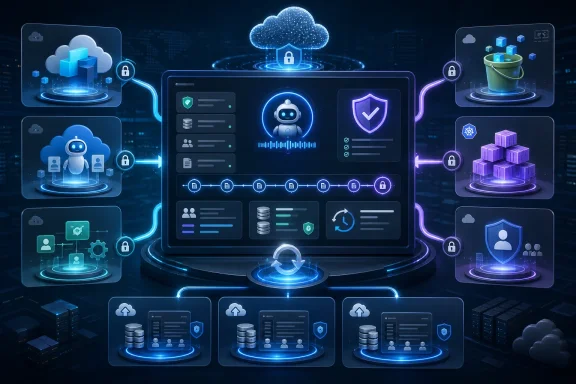
The Confidence Platform attempts to bridge those administrative domains. Rather than asking a security, compliance, or backup team to manage every service independently, AvePoint wants organizations to discover assets centrally, identify owners, evaluate configuration risks, apply policies, and recover protected content through a common operating model.
The latest release pushes AgentPulse further into operational resilience. Backing up the agent itself—not merely the business data that it accesses—turns agent governance into a configuration-protection discipline. That distinction will become increasingly important as agents accumulate complex instructions, flows, connectors, authentication dependencies, and business logic.
That ability changes the risk calculation. An incorrect answer from a chatbot is undesirable; an autonomous agent acting on an incorrect interpretation can alter operational data or initiate a chain of downstream actions.
AvePoint’s 2026 State of AI study, based on a survey of 750 IT leaders in financial services, healthcare, and government, found that 46.9 percent of employees relied on agents daily or weekly. The same research said 17.6 percent of surveyed organizations could not determine whether workers were using unsanctioned AI tools, nearly three times the reported percentage in the prior year.
These figures come from vendor-sponsored research and should be interpreted accordingly. Even so, the direction aligns with what many administrators already recognize: AI adoption can move faster than procurement, security review, and configuration management.
Microsoft already provides lifecycle mechanisms for moving Copilot Studio agents between Power Platform environments. Agents can be included in solutions, exported, imported, updated, and deployed through application lifecycle management processes. That is valuable, but application packaging and operational backup serve different purposes.
Those questions diverge when citizen developers make changes through graphical tools, when a component is omitted from a solution, or when production configuration evolves outside the formal release process. Microsoft’s own documentation notes that not every agent property or associated resource necessarily transfers through solution export, particularly when knowledge sources, custom topics, connectors, or related Dataverse components are stored separately.
AvePoint’s value will therefore depend on the completeness of its recovery set. Customers will need to determine whether a restored agent includes every dependent element required to function, as well as which items must be reauthenticated, relinked, or recreated.
Enterprises should treat agent recovery as a tested process rather than a product checkbox. That means defining recovery objectives, restoring into isolated environments, validating permissions, testing connected flows, and documenting which components remain outside the protected boundary.
This expansion is strategically important because enterprise agent adoption will not remain confined to one vendor. Microsoft has a strong position through Microsoft 365, Azure, Power Platform, and Copilot Studio, while Salesforce can embed Agentforce directly into customer relationship management, service, sales, and industry workflows.
A cross-platform view can help answer questions such as:
Customers should examine how AvePoint maps platform-specific conditions into common risk categories. A label such as “ownerless,” “inactive,” or “overexposed” must be based on rules clear enough for administrators to verify and challenge.
Salesforce itself emphasizes a shared responsibility model in which the platform provides foundational protections while customers configure permissions, data access, and agent guardrails. AvePoint adds another layer to that model, but it does not transfer accountability away from the organization operating the agent.
That interval is where risk often accumulates. Discovery without remediation can generate an impressive dashboard while leaving the underlying exposure unchanged.
An agent without a responsible owner can continue running after a project ends or an employee changes roles. Its connectors may retain access, its instructions may grow stale, and its outputs may no longer be monitored by anyone familiar with the original business purpose.
Automated ownership policies can help, but organizations need escalation rules for cases in which no suitable owner exists. Simply copying ownership to a manager or global administrator may satisfy a database requirement without creating meaningful accountability.
Sensitivity-aware policy can connect agent governance to existing classification systems. In practice, this could allow an organization to impose stricter review, logging, authentication, or deployment requirements when an agent can reach confidential repositories.
The difficult part is maintaining that context as connections change. If an administrator adds a new knowledge source or flow after approval, the agent’s effective risk level may increase even though its display name and stated purpose remain the same.
AvePoint has not eliminated the need for native platform controls, data loss prevention policies, conditional access, identity governance, or secure development practices. Its opportunity is to coordinate those disciplines and make policy drift visible before it becomes an incident.
This addresses a less fashionable but persistent problem: enterprise applications often outlive their original sponsors, permissions, secrets, and documentation.
Conversely, credentials that never expire can become long-lived security liabilities. Governance must balance continuity with the need to rotate secrets, review privileges, and eliminate abandoned integrations.
Lifecycle automation can help teams identify expiring components and track renewal responsibility. The larger benefit is organizational: it makes the dependency visible before an outage forces administrators to reverse-engineer it under pressure.
A policy applied at the wrong scope could affect many workloads at once. AvePoint must therefore provide granular role separation, clear previews, strong audit trails, and safe exception mechanisms if customers are to trust centralized automation across Azure estates.
For Windows-focused administrators, the shift is especially relevant. Microsoft cloud operations increasingly connect Entra identity, Intune configuration, Azure Virtual Desktop, Power Platform, and Microsoft 365, even when different internal teams manage each service.
The expansion also reflects customer reality. Multicloud does not always result from a deliberate architectural strategy; it frequently emerges through acquisitions, departmental choices, application requirements, and vendor dependencies.
Independent backup may still be valuable when organizations want separation from production credentials, centralized retention, cross-platform reporting, or recovery workflows not dependent on the same administrative boundary as the source. It can also help protect against mistakes that affect versioning or lifecycle configuration.
Customers should verify whether AvePoint protects object versions, metadata, tags, access-related configuration, retention states, and large-scale bucket structures. They should also understand restore throughput and the costs associated with transferring or retrieving significant volumes of cloud data.
Microsoft’s native Azure Kubernetes Service backup supports scheduled protection of cluster state and compatible persistent volumes, with granular restoration of namespaces or entire clusters under supported conditions. AvePoint enters a field where customers will compare its coverage, management experience, storage isolation, and multitenant capabilities against Azure-native services and established Kubernetes backup specialists.
A meaningful recovery plan must account for storage-driver support, application consistency, encryption, region availability, and dependencies outside the cluster. “AKS backup” can describe very different levels of protection, so prospective users should study the restore model rather than relying on the label.
Protecting identity configuration is therefore a business-continuity requirement as well as a security measure. A damaged policy or deleted configuration could interrupt access for a large external population even if the underlying application remains available.
Recovery also requires caution. Restoring an outdated identity state could reintroduce obsolete settings or interfere with legitimate security changes, making approval workflows and point-in-time selection particularly important.
ServiceNow records are not merely static documents. They may represent incidents, approvals, asset relationships, employee requests, configuration items, knowledge articles, and evidence needed for audits or investigations.
This distinction underpins the SaaS backup market. Platform resilience keeps the service operating; customer-controlled recovery helps an individual organization reverse changes within its own logical data set.
The strongest use case appears when a workflow spans multiple services. A ServiceNow request may trigger an identity change, update an Azure resource, create a Teams workspace, or invoke an automation. Recovering only one application can leave inconsistent state across the process.
Organizations should document the direction of dependencies and determine whether recovery must occur in a particular order. In complex cases, the backup platform supplies the recovery points while incident teams still perform the business-level reconciliation.
MSPs face the same governance problems as enterprises, multiplied across tenants with different configurations, budgets, regulatory requirements, and risk tolerances.
The operational gains are substantial:
MFA should be only one layer of defense. Providers also need phishing-resistant authentication where practical, conditional access, privileged access management, session controls, endpoint security, role minimization, and alerts for unusual cross-tenant behavior.
The feature also concentrates sensitive operational visibility. Providers will need tightly scoped roles and comprehensive logs so that technicians can manage assigned customers without gaining unnecessary access to other tenants or user-session information.
The challenge is preventing governance from becoming friction that pushes users toward unapproved alternatives.
The largest potential benefits include faster recovery, clearer ownership, consistent policy application, and improved visibility across environments. These gains are most valuable in organizations whose data and workflows already span several vendors.
If implemented poorly, however, centralized governance can slow legitimate experimentation. The best operating model will provide low-risk sandboxes and automated approval paths while reserving intensive review for agents that handle sensitive data or take consequential actions.
Those benefits depend on tested procedures. Backup coverage alone does not guarantee that a customer-facing process can be restored within an acceptable time.
Potential rivals include Microsoft and other cloud providers, established backup companies, SaaS management platforms, identity governance vendors, cloud security posture specialists, Kubernetes protection products, and emerging agent management platforms.
Breadth can also become a weakness if support is shallow. Enterprises will compare the fidelity, performance, and policy depth of a unified platform against specialist products that focus exclusively on one workload.
AvePoint must therefore demonstrate value above the native stack. Cross-cloud consistency, independent recovery, multitenant MSP operations, and richer automation are the most defensible differentiators.
A mature agent management platform may need to combine inventory, identity analysis, behavioral monitoring, policy enforcement, cost control, version history, evaluation, incident response, and recovery. AvePoint’s backup heritage gives it a distinctive entry point, but observability and real-time behavioral control may prove just as important as configuration protection.
Several questions will determine whether these additions become strategic controls or simply more entries in a feature matrix.
Independent testing should examine malicious prompt changes, deleted topics, broken flows, lost connectors, and restoration into alternate environments. The most convincing proof will be a repeatable recovery runbook rather than a successful demonstration involving a simple agent.
Such automation must remain explainable. Administrators need to know why a policy fired, what action occurred, and how to reverse an incorrect decision.
That evolution would bring AgentPulse into closer competition with AI security, model monitoring, and runtime protection platforms. It would also make the product more relevant to security operations centers investigating agent-linked incidents.
A business process may involve an Agentforce agent, ServiceNow records, S3 objects, an AKS-hosted service, and Entra identities. Showing each workload as “protected” is useful; restoring the full process in a controlled sequence is the harder and more valuable achievement.
AvePoint’s latest Confidence Platform expansion captures a turning point in enterprise IT: AI agents are ceasing to be disposable experiments and becoming durable operational assets that require owners, policies, audit trails, version history, and tested recovery. The company’s move into Copilot Studio agent backup, Salesforce Agentforce observability, ServiceNow protection, multicloud infrastructure, and MSP-scale automation gives it a credible foundation for that role, although execution will depend on recovery completeness and policy depth. As organizations grant agents access to more data and authority, the winners will not be those that deploy the greatest number fastest, but those that can prove what every agent is allowed to do, detect when it changes, and restore it safely when something goes wrong.
 Background
AvePoint built much of its reputation around Microsoft 365 migration, governance, and cloud backup. That focus made sense during the first major wave of enterprise cloud adoption, when organizations needed to move mailboxes, SharePoint sites, Teams workspaces, and business records out of on-premises systems while preserving permissions, retention controls, and recoverability.The operating environment is now considerably more complicated. A typical enterprise may still depend heavily on Microsoft 365, but its important business processes can also span Salesforce, ServiceNow, Google Workspace, Amazon Web Services, Azure subscriptions, Kubernetes clusters, Power Platform applications, and custom integrations connecting them all.
From collaboration governance to an enterprise trust layer
AvePoint describes its answer as a “trust layer” connecting governance, security, lifecycle management, backup, and recovery across the organization. The phrase is partly product positioning, but it identifies a genuine architectural problem: cloud platforms provide their own administrative and resilience capabilities, yet enterprises must apply consistent policies across platforms that were never designed to operate as one system.The Confidence Platform attempts to bridge those administrative domains. Rather than asking a security, compliance, or backup team to manage every service independently, AvePoint wants organizations to discover assets centrally, identify owners, evaluate configuration risks, apply policies, and recover protected content through a common operating model.
AgentPulse moves from monitoring to resilience
AgentPulse began as AvePoint’s answer to the visibility problem created by rapid AI agent adoption. Its Command Center reached general availability in early 2026, offering centralized discovery, governance, security posture assessment, and cost oversight for agents operating across supported cloud environments.The latest release pushes AgentPulse further into operational resilience. Backing up the agent itself—not merely the business data that it accesses—turns agent governance into a configuration-protection discipline. That distinction will become increasingly important as agents accumulate complex instructions, flows, connectors, authentication dependencies, and business logic.
Why AI Agents Need a Different Governance Model
Traditional generative AI tools mostly respond to prompts. Agentic systems can go further by planning tasks, choosing tools, querying enterprise repositories, triggering workflows, writing records, sending communications, and interacting with external systems.That ability changes the risk calculation. An incorrect answer from a chatbot is undesirable; an autonomous agent acting on an incorrect interpretation can alter operational data or initiate a chain of downstream actions.
Agents combine identity, logic, and data access
An enterprise agent is not just a language model wrapped in a user interface. It is better understood as a composite application containing several interdependent elements:- It has an identity, service account, or delegated user context that determines what it can access.
- It contains instructions, topics, prompts, conditions, and orchestration logic that determine what it should do.
- It connects to data stores, APIs, workflows, plug-ins, and other agents that expand what it can do.
- It produces logs, conversations, generated content, and business records that may require retention or review.
- It changes over time as administrators revise prompts, add connectors, and broaden deployment.
The agent estate can grow invisibly
Low-code tools make it possible for employees outside traditional development teams to build useful automations. They also make it easier for organizations to accumulate agents without centralized architecture reviews, formal ownership, or complete inventories.AvePoint’s 2026 State of AI study, based on a survey of 750 IT leaders in financial services, healthcare, and government, found that 46.9 percent of employees relied on agents daily or weekly. The same research said 17.6 percent of surveyed organizations could not determine whether workers were using unsanctioned AI tools, nearly three times the reported percentage in the prior year.
These figures come from vendor-sponsored research and should be interpreted accordingly. Even so, the direction aligns with what many administrators already recognize: AI adoption can move faster than procurement, security review, and configuration management.
Copilot Studio Backup Changes the Recovery Conversation
The most technically significant element of AvePoint’s announcement is backup and restoration for agents created in Microsoft Copilot Studio. AvePoint says AgentPulse can protect an agent’s configuration, logic, prompts, topics, orchestration, and flows, allowing administrators to return it to a known-good state.Microsoft already provides lifecycle mechanisms for moving Copilot Studio agents between Power Platform environments. Agents can be included in solutions, exported, imported, updated, and deployed through application lifecycle management processes. That is valuable, but application packaging and operational backup serve different purposes.
Deployment artifacts are not always recovery points
A managed release package answers the question, “What version did we intend to deploy?” A backup system should answer a different question: “What was actually present at a particular point, and how quickly can we restore it?”Those questions diverge when citizen developers make changes through graphical tools, when a component is omitted from a solution, or when production configuration evolves outside the formal release process. Microsoft’s own documentation notes that not every agent property or associated resource necessarily transfers through solution export, particularly when knowledge sources, custom topics, connectors, or related Dataverse components are stored separately.
AvePoint’s value will therefore depend on the completeness of its recovery set. Customers will need to determine whether a restored agent includes every dependent element required to function, as well as which items must be reauthenticated, relinked, or recreated.
Known-good recovery has several use cases
Agent backup is not limited to accidental deletion. It can support several increasingly plausible scenarios:- Administrators can reverse an erroneous prompt or orchestration change that causes unexpected behavior.
- Security teams can recover from malicious modification after determining when an agent’s instructions or connections were altered.
- Operations teams can restore a previous version when a newly published agent fails in production.
- Compliance personnel can preserve historical states to investigate how an agent was configured during a disputed transaction.
- Developers can compare versions to understand when behavior, access, or business logic changed.
Recovery testing will matter more than the backup button
A successful backup job does not prove that an agent can be restored into a usable state. Dependencies may have changed, credentials may have expired, connectors may point to missing resources, or an underlying schema may no longer match the recovered logic.Enterprises should treat agent recovery as a tested process rather than a product checkbox. That means defining recovery objectives, restoring into isolated environments, validating permissions, testing connected flows, and documenting which components remain outside the protected boundary.
Salesforce Agentforce Joins the Governance View
AgentPulse is also extending discovery and observability to Salesforce Agentforce. AvePoint says customers can now obtain a consistent view of agent activity across Microsoft, Google, and Salesforce environments rather than relying solely on separate platform consoles.This expansion is strategically important because enterprise agent adoption will not remain confined to one vendor. Microsoft has a strong position through Microsoft 365, Azure, Power Platform, and Copilot Studio, while Salesforce can embed Agentforce directly into customer relationship management, service, sales, and industry workflows.
Cross-platform visibility reduces administrative fragmentation
Native consoles remain essential because they expose the deepest platform-specific controls. The problem is that executives, risk teams, and managed service providers often need a higher-level inventory spanning all operating environments.A cross-platform view can help answer questions such as:
- Which production agents exist, and which business processes do they support?
- Who owns each agent, and is that owner still employed in the relevant role?
- What sensitive information can an agent reach?
- Which agents are inactive, duplicated, externally exposed, or unusually expensive?
- Which platforms contain agents that have not passed the organization’s current review process?
Common dashboards can hide important differences
Centralization also has limits. Copilot Studio and Agentforce use different data models, identity systems, development workflows, security layers, and deployment concepts. A single dashboard can normalize selected signals, but it cannot eliminate those architectural differences.Customers should examine how AvePoint maps platform-specific conditions into common risk categories. A label such as “ownerless,” “inactive,” or “overexposed” must be based on rules clear enough for administrators to verify and challenge.
Salesforce itself emphasizes a shared responsibility model in which the platform provides foundational protections while customers configure permissions, data access, and agent guardrails. AvePoint adds another layer to that model, but it does not transfer accountability away from the organization operating the agent.
Policy-Driven Guardrails Address the Ownership Gap
AgentPulse’s new agent-specific policies allow administrators to assign ownership, attach data-sensitivity context, and apply guardrails when agents are discovered. This is intended to shorten the interval between finding an unmanaged agent and bringing it under control.That interval is where risk often accumulates. Discovery without remediation can generate an impressive dashboard while leaving the underlying exposure unchanged.
Ownership is a technical control
Ownership is sometimes treated as an administrative field of little consequence. For agents, it determines who approves changes, reviews incidents, validates access, pays operating costs, and decides whether the agent remains necessary.An agent without a responsible owner can continue running after a project ends or an employee changes roles. Its connectors may retain access, its instructions may grow stale, and its outputs may no longer be monitored by anyone familiar with the original business purpose.
Automated ownership policies can help, but organizations need escalation rules for cases in which no suitable owner exists. Simply copying ownership to a manager or global administrator may satisfy a database requirement without creating meaningful accountability.
Sensitivity context must follow the data
An agent’s risk cannot be inferred solely from its name or platform. A seemingly ordinary support agent could have access to customer identity records, internal case notes, contractual details, or regulated health information.Sensitivity-aware policy can connect agent governance to existing classification systems. In practice, this could allow an organization to impose stricter review, logging, authentication, or deployment requirements when an agent can reach confidential repositories.
The difficult part is maintaining that context as connections change. If an administrator adds a new knowledge source or flow after approval, the agent’s effective risk level may increase even though its display name and stated purpose remain the same.
Guardrails require enforcement, not documentation
Written AI policies have limited value if platform controls do not enforce them. Effective guardrails should produce concrete outcomes such as restricting publication, generating remediation tasks, preventing anonymous access, limiting data connectors, or requiring review before sensitive actions are enabled.AvePoint has not eliminated the need for native platform controls, data loss prevention policies, conditional access, identity governance, or secure development practices. Its opportunity is to coordinate those disciplines and make policy drift visible before it becomes an incident.
Enterprise Application Lifecycle Controls Expand
Beyond AI agents, AvePoint is extending governance across enterprise applications, Microsoft Power Apps, Azure subscriptions, and resource groups. The company highlights automated imports and renewals intended to reduce manual tracking, prevent outages, and preserve audit-ready accountability.This addresses a less fashionable but persistent problem: enterprise applications often outlive their original sponsors, permissions, secrets, and documentation.
Application registrations create hidden dependencies
Cloud applications typically depend on identities, permissions, credentials, API consent, service principals, and configuration files. If a certificate or secret expires without warning, an otherwise healthy application can stop working immediately.Conversely, credentials that never expire can become long-lived security liabilities. Governance must balance continuity with the need to rotate secrets, review privileges, and eliminate abandoned integrations.
Lifecycle automation can help teams identify expiring components and track renewal responsibility. The larger benefit is organizational: it makes the dependency visible before an outage forces administrators to reverse-engineer it under pressure.
Azure scope increases the consequences of mistakes
Governance at the Azure subscription and resource-group level reaches beyond collaboration data. Those scopes may contain databases, virtual machines, storage accounts, Kubernetes clusters, networking resources, and production applications.A policy applied at the wrong scope could affect many workloads at once. AvePoint must therefore provide granular role separation, clear previews, strong audit trails, and safe exception mechanisms if customers are to trust centralized automation across Azure estates.
For Windows-focused administrators, the shift is especially relevant. Microsoft cloud operations increasingly connect Entra identity, Intune configuration, Azure Virtual Desktop, Power Platform, and Microsoft 365, even when different internal teams manage each service.
Multicloud Protection Broadens the Recovery Boundary
AvePoint is adding protection for AWS S3 storage, Azure Kubernetes environments, and Entra External ID. These sources represent very different kinds of state, reinforcing the company’s ambition to protect more than office documents and SaaS records.The expansion also reflects customer reality. Multicloud does not always result from a deliberate architectural strategy; it frequently emerges through acquisitions, departmental choices, application requirements, and vendor dependencies.
Amazon S3 is more than an object repository
S3 buckets can store application data, archives, exports, logs, media, analytics inputs, and backup files from other systems. Native capabilities such as versioning, replication, access logging, retention modes, and lifecycle policies can provide powerful resilience, but they must be configured correctly.Independent backup may still be valuable when organizations want separation from production credentials, centralized retention, cross-platform reporting, or recovery workflows not dependent on the same administrative boundary as the source. It can also help protect against mistakes that affect versioning or lifecycle configuration.
Customers should verify whether AvePoint protects object versions, metadata, tags, access-related configuration, retention states, and large-scale bucket structures. They should also understand restore throughput and the costs associated with transferring or retrieving significant volumes of cloud data.
Kubernetes protection must capture application state
Backing up Kubernetes requires more than copying container images. Images should already exist in registries; the difficult state resides in cluster objects, namespaces, secrets, configuration, operators, persistent volumes, and the external services on which the application depends.Microsoft’s native Azure Kubernetes Service backup supports scheduled protection of cluster state and compatible persistent volumes, with granular restoration of namespaces or entire clusters under supported conditions. AvePoint enters a field where customers will compare its coverage, management experience, storage isolation, and multitenant capabilities against Azure-native services and established Kubernetes backup specialists.
A meaningful recovery plan must account for storage-driver support, application consistency, encryption, region availability, and dependencies outside the cluster. “AKS backup” can describe very different levels of protection, so prospective users should study the restore model rather than relying on the label.
Entra External ID is identity infrastructure
Entra External ID supports customer and external-user identity scenarios. Its configuration can influence how customers, citizens, partners, or other outside parties authenticate to applications.Protecting identity configuration is therefore a business-continuity requirement as well as a security measure. A damaged policy or deleted configuration could interrupt access for a large external population even if the underlying application remains available.
Recovery also requires caution. Restoring an outdated identity state could reintroduce obsolete settings or interfere with legitimate security changes, making approval workflows and point-in-time selection particularly important.
ServiceNow Protection Targets Workflow-Critical Data
AvePoint’s addition of ServiceNow extends its multi-SaaS backup strategy into a platform that frequently supports IT service management, human resources, customer service, security operations, and enterprise workflow automation.ServiceNow records are not merely static documents. They may represent incidents, approvals, asset relationships, employee requests, configuration items, knowledge articles, and evidence needed for audits or investigations.
SaaS availability does not equal customer-level recovery
Major SaaS providers engineer their infrastructure for availability and platform resilience. That does not necessarily mean customers can recover every deleted record, overwritten field, malicious change, or configuration error at the required granularity.This distinction underpins the SaaS backup market. Platform resilience keeps the service operating; customer-controlled recovery helps an individual organization reverse changes within its own logical data set.
The strongest use case appears when a workflow spans multiple services. A ServiceNow request may trigger an identity change, update an Azure resource, create a Teams workspace, or invoke an automation. Recovering only one application can leave inconsistent state across the process.
Cross-application recovery remains difficult
AvePoint’s unified platform may simplify administration, but coordinated recovery is a harder problem than centralized backup. Restoring a ServiceNow record does not automatically undo actions previously triggered in Entra, Azure, Salesforce, or Microsoft 365.Organizations should document the direction of dependencies and determine whether recovery must occur in a particular order. In complex cases, the backup platform supplies the recovery points while incident teams still perform the business-level reconciliation.
AvePoint Elements Targets Managed Service Providers
The Elements Edition of the Confidence Platform is receiving updates aimed at managed service providers operating multiple customer environments. These include deeper Azure assessments, mandatory multifactor authentication, support for Center for Internet Security Level 2 baselines, multitenant baseline deployment, Azure Virtual Desktop session monitoring, and centralized application lifecycle capabilities.MSPs face the same governance problems as enterprises, multiplied across tenants with different configurations, budgets, regulatory requirements, and risk tolerances.
Baseline deployment can improve consistency
Multitenant baseline deployment allows a provider to push approved security and configuration standards across several customer tenants. This can reduce repetitive work and limit the drift that occurs when technicians configure every environment separately.The operational gains are substantial:
- Providers can apply common controls without repeating the same sequence tenant by tenant.
- Security teams can compare customers against a defined minimum posture.
- New tenants can be onboarded more consistently.
- Remediation campaigns can be executed faster when guidance changes.
- Audit evidence can be collected through a more standardized process.
Mandatory MFA protects privileged operations
Enforcing multifactor authentication for local users removes a dangerous category of optional security. MSP consoles are particularly attractive targets because one compromised technician account can provide access to multiple downstream customers.MFA should be only one layer of defense. Providers also need phishing-resistant authentication where practical, conditional access, privileged access management, session controls, endpoint security, role minimization, and alerts for unusual cross-tenant behavior.
Azure Virtual Desktop monitoring fills an operational gap
Centralized Azure Virtual Desktop session monitoring can help partners see host-pool activity and manage active sessions across tenants. This is useful for diagnosing stuck sessions, load problems, user-impacting failures, and capacity concerns.The feature also concentrates sensitive operational visibility. Providers will need tightly scoped roles and comprehensive logs so that technicians can manage assigned customers without gaining unnecessary access to other tenants or user-session information.
Consumer and Enterprise Impact
The announcement is primarily aimed at enterprises and service providers, but the consequences eventually reach end users. Better governance can reduce outages, lost work, privacy exposure, and unpredictable agent behavior in the applications employees use every day.The challenge is preventing governance from becoming friction that pushes users toward unapproved alternatives.
What enterprise administrators gain
For IT and security teams, the main attraction is consolidation. A common platform can reduce the number of disconnected inventories, backup consoles, spreadsheets, renewal calendars, and manually assembled compliance reports.The largest potential benefits include faster recovery, clearer ownership, consistent policy application, and improved visibility across environments. These gains are most valuable in organizations whose data and workflows already span several vendors.
What employees may notice
Employees may experience more controlled agent publication, additional approval steps, tighter connector restrictions, and quicker removal of inactive or noncompliant tools. They may also benefit from agents that can be restored after faulty changes instead of being rebuilt from memory.If implemented poorly, however, centralized governance can slow legitimate experimentation. The best operating model will provide low-risk sandboxes and automated approval paths while reserving intensive review for agents that handle sensitive data or take consequential actions.
What customers and external users gain
Protection for ServiceNow and Entra External ID can support continuity in customer-facing services. Better recovery may reduce the duration of authentication failures, missing cases, disrupted workflows, or lost service records.Those benefits depend on tested procedures. Backup coverage alone does not guarantee that a customer-facing process can be restored within an acceptable time.
Competitive Implications
AvePoint is positioning itself at the intersection of data protection, SaaS management, cloud security posture, AI governance, and application lifecycle management. That is an attractive market position, but it places the company in competition with several categories of vendor rather than one clearly defined peer group.Potential rivals include Microsoft and other cloud providers, established backup companies, SaaS management platforms, identity governance vendors, cloud security posture specialists, Kubernetes protection products, and emerging agent management platforms.
Platform breadth is AvePoint’s central argument
AvePoint’s pitch is that customers should not have to purchase and integrate a different governance or backup product for every new cloud service. The Confidence Platform can become more valuable as coverage expands because administrators gain consistency across sources.Breadth can also become a weakness if support is shallow. Enterprises will compare the fidelity, performance, and policy depth of a unified platform against specialist products that focus exclusively on one workload.
Microsoft remains both partner and competitor
AvePoint’s historical alignment with Microsoft gives it access to a large customer base and deep familiarity with Microsoft 365 and Power Platform. At the same time, Microsoft continues to add native governance, backup, security, and lifecycle features across its cloud portfolio.AvePoint must therefore demonstrate value above the native stack. Cross-cloud consistency, independent recovery, multitenant MSP operations, and richer automation are the most defensible differentiators.
Agent management is becoming a new software category
AvePoint calls attention to agent management platforms as enterprises move beyond isolated pilots. The category is still forming, and its eventual boundaries remain uncertain.A mature agent management platform may need to combine inventory, identity analysis, behavioral monitoring, policy enforcement, cost control, version history, evaluation, incident response, and recovery. AvePoint’s backup heritage gives it a distinctive entry point, but observability and real-time behavioral control may prove just as important as configuration protection.
Strengths and Opportunities
The release advances several practical capabilities rather than relying entirely on abstract AI-security claims.- Agent-level recovery addresses a real operational gap. Organizations need rollback mechanisms as Copilot Studio agents become production applications.
- Cross-platform discovery reflects multivendor reality. Supporting Microsoft, Google, and Salesforce environments can give governance teams a broader portfolio view.
- Policy-driven ownership can reduce orphaned assets. Automated accountability is especially useful in low-code environments with decentralized creation.
- ServiceNow and infrastructure coverage widen the protected business process. AvePoint can follow enterprise data beyond collaboration suites.
- MSP automation creates channel leverage. Multitenant baselines and centralized operations allow partners to deliver standardized services more efficiently.
- The combined governance-and-recovery model is compelling. Discovery identifies what exists, policy controls it, and backup provides a path back after failure.
Risks and Concerns
The announcement also raises questions that cannot be answered by the feature list alone.- The first-to-market claim requires careful qualification. Competing products may define agent export, versioning, replication, or recovery differently, so customers should evaluate capabilities rather than marketing labels.
- Restore completeness is crucial. An agent may depend on connectors, credentials, knowledge sources, Dataverse records, flows, and external APIs that are not equally recoverable.
- Centralization increases platform concentration risk. A governance console spanning many systems becomes a high-value target and requires exceptionally strong access controls.
- Automated policies can cause broad disruption. Incorrect baselines or ownership rules may affect multiple applications, subscriptions, or customer tenants.
- Cross-platform normalization may conceal differences. A common risk score is useful only if administrators can inspect the underlying evidence.
- Backup costs can rise rapidly. Object storage, Kubernetes volumes, SaaS retention, and frequent agent versions can produce significant storage and transfer expenses.
- Vendor research should not substitute for independent assessment. AvePoint’s incident statistics support its market argument, but organizations should measure their own agent inventory, exposure, and loss scenarios.
What to Watch Next
AvePoint plans to discuss its agent management and data protection work around Black Hat USA in August. The market should look beyond demonstrations and focus on recovery fidelity, policy transparency, licensing, workload limitations, and operational evidence from production deployments.Several questions will determine whether these additions become strategic controls or simply more entries in a feature matrix.
Recovery scope and testing
Customers need detailed documentation showing exactly which Copilot Studio components are captured, how versions are retained, and what happens to authentication and external dependencies after restore. Recovery time and scale will also matter for organizations managing hundreds or thousands of agents.Independent testing should examine malicious prompt changes, deleted topics, broken flows, lost connectors, and restoration into alternate environments. The most convincing proof will be a repeatable recovery runbook rather than a successful demonstration involving a simple agent.
Enforcement depth
AgentPulse’s value will grow if policies can trigger reliable remediation across platforms. Buyers should watch for controls that move beyond alerts into approval workflows, quarantine, publication restrictions, connector governance, and identity remediation.Such automation must remain explainable. Administrators need to know why a policy fired, what action occurred, and how to reverse an incorrect decision.
Expansion beyond configuration protection
Agent behavior can drift even when configuration remains unchanged because data, models, APIs, and external instructions change. AvePoint may eventually need deeper runtime signals that show not only how an agent is configured, but also what it is doing and whether its behavior remains within policy.That evolution would bring AgentPulse into closer competition with AI security, model monitoring, and runtime protection platforms. It would also make the product more relevant to security operations centers investigating agent-linked incidents.
Proof of unified recovery
The Confidence Platform’s larger promise is consistent resilience across SaaS, cloud infrastructure, and AI. The decisive test will be whether customers can coordinate recovery across those domains during a real incident.A business process may involve an Agentforce agent, ServiceNow records, S3 objects, an AKS-hosted service, and Entra identities. Showing each workload as “protected” is useful; restoring the full process in a controlled sequence is the harder and more valuable achievement.
AvePoint’s latest Confidence Platform expansion captures a turning point in enterprise IT: AI agents are ceasing to be disposable experiments and becoming durable operational assets that require owners, policies, audit trails, version history, and tested recovery. The company’s move into Copilot Studio agent backup, Salesforce Agentforce observability, ServiceNow protection, multicloud infrastructure, and MSP-scale automation gives it a credible foundation for that role, although execution will depend on recovery completeness and policy depth. As organizations grant agents access to more data and authority, the winners will not be those that deploy the greatest number fastest, but those that can prove what every agent is allowed to do, detect when it changes, and restore it safely when something goes wrong.
References
- Primary source: The Manila Times
Published: 2026-07-21T13:12:43+00:00
AvePoint Deepens the Trust Layer for Agentic AI, Enterprise Governance, and Multicloud Data Protection | The Manila Times
New capabilities strengthen agent governance, recoverability and backup, broaden control over enterprise apps and cloud infrastructure, and add protection for new SaaS and infrastructure environments www.manilatimes.net
- Related coverage: avepoint.com
AvePoint Research Reveals AI Visibility Gaps Have Nearly Tripled as AI Agents Scale and Almost Half of Enterprise Employees Now Rely on Agents Daily or Weekly | AvePoint
Third annual State of AI Report finds organizations lack the trust layer required to scale AI safely, as governance gaps, deployment delays, and AI-generated data are compounding the challengewww.avepoint.com
