

Microsoft shares rose on June 1, 2026, as investors reacted to reports of a unified Copilot push, Nvidia’s new Windows-focused RTX Spark silicon, GitHub Copilot’s shift to AI Credits, and fresh evidence that Microsoft’s AI business is growing quickly but becoming more expensive to run. The rally was not simply about another AI feature cycle. It was a vote of confidence in Microsoft’s attempt to turn Copilot from a scattered brand into a controlled computing layer. It was also a reminder that the bill for that strategy is now arriving.
For the last three years, Microsoft’s AI strategy has been easy to summarize and hard to experience cleanly. Copilot appeared in Windows, Edge, Microsoft 365, Teams, GitHub, Security, Azure, and consumer chat, often with different entry points, different permissions, different model behavior, and different licensing assumptions. The brand became omnipresent before the product became coherent.
That is why the reported push toward a more unified Copilot experience matters. If Microsoft is serious about merging consumer and enterprise Copilot flows into a single hub, the goal is not cosmetic simplification. The company is trying to make Copilot feel less like a button bolted onto every surface and more like the place where work begins, continues, and eventually completes itself.
The appointment of Jacob Andreou to lead a unified Copilot experience fits that shift. Microsoft said in March that it was bringing consumer and commercial Copilot work together under one effort, with Andreou responsible for design, product, growth, and engineering. That is not the kind of reorg a company makes when it believes the product is already self-explanatory.
The uncomfortable truth is that Copilot has had much more success as a strategic narrative than as a universal habit. GitHub Copilot is a real product with real developer adoption. Microsoft 365 Copilot is more complicated: powerful in the right workflows, expensive at scale, and still uneven enough that many organizations treat it as a pilot rather than a default seat entitlement. A unified app is Microsoft admitting that the sprawl itself has become part of the adoption problem.
That distinction matters because Microsoft’s advantage is not that it has the only capable model. It does not. Google, Anthropic, OpenAI, Meta, xAI, Mistral, and a long tail of coding and workflow startups are all pushing hard. Microsoft’s advantage is that it owns the workplace substrate where context already lives.
A unified Copilot hub would let Microsoft concentrate that context in one place. A user could move between personal and work accounts, between chat and agents, between a local Windows session and a cloud-backed workflow. For administrators, the promise is governance. For users, the promise is continuity. For Microsoft, the promise is leverage.
That leverage is also why regulators are paying attention. If Copilot becomes the default front end for Microsoft 365, Teams, Windows, Azure, and GitHub-adjacent work, competitors will not merely be fighting another chatbot. They will be fighting the default path through the modern Microsoft stack.
The old model was simple enough for buyers to understand. Pay a monthly fee and get access to a capable coding assistant. That worked when the product was mostly autocomplete, chat, and bounded interactions. It becomes strained when users expect autonomous coding agents, large-context debugging, multi-file refactors, test generation, code review, and repeated model calls that can run far beyond the cost profile of a simple suggestion.
Usage-based billing is GitHub’s way of aligning price with compute intensity. In plain English: a quick completion and a long-running agent task do not cost the same, and Microsoft no longer wants to pretend they do. The shift to AI Credits makes Copilot feel less like a fixed SaaS seat and more like a metered cloud service.
That will annoy some developers, especially those who had mentally filed Copilot under predictable tooling expenses. It will also force engineering managers to do something many have avoided: measure the productivity gain against the token burn. If a coding agent saves a senior developer three hours, the credit cost may be trivial. If it loops through speculative edits and burns through credits without producing reliable code, the economics look very different.
This is the broader AI market’s collision with reality. Vendors spent the first phase of the boom abstracting away inference cost to accelerate adoption. The next phase is about teaching customers that intelligence is not free, especially when it is invoked repeatedly, automatically, and with large context windows.
Even so, the scale of spending is staggering. Microsoft’s fiscal 2026 third-quarter commentary put capital expenditures above $30 billion for the quarter, with management pointing to cloud and AI infrastructure as the driver. The company has also signaled a roughly $190 billion calendar-year 2026 capital expenditure plan, a number that would have sounded absurd in the pre-generative-AI cloud era.
The bullish interpretation is straightforward. Microsoft is building the infrastructure for the next computing platform while demand is still outstripping supply. Its AI business has already crossed a tens-of-billions annualized run-rate, and Azure growth remains closely watched because investors see it as the cleanest readout of enterprise AI demand.
The bearish interpretation is equally straightforward. The company is spending at a level that requires sustained utilization, pricing power, and customer willingness to keep paying for AI features that remain uneven in daily use. If AI workloads become commoditized faster than expected, or if open models and specialized competitors undercut pricing, the capex burden could become a margin story rather than a growth story.
Microsoft’s task is to make the spending look like platform investment, not subsidy. GitHub’s credit shift is one small but important step in that direction. It tells the market that Microsoft will not absorb every marginal AI cost indefinitely just to maintain the illusion of flat-rate abundance.
Copilot+ PCs began with a relatively narrow proposition: efficient neural processing, local effects, live captions, Windows Studio features, and eventually Recall. Qualcomm had the early spotlight because its Arm chips delivered the battery life and NPU performance Microsoft wanted for the first wave. But the Copilot+ story has always needed more than one silicon supplier.
Nvidia changes the tone. Qualcomm made the AI PC feel like an efficiency play. Nvidia makes it feel like a workstation play. If RTX Spark-class hardware can run larger local models, heavier agent workflows, and GPU-accelerated creative or development tasks, Microsoft gets a more convincing answer to the question power users keep asking: why should AI make me buy a new PC?
That question matters for WindowsForum readers because the Windows ecosystem has been stuck between two eras. The traditional PC upgrade cycle has slowed, and many users do not need more CPU performance for browsing, Office, and video calls. AI gives the industry a new upgrade narrative, but only if the local features are useful enough to justify the hardware.
Recall remains the cautionary tale. Microsoft wanted it to be the iconic Copilot+ feature, then had to retreat and rework the privacy and security model after intense criticism. Nvidia-powered Windows AI PCs may create new possibilities, but the company still has to prove that local agents can be both powerful and trustworthy.
OEMs want choice. Enterprise buyers want roadmaps. Developers want a target that is broad enough to justify optimization work. If Dell, HP, ASUS, Lenovo, MSI, and Microsoft’s own Surface line can point to multiple AI PC classes, the market becomes less brittle.
There is still a compatibility wrinkle. Windows on Arm has improved substantially, but it is not invisible. Emulation is better, native app support is better, and many mainstream workflows are fine. But sysadmins know that “mostly compatible” is not the same as “safe to deploy everywhere,” especially in environments with old drivers, VPN clients, endpoint agents, line-of-business software, and weird peripherals that have survived three hardware refresh cycles.
Nvidia’s Windows AI hardware will therefore be judged on two tracks. Enthusiasts will ask how fast it runs models, games, creative workloads, and developer tools. IT departments will ask whether it can be imaged, secured, patched, managed, warrantied, and supported without creating a new exception category.
That is where Microsoft’s software consolidation and hardware alliance intersect. A unified Copilot layer is easier to sell if the endpoint story is credible. A new AI PC class is easier to sell if there is a visible software experience that needs it.
The product simplification is the Copilot consolidation story. Investors have watched Microsoft attach Copilot branding to nearly everything. A unified app suggests the company understands that distribution without coherence can become noise.
The hardware optionality is Nvidia. Microsoft gets a stronger answer to Apple Silicon, a more ambitious local-AI PC story, and a way to keep OEMs excited about premium Windows machines. Nvidia gets another route into the PC market at a moment when AI workloads are redefining what client hardware is supposed to do.
The monetization discipline is GitHub Copilot’s pricing change. It may be unpopular with some users, but Wall Street will recognize the signal. Microsoft is no longer treating AI inference as an invisible cost center. It is building mechanisms to meter, price, and shape demand.
But the risks are not theoretical. If Copilot adoption remains shallow outside developers and select enterprise workflows, the unified app will look like rearranged furniture. If AI Credits feel punitive, GitHub risks pushing heavy users toward Cursor, Claude Code, open-source stacks, or direct API workflows. If Nvidia-powered AI PCs are expensive niche devices, the Windows AI refresh could look more like ultrabook marketing than a platform shift.
Microsoft’s advantage in enterprise AI is that it can answer those questions in the language IT already uses: Entra ID, Purview, Defender, Intune, Conditional Access, sensitivity labels, audit logs, retention policies, and tenant boundaries. That is the pitch. Copilot is not merely a chatbot; it is a governed assistant inside the Microsoft security and compliance model.
The problem is that agentic computing raises the stakes. A search assistant retrieves information. An agent changes things. It can open tickets, edit files, generate pull requests, schedule meetings, query databases, update CRM records, or trigger workflows. The more useful Copilot becomes, the more consequential its permissions become.
That is why a unified Copilot app may actually make IT both happier and more nervous. Happier, because fewer scattered entry points should mean clearer governance and user education. More nervous, because a single hub that spans personal and work contexts, local and cloud actions, and human and autonomous workflows becomes a high-value control point.
The Windows angle is especially sensitive. Local AI features promise privacy and latency benefits, but they also introduce new policy questions. If an AI feature indexes user activity, captures screen context, or acts across applications, administrators need more than a toggle. They need defaults that do not create compliance surprises.
Teams already taught regulators how bundling works in modern enterprise software. Copilot raises the stakes because it can become the interface through which users consume the bundle. If the assistant is better because it has privileged access to Microsoft 365 context, and Microsoft 365 becomes stickier because Copilot is embedded throughout it, the flywheel is obvious.
Microsoft will argue that integration is exactly what customers want. There is truth in that. Nobody wants an enterprise AI assistant that cannot read the calendar, understand Teams meetings, respect document permissions, or work inside Word and Excel. Fragmentation is a real problem, and Microsoft can plausibly say it is solving it.
Competitors will argue that Microsoft is turning integration into foreclosure. There is truth there too. If third-party AI tools cannot access the same context, invoke the same workflows, or appear with the same prominence, “choice” becomes theoretical. The AI assistant market could become another layer where incumbency compounds.
The regulatory outcome will not arrive quickly enough to shape this week’s stock move. But it will shape the next several years of Microsoft’s AI rollout. The more Copilot becomes a workplace operating layer, the more governments will ask whether it is still just an app.
Government and defense contracts are not the same as consumer momentum, and they do not validate every AI feature. But they do validate Microsoft’s position as the default enterprise supplier for operating systems, productivity, collaboration, identity, cloud subscriptions, and licensing infrastructure. That matters because AI adoption in large organizations will be conservative, governed, and procurement-heavy.
A startup can win hearts with a brilliant coding tool or a better chat interface. Microsoft wins budgets by being already approved, already deployed, already integrated, and already covered by a master agreement. That is not glamorous, but it is enormously powerful.
The DoD deal also illustrates why Microsoft’s AI ambitions are inseparable from its licensing machine. Copilot does not have to win every user one at a time if it can be attached to broader enterprise agreements, security bundles, cloud commitments, and productivity renewals. The route to ubiquity is not only product love. It is procurement gravity.
That gravity can become a liability if customers feel trapped. But for now, it gives Microsoft something most AI challengers lack: a path from feature to standard operating environment.
Developers are unusually good at detecting when a tool’s economics have changed. They will notice if credits evaporate during agent sessions. They will compare Copilot against Cursor, Claude Code, direct model APIs, local models, and whatever open-source coding agent appears next week. They will share screenshots of surprising bills and benchmark the results in public.
That transparency is useful for the market. It will expose whether usage-based pricing maps cleanly to value or whether it creates anxiety that suppresses experimentation. The best outcome for Microsoft is that teams learn to treat AI coding work like cloud compute: monitored, budgeted, optimized, and justified by output. The worst outcome is that developers feel nickel-and-dimed and route around the platform.
There is also a cultural issue. Copilot began as a product that felt almost magical because the meter was hidden. Once the meter is visible, the relationship changes. Users start asking whether this prompt is worth it, whether this model is too expensive, whether an agent should keep running, and whether a cheaper tool would do.
That may be healthy. The industry needs less magical thinking around AI costs. But it means Microsoft has to compete on both capability and trust. A metered assistant must be good enough that users do not resent the meter.
For local AI to matter, it needs to become situationally indispensable. A developer should be able to run a code agent against a local repository without sending every file to the cloud. A video editor should be able to use generative tools without waiting on remote capacity. A security analyst should be able to triage sensitive artifacts locally. A knowledge worker should be able to search and summarize personal work history with confidence that the data boundary is real.
That is the version of the AI PC that could matter. It is not a laptop with a chatbot key. It is a machine with enough local intelligence to make the operating system feel more aware, more private, and more capable under user control.
Microsoft has pieces of this vision, but the execution has been uneven. Copilot in Windows has sometimes felt like a web service wearing an OS costume. Recall stumbled because the original framing underestimated how strongly users would react to persistent activity capture. Copilot+ branding created expectations before the feature set fully justified them.
Nvidia-powered hardware gives Microsoft another chance. But hardware alone will not carry the story. The local AI experience has to be useful, understandable, governable, and visibly better than opening a browser tab.
That is a much bigger ambition than adding assistants to Office documents. It means reshaping how work is initiated, how compute is consumed, how PCs are sold, how developers build, how administrators govern, and how Microsoft charges. It also means the company’s old strengths — bundling, distribution, enterprise agreements, platform control — are becoming newly valuable and newly controversial.
The bullish case is that Microsoft is one of the few companies with enough surface area to make AI agents useful in real work. It has identity, documents, email, meetings, code, devices, cloud, and security telemetry. If Copilot can safely connect those dots, Microsoft can justify both the capex and the premium.
The skeptical case is that AI remains too expensive, too inconsistent, and too competitively fluid for any one company to lock down the interface. Customers may use Microsoft where it is convenient, Anthropic where it is better, Google where Workspace dominates, local models where privacy matters, and specialized tools where workflow depth beats suite integration. In that world, Copilot becomes important but not inevitable.
The truth is likely between those poles. Microsoft does not need Copilot to be the only AI assistant. It needs Copilot to be the default assistant inside the environments Microsoft already controls. That is still a huge prize.
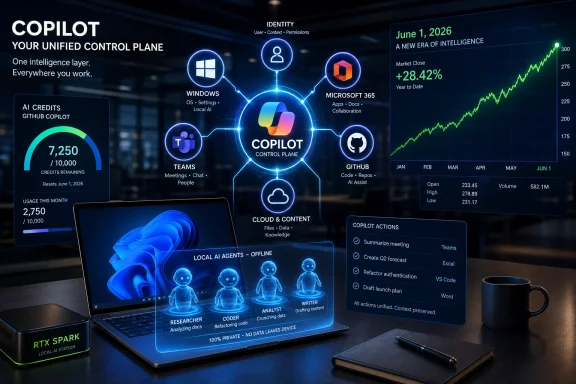 Microsoft’s AI Story Is Becoming Less About Demos and More About Distribution
For the last three years, Microsoft’s AI strategy has been easy to summarize and hard to experience cleanly. Copilot appeared in Windows, Edge, Microsoft 365, Teams, GitHub, Security, Azure, and consumer chat, often with different entry points, different permissions, different model behavior, and different licensing assumptions. The brand became omnipresent before the product became coherent.That is why the reported push toward a more unified Copilot experience matters. If Microsoft is serious about merging consumer and enterprise Copilot flows into a single hub, the goal is not cosmetic simplification. The company is trying to make Copilot feel less like a button bolted onto every surface and more like the place where work begins, continues, and eventually completes itself.
The appointment of Jacob Andreou to lead a unified Copilot experience fits that shift. Microsoft said in March that it was bringing consumer and commercial Copilot work together under one effort, with Andreou responsible for design, product, growth, and engineering. That is not the kind of reorg a company makes when it believes the product is already self-explanatory.
The uncomfortable truth is that Copilot has had much more success as a strategic narrative than as a universal habit. GitHub Copilot is a real product with real developer adoption. Microsoft 365 Copilot is more complicated: powerful in the right workflows, expensive at scale, and still uneven enough that many organizations treat it as a pilot rather than a default seat entitlement. A unified app is Microsoft admitting that the sprawl itself has become part of the adoption problem.
The Super-App Ambition Is Really a Control-Plane Ambition
Calling the next Copilot a “super-app” undersells the enterprise logic. Microsoft is not trying to build WeChat for office workers. It is trying to build an AI control plane that sits across identity, files, meetings, mail, code, device state, cloud resources, and business data.That distinction matters because Microsoft’s advantage is not that it has the only capable model. It does not. Google, Anthropic, OpenAI, Meta, xAI, Mistral, and a long tail of coding and workflow startups are all pushing hard. Microsoft’s advantage is that it owns the workplace substrate where context already lives.
A unified Copilot hub would let Microsoft concentrate that context in one place. A user could move between personal and work accounts, between chat and agents, between a local Windows session and a cloud-backed workflow. For administrators, the promise is governance. For users, the promise is continuity. For Microsoft, the promise is leverage.
That leverage is also why regulators are paying attention. If Copilot becomes the default front end for Microsoft 365, Teams, Windows, Azure, and GitHub-adjacent work, competitors will not merely be fighting another chatbot. They will be fighting the default path through the modern Microsoft stack.
GitHub Copilot Shows Where the Free-Meter Era Ends
The most revealing Microsoft AI news this week is not the prettiest one. GitHub Copilot’s move toward AI Credits is the clearest sign yet that the economics of “AI as a subscription feature” are being rewritten in public.The old model was simple enough for buyers to understand. Pay a monthly fee and get access to a capable coding assistant. That worked when the product was mostly autocomplete, chat, and bounded interactions. It becomes strained when users expect autonomous coding agents, large-context debugging, multi-file refactors, test generation, code review, and repeated model calls that can run far beyond the cost profile of a simple suggestion.
Usage-based billing is GitHub’s way of aligning price with compute intensity. In plain English: a quick completion and a long-running agent task do not cost the same, and Microsoft no longer wants to pretend they do. The shift to AI Credits makes Copilot feel less like a fixed SaaS seat and more like a metered cloud service.
That will annoy some developers, especially those who had mentally filed Copilot under predictable tooling expenses. It will also force engineering managers to do something many have avoided: measure the productivity gain against the token burn. If a coding agent saves a senior developer three hours, the credit cost may be trivial. If it loops through speculative edits and burns through credits without producing reliable code, the economics look very different.
This is the broader AI market’s collision with reality. Vendors spent the first phase of the boom abstracting away inference cost to accelerate adoption. The next phase is about teaching customers that intelligence is not free, especially when it is invoked repeatedly, automatically, and with large context windows.
Microsoft Can Absorb the Cost, But It Cannot Hide It Forever
Microsoft is better positioned than most companies to carry enormous AI infrastructure costs. Azure is a hyperscale cloud. Microsoft 365 is a high-margin subscription machine. Windows remains a distribution channel. GitHub gives Microsoft a privileged relationship with developers. LinkedIn gives it another professional data and workflow surface.Even so, the scale of spending is staggering. Microsoft’s fiscal 2026 third-quarter commentary put capital expenditures above $30 billion for the quarter, with management pointing to cloud and AI infrastructure as the driver. The company has also signaled a roughly $190 billion calendar-year 2026 capital expenditure plan, a number that would have sounded absurd in the pre-generative-AI cloud era.
The bullish interpretation is straightforward. Microsoft is building the infrastructure for the next computing platform while demand is still outstripping supply. Its AI business has already crossed a tens-of-billions annualized run-rate, and Azure growth remains closely watched because investors see it as the cleanest readout of enterprise AI demand.
The bearish interpretation is equally straightforward. The company is spending at a level that requires sustained utilization, pricing power, and customer willingness to keep paying for AI features that remain uneven in daily use. If AI workloads become commoditized faster than expected, or if open models and specialized competitors undercut pricing, the capex burden could become a margin story rather than a growth story.
Microsoft’s task is to make the spending look like platform investment, not subsidy. GitHub’s credit shift is one small but important step in that direction. It tells the market that Microsoft will not absorb every marginal AI cost indefinitely just to maintain the illusion of flat-rate abundance.
Nvidia Gives Windows a New Local-AI Argument
The Nvidia alliance lands in a different part of the same strategy. RTX Spark is being positioned as a new class of Windows PC silicon for personal AI agents, with Nvidia touting high local AI performance and large unified memory configurations. For Microsoft, the point is not merely another premium PC badge. It is a chance to make Windows relevant to AI work that cannot always live comfortably in the cloud.Copilot+ PCs began with a relatively narrow proposition: efficient neural processing, local effects, live captions, Windows Studio features, and eventually Recall. Qualcomm had the early spotlight because its Arm chips delivered the battery life and NPU performance Microsoft wanted for the first wave. But the Copilot+ story has always needed more than one silicon supplier.
Nvidia changes the tone. Qualcomm made the AI PC feel like an efficiency play. Nvidia makes it feel like a workstation play. If RTX Spark-class hardware can run larger local models, heavier agent workflows, and GPU-accelerated creative or development tasks, Microsoft gets a more convincing answer to the question power users keep asking: why should AI make me buy a new PC?
That question matters for WindowsForum readers because the Windows ecosystem has been stuck between two eras. The traditional PC upgrade cycle has slowed, and many users do not need more CPU performance for browsing, Office, and video calls. AI gives the industry a new upgrade narrative, but only if the local features are useful enough to justify the hardware.
Recall remains the cautionary tale. Microsoft wanted it to be the iconic Copilot+ feature, then had to retreat and rework the privacy and security model after intense criticism. Nvidia-powered Windows AI PCs may create new possibilities, but the company still has to prove that local agents can be both powerful and trustworthy.
Qualcomm Loses Exclusivity, But Windows Gains Optionality
The reported Nvidia-Microsoft hardware push also breaks the perception that premium Windows-on-Arm AI PCs are a Qualcomm-only story. That is healthy for the ecosystem. Microsoft has learned the hard way that Windows hardware transitions fail when too much depends on one supplier, one performance profile, or one compatibility story.OEMs want choice. Enterprise buyers want roadmaps. Developers want a target that is broad enough to justify optimization work. If Dell, HP, ASUS, Lenovo, MSI, and Microsoft’s own Surface line can point to multiple AI PC classes, the market becomes less brittle.
There is still a compatibility wrinkle. Windows on Arm has improved substantially, but it is not invisible. Emulation is better, native app support is better, and many mainstream workflows are fine. But sysadmins know that “mostly compatible” is not the same as “safe to deploy everywhere,” especially in environments with old drivers, VPN clients, endpoint agents, line-of-business software, and weird peripherals that have survived three hardware refresh cycles.
Nvidia’s Windows AI hardware will therefore be judged on two tracks. Enthusiasts will ask how fast it runs models, games, creative workloads, and developer tools. IT departments will ask whether it can be imaged, secured, patched, managed, warrantied, and supported without creating a new exception category.
That is where Microsoft’s software consolidation and hardware alliance intersect. A unified Copilot layer is easier to sell if the endpoint story is credible. A new AI PC class is easier to sell if there is a visible software experience that needs it.
The Stock Rally Is Rational, But Not Risk-Free
A one-day share move should never be mistaken for a verdict. Still, the reported June rally makes sense. Microsoft offered investors three things they like to see at once: product simplification, hardware optionality, and monetization discipline.The product simplification is the Copilot consolidation story. Investors have watched Microsoft attach Copilot branding to nearly everything. A unified app suggests the company understands that distribution without coherence can become noise.
The hardware optionality is Nvidia. Microsoft gets a stronger answer to Apple Silicon, a more ambitious local-AI PC story, and a way to keep OEMs excited about premium Windows machines. Nvidia gets another route into the PC market at a moment when AI workloads are redefining what client hardware is supposed to do.
The monetization discipline is GitHub Copilot’s pricing change. It may be unpopular with some users, but Wall Street will recognize the signal. Microsoft is no longer treating AI inference as an invisible cost center. It is building mechanisms to meter, price, and shape demand.
But the risks are not theoretical. If Copilot adoption remains shallow outside developers and select enterprise workflows, the unified app will look like rearranged furniture. If AI Credits feel punitive, GitHub risks pushing heavy users toward Cursor, Claude Code, open-source stacks, or direct API workflows. If Nvidia-powered AI PCs are expensive niche devices, the Windows AI refresh could look more like ultrabook marketing than a platform shift.
Enterprise IT Will Care Less About the Demo Than the Boundary
For administrators, the most important Copilot question is not whether the assistant can summarize a meeting or draft a document. It is where the boundary sits. What can Copilot see? What can it do? What logs are retained? What controls exist when an agent makes a mistake at machine speed?Microsoft’s advantage in enterprise AI is that it can answer those questions in the language IT already uses: Entra ID, Purview, Defender, Intune, Conditional Access, sensitivity labels, audit logs, retention policies, and tenant boundaries. That is the pitch. Copilot is not merely a chatbot; it is a governed assistant inside the Microsoft security and compliance model.
The problem is that agentic computing raises the stakes. A search assistant retrieves information. An agent changes things. It can open tickets, edit files, generate pull requests, schedule meetings, query databases, update CRM records, or trigger workflows. The more useful Copilot becomes, the more consequential its permissions become.
That is why a unified Copilot app may actually make IT both happier and more nervous. Happier, because fewer scattered entry points should mean clearer governance and user education. More nervous, because a single hub that spans personal and work contexts, local and cloud actions, and human and autonomous workflows becomes a high-value control point.
The Windows angle is especially sensitive. Local AI features promise privacy and latency benefits, but they also introduce new policy questions. If an AI feature indexes user activity, captures screen context, or acts across applications, administrators need more than a toggle. They need defaults that do not create compliance surprises.
Regulators Can See the Bundle Forming
The UK Competition and Markets Authority’s investigation into Microsoft’s business software ecosystem is not a sideshow. It is a preview of the regulatory argument that will follow AI into productivity software. The concern is not simply that Microsoft is large. It is that Microsoft can bind operating systems, productivity apps, collaboration tools, cloud licensing, security products, and AI assistants into a package that rivals cannot easily match.Teams already taught regulators how bundling works in modern enterprise software. Copilot raises the stakes because it can become the interface through which users consume the bundle. If the assistant is better because it has privileged access to Microsoft 365 context, and Microsoft 365 becomes stickier because Copilot is embedded throughout it, the flywheel is obvious.
Microsoft will argue that integration is exactly what customers want. There is truth in that. Nobody wants an enterprise AI assistant that cannot read the calendar, understand Teams meetings, respect document permissions, or work inside Word and Excel. Fragmentation is a real problem, and Microsoft can plausibly say it is solving it.
Competitors will argue that Microsoft is turning integration into foreclosure. There is truth there too. If third-party AI tools cannot access the same context, invoke the same workflows, or appear with the same prominence, “choice” becomes theoretical. The AI assistant market could become another layer where incumbency compounds.
The regulatory outcome will not arrive quickly enough to shape this week’s stock move. But it will shape the next several years of Microsoft’s AI rollout. The more Copilot becomes a workplace operating layer, the more governments will ask whether it is still just an app.
The DoD Deal Reinforces Microsoft’s Institutional Moat
The fresh U.S. defense software agreement, awarded through Dell as the procurement vehicle, reinforces a quieter part of Microsoft’s strength. The company is not only selling AI excitement to investors. It is embedded in the institutions that buy software by the decade.Government and defense contracts are not the same as consumer momentum, and they do not validate every AI feature. But they do validate Microsoft’s position as the default enterprise supplier for operating systems, productivity, collaboration, identity, cloud subscriptions, and licensing infrastructure. That matters because AI adoption in large organizations will be conservative, governed, and procurement-heavy.
A startup can win hearts with a brilliant coding tool or a better chat interface. Microsoft wins budgets by being already approved, already deployed, already integrated, and already covered by a master agreement. That is not glamorous, but it is enormously powerful.
The DoD deal also illustrates why Microsoft’s AI ambitions are inseparable from its licensing machine. Copilot does not have to win every user one at a time if it can be attached to broader enterprise agreements, security bundles, cloud commitments, and productivity renewals. The route to ubiquity is not only product love. It is procurement gravity.
That gravity can become a liability if customers feel trapped. But for now, it gives Microsoft something most AI challengers lack: a path from feature to standard operating environment.
Developers Are the First Customers to Feel the New AI Accounting
GitHub Copilot remains Microsoft’s cleanest AI success because developers adopted it before many executives had finished writing AI strategy decks. It solved an obvious problem, appeared in the flow of work, and improved quickly. That makes the pricing shift more important, not less.Developers are unusually good at detecting when a tool’s economics have changed. They will notice if credits evaporate during agent sessions. They will compare Copilot against Cursor, Claude Code, direct model APIs, local models, and whatever open-source coding agent appears next week. They will share screenshots of surprising bills and benchmark the results in public.
That transparency is useful for the market. It will expose whether usage-based pricing maps cleanly to value or whether it creates anxiety that suppresses experimentation. The best outcome for Microsoft is that teams learn to treat AI coding work like cloud compute: monitored, budgeted, optimized, and justified by output. The worst outcome is that developers feel nickel-and-dimed and route around the platform.
There is also a cultural issue. Copilot began as a product that felt almost magical because the meter was hidden. Once the meter is visible, the relationship changes. Users start asking whether this prompt is worth it, whether this model is too expensive, whether an agent should keep running, and whether a cheaper tool would do.
That may be healthy. The industry needs less magical thinking around AI costs. But it means Microsoft has to compete on both capability and trust. A metered assistant must be good enough that users do not resent the meter.
Windows AI Needs a Reason to Exist on the Device
The Nvidia partnership also revives a question Microsoft has not fully answered: what should AI do locally on a Windows PC that cloud AI cannot do better? Latency, privacy, offline availability, and cost are the standard answers. They are valid, but they are not yet a mass-market upgrade story.For local AI to matter, it needs to become situationally indispensable. A developer should be able to run a code agent against a local repository without sending every file to the cloud. A video editor should be able to use generative tools without waiting on remote capacity. A security analyst should be able to triage sensitive artifacts locally. A knowledge worker should be able to search and summarize personal work history with confidence that the data boundary is real.
That is the version of the AI PC that could matter. It is not a laptop with a chatbot key. It is a machine with enough local intelligence to make the operating system feel more aware, more private, and more capable under user control.
Microsoft has pieces of this vision, but the execution has been uneven. Copilot in Windows has sometimes felt like a web service wearing an OS costume. Recall stumbled because the original framing underestimated how strongly users would react to persistent activity capture. Copilot+ branding created expectations before the feature set fully justified them.
Nvidia-powered hardware gives Microsoft another chance. But hardware alone will not carry the story. The local AI experience has to be useful, understandable, governable, and visibly better than opening a browser tab.
The June Rally Is a Bet on Microsoft Turning AI Into an Operating Model
The market’s enthusiasm makes more sense if we stop treating each announcement as separate. The unified Copilot app, GitHub AI Credits, Nvidia RTX Spark Windows PCs, defense licensing momentum, and regulatory scrutiny are all pieces of the same transition. Microsoft is trying to turn AI from a feature category into an operating model for software, hardware, cloud, and licensing.That is a much bigger ambition than adding assistants to Office documents. It means reshaping how work is initiated, how compute is consumed, how PCs are sold, how developers build, how administrators govern, and how Microsoft charges. It also means the company’s old strengths — bundling, distribution, enterprise agreements, platform control — are becoming newly valuable and newly controversial.
The bullish case is that Microsoft is one of the few companies with enough surface area to make AI agents useful in real work. It has identity, documents, email, meetings, code, devices, cloud, and security telemetry. If Copilot can safely connect those dots, Microsoft can justify both the capex and the premium.
The skeptical case is that AI remains too expensive, too inconsistent, and too competitively fluid for any one company to lock down the interface. Customers may use Microsoft where it is convenient, Anthropic where it is better, Google where Workspace dominates, local models where privacy matters, and specialized tools where workflow depth beats suite integration. In that world, Copilot becomes important but not inevitable.
The truth is likely between those poles. Microsoft does not need Copilot to be the only AI assistant. It needs Copilot to be the default assistant inside the environments Microsoft already controls. That is still a huge prize.
The Real Test Comes After the Applause
Microsoft’s latest AI moves leave Windows users, developers, and IT departments with several concrete signals to watch over the next few months. The company has a credible strategy, but it is entering the phase where pricing, governance, and product coherence matter more than launch-stage excitement.- Microsoft’s reported Copilot consolidation should be judged by whether it reduces confusion across Windows, Microsoft 365, Teams, GitHub, and consumer accounts.
- GitHub Copilot’s AI Credits shift is the clearest sign that agentic AI costs are moving from vendor subsidy to customer-visible metering.
- Nvidia’s RTX Spark push gives Windows a stronger local-AI hardware story, but Microsoft still has to prove which everyday workflows need that power.
- Enterprise administrators should watch permission boundaries, auditability, data retention, and agent controls more closely than feature demos.
- Regulators are likely to treat Copilot as part of Microsoft’s broader software ecosystem, not as a standalone chatbot market.
- Investors are rewarding Microsoft’s AI positioning, but future confidence will depend on adoption, Azure growth, margin discipline, and whether customers accept the new economics.
References
- Primary source: AD HOC NEWS
Published: Mon, 01 Jun 2026 11:32:12 GMT
Microsoft’s Copilot Consolidation and Nvidia Alliance Fuel a June Rally — But the Costs Are Moun
Microsoft shares climb as it plans unified Copilot app, partners with Nvidia for chips, and shifts GitHub Copilot to credit-based pricing due to soaring AI costs.www.ad-hoc-news.de - Related coverage: axios.com
Microsoft debuts Nvidia-powered Microsoft Surface Ultra laptop
Microsoft is trying again to redefine the PC for the AI era.www.axios.com
- Related coverage: windowscentral.com
Microsoft confirms plans to integrate Copilot with the Taskbar on Windows 11 this summer: Ask Copilot expected to debut "mid-2026" | Windows Central
First announced last year, a new document has confirmed that Microsoft's upcoming "Ask Copilot" feature for Windows 11's Taskbar is arriving mid-2026.www.windowscentral.com - Related coverage: tomshardware.com
Nvidia and Microsoft tease "a new era of PC" ahead of Computex 2026 — coordinated social media posts could indicate that rumored N1X laptops will be Windows on Arm systems | Tom's Hardware
An Nvidia-powered Arm PC running Windows could inspire new local AI experiences beyond Copilot+.www.tomshardware.com - Related coverage: tomsguide.com
Nvidia N1X and N1 CPU: Everything we know so far | Tom's Guide
Nvidia has confirmed it's releasing its own CPU in collaboration with MediaTek, including a desktop-level N1X Arm chip and the N1 for gaming laptops, and now a surprise Intel x86 RTX silicon from an Nvidia and Intel partnership means another chip will be on the way. Find out everything we know...www.tomsguide.com - Official source: docs.github.com
Models and pricing for GitHub Copilot - GitHub Docs
See per-token pricing for the models available in GitHub Copilot and reference rates for additional usage across plans. docs.github.com
- Related coverage: investor.nvidia.com
NVIDIA Corporation - NVIDIA and Microsoft Reinvent Windows PCs for the Age of Personal AI
RTX Spark — a 1-Petaflop Superchip, the Full CUDA and RTX Ecosystem, and Windows-Native Agents — a New Beginning for Personal Computers News Summary: NVIDIA RTX Spark powers the world’s first Windows PCs purpose-built for personal agents, featuring 1 petaflop of AI performance, industry-leading...investor.nvidia.com - Related coverage: pondero.ai
GitHub Copilot Pricing in 2026: Which Plan to Pick Before June 1
GitHub Copilot switches to token-based AI Credits billing on June 1, 2026. This guide maps current plan prices (Free, Pro at $10, Pro+ at $39, Business at $19, Enterprise at $39), explains what changes on June 1, and gives a clear pick for each team size.pondero.ai
- Official source: blogs.microsoft.com
Announcing Copilot leadership update - The Official Microsoft Blog
Satya Nadella, Chairman and CEO, and Mustafa Suleyman, Executive Vice President and CEO of Microsoft AI, shared the below communications with Microsoft employees this morning. SATYA NADELLA MESSAGE I want to share two org changes we’re making to our Copilot org and superintelligence effort. It’s...blogs.microsoft.com - Related coverage: getburnrate.io
BurnRate Blog — AI Coding Cost Insights
Research-backed insights on AI coding tool costs. Industry data on what developers and teams actually spend on Claude, Cursor, Copilot, and Codex. getburnrate.io
- Related coverage: rollbrains.github.io
GitHub Copilot AI Credits: Pricing & June 2026 Changes
What Copilot's AI credits really cost, how the new credit system bills you, and exactly what changed in June 2026 — CLI credit limits in plain numbers. rollbrains.github.io
- Related coverage: agent-wars.com
Copilot's Free Ride Ends: GitHub Switches to Usage Billing
Agent Wars — Tracking the rise of AI agents. The definitive directory of AI agent platforms, tools, and frameworks. www.agent-wars.com
- Related coverage: usagebox.com

GitHub Copilot Pricing & Billing 2026: Plans, AI Credits & Overages | UsageBox
GitHub Copilot pricing for 2026, verified against GitHub's plans page: Free $0, Pro $10/mo (includes $15 credits), Pro+ $39/mo ($70), Max $100/mo ($200), plus Business and Enterprise seats. How AI Credits work (1 credit = $0.01), where to see usage in VS Code, and why some bills jumped.
usagebox.com
- Related coverage: frontierbeat.com
GitHub Copilot Drops Flat-Rate Pricing June 1—Power Users Pay by the Token - Frontierbeat
GitHub replaces flat-rate Copilot plans with token-based AI Credits on June 1. Business users get a $30 credit buffer—until August, when the subsidy ends. frontierbeat.com
- Related coverage: findskill.ai
GitHub Copilot's New AI Credits Billing: What Changes June 1 | FindSkill.ai — Learn AI for Your Job
GitHub Copilot switches to usage-based AI Credits on June 1, 2026. What each plan includes, how overage works, and the $0 cap that stops surprise bills.findskill.ai - Related coverage: therouter.ai
GitHub Copilot AI Credits, June 2026: Token Billing Explained and Fallback Removed — TheRouter.ai | TheRouter.ai
GitHub Copilot AI Credits launched June 2026, replacing Premium Request Units with token-based billing. The old model fallback that let you keep working on a cheaper model is gone—agentic sessions now stop when credits run out. Here's what changed and how to manage it.therouter.ai - Related coverage: techradar.com
Microsoft is mixing up its Copilot AI leadership, so Suleyman can 'build enterprise tuned lineages' | TechRadar
Microsoft brings consumer and enterprise Copilot into closer alignmentwww.techradar.com - Related coverage: elpais.com
Nvidia anuncia la reinvención del ordenador personal con un chip de IA con el que reta a Intel y AMD | Economía | EL PAÍS
El gigante crea un procesador diseñado junto a Microsoft. Fabricantes como Dell, HP y Asus se unen al proyectoelpais.com - Related coverage: itpro.com
Pentagon taps Dell for $9.7bn Microsoft licensing deal | IT Pro
US government wants to consolidate its defense IT budgets to save half a billion a yearwww.itpro.com - Official source: microsoft.com
FY26 Q3 - Press Releases - Investor Relations - Microsoft
FY26 Q3 - Press Releases - Investor Relations - Microsoftwww.microsoft.com
- Related coverage: ciotechoutlook.com
Pentagon Signs $9.69Bn Microsoft Software Contract
The Pentagon has signed a $9.69 billion software agreement with Microsoft aimed at improving efficiency and reducing operational costs.www.ciotechoutlook.com
- Related coverage: computerworld.com
Microsoft business software faces UK antitrust probe over bundling, AI lock-in – Computerworld
Investigation into Microsoft 365, Teams, Azure, and Copilot integrations reflects widening scrutiny of AI-era competition concerns. www.computerworld.com
- Related coverage: thenextweb.com
The CMA opens its fourth Strategic Market Status case into Microsoft
The CMA has launched its fourth Strategic Market Status investigation, into Microsoft's business software, including cloud licensing and Copilot defaults.thenextweb.com - Related coverage: opencall.news
