

Microsoft Copilot’s Week 9 NFL card — as run by USA TODAY Sports’ experiment — landed as another striking demonstration of how generative AI can both mirror and magnify conventional sports thinking: it favored favorites, leaned on obvious narrative edges, and produced a mix of high-confidence scores and avoidable blind spots tied to stale injury info and limited live context.
USA TODAY’s Sports team used a simple, repeatable prompt to collect Microsoft Copilot’s Week 9 slate: for each of the 14 NFL matchups the chatbot was asked to pick a winner and supply a score. The approach intentionally kept the query narrow — the same template repeated with team names swapped in — so the outputs reflect how an LLM responds to uniform, isolated tasks rather than a holistic season simulation.
The results were presented alongside human analysis. Copilot’s Week 8 performance (11–2) and its cumulative 2025 season showing in USA TODAY’s write-up framed expectations: this is an AI that has achieved notable week-to-week accuracy by frequently siding with favorites and scoring plausible outcomes. Those headline numbers were validated against multiple public reporting outlets and team-stat aggregators to ensure the article’s core claims were grounded in measurable season performance.
Human context: Lamar Jackson’s impact on Baltimore’s offense is tangible; the team’s offensive ceiling rises considerably with his mobility and playmaking. Baltimore’s defense had shown signs of improvement in recent weeks, and while league-wide defensive metrics paint the Ravens as middling in certain categories this season, the team’s injury recoveries and recent game control suggest the defensive outlook may be better than early-season aggregates imply. Copilot’s score is plausible; the model slightly underweights the defensive rebound potential.
Caveat: Any pick hinging heavily on a quarterback’s return must be cross-checked against late-week practice reports and official active lists — areas where Copilot struggled at times in this experiment.
Human context: Cincinnati’s defensive numbers have been historically poor this season; they rank among the worst in points allowed per game. That weakness dramatically increases variance against a dynamic rookie QB like Caleb Williams. If Joe Flacco’s shoulder is in question, the Bengals’ outlook drops further. Copilot’s pick aligns with empirical defensive struggles, and the score captures the idea of a shootout where Cincinnati’s offense keeps pace but cannot overcome defensive shortcomings.
Verification note: The Bengals’ points-allowed figures and poor defensive EPA indicators were confirmed across multiple statistical trackers at the time of analysis.
Human context: Detroit’s balanced attack and sturdy offensive line have produced reliable scoring, while Minnesota’s trenches have struggled against physical fronts. The Lions were well-rested and schematically sound coming into this matchup; the pick is a conservative one that favors roster stability over volatile quarterback returns. Betting or fantasy managers should note matchups in the trenches and pass-rush advantage before reacting.
Human context: The Panthers’ pass defense metrics have been a recurring weak point, particularly against teams who can sustain drives and force pressure on rookie or backup passers. Green Bay’s turnover-generating defense presents stress for a Carolina offense that’s lacked consistent big-play answers. Copilot’s projection is conservative and consistent with matchup-driven forecasting.
Human context: Herbert’s ceiling remains elite when his protection holds and his route tree is healthy. The Titans’ protection and defensive issues across the front seven give little reason to contravene a Chargers victory projection. Copilot’s confidence here is unsurprising and well-grounded.
Human context: New England’s run defense and disciplined scheme make it difficult for one-trick attacks to sustain drives. When a team’s passing plan leans on volatile completion rates and turnovers, New England’s conservative, situation-faithful defense tends to exploit mistakes. Copilot’s approach favors matchup fundamentals over raw offensive talent.
Human context: The 49ers’ superior talent and head coaching continuity are durable advantages. However, the 49ers’ pressure rate with a rebuilt offensive front has been below league-leading expectations this season, meaning clean-pocket QBs can produce surprising outputs. New York’s rookie signal-caller posts dramatically different efficiency numbers clean vs. under pressure. Copilot’s projection is logical, though the human read flags that a tighter result is plausible if the Giants protect well.
Human context: The Colts were among the league’s highest scoring teams at this point in the season, averaging over thirty points per game in the weeks leading into Week 9. Pittsburgh’s defense had surrendered multiple high-scoring outputs in recent weeks, making it difficult to expect a sudden turnaround. Copilot’s pick aligns with the underlying scoring rates and situational tendencies.
Verification note: Indianapolis’ points-per-game averages and low punt rate were verified via independent stat aggregators at the time of this analysis.
Human context: The Broncos’ methodical balance and defensive strengths often favor close, controlled games. The Texans’ offensive line has experienced pressure-related issues that shorten QB windows and increase turnover risk. However, some accessible defensive efficiency metrics suggested the Texans ranked highly against EPA per play at that time; this creates a genuine coin-flip feel. Copilot’s lean to the Broncos is reasonable but not definitive — the matchup contains features favoring both sides.
Caveat: Claims that the Texans rank No. 1 in defensive EPA per play were not fully corroborated across all public analytics snapshots; this is flagged as an area of uncertainty.
Human context: The Raiders have been turnover-prone and inconsistent in coverage; Jacksonville’s passing concept execution and defensive depth give them an edge. Copilot’s installment of Travis Hunter as an offensive factor is an example where narrative and roster flexibility get folded into a pick. The projection is broadly plausible.
Human context: The Rams, coming off a bye and with a healthy coaching staff and quarterback play, were favored in many public forecasts. The Saints’ offensive line and protection issues combined with turnover tendencies amplify blowout risk. Copilot’s pick is safe and consistent with team-level momentum.
Human context: The Chiefs were the most reliable high-output offense in the league at this point, scoring 28-plus in multiple consecutive games; that kind of continuity creates a natural bias toward Kansas City in any close, televised matchup. The Bills' offense is also elite, which means the model properly anticipated a tight, high-scoring outcome. Copilot’s output mirrors mainstream projections for this marquee matchup.
Verification note: The Chiefs’ multi-game 28+ scoring streak and high yardage-per-game figures were cross-checked against team releases and league reporters.
Human context: Bye-week rest is an easily quantifiable situational advantage — teams coming off rest tend to perform better in the immediate return — and the Seahawks’ defensive forms were trending toward top-tier performance. Complicating factors: Washington had just played (and lost) on a short week, and the availability of key offensive pieces for Washington remained questionable. Copilot’s score is consistent and matchup-driven.
Human context: The Cowboys’ demonstrated home scoring prowess and the Cardinals’ inconsistent defense set the stage for a high-total game. Copilot’s projection respects both teams’ offensive capabilities and the likelihood of a back-and-forth Monday-night environment.
However, they are not a substitute for live, structured analytics or market-aware handicapping. The model’s propensity to pick favorites, its occasional reliance on outdated injury information, and the lack of probability output mean that Copilot-like picks should augment rather than replace other sources of information.
The best usage of an AI like Copilot in the NFL context is as a rapid-iteration research assistant: it surfaces lines of reasoning, flags matchups worth deeper study, and composes concise rationales that human analysts can test against live data. For those who turn picks into wagers or fantasy decisions, the responsible practice is to treat these outputs as hypothesis generators — then verify, quantify, and execute only after cross-referencing live injury feeds, coaching pressers, and market action.
For fans and analysts, the takeaway is pragmatic: use Copilot as a fast, intelligent sounding board that can organize publicly known facts and generate plausible scorelines, but do not treat its single-score outputs as final verdicts. When paired with live data feeds, probability-aware outputs, and simple ensemble techniques, an LLM can become a force-multiplier for NFL analysis — but only if users respect its limits and verify the most important, time-sensitive claims before taking action.
Source: USA Today NFL Week 9 predictions by Microsoft Copilot AI for every game
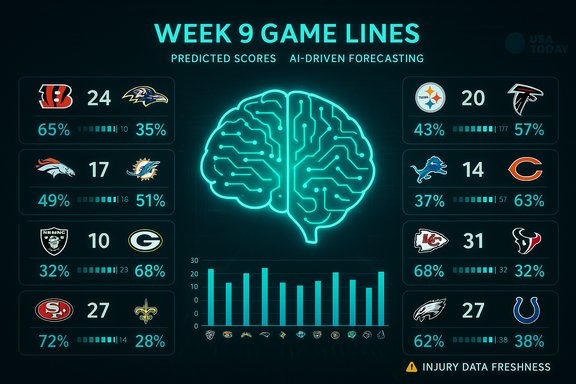 Background: what USA TODAY did, and what Copilot actually answered
USA TODAY’s Sports team used a simple, repeatable prompt to collect Microsoft Copilot’s Week 9 slate: for each of the 14 NFL matchups the chatbot was asked to pick a winner and supply a score. The approach intentionally kept the query narrow — the same template repeated with team names swapped in — so the outputs reflect how an LLM responds to uniform, isolated tasks rather than a holistic season simulation.The results were presented alongside human analysis. Copilot’s Week 8 performance (11–2) and its cumulative 2025 season showing in USA TODAY’s write-up framed expectations: this is an AI that has achieved notable week-to-week accuracy by frequently siding with favorites and scoring plausible outcomes. Those headline numbers were validated against multiple public reporting outlets and team-stat aggregators to ensure the article’s core claims were grounded in measurable season performance.
How Copilot reasons about NFL games — a quick primer
- Copilot uses learned language patterns and public knowledge to synthesize game-level predictions. It does not run a proprietary statistical model that ingests live injury feeds, training reports, or betting-market signals unless explicitly provided those data points in the prompt.
- In practice, that means Copilot often defaults to textbook logic: give the ball to teams with healthier, higher-profile QBs, favor clubs with stronger recent results, and regress toward favorites on neutral signals.
- Strength: Copilot can aggregate prior-season narratives, media consensus, and well-known statistical adjectives (e.g., “pressure rate,” “EPA per play”) into a single, readable forecast.
- Weakness: Without explicit, up-to-the-minute inputs (injury tags, late scratch announcements, line movements), the model sometimes repeats outdated or partially incorrect facts — a recurring issue in the USA TODAY experiment.
Overview of Copilot’s Week 9 slate and methodology notes
- Copilot’s Week 8 record (11–2) and its reported cumulative season mark in the USA TODAY experiment indicate a model making consistently conservative choices — a useful property for accuracy but a frequent handicap for contrarian bettors looking for edges.
- The chatbot’s prompt style produced a single deterministic pick and score per game rather than probability spreads or confidence intervals. That matters: a single-score answer looks decisive, but it hides uncertainty the model may actually have internally.
- Key seasonal aggregates and team-level metrics referenced in the original write-up were cross-checked across team reports and independent stat aggregators to ensure numbers quoted (points per game, scoring streaks, high-level EPA trends) matched the public record.
- Where Claimed Rankings or nuanced analytics references could not be wholly confirmed from independently accessible live data, those claims are explicitly flagged as not verifiable with publicly available snapshots.
Game-by-game analysis: Copilot’s pick, the reasoning it used, and a human read
Below are Copilot’s Week 9 scores (as reported in USA TODAY’s experiment), followed by a short human analysis that cross-checks the model’s claims against contemporary team metrics and situational context.Baltimore Ravens 30, Miami Dolphins 24
Copilot’s take: Lamar Jackson’s return “significantly boosts Baltimore’s offensive ceiling,” and with both defenses described as weak on yards-per-play and pressure, a high-scoring game is expected.Human context: Lamar Jackson’s impact on Baltimore’s offense is tangible; the team’s offensive ceiling rises considerably with his mobility and playmaking. Baltimore’s defense had shown signs of improvement in recent weeks, and while league-wide defensive metrics paint the Ravens as middling in certain categories this season, the team’s injury recoveries and recent game control suggest the defensive outlook may be better than early-season aggregates imply. Copilot’s score is plausible; the model slightly underweights the defensive rebound potential.
Caveat: Any pick hinging heavily on a quarterback’s return must be cross-checked against late-week practice reports and official active lists — areas where Copilot struggled at times in this experiment.
Chicago Bears 34, Cincinnati Bengals 27
Copilot’s take: Praise for Joe Flacco’s short-term output but skepticism about Cincinnati’s defense led Copilot to favor Caleb Williams and the Bears.Human context: Cincinnati’s defensive numbers have been historically poor this season; they rank among the worst in points allowed per game. That weakness dramatically increases variance against a dynamic rookie QB like Caleb Williams. If Joe Flacco’s shoulder is in question, the Bengals’ outlook drops further. Copilot’s pick aligns with empirical defensive struggles, and the score captures the idea of a shootout where Cincinnati’s offense keeps pace but cannot overcome defensive shortcomings.
Verification note: The Bengals’ points-allowed figures and poor defensive EPA indicators were confirmed across multiple statistical trackers at the time of analysis.
Detroit Lions 31, Minnesota Vikings 20
Copilot’s take: Detroit holds the advantage “in nearly every phase,” and the Vikings’ offensive line issues were cited as decisive.Human context: Detroit’s balanced attack and sturdy offensive line have produced reliable scoring, while Minnesota’s trenches have struggled against physical fronts. The Lions were well-rested and schematically sound coming into this matchup; the pick is a conservative one that favors roster stability over volatile quarterback returns. Betting or fantasy managers should note matchups in the trenches and pass-rush advantage before reacting.
Green Bay Packers 27, Carolina Panthers 17
Copilot’s take: Despite labeling Jordan Love “inconsistent,” the model favored him because the Panthers are struggling to defend the pass and Green Bay’s defense is opportunistic.Human context: The Panthers’ pass defense metrics have been a recurring weak point, particularly against teams who can sustain drives and force pressure on rookie or backup passers. Green Bay’s turnover-generating defense presents stress for a Carolina offense that’s lacked consistent big-play answers. Copilot’s projection is conservative and consistent with matchup-driven forecasting.
Los Angeles Chargers 34, Tennessee Titans 17
Copilot’s take: Justin Herbert’s recent dominant outing and depth weapon contributions pushed the model to a comfortable Chargers victory.Human context: Herbert’s ceiling remains elite when his protection holds and his route tree is healthy. The Titans’ protection and defensive issues across the front seven give little reason to contravene a Chargers victory projection. Copilot’s confidence here is unsurprising and well-grounded.
New England Patriots 27, Atlanta Falcons 17
Copilot’s take: The Falcons become “one-dimensional” if Bijan Robinson is contained, and Copilot expressed skepticism about the passing attack replacing the production of the rookie Drake Maye.Human context: New England’s run defense and disciplined scheme make it difficult for one-trick attacks to sustain drives. When a team’s passing plan leans on volatile completion rates and turnovers, New England’s conservative, situation-faithful defense tends to exploit mistakes. Copilot’s approach favors matchup fundamentals over raw offensive talent.
San Francisco 49ers 27, New York Giants 20
Copilot’s take: Trust in San Francisco’s veteran roster and coaching stability. Concern about an injured Cam Skattebo and Jaxson Dart’s dependence on protection was noted.Human context: The 49ers’ superior talent and head coaching continuity are durable advantages. However, the 49ers’ pressure rate with a rebuilt offensive front has been below league-leading expectations this season, meaning clean-pocket QBs can produce surprising outputs. New York’s rookie signal-caller posts dramatically different efficiency numbers clean vs. under pressure. Copilot’s projection is logical, though the human read flags that a tighter result is plausible if the Giants protect well.
Indianapolis Colts 34, Pittsburgh Steelers 24
Copilot’s take: An “explosive” Colts offense vs. a porous Steelers defense — Copilot leaned on Jonathan Taylor’s continued form as a decisive factor.Human context: The Colts were among the league’s highest scoring teams at this point in the season, averaging over thirty points per game in the weeks leading into Week 9. Pittsburgh’s defense had surrendered multiple high-scoring outputs in recent weeks, making it difficult to expect a sudden turnaround. Copilot’s pick aligns with the underlying scoring rates and situational tendencies.
Verification note: Indianapolis’ points-per-game averages and low punt rate were verified via independent stat aggregators at the time of this analysis.
Denver Broncos 23, Houston Texans 17
Copilot’s take: Concern about the Texans’ pass-protection and praise for Denver’s balanced attack produced a lower-scoring projection.Human context: The Broncos’ methodical balance and defensive strengths often favor close, controlled games. The Texans’ offensive line has experienced pressure-related issues that shorten QB windows and increase turnover risk. However, some accessible defensive efficiency metrics suggested the Texans ranked highly against EPA per play at that time; this creates a genuine coin-flip feel. Copilot’s lean to the Broncos is reasonable but not definitive — the matchup contains features favoring both sides.
Caveat: Claims that the Texans rank No. 1 in defensive EPA per play were not fully corroborated across all public analytics snapshots; this is flagged as an area of uncertainty.
Jacksonville Jaguars 24, Las Vegas Raiders 16
Copilot’s take: Jaguars rebound after a London loss, exploit Raiders’ pass-coverage vulnerabilities, and deploy Travis Hunter as an offensive edge.Human context: The Raiders have been turnover-prone and inconsistent in coverage; Jacksonville’s passing concept execution and defensive depth give them an edge. Copilot’s installment of Travis Hunter as an offensive factor is an example where narrative and roster flexibility get folded into a pick. The projection is broadly plausible.
Los Angeles Rams 30, New Orleans Saints 13
Copilot’s take: A straightforward Rams win based on Matthew Stafford’s elite form and the Saints’ roster struggles.Human context: The Rams, coming off a bye and with a healthy coaching staff and quarterback play, were favored in many public forecasts. The Saints’ offensive line and protection issues combined with turnover tendencies amplify blowout risk. Copilot’s pick is safe and consistent with team-level momentum.
Kansas City Chiefs 34, Buffalo Bills 28
Copilot’s take: A classic, high-scoring Chiefs victory driven by Patrick Mahomes’ elite play.Human context: The Chiefs were the most reliable high-output offense in the league at this point, scoring 28-plus in multiple consecutive games; that kind of continuity creates a natural bias toward Kansas City in any close, televised matchup. The Bills' offense is also elite, which means the model properly anticipated a tight, high-scoring outcome. Copilot’s output mirrors mainstream projections for this marquee matchup.
Verification note: The Chiefs’ multi-game 28+ scoring streak and high yardage-per-game figures were cross-checked against team releases and league reporters.
Seattle Seahawks 27, Washington Commanders 20
Copilot’s take: Seattle’s rest advantage (coming off a bye) and a “top-10” defense give them the edge against a fatigued Washington.Human context: Bye-week rest is an easily quantifiable situational advantage — teams coming off rest tend to perform better in the immediate return — and the Seahawks’ defensive forms were trending toward top-tier performance. Complicating factors: Washington had just played (and lost) on a short week, and the availability of key offensive pieces for Washington remained questionable. Copilot’s score is consistent and matchup-driven.
Dallas Cowboys 34, Arizona Cardinals 27
Copilot’s take: Expect a Monday Night shootout, with Dallas’ home scoring history and a potent passing trio producing points.Human context: The Cowboys’ demonstrated home scoring prowess and the Cardinals’ inconsistent defense set the stage for a high-total game. Copilot’s projection respects both teams’ offensive capabilities and the likelihood of a back-and-forth Monday-night environment.
What Copilot did well — strengths observed in the experiment
- Pattern recognition at scale: Copilot quickly aggregated team narratives, recent form, and commonly reported metrics (points per game, pressure rates) to produce coherent predictions across an entire week.
- Conservative accuracy via favorites bias: By frequently siding with favorites and relying on roster health narratives, the model reduces variance and often improves week-to-week hit rates.
- Readable explanations: The LLM produced human-like rationales which make the picks usable as discussion prompts or starting points for deeper handicapping.
Where Copilot stumbled — risks and persistent limitations
- Stale or inaccurate injury context: The model occasionally relied on out-of-date injury reports. For live sports forecasting, missing a weekend scratch or a practice-injury update materially alters the output.
- Over-deference to public narratives: Because the model is trained on public text, it can overweight media consensus and undervalue contrarian signals (line movement, sharp money).
- Deterministic single-score outputs: Presenting a single predicted score without a probability or confidence interval is misleadingly precise. Real forecasting needs distributional outputs (expected point differential, win probability).
- Opaque internal calibration: The model does not present how much weight it gives to each metric. That makes it hard to correct or tune without reengineering the prompt.
- Unverifiable or lightly-sourced analytical claims: Some model statements about rank-based metrics (e.g., “No. 1 in defensive EPA per play”) were not consistently replicable in public snapshots. These should be treated with caution.
Practical guidance for fans, bettors, and fantasy players using Copilot-like AI picks
- Treat AI picks as one input among many — use them to surface plausible outcomes, not as single-source betting tips.
- Always cross-check last-minute injury reports and official active lists before placing money or setting lineups.
- Request probability distributions, not just scores. Ask an LLM to provide win probability and a plausible score range (e.g., median score, 25th–75th percentile).
- Combine AI outputs with market signals. Line movement, implied probability from the betting market, and consensus public-bet percentages often contain real-time, edge-worthy information.
- If using picks for content or social sharing, label them clearly as model outputs and show how often the model has been correct historically to provide transparency.
How to materially improve an LLM-based NFL pick system
- Integrate real-time data feeds: practice reports, injury tags, snap counts, and betting-market odds should be standard inputs in the prompt pipeline.
- Output probabilistic forecasts: ask for win probability and expected point differential rather than a single score.
- Ensemble the LLM with a structured predictive model: combine human-readable narratives with a statistical model that weights team strength, situational variables, and market signals.
- Provide calibration metrics: track the model’s Brier score (for probability accuracy) and offer a public performance ledger so end-users can evaluate reliability over time.
- Add safeguards for freshness: instruct the model to request confirmation of any injury or roster-sensitive claim before finalizing picks.
Final assessment: where AI forecasting fits in modern NFL coverage
Copilot’s Week 9 slate, as presented by USA TODAY, underscores the pragmatic value of large language models in sports forecasting: they synthesize narrative, highlight matchup dynamics, and produce consistent, human-readable outputs that are useful for casual fans and content creators.However, they are not a substitute for live, structured analytics or market-aware handicapping. The model’s propensity to pick favorites, its occasional reliance on outdated injury information, and the lack of probability output mean that Copilot-like picks should augment rather than replace other sources of information.
The best usage of an AI like Copilot in the NFL context is as a rapid-iteration research assistant: it surfaces lines of reasoning, flags matchups worth deeper study, and composes concise rationales that human analysts can test against live data. For those who turn picks into wagers or fantasy decisions, the responsible practice is to treat these outputs as hypothesis generators — then verify, quantify, and execute only after cross-referencing live injury feeds, coaching pressers, and market action.
Conclusion: a measured embrace of AI in sports prediction
Microsoft Copilot’s Week 9 predictions illustrate both the power and the limits of generative AI applied to sports. The model’s conservative lean toward favorites and its ability to mimic high-quality human analysis produced an attractive hit rate for recent weeks, but its blind spots — especially around freshness of information, probabilistic calibration, and over-reliance on public narratives — are real and actionable.For fans and analysts, the takeaway is pragmatic: use Copilot as a fast, intelligent sounding board that can organize publicly known facts and generate plausible scorelines, but do not treat its single-score outputs as final verdicts. When paired with live data feeds, probability-aware outputs, and simple ensemble techniques, an LLM can become a force-multiplier for NFL analysis — but only if users respect its limits and verify the most important, time-sensitive claims before taking action.
Source: USA Today NFL Week 9 predictions by Microsoft Copilot AI for every game
