

Microsoft’s latest Copilot retreat is a tacit admission that its AI push across Windows went further than many users were willing to follow. Mozilla has seized on that reversal with unusual force, arguing that pulling back from forced integrations is not a triumph of restraint so much as a belated correction after months of overreach. The result is a familiar but important modern software story: when a platform owner treats AI as a default rather than a choice, backlash becomes part of the product cycle.
The controversy around Microsoft Copilot in Windows is bigger than one company’s feature rollback. It reflects a wider industry fight over whether AI should be added to operating systems and core apps as an always-on layer, or offered as a clearly optional tool that users can adopt at their own pace. Mozilla’s critique lands so sharply because it taps into a long-running grievance: large platform vendors often frame disruptive changes as progress, even when they arrive with minimal consent and limited transparency.
Microsoft’s Copilot strategy has evolved quickly over the last year. The company has embedded AI into consumer and productivity experiences, expanded Copilot branding across Windows and Microsoft 365, and used software updates, app defaults, and even hardware keys to normalize the assistant as part of the Windows experience. That approach created a sense of inevitability around AI, but it also blurred the line between optional productivity aid and imposed platform behavior.
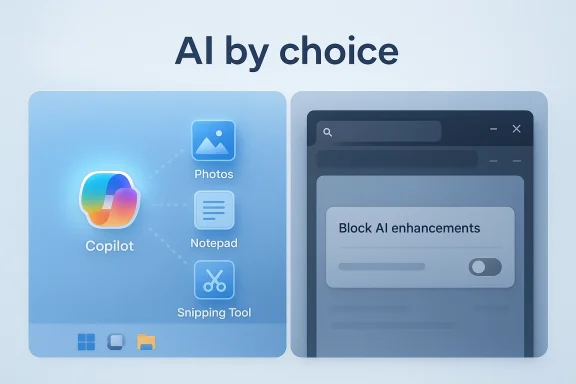
Mozilla’s response is not just rhetorical. Firefox 148 introduced a centralized AI Controls panel with a Block AI enhancements switch, designed to disable current and future built-in AI features in one place. That implementation is important because it reflects a different product philosophy: choice first, feature adoption second. In a market where users increasingly feel trapped by toggles scattered across menus and update cycles, central control is a meaningful differentiator.
The timing matters too. Mozilla’s April 2026 blog post arrived just days after Microsoft publicly said it was taking a more “intentional” approach to Copilot integration, a phrase that reads like a polite admission of overreach. The contrast between the two companies is not subtle: Microsoft is unwinding a push it launched from the top down, while Mozilla is turning user control into a visible product feature and a brand statement.
The company’s recent moves included auto-installing the M365 Copilot app on devices with Microsoft 365 desktop apps, placing Copilot buttons and keys into new hardware, and embedding AI assistance into everyday Windows tools such as Photos, Notepad, Snipping Tool, and Widgets. Each change may have been defensible as a convenience feature in isolation, but together they created the impression of an ecosystem being remade by fiat.
That approach is especially sensitive in Windows because the operating system is not merely an app environment. It is the control plane for everyday computing, where small interface changes can shape user behavior across work, school, and home devices. When AI features appear there first, and opt-out paths are unclear or inconsistent, the user experience shifts from assistance to imposition. That distinction is the heart of the backlash.
This is where Mozilla has found a potent talking point. Firefox’s AI Controls make the browser’s approach easy to explain in one sentence: users can turn AI off centrally, and that choice should persist. Whether every user wants that level of control is beside the point; the existence of the control itself is the product statement.
The contrast is especially powerful because it avoids abstract privacy language and instead focuses on usability. Mozilla is not merely saying AI is dangerous; it is saying that if a feature is truly valuable, users should be able to choose it without friction and reject it without punishment. That is a much harder argument for Microsoft to dismiss because it speaks to product design, not ideology.
According to Microsoft’s own recent messaging, the company is moving toward a more “intentional” integration model and removing some AI features from apps like Snipping Tool, Photos, Widgets, and Notepad. That wording matters because it suggests the original placement of those features was not sufficiently deliberate, even by Microsoft’s own standards. In other words, the rollback is both a product adjustment and an implicit self-critique.
The practical question is whether this is a genuine change in product philosophy or simply a temporary retreat after a noisy backlash. Microsoft still has every incentive to weave Copilot deeper into Windows, Microsoft 365, Edge, and cloud services. The challenge is that the company must now do so under closer scrutiny from users who have learned that defaults can be politically expensive.
The browser’s Block AI enhancements switch disables current and future built-in AI features, while still allowing users to manage specific functions individually if they want more nuance. That design is elegant because it solves the most common complaint: users don’t want to research every feature category just to stop unwanted AI from appearing in the first place. Choice is the point, not the workaround.
Mozilla has also been careful to frame AI Controls as a response to divergent user preferences. Some people want AI help for translations, tab organization, or accessibility tasks, while others want no generative AI in their browser at all. That framing is savvy because it avoids caricaturing one side as anti-technology and instead positions Firefox as the browser for users who want control over the pace of change.
Microsoft’s strategy reflects the logic of platform leverage. If you control Windows, Microsoft 365, and Edge, you can place Copilot at nearly every layer of the user journey, from document creation to system utilities to web search. That makes adoption easier to drive, but it also makes every misstep more visible and more politically fraught.
Mozilla’s counterstrategy is smaller but arguably cleaner. Firefox cannot match Microsoft’s distribution power, but it can win on principle, design clarity, and differentiation. For users exhausted by aggressive AI rollout, that may be enough to keep Firefox relevant as a refuge browser and a policy statement rolled into one.
Still, the enterprise story is not as simple as “less AI, more control.” Many organizations are actively experimenting with Microsoft 365 Copilot and related tools, and Microsoft’s release plans continue to show fresh AI capabilities across role-based Copilot offerings and the broader productivity stack. So even if some consumer-facing integrations are dialed back, the company’s enterprise AI push remains very much alive.
That split creates a dual-message problem. Microsoft wants to reassure skeptics that it will be more intentional, while also persuading customers that AI adoption still represents a meaningful productivity advantage. Those messages can coexist, but only if Microsoft proves that control, licensing, and deployment discipline are as mature as the AI features themselves.
The consumer response also reveals a tension in the AI market. Many users are curious about generative tools and will gladly use them when they offer genuine value. But curiosity is not the same as consent, and convenience is not the same as familiarity. Products that ignore that difference often create backlash that could have been avoided with better defaults and more visible opt-ins.
In that sense, Firefox’s AI Controls are not just a Firefox story. They are a signal to the wider software industry that the winning AI interface may be the one that makes restraint feel easy. Microsoft’s retreat, meanwhile, is a warning that even the most powerful platform company cannot assume users will accept every AI feature simply because it ships inside Windows.
For now, the broader lesson is clear: AI adoption in consumer software is entering a more mature phase, where usefulness alone is not enough. Users are asking who controls the feature, how it is introduced, and whether saying no actually means no. That is a harder standard than “ships with AI,” but it is also the standard that will define which companies earn trust in the next era of computing.
Source: Gadget Review Mozilla Blasts Microsoft’s Copilot Rollback as “Too Little, Too Late”
 Overview
The controversy around Microsoft Copilot in Windows is bigger than one company’s feature rollback. It reflects a wider industry fight over whether AI should be added to operating systems and core apps as an always-on layer, or offered as a clearly optional tool that users can adopt at their own pace. Mozilla’s critique lands so sharply because it taps into a long-running grievance: large platform vendors often frame disruptive changes as progress, even when they arrive with minimal consent and limited transparency.Microsoft’s Copilot strategy has evolved quickly over the last year. The company has embedded AI into consumer and productivity experiences, expanded Copilot branding across Windows and Microsoft 365, and used software updates, app defaults, and even hardware keys to normalize the assistant as part of the Windows experience. That approach created a sense of inevitability around AI, but it also blurred the line between optional productivity aid and imposed platform behavior.
Mozilla’s response is not just rhetorical. Firefox 148 introduced a centralized AI Controls panel with a Block AI enhancements switch, designed to disable current and future built-in AI features in one place. That implementation is important because it reflects a different product philosophy: choice first, feature adoption second. In a market where users increasingly feel trapped by toggles scattered across menus and update cycles, central control is a meaningful differentiator.
The timing matters too. Mozilla’s April 2026 blog post arrived just days after Microsoft publicly said it was taking a more “intentional” approach to Copilot integration, a phrase that reads like a polite admission of overreach. The contrast between the two companies is not subtle: Microsoft is unwinding a push it launched from the top down, while Mozilla is turning user control into a visible product feature and a brand statement.
How Microsoft Got Here
Microsoft’s Copilot expansion didn’t happen by accident. It was the result of a deliberate product and platform strategy that treated generative AI as the next major interface layer, something users would gradually accept because it appeared in enough places often enough to become normal. That logic makes sense inside a platform company, where distribution is as valuable as innovation, but it can look very different from the user side of the screen.The company’s recent moves included auto-installing the M365 Copilot app on devices with Microsoft 365 desktop apps, placing Copilot buttons and keys into new hardware, and embedding AI assistance into everyday Windows tools such as Photos, Notepad, Snipping Tool, and Widgets. Each change may have been defensible as a convenience feature in isolation, but together they created the impression of an ecosystem being remade by fiat.
That approach is especially sensitive in Windows because the operating system is not merely an app environment. It is the control plane for everyday computing, where small interface changes can shape user behavior across work, school, and home devices. When AI features appear there first, and opt-out paths are unclear or inconsistent, the user experience shifts from assistance to imposition. That distinction is the heart of the backlash.
The pattern behind the backlash
Mozilla’s criticism also plugs into a longer narrative about Microsoft’s relationship with defaults. The company has spent years trying to reassert its own browser, search, and app ecosystem through Windows prompts, deep-link behavior, and edge-case friction around alternatives. The AI dispute therefore feels less like an isolated policy quarrel and more like the latest chapter in a familiar control battle.- Microsoft’s AI features were often introduced before users had clear, obvious control over them.
- The company framed the changes as improvements rather than experiments.
- The rollout affected both consumer and enterprise experiences, but consumers felt the most visible pressure.
- The backlash was amplified because AI features appeared in core tools people rely on daily.
Mozilla’s Counterargument
Mozilla’s message is straightforward: software should not be allowed to assume consent simply because a company believes a feature is useful. In its April 2026 post, Mozilla argued that Microsoft’s rollback was welcome but insufficient, because the larger problem is the recurring pattern of introducing features in ways that leave users to clean up afterward.This is where Mozilla has found a potent talking point. Firefox’s AI Controls make the browser’s approach easy to explain in one sentence: users can turn AI off centrally, and that choice should persist. Whether every user wants that level of control is beside the point; the existence of the control itself is the product statement.
The contrast is especially powerful because it avoids abstract privacy language and instead focuses on usability. Mozilla is not merely saying AI is dangerous; it is saying that if a feature is truly valuable, users should be able to choose it without friction and reject it without punishment. That is a much harder argument for Microsoft to dismiss because it speaks to product design, not ideology.
Why “too little, too late” resonates
The phrase “too little, too late” works because it captures both the substance and the optics of the rollback. Microsoft is not removing Copilot from Windows, nor is it abandoning AI integration; it is simply narrowing the places where the assistant appears and, in theory, making the experience more intentional. That is a meaningful correction, but it is not a reset.- Mozilla’s critique is strongest when it frames AI as a consent issue.
- The company’s own Firefox controls provide a concrete alternative, not just a complaint.
- The timing of the post suggests a deliberate effort to shape the public narrative.
- The messaging lands because many users already feel fatigued by feature sprawl.
What Microsoft Is Rolling Back
Microsoft’s decision to scale back Copilot integrations in Windows does not mean it is abandoning AI in the desktop stack. It means the company is recalibrating where AI appears, how visible it is, and how aggressively it is pushed into fundamental app experiences. The difference may sound subtle, but for users it can be the difference between a tool they invoke and a tool that keeps interrupting them.According to Microsoft’s own recent messaging, the company is moving toward a more “intentional” integration model and removing some AI features from apps like Snipping Tool, Photos, Widgets, and Notepad. That wording matters because it suggests the original placement of those features was not sufficiently deliberate, even by Microsoft’s own standards. In other words, the rollback is both a product adjustment and an implicit self-critique.
The practical question is whether this is a genuine change in product philosophy or simply a temporary retreat after a noisy backlash. Microsoft still has every incentive to weave Copilot deeper into Windows, Microsoft 365, Edge, and cloud services. The challenge is that the company must now do so under closer scrutiny from users who have learned that defaults can be politically expensive.
Consumer experience versus enterprise deployment
For consumers, the issue is immediate and emotional. They see AI features appear in tools they did not ask to modify, then watch them get softened only after public complaints. For enterprises, the story is more nuanced, because managed environments can impose policy controls, licensing rules, and deployment governance in ways consumer PCs often cannot.- Consumer users care most about interruption, clutter, and surprise.
- Enterprise admins care most about control, governance, and change management.
- Microsoft’s rollback may reduce consumer frustration without fully changing enterprise rollout logic.
- The brand damage comes from the perception of forced adoption, not merely from the existence of AI.
Firefox 148 as a Product Statement
Firefox 148’s AI Controls panel is not just a settings update. It is a deliberate positioning move that says browser AI should be governed by a single, understandable control path rather than a maze of toggles that expire with the next update. For Mozilla, that is both a usability improvement and a competitive narrative.The browser’s Block AI enhancements switch disables current and future built-in AI features, while still allowing users to manage specific functions individually if they want more nuance. That design is elegant because it solves the most common complaint: users don’t want to research every feature category just to stop unwanted AI from appearing in the first place. Choice is the point, not the workaround.
Mozilla has also been careful to frame AI Controls as a response to divergent user preferences. Some people want AI help for translations, tab organization, or accessibility tasks, while others want no generative AI in their browser at all. That framing is savvy because it avoids caricaturing one side as anti-technology and instead positions Firefox as the browser for users who want control over the pace of change.
A small feature with large symbolism
The symbolic value of AI Controls may exceed its technical scope. In a market where browsers increasingly compete on ecosystem gravity rather than pure rendering performance, a control panel that promises stability across updates can become a trust feature. That trust is especially valuable for users who have grown wary of software that changes behavior after installation.- Firefox gives users a visible off-ramp from AI features.
- The browser presents control as a default expectation, not a hidden expert option.
- The feature reinforces Mozilla’s privacy and autonomy messaging.
- It creates a direct contrast with Microsoft’s more distributed rollout strategy.
The Competitive Stakes
This dispute is not just about one rollback or one browser update. It is part of a broader competition over who gets to define the next era of mainstream computing: the company that integrates AI everywhere and hopes users adapt, or the company that makes AI optional and argues trust is the better long-term moat.Microsoft’s strategy reflects the logic of platform leverage. If you control Windows, Microsoft 365, and Edge, you can place Copilot at nearly every layer of the user journey, from document creation to system utilities to web search. That makes adoption easier to drive, but it also makes every misstep more visible and more politically fraught.
Mozilla’s counterstrategy is smaller but arguably cleaner. Firefox cannot match Microsoft’s distribution power, but it can win on principle, design clarity, and differentiation. For users exhausted by aggressive AI rollout, that may be enough to keep Firefox relevant as a refuge browser and a policy statement rolled into one.
Rivals, ecosystems, and user trust
The broader market implication is that AI features are no longer being judged only on capability. They are now being judged on where they appear, how they are introduced, and whether users feel trapped by them. That shifts the competitive debate from performance to consent, which is a much less forgiving arena for platform companies.- Microsoft has more reach, but also more exposure.
- Mozilla has less scale, but a clearer trust narrative.
- Browser competition increasingly revolves around user autonomy.
- AI product strategy is becoming a branding issue, not just a feature issue.
Enterprise Impact
For IT departments, the Microsoft rollback should be viewed through the lens of governance rather than applause or criticism. Enterprises often welcome fewer surprises in Windows releases, especially when those changes affect productivity apps, user training, or support load. If Microsoft truly narrows AI exposure in consumer-facing tools while strengthening admin controls, that could reduce friction in managed environments.Still, the enterprise story is not as simple as “less AI, more control.” Many organizations are actively experimenting with Microsoft 365 Copilot and related tools, and Microsoft’s release plans continue to show fresh AI capabilities across role-based Copilot offerings and the broader productivity stack. So even if some consumer-facing integrations are dialed back, the company’s enterprise AI push remains very much alive.
That split creates a dual-message problem. Microsoft wants to reassure skeptics that it will be more intentional, while also persuading customers that AI adoption still represents a meaningful productivity advantage. Those messages can coexist, but only if Microsoft proves that control, licensing, and deployment discipline are as mature as the AI features themselves.
Why admins will care
Enterprise administrators tend to judge AI by operational costs, not marketing narratives. If an assistant appears in task flows without policy clarity, it creates support tickets, training overhead, and possible compliance questions. A rollback that reduces surprise may therefore be welcome, even if the underlying AI roadmap keeps expanding.- Fewer surprise features can simplify change management.
- Clearer control paths reduce help desk noise.
- Admins still need visibility into what Copilot does by default.
- Licensing complexity may remain a sticking point.
- Governance will matter more than branding in regulated industries.
Consumer Impact
For everyday Windows users, the issue is less about governance and more about dignity. People are tired of software that behaves as though the vendor’s roadmap outranks the customer’s preference, especially when the change involves a system-level assistant that appears in essential workflows. That sentiment is what gave Mozilla’s critique so much traction.The consumer response also reveals a tension in the AI market. Many users are curious about generative tools and will gladly use them when they offer genuine value. But curiosity is not the same as consent, and convenience is not the same as familiarity. Products that ignore that difference often create backlash that could have been avoided with better defaults and more visible opt-ins.
In that sense, Firefox’s AI Controls are not just a Firefox story. They are a signal to the wider software industry that the winning AI interface may be the one that makes restraint feel easy. Microsoft’s retreat, meanwhile, is a warning that even the most powerful platform company cannot assume users will accept every AI feature simply because it ships inside Windows.
The emotional layer
What makes the debate feel bigger than product design is the emotional residue of control loss. When users believe software changes on them without asking, every new feature becomes suspect. That mistrust can linger long after a company walks back the offending change.- Users want predictable behavior from core apps.
- They resent features that appear before they understand them.
- They are more tolerant of AI when it is obviously optional.
- Trust is harder to rebuild than a settings menu is to redesign.
Strengths and Opportunities
Microsoft still has a real opportunity here if it treats the rollback as a design reset rather than a public-relations patch. By simplifying Copilot’s placement, tightening opt-in flows, and making AI behavior easier to understand, it can reduce friction while preserving the upside of its broader AI strategy. Mozilla, meanwhile, can turn Firefox’s control-first posture into a durable brand advantage, especially among users who value clarity over novelty.- Microsoft can rebuild trust by making AI features easier to decline.
- A more intentional Copilot strategy may improve long-term adoption quality.
- Firefox can attract users frustrated by feature creep in Windows and browsers.
- Centralized controls are a compelling value proposition for privacy-conscious users.
- Enterprise buyers may appreciate clearer governance and fewer surprise changes.
- Product teams across the industry can learn that opt-in feels better than cleanup.
- The controversy gives both companies a clearer identity in a crowded AI market.
Risks and Concerns
The risk for Microsoft is that a partial rollback could satisfy neither critics nor believers. If Copilot remains too visible, users will continue to see forced AI everywhere; if it is dialed back too far, Microsoft may struggle to justify the ecosystem investments it has already made. Mozilla’s risk is the mirror image: if it overplays the anti-Microsoft angle, it may look reactive rather than visionary.- Microsoft may be seen as changing course only after public pressure.
- A confusing middle ground could leave AI both intrusive and underused.
- Users may assume future AI rollouts will repeat the same pattern.
- Mozilla must prove its controls are useful, not merely symbolic.
- The browser market is still brutal, and trust alone may not drive mass switching.
- Enterprise and consumer expectations may diverge even further.
- The entire industry could normalize consent theater instead of real choice.
Looking Ahead
The next phase of this story will be measured less by blog posts and more by product behavior. If Microsoft keeps simplifying Copilot’s footprint, improves transparency, and resists the temptation to make every app feel AI-native by default, it may slowly repair some of the damage. If it doesn’t, then Mozilla and other critics will continue using each rollout as evidence that platform giants still need external pressure to respect user preference.For now, the broader lesson is clear: AI adoption in consumer software is entering a more mature phase, where usefulness alone is not enough. Users are asking who controls the feature, how it is introduced, and whether saying no actually means no. That is a harder standard than “ships with AI,” but it is also the standard that will define which companies earn trust in the next era of computing.
- Watch whether Microsoft expands explicit opt-out controls across Windows and Microsoft 365.
- Watch whether Copilot integrations become less visible in core system apps.
- Watch whether Firefox’s AI Controls become a meaningful competitive reason to switch.
- Watch how enterprise administrators respond to the balance of convenience and control.
- Watch whether other browser and OS vendors copy Mozilla’s centralized choice model.
Source: Gadget Review Mozilla Blasts Microsoft’s Copilot Rollback as “Too Little, Too Late”
Last edited:
