

Microsoft said on July 1, 2026, that Frost & Sullivan named it a leader in the 2026 Frost Radar for Cloud/Application Runtime Security, citing Microsoft Defender for Cloud, Defender XDR integration, and the company’s scale across cloud, endpoint, identity, data, and application security. The announcement is less interesting as a trophy than as a marker of where cloud security is being dragged by reality. Visibility is no longer the scarce resource; judgment is. The new competition is over who can tell defenders which cloud risks are actually exploitable, reachable, and worth fixing first.
The old cloud-security bargain was straightforward: connect the account, scan the estate, produce findings, and let the customer sort the mess. That model fit an earlier era of cloud adoption, when the main enemy was misconfiguration and the main ask from management was proof that someone was watching. It does not fit an estate made of Kubernetes clusters, serverless functions, APIs, identity sprawl, machine credentials, CI/CD pipelines, and AI workloads that change faster than quarterly governance meetings can digest.
Microsoft’s pitch in the Frost Radar context is that Defender for Cloud can correlate signals across posture, identity, data, runtime, code, and application behavior, then elevate the combinations that form plausible attack paths. That distinction matters because a vulnerability in isolation is not the same thing as business risk. A low-severity exposure attached to internet reachability, excessive permissions, and sensitive data can be more urgent than a high-CVSS issue buried in a dead path.
This is the same argument that has reshaped endpoint detection over the past decade. Security teams did not need more raw telemetry; they needed a way to connect process behavior, identity activity, network movement, and endpoint state into a coherent incident. Cloud security is now undergoing the same compression, with the added difficulty that the “endpoint” may be a container, a function, an API route, or a workload identity that exists only because a pipeline created it ten minutes ago.
Microsoft’s advantage is obvious: it already owns major pieces of the enterprise security graph. Defender for Endpoint, Defender XDR, Entra ID, Sentinel, Purview, GitHub, Azure, and Defender for Cloud give Redmond an unusually broad map of how users, workloads, identities, data, and infrastructure interact. The question for customers is whether that map becomes operational clarity or merely a larger Microsoft-shaped dependency.
A vulnerable package may enter through a developer workflow, live in a container image, run inside Kubernetes, call an internal API, inherit a workload identity, and touch regulated data. Treating each point in that chain as a separate security discipline guarantees blind spots. The attacker sees a path; the defender sees dashboards.
That is why the market is converging around cloud detection and response and application detection and response as parts of the same runtime fabric. Cloud posture management can tell you what is misconfigured. Workload protection can tell you what is executing. Application security can tell you what code and APIs are exposed. The next step is deciding whether those facts connect into something an adversary can use.
Microsoft’s announcement leans heavily into that idea. Defender for Cloud is presented not merely as a posture scanner or workload protection product, but as a system for contextual risk reduction. The language is careful: prioritize exploitability, validate reachability, connect code to runtime, and push relevant findings into SOC workflows. In other words, Microsoft wants Defender for Cloud to sit between developers, cloud platform teams, and security operations as the connective tissue.
That is also why the Frost Radar recognition should not be read as a claim that Microsoft has “solved” cloud security. Analyst rankings are market signals, not engineering verdicts. But they do reveal which capabilities vendors now believe they must claim: runtime awareness, attack-path analysis, code-to-cloud traceability, API visibility, identity correlation, and AI workload coverage.
This is where Microsoft is trying to move the conversation away from severity alone. CVSS scores, compliance checks, and scanner outputs still matter, but they are blunt instruments when teams are drowning in findings. The more mature question is not “How bad is this issue in theory?” but “Can this issue be reached in this environment, by this path, with these permissions, against this asset?”
That shift has practical consequences for WindowsForum’s sysadmin and IT pro audience. In a hybrid estate, the riskiest path may cross Azure, AWS, GitHub, Entra ID, Windows Server, Linux containers, a managed database, and a SaaS API before anyone sees a conventional “incident.” The defender who only sees the cloud control plane, or only sees the workload, is late.
Microsoft’s code-to-runtime positioning is therefore more than marketing decoration. If a vulnerable dependency is discovered before deployment, the useful security question becomes whether that dependency ships, whether the relevant code path runs, whether the workload is exposed, and whether the identity attached to it can reach sensitive resources. That is the kind of prioritization security teams have been asking for because it cuts through the endless queue of technically valid but operationally weak findings.
The risk is that vendors overpromise the neatness of this correlation. Real environments have incomplete tagging, messy ownership, shadow infrastructure, legacy exceptions, third-party integrations, and half-migrated identity models. Attack-path analysis is only as good as the telemetry and assumptions behind it. Microsoft has the platform breadth to attempt it at scale, but customers still need to test whether its prioritization matches their own architecture and threat model.
That matters because few large organizations have a single-cloud reality. Mergers, developer preference, regulatory constraints, acquisitions, and business-unit autonomy all produce mixed estates. A security platform that cannot reason across clouds becomes another silo, even if it is excellent inside its preferred provider.
Microsoft has spent years positioning Defender for Cloud as a cloud-native application protection platform spanning Azure, AWS, Google Cloud, containers, servers, databases, DevOps, and APIs. The Frost Radar announcement extends that story into runtime and application security. The goal is to make Defender for Cloud feel less like an Azure feature and more like a control plane for risk operations.
The challenge is credibility outside Microsoft’s home turf. Security teams will expect strong Azure integration; they will scrutinize the depth of AWS and Google Cloud support more closely. They will also ask whether third-party signals are first-class citizens or merely imported evidence inside a Microsoft workflow.
This is where Microsoft’s Defender XDR integration can help and hurt. For organizations already standardized on Microsoft security, the promise of one incident graph spanning endpoint, identity, email, cloud, and workload is powerful. For organizations using a more heterogeneous stack, the same integration may look like another reason Microsoft wants to become the center of gravity for everything.
Traditional SOC workflows were built around events: suspicious login, malware execution, lateral movement, data exfiltration, command-and-control traffic. Cloud risk workflows were built around findings: public storage, permissive security group, exposed secret, vulnerable image, overprivileged identity. The modern incident often blends both.
A cloud detection may begin as posture context and become an active security incident when paired with runtime behavior. A workload vulnerability may be background noise until the affected container receives suspicious traffic. An identity permission may look excessive but unremarkable until it is used from an unusual location or combined with access to sensitive data.
Microsoft’s argument is that Defender for Cloud, when integrated with Defender XDR, can bridge that gap. Findings can become incidents when they are enriched with runtime and identity context. SOC analysts can investigate the chain rather than pivot across five tools to reconstruct it manually.
That is a real operational need. But it also changes who owns the fix. Developers may own the code. Platform teams may own Kubernetes or cloud configuration. Identity teams may own permissions. The SOC may own triage. If Microsoft’s platform can identify the path but the organization cannot assign responsibility, the finding still dies in a ticket queue.
The security concern is not just model theft or prompt injection, though both matter. It is the way AI workloads accelerate the already painful problem of machine-to-machine access. Agents need credentials. Pipelines need secrets. Retrieval systems need data permissions. APIs need exposure. Every one of those links can become part of an attack path.
This is where contextual risk reduction becomes especially important. A misconfigured AI service may not be the core issue. The real issue may be that the service is externally reachable, tied to an overprivileged identity, connected to sensitive data, and insufficiently monitored at runtime. That is the kind of blended exposure that old vulnerability-management tools struggle to express.
Microsoft is well positioned to talk about this because it sits at the intersection of Azure AI, GitHub, Entra, Defender, and Microsoft 365 data. It is also exposed to the downside: customers will expect Microsoft’s security stack to understand AI workloads before those workloads become the next unmanaged sprawl.
For IT leaders, the lesson is simple. AI security cannot be bolted onto cloud security as a separate dashboard. It has to be part of the same inventory, identity, data, runtime, and application model that governs everything else. Otherwise, organizations will repeat the mistakes of early cloud adoption at higher speed.
For many enterprises, that is welcome. Security teams are exhausted by tool sprawl. They do not want ten consoles that each explain ten percent of the problem. They want fewer systems, better correlation, and a defensible way to prioritize remediation.
But consolidation carries tradeoffs. A single platform can reduce complexity, but it can also concentrate assumptions. If Microsoft’s risk scoring, coverage gaps, or integration priorities do not match the customer’s environment, the organization may become overly dependent on a view of risk that feels complete because it is neatly presented.
There is also a competitive reality behind the analyst language. Microsoft is not alone in this race. CrowdStrike, Palo Alto Networks, Wiz, Lacework, Orca, Check Point, Tenable, Rapid7, and others have all pushed versions of runtime-aware, cloud-native risk prioritization. Some entered from endpoint and SOC operations, some from cloud posture, and some from agentless cloud visibility. The market is not waiting for Microsoft to define the category by itself.
That competition is healthy because no single vendor has a monopoly on cloud truth. Agentless scanning sees breadth. Agents and sensors see behavior. Code scanning sees pre-deployment risk. Identity analytics sees permission paths. Runtime detection sees live exploitation. The winners will be the platforms that combine those signals without burying defenders under a prettier mountain of alerts.
A good cloud security platform should reduce the number of arguments teams have about whether something matters. It should show why a finding is reachable, who owns the affected resource, what data or identity is at stake, and what remediation will break or preserve. It should help security teams move from “please fix this critical vulnerability” to “this exposed workload can reach this data through this identity, and here is the shortest safe fix.”
That is difficult because cloud ownership is often a social problem disguised as a technical one. The platform can identify a risky container image, but someone still needs to know which team built it, which pipeline produced it, which service depends on it, and whether patching it will disrupt production. Without ownership metadata and workflow discipline, even excellent detection becomes theater.
Microsoft’s GitHub and DevOps integrations could help here. If Defender for Cloud can trace a runtime issue back to the repository, infrastructure-as-code template, container image, or pipeline that introduced it, the remediation loop becomes shorter. That is the promise of code-to-cloud security: not merely catching mistakes earlier, but proving which earlier mistake is causing a live risk now.
Still, organizations should demand evidence. During evaluations, they should ask vendors to demonstrate risk reduction on real workloads, not canned demos. They should compare which platform correctly identifies reachable vulnerabilities, excessive identities, exposed APIs, sensitive data paths, and runtime anomalies in their own environment. The best-looking graph is not always the most operationally useful one.
The better lesson is that the cloud security problem has outgrown the old separation of duties. Application security, cloud security, identity, data governance, and SOC operations are now entangled. If your tooling, staffing, and remediation workflows still treat them as separate planets, attackers will move through the gaps.
Microsoft’s recognition reflects the market’s demand for connected context. It does not remove the need for basic hygiene: least privilege, patching, segmentation, secure pipelines, secret management, logging, incident response, and disciplined ownership. In fact, contextual platforms tend to expose how weak those foundations are.
The most successful customers will not be the ones that simply turn on more Defender features. They will be the ones that use the platform to force sharper operating models. Who owns workload identity risk? Who remediates vulnerable images? Who approves exposed APIs? Who decides when a cloud posture issue becomes a SOC incident? These are governance questions before they are product questions.
For Windows-heavy enterprises moving deeper into Azure and Microsoft 365, this is both convenient and uncomfortable. Convenient because Microsoft can connect more of the environment than most vendors. Uncomfortable because the more Microsoft connects, the more visible the organization’s internal fragmentation becomes.
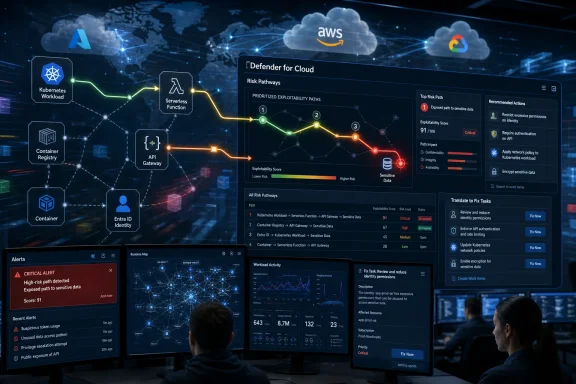 Microsoft Is Selling a Risk Model, Not Just Another Console
The old cloud-security bargain was straightforward: connect the account, scan the estate, produce findings, and let the customer sort the mess. That model fit an earlier era of cloud adoption, when the main enemy was misconfiguration and the main ask from management was proof that someone was watching. It does not fit an estate made of Kubernetes clusters, serverless functions, APIs, identity sprawl, machine credentials, CI/CD pipelines, and AI workloads that change faster than quarterly governance meetings can digest.Microsoft’s pitch in the Frost Radar context is that Defender for Cloud can correlate signals across posture, identity, data, runtime, code, and application behavior, then elevate the combinations that form plausible attack paths. That distinction matters because a vulnerability in isolation is not the same thing as business risk. A low-severity exposure attached to internet reachability, excessive permissions, and sensitive data can be more urgent than a high-CVSS issue buried in a dead path.
This is the same argument that has reshaped endpoint detection over the past decade. Security teams did not need more raw telemetry; they needed a way to connect process behavior, identity activity, network movement, and endpoint state into a coherent incident. Cloud security is now undergoing the same compression, with the added difficulty that the “endpoint” may be a container, a function, an API route, or a workload identity that exists only because a pipeline created it ten minutes ago.
Microsoft’s advantage is obvious: it already owns major pieces of the enterprise security graph. Defender for Endpoint, Defender XDR, Entra ID, Sentinel, Purview, GitHub, Azure, and Defender for Cloud give Redmond an unusually broad map of how users, workloads, identities, data, and infrastructure interact. The question for customers is whether that map becomes operational clarity or merely a larger Microsoft-shaped dependency.
The Frost Radar Recognition Shows Where the Category Is Moving
Frost & Sullivan’s Cloud/Application Runtime Security framing is significant because it puts cloud security and application runtime security in the same conversation. That is not just analyst taxonomy. It reflects the fact that modern incidents do not respect the old boundary between infrastructure and application security.A vulnerable package may enter through a developer workflow, live in a container image, run inside Kubernetes, call an internal API, inherit a workload identity, and touch regulated data. Treating each point in that chain as a separate security discipline guarantees blind spots. The attacker sees a path; the defender sees dashboards.
That is why the market is converging around cloud detection and response and application detection and response as parts of the same runtime fabric. Cloud posture management can tell you what is misconfigured. Workload protection can tell you what is executing. Application security can tell you what code and APIs are exposed. The next step is deciding whether those facts connect into something an adversary can use.
Microsoft’s announcement leans heavily into that idea. Defender for Cloud is presented not merely as a posture scanner or workload protection product, but as a system for contextual risk reduction. The language is careful: prioritize exploitability, validate reachability, connect code to runtime, and push relevant findings into SOC workflows. In other words, Microsoft wants Defender for Cloud to sit between developers, cloud platform teams, and security operations as the connective tissue.
That is also why the Frost Radar recognition should not be read as a claim that Microsoft has “solved” cloud security. Analyst rankings are market signals, not engineering verdicts. But they do reveal which capabilities vendors now believe they must claim: runtime awareness, attack-path analysis, code-to-cloud traceability, API visibility, identity correlation, and AI workload coverage.
Runtime Is Where Cloud Security Stops Being Theoretical
The phrase runtime security has become overused, but its core point is brutally practical. A vulnerability matters differently depending on whether the affected component is actually loaded, reachable, exposed, privileged, and connected to something valuable. Static scans are useful, but they often lack the context required to decide what must be fixed now.This is where Microsoft is trying to move the conversation away from severity alone. CVSS scores, compliance checks, and scanner outputs still matter, but they are blunt instruments when teams are drowning in findings. The more mature question is not “How bad is this issue in theory?” but “Can this issue be reached in this environment, by this path, with these permissions, against this asset?”
That shift has practical consequences for WindowsForum’s sysadmin and IT pro audience. In a hybrid estate, the riskiest path may cross Azure, AWS, GitHub, Entra ID, Windows Server, Linux containers, a managed database, and a SaaS API before anyone sees a conventional “incident.” The defender who only sees the cloud control plane, or only sees the workload, is late.
Microsoft’s code-to-runtime positioning is therefore more than marketing decoration. If a vulnerable dependency is discovered before deployment, the useful security question becomes whether that dependency ships, whether the relevant code path runs, whether the workload is exposed, and whether the identity attached to it can reach sensitive resources. That is the kind of prioritization security teams have been asking for because it cuts through the endless queue of technically valid but operationally weak findings.
The risk is that vendors overpromise the neatness of this correlation. Real environments have incomplete tagging, messy ownership, shadow infrastructure, legacy exceptions, third-party integrations, and half-migrated identity models. Attack-path analysis is only as good as the telemetry and assumptions behind it. Microsoft has the platform breadth to attempt it at scale, but customers still need to test whether its prioritization matches their own architecture and threat model.
Defender for Cloud Becomes More Important When It Leaves Azure
For Microsoft, the strategic value of Defender for Cloud is not simply protecting Azure workloads. Azure customers already expect Azure-native security controls. The bigger play is persuading enterprises that Microsoft can secure hybrid and multicloud environments without becoming just another Azure compliance dashboard.That matters because few large organizations have a single-cloud reality. Mergers, developer preference, regulatory constraints, acquisitions, and business-unit autonomy all produce mixed estates. A security platform that cannot reason across clouds becomes another silo, even if it is excellent inside its preferred provider.
Microsoft has spent years positioning Defender for Cloud as a cloud-native application protection platform spanning Azure, AWS, Google Cloud, containers, servers, databases, DevOps, and APIs. The Frost Radar announcement extends that story into runtime and application security. The goal is to make Defender for Cloud feel less like an Azure feature and more like a control plane for risk operations.
The challenge is credibility outside Microsoft’s home turf. Security teams will expect strong Azure integration; they will scrutinize the depth of AWS and Google Cloud support more closely. They will also ask whether third-party signals are first-class citizens or merely imported evidence inside a Microsoft workflow.
This is where Microsoft’s Defender XDR integration can help and hurt. For organizations already standardized on Microsoft security, the promise of one incident graph spanning endpoint, identity, email, cloud, and workload is powerful. For organizations using a more heterogeneous stack, the same integration may look like another reason Microsoft wants to become the center of gravity for everything.
The SOC Is Being Pulled Into Cloud Remediation
One of the more important implications of the CARS framing is that cloud security is no longer just a platform-engineering problem. It is becoming a SOC problem. Not because every cloud misconfiguration should generate an alert, but because the most serious cloud risks now resemble active attack paths rather than static hygiene issues.Traditional SOC workflows were built around events: suspicious login, malware execution, lateral movement, data exfiltration, command-and-control traffic. Cloud risk workflows were built around findings: public storage, permissive security group, exposed secret, vulnerable image, overprivileged identity. The modern incident often blends both.
A cloud detection may begin as posture context and become an active security incident when paired with runtime behavior. A workload vulnerability may be background noise until the affected container receives suspicious traffic. An identity permission may look excessive but unremarkable until it is used from an unusual location or combined with access to sensitive data.
Microsoft’s argument is that Defender for Cloud, when integrated with Defender XDR, can bridge that gap. Findings can become incidents when they are enriched with runtime and identity context. SOC analysts can investigate the chain rather than pivot across five tools to reconstruct it manually.
That is a real operational need. But it also changes who owns the fix. Developers may own the code. Platform teams may own Kubernetes or cloud configuration. Identity teams may own permissions. The SOC may own triage. If Microsoft’s platform can identify the path but the organization cannot assign responsibility, the finding still dies in a ticket queue.
AI Workloads Make the Old Cloud Inventory Problem Worse
Microsoft’s announcement nods to AI-powered workloads, agents, and machine identities, and that should not be treated as a fashionable add-on. AI adoption is making the cloud security problem more dynamic, not less. The more organizations deploy agents, retrieval systems, model endpoints, plug-ins, and automation tied to business data, the more they create new paths between code, identity, APIs, and sensitive information.The security concern is not just model theft or prompt injection, though both matter. It is the way AI workloads accelerate the already painful problem of machine-to-machine access. Agents need credentials. Pipelines need secrets. Retrieval systems need data permissions. APIs need exposure. Every one of those links can become part of an attack path.
This is where contextual risk reduction becomes especially important. A misconfigured AI service may not be the core issue. The real issue may be that the service is externally reachable, tied to an overprivileged identity, connected to sensitive data, and insufficiently monitored at runtime. That is the kind of blended exposure that old vulnerability-management tools struggle to express.
Microsoft is well positioned to talk about this because it sits at the intersection of Azure AI, GitHub, Entra, Defender, and Microsoft 365 data. It is also exposed to the downside: customers will expect Microsoft’s security stack to understand AI workloads before those workloads become the next unmanaged sprawl.
For IT leaders, the lesson is simple. AI security cannot be bolted onto cloud security as a separate dashboard. It has to be part of the same inventory, identity, data, runtime, and application model that governs everything else. Otherwise, organizations will repeat the mistakes of early cloud adoption at higher speed.
The Catch Is That Platform Unification Always Has a Price
Microsoft’s security strategy has a consistent rhythm: integrate broadly, bundle aggressively, and make the unified experience better for customers already inside the ecosystem. That has worked extremely well in endpoint, identity, email, and XDR. Defender for Cloud is now part of the same gravitational pull.For many enterprises, that is welcome. Security teams are exhausted by tool sprawl. They do not want ten consoles that each explain ten percent of the problem. They want fewer systems, better correlation, and a defensible way to prioritize remediation.
But consolidation carries tradeoffs. A single platform can reduce complexity, but it can also concentrate assumptions. If Microsoft’s risk scoring, coverage gaps, or integration priorities do not match the customer’s environment, the organization may become overly dependent on a view of risk that feels complete because it is neatly presented.
There is also a competitive reality behind the analyst language. Microsoft is not alone in this race. CrowdStrike, Palo Alto Networks, Wiz, Lacework, Orca, Check Point, Tenable, Rapid7, and others have all pushed versions of runtime-aware, cloud-native risk prioritization. Some entered from endpoint and SOC operations, some from cloud posture, and some from agentless cloud visibility. The market is not waiting for Microsoft to define the category by itself.
That competition is healthy because no single vendor has a monopoly on cloud truth. Agentless scanning sees breadth. Agents and sensors see behavior. Code scanning sees pre-deployment risk. Identity analytics sees permission paths. Runtime detection sees live exploitation. The winners will be the platforms that combine those signals without burying defenders under a prettier mountain of alerts.
The Practical Test Is Whether Findings Become Fixes
The most important measure of Microsoft’s Frost Radar recognition will not be the analyst chart. It will be whether Defender for Cloud helps customers remediate faster and more accurately. In security operations, prioritization is only valuable if it changes what gets fixed.A good cloud security platform should reduce the number of arguments teams have about whether something matters. It should show why a finding is reachable, who owns the affected resource, what data or identity is at stake, and what remediation will break or preserve. It should help security teams move from “please fix this critical vulnerability” to “this exposed workload can reach this data through this identity, and here is the shortest safe fix.”
That is difficult because cloud ownership is often a social problem disguised as a technical one. The platform can identify a risky container image, but someone still needs to know which team built it, which pipeline produced it, which service depends on it, and whether patching it will disrupt production. Without ownership metadata and workflow discipline, even excellent detection becomes theater.
Microsoft’s GitHub and DevOps integrations could help here. If Defender for Cloud can trace a runtime issue back to the repository, infrastructure-as-code template, container image, or pipeline that introduced it, the remediation loop becomes shorter. That is the promise of code-to-cloud security: not merely catching mistakes earlier, but proving which earlier mistake is causing a live risk now.
Still, organizations should demand evidence. During evaluations, they should ask vendors to demonstrate risk reduction on real workloads, not canned demos. They should compare which platform correctly identifies reachable vulnerabilities, excessive identities, exposed APIs, sensitive data paths, and runtime anomalies in their own environment. The best-looking graph is not always the most operationally useful one.
Microsoft’s Win Is Also a Warning to Security Teams
There is a temptation to read awards and analyst recognitions as reassurance. Microsoft is a leader, therefore the strategy is validated, therefore the stack is safe. That is exactly the wrong lesson.The better lesson is that the cloud security problem has outgrown the old separation of duties. Application security, cloud security, identity, data governance, and SOC operations are now entangled. If your tooling, staffing, and remediation workflows still treat them as separate planets, attackers will move through the gaps.
Microsoft’s recognition reflects the market’s demand for connected context. It does not remove the need for basic hygiene: least privilege, patching, segmentation, secure pipelines, secret management, logging, incident response, and disciplined ownership. In fact, contextual platforms tend to expose how weak those foundations are.
The most successful customers will not be the ones that simply turn on more Defender features. They will be the ones that use the platform to force sharper operating models. Who owns workload identity risk? Who remediates vulnerable images? Who approves exposed APIs? Who decides when a cloud posture issue becomes a SOC incident? These are governance questions before they are product questions.
For Windows-heavy enterprises moving deeper into Azure and Microsoft 365, this is both convenient and uncomfortable. Convenient because Microsoft can connect more of the environment than most vendors. Uncomfortable because the more Microsoft connects, the more visible the organization’s internal fragmentation becomes.
The Signal Behind Microsoft’s Frost Radar Moment
The concrete readout from this announcement is not that every organization should immediately standardize on Defender for Cloud. It is that the center of cloud security is moving toward runtime-informed, application-aware, identity-connected risk operations.- Microsoft’s July 1, 2026 announcement positions Defender for Cloud as part of a broader move from cloud visibility to contextual risk reduction.
- Frost & Sullivan’s Cloud/Application Runtime Security category reflects the convergence of cloud detection, application runtime security, posture management, and SOC workflows.
- The most important capability is not finding more issues, but identifying which issues are reachable, exploitable, and connected to critical assets.
- Defender XDR integration gives Microsoft a strong story for customers already invested in Microsoft security, but multicloud depth and third-party interoperability remain the practical tests.
- AI workloads increase the urgency because they create new combinations of APIs, identities, data access, automation, and runtime behavior.
- Security teams should judge platforms by whether they shorten remediation loops, not by whether they produce more elegant dashboards.
References
- Primary source: Microsoft
Published: Wed, 01 Jul 2026 16:00:00 GMT
Microsoft named a leader in the Frost Radar for cloud and application runtime security | Microsoft Security Blog
Frost Radar recognizes Microsoft leadership in cloud and application runtime security, helping teams prioritize and reduce exploitable risk.www.microsoft.com - Related coverage: crowdstrike.com
CrowdStrike Leads 2026 Frost Radar for Cloud Runtime Security
CrowdStrike earned top Innovation and Growth scores in the 2026 Frost Radar for Cloud and Application Runtime Security.www.crowdstrike.com
- Official source: learn.microsoft.com
Code to runtime for recommendations - Microsoft Defender for Cloud | Microsoft Learn
Learn how to use code to runtime visibility to trace security issues from runtime back to source code and fix them at the origin to prevent recurrence.learn.microsoft.com - Official source: azure.microsoft.com
- Official source: techcommunity.microsoft.com
- Related coverage: cioinfluence.com
- Related coverage: marketresearch.com
Frost Radar™: Cloud/Application Runtime Security, 2026
Frost Radar™: Cloud/Application Runtime Security, 2026 Cloud and AI adoption are expanding the runtime attack surface across multicloud infrastructure, containers, K8s, serverless, APIs, and AI - Market research report and industry analysis - 45375157www.marketresearch.com - Related coverage: frost.com
- Official source: cdn-dynmedia-1.microsoft.com
