

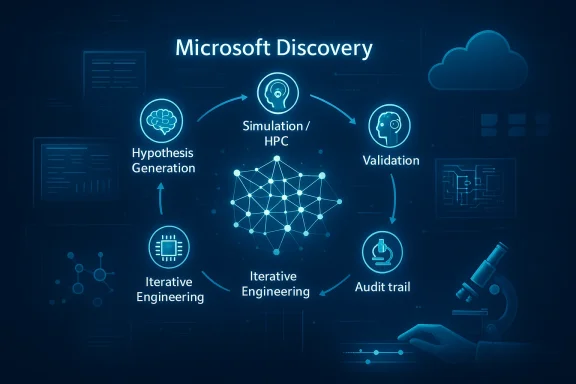
Microsoft is pushing Microsoft Discovery from a tightly controlled private preview into a broader enterprise preview, and that shift matters because it signals more than another Azure SKU entering the market. It marks one of Microsoft’s most ambitious attempts yet to apply agentic AI to the hardest parts of research and development: hypothesis generation, simulation, validation, and iterative engineering at industrial scale. The company is pairing that message with new partner integrations, customer case studies, and a stronger claim that Discovery is becoming a real platform rather than a concept demo.
Microsoft first framed Discovery as an enterprise agentic platform at Build 2025, positioning it around a simple but sweeping thesis: R&D is too complex for conventional retrieval, and too iterative for static automation. The original announcement emphasized specialized AI agents, a graph-based knowledge engine, and Azure-native governance as the core ingredients for a new discovery workflow. It also signaled that Microsoft wanted to connect Discovery to partner tools, open-source models, and the broader Microsoft cloud stack rather than keep it as a sealed vertical product.
That backdrop matters because the R&D market has spent years oscillating between two unsatisfying poles. On one side sit generic AI assistants that can summarize papers and draft text, but struggle with deep scientific reasoning. On the other side sit specialized scientific software stacks that are powerful but siloed, expensive to integrate, and hard to orchestrate across the full discovery loop. Microsoft is now arguing that the missing layer is not another model, but an agentic system that can coordinate tools, data, and human expertise across the entire workflow.
The new blog post makes clear that the company believes the market is moving from experimentation to operationalization. Microsoft is no longer speaking only about what Discovery could become; it is highlighting early customer deployments, partner ecosystem expansion, and real scientific outcomes. That is a meaningful rhetorical shift, because enterprise buyers usually want to know whether a platform can survive compliance scrutiny, handle messy proprietary data, and produce work product that engineers and scientists actually trust.
It is also notable that Discovery lands in the middle of a broader Microsoft push toward frontier AI workflows across the stack. Microsoft has been tightening the integration story between Azure infrastructure, Microsoft Foundry, Microsoft Fabric, and specialized industry workflows. Discovery fits that pattern neatly: it is vertical, but it still rides on the same cloud, data, agent, and governance plumbing Microsoft is trying to standardize across the enterprise market.
Microsoft is also targeting sectors where knowledge is fragmented across literature, internal data, and specialized tools. Life sciences, chemistry, semiconductors, and industrial engineering all have this pattern, and all are heavily constrained by iterative experimentation. In other words, Microsoft is not chasing a generic “AI for science” slogan; it is trying to solve the most painful bottlenecks in high-value R&D.
The architecture matters because Microsoft is making a specific claim about how scientific work should be represented. Discovery’s engine is meant to reason across proprietary data and external literature, while preserving the messy reality of science: conflicting theories, incomplete evidence, and multiple possible interpretations. That is a much more ambitious proposition than simple vector search or document chat, and it is exactly where general-purpose copilots tend to run out of steam.
The platform also signals a broader convergence between agentic AI and high-performance computing. Microsoft says agents can operate across in silico experimentation, HPC clusters, specialized quantitative models, and even physical laboratory systems under human oversight. In practical terms, that means Discovery is being designed to orchestrate not just text generation, but scientific computation and experimental pipelines.
The company is also leaning harder into the ecosystem story. Discovery is not just about Microsoft models and Microsoft data; it is being positioned to work with partner tools, open-source models, and adjacent Microsoft platforms such as Microsoft Foundry and Microsoft Fabric. That makes it more plausible as a strategic layer inside existing enterprise architectures, rather than an isolated research sandbox.
A preview expansion also creates a market signal. It tells CIOs, CTOs, and R&D leaders that Microsoft expects the platform to survive broader scrutiny, even if the fine details may still change. The company is careful to say that preview features can change before general availability, which is standard but also a reminder that early adopters are buying into a moving target.
This is more than a branding exercise. Traditional R&D workflows are often slow because they break at the handoff points: literature review, simulation, lab work, and engineering validation are managed by different systems and specialists. Microsoft is arguing that agentic orchestration can make those transitions more fluid, while still leaving humans in control of the critical decisions.
That control point is crucial. Microsoft repeatedly stresses that the researcher remains in charge, with governance, audit trails, and checkpoints built into the platform. This is one of the few parts of the pitch that directly addresses enterprise anxiety about autonomous systems, because no real R&D organization wants “black box science” generating undocumented decisions.
Microsoft is betting that specialized agents, each with a defined role, will outperform a single general assistant. That is consistent with the way enterprise automation is evolving more broadly: multi-agent systems, domain-specific data grounding, and workflow orchestration are becoming the default architecture. The company’s own Fabric and Foundry messaging points in the same direction.
Still, the value depends on whether the agents are actually good at deciding when to stop, when to ask for human review, and when to discard a path. In science, an autonomous system that moves quickly in the wrong direction can create more work, not less. That is why Microsoft’s governance pitch is not optional garnish; it is part of the core product claim. If the guardrails fail, the entire narrative weakens.
Microsoft says the platform supports digital, physical, and analytical tools used across R&D, including in silico experimentation, HPC, and specialized large quantitative models. It also mentions interoperability with physical labs, robotics, lab instrumentation, and IoT-enabled devices operated under human oversight. That breadth matters because real-world research is not just computational; it is a chain of physical and digital systems.
The platform’s design also leans heavily on the broader Microsoft cloud. Integration with Microsoft 365, Microsoft Foundry, and Microsoft Fabric suggests that Discovery is intended to sit inside an enterprise’s existing knowledge and workflow fabric. That could help with adoption, because organizations rarely want to stand up a completely separate environment for one strategic use case.
A graph model also helps explain why Microsoft talks so much about conflicting theories and experimental results. Science is not a deterministic Q&A problem; it is a process of adjudicating evidence. A graph lets agents navigate that complexity with more nuance than a simple summarizer could manage.
The weakness, of course, is that graphs are only as useful as the data and ontology behind them. If an organization’s data is messy, incomplete, or poorly governed, a sophisticated graph can still reproduce bad assumptions at scale. That is why the platform’s value will depend heavily on data quality and semantic discipline.
The company also frames the product as part of Azure’s security and compliance story, with the broader Azure cloud supplying the trust boundary. That will matter to large enterprises that already have policies around data residency, access control, and model governance. In other words, Microsoft is not just selling AI capability; it is selling an enterprise operating model for scientific AI.
This governance story is also a competitive differentiator. Many AI vendors can claim workflow automation, but far fewer can connect that claim to an existing enterprise control plane. Microsoft’s advantage is that it can talk about agent governance in the same breath as identity, data, compliance, and infrastructure.
That balancing act is likely to vary by sector. A materials-science team may tolerate more automation in simulation than a life-sciences team would in preclinical interpretation. Microsoft’s platform approach gives it room to tune those governance choices by use case rather than by one-size-fits-all policy.
The risk is that the more sophisticated the governance model becomes, the harder it may be for customers to configure and manage. Enterprises often underestimate how much friction is introduced by policy layering, permissions, and workflow gating. Discovery will need to prove that control can scale without choking off the very speed it promises. That is easier to advertise than to implement.
This matters because partner credibility is often what moves a platform from demo to deployment. A materials company, a pathology AI vendor, and a chip-design specialist all validating the same platform creates a stronger market signal than Microsoft’s internal R&D stories alone. It also helps Microsoft show breadth across life sciences, chemistry, engineering, and semiconductor design.
Interoperability is equally important. Microsoft says Discovery can integrate with existing business tools and assets, open-source models, and future capabilities such as quantum computing when relevant to commercial R&D. That “future-proof” language is doing a lot of work, but it also reflects a genuine product design goal: avoid locking customers into a single scientific stack.
This creates an unusual kind of customer path. An enterprise might start with Fabric for data, Foundry for agent management, and then add Discovery for domain-specific R&D workflows. That layered strategy is classic Microsoft: make the platform modular, then let adjacent workloads pull each other in.
The competitive implication is significant. Rivals may be able to beat Microsoft on individual scientific models or niche workflows, but they may struggle to match the combination of cloud, data, agents, governance, and partner ecosystem. Microsoft is trying to win the platform war, not just the feature war.
Syensqo is presented as a model of enterprise-scale transformation, using Discovery to modernize R&D knowledge foundations, scale cloud-based compute, and unify scientific and commercial data. The broader strategic message is that Discovery is not only for researchers in the lab; it is also for connecting R&D to commercialization and planning. That expands the product’s relevance beyond pure science teams.
GigaTIME represents a different pattern: AI-assisted pathology and tumor microenvironment analysis. Here the emphasis is on turning routine H&E slides into research-grade spatial signals, then embedding those outputs in a broader reasoning loop. Microsoft is careful to state that the tool is for research use only, not clinical diagnosis, which is important given the regulatory stakes in healthcare AI.
PhysicsX is perhaps the clearest engineering example. Microsoft says the partnership can compress simulation-heavy design cycles from weeks to days, while exploring thousands of manufacturable candidates. If that claim holds across more components and industries, the impact on industrial design productivity could be substantial.
Synopsys, meanwhile, highlights the chip-design angle. Semiconductor development is among the most complex and resource-intensive engineering disciplines, so agentic assistance could be a major force multiplier. Microsoft is smart to showcase this use case because it signals relevance in one of the most strategically important industries in the world.
For cloud rivals, the challenge is not just model quality. It is whether they can offer the same combination of data grounding, governance, collaboration, HPC integration, and domain-specific partner ecosystems. Microsoft’s advantage is that it can stitch together those layers across Azure, Foundry, and Fabric in a way that looks operationally complete.
For scientific software vendors, the challenge is more existential. If Microsoft can become the default orchestration layer for R&D workflows, then standalone tools risk being reduced to components inside a larger ecosystem. That does not mean they disappear, but it does mean they may need to compete on becoming the best plug-in rather than the entire platform.
There is also a channel effect. Microsoft’s partner network can help Discovery reach specialized industries that general AI vendors might never penetrate deeply. That makes the platform more likely to become embedded in transformation programs rather than isolated innovation pilots.
Still, competitors will not stand still. If Discovery proves attractive, others will likely respond with better scientific copilots, deeper integrations, or more aggressive pricing. The real race is whether Microsoft can convert early momentum into repeatable customer wins before the market fragments again. That window may not stay open for long.
It also benefits from being part of Microsoft’s wider AI platform strategy. The more Foundry, Fabric, and Discovery reinforce each other, the more Microsoft can sell a coherent enterprise transformation story instead of isolated tools. That could make adoption easier for companies already standardized on Azure.
The partner ecosystem is another major opportunity. If Microsoft keeps landing credible names across materials, pharma, semiconductors, and engineering, Discovery can become the default orchestration layer for many R&D leaders. The more use cases it supports, the more likely it is to win executive sponsorship.
Another concern is that scientific AI is only as good as the data underneath it. Messy ontologies, inconsistent lab metadata, and incomplete experiment histories can undermine even the most sophisticated reasoning engine. Microsoft can provide tooling, but it cannot magically fix poor research data discipline.
There is also a regulatory and reputational risk in healthcare and life sciences. Even with strong disclaimers, people may assume more than the system can safely deliver, especially when outputs appear polished or highly confident. Microsoft will need to keep emphasizing research-use-only boundaries where appropriate.
The other major question is how deeply Discovery becomes entwined with Microsoft’s wider agent stack. If Foundry, Fabric, and Discovery continue converging, Microsoft may be building something bigger than an R&D product: a full enterprise system for knowledge work, operational decision-making, and domain-specific automation. That would give the company a formidable position in the next phase of AI infrastructure.
What to watch next:
Source: Microsoft Azure Microsoft Discovery: Advancing agentic R&D at scale | Microsoft Azure Blog
 Background
Microsoft first framed Discovery as an enterprise agentic platform at Build 2025, positioning it around a simple but sweeping thesis: R&D is too complex for conventional retrieval, and too iterative for static automation. The original announcement emphasized specialized AI agents, a graph-based knowledge engine, and Azure-native governance as the core ingredients for a new discovery workflow. It also signaled that Microsoft wanted to connect Discovery to partner tools, open-source models, and the broader Microsoft cloud stack rather than keep it as a sealed vertical product.That backdrop matters because the R&D market has spent years oscillating between two unsatisfying poles. On one side sit generic AI assistants that can summarize papers and draft text, but struggle with deep scientific reasoning. On the other side sit specialized scientific software stacks that are powerful but siloed, expensive to integrate, and hard to orchestrate across the full discovery loop. Microsoft is now arguing that the missing layer is not another model, but an agentic system that can coordinate tools, data, and human expertise across the entire workflow.
The new blog post makes clear that the company believes the market is moving from experimentation to operationalization. Microsoft is no longer speaking only about what Discovery could become; it is highlighting early customer deployments, partner ecosystem expansion, and real scientific outcomes. That is a meaningful rhetorical shift, because enterprise buyers usually want to know whether a platform can survive compliance scrutiny, handle messy proprietary data, and produce work product that engineers and scientists actually trust.
It is also notable that Discovery lands in the middle of a broader Microsoft push toward frontier AI workflows across the stack. Microsoft has been tightening the integration story between Azure infrastructure, Microsoft Foundry, Microsoft Fabric, and specialized industry workflows. Discovery fits that pattern neatly: it is vertical, but it still rides on the same cloud, data, agent, and governance plumbing Microsoft is trying to standardize across the enterprise market.
Why Microsoft is betting here
The company’s own framing suggests that discovery is one of the few enterprise domains where agentic AI can produce an obvious return on investment. If an agent can shorten material screening, compress simulation cycles, or narrow a semiconductor design space, the business payoff can be measured in months of saved time, lower lab cost, or faster product launch. That is very different from consumer chat, where value is often diffuse and hard to benchmark.Microsoft is also targeting sectors where knowledge is fragmented across literature, internal data, and specialized tools. Life sciences, chemistry, semiconductors, and industrial engineering all have this pattern, and all are heavily constrained by iterative experimentation. In other words, Microsoft is not chasing a generic “AI for science” slogan; it is trying to solve the most painful bottlenecks in high-value R&D.
Overview
At the center of the announcement is an expanded preview for Microsoft Discovery, which Microsoft describes as an extensible platform for agentic orchestration, advanced reasoning, graph-based knowledge, and high-performance computing. The platform is built on Azure and designed to fit enterprise requirements for security, compliance, transparency, and governance, which is essential if it is going to touch sensitive formulations, proprietary research, or regulated development pipelines.The architecture matters because Microsoft is making a specific claim about how scientific work should be represented. Discovery’s engine is meant to reason across proprietary data and external literature, while preserving the messy reality of science: conflicting theories, incomplete evidence, and multiple possible interpretations. That is a much more ambitious proposition than simple vector search or document chat, and it is exactly where general-purpose copilots tend to run out of steam.
The platform also signals a broader convergence between agentic AI and high-performance computing. Microsoft says agents can operate across in silico experimentation, HPC clusters, specialized quantitative models, and even physical laboratory systems under human oversight. In practical terms, that means Discovery is being designed to orchestrate not just text generation, but scientific computation and experimental pipelines.
What changed in the expanded preview
The expanded preview suggests Microsoft has gained enough confidence in the architecture and customer demand to widen access, even while keeping the product in preview. That is important because preview status is often where enterprise platforms either harden into something adoptable or quietly stall. By emphasizing expanding interoperability and real-world results, Microsoft is trying to show momentum rather than promise.The company is also leaning harder into the ecosystem story. Discovery is not just about Microsoft models and Microsoft data; it is being positioned to work with partner tools, open-source models, and adjacent Microsoft platforms such as Microsoft Foundry and Microsoft Fabric. That makes it more plausible as a strategic layer inside existing enterprise architectures, rather than an isolated research sandbox.
A preview expansion also creates a market signal. It tells CIOs, CTOs, and R&D leaders that Microsoft expects the platform to survive broader scrutiny, even if the fine details may still change. The company is careful to say that preview features can change before general availability, which is standard but also a reminder that early adopters are buying into a moving target.
The Agentic R&D Model
Microsoft’s central argument is that research should be treated as a continuous loop, not a linear sequence of search, experiment, and report writing. In this model, specialized agents reason over knowledge, propose hypotheses, test them at scale, analyze the outcomes, and feed the results back into the next iteration. That is the “agentic loop” Microsoft wants to industrialize.This is more than a branding exercise. Traditional R&D workflows are often slow because they break at the handoff points: literature review, simulation, lab work, and engineering validation are managed by different systems and specialists. Microsoft is arguing that agentic orchestration can make those transitions more fluid, while still leaving humans in control of the critical decisions.
That control point is crucial. Microsoft repeatedly stresses that the researcher remains in charge, with governance, audit trails, and checkpoints built into the platform. This is one of the few parts of the pitch that directly addresses enterprise anxiety about autonomous systems, because no real R&D organization wants “black box science” generating undocumented decisions.
Why agents are different from copilots
A copilot can assist a scientist; an agentic system can help coordinate the whole experiment cycle. That distinction matters because the bottleneck in R&D is rarely just writing or retrieval. The bottleneck is deciding what to test next, how to interpret ambiguous results, and how to recombine data sources into a credible development path.Microsoft is betting that specialized agents, each with a defined role, will outperform a single general assistant. That is consistent with the way enterprise automation is evolving more broadly: multi-agent systems, domain-specific data grounding, and workflow orchestration are becoming the default architecture. The company’s own Fabric and Foundry messaging points in the same direction.
Still, the value depends on whether the agents are actually good at deciding when to stop, when to ask for human review, and when to discard a path. In science, an autonomous system that moves quickly in the wrong direction can create more work, not less. That is why Microsoft’s governance pitch is not optional garnish; it is part of the core product claim. If the guardrails fail, the entire narrative weakens.
Platform Architecture
Discovery is described as an extensible platform built around agentic orchestration, advanced reasoning, a graph-based knowledge foundation, and HPC. The key architectural idea is that the platform should not merely retrieve facts, but reason over relationships and context across datasets, literature, and experimental history. That is how Microsoft is trying to distinguish Discovery from ordinary enterprise search or chat tooling.Microsoft says the platform supports digital, physical, and analytical tools used across R&D, including in silico experimentation, HPC, and specialized large quantitative models. It also mentions interoperability with physical labs, robotics, lab instrumentation, and IoT-enabled devices operated under human oversight. That breadth matters because real-world research is not just computational; it is a chain of physical and digital systems.
The platform’s design also leans heavily on the broader Microsoft cloud. Integration with Microsoft 365, Microsoft Foundry, and Microsoft Fabric suggests that Discovery is intended to sit inside an enterprise’s existing knowledge and workflow fabric. That could help with adoption, because organizations rarely want to stand up a completely separate environment for one strategic use case.
Why the graph layer matters
The graph-based knowledge engine is arguably the most consequential technical piece in the announcement. Microsoft is effectively saying that R&D cannot be managed as disconnected chunks of text; it has to be modeled as relationships among entities, experiments, assumptions, results, and domain knowledge. That is a better match for scientific reasoning than flat retrieval alone.A graph model also helps explain why Microsoft talks so much about conflicting theories and experimental results. Science is not a deterministic Q&A problem; it is a process of adjudicating evidence. A graph lets agents navigate that complexity with more nuance than a simple summarizer could manage.
The weakness, of course, is that graphs are only as useful as the data and ontology behind them. If an organization’s data is messy, incomplete, or poorly governed, a sophisticated graph can still reproduce bad assumptions at scale. That is why the platform’s value will depend heavily on data quality and semantic discipline.
Governance, Compliance, and Control
Microsoft is clearly aware that autonomous systems in R&D raise governance concerns far beyond standard enterprise AI. Discovery therefore emphasizes centralized management, audit trails, checkpoints, and human oversight, all of which are meant to prevent uncontrolled agent behavior. This is especially important in regulated sectors like pharma, chemicals, and semiconductors, where traceability is not a nice-to-have but a requirement.The company also frames the product as part of Azure’s security and compliance story, with the broader Azure cloud supplying the trust boundary. That will matter to large enterprises that already have policies around data residency, access control, and model governance. In other words, Microsoft is not just selling AI capability; it is selling an enterprise operating model for scientific AI.
This governance story is also a competitive differentiator. Many AI vendors can claim workflow automation, but far fewer can connect that claim to an existing enterprise control plane. Microsoft’s advantage is that it can talk about agent governance in the same breath as identity, data, compliance, and infrastructure.
Enterprise trust versus research velocity
There is an inherent tension here. The more you add checkpoints and approvals, the less “autonomous” the system becomes. But the less you add, the less enterprises will trust it in high-value scientific workflows. Microsoft is trying to occupy the middle ground where agents can move quickly without becoming opaque.That balancing act is likely to vary by sector. A materials-science team may tolerate more automation in simulation than a life-sciences team would in preclinical interpretation. Microsoft’s platform approach gives it room to tune those governance choices by use case rather than by one-size-fits-all policy.
The risk is that the more sophisticated the governance model becomes, the harder it may be for customers to configure and manage. Enterprises often underestimate how much friction is introduced by policy layering, permissions, and workflow gating. Discovery will need to prove that control can scale without choking off the very speed it promises. That is easier to advertise than to implement.
Partner Ecosystem and Interoperability
Microsoft is clearly positioning Discovery as an ecosystem platform, not a standalone product. The announcement highlights collaboration with Syensqo, GigaTIME, PhysicsX, and Synopsys, alongside an expanding partner base and software integrators such as Accenture and Capgemini. That mix tells us Microsoft wants Discovery to become a reusable platform for multiple industrial verticals.This matters because partner credibility is often what moves a platform from demo to deployment. A materials company, a pathology AI vendor, and a chip-design specialist all validating the same platform creates a stronger market signal than Microsoft’s internal R&D stories alone. It also helps Microsoft show breadth across life sciences, chemistry, engineering, and semiconductor design.
Interoperability is equally important. Microsoft says Discovery can integrate with existing business tools and assets, open-source models, and future capabilities such as quantum computing when relevant to commercial R&D. That “future-proof” language is doing a lot of work, but it also reflects a genuine product design goal: avoid locking customers into a single scientific stack.
The Microsoft stack advantage
One of Microsoft’s strongest assets is that Discovery is not isolated from the rest of the company’s AI story. Microsoft Foundry provides the broader agent and model management layer, while Fabric provides enterprise data, semantic context, and operations integration. That means Discovery can plug into a platform story that already has momentum with enterprise buyers.This creates an unusual kind of customer path. An enterprise might start with Fabric for data, Foundry for agent management, and then add Discovery for domain-specific R&D workflows. That layered strategy is classic Microsoft: make the platform modular, then let adjacent workloads pull each other in.
The competitive implication is significant. Rivals may be able to beat Microsoft on individual scientific models or niche workflows, but they may struggle to match the combination of cloud, data, agents, governance, and partner ecosystem. Microsoft is trying to win the platform war, not just the feature war.
Customer Case Studies
Microsoft’s examples are useful because they reveal where Discovery is actually being applied. The company cites its own internal work on a non-PFAS immersion datacenter coolant prototype, discovered in about 200 hours using AI models and HPC tools. That example is telling because it combines sustainability, hardware engineering, and a clear speed-to-insight narrative.Syensqo is presented as a model of enterprise-scale transformation, using Discovery to modernize R&D knowledge foundations, scale cloud-based compute, and unify scientific and commercial data. The broader strategic message is that Discovery is not only for researchers in the lab; it is also for connecting R&D to commercialization and planning. That expands the product’s relevance beyond pure science teams.
GigaTIME represents a different pattern: AI-assisted pathology and tumor microenvironment analysis. Here the emphasis is on turning routine H&E slides into research-grade spatial signals, then embedding those outputs in a broader reasoning loop. Microsoft is careful to state that the tool is for research use only, not clinical diagnosis, which is important given the regulatory stakes in healthcare AI.
What these examples reveal
The common thread is not the specific domain, but the workflow shape. Each use case combines large data volumes, specialist expertise, iterative validation, and high costs for trial-and-error. Those are exactly the conditions under which agentic orchestration becomes valuable.PhysicsX is perhaps the clearest engineering example. Microsoft says the partnership can compress simulation-heavy design cycles from weeks to days, while exploring thousands of manufacturable candidates. If that claim holds across more components and industries, the impact on industrial design productivity could be substantial.
Synopsys, meanwhile, highlights the chip-design angle. Semiconductor development is among the most complex and resource-intensive engineering disciplines, so agentic assistance could be a major force multiplier. Microsoft is smart to showcase this use case because it signals relevance in one of the most strategically important industries in the world.
Competitive Implications
Microsoft Discovery is entering a space that overlaps with scientific software, enterprise AI platforms, cloud HPC, and vertical industry tooling. That makes the competitive landscape unusually broad. Microsoft is effectively challenging both horizontal AI platforms and narrow-domain specialists by arguing that its integration story is the real moat.For cloud rivals, the challenge is not just model quality. It is whether they can offer the same combination of data grounding, governance, collaboration, HPC integration, and domain-specific partner ecosystems. Microsoft’s advantage is that it can stitch together those layers across Azure, Foundry, and Fabric in a way that looks operationally complete.
For scientific software vendors, the challenge is more existential. If Microsoft can become the default orchestration layer for R&D workflows, then standalone tools risk being reduced to components inside a larger ecosystem. That does not mean they disappear, but it does mean they may need to compete on becoming the best plug-in rather than the entire platform.
Enterprise versus consumer implications
The enterprise angle is much stronger here than the consumer angle. R&D buyers care about governance, data integration, auditability, and reproducibility, all of which Microsoft is foregrounding. Consumer AI may get more headlines, but enterprise R&D can justify deeper investment and stickier long-term contracts.There is also a channel effect. Microsoft’s partner network can help Discovery reach specialized industries that general AI vendors might never penetrate deeply. That makes the platform more likely to become embedded in transformation programs rather than isolated innovation pilots.
Still, competitors will not stand still. If Discovery proves attractive, others will likely respond with better scientific copilots, deeper integrations, or more aggressive pricing. The real race is whether Microsoft can convert early momentum into repeatable customer wins before the market fragments again. That window may not stay open for long.
Strengths and Opportunities
Microsoft Discovery has several clear strengths that could make it a serious platform for enterprise R&D. The most obvious is that it combines agentic orchestration, graph-based reasoning, and Azure-grade governance in one stack. That combination is rare, and it aligns well with the operational realities of research organizations that cannot afford brittle point solutions.It also benefits from being part of Microsoft’s wider AI platform strategy. The more Foundry, Fabric, and Discovery reinforce each other, the more Microsoft can sell a coherent enterprise transformation story instead of isolated tools. That could make adoption easier for companies already standardized on Azure.
The partner ecosystem is another major opportunity. If Microsoft keeps landing credible names across materials, pharma, semiconductors, and engineering, Discovery can become the default orchestration layer for many R&D leaders. The more use cases it supports, the more likely it is to win executive sponsorship.
- Cross-domain fit across life sciences, materials, semiconductors, and industrial engineering.
- Enterprise trust posture with governance, audit trails, and human oversight.
- Platform leverage through Azure, Foundry, and Fabric integration.
- Partner credibility from industry specialists rather than only Microsoft itself.
- Workflow breadth spanning literature, simulation, physical labs, and analytics.
- Commercial upside from connecting research outputs to product development and go-to-market.
- Strong narrative alignment with the industry shift toward multi-agent systems.
Risks and Concerns
The biggest risk is that the product promise may outrun practical adoption. R&D teams are notoriously skeptical of tools that sound transformative but create new integration work, new governance burdens, or fragile automation chains. If Discovery is hard to onboard, customers may admire it without deploying it widely.Another concern is that scientific AI is only as good as the data underneath it. Messy ontologies, inconsistent lab metadata, and incomplete experiment histories can undermine even the most sophisticated reasoning engine. Microsoft can provide tooling, but it cannot magically fix poor research data discipline.
There is also a regulatory and reputational risk in healthcare and life sciences. Even with strong disclaimers, people may assume more than the system can safely deliver, especially when outputs appear polished or highly confident. Microsoft will need to keep emphasizing research-use-only boundaries where appropriate.
- Data quality dependency that can limit output reliability.
- Integration complexity for legacy lab, simulation, and PLM environments.
- Governance overhead that could slow adoption if over-engineered.
- Expectation risk if customers assume near-autonomous scientific breakthroughs.
- Regulatory sensitivity in pharma, pathology, and healthcare-adjacent use cases.
- Potential vendor lock-in concerns as organizations build around Azure-native workflows.
- Proof gap between demo-like outcomes and repeatable enterprise ROI.
Looking Ahead
The next phase for Microsoft Discovery will likely be judged less by how impressive the technology sounds and more by how repeatable the customer outcomes become. The company has already shown that it can produce compelling proof points, but the market will now ask whether those wins can scale across departments, geographies, and regulated workflows. That is the difference between an exciting platform and an enterprise standard.The other major question is how deeply Discovery becomes entwined with Microsoft’s wider agent stack. If Foundry, Fabric, and Discovery continue converging, Microsoft may be building something bigger than an R&D product: a full enterprise system for knowledge work, operational decision-making, and domain-specific automation. That would give the company a formidable position in the next phase of AI infrastructure.
What to watch next:
- Broader general availability signals and whether preview constraints loosen.
- Additional customer disclosures showing repeatable ROI, not one-off wins.
- Deeper ties between Discovery, Microsoft Foundry, and Microsoft Fabric.
- New partner integrations in pharma, chemicals, semiconductor design, and industrial engineering.
- Documentation and onboarding guidance that reveal how complex enterprise deployment really is.
- Evidence that governance and human oversight scale without slowing research velocity.
Source: Microsoft Azure Microsoft Discovery: Advancing agentic R&D at scale | Microsoft Azure Blog
