

Microsoft announced at Build 2026 that Microsoft Discovery is generally available for organizations, while a new Microsoft Discovery desktop app is entering preview for researchers, students, labs, and scientific teams that want a local way into its agentic R&D workflow platform. The announcement is not another chatbot launch dressed in lab-coat language. It is Microsoft’s bid to turn Azure into the coordination layer for scientific and engineering work that depends on hypotheses, simulations, experiments, proprietary data, and human review. If Copilot was Microsoft’s answer to knowledge work, Discovery is its attempt to make the same argument for the laboratory, the materials program, the semiconductor design group, and the industrial R&D pipeline.
The most important thing about Microsoft Discovery is not that it uses agents. Every major cloud vendor is now trying to make agentic AI sound like the inevitable next phase of enterprise computing. What matters is that Microsoft is aiming the architecture at the least forgiving corner of the AI market: research and development workflows where a plausible-sounding answer is not just unhelpful, but dangerous.
Scientific and engineering work is iterative by nature. A team starts with evidence, forms a hypothesis, tests it with modeling or experiments, examines the result, and decides whether to continue, discard, or reframe the problem. Microsoft’s pitch is that Discovery can help preserve that loop instead of flattening it into a single prompt and response.
That is a more serious claim than “AI for science” usually gets in product marketing. The history of enterprise AI is littered with systems that performed impressively in demos but struggled when moved into domains where provenance, repeatability, and domain-specific tooling mattered more than conversational fluency. Discovery is Microsoft’s attempt to say that the problem is not merely model intelligence; it is orchestration.
The platform therefore arrives with the usual Azure vocabulary — governance, security, compliance, integration — but those words carry more weight in this context than they do in a generic office automation pitch. A materials scientist does not only need a ranked list of candidate molecules. A semiconductor engineer does not only need a summary of design options. A biopharma researcher does not only need a literature synthesis. They need a chain of reasoning that can be inspected, challenged, reproduced, and tied back to evidence.
The distinction is important. In preview, a vendor can show a convincing prototype and rely on the optimism of technically sophisticated partners. At general availability, procurement teams, security officers, legal departments, and operational leaders enter the room. They ask where data goes, who can see it, how results are logged, whether outputs can be reviewed, and how a failed workflow can be reconstructed after the fact.
Microsoft’s language around Discovery is clearly shaped by those concerns. The company emphasizes reproducible workflows, reviewable outputs, governed access to proprietary knowledge, and human judgment remaining central to decisions. That is not just responsible-AI boilerplate. It is a recognition that R&D organizations cannot simply hand over expensive experimental cycles or safety-sensitive scientific decisions to an opaque automation system.
The claim is not that Discovery replaces scientists. Microsoft is careful to frame the platform as a way to coordinate tools, data, and agents around expert review. That caution is partly ethical, partly practical, and partly defensive. The more ambitious the system sounds, the more customers will ask whether it can explain itself when the stakes are measured in failed drug candidates, flawed materials, manufacturing defects, or wasted lab time.
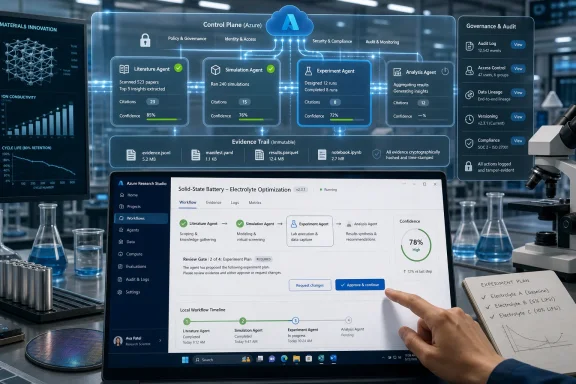
A generic assistant answers a request. A Discovery workflow is supposed to coordinate a process. It can involve specialized agents, institutional knowledge, external scientific information, modeling tools, simulations, analysis systems, validation data, and human checkpoints. In Microsoft’s telling, the platform is less a single brilliant researcher than a managed research team with memory, task status, confidence scoring, and citations to the evidence it used.
That framing fits the broader direction of Microsoft’s AI strategy. The company has been moving from individual Copilot experiences toward systems that let organizations build, govern, and monitor fleets of AI agents. Discovery applies that same enterprise pattern to scientific and engineering work, where the agents may need to call specialized tools rather than simply draft an email or summarize a meeting.
The hard part is not making an agent appear helpful in isolation. The hard part is making many agents useful together without losing traceability. If one agent extracts evidence from literature, another runs simulations, another interprets experimental data, and another proposes next steps, the organization needs to know how those intermediate steps influenced the final recommendation. Otherwise, the workflow becomes a machine for laundering uncertainty into confidence.
That is why Microsoft’s emphasis on confidence scoring and cited research findings is more than a UI detail. In scientific work, the output is only as useful as the record behind it. Discovery’s value will depend on whether it can make the reasoning trail legible enough for researchers to challenge it, not merely admire it.
That is a familiar Microsoft move. The enterprise platform is where governance, procurement, and large-scale cloud consumption live. The app is where habit formation begins. If Discovery is going to become part of research culture rather than remain an Azure SKU for innovation departments, Microsoft needs students, postdocs, engineers, and small research teams to experience it before their organization standardizes on it.
This is where the Windows angle becomes more interesting. Microsoft has spent years trying to make Windows feel less like a passive endpoint and more like a developer and AI workstation, with GitHub Copilot, Windows development tooling, local AI features, WSL investments, and containerized execution all moving in the same direction. A Discovery desktop app extends that logic into scientific computing: the PC becomes the place where exploratory workflows begin, even if the governed platform is where mature programs scale.
The preview status matters, though. Microsoft says preview features can change, and customers should read that sentence as more than legal caution. The local app may lower the barrier to entry, but it is not the same thing as a production-ready enterprise deployment with all the governance, integration, and compliance assumptions that large organizations require.
Still, the strategy is obvious. Discovery’s enterprise future depends on researchers believing it is useful before administrators make it mandatory. The desktop app gives Microsoft a way to seed that belief at the edge of the organization.
Modern R&D teams already have tools. They have modeling software, simulation frameworks, data repositories, lab notebooks, literature databases, experimental instruments, automation systems, and domain experts. The bottleneck is often not the absence of software but the friction of moving between evidence, computation, experiment, interpretation, and decision-making.
In battery research, that friction appears when teams must balance redox potential, solubility, synthetic tractability, reversibility, cost, safety, and manufacturability. In semiconductor materials, it appears when candidate exploration must stay grounded in physical constraints. In life sciences, it appears when literature, experiments, models, and cohort data all point in different directions. In mining, it appears when a theoretically promising chemistry must still work against real ore bodies and operating conditions.
Microsoft’s wager is that agentic workflows can turn those fragmented processes into something more systematic. Not necessarily fully autonomous, and certainly not universally reliable, but more repeatable and more inspectable than the ad hoc combination of spreadsheets, scripts, papers, meetings, and one-off analyses that often governs complex technical work.
That is also why the partner ecosystem matters. Discovery cannot succeed as a sealed Microsoft-only science machine. It needs domain-specific agents, trusted data sources, lab integrations, modeling systems, and industrial partners that understand the context Microsoft does not own. Wiley’s research agent, Causaly’s biomedical evidence tooling, Ginkgo’s autonomous lab ambitions, and Cambridge Consultants’ closed-loop systems are not decorative alliances; they are the admission that scientific workflows are too specialized for a single vendor stack to cover.
Discovery will be judged on which side of that line it falls. Microsoft’s strongest case is that R&D workflows actually do need multi-step coordination. A researcher might want an agent to search literature, compare findings against internal datasets, generate hypotheses, send candidate structures to a simulation tool, interpret results, identify uncertainty, and suggest the next experiment. That is a legitimate agentic pattern.
But the more autonomy a system gains, the more governance becomes the central technical problem. An agent that can read proprietary data, invoke tools, generate code, or influence experiments must be constrained. It needs permissions, audit trails, policy enforcement, and review gates. It needs to know not only what it can do, but what it must not do.
Microsoft’s broader Build 2026 messaging around agent containment and policy-driven execution on Windows underscores the same issue. The industry is moving from “Can an AI system act?” to “Can we safely define the box inside which it acts?” Discovery is a science-and-engineering expression of that shift.
That is why the platform’s usefulness will depend less on the glamour of its agents than on the duller machinery around them. Identity, access control, data boundaries, logging, versioning, reproducibility, and tool governance are what will determine whether Discovery is trusted in serious R&D environments. If those pieces work, the agents become useful. If they do not, the agents become liabilities with impressive demos.
The most credible version of Discovery’s promise is that it can shorten iteration cycles. If a system can help researchers identify better candidates earlier, avoid redundant searches, preserve reasoning paths, and coordinate tools more cleanly, then teams can spend less time wrangling process and more time testing meaningful ideas. That is valuable even when the final scientific answer remains uncertain.
The less credible version is the implied fantasy that AI can industrialize discovery into a predictable output stream. Science resists that. Experiments fail. Data is incomplete. Models encode assumptions. Lab conditions diverge from simulations. Promising candidates hit manufacturing, safety, regulatory, or economic constraints. The world has a way of punishing systems that confuse correlation with causation or confidence with truth.
Microsoft’s announcement is at its strongest when it acknowledges those realities. The repeated emphasis on human experts, experimental characterization, validation, and review suggests the company understands that Discovery must work inside the scientific process, not above it. The platform can propose, compare, retrieve, orchestrate, and reason. It cannot abolish the need for judgment.
For IT leaders, that distinction should shape evaluation. The right question is not whether Discovery will replace R&D teams. It is whether it can make expensive expert teams more effective by reducing coordination overhead and making exploratory work more transparent.
That matters because the cloud market is increasingly about specialized workflows rather than raw compute alone. Hyperscalers are not just selling virtual machines and storage; they are selling integrated environments for AI development, data analytics, cybersecurity, software engineering, and now scientific discovery. The customer is no longer merely choosing where to run workloads. The customer is choosing which vendor gets embedded into the operating model.
For Microsoft, Discovery connects several strategic threads. Azure supplies the compute and governance base. GitHub Copilot provides a user and developer entry point. Microsoft’s AI agent framework provides orchestration logic. Partner agents and domain integrations provide vertical credibility. Windows and local apps provide a personal-computing edge that keeps users in Microsoft’s orbit before projects move into enterprise scale.
That makes Discovery a platform play, not merely a product launch. If it works, Microsoft becomes part of how organizations define and manage scientific workflows. If it fails, it risks becoming another ambitious AI-branded environment that looks compelling on stage but proves too complex, too expensive, or too disconnected from the messy reality of research teams.
Those questions are not obstacles to the story; they are the story. The difference between consumer AI and enterprise R&D AI is that the latter must survive contact with institutional risk. A hallucinated paragraph in a personal note is annoying. A hallucinated inference in a drug discovery workflow, materials safety assessment, or industrial process recommendation can be far more consequential.
Microsoft’s best argument is that Discovery is designed for those constraints from the beginning. The platform’s stated emphasis on transparency, governance, evidence preservation, and human oversight is exactly what large organizations need to hear. But customers should still test those claims against their own workflows, data sensitivity, and validation requirements.
The preview app adds another layer of complexity. It may encourage experimentation by individuals and smaller teams, but organizations will need policies about what data can be used locally, how work moves from the app into the enterprise platform, and whether Copilot-linked access aligns with internal controls. A lightweight entry point is useful only if it does not become a shadow R&D system.
That is an important maturation. The first wave of generative AI was dominated by interfaces. The next wave will be dominated by execution environments. Enterprises will not deploy powerful agents broadly unless they can contain them, monitor them, and tie them to business processes with clear accountability.
Discovery is one of the more consequential expressions of that shift because R&D is both high-value and high-risk. A successful platform could help accelerate materials discovery, energy storage research, biological experimentation, semiconductor development, mining chemistry, and pharmaceutical decision-making. A poorly governed one could create expensive confusion at scale.
For WindowsForum readers, the announcement is also a reminder that Microsoft’s AI strategy is not confined to Windows features or Microsoft 365 copilots. The company is building an ecosystem in which Windows, GitHub, Azure, and domain-specific AI platforms reinforce each other. The desktop app is the front door; Azure is the control plane; agents are the connective tissue.
The strongest signal to watch is whether customers move beyond pilot projects into repeatable programs. A one-off collaboration can produce a compelling quote and a polished demo. A production deployment has to handle messy data, skeptical users, compliance reviews, budget scrutiny, tool incompatibilities, and the accumulated habits of specialized teams.
Another signal will be how well Microsoft handles uncertainty. Scientific workflows do not need AI systems that sound certain. They need systems that expose assumptions, preserve evidence, quantify confidence carefully, and leave room for expert disagreement. If Discovery becomes a machine for generating polished conclusions faster than teams can validate them, it will undermine its own premise.
The opportunity is real because the pain is real. R&D organizations are under pressure to explore larger design spaces, reduce failed cycles, accelerate time to market, and make better use of institutional knowledge. Microsoft is betting that the answer is not a smarter chatbot but a governed agentic platform that can coordinate the work around the science.
 Microsoft Wants the Lab Notebook to Become a Cloud Workflow
The most important thing about Microsoft Discovery is not that it uses agents. Every major cloud vendor is now trying to make agentic AI sound like the inevitable next phase of enterprise computing. What matters is that Microsoft is aiming the architecture at the least forgiving corner of the AI market: research and development workflows where a plausible-sounding answer is not just unhelpful, but dangerous.Scientific and engineering work is iterative by nature. A team starts with evidence, forms a hypothesis, tests it with modeling or experiments, examines the result, and decides whether to continue, discard, or reframe the problem. Microsoft’s pitch is that Discovery can help preserve that loop instead of flattening it into a single prompt and response.
That is a more serious claim than “AI for science” usually gets in product marketing. The history of enterprise AI is littered with systems that performed impressively in demos but struggled when moved into domains where provenance, repeatability, and domain-specific tooling mattered more than conversational fluency. Discovery is Microsoft’s attempt to say that the problem is not merely model intelligence; it is orchestration.
The platform therefore arrives with the usual Azure vocabulary — governance, security, compliance, integration — but those words carry more weight in this context than they do in a generic office automation pitch. A materials scientist does not only need a ranked list of candidate molecules. A semiconductor engineer does not only need a summary of design options. A biopharma researcher does not only need a literature synthesis. They need a chain of reasoning that can be inspected, challenged, reproduced, and tied back to evidence.
General Availability Is a Promise About Operations, Not Magic
Microsoft introduced Discovery in private preview at Build 2025, then widened its positioning ahead of this year’s Build before declaring the platform generally available. That chronology matters because the move from preview to general availability is less about scientific breakthrough than operational confidence. Microsoft is telling enterprise customers that Discovery is ready to be used as a production platform for R&D programs rather than a protected experiment for a handful of early adopters.The distinction is important. In preview, a vendor can show a convincing prototype and rely on the optimism of technically sophisticated partners. At general availability, procurement teams, security officers, legal departments, and operational leaders enter the room. They ask where data goes, who can see it, how results are logged, whether outputs can be reviewed, and how a failed workflow can be reconstructed after the fact.
Microsoft’s language around Discovery is clearly shaped by those concerns. The company emphasizes reproducible workflows, reviewable outputs, governed access to proprietary knowledge, and human judgment remaining central to decisions. That is not just responsible-AI boilerplate. It is a recognition that R&D organizations cannot simply hand over expensive experimental cycles or safety-sensitive scientific decisions to an opaque automation system.
The claim is not that Discovery replaces scientists. Microsoft is careful to frame the platform as a way to coordinate tools, data, and agents around expert review. That caution is partly ethical, partly practical, and partly defensive. The more ambitious the system sounds, the more customers will ask whether it can explain itself when the stakes are measured in failed drug candidates, flawed materials, manufacturing defects, or wasted lab time.
The Discovery Engine Is Microsoft’s Real Product
The center of the announcement is the Microsoft Discovery Engine, which Microsoft describes as the core mechanism for moving from evidence to hypotheses, through execution and analysis, and into another iteration. That may sound abstract, but it is the key to understanding why Discovery is different from a general-purpose AI assistant.A generic assistant answers a request. A Discovery workflow is supposed to coordinate a process. It can involve specialized agents, institutional knowledge, external scientific information, modeling tools, simulations, analysis systems, validation data, and human checkpoints. In Microsoft’s telling, the platform is less a single brilliant researcher than a managed research team with memory, task status, confidence scoring, and citations to the evidence it used.
That framing fits the broader direction of Microsoft’s AI strategy. The company has been moving from individual Copilot experiences toward systems that let organizations build, govern, and monitor fleets of AI agents. Discovery applies that same enterprise pattern to scientific and engineering work, where the agents may need to call specialized tools rather than simply draft an email or summarize a meeting.
The hard part is not making an agent appear helpful in isolation. The hard part is making many agents useful together without losing traceability. If one agent extracts evidence from literature, another runs simulations, another interprets experimental data, and another proposes next steps, the organization needs to know how those intermediate steps influenced the final recommendation. Otherwise, the workflow becomes a machine for laundering uncertainty into confidence.
That is why Microsoft’s emphasis on confidence scoring and cited research findings is more than a UI detail. In scientific work, the output is only as useful as the record behind it. Discovery’s value will depend on whether it can make the reasoning trail legible enough for researchers to challenge it, not merely admire it.
The Desktop App Is the Trojan Horse for Adoption
The second announcement — the Microsoft Discovery app in preview — may prove just as consequential as the platform’s general availability. Microsoft describes it as a localized desktop experience for researchers, students, academic labs, and scientific teams that want to start using Discovery capabilities without beginning with a full enterprise deployment. Users can get started through a GitHub Copilot account, with the app available via Microsoft’s Discovery GitHub presence.That is a familiar Microsoft move. The enterprise platform is where governance, procurement, and large-scale cloud consumption live. The app is where habit formation begins. If Discovery is going to become part of research culture rather than remain an Azure SKU for innovation departments, Microsoft needs students, postdocs, engineers, and small research teams to experience it before their organization standardizes on it.
This is where the Windows angle becomes more interesting. Microsoft has spent years trying to make Windows feel less like a passive endpoint and more like a developer and AI workstation, with GitHub Copilot, Windows development tooling, local AI features, WSL investments, and containerized execution all moving in the same direction. A Discovery desktop app extends that logic into scientific computing: the PC becomes the place where exploratory workflows begin, even if the governed platform is where mature programs scale.
The preview status matters, though. Microsoft says preview features can change, and customers should read that sentence as more than legal caution. The local app may lower the barrier to entry, but it is not the same thing as a production-ready enterprise deployment with all the governance, integration, and compliance assumptions that large organizations require.
Still, the strategy is obvious. Discovery’s enterprise future depends on researchers believing it is useful before administrators make it mandatory. The desktop app gives Microsoft a way to seed that belief at the edge of the organization.
Microsoft Is Selling Coordination to Industries Drowning in Tools
The customer and partner examples in Microsoft’s announcement span battery chemistry, origins-of-life research, autonomous laboratories, biological discovery, biomedical evidence synthesis, mining, semiconductor materials, and pharmaceuticals. That breadth is useful marketing, but it also reveals the platform’s actual target. Microsoft is not chasing a single scientific vertical. It is chasing the coordination problem that appears across all of them.Modern R&D teams already have tools. They have modeling software, simulation frameworks, data repositories, lab notebooks, literature databases, experimental instruments, automation systems, and domain experts. The bottleneck is often not the absence of software but the friction of moving between evidence, computation, experiment, interpretation, and decision-making.
In battery research, that friction appears when teams must balance redox potential, solubility, synthetic tractability, reversibility, cost, safety, and manufacturability. In semiconductor materials, it appears when candidate exploration must stay grounded in physical constraints. In life sciences, it appears when literature, experiments, models, and cohort data all point in different directions. In mining, it appears when a theoretically promising chemistry must still work against real ore bodies and operating conditions.
Microsoft’s wager is that agentic workflows can turn those fragmented processes into something more systematic. Not necessarily fully autonomous, and certainly not universally reliable, but more repeatable and more inspectable than the ad hoc combination of spreadsheets, scripts, papers, meetings, and one-off analyses that often governs complex technical work.
That is also why the partner ecosystem matters. Discovery cannot succeed as a sealed Microsoft-only science machine. It needs domain-specific agents, trusted data sources, lab integrations, modeling systems, and industrial partners that understand the context Microsoft does not own. Wiley’s research agent, Causaly’s biomedical evidence tooling, Ginkgo’s autonomous lab ambitions, and Cambridge Consultants’ closed-loop systems are not decorative alliances; they are the admission that scientific workflows are too specialized for a single vendor stack to cover.
The “Agentic” Label Hides a Governance Problem
The term agentic AI is doing a lot of work in this announcement, as it does across the current AI industry. At its most useful, it means software that can plan, call tools, adapt to intermediate results, and pursue a goal across multiple steps. At its least useful, it is a marketing label attached to any chatbot with a longer context window and access to an API.Discovery will be judged on which side of that line it falls. Microsoft’s strongest case is that R&D workflows actually do need multi-step coordination. A researcher might want an agent to search literature, compare findings against internal datasets, generate hypotheses, send candidate structures to a simulation tool, interpret results, identify uncertainty, and suggest the next experiment. That is a legitimate agentic pattern.
But the more autonomy a system gains, the more governance becomes the central technical problem. An agent that can read proprietary data, invoke tools, generate code, or influence experiments must be constrained. It needs permissions, audit trails, policy enforcement, and review gates. It needs to know not only what it can do, but what it must not do.
Microsoft’s broader Build 2026 messaging around agent containment and policy-driven execution on Windows underscores the same issue. The industry is moving from “Can an AI system act?” to “Can we safely define the box inside which it acts?” Discovery is a science-and-engineering expression of that shift.
That is why the platform’s usefulness will depend less on the glamour of its agents than on the duller machinery around them. Identity, access control, data boundaries, logging, versioning, reproducibility, and tool governance are what will determine whether Discovery is trusted in serious R&D environments. If those pieces work, the agents become useful. If they do not, the agents become liabilities with impressive demos.
The Best Case Is Faster Iteration, Not Instant Discovery
Microsoft’s examples are full of acceleration claims: narrowing vast search spaces, reducing timelines, helping teams move from hypotheses to validation, and connecting autonomous labs with AI reasoning. Those claims are plausible in direction, but they should be read carefully. R&D acceleration is not the same thing as guaranteed breakthrough.The most credible version of Discovery’s promise is that it can shorten iteration cycles. If a system can help researchers identify better candidates earlier, avoid redundant searches, preserve reasoning paths, and coordinate tools more cleanly, then teams can spend less time wrangling process and more time testing meaningful ideas. That is valuable even when the final scientific answer remains uncertain.
The less credible version is the implied fantasy that AI can industrialize discovery into a predictable output stream. Science resists that. Experiments fail. Data is incomplete. Models encode assumptions. Lab conditions diverge from simulations. Promising candidates hit manufacturing, safety, regulatory, or economic constraints. The world has a way of punishing systems that confuse correlation with causation or confidence with truth.
Microsoft’s announcement is at its strongest when it acknowledges those realities. The repeated emphasis on human experts, experimental characterization, validation, and review suggests the company understands that Discovery must work inside the scientific process, not above it. The platform can propose, compare, retrieve, orchestrate, and reason. It cannot abolish the need for judgment.
For IT leaders, that distinction should shape evaluation. The right question is not whether Discovery will replace R&D teams. It is whether it can make expensive expert teams more effective by reducing coordination overhead and making exploratory work more transparent.
Azure Gets a New Claim on the Future of Scientific Computing
Discovery also gives Azure a sharper story in high-value technical computing. Microsoft already has cloud infrastructure, AI models, data services, developer tools, GitHub, and enterprise identity. Discovery packages those assets into a platform narrative for organizations whose competitive advantage depends on research speed.That matters because the cloud market is increasingly about specialized workflows rather than raw compute alone. Hyperscalers are not just selling virtual machines and storage; they are selling integrated environments for AI development, data analytics, cybersecurity, software engineering, and now scientific discovery. The customer is no longer merely choosing where to run workloads. The customer is choosing which vendor gets embedded into the operating model.
For Microsoft, Discovery connects several strategic threads. Azure supplies the compute and governance base. GitHub Copilot provides a user and developer entry point. Microsoft’s AI agent framework provides orchestration logic. Partner agents and domain integrations provide vertical credibility. Windows and local apps provide a personal-computing edge that keeps users in Microsoft’s orbit before projects move into enterprise scale.
That makes Discovery a platform play, not merely a product launch. If it works, Microsoft becomes part of how organizations define and manage scientific workflows. If it fails, it risks becoming another ambitious AI-branded environment that looks compelling on stage but proves too complex, too expensive, or too disconnected from the messy reality of research teams.
Enterprise IT Will Ask the Unromantic Questions First
For all the excitement around AI-assisted science, the first serious adoption conversations will be mundane. Security teams will ask how proprietary data is connected and governed. Compliance leaders will ask how workflows are audited. Researchers will ask whether the platform works with their existing tools instead of forcing unnatural migrations. Finance leaders will ask whether the productivity gains justify cloud costs.Those questions are not obstacles to the story; they are the story. The difference between consumer AI and enterprise R&D AI is that the latter must survive contact with institutional risk. A hallucinated paragraph in a personal note is annoying. A hallucinated inference in a drug discovery workflow, materials safety assessment, or industrial process recommendation can be far more consequential.
Microsoft’s best argument is that Discovery is designed for those constraints from the beginning. The platform’s stated emphasis on transparency, governance, evidence preservation, and human oversight is exactly what large organizations need to hear. But customers should still test those claims against their own workflows, data sensitivity, and validation requirements.
The preview app adds another layer of complexity. It may encourage experimentation by individuals and smaller teams, but organizations will need policies about what data can be used locally, how work moves from the app into the enterprise platform, and whether Copilot-linked access aligns with internal controls. A lightweight entry point is useful only if it does not become a shadow R&D system.
The Build 2026 Message Is That Agents Need Places to Work
Microsoft Discovery fits neatly into the broader theme of Build 2026: AI agents are moving from novelty to infrastructure. The company is no longer merely asking users to chat with models. It is trying to define where agents run, what they can access, how they are governed, and how they connect to existing workflows.That is an important maturation. The first wave of generative AI was dominated by interfaces. The next wave will be dominated by execution environments. Enterprises will not deploy powerful agents broadly unless they can contain them, monitor them, and tie them to business processes with clear accountability.
Discovery is one of the more consequential expressions of that shift because R&D is both high-value and high-risk. A successful platform could help accelerate materials discovery, energy storage research, biological experimentation, semiconductor development, mining chemistry, and pharmaceutical decision-making. A poorly governed one could create expensive confusion at scale.
For WindowsForum readers, the announcement is also a reminder that Microsoft’s AI strategy is not confined to Windows features or Microsoft 365 copilots. The company is building an ecosystem in which Windows, GitHub, Azure, and domain-specific AI platforms reinforce each other. The desktop app is the front door; Azure is the control plane; agents are the connective tissue.
The Real Test Will Happen After the Demo
Microsoft has assembled the right vocabulary and many of the right partners, but Discovery’s success will be measured in the unglamorous months after general availability. The platform has to prove that it can fit into real R&D environments without demanding that scientists redesign their work around Microsoft’s product boundaries.The strongest signal to watch is whether customers move beyond pilot projects into repeatable programs. A one-off collaboration can produce a compelling quote and a polished demo. A production deployment has to handle messy data, skeptical users, compliance reviews, budget scrutiny, tool incompatibilities, and the accumulated habits of specialized teams.
Another signal will be how well Microsoft handles uncertainty. Scientific workflows do not need AI systems that sound certain. They need systems that expose assumptions, preserve evidence, quantify confidence carefully, and leave room for expert disagreement. If Discovery becomes a machine for generating polished conclusions faster than teams can validate them, it will undermine its own premise.
The opportunity is real because the pain is real. R&D organizations are under pressure to explore larger design spaces, reduce failed cycles, accelerate time to market, and make better use of institutional knowledge. Microsoft is betting that the answer is not a smarter chatbot but a governed agentic platform that can coordinate the work around the science.
The Practical Read for WindowsForum’s IT Crowd
Discovery is not a feature most Windows users will install casually, but it is a signpost for where Microsoft thinks serious AI adoption is heading. The center of gravity is moving from prompt boxes toward managed workflows, from individual assistance toward organizational process, and from model output toward governed evidence chains.- Microsoft Discovery is now positioned as a production Azure platform for organizations building agentic AI workflows across scientific and engineering R&D.
- The Microsoft Discovery app preview is designed to let researchers, students, and small teams experiment locally before moving mature work into the broader platform.
- The announcement’s most important claims are about reproducibility, reviewability, governance, and integration with existing scientific tools rather than raw model intelligence.
- Partner examples show Microsoft aiming Discovery at coordination-heavy domains such as battery chemistry, bioscience, mining, semiconductors, autonomous labs, and pharmaceuticals.
- Enterprise adopters should evaluate Discovery by its audit trails, data controls, tool integration, validation workflow, and cost model, not by demo quality alone.
- The broader Build 2026 pattern is clear: Microsoft wants agents to become governed infrastructure across Windows, GitHub, Azure, and specialized enterprise platforms.
References
- Primary source: Microsoft Azure
Published: Tue, 02 Jun 2026 18:15:00 GMT
Announcing Microsoft Discovery general availability and Microsoft Discovery app preview | Microsoft Azure Blog
Discover Microsoft Discovery, now generally available, an agentic AI platform for building and managing workflows, with a new app in preview. azure.microsoft.com
- Related coverage: techradar.com
10 products that launched at Microsoft Build — and what happened to them | TechRadar
From Windows 8 to Copilot, here’s everything that was born at Buildwww.techradar.com - Related coverage: tomsguide.com
Microsoft Build 2026 preview — all the big announcements to expect | Tom's Guide
Microsoft Build 2026 should be a showcase for the company's latest and upcoming AI efforts. Here are some of the big announcements we expect to see.www.tomsguide.com - Official source: learn.microsoft.com
Deploy a tool to Microsoft Discovery | Microsoft Learn
Learn how to convert a tool definition YAML to JSON and create a Microsoft Discovery tool resource by using the Azure portal or REST API.learn.microsoft.com - Official source: microsoft.com
Microsoft Build 2026 sessions every startup should attend
Explore the Microsoft Build 2026 sessions every startup should attend, from AI prototyping and agentic workflows to cost optimization, production readiness, and go-to-market growth.www.microsoft.com - Official source: news.microsoft.com
Microsoft Build 2026
 news.microsoft.com
- Official source: blogs.microsoft.com
How Microsoft is empowering Frontier Transformation with Intelligence + Trust - The Official Microsoft Blog
At Microsoft Ignite in November, we introduced Frontier Transformation — a holistic reimagining of business aligning AI with human ambition to help organizations achieve their highest aspirations and growth potential. While AI Transformation centered on efficiency and productivity, Frontier...blogs.microsoft.com
