

Microsoft made Microsoft Discovery generally available on June 2, 2026, and BHP says it has already used the Azure-based agentic AI platform to screen more than 500,000 possible copper-leaching reagents for a mining problem central to the energy transition. That is the plain fact. The more interesting one is that Microsoft is trying to move AI out of the office-productivity demo loop and into the expensive, slow, physically constrained world of industrial science. If Discovery works as advertised, it could make Azure less a place where companies host models and more a place where companies compress years of R&D into weeks of computational triage.
The BHP project is a useful showcase because it is not about writing emails faster, summarizing meetings, or decorating a familiar app with a Copilot sidebar. It is about copper, chemistry, ore bodies, and the unglamorous bottleneck between global electrification ambitions and the materials required to build them. The pitch is not that AI has discovered a miracle molecule, but that it can help scientists search a large chemical space before anyone orders supplies, books lab time, or commits to a field trial.
That distinction matters. Microsoft Discovery is being positioned as an agentic R&D platform: a system of specialized AI agents that can search literature, generate hypotheses, run simulations, coordinate high-performance computing jobs, and feed results back into the next round of work. In Microsoft’s telling, this is not one chatbot with a lab coat. It is a managed research environment where multiple tools and models can be orchestrated against a scientific objective.
For WindowsForum readers, the obvious connection is Azure rather than Windows. But the broader Microsoft strategy is familiar: put a new abstraction layer on top of messy enterprise work, then make that layer feel inevitable. Windows did it for PCs, Office did it for knowledge work, Azure did it for infrastructure, and Microsoft now wants agentic platforms to do it for research organizations that still depend on fragmented pipelines, bespoke scripts, institutional memory, and lab notebooks.
The mining example also helps Microsoft avoid the usual trap of AI announcements that sound impressive but float above reality. Copper extraction is a hard physical problem with measurable outcomes. Either a reagent improves recovery, selectivity, cost, safety, or environmental performance, or it does not. That gives the story a grounding that many enterprise AI launches lack.
The problem is that copper demand is rising just as easy copper is becoming harder to find. Large, high-grade deposits are not waiting politely near the surface. Many remaining resources are deeper, lower grade, more geologically complex, or more expensive to process. That forces miners to squeeze more value from existing assets and develop better ways to handle ore that was once marginal.
BHP, as one of the world’s largest mining companies, has a direct interest in that squeeze. Its public framing is that copper is critical to the energy transition and that new processing methods could improve recovery from deposits that are harder to exploit. That is not just corporate sustainability language. It is also a hard economic incentive: if better leaching chemistry can recover more copper from difficult material, the value of existing resources changes.
Leaching is one route through that problem. Instead of relying entirely on traditional concentration and smelting routes, leaching uses chemistry to dissolve copper so it can later be recovered through downstream processes such as solvent extraction and electrowinning. The details vary by ore type, mineralogy, site conditions, and reagent chemistry, but the strategic appeal is simple: unlock copper that is otherwise too slow, too costly, or too inefficient to process.
The catch is that finding the right reagent is not like choosing a detergent. A useful candidate has to interact with copper-bearing minerals in the desired way, operate under practical conditions, avoid unacceptable side effects, fit into process economics, and survive scrutiny from safety, environmental, and operational teams. That is why BHP’s statement that scientists have been chasing better copper leaching reagents for decades rings true. The search space is vast, and the physical world is unforgiving.
That narrowing is where AI and high-performance computing can make a practical difference. Tens of thousands of quantum chemistry calculations and simulations can evaluate properties that would be impractical to measure experimentally at the same scale. The result is not certainty. It is prioritization.
In industrial R&D, prioritization is often the difference between progress and paralysis. A lab can test only so many candidates. Expert chemists can argue through only so many hypotheses. Budgets, equipment, and people impose limits long before the theoretical search space is exhausted. If Discovery helps researchers discard weak candidates early and focus on plausible ones sooner, the value is not magic. It is throughput.
That makes the BHP example more credible than a claim that AI has automated mining chemistry. The computational stage can accelerate discovery, but it cannot repeal validation. Australian laboratories still have to test narrowed-down molecules. BHP still has to evaluate performance in real ore systems. Engineers still have to ask whether a reagent that looks promising in a simulation behaves acceptably in plant conditions.
Microsoft’s preferred phrase is that Discovery mimics the scientific method. That is a bold formulation, but the weaker version is more defensible: it can help structure and accelerate parts of the scientific workflow. Literature review, hypothesis generation, simulation planning, analysis, and iterative refinement are all real pain points in R&D organizations. The opportunity is not to remove scientists from the loop; it is to give them a better loop.
That makes research a more natural fit for agent orchestration. A literature-review agent can gather and summarize prior findings. A chemistry or materials agent can generate candidate hypotheses. A simulation agent can dispatch computational jobs. An analysis agent can interpret outputs and recommend the next round. Human scientists can then approve, redirect, or reject the system’s path.
This architecture also maps neatly onto Azure’s strengths. High-performance computing, storage, governance, identity, compliance, and model hosting are already cloud selling points. Discovery bundles those ingredients into a domain-specific environment rather than asking every R&D organization to assemble its own platform from separate Azure services, open-source tools, internal databases, and notebooks.
The danger is that “agentic” becomes a marketing skin over workflows that are still brittle underneath. R&D data is messy, proprietary, unevenly labeled, and often trapped across legacy systems. Scientific literature can be contradictory. Simulations can be expensive and wrong. Models can hallucinate or overfit. Lab results can invalidate months of elegant computation.
Microsoft appears aware of that risk, at least in its positioning. Discovery is described as keeping researchers in control, supporting governance, and integrating with physical labs rather than replacing them. That is the right answer for a market where a bad AI recommendation can waste more than time. In mining, materials, pharmaceuticals, semiconductors, and energy, flawed R&D guidance can burn capital, delay projects, and create safety or environmental exposure.
That is strategically important. Cloud infrastructure is powerful but increasingly commoditized at the level most executives understand. Everyone claims GPUs, security, scale, and AI services. A platform tied directly to R&D outcomes gives Microsoft a more differentiated story, especially in industries where a single discovery can justify years of software spending.
It also gives Microsoft a way to talk about AI return on investment without pretending that every employee needs a chatbot subscription. In industrial settings, the ROI story is often more concrete. If a platform shortens a research cycle, improves recovery, reduces failed experiments, or helps a company identify a viable process earlier, the value can be much larger than saving a few minutes per document.
The BHP project is almost tailor-made for that pitch. Copper is strategically important, the chemistry problem is long-running, and the search space is huge. Microsoft can point to a global mining company and say that Discovery is not speculative infrastructure waiting for a use case. It is already being applied to a materials bottleneck that sits near the center of the energy transition.
There is a Microsoft ecosystem angle here too. The company is also previewing a Microsoft Discovery app, described as a local on-ramp for individuals with a GitHub Copilot account. The enterprise service runs in Azure for governed, large-scale R&D, while the desktop app is meant to lower the barrier for researchers who want to experiment before a full organizational deployment. That two-tier pattern is classic Microsoft: seed familiarity at the individual level, then convert serious usage into managed enterprise infrastructure.
That is why the reagent story is more interesting than a generic “AI in mining” headline. It reaches into process chemistry, where incremental gains can matter enormously. Better leaching could improve recovery from lower-grade material, change the economics of stockpiles or difficult ore types, and reduce the need to chase only the richest deposits. It could also create new operational trade-offs around reagent cost, water use, acid consumption, impurity behavior, and environmental controls.
None of that is guaranteed by Microsoft Discovery. The platform can help propose and evaluate candidates, but the mine site will impose the verdict. A molecule that works in a controlled computational model may fail in heterogeneous ore. A reagent that improves copper dissolution may introduce downstream complications. A promising lab result may be uneconomic at scale. These are not footnotes; they are the core difficulty.
Still, better computational screening changes the odds. Traditional R&D often advances through sequential stages because each step is expensive and labor-intensive. Agentic systems promise more parallelism: more candidates considered, more simulations run, more literature digested, more hypotheses ranked. The value is less about replacing expertise than increasing the surface area over which expertise can operate.
Jessica Farrell, BHP’s vice president of innovation, framed the project as giving scientists better tools to focus on the most promising leaching solutions sooner. That is exactly the right level of ambition. If the output of AI is a shorter, smarter queue for human scientists, it can be valuable without being autonomous in the sci-fi sense.
An AI platform can model parts of that process. It can preserve context across iterations, compare hypotheses, execute computational tasks, and generate explanations. It can help avoid the loss of institutional knowledge that happens when projects are spread across documents, spreadsheets, code repositories, and inboxes. It can also make research programs more auditable if decisions, assumptions, and intermediate results are captured in a shared system.
But there is a difference between managing scientific work and producing scientific truth. Discovery can help researchers explore a search space faster, but reality remains the final integration test. In chemistry-heavy domains, that means wet labs, pilot plants, process engineers, safety reviews, environmental assessments, and economic models. The platform may accelerate the path to those gates; it does not remove them.
This matters because enterprise buyers have been burned by AI systems that sound more capable in product language than they are in production. Microsoft is trying to avoid that by emphasizing human oversight, governance, and integration with existing tools. Yet the marketing phrase “agentic AI” still carries a risk of overstatement. IT leaders evaluating Discovery should ask not whether it has agents, but where the handoffs, logs, controls, and failure modes sit.
The best version of Discovery is not an oracle. It is a research operating system that makes uncertainty easier to manage. That may sound less glamorous, but for serious R&D organizations it is more useful.
Microsoft has an advantage here because Azure already speaks the language of enterprise governance. Discovery can inherit cloud controls that startups may struggle to match at global scale. For heavily regulated or safety-sensitive industries, that matters as much as model quality. A brilliant AI tool that cannot pass security review is a demo, not infrastructure.
BHP’s use case also highlights the sensitivity of industrial data. Ore-body information, process chemistry, recovery rates, and reagent performance can be commercially significant. A mining company will want to know exactly what data goes where, what models touch it, how outputs are retained, and whether proprietary knowledge can leak into systems outside its control. Those are board-level concerns, not implementation details.
There is also the question of reproducibility. If an agentic system recommends a candidate molecule, the research team needs to know why. Which literature did it weigh? Which simulations were run? What assumptions were embedded in the model? What alternatives were rejected? Without that traceability, agentic R&D becomes a black box dressed as acceleration.
Microsoft’s platform language around knowledge graphs, orchestration, explainable outputs, and persistent research state appears designed to answer that concern. The market will decide whether the implementation is strong enough. In serious R&D, confidence is not built by a polished interface. It is built by surviving audits, failed experiments, skeptical scientists, and repeat use on problems that matter.
Industrial science is a particularly attractive prize because it is compute-hungry and sticky. Once a research organization connects proprietary data, models, workflows, lab systems, and institutional memory to a platform, switching costs rise quickly. The cloud provider becomes part of the R&D fabric. That is a stronger relationship than selling raw GPU hours.
BHP gives Microsoft a flagship industrial customer in a sector where the stakes are tangible. If Discovery can help mining companies, energy firms, pharmaceutical labs, semiconductor manufacturers, or materials companies shorten development cycles, Microsoft can sell Azure as an innovation platform rather than a back-end utility. That is a higher-margin, higher-influence position.
For competitors, the challenge is obvious. Google, Amazon, NVIDIA, specialized scientific AI firms, and domain-specific software vendors all have pieces of this puzzle. Some have stronger research pedigrees in particular domains. Some have deeper hardware stories. Some have more focused chemistry, biology, or materials platforms. Microsoft’s bet is that enterprise integration and agent orchestration can bind enough pieces together to win broad adoption.
That breadth is both strength and risk. R&D is not one market. A copper leaching workflow is not a drug discovery workflow, and neither is the same as semiconductor process optimization. A general platform must be extensible enough to matter in each domain without becoming so generic that specialists outperform it at every important task.
The Discovery app preview is part of that pattern. A local, VS Code-flavored experience that uses GitHub Copilot credentials is not going to run BHP-scale simulations on a laptop. But it can introduce researchers, students, developers, and domain experts to the workflow concepts behind Discovery: agents, knowledge indexing, hypothesis generation, and tool invocation. That matters because platform adoption often begins with individuals who prove a workflow before IT standardizes it.
For Windows users, this is another example of Microsoft treating the PC as an on-ramp to cloud-scale AI rather than the whole destination. Local compute handles exploration, prototyping, and personal workflows. Azure handles governed scale, collaboration, private data, and high-performance workloads. The strategic line between desktop and cloud is not disappearing, but it is becoming more porous.
That has implications for developers and admins. If agentic R&D tools follow the same path as other Microsoft platforms, organizations will eventually need policies for local AI apps, Copilot account usage, data sensitivity, extension permissions, and migration from personal experiments to enterprise workspaces. Shadow IT does not become less complicated just because the shadow is cast by scientists instead of sales teams.
The upside is that Microsoft may be building a more coherent path from personal experimentation to enterprise deployment than many AI vendors offer. The downside is that every new on-ramp also creates a new governance surface. IT teams should assume that agentic tools will arrive first as curiosity, then as pilot, then as business-critical workflow.
That is where many AI-for-science narratives become less tidy. Computational narrowing can be genuinely valuable even if the final outcome is modest. A failed candidate can still teach researchers something useful. A platform can still save time by eliminating bad paths earlier. But the public story will naturally look for a breakthrough molecule or a dramatic recovery improvement.
Microsoft and BHP would be wise to resist overcompressing the narrative. The credible claim today is that Discovery helped evaluate a massive search space and reduce it to more promising candidates for laboratory testing. That is meaningful. It is not the same as saying AI has solved copper leaching.
The distinction matters for trust. Scientists and engineers are often more receptive to tools that respect domain complexity than to tools that pretend complexity is gone. If Microsoft wants Discovery to become serious R&D infrastructure, it needs skeptical technical users to believe the platform makes their work better without flattening their expertise into marketing copy.
There is also a public-policy dimension. Critical minerals are increasingly discussed through national security, industrial policy, permitting, environmental justice, and climate strategy. Faster copper innovation could help, but technology does not erase the social and regulatory challenges of mining. Better extraction chemistry may improve recovery, but new mines, community consent, water constraints, and environmental safeguards remain central to the copper supply story.
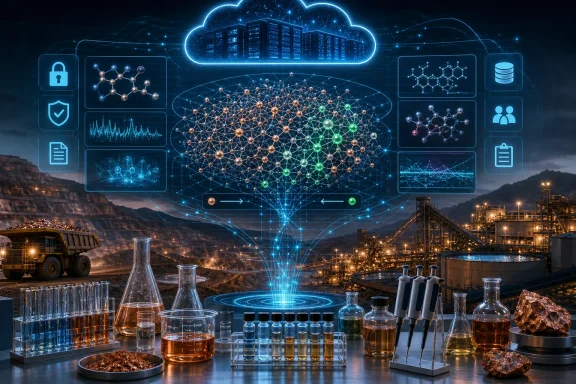 Microsoft Wants AI to Leave the Chat Window and Enter the Lab
The BHP project is a useful showcase because it is not about writing emails faster, summarizing meetings, or decorating a familiar app with a Copilot sidebar. It is about copper, chemistry, ore bodies, and the unglamorous bottleneck between global electrification ambitions and the materials required to build them. The pitch is not that AI has discovered a miracle molecule, but that it can help scientists search a large chemical space before anyone orders supplies, books lab time, or commits to a field trial.That distinction matters. Microsoft Discovery is being positioned as an agentic R&D platform: a system of specialized AI agents that can search literature, generate hypotheses, run simulations, coordinate high-performance computing jobs, and feed results back into the next round of work. In Microsoft’s telling, this is not one chatbot with a lab coat. It is a managed research environment where multiple tools and models can be orchestrated against a scientific objective.
For WindowsForum readers, the obvious connection is Azure rather than Windows. But the broader Microsoft strategy is familiar: put a new abstraction layer on top of messy enterprise work, then make that layer feel inevitable. Windows did it for PCs, Office did it for knowledge work, Azure did it for infrastructure, and Microsoft now wants agentic platforms to do it for research organizations that still depend on fragmented pipelines, bespoke scripts, institutional memory, and lab notebooks.
The mining example also helps Microsoft avoid the usual trap of AI announcements that sound impressive but float above reality. Copper extraction is a hard physical problem with measurable outcomes. Either a reagent improves recovery, selectivity, cost, safety, or environmental performance, or it does not. That gives the story a grounding that many enterprise AI launches lack.
BHP’s Copper Problem Is the Energy Transition’s Copper Problem
Copper is one of those materials that disappears into the background precisely because modern life depends on it. It conducts electricity, tolerates demanding environments, and shows up everywhere from motors and transformers to solar farms, wind turbines, data centers, charging infrastructure, and grid upgrades. The energy transition is often narrated through batteries, semiconductors, and renewable generation, but much of that transition is wired together with copper.The problem is that copper demand is rising just as easy copper is becoming harder to find. Large, high-grade deposits are not waiting politely near the surface. Many remaining resources are deeper, lower grade, more geologically complex, or more expensive to process. That forces miners to squeeze more value from existing assets and develop better ways to handle ore that was once marginal.
BHP, as one of the world’s largest mining companies, has a direct interest in that squeeze. Its public framing is that copper is critical to the energy transition and that new processing methods could improve recovery from deposits that are harder to exploit. That is not just corporate sustainability language. It is also a hard economic incentive: if better leaching chemistry can recover more copper from difficult material, the value of existing resources changes.
Leaching is one route through that problem. Instead of relying entirely on traditional concentration and smelting routes, leaching uses chemistry to dissolve copper so it can later be recovered through downstream processes such as solvent extraction and electrowinning. The details vary by ore type, mineralogy, site conditions, and reagent chemistry, but the strategic appeal is simple: unlock copper that is otherwise too slow, too costly, or too inefficient to process.
The catch is that finding the right reagent is not like choosing a detergent. A useful candidate has to interact with copper-bearing minerals in the desired way, operate under practical conditions, avoid unacceptable side effects, fit into process economics, and survive scrutiny from safety, environmental, and operational teams. That is why BHP’s statement that scientists have been chasing better copper leaching reagents for decades rings true. The search space is vast, and the physical world is unforgiving.
Screening Half a Million Molecules Is Not the Same as Discovering One Winner
The headline number — more than 500,000 chemical reagents assessed — is impressive, but it should be read correctly. Screening half a million molecules does not mean half a million lab experiments were performed, nor does it mean a production-ready reagent has emerged. It means BHP, Microsoft, and computational chemistry partner Prescience Insilico used computational methods to narrow a very large candidate field into a smaller set worthy of physical testing.That narrowing is where AI and high-performance computing can make a practical difference. Tens of thousands of quantum chemistry calculations and simulations can evaluate properties that would be impractical to measure experimentally at the same scale. The result is not certainty. It is prioritization.
In industrial R&D, prioritization is often the difference between progress and paralysis. A lab can test only so many candidates. Expert chemists can argue through only so many hypotheses. Budgets, equipment, and people impose limits long before the theoretical search space is exhausted. If Discovery helps researchers discard weak candidates early and focus on plausible ones sooner, the value is not magic. It is throughput.
That makes the BHP example more credible than a claim that AI has automated mining chemistry. The computational stage can accelerate discovery, but it cannot repeal validation. Australian laboratories still have to test narrowed-down molecules. BHP still has to evaluate performance in real ore systems. Engineers still have to ask whether a reagent that looks promising in a simulation behaves acceptably in plant conditions.
Microsoft’s preferred phrase is that Discovery mimics the scientific method. That is a bold formulation, but the weaker version is more defensible: it can help structure and accelerate parts of the scientific workflow. Literature review, hypothesis generation, simulation planning, analysis, and iterative refinement are all real pain points in R&D organizations. The opportunity is not to remove scientists from the loop; it is to give them a better loop.
Agentic AI Fits R&D Better Than It Fits Many Office Tasks
Agentic AI has become one of the tech industry’s favorite phrases, and much of it deserves skepticism. In office settings, an “agent” often means a model that can click through SaaS tools with uneven reliability, producing just enough productivity theater to justify a keynote demo. Scientific R&D is different because it already consists of multi-step workflows, specialized tools, intermediate artifacts, and explicit validation gates.That makes research a more natural fit for agent orchestration. A literature-review agent can gather and summarize prior findings. A chemistry or materials agent can generate candidate hypotheses. A simulation agent can dispatch computational jobs. An analysis agent can interpret outputs and recommend the next round. Human scientists can then approve, redirect, or reject the system’s path.
This architecture also maps neatly onto Azure’s strengths. High-performance computing, storage, governance, identity, compliance, and model hosting are already cloud selling points. Discovery bundles those ingredients into a domain-specific environment rather than asking every R&D organization to assemble its own platform from separate Azure services, open-source tools, internal databases, and notebooks.
The danger is that “agentic” becomes a marketing skin over workflows that are still brittle underneath. R&D data is messy, proprietary, unevenly labeled, and often trapped across legacy systems. Scientific literature can be contradictory. Simulations can be expensive and wrong. Models can hallucinate or overfit. Lab results can invalidate months of elegant computation.
Microsoft appears aware of that risk, at least in its positioning. Discovery is described as keeping researchers in control, supporting governance, and integrating with physical labs rather than replacing them. That is the right answer for a market where a bad AI recommendation can waste more than time. In mining, materials, pharmaceuticals, semiconductors, and energy, flawed R&D guidance can burn capital, delay projects, and create safety or environmental exposure.
Azure Becomes the Workbench, Not Just the Data Center
For years, cloud providers have sold infrastructure to research teams: virtual machines, GPU clusters, managed databases, storage, and security controls. Microsoft Discovery is a more ambitious move because it tries to claim the research workflow itself. If Azure is where the experiment is designed, simulated, tracked, governed, and connected back to enterprise knowledge, then Microsoft is no longer merely renting compute. It is mediating scientific process.That is strategically important. Cloud infrastructure is powerful but increasingly commoditized at the level most executives understand. Everyone claims GPUs, security, scale, and AI services. A platform tied directly to R&D outcomes gives Microsoft a more differentiated story, especially in industries where a single discovery can justify years of software spending.
It also gives Microsoft a way to talk about AI return on investment without pretending that every employee needs a chatbot subscription. In industrial settings, the ROI story is often more concrete. If a platform shortens a research cycle, improves recovery, reduces failed experiments, or helps a company identify a viable process earlier, the value can be much larger than saving a few minutes per document.
The BHP project is almost tailor-made for that pitch. Copper is strategically important, the chemistry problem is long-running, and the search space is huge. Microsoft can point to a global mining company and say that Discovery is not speculative infrastructure waiting for a use case. It is already being applied to a materials bottleneck that sits near the center of the energy transition.
There is a Microsoft ecosystem angle here too. The company is also previewing a Microsoft Discovery app, described as a local on-ramp for individuals with a GitHub Copilot account. The enterprise service runs in Azure for governed, large-scale R&D, while the desktop app is meant to lower the barrier for researchers who want to experiment before a full organizational deployment. That two-tier pattern is classic Microsoft: seed familiarity at the individual level, then convert serious usage into managed enterprise infrastructure.
The Mining Industry Does Not Need AI Hype; It Needs Better Recovery
The mining sector has seen plenty of digital transformation promises. Autonomous haul trucks, remote operations centers, predictive maintenance, ore-body modeling, digital twins, and sensor-heavy processing plants are already part of the modern mining technology stack. AI is not arriving in a vacuum. It is entering an industry that has long used computation but still faces stubborn physical constraints.That is why the reagent story is more interesting than a generic “AI in mining” headline. It reaches into process chemistry, where incremental gains can matter enormously. Better leaching could improve recovery from lower-grade material, change the economics of stockpiles or difficult ore types, and reduce the need to chase only the richest deposits. It could also create new operational trade-offs around reagent cost, water use, acid consumption, impurity behavior, and environmental controls.
None of that is guaranteed by Microsoft Discovery. The platform can help propose and evaluate candidates, but the mine site will impose the verdict. A molecule that works in a controlled computational model may fail in heterogeneous ore. A reagent that improves copper dissolution may introduce downstream complications. A promising lab result may be uneconomic at scale. These are not footnotes; they are the core difficulty.
Still, better computational screening changes the odds. Traditional R&D often advances through sequential stages because each step is expensive and labor-intensive. Agentic systems promise more parallelism: more candidates considered, more simulations run, more literature digested, more hypotheses ranked. The value is less about replacing expertise than increasing the surface area over which expertise can operate.
Jessica Farrell, BHP’s vice president of innovation, framed the project as giving scientists better tools to focus on the most promising leaching solutions sooner. That is exactly the right level of ambition. If the output of AI is a shorter, smarter queue for human scientists, it can be valuable without being autonomous in the sci-fi sense.
The “Scientific Method” Claim Needs a Careful Reading
Microsoft’s description of Discovery as mimicking the scientific method is rhetorically useful, but it deserves scrutiny. The scientific method is not simply a workflow of hypothesis, experiment, and analysis. It is also a social, institutional, and epistemic process involving replication, critique, uncertainty, and eventual acceptance or rejection by communities of experts.An AI platform can model parts of that process. It can preserve context across iterations, compare hypotheses, execute computational tasks, and generate explanations. It can help avoid the loss of institutional knowledge that happens when projects are spread across documents, spreadsheets, code repositories, and inboxes. It can also make research programs more auditable if decisions, assumptions, and intermediate results are captured in a shared system.
But there is a difference between managing scientific work and producing scientific truth. Discovery can help researchers explore a search space faster, but reality remains the final integration test. In chemistry-heavy domains, that means wet labs, pilot plants, process engineers, safety reviews, environmental assessments, and economic models. The platform may accelerate the path to those gates; it does not remove them.
This matters because enterprise buyers have been burned by AI systems that sound more capable in product language than they are in production. Microsoft is trying to avoid that by emphasizing human oversight, governance, and integration with existing tools. Yet the marketing phrase “agentic AI” still carries a risk of overstatement. IT leaders evaluating Discovery should ask not whether it has agents, but where the handoffs, logs, controls, and failure modes sit.
The best version of Discovery is not an oracle. It is a research operating system that makes uncertainty easier to manage. That may sound less glamorous, but for serious R&D organizations it is more useful.
Governance Will Decide Whether Agents Belong in Serious R&D
Scientific and industrial organizations do not adopt new platforms purely because they are clever. They adopt them when they can be governed. That means identity management, access controls, audit trails, data boundaries, model transparency, reproducibility, cost controls, and clear accountability when automated systems recommend actions.Microsoft has an advantage here because Azure already speaks the language of enterprise governance. Discovery can inherit cloud controls that startups may struggle to match at global scale. For heavily regulated or safety-sensitive industries, that matters as much as model quality. A brilliant AI tool that cannot pass security review is a demo, not infrastructure.
BHP’s use case also highlights the sensitivity of industrial data. Ore-body information, process chemistry, recovery rates, and reagent performance can be commercially significant. A mining company will want to know exactly what data goes where, what models touch it, how outputs are retained, and whether proprietary knowledge can leak into systems outside its control. Those are board-level concerns, not implementation details.
There is also the question of reproducibility. If an agentic system recommends a candidate molecule, the research team needs to know why. Which literature did it weigh? Which simulations were run? What assumptions were embedded in the model? What alternatives were rejected? Without that traceability, agentic R&D becomes a black box dressed as acceleration.
Microsoft’s platform language around knowledge graphs, orchestration, explainable outputs, and persistent research state appears designed to answer that concern. The market will decide whether the implementation is strong enough. In serious R&D, confidence is not built by a polished interface. It is built by surviving audits, failed experiments, skeptical scientists, and repeat use on problems that matter.
This Is Also a Cloud Land Grab for Industrial Science
The wider strategic context is Microsoft Build 2026 and the company’s continued push to make agents the next organizing layer of computing. Discovery sits alongside a larger movement across Microsoft’s portfolio: Copilot for productivity, Foundry for model and agent development, Azure AI infrastructure for scale, and specialized platforms for vertical workflows. The company is not merely adding AI features. It is trying to define where agentic work happens.Industrial science is a particularly attractive prize because it is compute-hungry and sticky. Once a research organization connects proprietary data, models, workflows, lab systems, and institutional memory to a platform, switching costs rise quickly. The cloud provider becomes part of the R&D fabric. That is a stronger relationship than selling raw GPU hours.
BHP gives Microsoft a flagship industrial customer in a sector where the stakes are tangible. If Discovery can help mining companies, energy firms, pharmaceutical labs, semiconductor manufacturers, or materials companies shorten development cycles, Microsoft can sell Azure as an innovation platform rather than a back-end utility. That is a higher-margin, higher-influence position.
For competitors, the challenge is obvious. Google, Amazon, NVIDIA, specialized scientific AI firms, and domain-specific software vendors all have pieces of this puzzle. Some have stronger research pedigrees in particular domains. Some have deeper hardware stories. Some have more focused chemistry, biology, or materials platforms. Microsoft’s bet is that enterprise integration and agent orchestration can bind enough pieces together to win broad adoption.
That breadth is both strength and risk. R&D is not one market. A copper leaching workflow is not a drug discovery workflow, and neither is the same as semiconductor process optimization. A general platform must be extensible enough to matter in each domain without becoming so generic that specialists outperform it at every important task.
The Windows Angle Is Indirect but Real
At first glance, this announcement belongs to Azure, mining, and AI rather than Windows. But for WindowsForum’s audience, the connection is still worth watching. Microsoft’s agent strategy is increasingly spanning cloud and client, with local apps, developer tooling, identity, and enterprise management all feeding into the same direction of travel.The Discovery app preview is part of that pattern. A local, VS Code-flavored experience that uses GitHub Copilot credentials is not going to run BHP-scale simulations on a laptop. But it can introduce researchers, students, developers, and domain experts to the workflow concepts behind Discovery: agents, knowledge indexing, hypothesis generation, and tool invocation. That matters because platform adoption often begins with individuals who prove a workflow before IT standardizes it.
For Windows users, this is another example of Microsoft treating the PC as an on-ramp to cloud-scale AI rather than the whole destination. Local compute handles exploration, prototyping, and personal workflows. Azure handles governed scale, collaboration, private data, and high-performance workloads. The strategic line between desktop and cloud is not disappearing, but it is becoming more porous.
That has implications for developers and admins. If agentic R&D tools follow the same path as other Microsoft platforms, organizations will eventually need policies for local AI apps, Copilot account usage, data sensitivity, extension permissions, and migration from personal experiments to enterprise workspaces. Shadow IT does not become less complicated just because the shadow is cast by scientists instead of sales teams.
The upside is that Microsoft may be building a more coherent path from personal experimentation to enterprise deployment than many AI vendors offer. The downside is that every new on-ramp also creates a new governance surface. IT teams should assume that agentic tools will arrive first as curiosity, then as pilot, then as business-critical workflow.
The Hard Part Begins After the Press Release
The BHP project is promising, but the most important results are still ahead. Screening candidate reagents is an early-stage acceleration story. The harder question is whether any of those candidates produce durable improvements in lab testing, pilot environments, and eventually production economics.That is where many AI-for-science narratives become less tidy. Computational narrowing can be genuinely valuable even if the final outcome is modest. A failed candidate can still teach researchers something useful. A platform can still save time by eliminating bad paths earlier. But the public story will naturally look for a breakthrough molecule or a dramatic recovery improvement.
Microsoft and BHP would be wise to resist overcompressing the narrative. The credible claim today is that Discovery helped evaluate a massive search space and reduce it to more promising candidates for laboratory testing. That is meaningful. It is not the same as saying AI has solved copper leaching.
The distinction matters for trust. Scientists and engineers are often more receptive to tools that respect domain complexity than to tools that pretend complexity is gone. If Microsoft wants Discovery to become serious R&D infrastructure, it needs skeptical technical users to believe the platform makes their work better without flattening their expertise into marketing copy.
There is also a public-policy dimension. Critical minerals are increasingly discussed through national security, industrial policy, permitting, environmental justice, and climate strategy. Faster copper innovation could help, but technology does not erase the social and regulatory challenges of mining. Better extraction chemistry may improve recovery, but new mines, community consent, water constraints, and environmental safeguards remain central to the copper supply story.
The Copper Demo Shows Where Microsoft’s Agent Bet Gets Serious
This announcement is strongest when read as a practical signal rather than a victory lap. Microsoft Discovery is now generally available, BHP has used it on a difficult copper-processing problem, and the result is a large computational screen that will feed human laboratory work. The importance lies in the workflow, not in a claim of instant discovery.- Microsoft Discovery is moving from preview positioning into general availability as an Azure-based platform for enterprise R&D.
- BHP’s copper project used Discovery with Microsoft and Prescience Insilico to assess more than 500,000 potential leaching reagents.
- The immediate value is computational triage, narrowing a huge chemical search space before expensive laboratory validation.
- The platform’s credibility will depend on governance, reproducibility, and integration with real labs, not just agentic branding.
- For IT teams, the Discovery app preview hints at a familiar Microsoft adoption pattern: individual experimentation first, enterprise control later.
- For the energy transition, better copper processing would be useful, but it remains one piece of a larger supply, permitting, and infrastructure puzzle.
References
- Primary source: Microsoft Source
Published: 2026-06-02T18:30:16.307213
BHP uses AI to find better ways to extract copper | Microsoft Signal Blog | Microsoft
Using AI, BHP screened 500,000 molecules to find more efficient ways to extract copper, accelerating research with Microsoft Discovery.news.microsoft.com
- Related coverage: techradar.com
50 Microsoft tools you can use for free just in time for Build 2026 | TechRadar
Free tools from across the Microsoft ecosystemwww.techradar.com - Official source: azure.microsoft.com
Transforming R&D with agentic AI: Introducing Microsoft Discovery | Microsoft Azure Blog
Learn more about the new enterprise agentic platform, , accelerating research and development azure.microsoft.com
- Related coverage: prnewswire.com
First Foundation Labs, Founded by Luma Group, Collaborates with Microsoft to Bring AI-Powered Clinical and Translational Reasoning to Microsoft Discovery
/PRNewswire/ -- First Foundation Labs (1FL), a life sciences AI company pioneering clinical and translational reasoning spun out of Luma Group, announced a... www.prnewswire.com
- Official source: blogs.microsoft.com
Microsoft at NVIDIA GTC: New solutions for Microsoft Foundry, Azure AI infrastructure and Physical AI - The Official Microsoft Blog
Microsoft combines accelerated computing with cloud scale engineering to bring advanced AI capabilities to our customers. For years, we’ve worked with NVIDIA to integrate hardware, software and infrastructure to power many of today’s most important AI breakthroughs. What’s new at NVIDIA GTC...blogs.microsoft.com - Related coverage: bhp.com
Copper | BHP
Copper is a pinkish-orange metal. It’s an excellent conductor of electricity and is used in a broad range of everyday household products. Copper is also corrosion resistant and antimicrobial, meaning it prevents the growth of bacteria.www.bhp.com
- Related coverage: notebookcheck.net
Microsoft Build 2026: What to expect from the June 2 keynote - Notebookcheck News
Microsoft Build 2026 opens June 2 in San Francisco with AI agents, GitHub Copilot updates, and Windows local AI. Here is what developers can expect. www.notebookcheck.net
- Related coverage: hpcwire.com
AIwire - Covering Scientific & Technical AI
May 18, 2026 — Open source is the foundation for AI and, as AI workloads scale, developers need that foundation to be more secure, more predictable, and easier to build apps […]www.hpcwire.com - Official source: devblogs.microsoft.com
What's new in Microsoft Foundry | Build Edition | Microsoft Foundry Blog
Microsoft Build 2026 brings a major set of Microsoft Foundry updates for developers building agents: hosted runtimes, Toolboxes, memory, Voice Live, Foundry IQ, new models, managed compute, and trust, evaluation, and observability tools.devblogs.microsoft.com - Related coverage: strategicfocus.com
Microsoft Discovery: Advancing agentic R&D at scale - Strategic Focus
Transforming R&D with agentic AI: Introducing Microsoft Discovery Read the blog Over the past year, we’ve made significant progress with Microsoft Discovery by working closely with research and development (R&D) organizations. Today, we’re sharing how those efforts are translating into...strategicfocus.com - Official source: microsoft.com
- Official source: cdn-dynmedia-1.microsoft.com
The Next Wave of AI Innovation: Microsoft Introduces Azure AI Foundry, A New Unified AI, and GenAI Platform at Ignite 2024
PDF documentcdn-dynmedia-1.microsoft.com
