

Microsoft’s stock was hit with a fresh vote of caution on Monday as Melius Research lowered its rating to Hold, marking the second high‑profile downgrade in less than a week after Stifel’s similar call. The message from the street is blunt: Microsoft’s rapid pivot into generative AI has created material strategic opportunities, but it has also introduced new operational trade‑offs, concentration risks and capital demands that could weigh on revenue growth, margins and free cash flow in the near term. Analysts singled out Copilot monetization, datacenter capacity allocation, and the sheer scale of AI capital spending as the proximate drivers of the downgrade — and investors quickly re‑priced some of the optimism that had propelled Microsoft’s shares higher over the past year.
Microsoft’s recent earnings cycle produced a paradoxical combination of strong top‑line performance and investor unease. The company reported healthy revenue growth and a massive increase in commercial backlog (remaining performance obligations), but it also disclosed a sharp surge in capital expenditures and heavy internal use of constrained GPU capacity. Within days of that report, Stifel cut its recommendation, and Melius followed with its downgrade — citing competitive pressure in AI, uncertain Copilot monetization, and a need for materially higher capex to sustain the company’s position.
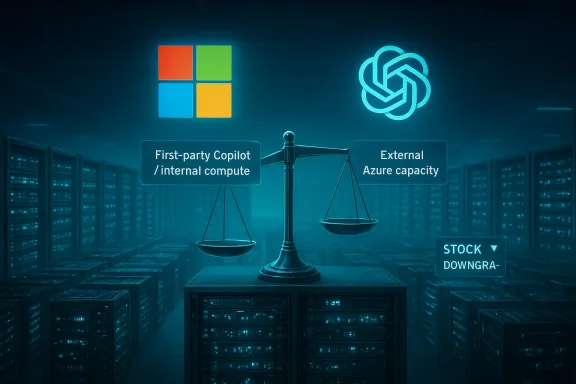
This sequence matters because it signals a shift in how Wall Street is valuing the AI transition: investors are no longer content to assume that heavy upfront spending will be rewarded with proportionate near‑term earnings expansion. Instead, analysts are probing whether Microsoft will have to choose between allocating scarce AI compute to first‑party products like Copilot and internal R&D, or to external Azure customers — a tension that could compress cloud revenue growth even as AI adoption expands.
Combined, the two downgrades expose a common thesis: AI transforms Microsoft’s TAM (total addressable market), but it also transforms its cost structure — fast, large, and front‑loaded.
For readers — whether investors, enterprise IT leaders or Microsoft partners — the prudent posture is to treat this episode as the market asking Microsoft for more operational transparency and a clearer roadmap from spending to returns. The company’s strategic assets remain formidable, but the transition to an AI‑first world has introduced new governance questions about capacity allocation, pricing discipline and concentration risk. Those are solvable problems; the only question is the timeline — and timing is exactly what the market is now pricing.
In the weeks ahead, watch management’s follow‑up communications: any signal that Microsoft will tighten capacity allocation metrics, disclose Copilot monetization milestones, or moderate capex growth will likely soothe investors. Conversely, continued ambiguity about those variables will keep valuations under pressure, even if product and technology advances remain structurally positive for the company’s long‑term prospects.
Source: bloomberg.com https://www.bloomberg.com/news/arti...ius-warns-on-ai-risks/?srnd=homepage-americas
 Background: two downgrades in a week — what changed
Microsoft’s recent earnings cycle produced a paradoxical combination of strong top‑line performance and investor unease. The company reported healthy revenue growth and a massive increase in commercial backlog (remaining performance obligations), but it also disclosed a sharp surge in capital expenditures and heavy internal use of constrained GPU capacity. Within days of that report, Stifel cut its recommendation, and Melius followed with its downgrade — citing competitive pressure in AI, uncertain Copilot monetization, and a need for materially higher capex to sustain the company’s position.This sequence matters because it signals a shift in how Wall Street is valuing the AI transition: investors are no longer content to assume that heavy upfront spending will be rewarded with proportionate near‑term earnings expansion. Instead, analysts are probing whether Microsoft will have to choose between allocating scarce AI compute to first‑party products like Copilot and internal R&D, or to external Azure customers — a tension that could compress cloud revenue growth even as AI adoption expands.
Overview: the two downgrades and the immediate rationale
Stifel’s downgrade: Azure supply constraints and margin pressure
Earlier in the week, Stifel flagged what it sees as tangible supply constraints in Azure and intensifying competition from Google and AI‑native rivals. The analyst argued that Azure’s growth may decelerate shorter‑term because Microsoft has been reallocating GPU capacity away from third‑party cloud customers toward first‑party AI initiatives, which reduces the addressable capacity for revenue‑generating external workloads. Stifel also warned that Microsoft’s heavy capital program aimed at building AI infrastructure could depress operating margins.Melius’ downgrade: Copilot monetization and capex uncertainty
Melius took aim at Microsoft’s consumer and productivity stack, arguing that Microsoft 365 and Copilot face direct threats from newly emergent AI products by competitors such as Anthropic and Google. The firm questioned both the rate at which Copilot can be monetized and whether Microsoft would be forced to subsidize Copilot adoption (even to the point of giving it away) to defend market share — a scenario that would erode the profitability of Microsoft’s most lucrative enterprise franchises and increase pressure on Azure to absorb internal compute needs.Combined, the two downgrades expose a common thesis: AI transforms Microsoft’s TAM (total addressable market), but it also transforms its cost structure — fast, large, and front‑loaded.
The numbers investors are watching
Microsoft’s latest quarter produced headline figures that both underscore the company’s momentum and reveal the strain created by AI demand:- Commercial remaining performance obligations (RPO) surged to roughly $625 billion, more than doubling year over year. A surprising share — near half of that backlog — was reported as tied to OpenAI commitments.
- Capital expenditures in the quarter jumped sharply (tens of billions), with much of that spending directed to short‑lived compute hardware such as GPUs and CPUs. This drove a meaningful drop in free cash flow versus the prior period.
- Guidance signaled continued investment that will keep cloud gross margins and operating margins under short‑term pressure as Microsoft allocates capacity between first‑party AI products and external Azure customers.
Why analysts singled out Copilot — monetization is the bottleneck
Microsoft has aggressively embedded generative AI across its productivity suite under the Copilot brand. Copilot promises to transform worker productivity and to open new subscription and upsell paths across Microsoft 365, GitHub and verticalized solutions. But turning transformational capabilities into predictable, high‑margin revenue is a difficult, multi‑year task. Analysts highlighted several reasons Copilot’s monetization remains uncertain:- Adoption vs. monetization gap: Corporations may adopt Copilot functionality for pilots or productivity experiments without immediately converting that usage into full paid deployments or premium seats. The product‑to‑pricing conversion curve can be long.
- Competitive parity: AI models and assistants from competitors (notably Google’s Gemini derivatives and Anthropic’s enterprise offerings) are increasingly comparable and, in some cases, better integrated with rival cloud stacks — giving customers leverage in pricing negotiations.
- Free vs. paid distribution trade‑offs: If Microsoft subsidizes Copilot (or gives it away) to accelerate uptake, it risks cannibalizing revenue from legacy productivity suites and reducing software margins. Conversely, if Microsoft prices Copilot aggressively, it risks slower enterprise attachment and a delayed ramp.
The capacity allocation dilemma: internal needs vs external revenue
A critical operational issue exposed by Microsoft’s disclosures is how the company allocates limited AI compute capacity — GPUs are scarce and expensive, and provisioning large, reliable pools for enterprise customers is complex.- Prioritizing first‑party AI: Microsoft is using substantial GPU/CPU capacity to run its own Copilot, model training and R&D, and to support close partners. That internal usage does not immediately show up as external cloud revenue but does consume the same constrained resources.
- Opportunity cost for Azure: Every GPU allocated internally is capacity that cannot be sold to external customers. When capacity is the binding constraint, Microsoft faces a real trade‑off: maximize short‑term revenue by selling to third parties, or support strategic first‑party experiences that underpin longer‑term product differentiation.
- Visibility and guidance: Management framed upcoming Azure guidance as an “allocated capacity” measure rather than pure demand, implicitly acknowledging that supply constraints — not weak demand — are influencing growth rates.
OpenAI concentration: a double‑edged sword
Microsoft’s close partnership with OpenAI is central to its AI strategy, but the relationship also creates concentration risk that investors and analysts flagged:- Scale benefits: Exclusive or preferential access to OpenAI models delivered prestige and technical differentiation early on. Strategic alignment supported large, multi‑year commitments that bolstered Microsoft’s RPO.
- Concentration risk: When a single customer/partner accounts for a large share of contracted backlog, the business becomes more sensitive to that counterparty’s strategic choices, compute needs, and contractual renewals. Microsoft disclosed that OpenAI represents a significant proportion of its commercial backlog, which makes some analysts uneasy about earnings volatility if those dynamics change.
- Negotiation leverage: Large internal commitments can give Microsoft preferential capacity access but may also complicate pricing and profit allocation internally, particularly if OpenAI demands favorable economics that compress Microsoft’s margins on those arrangements.
Competitive pressure: Google, Anthropic and the cloud arms race
Analysts repeatedly referenced intensifying competition in the cloud‑AI layer as a material reason for caution:- Google Cloud’s momentum: Google has been aggressively integrating its Gemini family and cloud services, generating strong growth and margin improvements that make it a more credible alternative for enterprise AI workloads.
- Anthropic and AI‑native vendors: Lightweight, innovative AI firms are building specialized assistants and tools that target enterprise niches (legal, finance, developer workflows) — and some of these products are gaining traction quickly.
- Price and feature dynamics: As more capable models enter the market, customers gain leverage to extract better pricing or to multi‑home across providers, which could pressure Microsoft’s ability to command premium pricing for Copilot and Azure AI services.
Financial implications: capex, margins and free cash flow
Investors are particularly sensitive to three financial variables affected by the AI build‑out:- Capital expenditures: Microsoft’s capex increased dramatically as it rushed to expand GPU/CPU capacity. Much of this spend is on assets with fast depreciation schedules, which creates the risk of high upfront cash burn with a delayed revenue payback.
- Gross and operating margins: Management signaled lower cloud gross margins in the near term due to AI cost intensity and the mix effects of first‑party AI usage consuming capacity. Operating margins were likewise expected to be modestly pressured before efficiencies and software‑driven leverage kick in.
- Free cash flow: Cash flow from operations can remain strong while free cash flow is compressed if capex accelerates. That dynamics is pivotal to both capital allocation (buybacks/dividends) and valuation — investors demanded clearer timelines for margin recovery.
The strategic case for Microsoft — why the downgrades are not a knockout punch
Despite the downgrades, there are several robust arguments that underpin a bullish long‑term thesis for Microsoft:- Diversified revenue engines: Microsoft’s portfolio spans cloud infrastructure (Azure), productivity software (Microsoft 365), developer tools (GitHub), and verticalized applications (Dynamics). This breadth reduces single‑point‑failure risk relative to more concentrated peers.
- Strong balance sheet and cash generation: Prior to the AI build‑out, Microsoft generated significant free cash flow and retains the balance‑sheet flexibility to fund capex, partnerships and M&A. That financial strength matters when the technology transition requires heavy up‑front investment.
- Deep enterprise relationships: Microsoft’s longstanding relationships with enterprise IT buyers give it a distribution advantage for embedding Copilot into workflow processes where switching friction is high.
- Model and tooling integration: Owning both a cloud platform and productivity stack allows Microsoft to optimize the interplay between infrastructure and applications in ways that smaller players cannot replicate easily.
What to watch next — five key questions for investors and customers
- Copilot monetization metrics: Will Microsoft disclose more granular adoption, conversion and retention metrics for Copilot across enterprise segments? Those numbers will determine revenue trajectory.
- Capex cadence and ROI: How quickly do GPU investments translate into sellable Azure capacity, and what is the expected payback window on those assets?
- Azure capacity allocation policy: Will Microsoft publish clearer rules or SLAs governing how it divides GPUs between first‑party use, partner commitments and external customers?
- OpenAI contractual terms and concentration mitigation: How will Microsoft evolve its commercial arrangements with OpenAI to reduce single‑counterparty concentration in the backlog?
- Competitive product developments: How rapidly do offerings from Google, Anthropic and others gain enterprise traction, and how will that affect Microsoft’s pricing power?
Implications for enterprise customers and partners
For large enterprise customers and ISVs that build on Azure or integrate Copilot, the current environment carries mixed implications:- Potential upside: Microsoft’s continued investment in capacity and models means customers can expect richer AI services and faster feature rollouts. Copilot integrations could deliver substantial productivity gains if they are executed well.
- Near‑term friction: Capacity allocation and prioritization could affect external customers’ access to low‑latency, large‑model workloads — especially for companies that lack multi‑cloud flexibility or alternate procurement leverage.
- Pricing leverage: Corporates negotiating large AI commitments may find more favorable commercial terms as vendors compete for strategic accounts. That is good for buyers but could compress margins for providers.
Risks that deserve sober attention
Several risk vectors deserve explicit emphasis because they could materially worsen Microsoft’s near‑term outlook:- Demand dislocation: If customers delay purchases until pricing or model stability improves, expected revenue growth could soften.
- Hardware supply shocks: Continued disruption in the GPU supply chain or spikes in component prices would escalate capex and slow throughput.
- Contract renegotiations or OpenAI shifts: Any change in the economics or duration of Microsoft’s flagship OpenAI partnership could ripple through backlog conversion and near‑term revenue recognition.
- Regulatory or antitrust scrutiny: As Microsoft deepens its AI integration across productivity and cloud, regulators may scrutinize bundling, preferential treatment or competitive conduct more closely, potentially constraining go‑to‑market approaches.
- Competitive breakthroughs: A rival that offers materially better model capability or dramatically more cost‑effective cloud AI could erode Microsoft’s strategic position faster than current estimates assume.
Strategic options Microsoft can deploy
To address the concerns that triggered the downgrades, Microsoft has a set of levers it can pull — each with trade‑offs:- Increase capex yet again to relieve capacity constraints: This would boost supply but requires more cash up front and risks overcapacity if demand normalizes.
- Re‑architect pricing and monetization of Copilot to accelerate revenue without heavy subsidy: A calibrated pricing approach could improve near‑term cash flow but may slow adoption.
- Prioritize external Azure customers in allocation to protect cloud revenue: That would preserve immediate sales but could compromise first‑party product differentiation.
- Broaden partnerships to diversify large‑customer concentration: Spreading strategic deployments across more partners reduces counterparty risk but may dilute competitive exclusivity.
- Improve operational disclosures: Providing clearer, quantitative metrics on Copilot adoption, capex-to‑revenue conversion and capacity allocation would lower the uncertainty premium in valuations.
Bottom line — a recalibration, not a collapse
The twin downgrades from Stifel and Melius represent a recalibration in investor expectations, not a verdict that Microsoft’s AI strategy will fail. The core tension is real: Microsoft faces a classic build‑now, monetize‑later challenge amplified by hardware scarcity and a major single partner that consumes a large share of contracted capacity. Analysts and investors demand clearer visibility on how those investments will convert into durable, margin‑rich revenue.For readers — whether investors, enterprise IT leaders or Microsoft partners — the prudent posture is to treat this episode as the market asking Microsoft for more operational transparency and a clearer roadmap from spending to returns. The company’s strategic assets remain formidable, but the transition to an AI‑first world has introduced new governance questions about capacity allocation, pricing discipline and concentration risk. Those are solvable problems; the only question is the timeline — and timing is exactly what the market is now pricing.
In the weeks ahead, watch management’s follow‑up communications: any signal that Microsoft will tighten capacity allocation metrics, disclose Copilot monetization milestones, or moderate capex growth will likely soothe investors. Conversely, continued ambiguity about those variables will keep valuations under pressure, even if product and technology advances remain structurally positive for the company’s long‑term prospects.
Source: bloomberg.com https://www.bloomberg.com/news/arti...ius-warns-on-ai-risks/?srnd=homepage-americas
