

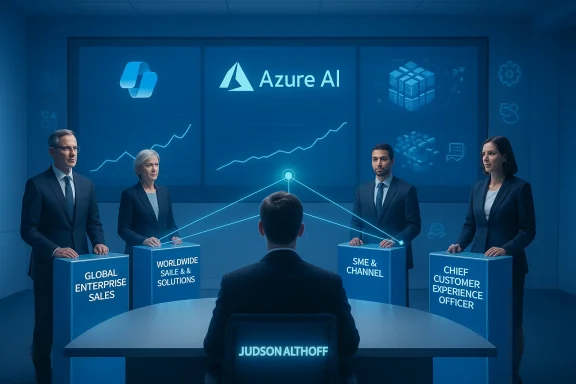
Microsoft’s commercial organization just reshuffled its front line: four senior sales and customer-leadership executives — Deb Cupp, Nick Parker, Ralph Haupter, and Mala Anand — were elevated to Executive Vice President rank and placed to report directly to Commercial CEO Judson Althoff in a deliberate push to shorten the customer‑to‑product feedback loop as Microsoft shifts from AI experimentation to enterprise-scale deployment.
The promotions come against a fraught financial backdrop: Microsoft’s fiscal Q2 FY2026 results showed record AI‑related investment and solid topline growth, but also intensified investor scrutiny over capital spending, capacity constraints, and the pace of commercial monetization. Executive moves inside the commercial organization follow Judson Althoff’s October elevation to CEO of Microsoft’s commercial business, a structural change meant to let Satya Nadella concentrate on engineering, datacenter architecture and AI science while a dedicated commercial leader drives sales, go‑to‑market and customer success.
This latest reorganization elevates four leaders into named commercial roles with expanded mandates:
This is a pragmatic shift. AI adoption often hinges less on model benchmarks and more on change management, integration with line‑of‑business systems, security and compliance, and partner‑delivered services. Senior sales and customer success leaders who can marshal engineering, services, and partners around those tangible deployment problems can shorten time‑to‑value and accelerate paid adoption.
The promotions therefore reflect a strategic pivot: move from an engineering‑led, platform‑build phase to an operational phase where sales execution, partner enablement and customer success determine whether billions of dollars of AI investment translate into durable revenue.
Strengths and expectations:
Strengths and expectations:
Strengths and expectations:
Strengths and expectations:
Key financial realities tied to the organizational changes:
What differentiates Microsoft:
For partners, the message is clearer: Microsoft intends to lean into channel execution. That means both opportunity and responsibility. Partners who invest in AI delivery skills, develop vertical IP, and align with Microsoft’s emerging commercial plays will be positioned to capture significant share. Those that do not risk being bypassed by Microsoft’s internal managed offerings or better‑enabled competitors.
However, promotions alone are not a panacea. Execution risk is real: capacity, partner competency, product‑operational tooling, and demonstrable ROI remain the hard parts. Success will depend on tangible improvements in deployment velocity, pricing creativity, partner economics, and the company’s ability to translate internal technical momentum into measurable customer value.
If Microsoft can tie the C‑suite reorganization to disciplined commercialization playbooks and measurable customer outcomes, these promotions could mark the inflection point where AI investments start to deliver scaled, durable revenue. If not, the company risks another cycle of heavy spend, mixed adoption signals, and continued investor skepticism.
Either way, the coming quarters will be decisive. The new EVPs will be judged not on org charts or titles, but on the speed with which customers go from trial to production — and the degree to which AI becomes a routine, measurable productivity tool across Microsoft’s vast commercial base.
Source: WinBuzzer Microsoft Elevates Four EVPs to Drive Enterprise AI Adoption
 Background / Overview
The promotions come against a fraught financial backdrop: Microsoft’s fiscal Q2 FY2026 results showed record AI‑related investment and solid topline growth, but also intensified investor scrutiny over capital spending, capacity constraints, and the pace of commercial monetization. Executive moves inside the commercial organization follow Judson Althoff’s October elevation to CEO of Microsoft’s commercial business, a structural change meant to let Satya Nadella concentrate on engineering, datacenter architecture and AI science while a dedicated commercial leader drives sales, go‑to‑market and customer success.This latest reorganization elevates four leaders into named commercial roles with expanded mandates:
- Deb Cupp — Executive Vice President and Chief Revenue Officer, Global Enterprise Sales.
- Nick Parker — Executive Vice President and Chief Business Officer, Worldwide Sales & Solutions.
- Ralph Haupter — Executive Vice President and Chief Revenue Officer, Small & Medium Enterprises and Channel (SME&C).
- Mala Anand — Executive Vice President and Chief Customer Experience Officer.
Why Microsoft moved the chess pieces now
Flattening the organization to accelerate customer feedback
Microsoft’s internal message, as relayed publicly by multiple outlets, is explicit: AI adoption in enterprises is happening fast, and organizational layers that delay customer feedback into product decisions impose a real cost. By elevating senior customer‑facing leaders to EVP rank — and consolidating commercial responsibilities under Althoff — Microsoft intends to make product, operations and go‑to‑market decisions more tightly coupled to what customers actually need.This is a pragmatic shift. AI adoption often hinges less on model benchmarks and more on change management, integration with line‑of‑business systems, security and compliance, and partner‑delivered services. Senior sales and customer success leaders who can marshal engineering, services, and partners around those tangible deployment problems can shorten time‑to‑value and accelerate paid adoption.
Timing: from platform build to commercialization
Microsoft’s Q2 FY2026 financial disclosures and executive commentary made the tradeoffs visible: the company is pouring unprecedented capital into AI infrastructure and services while tracking early signals of product adoption and monetization. Those signals — including 15 million paid Microsoft 365 Copilot seats and substantially increased enterprise engagement metrics — are promising, but they sit beside stark operational realities such as GPU capacity constraints, heavy capital expenditures, and lower paid penetration of Copilot relative to Microsoft’s overall M365 install base.The promotions therefore reflect a strategic pivot: move from an engineering‑led, platform‑build phase to an operational phase where sales execution, partner enablement and customer success determine whether billions of dollars of AI investment translate into durable revenue.
The four new EVPs: roles, strengths, and immediate expectations
Deb Cupp — EVP & Chief Revenue Officer, Global Enterprise Sales
Deb Cupp inherits responsibility for Microsoft’s largest, most strategic accounts — the customers that deliver the majority of commercial revenue. Her brief is to accelerate AI deployment in complex, regulated, or mission‑critical environments where adoption is slower but contract sizes are large.Strengths and expectations:
- Deep enterprise sales experience and relationships across Fortune customers.
- Expected to prioritize outcome‑based selling: tie Copilot and Azure AI deployments to measurable productivity gains, regulatory risk reduction, or cost avoidance.
- Likely to overhaul enterprise packaging and incentives to push broader seat attach beyond pilot teams.
Nick Parker — EVP & Chief Business Officer, Worldwide Sales & Solutions
Nick Parker’s remit centers on the partner ecosystem and go‑to‑market architecture that reaches thousands of resellers and system integrators worldwide. In practice, Parker must convert partner reach into technical capacity and delivery velocity for AI projects.Strengths and expectations:
- Long institutional knowledge of Microsoft’s partner channel, which remains a force multiplier for deployment and support.
- Will be charged with partner enablement programs, co‑engineering incentives, and partner certification to scale AI implementations beyond Microsoft’s internal services footprint.
- Expected to lead partner pricing and bundling initiatives that make Copilot and Azure AI easier to resell and integrate.
Ralph Haupter — EVP & Chief Revenue Officer, SME & Channel
Ralph Haupter will focus on the small and medium enterprise segment — a vast market historically underpenetrated by advanced enterprise tech but now increasingly receptive to packaged AI solutions.Strengths and expectations:
- Global market leadership experience and familiarity with regional go‑to‑market nuance.
- Charged with creating repeatable, low‑touch sales motions and Cloud Solution Provider (CSP) partner plays that make AI accessible to SMBs.
- Expected to help product teams productize “out‑of‑box” AI scenarios that deliver clear ROI for businesses with limited IT budgets and skills.
Mala Anand — EVP & Chief Customer Experience Officer
Mala Anand’s role explicitly bridges product, services and customer outcomes. Coming from SAP and with a background in enterprise software delivery, Anand will oversee customer success, support, and industry solutions delivery.Strengths and expectations:
- Focus on post‑sale experience: onboarding, professional services, success metrics, and retention.
- Expected to standardize outcome metrics (e.g., time saved, cost avoided, revenue uplift) and require them as part of commercial handoffs.
- Will likely drive investments in managed services, vertical accelerators, and internal tooling to reduce customer time‑to‑value.
Financial and market context that shaped the move
Microsoft’s fiscal disclosures for Q2 FY2026 made two things clear: (1) the company is spending at a record pace on AI infrastructure and (2) the market is demanding near‑term receipts in the form of monetization and margin visibility.Key financial realities tied to the organizational changes:
- Microsoft Cloud revenue exceeded the $50 billion mark in the quarter, underscoring the centrality of cloud and AI to the company’s growth thesis.
- Capital expenditure for AI infrastructure was unusually large during the period; management cited multi‑billion dollar investments intended to expand GPU capacity and datacenter footprint.
- Product adoption metrics show traction — including millions of paid Copilot seats and strong increases in user engagement — but paid penetration relative to the full Microsoft 365 install base remains low, and investors reacted to the spend cadence and guidance with heightened volatility.
What Microsoft is signaling to customers, partners and Wall Street
Microsoft’s actions send three intertwined signals:- Customer urgency: The company is elevating customer‑facing leaders to ensure rapid feedback loops from deployments inform product roadmaps and service design. This is a recognition that successful adoption requires more than APIs and model quality; it requires dedicated sales, enablement and success resources.
- Partner dependence: Microsoft knows it cannot scale AI deployments alone. The partner ecosystem plays a central role in packaging, integrating and operating AI solutions for customers. Formalizing partner leadership at the EVP level signals a renewed investment in partner economics and co‑engineering.
- Execution over experimentation: Microsoft is shifting emphasis from pure platform capability to go‑to‑market execution and value delivery. The company is effectively saying that the next phase of competition will be decided at the point where customers can operationalize agents, Copilot workflows and domain‑specific AI — not just where models claim superior benchmarks.
Strengths of the restructuring
- Clear accountability: By granting EVP titles and direct reporting lines, Microsoft removes ambiguity about who’s responsible for customer outcomes, partner programs, SME scale, and enterprise renewals.
- Faster product‑market feedback: A shortened feedback loop can accelerate prioritization of features, security hardening, and vertical accelerators that matter to customers.
- Channel leverage: Formalizing partner leadership increases the odds that Microsoft will scale deployments through resellers, MSPs and systems integrators.
- Focus on outcomes: Placing customer experience and success at the EVP level elevates operational metrics — a necessary corrective to an engineering‑only focus.
Risks and blind spots
- Execution complexity: Reorganizations simplify names on an org chart, but they don’t instantly create delivery capacity. Chiefly, Microsoft still faces a shortage of GPU supply, trained engineering resources, and partner capability to deliver AI production at the scale needed for enterprise transformation.
- Overreliance on sales muscle: Elevating sales leadership is necessary but not sufficient. If product reliability, observability and integration tooling lag, sales wins may stall during deployment and erode trust.
- Partner economics and margin pressure: Pushing Copilot and AI services through partners requires careful economics. Unsustainable pricing or insufficient margin will impede partner enthusiasm and reduce deployment throughput.
- Customer ROI scepticism: The low paid attach rate for Copilot relative to total Microsoft 365 seats indicates customers are still evaluating ROI. Heavy sales pushes without commensurate outcome evidence risk customer churn or downgrades.
- Market expectations and capital markets pressure: The market has demanded faster monetization of AI investments; failure to show improved conversion and margin expansion could prolong valuation pressure.
Technical and commercial levers the EVPs should pull
To move the needle quickly, the new EVPs will need to coordinate across multiple levers. Below are pragmatic actions that align with the responsibilities Microsoft has just centralized.- Standardize outcome metrics
- Define clear KPIs for AI deployments (e.g., meetings shortened, time saved per task, automation of X face‑to‑face hours).
- Make those KPIs part of contractual success criteria and renewal discussions.
- Productize vertical accelerators
- Ship ready‑to‑deploy vertical solutions (legal, finance, healthcare, manufacturing) that reduce integration time and risk.
- Bundle those with industry‑specific data connectors and pre‑built prompts/agents.
- Scale partner training and certification
- Launch accelerated partner bootcamps for AI delivery and embed certification requirements into CSP program tiers.
- Provide deployment blueprints and funded pilots to jump‑start partner delivery teams.
- Improve procurement and billing flexibility
- Offer pilot credits, outcome‑based billing, and consumption tiers that lower the initial friction in buying Copilot and Azure AI.
- Provide transparent usage metering that helps customers forecast cloud spend tied to AI workloads.
- Invest in deployment tooling and observability
- Ship best‑practice guides and native tooling for model monitoring, hallucination detection, and compliance audits.
- Package managed services options for customers lacking in‑house AI ops capabilities.
- Focus on capacity allocation
- Create prioritized capacity lanes for customers with the highest ROI potential, while investing in longer‑term capacity expansion to reduce supply constraints.
Competitors and the wider enterprise AI battle
Microsoft is not alone in the race to commercialize AI. Amazon Web Services and Google Cloud continue to push aggressive infrastructure and platform strategies, and both are investing heavily in enterprise‑grade AI tooling and go‑to‑market models.What differentiates Microsoft:
- Deep enterprise relationships across Office, Azure and LinkedIn ecosystems.
- A broad install base (Microsoft 365) that can be instrumented as a data layer for Copilot experiences.
- A substantial partner network that, if effectively mobilized, can scale delivery.
- Supply constraints and the economics of running large AI workloads.
- Conversion of trial or included features into paid seats.
- Evolving customer expectations about privacy, data residency, and model explainability — areas that often favor smaller, specialized providers for particular verticals.
How customers and partners should read the move
For enterprise IT leaders, Microsoft’s reorganization is both a promise and a test. The promise: more senior commercial leadership focused on outcomes, faster escalation routes, and a partner ecosystem that is better enabled to deliver. The test: will Microsoft translate that intent into predictable delivery velocity, transparent economics, and measurable ROI?For partners, the message is clearer: Microsoft intends to lean into channel execution. That means both opportunity and responsibility. Partners who invest in AI delivery skills, develop vertical IP, and align with Microsoft’s emerging commercial plays will be positioned to capture significant share. Those that do not risk being bypassed by Microsoft’s internal managed offerings or better‑enabled competitors.
Near‑term signals to watch
The market and customers will use several practical signals to judge whether this reorganization is paying off:- Expansion rates of paid Copilot seats beyond initial pilot teams and into boardroom or business‑unit scale deployments.
- Growth in CSP partner bookings for AI solutions and the number of partners achieving advanced AI certifications.
- Improvement in time‑to‑production metrics for customers (from pilot to production) and demonstrable ROI case studies.
- Changes to Azure guidance that indicate improved capacity utilization and normalized capex cadence.
- Renewal and upsell metrics in large enterprise accounts where Deb Cupp now has primary accountability.
Final assessment: can leadership promotions close the AI ROI gap?
The elevation of Deb Cupp, Nick Parker, Ralph Haupter, and Mala Anand to EVP rank is a clear tactical response to a strategic problem: Microsoft must prove that its vast investments in AI can be converted into repeatable commercial outcomes. The move sharpens accountability, emphasizes partners and customer success, and aligns commercial leadership under a single executive — Judson Althoff — whose job is to operationalize the company’s AI value proposition.However, promotions alone are not a panacea. Execution risk is real: capacity, partner competency, product‑operational tooling, and demonstrable ROI remain the hard parts. Success will depend on tangible improvements in deployment velocity, pricing creativity, partner economics, and the company’s ability to translate internal technical momentum into measurable customer value.
If Microsoft can tie the C‑suite reorganization to disciplined commercialization playbooks and measurable customer outcomes, these promotions could mark the inflection point where AI investments start to deliver scaled, durable revenue. If not, the company risks another cycle of heavy spend, mixed adoption signals, and continued investor skepticism.
Either way, the coming quarters will be decisive. The new EVPs will be judged not on org charts or titles, but on the speed with which customers go from trial to production — and the degree to which AI becomes a routine, measurable productivity tool across Microsoft’s vast commercial base.
Source: WinBuzzer Microsoft Elevates Four EVPs to Drive Enterprise AI Adoption
