

Microsoft’s push to fold compute, governance, and assistive AI into a single operational layer is rewriting the rules of logistics execution: where intelligence lives—at the edge, inside the ERP/WMS/TMS, or only in a dashboard—now determines whether a routing recommendation becomes a missed SLA or a closed-loop correction that preserves on-time delivery.
Logistics has always been a choreography of timing, ownership, and interfaces. Modern supply chains stitch together ERP, WMS, TMS, carrier APIs, telematics, and ad hoc spreadsheets. That topology produces two chronic failures: inconsistent event semantics (is an ASN “dispatched” or “in transit”?) and brittle latency assumptions (what’s “real time” at decision cut‑off?). Microsoft’s strategy—centered on Azure for compute and device management, Copilot for assistive workflows, and Fabric for a unified data plane—aims to collapse the distance between streaming telemetry and actionable decisioning. The promise is a single platform where ingestion, analytics, governance, and AI-assisted decisions live in one place.
This is not mere marketing: Microsoft’s Fabric now explicitly includes a Real‑Time Intelligence workload and a Real‑time hub designed to ingest, transform and route event streams without forcing them to “land first” in a batch store—a capability that shifts analytics left toward operations. Copilot, separately, is being embedded into Dynamics 365 and Field Service to provide contextual recommendations inside the apps operations teams already use. Together they represent an architectural nudge away from point‑to‑point glue and toward a centralized fabric that both ingests telemetry and surfaces prescriptive suggestions.
That pattern simplifies duplication and reconciliations but concentrates risk. Consider three common failure modes:
But that model of assistance can be configured in multiple ways:
Auditability matters. When decisions are automated or suggested by an LLM-anchored Copilot, organizations will need defensible trails: what data led to the recommendation, which model version was used, and who approved or overruled it. Microsoft’s Fabric and Purview tools support lineage and governance, but those features must be operationalized inside procurement and legal processes.
The practical path forward is straightforward in concept but demanding in execution: start with a tightly scoped, closed‑loop pilot that has clear decision rights and rollback paths; bake SLAs into data pipelines; and negotiate partner contracts to accept machine‑initiated actions only where safety, auditability and remediation are agreed. If you do those things, the promise of reduced dwell, fewer missed appointments, and more predictable freight outcomes moves from aspiration to measurable improvement. If you skip them, Copilot and Fabric will still deliver valuable insights — they just won’t change how the cargo moves.
Microsoft’s stack gives logistics teams powerful new tools, but those tools merely raise the bar for execution discipline. The true winners will be the organizations that treat the platform as an architectural choice and invest equally in engineering, governance, and partner contracts so that visibility becomes the prelude to dependable action rather than a fancier status board.
Source: GetTransport.com How Microsoft’s Azure, Copilot and Fabric Are Reshaping Logistics Execution
 Background
Logistics has always been a choreography of timing, ownership, and interfaces. Modern supply chains stitch together ERP, WMS, TMS, carrier APIs, telematics, and ad hoc spreadsheets. That topology produces two chronic failures: inconsistent event semantics (is an ASN “dispatched” or “in transit”?) and brittle latency assumptions (what’s “real time” at decision cut‑off?). Microsoft’s strategy—centered on Azure for compute and device management, Copilot for assistive workflows, and Fabric for a unified data plane—aims to collapse the distance between streaming telemetry and actionable decisioning. The promise is a single platform where ingestion, analytics, governance, and AI-assisted decisions live in one place.This is not mere marketing: Microsoft’s Fabric now explicitly includes a Real‑Time Intelligence workload and a Real‑time hub designed to ingest, transform and route event streams without forcing them to “land first” in a batch store—a capability that shifts analytics left toward operations. Copilot, separately, is being embedded into Dynamics 365 and Field Service to provide contextual recommendations inside the apps operations teams already use. Together they represent an architectural nudge away from point‑to‑point glue and toward a centralized fabric that both ingests telemetry and surfaces prescriptive suggestions.
Where platform AI changes the calculus
From dashboards to decision rails
At a logical level there are three places AI can sit:- At the edge (on devices or local gateways), producing low-latency, limited-context decisions.
- Inside execution systems (ERP/WMS/TMS), where final decision rights and command APIs exist.
- In advisory or dashboard layers (Copilot-style), which improve human decision speed but do not automatically change execution state.
Event quality becomes the new currency
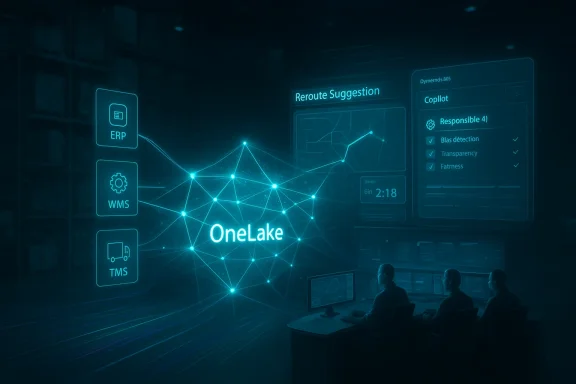
Fabric’s Real‑time Intelligence and OneLake promise to standardize and catalog events from multiple sources so that models and copilots can ground recommendations against a single semantic layer. In practice that transfers the burden from “how do we merge data?” to “who owns the source of truth, and how is it kept fresh?” Organizations moving to a Fabric-centric architecture must treat event freshness, schema contracts and timestamp fidelity as first‑class SLAs. If a predictive re‑route arrives after the carrier appointment cut‑off, it is worse than useless — it is noise that increases cognitive load and can create process churn. Microsoft’s tooling supports real‑time triggers and conditional alerts, but operators still need contractual and engineering guarantees for latency and data ownership.What “embedded AI” really means for operations
Integration patterns change — but so do failure modes
Traditionally logistics integration looked like a web of adapters: ERP ↔ WMS ↔ TMS ↔ carrier EDI/API. Embedded AI nudges teams toward a centralized fabric and shared services model: all events stream into a central data plane, models are trained on the semantic layer, and Copilots or automation layers read that same layer to provide recommendations or initiate actions.That pattern simplifies duplication and reconciliations but concentrates risk. Consider three common failure modes:
- Schema drift: a carrier changes an ASN payload and downy drop fields; the semantic layer surfaces stale inventory counts.
- Token and credential expiry: a short-lived token used by a near-edge adapter expires during peak operations, dropping messages into a dead letter queue.
- Decision latency: an ML model’s output becomes stale by the time orchestration triggers, because pipeline SLAs weren’t enforced end-to-end.
Advisory versus execution value
We can parse the net value into two buckets:- Advisory gains: faster analysis, improved root‑cause visibility, fewer human errors in planning. These are the quick wins organizations usually realize first when they adopt Copilot and Fabric.
- Execution gains: reduced dwell time, fewer missed appointments, lower detention and demurrage — the hard operational improvements that require execution hooks into the TMS, driver apps, or robotics controllers.
Microsoft Fabric: the data foundation and its limits
What Fabric gives you
Fabric unifies data engineering, analytics and governance under OneLake and introduces Real‑Time Intelligence for event processing. The platform is intentionally lake‑centric and offers:- A single semantic layer (OneLake) for shared definitions and lineage.
- A Real‑time hub that ingests event streams and exposes them to analytics and triggerable actions.
- Built‑in governance and lineage tools to support auditability.
What Fabric cannot buy you
Unification is necessary but not sufficient. The platform cannot:- Enforce who in your org must resolve an ASN discrepancy at 09:15 to keep a 10:00 loading window.
- Force carriers, brokerages or 3PL partners to accept machine‑generated execution instructions unless their contracts and apps allow it.
- Replace robust device life‑cycle management, firmware policy, and physical device SLAs.
Copilot and decision proximity
Copilot’s role inside operational apps
Microsoft has explicitly embedded Copilot into Dynamics 365 modules and into Field Service to provide context‑aware assistance and to trigger flows and connectors. The product design assumes human‑in‑the‑loop review: Copilot grounds responses via Dataverse and Microsoft Graph, adds responsible‑AI checks, and then surfaces recommendations or draft actions inside the app. That architecture is ideal for accelerating decision cycles where a human needs to validate context and exceptions are frequent.But that model of assistance can be configured in multiple ways:
- Read‑only advisory: Copilot summarizes risk and offers a suggested email to inform partners.
- Assisted decision: Copilot drafts a TMS change that a dispatcher must approve.
- Autonomic execution (rare): Copilot triggers a pre‑approved set of changes automatically when conditions meet pre-set safety and business rules.
When recommendations must become commands
There are high‑value logistics flows where closing the loop is essential: appointment scheduling, pallet reallocation at cross‑docks, perishable goods rerouting, or automated detention mitigation. For these flows, organizations need:- Clear decision ownership and an approved escalation matrix.
- Execution APIs with idempotency and compensating transactions.
- Observability for upstream and downstream failures.
- Fallback paths that guarantee safe manual takeover.
Where AI is already delivering real value — and where it isn’t
Practical wins
Platform AI delivers measurable improvements today in a handful of repeatable logistics tasks:- Demand sensing and short‑term SKU forecasting from blended signals (POS, telemetry, weather).
- Scenario analysis and what‑if simulations for capacity and routing.
- Exception identification and prioritized intervention lists.
- Reporting automation that reduces manual reconciliation time.
Where AI still struggles
Direct autonomous execution — closed loops that push commands to drivers, robots or external carriers — remain the hardest problem. Reasons include:- Decision authority: who is legally and operationally responsible when an autonomous reroute causes a missed delivery?
- Safety constraints: especially with robotics or on‑vehicle instructions where physical risk exists.
- Contractual reach: many carriers’ systems and SLAs do not accept machine‑initiated bookings or reroutes without manual confirmation.
- Observability and auditability requirements for compliance and claims.
Integration realities: ERP, WMS, TMS and the hybrid topology
Coexistence, not replacement
Microsoft’s approach explicitly favors coexistence with incumbent ERP, WMS and TMS systems rather than wholesale replacement. Dynamics 365 and Power Platform integrations are meant to sit alongside specialized planning tools and external carrier systems. This pragmatic stance accelerates adoption, but it creates hybrid topologies that increase the surface area for integration errors. In an execution‑heavy operation, every dropped message or schema mismatch can ripple through the network and cause missed slots and detention charges.Make interface stability a KPI
When model outputs can influence real‑world movements, interface stability becomes an operational KPI. Logmeasure and enforce:- Message delivery SLAs (p99 latencies for events).
- Schema contract adherence and migration windows.
- Token management and credential rotation policies.
- End‑to‑end observability for pipelines (ingest → model → action).
Practical operational recommendations
To translate platform AI potential into execution gains, logistics leaders should prioritize the following actions:- Define decision ownership for every AI output. For each recommendation, document: who acts, within what time window, and what are authorized automated changes.
- Put SLAs on pipeline latency and event freshness, not just uptime. A platform may be “up” while events are delayed past your cut‑off.
- Pilot closed‑loop automation on a small number of high‑value lanes. Validate decision rights, carrier acceptance, and fallbacks before scaling.
- Invest in interface testing and observability: synthetic transactions, contract testing for APIs, and chaos‑style tests for edge failures.
- Maintain governance guardrails: immutable audit logs, human override paths, and safety rules that prevent escalations that break contracts or laws.
- Negotiate partner contracts to accept machine-generated actions where appropriate, and include remediation clauses for false positives and failed autonomous actions.
A short catalog of implementation patterns and their tradeoffs
- Demand sensing (analytics + advisory): Low technical risk, fast ROI. Tradeoff: advisory rather than enforced execution.
- Exception identification + orchestrated human workflow: Medium risk; requires tight UI/UX and SLA enforcement.
- Workflow automation (e.g., auto‑reschedule within a warehouse): Higher risk; requires idempotent APIs and rollback mechanisms.
- Autonomous execution (robotics, vehicle commands): Highest risk; requires safety certification, legal clarity, and partner acceptance.
The human factor: governance and organizational readiness
Rapid access to AI services can outpace an organization’s ability to operationalize them. Dashboards full of insights are valuable, but they are not a substitute for clear operating procedures. Leaders often underestimate the change management required to convert “visibility” into “control.” This includes retraining planners, redefining SOPs, and rewriting SLAs with carriers and 3PL partners to accept a degree of machine-driven automation.Auditability matters. When decisions are automated or suggested by an LLM-anchored Copilot, organizations will need defensible trails: what data led to the recommendation, which model version was used, and who approved or overruled it. Microsoft’s Fabric and Purview tools support lineage and governance, but those features must be operationalized inside procurement and legal processes.
Emerging signals and industry examples
Three real-world tie‑ins illustrate the contours of what’s possible today:- C.H. Robinson + Azure: Navisphere Vision layers Azure IoT and ML to offer predictive disruption detection and richer telemetry for multis a canonical example of a TMS vendor partnering with a hyperscaler to accelerate visibility and predictive alerts.
- FedEx Surround: FedEx’s platform built on Azure produces near‑real‑time monitoring and intervention for critical shipments, showing how a carrier can productize visibility and offer intervention services to customers. FedEx Surround highlights that carrier‑owned data plus hyperscaler analytics can create distinctive operational offerings.
- Hexagon Robotics + Microsoft: the AEON humanoid partnership demonstrates how Fabric RTI and Azure IoT make streaming telemetry and cloud-assisted MLOps feasible for robotics — a preview of how physical automation will increasingly rely on integrated cloud fabrics for telemetry, training and governance. That work is promising but still early for broad factory deployments.
Risk matrix: what to watch for
- Data quality and timestamp fidelity — impact: missed appointments and SLA breaches.
- Interface churn and schema drift — impact: silent data loss and incorrect model inferences.
- Contractual mismatch with carriers — impact: inability to execute machine‑generated actions.
- Overreliance on advisory outcomes — impact: insight saturation and no operational improvement.
- Security, compliance and data residency — impact: regulatory penalties and customer trust erosion.
Conclusion
Microsoft’s combination of Azure, Copilot, and Fabric reframes the logistics problem: the battleground is no longer solely model accuracy but the architecture and governance that convert insight into reliable action. Platform AI simplifies data plumbing, accelerates insight generation, and lowers the cost of building predictive services. Yet operational value depends on three things every logistics leader must prioritize now: execution hooks (APIs and contractual acceptance for automated actions), integration reliability (SLAs for event freshness and interface stability), and explicit decision ownership (who can approve or override actions, and how this is audited).The practical path forward is straightforward in concept but demanding in execution: start with a tightly scoped, closed‑loop pilot that has clear decision rights and rollback paths; bake SLAs into data pipelines; and negotiate partner contracts to accept machine‑initiated actions only where safety, auditability and remediation are agreed. If you do those things, the promise of reduced dwell, fewer missed appointments, and more predictable freight outcomes moves from aspiration to measurable improvement. If you skip them, Copilot and Fabric will still deliver valuable insights — they just won’t change how the cargo moves.
Microsoft’s stack gives logistics teams powerful new tools, but those tools merely raise the bar for execution discipline. The true winners will be the organizations that treat the platform as an architectural choice and invest equally in engineering, governance, and partner contracts so that visibility becomes the prelude to dependable action rather than a fancier status board.
Source: GetTransport.com How Microsoft’s Azure, Copilot and Fabric Are Reshaping Logistics Execution
