

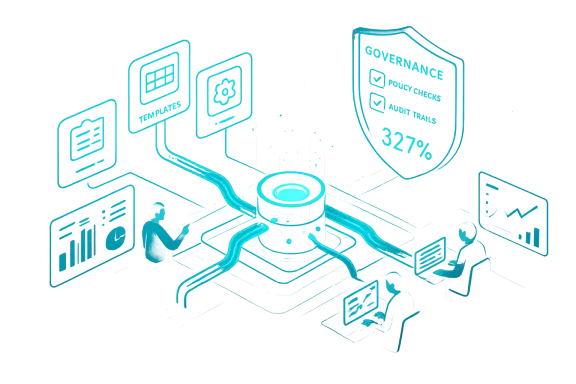
When Forrester modeled the economics of enterprise AI around Microsoft Foundry, the headline number — a 327% return on investment (ROI) over three years — grabbed attention, but the study’s real story is less about flashy percentages and more about where the value accrues: developer productivity, platform reuse, and trust-enabling governance that turns pilots into scaleable programs. m]
The Forrester Total Economic Impact™ (TEI) study commissioned by Microsoft examined a composite enterprise (roughly $10 billion in revenue, 25,000 employees, 100 technical staff) to estimate the three‑year, risk‑adjusted economic impact of adopting Microsoft Foundry for building AI applications and agents. Forrester combined interviews, a broader survey, and a financial model to produce a cash‑flow view thd benefits, costs, and risk adjustments — the TEI method that Forrester uses across vendor-commissioned studies.
Key topline findings the study and Microsoft’s summary emphasize:
Why this matters in practical terms:
If you lead AI programs, act with three priorities:
Source: Microsoft Azure The economics of enterprise AI: What the Forrester TEI study reveals about Microsoft Foundry | Microsoft Azure Blog
 Background / Overview
The Forrester Total Economic Impact™ (TEI) study commissioned by Microsoft examined a composite enterprise (roughly $10 billion in revenue, 25,000 employees, 100 technical staff) to estimate the three‑year, risk‑adjusted economic impact of adopting Microsoft Foundry for building AI applications and agents. Forrester combined interviews, a broader survey, and a financial model to produce a cash‑flow view thd benefits, costs, and risk adjustments — the TEI method that Forrester uses across vendor-commissioned studies.Key topline findings the study and Microsoft’s summary emphasize:
- A 327% ROI over three years for the composite organization.
- The largest single quantified benefit was developer productivity, valued at $15.7 million in present value across three years.
- Productivity improvements of up to 35% for technical teams, payback in as few as six months, and infrastructure cost avoidance through decommissioning legacy tools.
What the Forrester TEI study actually modeled
Method, sample and risk adjustments
Forrester’s TEI methodology constructs a financial model by:- Interviewing a set of customer stakeholders to collect empirical inputs,
- Designing a composite organization that reflects the interviewees, and
- Building a cash‑flow model that is then risk‑adjusted to avoid overclaiming benefits. This approach is standard for TEI engagements and explicitly adjusts benefits downward and costs upward to be conservative.
- In‑depth interviews (10 decision‑makers at five organizations),
- A broader survey of 154 AI decision‑makers and leaders across the U.S. and Europe,
- A financial model using a conservative stance (higher costs, lowered benefits) applied to the composite enterprise described above.
What was counted as benefits and costs
Forrester’s value buckets in this engagement included:- Developer productivity and reduced engineering toil,
- Operational efficiencies from decommissioning duplicate tools and infrastructure,
- Faster time to market for AI apps and agents (leading to revenue or cost avoidance),
- Governance and risk mitigation benefits (enabling higher‑impact use cases),
- Implementation and subscription costs for Foundry, plus any incremental infrastructure or personnel costs.
The headline driver: developer productivity — why it matters
The single biggest takeaway of the Forrester model is that developer productivity — not raw model capability or immediate cost savings on infrastructure — was the largest contributor to ROI. Forrester estimated a productivity gain worth up to $15.7 million over three years for the composite organization, driven by:- Eliminating repetitive, undifferentiated engineering work (stitching pipelines, re-creating context stores, re-implementing governance),
- Providing reusable templates, knowledge bases, and standard evaluations,
- Faster grounding of models to enterprise knowledge via Foundry IQ, and
- Reducing time spent managing container infrastructure or ad‑hoc tooling.
Why this matters in practical terms:
- Time saved for senior engineers translates directly into more features, faster iteration, less context switching, and fewer delayed projects — all measurable inputs in a TEI cash‑flow model.
- Productivity gains compound as organizations reuse templates and knowledge bases across projects; a shared platform multiplies the return of a single development effort.
Platform thinking vs. point solutions: operational and financial consequences
Forrester’s narrative — echoed in Microsoft’s summary — is that platform consolidation reduces the “hidden tax” of AI initiatives. The mechanics are simple:- Point solutions proliferate their own pipelines, governance, connectors, and integrations.
- Each new project then rebuilds existing plumbing instead of focusing on business‑specific logic.
- A unified platform like Microsoft Foundry centralizes knowledge bases, evaluation tooling, and guardrails so teams can reuse work.
- 32% of surveyed adopters reported the ability to reduce costs by decommissioning legacy AI tools, with the composite organization avoiding up to $4.3M in infrastructure costs over three years.
Trust, governance, and the Control Plane: unlocking higher‑impact work
Moving from internal automation to customer‑facing or judgement‑assisting AI requires organizations to trust their models and agents. The study highlights governance and compliance as a central adoption driver:- 67% of surveyed organizations cited concerns about AI security, privacy, or governance as a top reason for adopting Foundry.
- Governance reduces the risk of model drift, data leakage, and regulatory exposure,
- Observability and continuous evaluation reduce time spent triaging failures,
- Central policies make audits and compliance attestations repeatable and defensible.
Strengths: Where the Forrester findings convincingly align with enterprise realities
- Productivity unlock is real. Multiple vendor-neutral studies and operational anecdotes across the industry show engineering teams spend a large portion of time on integration and tooling. Foundry’s value proposition maps directly to those pain points, and Forrester’s productivity lift is consistent with other TEI engagements showing developer time as a high-leverage lever.
- Platform-level reuse compounds value. The cash‑flow profile in the report — accelerating benefits year over year — reflects a realistic compounding effect when reusable assets are genuinely shared across programs.
- Governance-first design enables scale. The emphasis on model scanning, continuous evaluation, and centralized policy is what allows organizations to graduate from low‑risk automation to customer‑impacting agents. That’s a necessary pathway for trusted enterprise adoption.
Risks, blind spots, and limits of the claim — what leaders should scrutinize
No commissioned study is free of bias or limitation. Here are the central caveats and risks to keep front of mind:1) Commissioning and sample limitations
Forrester TEI studies are valuable but are also commissioned by the vendor — Microsoft in this case. The underlying interviews are selective (10 interviews in this study) and the broader survey is self‑reported (154 respondents). Even with risk adjustments, the sample can reflect early adopters and customers with favorable experiences. Treat the composite ROI as a scenario, not a universal guarantee.2) Generalizability across industry and scale
The composite enterprise used in modeling (a $10B revenue firm with 25,000 employees) may not reflect your size, sectoral complexity, or legacy stack. Manufacturing, financial services, and regulated healthcare have particular constraints — data residency, compliance, and operational risk — that change implementation time and cost. Validate assumptions with a pilot aligned to your industry context.3) Vendor lock‑in and portability tradeoffs
Platform consolidation reduces duplication but increases coupling. Organizations must weigh short‑term productivity gains against longer‑term risks of dependency and migration costs. Multi‑cloud strategies, open model formats (e.g., ONNX or containerized serving), and escape clauses in contracts are important mitigations. File-level case studies in practice often emphasize careful integration planning to avoid lock‑in.4) Measurement fidelity for developer productivity
Quantifying developer productivity is notoriously tricky. Beware of optimistic multipliers or attributing unrelated efficiency gains to a single platform. Good measurement requires:- Baseline metrics (story points, cycle time, mean time to repair),
- Clear attribution windows,
- A process to isolate platform effects from organizational process changes.
5) Hidden operational costs and compute economics
Foundry abstracts away some infrastructure management, but compute costs for training, fine‑tuning, and inference still materialize. The TEI model explicitly tries to account for infrastructure savings from decommissioning, but organizations with heavy custom training or on‑prem constraints may see different results. Run a TCO exercise that includes tokens, inference volume, data egress, and storage.Practical verification checklist: what to test before you bet the farm
Before committing to a platform consolidation, design a focused validation program that tests the claims Forrester measured in ways that map to your organization.- Baseline developer time and outputs:
- Measure current cycle time for typical AI projects (prototype → production),
- Track hours spent on data plumbing, connectors, and governance per project.
- Short pilot with reusability goals:
- Build two comparable agents: one using current tooling, one in Foundry,
- Force re‑use: require the Foundry implementation to serve two different teams using the same knowledge base.
- Governance and compliance proof points:
- Run a model‑scanning exercise and evaluation pipeline against a sensitive dataset,
- Verify audit logs, policy enforcement, and remediation playbooks.
- Cost modeling:
- Map subscription and service fees, expected inference volume, and any migration costs, then stress‑test for 2× and 5× usage scenarios.
- Exit and portability:
- Test export of knowledge bases, connectors, and model artifacts to ensure migration paths exist.
Recommended commercial and operational guardrails
- Negotiate proof‑of‑value milestones into procurement contracts (short payback windows for initial workloads).
- Require transparency on evaluation and model‑scanning outputs: What does “model scanning” detect and how is remediation provided?
- Insist on billing flexibility during pilots (monthly or consumption billing where available) to reduce procurement friction.
- Lock in portability commitments (artifact export, documented APIs) and a transition plan as part of the SOW.
- Establish a central AI program office (AI‑PO) to enforce reusable templates, common knowledge bases, and evaluation standards.
Interpreting the numbers: a show the productivity claim maps to dollars)
Forrester’s headline $15.7M productivity figure is a present‑value number derived from:- A composite workforce size and fully‑burdened salary assumptions,
- An assumed percentage reduction in undifferentiated engineering time (e.g., 30%–40% reported by interviewees),
- A recapture rate (how much of the freed time converts into productive output),
- Discounting and risk adjustment.
- Calculate annual fully‑burdened cost of AI engineers involved (FTE_count × fully_burdened_salary).
- Multiply by % of time regained (e.g., 30%).
- Multiply by recapture rate (e.g., 75% of time becomes productive value).
- Discount and annualize across your expected three‑year adoption horizon.
Conclusion — what leaders should take away and the next move
The Forrester TEI study on Microsoft Foundry is useful because it translates platform promises into measurable financial terms: large ROI driven primarily by developer productivity, compounding returns from reuse, and governance features that unlock higher‑impact work. But the study is vendor‑commissioned and based on a specific composite — so treat the headline 327% ROI as a directional signal, not a guarantee.If you lead AI programs, act with three priorities:
- Measure first: baseline developer time, integration toil, and governance gaps before you sign.
- Pilot with intent: build a rapid, multi‑team pilot that forces reuse and quantifies productivity gains.
- Govern and contract: require model‑scanning evidence, auditability, billing flexibility, and migration paths.
Source: Microsoft Azure The economics of enterprise AI: What the Forrester TEI study reveals about Microsoft Foundry | Microsoft Azure Blog
