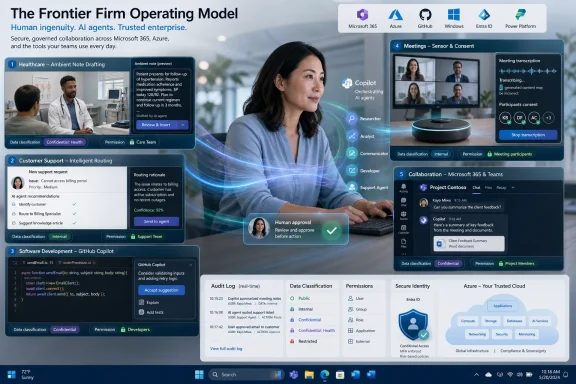
On July 2, 2026, Microsoft announced a $2.5 billion Microsoft Frontier Company initiative that will put roughly 6,000 employees into enterprise AI deployment work, pairing engineers, trainers, sales specialists, and industry experts directly with large customers including Unilever and Novo Nordisk. The move is not just another AI product launch. It is Microsoft admitting that the hardest part of enterprise AI is no longer access to models, but the messy business of making those models useful inside real companies. After three years of Copilot branding, Azure AI expansion, and OpenAI halo effects, Redmond is now selling implementation as the product.
The old enterprise software bargain was simple enough: Microsoft built the platform, partners handled much of the customization, and customers paid through licenses, cloud consumption, support contracts, and consulting ecosystems. Frontier Company bends that model. Microsoft is not merely giving CIOs a portal full of AI tools; it is sending people inside the customer’s operating machinery to help decide which tools belong there.
That matters because generative AI has run into a familiar enterprise wall. Pilots are easy, demos are dazzling, and internal hackathons produce convincing prototypes. But the journey from “this chatbot summarizes meetings” to “this system changes how a pharmaceutical company manages R&D, compliance, procurement, and customer service” is long, political, and full of legacy data nobody wants to clean.
Microsoft’s answer is to industrialize the hand-holding. The company is effectively saying that AI adoption requires a deployment corps: people who can translate between model capability, business process, security policy, data architecture, and executive impatience. In that sense, Frontier Company looks less like a moonshot and more like a giant services bet attached to Microsoft’s cloud business.
The symbolism is hard to miss. A company that spent decades monetizing standardized software is now leaning into bespoke transformation work. That is not a retreat from product strategy; it is an acknowledgment that enterprise AI does not become valuable until it is entangled with the customer’s proprietary workflows.
But speed created its own problem. Copilot became a brand umbrella so wide that it often described aspiration more than outcome. For many organizations, the question shifted from “Can we buy Microsoft AI?” to “What exactly do we do with it after procurement signs the order?”
That is the gap Frontier Company is designed to occupy. The initiative is not aimed at consumers who want a better assistant in Windows. It is aimed at enterprises that need AI systems to survive contact with permissions, records retention, identity management, industry regulation, data residency, internal politics, and return-on-investment committees.
This is also why the number 6,000 matters. It signals that Microsoft sees AI adoption as labor-intensive at scale. The company may sell automation, but it is hiring and redeploying human expertise to get the automation accepted, integrated, trusted, and measured.
There is an irony here, but not a contradiction. The more powerful enterprise AI becomes, the more organizations need people who understand where it should not act, which data it should not see, and which processes cannot be casually rewritten by a model output. Frontier Company is Microsoft’s attempt to wrap that uncomfortable truth in a commercial operating model.
That shift reflects both customer demand and market reality. OpenAI gave Microsoft the early lead, but enterprise buyers do not want their most important workflows trapped behind one model provider’s roadmap, pricing, latency profile, or governance assumptions. As Google, Anthropic, Meta-linked open models, DeepSeek, and other competitors improved, “best model for the task” became a more credible demand.
For Microsoft, this is a defensive and offensive move at once. Defensively, it reduces the risk that customers view Azure AI as too tightly coupled to OpenAI. Offensively, it lets Microsoft position Azure, Microsoft 365, Copilot Studio, Fabric, Defender, Entra, and GitHub as the control plane around a multi-model future.
That is a more durable enterprise posture than model nationalism. CIOs care about model performance, but they care just as much about auditability, identity, procurement leverage, data boundaries, uptime, and exit options. Microsoft is trying to make the model less important than the platform that governs, routes, monitors, and monetizes it.
The deeper message is that Microsoft wants to own the AI operating environment, not just the AI conversation. If a bank, manufacturer, retailer, or drugmaker can swap models while keeping Microsoft’s deployment scaffolding, then Microsoft still wins even when the model leaderboard changes.
That is the strategic heart of the initiative. Microsoft has spent enormous sums on AI infrastructure, and Wall Street has rewarded the company for positioning itself at the center of the generative AI economy. But infrastructure only pays off if customers move beyond experiments and start running production systems that consume capacity continuously.
The consulting layer helps bridge that gap. A customer that cannot prove value from a Copilot trial may hesitate before expanding licenses or moving more data into Azure. A customer whose AI agents begin automating claims review, supply-chain forecasting, software testing, or sales operations becomes a much stickier account.
This is where Frontier Company borrows from the playbooks of systems integrators, cloud professional services teams, and companies like Palantir. The winning move is not merely to sell software; it is to become embedded in the customer’s definition of how modern work gets done. Once that happens, the vendor is no longer a line item. It becomes part of the operating model.
That embedded posture is lucrative, but it also changes expectations. Microsoft will be judged less by whether AI demos impress at conferences and more by whether deployments produce measurable business outcomes. The company is putting itself closer to the blast radius when projects disappoint.
Every serious AI deployment eventually collides with the same questions. Who can query which data? Which model processed the prompt? Where was the output stored? Was confidential information exposed? Can the result be reproduced? What happens when an AI agent takes an action across Microsoft 365, Teams, SharePoint, Power Platform, or a custom line-of-business app?
Those are not abstract concerns for administrators. They are ticket queues, audit findings, security reviews, conditional access policies, data loss prevention rules, retention labels, and late-night rollback plans. If Microsoft wants AI to move from novelty to infrastructure, it has to make those concerns manageable.
Frontier Company therefore carries an implicit promise: Microsoft will not just sell the shiny AI layer, but help customers wire it into the dull, necessary machinery of enterprise control. That means Entra identity, Purview governance, Defender security, Intune management, Azure policy, and the sprawling reality of hybrid estates.
The challenge is that governance is not a feature toggle. It is organizational muscle memory. Microsoft can send specialists, but customers still need data owners, risk teams, legal departments, and business units to agree on how AI should be used. The vendor can accelerate deployment; it cannot magically erase institutional ambiguity.
For Microsoft, the corporate logic is straightforward: reallocate toward the highest-growth markets, invest where customer demand is strongest, and reduce spending in areas that no longer fit the strategy. For employees and observers, the message is harsher. The company can mobilize 6,000 people for AI adoption while other workers face uncertainty about whether their roles survive the same AI-driven restructuring.
This tension is not unique to Microsoft. The entire technology sector is trying to convince customers that AI will unlock productivity while also using AI investment as justification for sharper prioritization and leaner workforces. But Microsoft’s scale makes the contradiction more visible.
The risk is reputational as much as operational. Enterprise customers want transformation, but they also want stability from their strategic vendors. If Microsoft’s AI push is perceived as a constant internal reshuffling exercise, customers may wonder whether today’s named program will still have the same staffing, incentives, and support structure a year from now.
Still, the labor optics also reveal why Microsoft is moving so aggressively. The company believes AI is not a feature cycle; it is a platform transition. In platform transitions, vendors tolerate disruption because the cost of hesitation is losing the next control point.
Microsoft will almost certainly frame this as additive rather than competitive. The company still needs partners to reach industries, regions, and midmarket customers at a scale Microsoft cannot handle alone. But the highest-profile enterprise AI projects are strategically important enough that Microsoft wants direct involvement.
That direct involvement changes the balance of influence. When Microsoft personnel are embedded in a customer’s AI transformation effort, they can shape architectural choices early. They can steer workloads toward Azure services, recommend Copilot extensions, introduce Microsoft security and governance tooling, and gather product feedback before partners or rivals define the customer’s mental model.
For partners, the opportunity is to attach themselves to the new motion rather than resist it. The danger is being pushed downstream into execution while Microsoft owns the boardroom narrative. AI transformation is becoming too strategic for Redmond to leave entirely to the channel.
This is another sign that enterprise AI is compressing old boundaries. Product vendor, cloud provider, consultant, trainer, security advisor, and workflow designer are becoming overlapping roles. Microsoft wants to sit at the center of that overlap.
For administrators, that means AI adoption will arrive less as a single Windows feature and more as a set of cross-platform demands. Copilot-enabled workflows may touch Windows 11 PCs, Copilot+ PCs, Teams meetings, SharePoint libraries, Outlook mailboxes, Power Platform apps, GitHub repositories, Azure resources, and third-party systems. The endpoint becomes the place where many AI-mediated actions begin, but not where they end.
That will put pressure on device management and security baselines. If AI tools can surface, summarize, transform, and act on enterprise data, then endpoint posture becomes part of AI governance. A poorly managed device is not just a device risk; it may become an AI access risk.
The practical takeaway for IT pros is that AI readiness is not solved by buying licenses. It requires identity hygiene, data classification, least-privilege access, monitoring, user training, and ruthless cleanup of stale permissions. Microsoft’s deployment army may help large enterprises confront those issues, but smaller organizations will still need to do much of the hard work themselves.
Windows remains relevant because it is where workers meet the AI layer. But the more Microsoft succeeds, the less AI will feel like a Windows feature and the more it will feel like a managed enterprise fabric running through everything.
The next phase will be funded by evidence. Companies will ask which processes became faster, which costs fell, which revenue improved, which risks increased, and which employees actually changed how they work. Microsoft’s Frontier Company exists because those answers are difficult to produce without implementation discipline.
That does not mean AI is failing. It means AI is growing up into the same unforgiving enterprise economics as every other major technology wave. Cloud migration, ERP modernization, zero-trust security, and data platform consolidation all went through versions of this cycle. The hype opens the door; operational proof keeps the budget.
Microsoft’s advantage is that it already owns much of the enterprise surface area where proof might be measured. Microsoft 365 knows how people collaborate. Azure hosts data and applications. GitHub tracks developer workflows. Defender sees security signals. Linked together, those systems can help tell an ROI story that a standalone model provider cannot.
The danger is that Microsoft may overpromise how quickly that story emerges. AI projects often fail not because the model is weak, but because the business process is incoherent. No vendor wants to say that too loudly, but every experienced IT pro knows it.
The concrete lessons are already visible:
Microsoft’s Frontier Company is a wager that the next phase of AI will be won not by the vendor with the flashiest model demo, but by the one that can turn scattered enterprise experiments into durable operating systems for work. If Microsoft can make that happen, AI becomes another layer of its commercial empire; if it cannot, Frontier Company will stand as an expensive reminder that transformation is easier to announce than to deploy. Either way, the age of casual AI experimentation is giving way to a more demanding era, where businesses will expect the technology — and its vendors — to prove their worth.
The practical significance is that Microsoft’s enterprise AI push now has a major government-scale proof point, not just private-sector customer examples. Abu Dhabi says Copilot will be standardized as the AI productivity platform across its public sector, with the goal of speeding internal decision-making and improving services for citizens, residents, and businesses.
The deployment also sharpens the sovereignty angle. Abu Dhabi’s media office says all licences include Advanced Data Residency, with AI processing kept within UAE borders. For IT leaders, that is the key operational detail: large AI rollouts are increasingly being sold not just on productivity, but on residency, governance, compliance, security assessments, training, and certification.
The programme also points beyond chat-style productivity. Abu Dhabi says an “AI Factory” capability is being established to support hundreds of use cases and more than 1,000 public-sector agents, spanning tasks such as document processing, constituent queries, policy analysis, and workflow automation. That reinforces Microsoft’s broader message: enterprise AI adoption is becoming a managed operating model, not a simple licence upgrade.

 www.mediaoffice.abudhabi
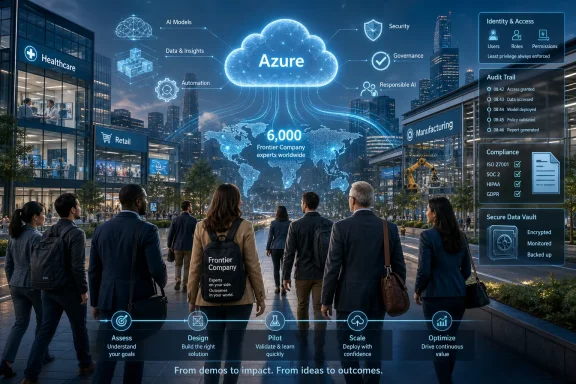 Microsoft Turns AI From Software License Into Field Operation
The old enterprise software bargain was simple enough: Microsoft built the platform, partners handled much of the customization, and customers paid through licenses, cloud consumption, support contracts, and consulting ecosystems. Frontier Company bends that model. Microsoft is not merely giving CIOs a portal full of AI tools; it is sending people inside the customer’s operating machinery to help decide which tools belong there.That matters because generative AI has run into a familiar enterprise wall. Pilots are easy, demos are dazzling, and internal hackathons produce convincing prototypes. But the journey from “this chatbot summarizes meetings” to “this system changes how a pharmaceutical company manages R&D, compliance, procurement, and customer service” is long, political, and full of legacy data nobody wants to clean.
Microsoft’s answer is to industrialize the hand-holding. The company is effectively saying that AI adoption requires a deployment corps: people who can translate between model capability, business process, security policy, data architecture, and executive impatience. In that sense, Frontier Company looks less like a moonshot and more like a giant services bet attached to Microsoft’s cloud business.
The symbolism is hard to miss. A company that spent decades monetizing standardized software is now leaning into bespoke transformation work. That is not a retreat from product strategy; it is an acknowledgment that enterprise AI does not become valuable until it is entangled with the customer’s proprietary workflows.
The Copilot Era Needed a Second Act
Microsoft’s first AI act was speed. It moved faster than almost any other incumbent after the ChatGPT shock, putting Copilot into Windows, Microsoft 365, GitHub, Dynamics, Security, and Azure. The strategy was blunt and effective: make AI feel like a layer across the Microsoft estate before rivals could define the category.But speed created its own problem. Copilot became a brand umbrella so wide that it often described aspiration more than outcome. For many organizations, the question shifted from “Can we buy Microsoft AI?” to “What exactly do we do with it after procurement signs the order?”
That is the gap Frontier Company is designed to occupy. The initiative is not aimed at consumers who want a better assistant in Windows. It is aimed at enterprises that need AI systems to survive contact with permissions, records retention, identity management, industry regulation, data residency, internal politics, and return-on-investment committees.
This is also why the number 6,000 matters. It signals that Microsoft sees AI adoption as labor-intensive at scale. The company may sell automation, but it is hiring and redeploying human expertise to get the automation accepted, integrated, trusted, and measured.
There is an irony here, but not a contradiction. The more powerful enterprise AI becomes, the more organizations need people who understand where it should not act, which data it should not see, and which processes cannot be casually rewritten by a model output. Frontier Company is Microsoft’s attempt to wrap that uncomfortable truth in a commercial operating model.
Model Choice Becomes the New Enterprise Comfort Blanket
One of the more important parts of Microsoft’s pitch is its emphasis on choice. The company is no longer presenting enterprise AI as a straight line from OpenAI models to Microsoft products to customer productivity. Instead, it is talking about Microsoft models, commercial third-party models, and open-source alternatives as ingredients in a broader deployment architecture.That shift reflects both customer demand and market reality. OpenAI gave Microsoft the early lead, but enterprise buyers do not want their most important workflows trapped behind one model provider’s roadmap, pricing, latency profile, or governance assumptions. As Google, Anthropic, Meta-linked open models, DeepSeek, and other competitors improved, “best model for the task” became a more credible demand.
For Microsoft, this is a defensive and offensive move at once. Defensively, it reduces the risk that customers view Azure AI as too tightly coupled to OpenAI. Offensively, it lets Microsoft position Azure, Microsoft 365, Copilot Studio, Fabric, Defender, Entra, and GitHub as the control plane around a multi-model future.
That is a more durable enterprise posture than model nationalism. CIOs care about model performance, but they care just as much about auditability, identity, procurement leverage, data boundaries, uptime, and exit options. Microsoft is trying to make the model less important than the platform that governs, routes, monitors, and monetizes it.
The deeper message is that Microsoft wants to own the AI operating environment, not just the AI conversation. If a bank, manufacturer, retailer, or drugmaker can swap models while keeping Microsoft’s deployment scaffolding, then Microsoft still wins even when the model leaderboard changes.
The Services Pivot Is a Cloud Consumption Strategy in Disguise
Frontier Company may be presented as an adoption accelerator, but it is also a demand-generation engine for Azure. Every successful enterprise AI deployment consumes compute, storage, data services, identity services, observability tools, security products, and developer platforms. The more deeply AI is embedded into a customer’s workflow, the harder that cloud footprint becomes to unwind.That is the strategic heart of the initiative. Microsoft has spent enormous sums on AI infrastructure, and Wall Street has rewarded the company for positioning itself at the center of the generative AI economy. But infrastructure only pays off if customers move beyond experiments and start running production systems that consume capacity continuously.
The consulting layer helps bridge that gap. A customer that cannot prove value from a Copilot trial may hesitate before expanding licenses or moving more data into Azure. A customer whose AI agents begin automating claims review, supply-chain forecasting, software testing, or sales operations becomes a much stickier account.
This is where Frontier Company borrows from the playbooks of systems integrators, cloud professional services teams, and companies like Palantir. The winning move is not merely to sell software; it is to become embedded in the customer’s definition of how modern work gets done. Once that happens, the vendor is no longer a line item. It becomes part of the operating model.
That embedded posture is lucrative, but it also changes expectations. Microsoft will be judged less by whether AI demos impress at conferences and more by whether deployments produce measurable business outcomes. The company is putting itself closer to the blast radius when projects disappoint.
Enterprise AI Is Running Into the Governance Wall
For WindowsForum readers, the most interesting part of the story may not be the executive branding. It is the practical admission that enterprise AI is a governance problem wearing a productivity costume.Every serious AI deployment eventually collides with the same questions. Who can query which data? Which model processed the prompt? Where was the output stored? Was confidential information exposed? Can the result be reproduced? What happens when an AI agent takes an action across Microsoft 365, Teams, SharePoint, Power Platform, or a custom line-of-business app?
Those are not abstract concerns for administrators. They are ticket queues, audit findings, security reviews, conditional access policies, data loss prevention rules, retention labels, and late-night rollback plans. If Microsoft wants AI to move from novelty to infrastructure, it has to make those concerns manageable.
Frontier Company therefore carries an implicit promise: Microsoft will not just sell the shiny AI layer, but help customers wire it into the dull, necessary machinery of enterprise control. That means Entra identity, Purview governance, Defender security, Intune management, Azure policy, and the sprawling reality of hybrid estates.
The challenge is that governance is not a feature toggle. It is organizational muscle memory. Microsoft can send specialists, but customers still need data owners, risk teams, legal departments, and business units to agree on how AI should be used. The vendor can accelerate deployment; it cannot magically erase institutional ambiguity.
Layoff Optics Make the AI Story Harder to Sell
The timing is uncomfortable. Microsoft’s latest AI expansion comes amid reports of further job cuts and continued resource shifts toward cloud and artificial intelligence. That makes Frontier Company both a growth story and a labor story.For Microsoft, the corporate logic is straightforward: reallocate toward the highest-growth markets, invest where customer demand is strongest, and reduce spending in areas that no longer fit the strategy. For employees and observers, the message is harsher. The company can mobilize 6,000 people for AI adoption while other workers face uncertainty about whether their roles survive the same AI-driven restructuring.
This tension is not unique to Microsoft. The entire technology sector is trying to convince customers that AI will unlock productivity while also using AI investment as justification for sharper prioritization and leaner workforces. But Microsoft’s scale makes the contradiction more visible.
The risk is reputational as much as operational. Enterprise customers want transformation, but they also want stability from their strategic vendors. If Microsoft’s AI push is perceived as a constant internal reshuffling exercise, customers may wonder whether today’s named program will still have the same staffing, incentives, and support structure a year from now.
Still, the labor optics also reveal why Microsoft is moving so aggressively. The company believes AI is not a feature cycle; it is a platform transition. In platform transitions, vendors tolerate disruption because the cost of hesitation is losing the next control point.
Microsoft Is Rebuilding the Partner Model Around Itself
The Frontier Company announcement will make Microsoft partners pay attention. Systems integrators, managed service providers, consultants, and independent software vendors have long depended on Microsoft’s platforms as fertile ground for implementation work. A 6,000-person Microsoft deployment unit moves the mothership closer to that revenue stream.Microsoft will almost certainly frame this as additive rather than competitive. The company still needs partners to reach industries, regions, and midmarket customers at a scale Microsoft cannot handle alone. But the highest-profile enterprise AI projects are strategically important enough that Microsoft wants direct involvement.
That direct involvement changes the balance of influence. When Microsoft personnel are embedded in a customer’s AI transformation effort, they can shape architectural choices early. They can steer workloads toward Azure services, recommend Copilot extensions, introduce Microsoft security and governance tooling, and gather product feedback before partners or rivals define the customer’s mental model.
For partners, the opportunity is to attach themselves to the new motion rather than resist it. The danger is being pushed downstream into execution while Microsoft owns the boardroom narrative. AI transformation is becoming too strategic for Redmond to leave entirely to the channel.
This is another sign that enterprise AI is compressing old boundaries. Product vendor, cloud provider, consultant, trainer, security advisor, and workflow designer are becoming overlapping roles. Microsoft wants to sit at the center of that overlap.
Windows Is Not the Headline, but It Is Still in the Stack
This announcement is not primarily about Windows, and that is precisely why Windows users should care. Microsoft’s AI strategy is increasingly built around the full enterprise environment: endpoints, identity, collaboration, cloud, developer tooling, data platforms, and security. Windows is one node in that system, not the whole system.For administrators, that means AI adoption will arrive less as a single Windows feature and more as a set of cross-platform demands. Copilot-enabled workflows may touch Windows 11 PCs, Copilot+ PCs, Teams meetings, SharePoint libraries, Outlook mailboxes, Power Platform apps, GitHub repositories, Azure resources, and third-party systems. The endpoint becomes the place where many AI-mediated actions begin, but not where they end.
That will put pressure on device management and security baselines. If AI tools can surface, summarize, transform, and act on enterprise data, then endpoint posture becomes part of AI governance. A poorly managed device is not just a device risk; it may become an AI access risk.
The practical takeaway for IT pros is that AI readiness is not solved by buying licenses. It requires identity hygiene, data classification, least-privilege access, monitoring, user training, and ruthless cleanup of stale permissions. Microsoft’s deployment army may help large enterprises confront those issues, but smaller organizations will still need to do much of the hard work themselves.
Windows remains relevant because it is where workers meet the AI layer. But the more Microsoft succeeds, the less AI will feel like a Windows feature and the more it will feel like a managed enterprise fabric running through everything.
The ROI Test Is Coming for Everyone
The first phase of generative AI was funded by wonder. Executives saw ChatGPT, watched a few demos, and authorized pilots because the risk of missing the wave seemed greater than the risk of overspending. That phase is ending.The next phase will be funded by evidence. Companies will ask which processes became faster, which costs fell, which revenue improved, which risks increased, and which employees actually changed how they work. Microsoft’s Frontier Company exists because those answers are difficult to produce without implementation discipline.
That does not mean AI is failing. It means AI is growing up into the same unforgiving enterprise economics as every other major technology wave. Cloud migration, ERP modernization, zero-trust security, and data platform consolidation all went through versions of this cycle. The hype opens the door; operational proof keeps the budget.
Microsoft’s advantage is that it already owns much of the enterprise surface area where proof might be measured. Microsoft 365 knows how people collaborate. Azure hosts data and applications. GitHub tracks developer workflows. Defender sees security signals. Linked together, those systems can help tell an ROI story that a standalone model provider cannot.
The danger is that Microsoft may overpromise how quickly that story emerges. AI projects often fail not because the model is weak, but because the business process is incoherent. No vendor wants to say that too loudly, but every experienced IT pro knows it.
Redmond’s 6,000-Person Bet Leaves CIOs With Fewer Excuses
Microsoft’s new AI deployment push gives enterprise leaders a clearer path, but it also removes a convenient ambiguity. If the vendor is willing to supply people, tooling, model options, and implementation frameworks, then customers can no longer blame slow progress solely on immature technology.The concrete lessons are already visible:
- Microsoft is treating enterprise AI adoption as a services-heavy transformation problem, not simply a software licensing opportunity.
- The company’s multi-model posture is a strategic hedge against overdependence on OpenAI and a concession to enterprise demands for flexibility.
- Frontier Company is likely to drive Azure consumption by turning AI pilots into production workloads that need compute, data, identity, and security services.
- IT administrators should expect AI projects to increase pressure on governance, permissions, endpoint security, data classification, and audit readiness.
- Microsoft partners may benefit from expanded demand, but they will also face a more assertive Microsoft in strategic enterprise AI engagements.
- Customers should judge the initiative by measurable workflow change, not by the number of copilots, agents, or models attached to a project.
Microsoft’s Frontier Company is a wager that the next phase of AI will be won not by the vendor with the flashiest model demo, but by the one that can turn scattered enterprise experiments into durable operating systems for work. If Microsoft can make that happen, AI becomes another layer of its commercial empire; if it cannot, Frontier Company will stand as an expensive reminder that transformation is easier to announce than to deploy. Either way, the age of casual AI experimentation is giving way to a more demanding era, where businesses will expect the technology — and its vendors — to prove their worth.
Update: Abu Dhabi rolls out Microsoft 365 Copilot to 35,000 government employees (July 6, 2026)
Abu Dhabi Government says it has deployed Microsoft 365 Copilot to 26,000 civil servants across 27 government entities, expanding from 9,000 existing licences to a total of 35,000 users. The rollout is being framed as part of a “Frontier Employee Programme” and as one of the largest public-sector AI productivity deployments to date.The practical significance is that Microsoft’s enterprise AI push now has a major government-scale proof point, not just private-sector customer examples. Abu Dhabi says Copilot will be standardized as the AI productivity platform across its public sector, with the goal of speeding internal decision-making and improving services for citizens, residents, and businesses.
The deployment also sharpens the sovereignty angle. Abu Dhabi’s media office says all licences include Advanced Data Residency, with AI processing kept within UAE borders. For IT leaders, that is the key operational detail: large AI rollouts are increasingly being sold not just on productivity, but on residency, governance, compliance, security assessments, training, and certification.
The programme also points beyond chat-style productivity. Abu Dhabi says an “AI Factory” capability is being established to support hundreds of use cases and more than 1,000 public-sector agents, spanning tasks such as document processing, constituent queries, policy analysis, and workflow automation. That reinforces Microsoft’s broader message: enterprise AI adoption is becoming a managed operating model, not a simple licence upgrade.
Abu Dhabi Government partners with Microsoft for Frontier Employee Programme, in one of public sector’s largest AI productivity rollouts
Abu Dhabi Government has announced the rollout of Microsoft 365 Copilot across Abu Dhabi's public sector, equipping tens of thousands of government employees with generative AI in their daily tools as the emirate advances its bid to become the world's first AI-native government...
References
- Primary source: The American Bazaar
Published: 2026-07-02T18:34:11.770227
Microsoft mobilizes workers to accelerate enterprise AI adoption
Microsoft deploys 6,000 employees to help businesses adopt AI faster through its new $2.5 billion enterprise AI initiative.americanbazaaronline.com - Related coverage: techcrunch.com
Microsoft launches its own AI deployment company with $2.5 billion commitment | TechCrunch
Microsoft follows Amazon, OpenAI, and Anthropic with its new AI deployment group.techcrunch.com - Related coverage: investing.com
Microsoft launches firm to help companies adopt AI with $2.5 billion By Reuters
Microsoft launches firm to help companies adopt AI with $2.5 billionwww.investing.com - Official source: blogs.microsoft.com
How Microsoft is empowering Frontier Transformation with Intelligence + Trust - The Official Microsoft Blog
At Microsoft Ignite in November, we introduced Frontier Transformation — a holistic reimagining of business aligning AI with human ambition to help organizations achieve their highest aspirations and growth potential. While AI Transformation centered on efficiency and productivity, Frontier...blogs.microsoft.com - Official source: news.microsoft.com
- Related coverage: geekwire.com
Microsoft unveils $2.5B 'Frontier Company' to embed AI engineers inside customers – GeekWire
"Microsoft Frontier Company" is a $2.5 billion initiative that will embed engineers inside customer organizations to build and run their AI systems. The move follows similar efforts by Amazon, OpenAI and Anthropic, and expands work Microsoft was already doing through its consulting arm...www.geekwire.com

- Related coverage: financialexpress.com
- Related coverage: europapress.es
Microsoft invierte unos 2.200 millones y destinará 6.000 empleados en una nueva unidad de adopción de la IA
El gigante tecnológico estadounidense Microsoft ha anunciado una inversión de 2.500 millones de dólares...www.europapress.es
- Related coverage: windowscentral.com
Microsoft diversifies Copilot 355 AI stack beyond OpenAI | Windows Central
Microsoft’s Copilot 365 AI stack just got a Claude infusion. Here's why OpenAI should be concerned.www.windowscentral.com - Related coverage: itpro.com
Satya Nadella says “our multi-model approach goes beyond choice’ as Microsoft adds Claude AI models to 365 Copilot | IT Pro
Users can choose between both OpenAI and Anthropic models in Microsoft 365 Copilotwww.itpro.com - Related coverage: techradar.com
Microsoft is mixing up its Copilot AI leadership, so Suleyman can 'build enterprise tuned lineages' | TechRadar
Microsoft brings consumer and enterprise Copilot into closer alignmentwww.techradar.com - Official source: cdn-dynmedia-1.microsoft.com
- Official source: smt.microsoft.com
Last edited: