

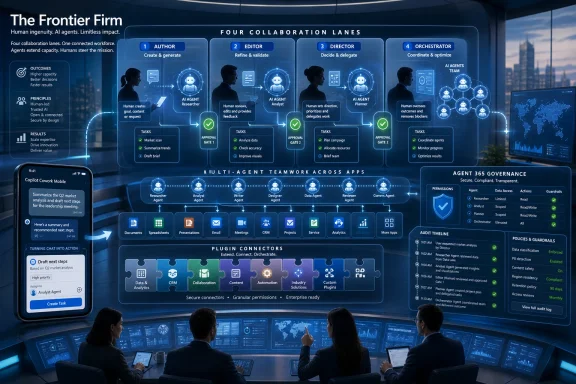
Microsoft used its May 5, 2026 Official Microsoft Blog post to argue that “Frontier Firms” are rebuilding work around four human-agent collaboration patterns: author, editor, director and orchestrator, while expanding Copilot Cowork for mobile, plugins and enterprise agent governance. The announcement is less a product update than a management manifesto. Microsoft is telling customers that the next phase of AI adoption will not be won by buying chatbots, but by redesigning the operating model around them.
For the last two years, enterprise AI has mostly been sold as personal productivity software with a bigger vocabulary. Draft this email. Summarize that meeting. Turn these bullets into a deck. Microsoft’s latest pitch moves the battleground away from individual convenience and toward organizational design.
That shift matters because it is how Microsoft wants CIOs, CFOs and business-unit leaders to justify the next wave of AI spending. Copilot as an assistant was relatively easy to explain but hard to value. Copilot as a coworker, agent platform and managed execution layer is more ambitious: it asks the enterprise to reorganize work so software can do more than answer questions.
The phrase “Frontier Firm” is doing a lot of work here. It sounds like consulting-room futurism, but Microsoft’s definition is concrete enough to be useful: a company that deliberately assigns different kinds of work to different patterns of human-agent collaboration. The human is not removed from the system; the human is moved up the stack.
That is the thesis Microsoft wants leaders to absorb. AI adoption is no longer primarily about whether employees have access to a model. It is about whether managers know when workers should write with AI, edit AI, delegate to AI or supervise a network of agents operating across a workflow.
In the author pattern, the worker remains the producer and calls on AI for fragments: a line of code, a sentence, a table, a first-pass analysis. This is the most familiar form of generative AI use because it resembles autocomplete with ambition. It is also the easiest to deploy without changing anyone’s job description.
The editor pattern shifts the first draft to the AI. The worker becomes a reviewer, corrector and approver. That sounds like a small change, but anyone who has managed creative, legal, engineering or operations work knows it alters the rhythm of production. The human no longer starts with a blank page; the human starts with something that may be plausible, wrong, useful or dangerously overconfident.
The director pattern is where Microsoft’s enterprise ambitions become more visible. Here, the worker creates a spec and hands off an entire task to AI in the background. This is no longer assistance at the edge of a workflow. It is delegation.
The orchestrator pattern goes further still: multiple agents run in parallel across a business process, with humans pulled in for exceptions, approvals and escalations. This is the model that makes executives excited and sysadmins nervous, because it promises scale while creating new categories of failure. A single mistaken summary is one thing; a system of semi-autonomous agents acting across data, apps and business functions is something else entirely.
Microsoft is careful to say that not every process should be pushed to orchestration. That caveat is important. The wrong lesson from agentic AI would be to automate every workflow until humans become auditors of a machine bureaucracy they no longer understand. The better lesson is that different work deserves different control structures.
That is a profound repositioning. Software vendors usually argue that their product unlocks new capabilities. Microsoft is arguing that capability is already leaking into the organization from the bottom up, and that leadership is now the bottleneck. Employees have learned to use AI faster than companies have learned to manage AI-shaped work.
The company’s 2026 Work Trend Index research gives this argument a statistical spine. Microsoft says it analyzed trillions of anonymized Microsoft 365 productivity signals, surveyed 20,000 AI-using workers across 10 countries and examined more than 100,000 Microsoft 365 Copilot chats through privacy-preserving methods. The headline result is that nearly half of Copilot conversations support cognitive work: analysis, problem solving, evaluation and creative thinking.
That is exactly where the enterprise value proposition becomes complicated. If AI were only doing clerical cleanup, the governance model would be straightforward. But when AI participates in judgment work, the organization needs new habits around verification, accountability and standards. Quality control and critical thinking stop being soft skills and become the control plane for knowledge work.
Microsoft’s survey finding that 58 percent of AI users say they are producing work they could not have produced a year earlier is the optimistic version of the story. The more operationally important version is that output is increasing before most companies have rebuilt their review systems. A faster factory with the same inspection line does not automatically produce better goods.
The numbers Microsoft offers sharpen the point. It says 65 percent of surveyed AI users fear falling behind if they do not use AI to adapt quickly, while 45 percent say it feels safer to focus on current goals than to redesign work with AI. Only 13 percent say they are rewarded for reinventing work with AI even if results are not immediately met.
That last figure is the one that should bother executives. Companies cannot demand transformation while punishing the failed experiments that transformation requires. They can, of course, demand adoption theater: more prompts, more internal demos, more dashboards showing usage. But adoption theater is not an operating model.
The paradox also explains why software engineering has become the test bed for human-agent collaboration. Engineering already has specs, tests, version control, code review and deployment gates. AI can be inserted into that workflow because the work was already modular, instrumented and reviewable. Many other business functions are not so lucky.
Sales, finance, HR, legal, support and operations often run on a messier combination of systems, tribal knowledge, spreadsheets, approvals and exceptions. To make AI useful there, leaders have to do the boring work first: define processes, identify decision rights, document standards and decide what “good” looks like. The agent is not a substitute for that work. It exposes whether that work has been done.
This is Microsoft’s attempt to move Copilot from a conversational interface into an execution layer. Chat was the on-ramp. Cowork is the bet that enterprises want AI systems that can carry out multistep work across applications, business systems and data sources while remaining governed by Microsoft’s administrative and security stack.
The mobile piece is more than convenience. If AI agents are supposed to manage background work, escalate exceptions and keep processes moving, they cannot be chained to a desktop session. Mobile access makes Cowork feel less like an Office feature and more like a work coordination fabric.
The plugin ecosystem is just as important. Microsoft knows that the modern enterprise does not live entirely inside Microsoft 365, no matter how much Redmond might wish otherwise. Work happens in CRMs, data platforms, design tools, analytics systems, project management apps and industry-specific services. A useful agent platform has to cross those boundaries without becoming a compliance nightmare.
That is where Microsoft’s familiar enterprise advantage comes in. The company is not simply selling model quality. It is selling identity, governance, data access, auditability and admin control. For many CIOs, those features are not accessories; they are the difference between a pilot and deployment.
This is the part of the AI story that consumer demos tend to skip. A company does not merely need an agent that can book a meeting, generate a report or update a workflow. It needs to know which agent did what, under whose authority, using which data, subject to which policy and with what recourse if the result was wrong.
That requirement becomes more urgent as agents move from drafting to doing. A draft can be rejected. An action may trigger downstream consequences. Once AI systems can operate across sales, service and operations, governance becomes an architectural necessity rather than a compliance afterthought.
Microsoft’s broader packaging reinforces the point. The company has been positioning Microsoft 365 E7 as a premium “Frontier Suite” that brings together secure productivity, Copilot and Agent 365. That is not subtle. Microsoft wants AI governance, productivity and security to be purchased as one enterprise platform rather than assembled piecemeal.
For WindowsForum readers, the pattern should look familiar. Microsoft’s strongest enterprise moves have often paired a user-facing productivity shift with an administrative control layer. Windows, Office, Active Directory, Intune, Defender, Purview and now Copilot all follow the same gravitational logic: make the user experience indispensable, then make the management plane the reason the enterprise standardizes.
That should not surprise anyone who has watched enterprise software rollouts succeed or fail. Workers do not operate in a vacuum. They respond to what their managers reward, what their peers normalize and what their organization makes time for. If AI experimentation is treated as extra work after the “real” work is finished, it will remain shallow.
The middle manager is therefore central to the Frontier Firm, even if the phrase sounds designed for keynote stages. Managers decide whether a team can spend time redesigning a reporting process, rewriting a customer-support workflow or turning a recurring analysis into an agent-assisted routine. They also decide whether an AI-assisted output is accepted, distrusted or quietly redone by humans after hours.
This is where Microsoft’s four patterns become useful as a management language. A manager can ask: should this task be authored by a human with AI support, drafted by AI for human review, delegated to an agent from a spec or orchestrated across multiple agents? That framing is more practical than a vague instruction to “use AI more.”
It also creates a path for governance that is not purely technical. Not every risk can be solved with a policy toggle. Some risks require judgment about work design. The wrong collaboration pattern can be just as dangerous as the wrong permission.
In the author pattern, accountability feels familiar because the human visibly produces the work. In the editor pattern, responsibility becomes more ambiguous because the human is validating a machine’s draft. In the director and orchestrator patterns, the human may be accountable for outcomes produced by systems whose intermediate steps they did not personally perform.
That is not unprecedented. Managers have always been accountable for work done by others. But AI agents are not employees, and they do not carry professional judgment, institutional memory or moral responsibility. They execute within the boundaries of their design, data and instructions. When those boundaries are poor, the human is left holding the bag.
This is why Microsoft’s emphasis on quality control and critical thinking is not a motivational flourish. It is a warning label. The more AI participates in cognitive work, the more organizations need people who can evaluate reasoning, detect gaps, challenge confident nonsense and decide when automation should stop.
There is a danger here for companies looking for labor savings before they understand the work. If AI reduces execution time, leaders may be tempted to reduce headcount before rebuilding review capacity. That would be a brittle version of the Frontier Firm: faster, leaner and more exposed to silent failure.
But engineering is a misleadingly friendly environment for AI. Code either compiles or it does not, tests pass or fail, and changes can be reviewed in diffs. Even then, AI-generated code can introduce security issues, architectural drift and maintenance debt. The tooling helps, but it does not make the judgment problem vanish.
Other functions lack such crisp feedback loops. A marketing strategy can be plausible and still wrong. A financial analysis can be formatted beautifully and still rest on a broken assumption. A customer-service escalation can be resolved quickly and still violate a policy or damage a relationship.
That does not mean agentic AI will be less useful outside engineering. It means the operating model will matter more. The more subjective the work, the more explicit the standards need to be. The more consequential the decision, the more carefully the human-in-the-loop design must be specified.
This is why the “orchestrator” pattern should be treated as powerful but expensive. It requires process clarity, data hygiene, permission boundaries, escalation rules and monitoring. Without those, orchestration is just automation with a better résumé.
The company has several advantages. Microsoft 365 already contains email, calendars, documents, meetings, chats and organizational identity for a vast number of enterprises. Dynamics, Fabric, Power Platform, Purview, Defender, Entra and Intune extend that footprint into business applications, data, compliance and endpoint management. If agents need context, Microsoft sits near a great deal of it.
The risk for customers is lock-in dressed as integration. A deeply governed, cross-application agent platform is valuable precisely because it connects to so much of the enterprise. But the deeper the connection, the harder it becomes to move away. Microsoft’s emphasis on partner plugins and federated connectors helps, but the control plane remains the prize.
This is not inherently bad. Enterprises often choose integrated platforms because integration is cheaper than purity. The question is whether Microsoft can keep the platform open enough that customers retain leverage, and governed enough that customers trust it with real work.
There is also competition at the model and workflow layers. OpenAI, Anthropic, Google, Salesforce, ServiceNow, Atlassian and a long tail of vertical AI vendors all want pieces of the same enterprise execution market. Microsoft’s answer is to make Copilot less like a chatbot and more like a managed workplace runtime.
The PC era taught enterprises to manage users, devices, applications and data. The cloud era shifted much of that management into identity and SaaS control planes. The agent era adds a new managed entity: software that can act with delegated authority across systems.
That changes the job of IT. Admins will not only ask which users have access to which apps. They will ask which agents can access which data, which actions require approval, which workflows are allowed to run unattended and how exceptions are logged. The traditional boundary between endpoint management, app governance and business-process design will blur.
This is also why Microsoft’s AI push keeps circling back to security. The company knows enterprises will not deploy autonomous or semi-autonomous agents widely unless they can govern them. The old promise was “your files are protected.” The new promise must be “your non-human workers are constrained.”
For IT departments, that is both an opportunity and a burden. The opportunity is that governance becomes central to AI value, not a blocker tacked on at the end. The burden is that the surface area of work expands dramatically. Every useful agent is also a new object to inventory, secure and explain.
Microsoft’s Frontier Firm argument effectively demotes prompting from the main event to one technique among many. In the author and editor modes, good prompting still matters. In the director and orchestrator modes, the more important artifact is the spec: the definition of the task, constraints, data sources, success criteria and escalation rules.
That is a different discipline. It borrows from product management, operations, compliance, software design and management science. The worker becomes less a prompt whisperer and more a designer of repeatable work.
This has implications for training. A company that teaches employees only how to write better prompts will get incremental productivity. A company that teaches teams how to redesign recurring workflows around AI may get compounding returns. The difference is whether AI use remains personal craft or becomes institutional learning.
Microsoft’s claim that every organization is a learning system points in this direction. If teams capture what works, standardize it, govern it and reuse it, the organization gets smarter. If every employee improvises privately in a chat window, the organization gets anecdotes.
Some returns will be obvious: faster research, shorter drafting cycles, reduced manual coordination, quicker reporting and better access to institutional knowledge. Others will be harder to measure, especially when AI changes the shape of a process rather than simply reducing the time spent on a task.
The danger is that companies will buy the platform and skip the redesign. That is how enterprise software disappoints. A tool capable of orchestration does not create an orchestrated organization. It merely gives one a place to exist.
The more optimistic scenario is that AI forces long-delayed process clarity. Many organizations have tolerated messy workflows because human beings were flexible enough to bridge the gaps. Agents are less forgiving. To delegate work to them, companies must define the work.
That may be the most durable value of the Frontier Firm idea. It frames AI not as magic, but as pressure. The companies that respond by cleaning up data, clarifying accountability and redesigning workflows will get better even when the models change. The companies that respond by sprinkling agents over chaos will get faster chaos.
Source: The Official Microsoft Blog How Frontier Firms are rebuilding the operating model for the age of AI - The Official Microsoft Blog
 Microsoft Turns the AI Debate From Tools to Org Charts
For the last two years, enterprise AI has mostly been sold as personal productivity software with a bigger vocabulary. Draft this email. Summarize that meeting. Turn these bullets into a deck. Microsoft’s latest pitch moves the battleground away from individual convenience and toward organizational design.That shift matters because it is how Microsoft wants CIOs, CFOs and business-unit leaders to justify the next wave of AI spending. Copilot as an assistant was relatively easy to explain but hard to value. Copilot as a coworker, agent platform and managed execution layer is more ambitious: it asks the enterprise to reorganize work so software can do more than answer questions.
The phrase “Frontier Firm” is doing a lot of work here. It sounds like consulting-room futurism, but Microsoft’s definition is concrete enough to be useful: a company that deliberately assigns different kinds of work to different patterns of human-agent collaboration. The human is not removed from the system; the human is moved up the stack.
That is the thesis Microsoft wants leaders to absorb. AI adoption is no longer primarily about whether employees have access to a model. It is about whether managers know when workers should write with AI, edit AI, delegate to AI or supervise a network of agents operating across a workflow.
The Four Patterns Are a Maturity Model in Disguise
Microsoft’s four patterns — author, editor, director and orchestrator — are presented as collaboration modes, not a ladder. In practice, they read like a maturity model for enterprise AI.In the author pattern, the worker remains the producer and calls on AI for fragments: a line of code, a sentence, a table, a first-pass analysis. This is the most familiar form of generative AI use because it resembles autocomplete with ambition. It is also the easiest to deploy without changing anyone’s job description.
The editor pattern shifts the first draft to the AI. The worker becomes a reviewer, corrector and approver. That sounds like a small change, but anyone who has managed creative, legal, engineering or operations work knows it alters the rhythm of production. The human no longer starts with a blank page; the human starts with something that may be plausible, wrong, useful or dangerously overconfident.
The director pattern is where Microsoft’s enterprise ambitions become more visible. Here, the worker creates a spec and hands off an entire task to AI in the background. This is no longer assistance at the edge of a workflow. It is delegation.
The orchestrator pattern goes further still: multiple agents run in parallel across a business process, with humans pulled in for exceptions, approvals and escalations. This is the model that makes executives excited and sysadmins nervous, because it promises scale while creating new categories of failure. A single mistaken summary is one thing; a system of semi-autonomous agents acting across data, apps and business functions is something else entirely.
Microsoft is careful to say that not every process should be pushed to orchestration. That caveat is important. The wrong lesson from agentic AI would be to automate every workflow until humans become auditors of a machine bureaucracy they no longer understand. The better lesson is that different work deserves different control structures.
The Operating Model Is the Product
The most important sentence in Microsoft’s post is not about Copilot Cowork Mobile, plugins or connectors. It is the claim that the constraint is no longer what people can do, but how work is structured around them.That is a profound repositioning. Software vendors usually argue that their product unlocks new capabilities. Microsoft is arguing that capability is already leaking into the organization from the bottom up, and that leadership is now the bottleneck. Employees have learned to use AI faster than companies have learned to manage AI-shaped work.
The company’s 2026 Work Trend Index research gives this argument a statistical spine. Microsoft says it analyzed trillions of anonymized Microsoft 365 productivity signals, surveyed 20,000 AI-using workers across 10 countries and examined more than 100,000 Microsoft 365 Copilot chats through privacy-preserving methods. The headline result is that nearly half of Copilot conversations support cognitive work: analysis, problem solving, evaluation and creative thinking.
That is exactly where the enterprise value proposition becomes complicated. If AI were only doing clerical cleanup, the governance model would be straightforward. But when AI participates in judgment work, the organization needs new habits around verification, accountability and standards. Quality control and critical thinking stop being soft skills and become the control plane for knowledge work.
Microsoft’s survey finding that 58 percent of AI users say they are producing work they could not have produced a year earlier is the optimistic version of the story. The more operationally important version is that output is increasing before most companies have rebuilt their review systems. A faster factory with the same inspection line does not automatically produce better goods.
The Transformation Paradox Is Really a Management Failure
Microsoft calls out a “Transformation Paradox”: workers feel pressure to adapt quickly with AI, yet many feel safer focusing on current goals than redesigning work. That tension will be familiar to anyone inside a large organization. The enterprise says it wants reinvention, then measures the quarter as if nothing has changed.The numbers Microsoft offers sharpen the point. It says 65 percent of surveyed AI users fear falling behind if they do not use AI to adapt quickly, while 45 percent say it feels safer to focus on current goals than to redesign work with AI. Only 13 percent say they are rewarded for reinventing work with AI even if results are not immediately met.
That last figure is the one that should bother executives. Companies cannot demand transformation while punishing the failed experiments that transformation requires. They can, of course, demand adoption theater: more prompts, more internal demos, more dashboards showing usage. But adoption theater is not an operating model.
The paradox also explains why software engineering has become the test bed for human-agent collaboration. Engineering already has specs, tests, version control, code review and deployment gates. AI can be inserted into that workflow because the work was already modular, instrumented and reviewable. Many other business functions are not so lucky.
Sales, finance, HR, legal, support and operations often run on a messier combination of systems, tribal knowledge, spreadsheets, approvals and exceptions. To make AI useful there, leaders have to do the boring work first: define processes, identify decision rights, document standards and decide what “good” looks like. The agent is not a substitute for that work. It exposes whether that work has been done.
Copilot Cowork Is Microsoft’s Bid to Own the Execution Layer
The product news in the post is that Microsoft is expanding Copilot Cowork with mobile apps for iOS and Android, a growing plugin ecosystem, native integrations across Microsoft services such as Dynamics 365 and Fabric, partner integrations including LSEG, Miro, monday.com and S&P Global Energy, and federated Copilot connectors in Researcher and Microsoft 365 Copilot Chat.This is Microsoft’s attempt to move Copilot from a conversational interface into an execution layer. Chat was the on-ramp. Cowork is the bet that enterprises want AI systems that can carry out multistep work across applications, business systems and data sources while remaining governed by Microsoft’s administrative and security stack.
The mobile piece is more than convenience. If AI agents are supposed to manage background work, escalate exceptions and keep processes moving, they cannot be chained to a desktop session. Mobile access makes Cowork feel less like an Office feature and more like a work coordination fabric.
The plugin ecosystem is just as important. Microsoft knows that the modern enterprise does not live entirely inside Microsoft 365, no matter how much Redmond might wish otherwise. Work happens in CRMs, data platforms, design tools, analytics systems, project management apps and industry-specific services. A useful agent platform has to cross those boundaries without becoming a compliance nightmare.
That is where Microsoft’s familiar enterprise advantage comes in. The company is not simply selling model quality. It is selling identity, governance, data access, auditability and admin control. For many CIOs, those features are not accessories; they are the difference between a pilot and deployment.
Agent 365 Is the Quiet Center of the Strategy
Microsoft’s reference to management and governance through Agent 365 should not be treated as a footnote. If Copilot Cowork is the worker-facing experience, Agent 365 is the administrative claim underneath it: that agents can be inventoried, governed, monitored and controlled as first-class enterprise actors.This is the part of the AI story that consumer demos tend to skip. A company does not merely need an agent that can book a meeting, generate a report or update a workflow. It needs to know which agent did what, under whose authority, using which data, subject to which policy and with what recourse if the result was wrong.
That requirement becomes more urgent as agents move from drafting to doing. A draft can be rejected. An action may trigger downstream consequences. Once AI systems can operate across sales, service and operations, governance becomes an architectural necessity rather than a compliance afterthought.
Microsoft’s broader packaging reinforces the point. The company has been positioning Microsoft 365 E7 as a premium “Frontier Suite” that brings together secure productivity, Copilot and Agent 365. That is not subtle. Microsoft wants AI governance, productivity and security to be purchased as one enterprise platform rather than assembled piecemeal.
For WindowsForum readers, the pattern should look familiar. Microsoft’s strongest enterprise moves have often paired a user-facing productivity shift with an administrative control layer. Windows, Office, Active Directory, Intune, Defender, Purview and now Copilot all follow the same gravitational logic: make the user experience indispensable, then make the management plane the reason the enterprise standardizes.
The Frontier Firm Will Be Built by Middle Management or Not at All
The executive story around AI tends to be top-down: CEOs announce transformation, CIOs select platforms, workers adopt tools. Microsoft’s own data points to a more uncomfortable reality. Culture, manager support and talent practices appear to matter more than individual mindset.That should not surprise anyone who has watched enterprise software rollouts succeed or fail. Workers do not operate in a vacuum. They respond to what their managers reward, what their peers normalize and what their organization makes time for. If AI experimentation is treated as extra work after the “real” work is finished, it will remain shallow.
The middle manager is therefore central to the Frontier Firm, even if the phrase sounds designed for keynote stages. Managers decide whether a team can spend time redesigning a reporting process, rewriting a customer-support workflow or turning a recurring analysis into an agent-assisted routine. They also decide whether an AI-assisted output is accepted, distrusted or quietly redone by humans after hours.
This is where Microsoft’s four patterns become useful as a management language. A manager can ask: should this task be authored by a human with AI support, drafted by AI for human review, delegated to an agent from a spec or orchestrated across multiple agents? That framing is more practical than a vague instruction to “use AI more.”
It also creates a path for governance that is not purely technical. Not every risk can be solved with a policy toggle. Some risks require judgment about work design. The wrong collaboration pattern can be just as dangerous as the wrong permission.
The Human Role Shrinks in Execution and Expands in Accountability
Microsoft says human involvement does not disappear as agent use increases; it changes shape. That is true, but it deserves a harder edge. The human role may shrink in tactical execution while expanding in accountability, and that is not always a comfortable trade.In the author pattern, accountability feels familiar because the human visibly produces the work. In the editor pattern, responsibility becomes more ambiguous because the human is validating a machine’s draft. In the director and orchestrator patterns, the human may be accountable for outcomes produced by systems whose intermediate steps they did not personally perform.
That is not unprecedented. Managers have always been accountable for work done by others. But AI agents are not employees, and they do not carry professional judgment, institutional memory or moral responsibility. They execute within the boundaries of their design, data and instructions. When those boundaries are poor, the human is left holding the bag.
This is why Microsoft’s emphasis on quality control and critical thinking is not a motivational flourish. It is a warning label. The more AI participates in cognitive work, the more organizations need people who can evaluate reasoning, detect gaps, challenge confident nonsense and decide when automation should stop.
There is a danger here for companies looking for labor savings before they understand the work. If AI reduces execution time, leaders may be tempted to reduce headcount before rebuilding review capacity. That would be a brittle version of the Frontier Firm: faster, leaner and more exposed to silent failure.
Software Engineering Shows the Future, but Also the Limit
Microsoft begins with software engineering because that is where the four collaboration patterns are easiest to see. Developers already move fluidly among authoring code with AI suggestions, editing generated implementations, directing coding agents with specifications and orchestrating systems that test, review and deploy.But engineering is a misleadingly friendly environment for AI. Code either compiles or it does not, tests pass or fail, and changes can be reviewed in diffs. Even then, AI-generated code can introduce security issues, architectural drift and maintenance debt. The tooling helps, but it does not make the judgment problem vanish.
Other functions lack such crisp feedback loops. A marketing strategy can be plausible and still wrong. A financial analysis can be formatted beautifully and still rest on a broken assumption. A customer-service escalation can be resolved quickly and still violate a policy or damage a relationship.
That does not mean agentic AI will be less useful outside engineering. It means the operating model will matter more. The more subjective the work, the more explicit the standards need to be. The more consequential the decision, the more carefully the human-in-the-loop design must be specified.
This is why the “orchestrator” pattern should be treated as powerful but expensive. It requires process clarity, data hygiene, permission boundaries, escalation rules and monitoring. Without those, orchestration is just automation with a better résumé.
Microsoft’s Pitch Is Also a Land Grab
There is a strategic layer beneath the management language. Microsoft is trying to make itself the default environment in which enterprise AI work is designed, executed and governed. That is a much larger ambition than selling Copilot seats.The company has several advantages. Microsoft 365 already contains email, calendars, documents, meetings, chats and organizational identity for a vast number of enterprises. Dynamics, Fabric, Power Platform, Purview, Defender, Entra and Intune extend that footprint into business applications, data, compliance and endpoint management. If agents need context, Microsoft sits near a great deal of it.
The risk for customers is lock-in dressed as integration. A deeply governed, cross-application agent platform is valuable precisely because it connects to so much of the enterprise. But the deeper the connection, the harder it becomes to move away. Microsoft’s emphasis on partner plugins and federated connectors helps, but the control plane remains the prize.
This is not inherently bad. Enterprises often choose integrated platforms because integration is cheaper than purity. The question is whether Microsoft can keep the platform open enough that customers retain leverage, and governed enough that customers trust it with real work.
There is also competition at the model and workflow layers. OpenAI, Anthropic, Google, Salesforce, ServiceNow, Atlassian and a long tail of vertical AI vendors all want pieces of the same enterprise execution market. Microsoft’s answer is to make Copilot less like a chatbot and more like a managed workplace runtime.
The Windows Angle Is the Return of Managed Computing
For Windows enthusiasts and IT pros, the AI workplace story can feel oddly detached from the operating system. Much of the action is in cloud services, Microsoft 365, identity, compliance and workflow orchestration. But the deeper pattern is very Windows-like: managed computing is back at the center.The PC era taught enterprises to manage users, devices, applications and data. The cloud era shifted much of that management into identity and SaaS control planes. The agent era adds a new managed entity: software that can act with delegated authority across systems.
That changes the job of IT. Admins will not only ask which users have access to which apps. They will ask which agents can access which data, which actions require approval, which workflows are allowed to run unattended and how exceptions are logged. The traditional boundary between endpoint management, app governance and business-process design will blur.
This is also why Microsoft’s AI push keeps circling back to security. The company knows enterprises will not deploy autonomous or semi-autonomous agents widely unless they can govern them. The old promise was “your files are protected.” The new promise must be “your non-human workers are constrained.”
For IT departments, that is both an opportunity and a burden. The opportunity is that governance becomes central to AI value, not a blocker tacked on at the end. The burden is that the surface area of work expands dramatically. Every useful agent is also a new object to inventory, secure and explain.
The Real Upgrade Is From Prompting to Process Design
The first wave of enterprise AI training taught workers how to prompt. That was necessary but insufficient. Prompting is a user skill; process design is an organizational capability.Microsoft’s Frontier Firm argument effectively demotes prompting from the main event to one technique among many. In the author and editor modes, good prompting still matters. In the director and orchestrator modes, the more important artifact is the spec: the definition of the task, constraints, data sources, success criteria and escalation rules.
That is a different discipline. It borrows from product management, operations, compliance, software design and management science. The worker becomes less a prompt whisperer and more a designer of repeatable work.
This has implications for training. A company that teaches employees only how to write better prompts will get incremental productivity. A company that teaches teams how to redesign recurring workflows around AI may get compounding returns. The difference is whether AI use remains personal craft or becomes institutional learning.
Microsoft’s claim that every organization is a learning system points in this direction. If teams capture what works, standardize it, govern it and reuse it, the organization gets smarter. If every employee improvises privately in a chat window, the organization gets anecdotes.
The Economics Are Still Unproven, but the Direction Is Clear
Microsoft’s article is confident, as corporate blogs tend to be. The harder question is whether the economics will justify the platform shift. AI seats, premium bundles, agent governance, integration work, process redesign and training all cost money before they generate measurable returns.Some returns will be obvious: faster research, shorter drafting cycles, reduced manual coordination, quicker reporting and better access to institutional knowledge. Others will be harder to measure, especially when AI changes the shape of a process rather than simply reducing the time spent on a task.
The danger is that companies will buy the platform and skip the redesign. That is how enterprise software disappoints. A tool capable of orchestration does not create an orchestrated organization. It merely gives one a place to exist.
The more optimistic scenario is that AI forces long-delayed process clarity. Many organizations have tolerated messy workflows because human beings were flexible enough to bridge the gaps. Agents are less forgiving. To delegate work to them, companies must define the work.
That may be the most durable value of the Frontier Firm idea. It frames AI not as magic, but as pressure. The companies that respond by cleaning up data, clarifying accountability and redesigning workflows will get better even when the models change. The companies that respond by sprinkling agents over chaos will get faster chaos.
The Frontier Firm Lives or Dies in the Hand-Off
Microsoft’s May 5 announcement is best understood as a marker in the evolution of enterprise AI from assistance to delegation. The concrete product news matters, but the larger argument matters more: the value shifts from the model itself to the quality of the hand-off between human intent and machine execution.- Microsoft is defining the next phase of AI adoption around four collaboration patterns: author, editor, director and orchestrator.
- Copilot Cowork is being positioned as an execution layer that can run multistep work across Microsoft and third-party systems.
- Copilot Cowork Mobile extends agent-assisted workflows to iOS and Android, making background delegation less dependent on the desktop.
- Plugins, federated connectors and native Microsoft integrations are central to Microsoft’s attempt to turn Copilot into a cross-enterprise workflow platform.
- Agent 365 is the governance bet behind the product story, giving IT a way to manage agents as enterprise actors.
- The hardest work for customers will be redesigning incentives, review systems and processes so AI use becomes organizational learning rather than individual improvisation.
Source: The Official Microsoft Blog How Frontier Firms are rebuilding the operating model for the age of AI - The Official Microsoft Blog
