

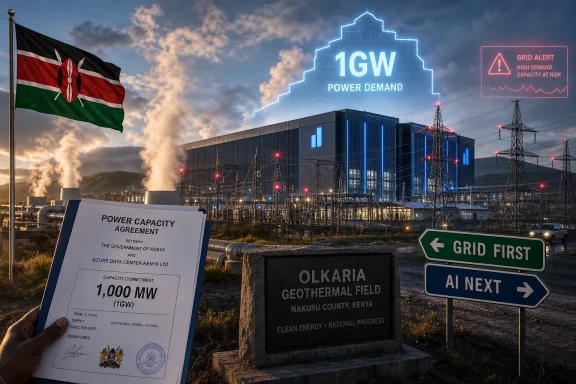
Microsoft and G42’s planned $1 billion geothermal-powered AI data center in Kenya has stalled in May 2026 after the Kenyan government declined to guarantee the electricity capacity and payments needed to support the project at full scale. The blockage is not a local procurement hiccup; it is a preview of the next phase of the AI buildout, where cloud regions are negotiated as much with grid operators and finance ministries as with developers. Kenya was supposed to be the elegant version of the story: renewable power, regional cloud access, geopolitical alignment, and a flagship African AI campus. Instead, the project has become a blunt reminder that “green” electricity is still electricity, and hyperscale demand can overwhelm even a country with unusually strong renewable credentials.
The phrase that made the story travel was Kenyan President William Ruto’s warning that powering the full-scale data center could require shutting off “half the country.” That line is politically theatrical, but it is not technologically absurd. A 1 gigawatt data center campus would be enormous anywhere; in a country whose installed generation capacity is measured at roughly three times that figure, it becomes a national planning problem.
That is the part of the AI boom that vendors have preferred to discuss in abstractions. “Capacity” sounds like a cloud term until it means substations, turbines, transmission lines, payment guarantees, and the possibility that ordinary consumers may be asked to subsidize the reserve margin for foreign-owned compute. Kenya’s government appears to have understood the offer not simply as a technology investment, but as a demand for a public guarantee against a private project’s appetite.
The project’s initial phase was reportedly designed around 100 megawatts, already a serious power draw. The long-term ambition, however, was the figure that changed the politics: 1 gigawatt. That is not a data hall; it is an industrial load comparable to a major smelter, a cluster of factories, or a small city.
The tension is especially sharp because Kenya is not an energy laggard by regional standards. Its geothermal resources are real, its grid is cleaner than many richer countries’ grids, and Olkaria is one of the most plausible places in Africa to pitch a renewable data center campus. If the arithmetic is difficult there, it will be harder almost everywhere else.
The choice of Olkaria mattered. Kenya’s Rift Valley geothermal fields are among the country’s strongest energy assets, and geothermal power offers something solar and wind cannot always provide: steady baseload generation. For a data center operator, that is gold. For a government trying to sell digital transformation without embracing diesel generators, it is politically useful.
The project also fit Microsoft’s wider strategic moment. The company’s cloud and AI business is in a capacity race with Amazon, Google, Oracle, and a growing cast of sovereign AI backers. Microsoft does not merely need more data centers; it needs them in more regions, closer to customers, regulators, developers, and future AI workloads.
For East Africa, a local Azure region would have been more than a branding exercise. Latency matters for some services, data residency matters for governments and regulated industries, and local cloud infrastructure can help build an ecosystem around startups, public-sector modernization, fintech, healthcare, and education. In that sense, the Kenya plan was a serious piece of digital infrastructure policy, not just a trophy campus.
But the clean story always depended on a harder promise: that the country could produce, reserve, and finance enough power for the project without distorting the rest of the economy. That promise is now the point of dispute.
Capacity guarantees can be rational. If a government wants a private company to anchor a new industrial corridor, it may need to provide long-term certainty. Power plants and transmission lines are not built on vibes; they are financed against contracts, demand forecasts, and bankable commitments.
But guarantees can also become a quiet transfer of risk. If the state promises payments or reserved capacity and the project ramps slowly, underperforms, changes scope, or becomes politically unpopular, taxpayers may still be on the hook. If the grid expands around a hyperscaler’s needs, the public may effectively become the backstop for a private AI strategy.
That is why Kenya’s refusal matters. It suggests the government is not rejecting the idea of becoming a cloud hub, but it is resisting the terms under which that transformation is financed. John Tanui, principal secretary in the Ministry of Information, has reportedly said the project has not failed or been withdrawn and still needs further structuring. That phrasing is diplomatic, but it says enough: the original structure did not survive contact with the grid.
For Microsoft and G42, the issue is equally blunt. AI data centers cannot be built on aspirational power. The servers, cooling systems, redundancy, and networking gear only become useful when electrons are available continuously and predictably. A cloud region that cannot be powered is not a region; it is a press release with a land parcel.
At the full 1 gigawatt scale, the data center would represent an extraordinary share of Kenya’s current electricity system. Even the 100 megawatt initial phase would be visible inside the national load curve, especially if concentrated near geothermal assets that already serve other customers. The question is not whether the electrons are renewable. The question is whether they are available, deliverable, and politically defensible.
The “half the country” remark captures a real public-policy problem: electricity systems are built around peak demand, reserve margins, and reliability obligations. A new always-on industrial customer can force the state to accelerate generation, transmission, and grid-balancing investments. If those upgrades are funded well and shared broadly, the country benefits. If they are rushed or poorly contracted, the country inherits fragility.
Kenya’s leaders also have to consider the optics of abundance for machines amid scarcity for people. A hyperscale AI facility may create skilled jobs, local procurement, tax revenue, and cloud access, but it does not employ people at the scale of traditional manufacturing. To many citizens, a gigawatt-scale data center can look like a foreign machine room receiving priority over homes, farms, factories, and small businesses.
That does not mean the project is doomed. It means the next version will probably need a more explicit bargain: phased capacity, dedicated generation, grid upgrades, transparent tariff treatment, and safeguards against passing disproportionate costs to ordinary consumers. The politics of AI infrastructure are becoming the politics of energy allocation.
G42’s agreement to reduce exposure to Chinese holdings and remove Huawei equipment from parts of its infrastructure helped make the Microsoft partnership politically viable in Washington. In return, Microsoft gained a strategic partner with deep capital ties and ambitions beyond the UAE. Kenya was a natural showcase: a project in Africa, built around renewable energy, tied to Azure, and symbolically aligned with a U.S.-friendly technology stack.
That is why the stall is more than a local setback. If Microsoft and G42 cannot make the Kenya model work under relatively favorable renewable-power conditions, it raises questions about how easily this partnership can replicate sovereign AI infrastructure across other emerging markets. Money can announce a data center. It cannot instantly produce transmission capacity.
The Huawei subplot sharpens the point. While Microsoft and G42 pursue a cloud-and-AI campus constrained by national power economics, Huawei continues to deepen its African telecommunications footprint through fiber, mobile, and carrier relationships. Those are different layers of the technology stack, but they compete for influence, standards, procurement familiarity, and political trust.
Microsoft’s advantage is cloud credibility and enterprise depth. Huawei’s advantage is years of embedded infrastructure work across telecom markets. The Kenya data center was meant to show that the Microsoft-G42 axis could deliver not only capital but sovereign-grade infrastructure. The pause gives rivals time and gives governments a reason to ask harder questions.
AI has changed the data center business because training and inference workloads are denser, hotter, and more power-hungry than many traditional cloud workloads. A conventional enterprise cloud region could grow with broad demand. AI campuses increasingly arrive as concentrated industrial loads, designed around accelerator clusters and high-utilization compute. The grid sees them not as “digital services” but as very large customers that want reliable power now.
That shift exposes a mismatch between software timelines and energy timelines. Microsoft can deploy a new model, package a Copilot feature, or redirect capital expenditure in quarters. Power systems are planned in years and decades. Transmission lines require permits, land rights, public hearings, equipment orders, and political patience.
This is why “green data center” claims deserve scrutiny. Renewable sourcing can reduce emissions, but it does not erase grid impact. If a hyperscaler buys up clean baseload power that would otherwise serve the public grid, the system may still need replacement generation elsewhere. If new renewable capacity is built specifically for the facility, the question becomes who pays for the grid reinforcement that makes it reliable.
Kenya’s geothermal resource is attractive precisely because it is stable. That also makes it valuable to everyone else. In a country trying to expand industry, electrify more activity, stabilize costs, and improve reliability, dedicating a major chunk of dependable power to AI compute is not a purely environmental choice. It is an economic allocation decision.
A serious East Africa Azure region would therefore have practical value. It could help banks, public agencies, universities, hospitals, developers, and regional businesses build services closer to users. It could also reduce dependence on routing sensitive workloads through Europe, South Africa, or the Middle East.
But cloud regions do not automatically create digital sovereignty. If the power contract is opaque, the cloud platform foreign-owned, the AI stack externally governed, and the economics tilted toward serving global workloads, the host country may receive less sovereignty than advertised. It may get infrastructure on its soil without full control over the priorities that infrastructure serves.
That is the uncomfortable balance Kenya is trying to strike. The country wants investment and regional leadership, but it also has to avoid becoming a cheap power-and-land platform for someone else’s AI race. A data center can be a national asset if it anchors skills, services, resilience, and local value creation. It can be a national burden if it consumes scarce power while most of the high-margin value accrues offshore.
The right question is not whether Africa needs more data centers. It does. The better question is what kind of data centers, under what contracts, powered by what new infrastructure, and serving whose workloads.
The Kenya proposal was designed to fit the cleaner side of that narrative. Geothermal power is an easier sell than coal-backed capacity. A new African cloud region is easier to defend than another contested campus in an already saturated U.S. data center corridor. The project could be framed as both development and decarbonization.
But climate-friendly sourcing does not solve the politics of scarcity. If a project requires government-backed capacity assurances at a scale that alarms national leaders, the sustainability label is not enough. A renewable megaproject can still be extractive if it captures scarce infrastructure without building enough shared capacity around it.
For Microsoft, this is a reputational risk as much as a logistical one. The company wants to be seen as the responsible hyperscaler: enterprise-trusted, security-conscious, climate-aware, and globally engaged. A story about an AI data center that could consume a staggering share of a developing country’s power supply cuts against that positioning, even if the actual engineering plan is more nuanced than the headline.
The company’s best defense would be a revised structure that visibly expands Kenya’s grid rather than merely reserving it. That means additional generation, transmission investment, local workforce development, clear public benefits, and a phased ramp that aligns with national capacity growth. Anything less will look like the cloud asking the state to clear the runway for private compute.
The difficulty is that governments have learned to read the fine print. A small first phase can create pressure for later concessions. Once land, fiber, political capital, and initial power arrangements are committed, future expansions become harder to refuse. The host country may find itself negotiating from a weaker position after the anchor tenant is already embedded.
That is why Kenya’s pause is rational. It gives the state a chance to ask whether the first 100 megawatts are truly the first step in a mutually beneficial industrial strategy or the opening wedge for a much larger obligation. It also gives officials leverage to demand that any expansion be tied to new generation rather than existing public supply.
The existence of a separate 60 megawatt data center discussion involving local developer EcoCloud further complicates the allocation picture. Kenya is not evaluating one isolated project; it is deciding how much of its next wave of electricity growth should be reserved for digital infrastructure. If every project arrives with a promise of transformation and a demand for preferential power treatment, the grid becomes the battlefield.
The practical compromise may be a slower, more modular buildout. Microsoft and G42 could get a smaller cloud region online, prove demand, fund dedicated power additions, and scale only as the national system grows. That would be less cinematic than a gigawatt AI campus, but it would be more politically durable.
Governments will increasingly ask for a clearer exchange. If a hyperscaler wants reserved power, what does the country receive beyond construction spending and cloud availability? If the state helps finance grid upgrades, does it gain cheaper public-sector cloud access, training programs, research capacity, local procurement, or guaranteed service for domestic customers? If the data center supports AI workloads, are those workloads primarily local or global?
These questions will be especially important in countries where electricity access, reliability, or affordability remain politically sensitive. A minister cannot easily defend blackouts or tariff hikes by saying the country now has a world-class AI campus. The public will ask whether that campus made their lives better.
There is also a security dimension. Data centers hosting government workloads, financial systems, AI models, and regional cloud services become strategic assets. Their ownership, supply chain, power dependencies, and geopolitical alignments matter. Microsoft and G42 may offer a Western-aligned alternative to Chinese infrastructure, but that does not eliminate the need for sovereign oversight.
The lesson for hyperscalers is simple: the next billion-dollar cloud deal must be sold as infrastructure policy, not just technology investment. The countries hosting these projects will demand evidence that the grid, the economy, and the public share in the upside.
AI is turning cloud infrastructure into a physical supply-chain business again. GPUs get the attention, but the limiting factors increasingly include transformers, substations, water systems, fiber routes, permitting, and long-term power contracts. The cloud is still someone else’s computer; now it is also someone else’s grid connection.
That matters for enterprise planning. Organizations adopting Azure AI services may assume cloud capacity will appear wherever Microsoft’s roadmap says it will. But regional availability is becoming more contingent. A service may exist in one geography and lag in another because the bottleneck is not software readiness but power delivery.
It also matters for public-sector and regulated customers in emerging markets. A local cloud region can be transformative, but only if it is reliable, affordable, and politically stable. If the surrounding infrastructure deal becomes controversial, customers may hesitate to build critical workloads around it.
Microsoft’s Kenya problem is therefore not an isolated embarrassment. It is a signal that the AI platform race is constrained by national infrastructure politics. The winners will not simply be the companies with the best models or developer tools. They will be the companies that can make durable bargains with power systems.
Source: Ubergizmo Microsoft’s Massive Kenya AI Data Center Blocked By ‘Half the Country’ Power Demand
 The Cloud Has Run Into the Grid
The phrase that made the story travel was Kenyan President William Ruto’s warning that powering the full-scale data center could require shutting off “half the country.” That line is politically theatrical, but it is not technologically absurd. A 1 gigawatt data center campus would be enormous anywhere; in a country whose installed generation capacity is measured at roughly three times that figure, it becomes a national planning problem.That is the part of the AI boom that vendors have preferred to discuss in abstractions. “Capacity” sounds like a cloud term until it means substations, turbines, transmission lines, payment guarantees, and the possibility that ordinary consumers may be asked to subsidize the reserve margin for foreign-owned compute. Kenya’s government appears to have understood the offer not simply as a technology investment, but as a demand for a public guarantee against a private project’s appetite.
The project’s initial phase was reportedly designed around 100 megawatts, already a serious power draw. The long-term ambition, however, was the figure that changed the politics: 1 gigawatt. That is not a data hall; it is an industrial load comparable to a major smelter, a cluster of factories, or a small city.
The tension is especially sharp because Kenya is not an energy laggard by regional standards. Its geothermal resources are real, its grid is cleaner than many richer countries’ grids, and Olkaria is one of the most plausible places in Africa to pitch a renewable data center campus. If the arithmetic is difficult there, it will be harder almost everywhere else.
Microsoft’s East Africa Bet Was Supposed to Be the Clean Version of AI Expansion
When Microsoft and Abu Dhabi-based G42 announced the Kenya project in May 2024, the pitch had nearly every ingredient a modern hyperscaler wants attached to a new region. It would be a billion-dollar investment, it would rely on geothermal energy, it would support a new Microsoft Azure cloud region for East Africa, and it would give Kenya a symbolic place in the global AI infrastructure map.The choice of Olkaria mattered. Kenya’s Rift Valley geothermal fields are among the country’s strongest energy assets, and geothermal power offers something solar and wind cannot always provide: steady baseload generation. For a data center operator, that is gold. For a government trying to sell digital transformation without embracing diesel generators, it is politically useful.
The project also fit Microsoft’s wider strategic moment. The company’s cloud and AI business is in a capacity race with Amazon, Google, Oracle, and a growing cast of sovereign AI backers. Microsoft does not merely need more data centers; it needs them in more regions, closer to customers, regulators, developers, and future AI workloads.
For East Africa, a local Azure region would have been more than a branding exercise. Latency matters for some services, data residency matters for governments and regulated industries, and local cloud infrastructure can help build an ecosystem around startups, public-sector modernization, fintech, healthcare, and education. In that sense, the Kenya plan was a serious piece of digital infrastructure policy, not just a trophy campus.
But the clean story always depended on a harder promise: that the country could produce, reserve, and finance enough power for the project without distorting the rest of the economy. That promise is now the point of dispute.
The Capacity Payment Fight Is the Real Story
The disagreement over guaranteed annual capacity payments sounds technical, but it goes to the heart of who carries the risk when AI infrastructure arrives before the grid is ready. A hyperscale data center needs confidence that power will be available when servers arrive. A government needs confidence that it is not locking public finances into an obligation that benefits a narrow set of investors while households and businesses face higher costs or constrained supply.Capacity guarantees can be rational. If a government wants a private company to anchor a new industrial corridor, it may need to provide long-term certainty. Power plants and transmission lines are not built on vibes; they are financed against contracts, demand forecasts, and bankable commitments.
But guarantees can also become a quiet transfer of risk. If the state promises payments or reserved capacity and the project ramps slowly, underperforms, changes scope, or becomes politically unpopular, taxpayers may still be on the hook. If the grid expands around a hyperscaler’s needs, the public may effectively become the backstop for a private AI strategy.
That is why Kenya’s refusal matters. It suggests the government is not rejecting the idea of becoming a cloud hub, but it is resisting the terms under which that transformation is financed. John Tanui, principal secretary in the Ministry of Information, has reportedly said the project has not failed or been withdrawn and still needs further structuring. That phrasing is diplomatic, but it says enough: the original structure did not survive contact with the grid.
For Microsoft and G42, the issue is equally blunt. AI data centers cannot be built on aspirational power. The servers, cooling systems, redundancy, and networking gear only become useful when electrons are available continuously and predictably. A cloud region that cannot be powered is not a region; it is a press release with a land parcel.
Kenya Is Not Saying No to AI, It Is Saying the Grid Comes First
It would be easy to frame the standoff as a developing country turning away a transformative investment. That reading is too simple. Kenya’s dilemma is not whether AI infrastructure is desirable; it is whether a megaproject should be allowed to jump the queue ahead of national power planning.At the full 1 gigawatt scale, the data center would represent an extraordinary share of Kenya’s current electricity system. Even the 100 megawatt initial phase would be visible inside the national load curve, especially if concentrated near geothermal assets that already serve other customers. The question is not whether the electrons are renewable. The question is whether they are available, deliverable, and politically defensible.
The “half the country” remark captures a real public-policy problem: electricity systems are built around peak demand, reserve margins, and reliability obligations. A new always-on industrial customer can force the state to accelerate generation, transmission, and grid-balancing investments. If those upgrades are funded well and shared broadly, the country benefits. If they are rushed or poorly contracted, the country inherits fragility.
Kenya’s leaders also have to consider the optics of abundance for machines amid scarcity for people. A hyperscale AI facility may create skilled jobs, local procurement, tax revenue, and cloud access, but it does not employ people at the scale of traditional manufacturing. To many citizens, a gigawatt-scale data center can look like a foreign machine room receiving priority over homes, farms, factories, and small businesses.
That does not mean the project is doomed. It means the next version will probably need a more explicit bargain: phased capacity, dedicated generation, grid upgrades, transparent tariff treatment, and safeguards against passing disproportionate costs to ordinary consumers. The politics of AI infrastructure are becoming the politics of energy allocation.
G42 Adds a Geopolitical Layer Microsoft Cannot Wish Away
The Kenya project was also the first major test of Microsoft’s partnership with G42 after Microsoft’s $1.5 billion investment in the Abu Dhabi AI company. That deal was never just commercial. It sat at the intersection of U.S. export controls, Gulf sovereign AI ambitions, Chinese technology influence, and Microsoft’s need for partners that can move capital and infrastructure quickly.G42’s agreement to reduce exposure to Chinese holdings and remove Huawei equipment from parts of its infrastructure helped make the Microsoft partnership politically viable in Washington. In return, Microsoft gained a strategic partner with deep capital ties and ambitions beyond the UAE. Kenya was a natural showcase: a project in Africa, built around renewable energy, tied to Azure, and symbolically aligned with a U.S.-friendly technology stack.
That is why the stall is more than a local setback. If Microsoft and G42 cannot make the Kenya model work under relatively favorable renewable-power conditions, it raises questions about how easily this partnership can replicate sovereign AI infrastructure across other emerging markets. Money can announce a data center. It cannot instantly produce transmission capacity.
The Huawei subplot sharpens the point. While Microsoft and G42 pursue a cloud-and-AI campus constrained by national power economics, Huawei continues to deepen its African telecommunications footprint through fiber, mobile, and carrier relationships. Those are different layers of the technology stack, but they compete for influence, standards, procurement familiarity, and political trust.
Microsoft’s advantage is cloud credibility and enterprise depth. Huawei’s advantage is years of embedded infrastructure work across telecom markets. The Kenya data center was meant to show that the Microsoft-G42 axis could deliver not only capital but sovereign-grade infrastructure. The pause gives rivals time and gives governments a reason to ask harder questions.
The AI Boom Is Repricing Electricity Everywhere
Kenya’s grid problem is dramatic because the percentages are dramatic, but the underlying constraint is global. In the United States, Europe, and parts of Asia, data center developers are already colliding with interconnection queues, local opposition, water constraints, power purchase bottlenecks, and utility planning cycles that move slower than AI demand forecasts.AI has changed the data center business because training and inference workloads are denser, hotter, and more power-hungry than many traditional cloud workloads. A conventional enterprise cloud region could grow with broad demand. AI campuses increasingly arrive as concentrated industrial loads, designed around accelerator clusters and high-utilization compute. The grid sees them not as “digital services” but as very large customers that want reliable power now.
That shift exposes a mismatch between software timelines and energy timelines. Microsoft can deploy a new model, package a Copilot feature, or redirect capital expenditure in quarters. Power systems are planned in years and decades. Transmission lines require permits, land rights, public hearings, equipment orders, and political patience.
This is why “green data center” claims deserve scrutiny. Renewable sourcing can reduce emissions, but it does not erase grid impact. If a hyperscaler buys up clean baseload power that would otherwise serve the public grid, the system may still need replacement generation elsewhere. If new renewable capacity is built specifically for the facility, the question becomes who pays for the grid reinforcement that makes it reliable.
Kenya’s geothermal resource is attractive precisely because it is stable. That also makes it valuable to everyone else. In a country trying to expand industry, electrify more activity, stabilize costs, and improve reliability, dedicating a major chunk of dependable power to AI compute is not a purely environmental choice. It is an economic allocation decision.
Africa’s Cloud Gap Is Real, But So Is the Infrastructure Gap
Africa’s tiny share of global data center capacity is a problem. The continent has young populations, fast-growing digital services, major fintech adoption, and governments that increasingly want local data processing. Depending on distant cloud regions can mean higher latency, higher costs, regulatory complications, and weaker local technical ecosystems.A serious East Africa Azure region would therefore have practical value. It could help banks, public agencies, universities, hospitals, developers, and regional businesses build services closer to users. It could also reduce dependence on routing sensitive workloads through Europe, South Africa, or the Middle East.
But cloud regions do not automatically create digital sovereignty. If the power contract is opaque, the cloud platform foreign-owned, the AI stack externally governed, and the economics tilted toward serving global workloads, the host country may receive less sovereignty than advertised. It may get infrastructure on its soil without full control over the priorities that infrastructure serves.
That is the uncomfortable balance Kenya is trying to strike. The country wants investment and regional leadership, but it also has to avoid becoming a cheap power-and-land platform for someone else’s AI race. A data center can be a national asset if it anchors skills, services, resilience, and local value creation. It can be a national burden if it consumes scarce power while most of the high-margin value accrues offshore.
The right question is not whether Africa needs more data centers. It does. The better question is what kind of data centers, under what contracts, powered by what new infrastructure, and serving whose workloads.
Microsoft’s Climate Math Now Has a Capacity Problem Attached
Microsoft has spent years telling a story in which cloud scale, clean energy procurement, and corporate climate commitments can coexist. The AI boom has made that story harder. The company’s emissions and electricity demands have come under greater scrutiny as it races to build infrastructure for Azure and Copilot workloads.The Kenya proposal was designed to fit the cleaner side of that narrative. Geothermal power is an easier sell than coal-backed capacity. A new African cloud region is easier to defend than another contested campus in an already saturated U.S. data center corridor. The project could be framed as both development and decarbonization.
But climate-friendly sourcing does not solve the politics of scarcity. If a project requires government-backed capacity assurances at a scale that alarms national leaders, the sustainability label is not enough. A renewable megaproject can still be extractive if it captures scarce infrastructure without building enough shared capacity around it.
For Microsoft, this is a reputational risk as much as a logistical one. The company wants to be seen as the responsible hyperscaler: enterprise-trusted, security-conscious, climate-aware, and globally engaged. A story about an AI data center that could consume a staggering share of a developing country’s power supply cuts against that positioning, even if the actual engineering plan is more nuanced than the headline.
The company’s best defense would be a revised structure that visibly expands Kenya’s grid rather than merely reserving it. That means additional generation, transmission investment, local workforce development, clear public benefits, and a phased ramp that aligns with national capacity growth. Anything less will look like the cloud asking the state to clear the runway for private compute.
The First Phase May Be Plausible, but the Gigawatt Dream Is the Political Problem
A 100 megawatt first phase is not trivial, but it is at least imaginable with careful planning. Large data center campuses often grow in stages, and developers routinely announce long-term power envelopes that may take many years to fill. If Kenya, Microsoft, G42, and local energy partners can isolate the first phase from the larger 1 gigawatt anxiety, the project may still move forward.The difficulty is that governments have learned to read the fine print. A small first phase can create pressure for later concessions. Once land, fiber, political capital, and initial power arrangements are committed, future expansions become harder to refuse. The host country may find itself negotiating from a weaker position after the anchor tenant is already embedded.
That is why Kenya’s pause is rational. It gives the state a chance to ask whether the first 100 megawatts are truly the first step in a mutually beneficial industrial strategy or the opening wedge for a much larger obligation. It also gives officials leverage to demand that any expansion be tied to new generation rather than existing public supply.
The existence of a separate 60 megawatt data center discussion involving local developer EcoCloud further complicates the allocation picture. Kenya is not evaluating one isolated project; it is deciding how much of its next wave of electricity growth should be reserved for digital infrastructure. If every project arrives with a promise of transformation and a demand for preferential power treatment, the grid becomes the battlefield.
The practical compromise may be a slower, more modular buildout. Microsoft and G42 could get a smaller cloud region online, prove demand, fund dedicated power additions, and scale only as the national system grows. That would be less cinematic than a gigawatt AI campus, but it would be more politically durable.
The New Cloud Region Bargain Will Be Written in Megawatts
The Kenya standoff shows how the cloud region sales pitch is changing. For years, hyperscalers promised lower latency, local data residency, jobs, startup ecosystems, and public-sector modernization. Those arguments still matter, but they now arrive with a much larger power bill.Governments will increasingly ask for a clearer exchange. If a hyperscaler wants reserved power, what does the country receive beyond construction spending and cloud availability? If the state helps finance grid upgrades, does it gain cheaper public-sector cloud access, training programs, research capacity, local procurement, or guaranteed service for domestic customers? If the data center supports AI workloads, are those workloads primarily local or global?
These questions will be especially important in countries where electricity access, reliability, or affordability remain politically sensitive. A minister cannot easily defend blackouts or tariff hikes by saying the country now has a world-class AI campus. The public will ask whether that campus made their lives better.
There is also a security dimension. Data centers hosting government workloads, financial systems, AI models, and regional cloud services become strategic assets. Their ownership, supply chain, power dependencies, and geopolitical alignments matter. Microsoft and G42 may offer a Western-aligned alternative to Chinese infrastructure, but that does not eliminate the need for sovereign oversight.
The lesson for hyperscalers is simple: the next billion-dollar cloud deal must be sold as infrastructure policy, not just technology investment. The countries hosting these projects will demand evidence that the grid, the economy, and the public share in the upside.
The Kenya Pause Tells IT Leaders Where the Bottleneck Has Moved
For WindowsForum readers, the story may look far away from the daily concerns of Azure tenants, sysadmins, developers, and Windows shops. It is not. The same capacity constraints that stall a Kenyan cloud region also shape where Microsoft can offer services, how quickly AI features scale, what regions get priority, and how cloud pricing evolves.AI is turning cloud infrastructure into a physical supply-chain business again. GPUs get the attention, but the limiting factors increasingly include transformers, substations, water systems, fiber routes, permitting, and long-term power contracts. The cloud is still someone else’s computer; now it is also someone else’s grid connection.
That matters for enterprise planning. Organizations adopting Azure AI services may assume cloud capacity will appear wherever Microsoft’s roadmap says it will. But regional availability is becoming more contingent. A service may exist in one geography and lag in another because the bottleneck is not software readiness but power delivery.
It also matters for public-sector and regulated customers in emerging markets. A local cloud region can be transformative, but only if it is reliable, affordable, and politically stable. If the surrounding infrastructure deal becomes controversial, customers may hesitate to build critical workloads around it.
Microsoft’s Kenya problem is therefore not an isolated embarrassment. It is a signal that the AI platform race is constrained by national infrastructure politics. The winners will not simply be the companies with the best models or developer tools. They will be the companies that can make durable bargains with power systems.
The Kenya Deal Now Has to Earn Its Electrons
The concrete lessons from this stalled project are narrower than the rhetoric and larger than the press release. Kenya has not closed the door on Microsoft and G42, but it has made clear that a gigawatt-scale AI campus cannot be treated as an ordinary foreign investment.- The project was announced as a $1 billion Microsoft-G42 investment in May 2024, centered on a geothermal-powered data center campus in Olkaria for a new East Africa Azure cloud region.
- The current delay turns on power guarantees and capacity-payment demands, not on a public rejection of cloud computing or AI infrastructure.
- The proposed 100 megawatt first phase is large but potentially manageable, while the long-term 1 gigawatt ambition is what makes the project a national grid issue.
- Kenya’s renewable-heavy electricity mix strengthens the case for the campus, but it does not eliminate competition for limited reliable power.
- Microsoft and G42 will likely need to restructure the deal around phased growth, dedicated new generation, grid upgrades, and clearer public benefits.
- The episode foreshadows similar conflicts elsewhere as AI data centers begin to look less like office parks and more like strategic industrial loads.
Source: Ubergizmo Microsoft’s Massive Kenya AI Data Center Blocked By ‘Half the Country’ Power Demand
