

Microsoft’s latest patent filing shows a tactile idea that could make Surface laptops — and possibly future foldables — feel more alive: a closed‑loop, “haptic‑sonic” trackpad that listens to itself and tunes its click so vibration and sound remain consistent as hardware ages or chassis properties change.
Microsoft was issued a patent titled “Computing device with haptic trackpad” (patent number US 12,314,475) that describes a system where a trackpad’s haptic actuator is driven, the resulting sonic output is recorded by the device microphone, and firmware or software compares that sound against a stored target signature to adjust actuator drive signals over time. The patent explicitly calls out using the microphone to detect sonic variance, recalibrate the actuator driving waveform, and — if necessary — fall back to using built‑in speakers or another device to reproduce the expected click sound when the actuator appears degraded. That idea arrives at an interesting moment for Windows: Microsoft is already experimenting with system‑level haptic signals in Windows 11 (Insider builds show hidden controls for “haptic signals” tied to UI actions), and Surface devices since the Copilot+ refresh have included solid‑state haptic trackpads — hardware that could take advantage of a sophisticated calibration system. The OS‑side groundwork and the hardware patent together sketch a practical path from laboratory patent to a shipped Surface feature — but there are important caveats and trade‑offs that deserve scrutiny.
Microsoft’s patent aims at a complementary problem space: maintaining consistent sonic/haptic output over time and varying chassis conditions by listening and self‑tuning. This is not identical to Apple’s pressure‑sensing focus, but it targets the same user perception axis — consistent, premium click feedback. Where Apple invests heavily in actuator tuning and integrated hardware design, the Microsoft approach adds a closed‑loop acoustic sensor layer to keep actuators in line. Both are sophisticated; the difference is that Microsoft’s patent leans on audio sensing and dynamic adjustment as the core mechanism.
Key risks and mitigations:
That said, patents are design recipes, not finished products. The real test is engineering quality, QA across different chassis and hinge designs, handling privacy and meeting scenarios, and delivering consistent cross‑device behavior without battery or noise penalties. If Microsoft addresses those practicalities — and builds open APIs so developers and OEMs can follow — the sonic‑calibrated trackpad could be a meaningful UX innovation for Windows hardware.
For now, the patent is a signal: Microsoft is thinking beyond raw actuator power and into acoustic sensing, calibration, and perception‑level consistency. The path from patent to polished Surface feature will require careful firmware design, clear user controls, and a commitment to privacy and enterprise manageability before it becomes a routine part of Windows laptop life.
Conclusion
Microsoft’s “haptic‑sonic” trackpad patent outlines a technically interesting, sensor‑augmented approach to keep click feel consistent over a device’s life, and it pairs naturally with the OS‑level haptics work in Windows 11 and current Surface hardware. The concept could challenge Apple’s dominance in trackpad polish — but only if Microsoft moves beyond the patent, ships robust firmware and drivers, and addresses privacy and enterprise controls. The next milestones to watch are Windows Insider behavior, Surface firmware notes, and independent reviews when hardware ships.
Source: Windows Latest Microsoft's patented 'sonic' trackpad for Surface Laptop could challenge Apple MacBook's Force Touch
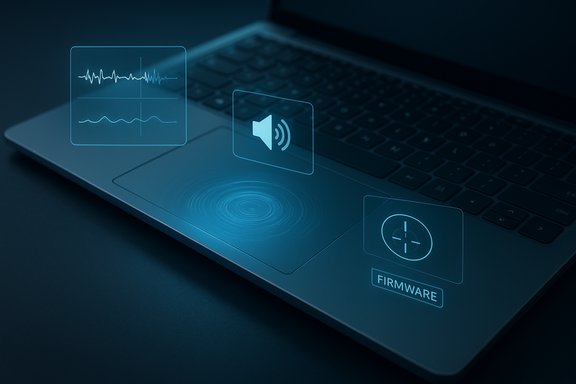 Background / Overview
Microsoft was issued a patent titled “Computing device with haptic trackpad” (patent number US 12,314,475) that describes a system where a trackpad’s haptic actuator is driven, the resulting sonic output is recorded by the device microphone, and firmware or software compares that sound against a stored target signature to adjust actuator drive signals over time. The patent explicitly calls out using the microphone to detect sonic variance, recalibrate the actuator driving waveform, and — if necessary — fall back to using built‑in speakers or another device to reproduce the expected click sound when the actuator appears degraded. That idea arrives at an interesting moment for Windows: Microsoft is already experimenting with system‑level haptic signals in Windows 11 (Insider builds show hidden controls for “haptic signals” tied to UI actions), and Surface devices since the Copilot+ refresh have included solid‑state haptic trackpads — hardware that could take advantage of a sophisticated calibration system. The OS‑side groundwork and the hardware patent together sketch a practical path from laboratory patent to a shipped Surface feature — but there are important caveats and trade‑offs that deserve scrutiny. What the patent actually claims: a practical summary
The closed‑loop sonic calibration idea
- A laptop or computing device contains:
- a trackpad with a haptic actuator (piezo or similar),
- one or more microphones,
- a processor and firmware that store a target sonic signature for “healthy” trackpad clicks.
- When the trackpad is actuated, the microphone records the resulting sonic output (the patent calls this a “trackpad sonic output”).
- The device computes a sonic variance by comparing the recorded sound against the stored target.
- Based on that variance, the firmware adjusts the driving signal (waveform, amplitude, timing) for the haptic actuator to nudge the produced sound and feel back toward the target.
Fallbacks and redundancy
- If the system deems the actuator’s sonic output too degraded (below decibel thresholds or in certain frequency ranges), the patent allows the system to:
- use the device’s speaker(s) to reproduce the click sound, and/or
- activate haptics or speakers on a connected external device to supply the missing audio/haptic cue.
- The idea is to preserve consistent user experience even if mechanical tolerances shift (wear, drops, chassis flex), by either tuning the actuator or substituting audio/haptic signals from other transducers.
Dates and provenance
- The patent application was filed with priority claims in 2024 and the U.S. patent grant is recorded with publication/issue metadata in 2025. Public patent records (Google Patents and patent registries) show the filing and grant metadata and the core claims described above. These documents are the primary, verifiable record of the invention as claimed.
How this could work in real hardware
The signal path (simplified)
- OS/firmware triggers a haptic waveform to the actuator for a given user event (click, tap, UI feedback).
- The actuator vibrates the trackpad and the mechanical motion produces both tactile sensation and a faint acoustic waveform transmitted through the chassis.
- Onboard microphones capture the acoustic signature (the “sonic output”).
- Firmware measures differences vs. the stored target signature and modifies the waveform parameters (timing, frequency components, amplitude).
- Optionally, if calibration cannot recover a satisfactory match, the OS/firmware triggers speaker audio or external haptics as a fallback.
Why Microsoft would want this
- Consistent UX: Haptic sensations are part of the product’s perceived quality; small changes in vibration or sound can make a once‑premium trackpad feel cheap.
- Manufacturing tolerance leniency: Closed‑loop tuning can reduce QA rejects or allow looser mechanical tolerances while still delivering a target sensation.
- Longer perceived lifespan: Users who feel the trackpad “still clicks right” are less likely to request warranty service or believe their device degraded.
- Feature differentiation: If implemented well, a trackpad that keeps its signature “click” across years becomes a Surface talking point against competitors, including Apple’s Force Touch. Patent text explicitly describes this benefit path.
How this compares to Apple’s Force Touch and other haptic approaches
Force Touch / Taptic Engine baseline
Apple’s Force Touch (and subsequent Force Touch‑derived implementations) replaced mechanical travel with actuators (the Taptic Engine) and pressure sensing, delivering a consistent “click” sensation and enabling pressure‑sensitive actions. Apple’s implementation is widely credited with raising the UX bar for trackpads by combining reliable force sensing with tight firmware control.Microsoft’s patent aims at a complementary problem space: maintaining consistent sonic/haptic output over time and varying chassis conditions by listening and self‑tuning. This is not identical to Apple’s pressure‑sensing focus, but it targets the same user perception axis — consistent, premium click feedback. Where Apple invests heavily in actuator tuning and integrated hardware design, the Microsoft approach adds a closed‑loop acoustic sensor layer to keep actuators in line. Both are sophisticated; the difference is that Microsoft’s patent leans on audio sensing and dynamic adjustment as the core mechanism.
Other approaches in the PC ecosystem
- Third‑party peripherals and some OEMs already expose haptic actuators and vendor tools for tuning, and Windows peripherals such as high‑end mice show vendor‑level haptics today. That means platform‑level haptic signals in Windows 11 could route both to internal trackpads and to capable external devices. Microsoft’s patent goes further by using microphones and speaker fallback logic to preserve the audio/tactile identity.
Windows platform readiness: the OS side of the story
Microsoft’s operating system has been moving toward richer input feedback. Insider builds of Windows 11 have surfaced a hidden “Haptic signals” setting that suggests system‑wide haptic cues for UI actions (snap windows, align objects, etc., plus granular intensity controls. That system‑level plumbing — combined with vendor drivers that expose haptic primitives — is precisely the kind of platform support a smart trackpad would need to make the experience consistent across apps and system events. The platform aspects to watch:- Driver/firmware APIs: Windows needs a standard way to address haptic primitives (pulse, envelope, frequency). Fragmented or proprietary drivers will produce inconsistent UX.
- User controls & accessibility: Global toggles, per‑app opt‑outs and intensity sliders are essential; early strings in Windows Insider builds indicate Microsoft is already thinking along these lines.
- Privacy & microphone use policy: If microphones are used for calibration, OS and firmware must honor privacy modes, recording indicators, and policies that prevent microphone use in sensitive contexts — more on that below.
Use cases beyond clamshell laptops: foldables and other form factors
The patent text explicitly mentions broader device classes — including a “foldable” computing device — though it does not detail the UX design for foldables. That raises interesting possibilities and practical questions.Why foldables are challenging and interesting
- Foldable chassis change mechanical coupling between trackpad surfaces and the rest of the device as hinges move and structural stiffness varies. A calibration system that listens to the acoustic response could adapt haptic drive parameters depending on hinge angle or closed/open state.
- Foldable designs may also integrate multiple haptic transducers in separate modules (keyboard base, tablet surface) that could be orchestrated so the perceived cue remains consistent despite changing mechanical coupling.
Practical unknowns
- The patent describes the capability; it does not demonstrate a shipped foldable Surface that uses it. Patent filing is an early step and does not guarantee productization, timing, or final engineering choices.
- Foldable designs introduce new acoustic paths (hinge cavities, variable seals) that could complicate microphone‑based measurement unless firmware also accounts for hinge position and other mechanical metadata. The patent notes these mechanical variance challenges, but field deployment will be more complex than the on‑paper description.
Privacy, audio artifacts and risk assessment
Using microphones to listen to hardware raises immediate privacy and UX concerns. The patent addresses the microphone as a sensor to measure the device’s own sonic signature — but shipping this feature requires careful design to avoid misuse or surprising behavior.Key risks and mitigations:
- Perceived “always listening” fear: Users must be able to trust that microphone use is local, transient, and confined to calibration windows. Transparent UI indicators and clear documentation are essential.
- Accidental recordings: Calibration algorithms must avoid storing or processing speech content. The patent frames measurement in terms of waveform characteristics (levels, frequency bands) not intelligible content, but implementers must enforce strict audio data processing boundaries.
- Audio cross‑talk in meetings: Haptic actuators produce audible artifacts during meetings; compensatory policies (mute calibration during active calls, low‑intensity operation) will be necessary to avoid audible pops.
- Security oversight: Enterprises will require MDM policies to disable microphone‑based calibration if corporate policy forbids microphone use. Microsoft and OEMs should provide Group Policy controls or firmware toggles.
- Energy & battery: Continual sensing and additional speaker playback in fallback mode consume power; the system needs conservative duty cycles and sensible defaults in battery modes.
Developer and OEM implications
For this idea to be valuable beyond a patent, three things must happen in the ecosystem:- Standardized haptic primitives and driver models: Windows must expose a stable API so apps and the shell can request haptic patterns in a device‑agnostic way.
- OEM firmware cooperation: Hardware vendors must ship actuators that expose the required diagnostic hooks, and firmware teams must implement safe calibration loops.
- App design and accessibility: Developers should respect global haptic settings, offer per‑app toggles, and use haptics for meaningful, not noisy, feedback.
Where Microsoft’s claim strengthens or risks its position vs. Apple
Strengths:- Closed‑loop calibration is novel and pragmatic: Rather than relying solely on static hardware tuning, the system adapts; that reduces the long‑term degradation problem and could deliver a “still clicks like new” story.
- Fallback flexibility: Using speakers or external devices as audio/haptic proxies is clever and could keep the UX consistent even when actuators degrade.
- Platform timing: Microsoft is already planting haptic UX plumbing in Windows 11 and shipping haptic‑capable Surfaces; the timing is conducive to a coordinated hardware and software rollout.
- Patent ≠ product: A granted patent documents an invention; it does not guarantee the feature will ship, nor that it will be stable, performant, or free of side effects in the field. Engineering realities (noise, microphone sensitivity, meeting interference) can delay or change the design.
- Privacy & enterprise pushback: Companies with strict microphone policies may block microphone‑based calibration, reducing effectiveness in corporate fleets.
- Fragmentation: Without open standards and consistent drivers, haptic experiences could remain uneven across OEMs and peripherals.
- Audio fidelity dependence: Microphone‑based measurement requires predictable acoustic paths; devices with different materials and assembly quality will respond differently and may need per‑SKU tuning.
What to watch next (practical checklist)
- Insider builds & driver updates: Track Windows Insider releases for the “Haptic signals” UI to mature from hidden strings to active controls. That will show Microsoft’s software commitment.
- Surface firmware/driver changelogs: Look for firmware that exposes microphone‑based calibration or explicit haptic diagnostics in Surface firmware notes.
- OEM adoption: If other PC makers (Dell, Lenovo, HP) start listing microphone‑assisted haptic calibration in their spec or firmware notes, the idea is moving beyond a Microsoft‑only patent.
- User documentation & privacy controls: Release notes or support docs describing how and when the microphone is used, and how to opt out, will be essential to public trust.
- Independent reviews: Hands‑on testing should validate whether the system actually makes the click feel more consistent and whether speaker fallback is audible or intrusive.
Final analysis: potential, caution, and market impact
Microsoft’s haptic‑sonic trackpad patent is a clever, engineering‑driven response to a real product problem: how to maintain tactile quality across manufacturing variance and device aging. The closed‑loop idea is technically sound on paper and benefits from timing: Windows 11 is preparing system‑level haptic features, and Surface devices already use solid‑state haptics. If Microsoft ships a well‑tuned implementation with robust privacy guarantees, this could materially improve the long‑term feel of Surface trackpads and become a differentiator against rival trackpad solutions.That said, patents are design recipes, not finished products. The real test is engineering quality, QA across different chassis and hinge designs, handling privacy and meeting scenarios, and delivering consistent cross‑device behavior without battery or noise penalties. If Microsoft addresses those practicalities — and builds open APIs so developers and OEMs can follow — the sonic‑calibrated trackpad could be a meaningful UX innovation for Windows hardware.
For now, the patent is a signal: Microsoft is thinking beyond raw actuator power and into acoustic sensing, calibration, and perception‑level consistency. The path from patent to polished Surface feature will require careful firmware design, clear user controls, and a commitment to privacy and enterprise manageability before it becomes a routine part of Windows laptop life.
Conclusion
Microsoft’s “haptic‑sonic” trackpad patent outlines a technically interesting, sensor‑augmented approach to keep click feel consistent over a device’s life, and it pairs naturally with the OS‑level haptics work in Windows 11 and current Surface hardware. The concept could challenge Apple’s dominance in trackpad polish — but only if Microsoft moves beyond the patent, ships robust firmware and drivers, and addresses privacy and enterprise controls. The next milestones to watch are Windows Insider behavior, Surface firmware notes, and independent reviews when hardware ships.
Source: Windows Latest Microsoft's patented 'sonic' trackpad for Surface Laptop could challenge Apple MacBook's Force Touch
