

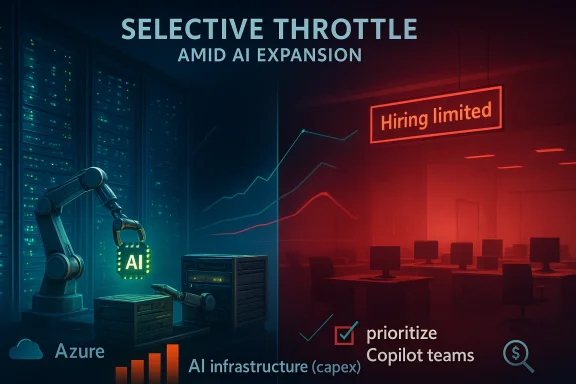
Microsoft’s decision to pause hiring in parts of its cloud organization and North American sales teams is another sign that the company’s AI boom is colliding with a very old corporate problem: how to fund growth without letting margins slip. The move is reportedly limited rather than company-wide, but it lands at a sensitive moment, with Microsoft pouring record sums into data centers, chips, and AI infrastructure while investors scrutinize every point of cloud profitability. In practical terms, this is less a blunt austerity measure than a selective throttle on headcount, aimed at keeping expenses in check without slowing the most strategically important AI bets.
The reported hiring pause reflects a familiar Microsoft pattern: spend aggressively where the company sees long-term leverage, then tighten elsewhere to preserve operating discipline. This time, the tension is sharper because the spending is not on a far-off moonshot, but on the physical backbone of the company’s AI strategy. Microsoft’s recent quarter showed continued growth in Intelligent Cloud, but it also showed higher costs of revenue, lower cloud gross-margin percentage, and rising operating expenses tied to compute capacity and AI talent. (microsoft.com)
What makes the development notable is that it appears to be targeted at divisions that sit close to revenue generation, not just support functions. Cloud sales teams and broader North American sales operations are usually where companies try to add coverage, deepen customer relationships, and accelerate upsell. Freezing hiring there suggests Microsoft is asking managers to do more with the same while the company absorbs a huge AI capex bill. (mix929.com)
The timing also matters. Microsoft is nearing the end of its fiscal year in June, a period when many large tech companies naturally slow hiring and budgeting decisions. But the company is doing so while its AI infrastructure investments are still expanding, and while investors are increasingly focused on whether that spend will show up as durable revenue rather than just higher depreciation and lower margins. (mix929.com)
That is why this story is bigger than a routine corporate pause. It sits at the intersection of AI ambition, margin pressure, and organizational prioritization. Microsoft is still hiring for Copilot-related work, which is a clue that the company is not backing away from AI; it is reallocating scarce hiring capacity toward the areas it believes can create the highest strategic return. (mix929.com)
The financial consequence is straightforward: when capex surges, margins get squeezed before the revenue flywheel fully turns. Microsoft’s FY26 Q2 results showed Microsoft Cloud gross margin percentage slipping to 67% because of continued AI infrastructure investment and product usage growth, even as revenue rose strongly. The Intelligent Cloud segment itself saw Azure growth of 39%, but the cost of revenue also climbed sharply. (microsoft.com)
This is not the first time Microsoft has tightened hiring or expenses in a specific area. Earlier pauses and layoffs have hit consulting, gaming, and parts of sales operations when the company wanted to rebalance costs. The difference now is scale and context: AI infrastructure spending has become so central to strategy that even well-performing units are being asked to show better efficiency. That makes the current pause feel more like a margin-management tool than a simple response to a weak business line.
The other backdrop is investor psychology. Microsoft’s cloud and AI narrative has been one of the market’s most convincing growth stories, but the market has also become less forgiving about companies funding AI leadership through open-ended spending. When operating leverage weakens, investors start asking whether “growth at any cost” is morphing into “AI at any cost.” Microsoft is trying to avoid that impression before it hardens.
At the same time, the company’s mix of businesses creates crosscurrents. Gaming has shown softness in some periods, consulting has faced weaker demand, and cloud growth, while still strong, is not immune to cyclical enterprise caution. In that environment, managers will naturally be told to preserve headcount where possible, especially if leadership believes AI tooling can offset some productivity gaps. That is the unspoken logic behind many selective freezes. (mix929.com)
It also changes manager behavior. Instead of treating headcount as an obvious remedy for quota pressure or workload growth, teams will likely shift toward internal reallocation, overtime, or automation. That can improve short-term efficiency, but it can also create hidden strain if the remaining workforce has to absorb the same customer load. The real effect may not be visible in one quarter. (mix929.com)
A selective pause like this often reflects confidence in existing coverage. Microsoft may believe its cloud sales motion is mature enough to withstand a temporary slowdown in hiring, especially if Copilot and other AI-led products can help salespeople carry more accounts or deepen account penetration with fewer specialist roles. That is plausible, but it is still an inference rather than a disclosed plan. (mix929.com)
That said, a pause can also be read as a sign of maturity. A business that is overhiring into a booming demand cycle can inflate costs faster than it can train new staff. Microsoft appears to be trying to avoid that trap while it digests its AI infrastructure expansion. In a narrow sense, this is disciplined capital allocation. (microsoft.com)
Key takeaways from this section:
The scale matters. Microsoft’s recent capex reached $37.5 billion in a quarter according to reporting cited by Reuters, with a large share tied to AI hardware. Even if that spending is justified by backlog and demand, it pushes the company into a classic trade-off: invest now, compress margin now, and hope the revenue mix improves later. That is a strategic bet, not a temporary accounting artifact. (mix929.com)
For investors, that creates a simple but uncomfortable question: how much margin compression is acceptable before the AI story needs to prove itself in cash flow? Microsoft is still producing enormous profit, but the market’s tolerance for rising capex is not unlimited. A hiring freeze in adjacent units is one way to show that management is paying attention. (microsoft.com)
There is also a sequencing issue. AI infrastructure benefits can lag the investment cycle, especially when capacity is built ahead of demand. Microsoft’s leadership has been explicit that it wants to build quickly and then improve yield through software optimization. Until that yield shows up more visibly, disciplined hiring becomes one of the few levers available to protect profitability. (microsoft.com)
A concise way to read the situation is this:
Microsoft’s own commentary emphasizes that its capex is tied to backlog and contracted demand. Amy Hood said the company had $368 billion of contracted backlog to deliver across Azure and Microsoft Cloud, and that spending on short-lived assets like GPUs and CPUs was aligned to that demand curve. That is a powerful defense of the buildout, but it also implies the company must continue converting backlog into revenue at scale. (microsoft.com)
That conversion is where hiring matters. If Microsoft is going to fulfill a massive backlog efficiently, it needs the right combination of technical, operational, and sales staff. Yet if the company overextends on headcount while expanding data center capacity, it risks lowering returns on invested capital. The hiring freeze suggests leadership believes the balance has tilted toward too much staffing optionality in some areas. (mix929.com)
That shift matters for competitors too. Amazon Web Services and Google Cloud will watch for signs that Microsoft’s infrastructure strategy is stretching its economics, because any slowdown in hiring or execution can create openings in enterprise sales cycles. But the reverse is also true: if Microsoft keeps growing Azure while controlling hiring, rivals may face a more efficient and durable competitor. Either outcome reinforces how high the stakes have become. (microsoft.com)
Key points here:
There is a possible upside for customers, however. A leaner sales organization can sometimes become more disciplined about prioritizing high-value accounts and reducing internal friction. If Microsoft uses AI tools internally to automate routine tasks, customers might see faster self-service and more focused interactions. But that benefit depends on the quality of the automation, and not all productivity gains are immediate. (mix929.com)
The biggest enterprise question is whether the pause is temporary or the beginning of a broader operational reset. If it is short-lived and concentrated around the fiscal year close, customers may barely feel it. If it extends into the next cycle, it could influence how aggressively Microsoft pursues expansion opportunities, renewals, and AI migrations. (mix929.com)
That matters because consumer sentiment often lags corporate strategy. End users may not care about hiring freezes in cloud sales, but they do care whether Copilot becomes more capable, more available, and more integrated into products they already use. Keeping the AI product teams funded while slowing other areas is a way of preserving momentum where the brand promise is most visible. (mix929.com)
Still, there is a danger in assuming AI hiring alone guarantees product traction. The market is increasingly asking whether users will pay enough for AI to justify the infrastructure cost. Microsoft needs Copilot to become not just a feature, but a revenue engine. That remains a work in progress. (microsoft.com)
For the ecosystem, the message is clearer: Microsoft will fund the AI layers that it believes matter most, even if that means asking mature units to absorb the restraint. That creates a sharper internal hierarchy, with AI productization at the top and expansion hiring below it. It is a sign of strategic prioritization, but also a reminder that not every part of the business gets to grow at the same speed. (mix929.com)
This could help competitors in the short term if they can market themselves as more operationally flexible. But Microsoft still has one of the deepest enterprise distributions in the market, and its integration of Azure, Microsoft 365, Security, and Copilot remains formidable. A hiring pause is not the same as a slowdown in strategic intent. (microsoft.com)
What it does signal is that the AI buildout is no longer abstract. It is colliding with real organizational trade-offs. Competitors that can show better cost discipline without sacrificing product velocity may win investor favor, even if they lack Microsoft’s scale. That creates a new axis of competition: not just who can build the best AI stack, but who can finance it cleanly. (microsoft.com)
Another thing to watch is whether Microsoft extends restraint to other business lines if cloud margins continue to soften. If the company keeps growing Azure and Copilot while maintaining headcount discipline, it can argue that it is simply optimizing. If the costs keep rising faster than expected, though, the market may push for deeper operational changes. That is where the real test lies. (microsoft.com)
Important signals to monitor:
Source: HR Katha Microsoft halts hiring in key units
 Overview
The reported hiring pause reflects a familiar Microsoft pattern: spend aggressively where the company sees long-term leverage, then tighten elsewhere to preserve operating discipline. This time, the tension is sharper because the spending is not on a far-off moonshot, but on the physical backbone of the company’s AI strategy. Microsoft’s recent quarter showed continued growth in Intelligent Cloud, but it also showed higher costs of revenue, lower cloud gross-margin percentage, and rising operating expenses tied to compute capacity and AI talent. (microsoft.com)What makes the development notable is that it appears to be targeted at divisions that sit close to revenue generation, not just support functions. Cloud sales teams and broader North American sales operations are usually where companies try to add coverage, deepen customer relationships, and accelerate upsell. Freezing hiring there suggests Microsoft is asking managers to do more with the same while the company absorbs a huge AI capex bill. (mix929.com)
The timing also matters. Microsoft is nearing the end of its fiscal year in June, a period when many large tech companies naturally slow hiring and budgeting decisions. But the company is doing so while its AI infrastructure investments are still expanding, and while investors are increasingly focused on whether that spend will show up as durable revenue rather than just higher depreciation and lower margins. (mix929.com)
That is why this story is bigger than a routine corporate pause. It sits at the intersection of AI ambition, margin pressure, and organizational prioritization. Microsoft is still hiring for Copilot-related work, which is a clue that the company is not backing away from AI; it is reallocating scarce hiring capacity toward the areas it believes can create the highest strategic return. (mix929.com)
Background
Microsoft has been in a prolonged transition from a software licensing giant to a cloud-and-AI platform company. That shift has been underway for years, but the current phase is more capital-intensive than the earlier cloud era because generative AI requires extraordinary computing density, specialized accelerators, and fast network/storage buildouts. Amy Hood has said Microsoft’s spending is tied to a large contracted backlog and to building capacity for that demand, while Satya Nadella has argued that software expertise is what turns raw infrastructure into a differentiated hyperscale platform. (microsoft.com)The financial consequence is straightforward: when capex surges, margins get squeezed before the revenue flywheel fully turns. Microsoft’s FY26 Q2 results showed Microsoft Cloud gross margin percentage slipping to 67% because of continued AI infrastructure investment and product usage growth, even as revenue rose strongly. The Intelligent Cloud segment itself saw Azure growth of 39%, but the cost of revenue also climbed sharply. (microsoft.com)
This is not the first time Microsoft has tightened hiring or expenses in a specific area. Earlier pauses and layoffs have hit consulting, gaming, and parts of sales operations when the company wanted to rebalance costs. The difference now is scale and context: AI infrastructure spending has become so central to strategy that even well-performing units are being asked to show better efficiency. That makes the current pause feel more like a margin-management tool than a simple response to a weak business line.
The other backdrop is investor psychology. Microsoft’s cloud and AI narrative has been one of the market’s most convincing growth stories, but the market has also become less forgiving about companies funding AI leadership through open-ended spending. When operating leverage weakens, investors start asking whether “growth at any cost” is morphing into “AI at any cost.” Microsoft is trying to avoid that impression before it hardens.
At the same time, the company’s mix of businesses creates crosscurrents. Gaming has shown softness in some periods, consulting has faced weaker demand, and cloud growth, while still strong, is not immune to cyclical enterprise caution. In that environment, managers will naturally be told to preserve headcount where possible, especially if leadership believes AI tooling can offset some productivity gaps. That is the unspoken logic behind many selective freezes. (mix929.com)
Why the Hiring Pause Matters
A hiring pause in cloud and sales is important because those are not peripheral functions. They are the engine rooms of enterprise monetization, where Microsoft converts infrastructure investments into recurring revenue. Halting fresh recruitment there suggests leadership sees enough internal slack, automation potential, or reprioritization room to hold the line without immediately damaging near-term sales execution. (mix929.com)The Signal to Managers
The instruction reportedly told managers not to bring in new candidates unless they already had offers. That is a narrower and more disciplined form of hiring control than a blanket freeze, because it preserves continuity in active pipelines while cutting off net-new expansion. In practice, it signals that every open seat now needs a tighter business case. (mix929.com)It also changes manager behavior. Instead of treating headcount as an obvious remedy for quota pressure or workload growth, teams will likely shift toward internal reallocation, overtime, or automation. That can improve short-term efficiency, but it can also create hidden strain if the remaining workforce has to absorb the same customer load. The real effect may not be visible in one quarter. (mix929.com)
A selective pause like this often reflects confidence in existing coverage. Microsoft may believe its cloud sales motion is mature enough to withstand a temporary slowdown in hiring, especially if Copilot and other AI-led products can help salespeople carry more accounts or deepen account penetration with fewer specialist roles. That is plausible, but it is still an inference rather than a disclosed plan. (mix929.com)
Why Sales Is Especially Sensitive
Sales hiring is often one of the easiest levers to pull because revenue teams have measurable output, but it is also one of the easiest places to undercut future growth. When companies slow sales hiring too much, the impact tends to show up later through weaker pipeline development, slower customer adoption, and more uneven geographic coverage. Microsoft is taking a calculated risk if this pause lasts too long. (mix929.com)That said, a pause can also be read as a sign of maturity. A business that is overhiring into a booming demand cycle can inflate costs faster than it can train new staff. Microsoft appears to be trying to avoid that trap while it digests its AI infrastructure expansion. In a narrow sense, this is disciplined capital allocation. (microsoft.com)
Key takeaways from this section:
- The pause appears targeted, not universal.
- Cloud and sales are core revenue-generating areas, so the move is meaningful.
- Existing offers are reportedly unaffected, which softens disruption.
- Microsoft is trying to hold margins while AI capex remains elevated.
- The decision suggests internal confidence, but also clear pressure to be more efficient.
AI Spending Is Changing Microsoft’s Cost Structure
Microsoft’s AI buildout is now large enough to affect how the company thinks about hiring, margins, and operating discipline across the board. The latest earnings disclosures show that Microsoft Cloud gross margin percentage fell because of continued AI infrastructure investment, while operating expenses rose due to compute capacity and AI talent. That is the financial background behind the hiring move. (microsoft.com)Capex Is Not Just a Technical Choice
When a company spends tens of billions on data centers, the staffing implications are immediate. Hardware deployment requires installation, power planning, networking, support, security, and ongoing operations. In that environment, every new hire has to compete with infrastructure dollars for budget space. Microsoft’s management has effectively acknowledged that the company’s growth engine now depends on physical capacity as much as software execution. (microsoft.com)The scale matters. Microsoft’s recent capex reached $37.5 billion in a quarter according to reporting cited by Reuters, with a large share tied to AI hardware. Even if that spending is justified by backlog and demand, it pushes the company into a classic trade-off: invest now, compress margin now, and hope the revenue mix improves later. That is a strategic bet, not a temporary accounting artifact. (mix929.com)
For investors, that creates a simple but uncomfortable question: how much margin compression is acceptable before the AI story needs to prove itself in cash flow? Microsoft is still producing enormous profit, but the market’s tolerance for rising capex is not unlimited. A hiring freeze in adjacent units is one way to show that management is paying attention. (microsoft.com)
Infrastructure and Margin Compression
The company’s cloud gross margin percentage fell to 67% in FY26 Q2, while Intelligent Cloud revenue still rose 29%. That combination tells the whole story: growth remains healthy, but the margin profile is worsening because infrastructure intensity is increasing faster than optimization can offset it. This is exactly the sort of pressure that leads to headcount restraint. (microsoft.com)There is also a sequencing issue. AI infrastructure benefits can lag the investment cycle, especially when capacity is built ahead of demand. Microsoft’s leadership has been explicit that it wants to build quickly and then improve yield through software optimization. Until that yield shows up more visibly, disciplined hiring becomes one of the few levers available to protect profitability. (microsoft.com)
A concise way to read the situation is this:
- Microsoft is spending heavily on AI infrastructure.
- That spending is lowering cloud gross margins.
- The company is slowing hiring in units where it can.
- Copilot and other AI priorities still get staffing support.
- The goal is to preserve strategic momentum while reducing cost creep.
Azure, OpenAI, and the Backlog Question
Azure remains the center of gravity in Microsoft’s cloud story, but the relationship between Azure growth and AI demand is becoming more complicated. Microsoft says Azure and other cloud services revenue grew 39% in FY26 Q2, yet the company is also carrying the burden of a huge infrastructure build and market scrutiny over the scale of its OpenAI relationship. That combination makes every operating decision feel more consequential than it would in a normal cycle. (microsoft.com)The OpenAI Exposure Debate
The report cited by HR Katha says investors are watching Microsoft’s reliance on OpenAI, which is said to make up a large share of Azure’s committed backlog. That figure is difficult to verify independently from official disclosures, so it should be treated cautiously. Still, the broader point stands: OpenAI-linked demand has become strategically important to Microsoft’s cloud economics, and that makes the company more exposed to questions about concentration. According to the report, that exposure is one reason the market is watching margin discipline closely. (mix929.com)Microsoft’s own commentary emphasizes that its capex is tied to backlog and contracted demand. Amy Hood said the company had $368 billion of contracted backlog to deliver across Azure and Microsoft Cloud, and that spending on short-lived assets like GPUs and CPUs was aligned to that demand curve. That is a powerful defense of the buildout, but it also implies the company must continue converting backlog into revenue at scale. (microsoft.com)
That conversion is where hiring matters. If Microsoft is going to fulfill a massive backlog efficiently, it needs the right combination of technical, operational, and sales staff. Yet if the company overextends on headcount while expanding data center capacity, it risks lowering returns on invested capital. The hiring freeze suggests leadership believes the balance has tilted toward too much staffing optionality in some areas. (mix929.com)
Azure’s Growth, but at What Cost?
Azure growth of 39% is still strong by any reasonable standard, but hyperscale businesses are judged not just on top-line growth. They are judged on how well they convert scale into margin and on whether growth remains efficient as the platform matures. Microsoft’s recent results suggest the company is still winning on volume, but no longer on effortless margin expansion. (microsoft.com)That shift matters for competitors too. Amazon Web Services and Google Cloud will watch for signs that Microsoft’s infrastructure strategy is stretching its economics, because any slowdown in hiring or execution can create openings in enterprise sales cycles. But the reverse is also true: if Microsoft keeps growing Azure while controlling hiring, rivals may face a more efficient and durable competitor. Either outcome reinforces how high the stakes have become. (microsoft.com)
Key points here:
- Azure growth remains strong, but costs are rising faster.
- OpenAI-linked demand is strategically important, though not fully transparent.
- Backlog creates justification for spending, but also pressure to execute flawlessly.
- Hiring discipline is part of the margin-defense strategy.
- Competitors will interpret the pause as a sign of both caution and confidence.
What It Means for Enterprise Customers
For enterprise buyers, a hiring pause in cloud and sales is not necessarily a red flag, but it does raise questions about service depth and account coverage. If Microsoft is asking teams to do more without adding people, customers may eventually notice slower response times, tighter account management, or more standardized engagement. That would be especially noticeable in complex procurement and migration cycles. (mix929.com)Sales Execution Could Get Leaner
Large enterprise deals often depend on a mix of field sales, solution architects, partner support, and cloud specialists. If hiring slows in those layers, Microsoft will need to rely more heavily on existing talent and partner ecosystems. That can work well when products are mature, but it can be harder when customers need bespoke guidance for AI adoption and hybrid deployments. (microsoft.com)There is a possible upside for customers, however. A leaner sales organization can sometimes become more disciplined about prioritizing high-value accounts and reducing internal friction. If Microsoft uses AI tools internally to automate routine tasks, customers might see faster self-service and more focused interactions. But that benefit depends on the quality of the automation, and not all productivity gains are immediate. (mix929.com)
The biggest enterprise question is whether the pause is temporary or the beginning of a broader operational reset. If it is short-lived and concentrated around the fiscal year close, customers may barely feel it. If it extends into the next cycle, it could influence how aggressively Microsoft pursues expansion opportunities, renewals, and AI migrations. (mix929.com)
Customer Impact Checklist
- Large accounts may see tighter coverage.
- Partner-led motions may become more important.
- AI-heavy deals could receive priority over routine sales work.
- Support quality may remain stable if the freeze is short.
- Longer freezes could affect hiring pipelines and field expansion.
What It Means for Consumers and Copilot
The fact that the Copilot AI team is still hiring is just as important as the freeze itself. It shows that Microsoft is not retreating from consumer-facing and productivity AI; it is drawing a line between strategic growth areas and broader commercial expansion. In other words, Microsoft is still paying for the future, just not evenly across the organization. (mix929.com)Copilot Remains a Priority
Copilot sits at the heart of Microsoft’s AI branding, spanning productivity, enterprise workflows, and consumer discovery. Keeping hiring alive there implies the company still sees Copilot as a path to both monetization and ecosystem lock-in. It also suggests Microsoft wants to protect the teams most closely associated with its long-term AI narrative. (mix929.com)That matters because consumer sentiment often lags corporate strategy. End users may not care about hiring freezes in cloud sales, but they do care whether Copilot becomes more capable, more available, and more integrated into products they already use. Keeping the AI product teams funded while slowing other areas is a way of preserving momentum where the brand promise is most visible. (mix929.com)
Still, there is a danger in assuming AI hiring alone guarantees product traction. The market is increasingly asking whether users will pay enough for AI to justify the infrastructure cost. Microsoft needs Copilot to become not just a feature, but a revenue engine. That remains a work in progress. (microsoft.com)
Consumer-Facing Implications
For consumers, the near-term effect may be minimal. Microsoft’s consumer product road map is broad enough that a targeted hiring pause in cloud and sales should not immediately slow Windows, Office, or Copilot updates. The real risk is slower iteration if the company becomes too focused on margin defense. (microsoft.com)For the ecosystem, the message is clearer: Microsoft will fund the AI layers that it believes matter most, even if that means asking mature units to absorb the restraint. That creates a sharper internal hierarchy, with AI productization at the top and expansion hiring below it. It is a sign of strategic prioritization, but also a reminder that not every part of the business gets to grow at the same speed. (mix929.com)
Competitive Pressure Across Big Tech
Microsoft’s hiring pause does not happen in isolation. Other large technology companies have also been tightening hiring, trimming layers, or reworking headcount to fund AI and data center expansion. The broader message across Big Tech is that the AI race is increasingly a capital-allocation contest, not just a product contest. (mix929.com)Rivals Are Watching the Margin Story
Amazon, Meta, and other platform companies have been managing cost pressure while investing heavily in AI infrastructure. Microsoft’s move fits that broader pattern, but it carries special significance because the company’s cloud franchise is one of the clearest indicators of enterprise AI demand. If Microsoft sees reason to limit hiring, rivals will infer that even a strong cloud leader feels the pressure to restrain overhead. (mix929.com)This could help competitors in the short term if they can market themselves as more operationally flexible. But Microsoft still has one of the deepest enterprise distributions in the market, and its integration of Azure, Microsoft 365, Security, and Copilot remains formidable. A hiring pause is not the same as a slowdown in strategic intent. (microsoft.com)
What it does signal is that the AI buildout is no longer abstract. It is colliding with real organizational trade-offs. Competitors that can show better cost discipline without sacrificing product velocity may win investor favor, even if they lack Microsoft’s scale. That creates a new axis of competition: not just who can build the best AI stack, but who can finance it cleanly. (microsoft.com)
Market Implications
- Investors will compare capex intensity across hyperscalers.
- Margin resilience may matter as much as raw AI growth.
- Hiring discipline becomes a proxy for management confidence.
- Enterprise buyers may favor vendors with clearer execution focus.
- Microsoft’s pause could pressure rivals to explain their own cost controls.
Strengths and Opportunities
Microsoft still enters this period from a position of unusual strength. Cloud revenue is growing, AI demand is real, and the company has the scale to absorb a selective hiring pause without derailing its core strategy. The opportunity is to turn this into a proof point that Microsoft can fund AI leadership while keeping the organization disciplined. (microsoft.com)- Strong Azure growth provides a revenue base to support AI investment.
- A targeted pause is less disruptive than a company-wide freeze.
- Copilot and other AI teams remain funded, protecting strategic momentum.
- Management can use the pause to test productivity gains from AI tools.
- Investors may view the move as a sign of maturity and discipline.
- Microsoft’s backlog gives it room to justify near-term spending.
- The company can reallocate headcount toward higher-return initiatives.
Risks and Concerns
The risk is that a selective freeze becomes a broader constraint on growth or morale. If teams in cloud and sales feel stretched for too long, Microsoft could end up saving money now but losing agility later. The company also risks sending a mixed signal: aggressive AI spending on one hand, but caution and hiring restraint on the other. (mix929.com)- Sales coverage could weaken if hiring stays paused too long.
- Employee morale may suffer if people interpret the move as stealth austerity.
- Margin pressure could persist if AI infrastructure costs keep rising.
- Customers may see slower response times or less bespoke engagement.
- Overreliance on a few AI demand sources could remain a concern.
- Investors may demand clearer proof that AI spending is generating returns.
- A prolonged freeze could limit Microsoft’s ability to capitalize on demand spikes.
Looking Ahead
The key question now is whether this hiring pause is a brief fiscal-year adjustment or the first visible sign of a more systematic operating reset. Microsoft has the balance sheet and product breadth to manage either path, but the consequences differ sharply. A short pause suggests prudence; a longer one would suggest that AI infrastructure has begun to reshape the company’s internal economics in a more durable way. (mix929.com)Another thing to watch is whether Microsoft extends restraint to other business lines if cloud margins continue to soften. If the company keeps growing Azure and Copilot while maintaining headcount discipline, it can argue that it is simply optimizing. If the costs keep rising faster than expected, though, the market may push for deeper operational changes. That is where the real test lies. (microsoft.com)
Important signals to monitor:
- Whether the hiring pause remains limited to cloud and North American sales.
- Whether Copilot hiring continues at the current pace.
- Whether Microsoft’s cloud gross margin percentage stabilizes or declines further.
- Whether management comments more explicitly on AI ROI and workforce efficiency.
- Whether other Big Tech firms adopt similar targeted freezes.
Source: HR Katha Microsoft halts hiring in key units
