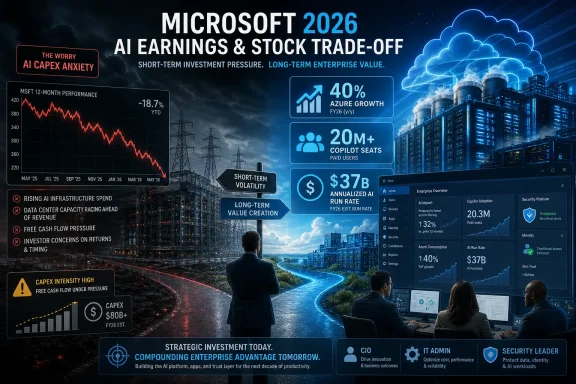
Microsoft is again one of the Nasdaq-100’s defining companies in 2026, with its stock story now tied less to Windows licensing and more to Azure cloud growth, AI infrastructure spending, subscription software, and whether those investments can keep producing durable profits. The investor question is no longer whether Microsoft is a technology incumbent with impressive cash flows. It is whether the company can turn the most expensive platform transition in modern computing into returns large enough to justify its scale, valuation, and index weight.
There was a time when Microsoft’s market identity was easy to summarize: Windows on the desktop, Office in the enterprise, and a server business that followed wherever corporate IT went. That version of Microsoft still exists, but it is no longer the version that moves the Nasdaq-100. Today’s Microsoft is a cloud-and-AI infrastructure company with a productivity software empire attached.
That distinction matters because Microsoft is not merely another large constituent in a growth index. It is one of the stocks through which millions of investors get indirect exposure to enterprise IT spending, cloud migration, AI adoption, and the broader confidence trade around large-cap technology. When Microsoft rallies, index funds, technology ETFs, retirement accounts, and model portfolios feel it. When Microsoft stumbles, the wobble travels far beyond Redmond.
The company’s current pitch to investors is unusually ambitious. Microsoft is asking the market to believe that Azure, Copilot, GitHub, security products, and AI model services can form a single commercial flywheel: more customers use Microsoft’s software, more workloads move to its cloud, more AI features increase consumption, and more data center spending becomes necessary to feed the loop. That is a compelling story, but also a capital-hungry one.
The risk is that the story sounds cleaner than the economics. AI demand is real, but so are GPU constraints, power costs, depreciation, competitive pricing, and the difficulty of proving that every Copilot seat or AI workload creates lasting enterprise value. Microsoft’s advantage is that it can fund the experiment from a position of enormous strength. Its challenge is that investors are now measuring it against an expectation that strength will translate into near-flawless execution.
That transition gave Microsoft what most AI aspirants lack: recurring revenue, deep enterprise contracts, global distribution, and the ability to bundle new capabilities into products customers already use. A start-up selling an AI assistant has to fight for procurement attention. Microsoft can put Copilot beside Word, Excel, Teams, Outlook, Windows, Dynamics, GitHub, and Azure, then ask CIOs whether they would like the upgrade added to an existing relationship.
This is why Microsoft’s business model remains so resilient even as its investment profile becomes more aggressive. Productivity and Business Processes, Intelligent Cloud, and More Personal Computing are not equal engines, but they are interlocking ones. Productivity subscriptions deepen identity and collaboration dependence. Azure supplies infrastructure. Security, management, and compliance tools make the stack harder to replace. Gaming and Windows are no longer the center of the company, but they still widen the ecosystem.
The recurring revenue base is the financial bridge between yesterday’s Microsoft and tomorrow’s AI platform. It gives the company room to spend heavily without looking speculative in the way a pure-play AI infrastructure company might. Investors may argue about the return on AI capital expenditure, but few doubt Microsoft’s ability to generate the cash required to keep building.
That is the difference between a growth story and a balance-sheet story. Microsoft is both, which is why the market treats it differently from most technology companies chasing the same AI wave.
The cloud business benefits from a structural shift that is still incomplete. Many organizations continue to run hybrid estates, with legacy workloads on-premises, newer workloads in public cloud, and sensitive operations distributed across private, sovereign, or regulated environments. Microsoft has been unusually effective at serving that messy middle because it understands enterprise compromise. It does not need every customer to become cloud-native overnight; it needs them to keep choosing Microsoft as the migration path.
That hybrid credibility is a major advantage against cloud rivals that sometimes speak as if the future arrives all at once. Banks, hospitals, manufacturers, governments, and heavily regulated enterprises rarely move that way. They modernize in stages, protect old systems longer than vendors would like, and buy from companies that can support complexity without making it feel like failure.
AI strengthens Azure’s position because AI workloads are not just another cloud use case. Training, inference, vector search, data governance, model monitoring, and application integration all demand infrastructure and tooling. Microsoft can sell those layers through Azure while also surfacing AI through higher-level products such as Copilot and developer services. The more AI becomes an enterprise architecture problem rather than a novelty feature, the more Microsoft’s full-stack approach makes sense.
Still, Azure’s success brings a harsher test. The market is no longer impressed merely by cloud growth; it wants to know whether that growth is profitable after the next wave of data centers, accelerators, networking gear, and energy contracts is counted. Azure is the fulcrum because it carries both sides of the argument: the clearest evidence of demand and the clearest reason capital spending keeps rising.
That is why capital expenditure has become the central tension in Microsoft’s long-term investment case. The company can report strong revenue growth and still face investor skepticism if the cost of enabling that growth climbs faster than expected. AI infrastructure is expensive in ways that traditional software was not. It requires specialized chips, advanced networking, cooling, power availability, data center construction, and long-term supply commitments.
Microsoft is not alone. Amazon, Google, Meta, Oracle, and a constellation of AI cloud providers are all competing for the same broad ingredients: accelerators, power, land, fiber, and engineering talent. The difference is that Microsoft has tied this spending directly to an enterprise software monetization engine. It is not just building capacity in the abstract; it is trying to attach that capacity to Azure consumption, Microsoft 365 upgrades, GitHub usage, Dynamics workflows, and security workloads.
That makes the spending more defensible, but not automatically successful. The most important question is whether AI features become must-have productivity infrastructure or merely premium add-ons that some customers test, trim, and renegotiate. Copilot is the test case. If it becomes a normal line item in enterprise software budgets, Microsoft’s AI economics could look powerful. If adoption is uneven or usage disappoints, the company may still have world-class infrastructure but less pricing leverage than bulls expect.
The company’s advantage is patience. Microsoft can absorb years of elevated investment better than almost anyone in technology. But even for Microsoft, AI capital spending is now the bill that arrives before the proof.
Microsoft has spent years training customers to accept tiering. Basic productivity tools become premium productivity suites. Security and compliance features move into higher SKUs. Teams, identity, device management, endpoint security, analytics, and now AI all become reasons to upgrade rather than switch. In enterprise software, the best business model is not selling a new product every year. It is making the existing contract broader, stickier, and more expensive because the customer’s operations increasingly depend on it.
That dynamic is visible in how Microsoft packages AI. Copilot is not positioned as a separate curiosity but as an embedded layer across work. In Word, it drafts. In Excel, it analyzes. In Teams, it summarizes. In Outlook, it triages. In GitHub, it codes. In security tools, it investigates. The company’s bet is that AI will be most valuable not as a destination app but as a capability infused into workflows people already inhabit.
This is commercially astute. Enterprises do not want hundreds of disconnected AI pilots forever. They want managed tools, auditability, identity integration, data boundaries, and vendor accountability. Microsoft can offer those comforts in a way many smaller AI firms cannot. That does not guarantee success, but it lowers friction.
The margin defense comes from the fact that software subscriptions can still carry attractive economics if AI usage is priced and managed properly. The concern is that generative AI adds a variable infrastructure cost to products that historically scaled with much higher software margins. Microsoft’s job is to make AI feel like a premium software layer while managing it internally like an industrial-scale compute service.
Windows 11 has increasingly become a vehicle for Microsoft’s broader cloud-and-AI agenda. Account integration, OneDrive defaults, Edge promotion, Microsoft 365 hooks, security baselines, Copilot branding, and device management all reflect the same strategic pattern. Windows is not just an operating system; it is a distribution layer for services.
That has produced a familiar tension. Enthusiasts often want a cleaner, more local, less promotional Windows experience. Microsoft wants Windows to remain relevant in a world where value is captured through cloud identity, subscriptions, AI assistants, and cross-device services. The company’s incentives are not mysterious. If Windows is the front door to Microsoft’s paid ecosystem, every setup screen and taskbar surface becomes commercially meaningful.
For enterprises, the calculus is more practical. Windows remains deeply embedded in endpoint fleets, Active Directory and Entra identity patterns, management tooling, security operations, and application compatibility. Microsoft can use that installed base to bring AI and cloud management deeper into corporate environments, but it must avoid making IT departments feel that the endpoint is becoming an advertising surface or an uncontrolled policy variable.
This is where Microsoft’s investor story intersects with user trust. The more the company relies on monetizing its installed base, the more carefully it must handle defaults, privacy, telemetry, and administrative control. Wall Street may cheer higher ARPU. Sysadmins notice when “helpful integration” looks like another setting to disable.
That creates a feedback loop between company fundamentals and market structure. Strong Microsoft earnings can reinforce confidence in megacap technology broadly. Disappointing guidance can pressure not only Microsoft shares but also sentiment toward cloud peers, software names, chip suppliers, and AI infrastructure beneficiaries. The company is both a business and a market signal.
This is why Microsoft’s spending plans attract so much scrutiny. When a smaller software company increases capex, the market reads it as a company-specific decision. When Microsoft does it, investors read it as evidence about the entire AI economy. Are customers demanding more AI capacity than the industry can supply? Are hyperscalers overbuilding? Are chipmakers capturing too much of the value? Are software margins structurally changing?
Microsoft’s scale turns those questions into index-level concerns. The company’s AI buildout affects expectations for Nvidia, AMD, networking vendors, power providers, data center operators, cloud rivals, and enterprise software companies. It also affects the valuation logic of the Nasdaq-100 itself, which has become increasingly concentrated in a small group of companies with the cash and infrastructure to compete in AI.
Concentration is not inherently bad if the leaders keep delivering. But it does mean investors are relying on a narrower set of assumptions than a headline index chart may suggest. One of those assumptions is that Microsoft can keep converting cloud and AI demand into cash flow without surrendering the financial discipline that made it a cornerstone holding in the first place.
That is also why regulators keep watching. The same bundling power that makes Microsoft commercially formidable can raise concerns about competition, self-preferencing, data control, and customer lock-in. Cloud licensing practices, app distribution, Teams integration, AI partnerships, cybersecurity obligations, and digital market rules all sit within a broader regulatory environment that is less forgiving than the one large tech enjoyed a decade ago.
Microsoft has tried to present itself as the responsible enterprise platform company: security-conscious, compliance-friendly, partner-oriented, and more pragmatic than ideological. That posture has real value. CIOs do not buy infrastructure only on features; they buy on trust, supportability, procurement stability, and regulatory defensibility. Microsoft knows how to speak that language.
But the company’s reach makes friction inevitable. Competitors will argue that Microsoft uses its installed base to steer customers toward Azure or Microsoft 365. Regulators will examine whether AI partnerships create hidden control structures. Enterprise customers will ask how portable their data, models, and workflows really are once they standardize on Microsoft’s stack.
For long-term investors, regulation is not a reason to dismiss Microsoft. It is a reason to apply a discount to any story that assumes frictionless platform expansion. The more successful Microsoft becomes at making AI, cloud, and productivity inseparable, the more scrutiny that success invites.
Amazon remains a formidable infrastructure competitor with deep cloud credibility and a massive installed base. Google brings AI research pedigree, custom silicon, data expertise, and renewed enterprise ambition. Oracle has become more relevant in cloud infrastructure than many expected, particularly around database workloads and AI capacity deals. Specialized AI cloud firms and model providers can pressure pricing and innovation cycles even if they lack Microsoft’s enterprise reach.
In productivity software, Microsoft’s moat remains wide, but not unchallenged. Google Workspace persists, especially in education, smaller organizations, and cloud-native companies. Collaboration tools, workflow platforms, and vertical SaaS vendors can chip away at specific use cases. AI-native applications may not replace Microsoft 365 wholesale, but they can redefine expectations for speed and automation.
In developer tools, GitHub is a powerful asset, but developers are famously willing to experiment. Coding assistants, model APIs, open-source tools, and local development workflows can shift quickly. Microsoft’s advantage is distribution; its vulnerability is complacency. If AI coding tools become a commodity, GitHub Copilot must remain more than a familiar brand.
The deeper competitive issue is value capture. AI may increase demand for compute, but that does not mean every layer earns exceptional returns. Chip suppliers may capture one slice, cloud platforms another, model providers another, and application vendors another. Microsoft is trying to participate across several layers at once. That is strategically wise, but it also exposes the company to margin pressure across the stack.
The company also benefits from a rare alignment of trends. Enterprises are still modernizing infrastructure. Cybersecurity remains a board-level priority. AI adoption is moving from experimentation into procurement. Developers are embracing assisted coding. Data estates are becoming more complex. Hybrid work has made collaboration software essential rather than optional. Microsoft has credible products in all of these areas.
That breadth makes the company hard to dislodge. A customer may choose another cloud for some workloads, another security vendor for a specific need, or another AI model for a particular application. But Microsoft’s power lies in being good enough, integrated enough, and already approved enough across a wide surface area. In enterprise technology, the default vendor has enormous advantages.
The financial case is similarly straightforward. If Azure continues growing at high rates, if Microsoft 365 upselling remains healthy, if AI features support premium pricing, and if capex moderates relative to revenue over time, Microsoft can sustain a blend of growth and profitability that almost no company of its size can match. That is why it remains a core holding for many investors who want exposure to innovation without abandoning quality.
The bullish case, however, depends on the word if doing a lot of work. Microsoft does not need perfection, but it does need evidence that AI monetization is moving beyond narrative. Investors will tolerate heavy spending when they can see the revenue curve. They become less patient when spending is certain and returns are theoretical.
This is a reasonable concern. Classic software margins were built on near-zero marginal distribution costs. Generative AI changes that equation because every prompt, summary, code completion, and inference workload consumes compute. If customers use AI heavily, infrastructure costs rise. If they do not use it heavily, the value proposition weakens. Microsoft must thread a narrow needle: encourage enough usage to make AI indispensable while pricing it high enough to protect margins.
There is also the risk of enterprise fatigue. CIOs have spent years absorbing cloud migrations, security upgrades, collaboration transformations, compliance mandates, and subscription price increases. AI may be a priority, but priorities still compete for budget. A technology can be strategically important and still face slower adoption if procurement teams demand proof of productivity gains.
Another concern is depreciation. Data centers and accelerators do not remain cutting-edge forever. If AI hardware cycles shorten, hyperscalers may face a faster treadmill than investors expect. Microsoft can manage this better than most, but it cannot escape physics, supply chains, or accounting.
The bear case, then, is not that Microsoft becomes irrelevant. It is that the company remains excellent while the stock’s expectations become too demanding. In megacap technology, that distinction matters. A great company can still produce mediocre returns if investors pay for a future that arrives more slowly than promised.
This is where Microsoft has both an advantage and a burden. Its identity, compliance, endpoint management, data protection, and security tooling give it a strong foundation for enterprise AI. If a company already uses Microsoft 365, Entra, Purview, Defender, Intune, and Azure, Microsoft can argue that AI should live inside the same control plane. That argument will land with many CIOs.
But admins will demand clarity. Which data can AI access? How are permissions inherited? What logs exist? How are prompts retained? What happens across tenants, regions, and regulated environments? Can features be disabled cleanly? Are defaults conservative enough for sensitive organizations? These are not side issues. They are the conditions for adoption.
Microsoft’s recent history gives IT departments reasons for both confidence and caution. The company understands enterprise management deeply, but it also has a habit of pushing consumer-like experiences, promotional surfaces, and cloud defaults into products used by highly controlled organizations. AI raises the stakes because a confusing default is no longer merely annoying. It can become a data governance incident.
The company that wins enterprise AI will not be the one with the flashiest assistant. It will be the one that makes AI feel boring enough for regulated operations. Microsoft is well positioned for that role, but it has to earn it in the admin console, not just the earnings call.
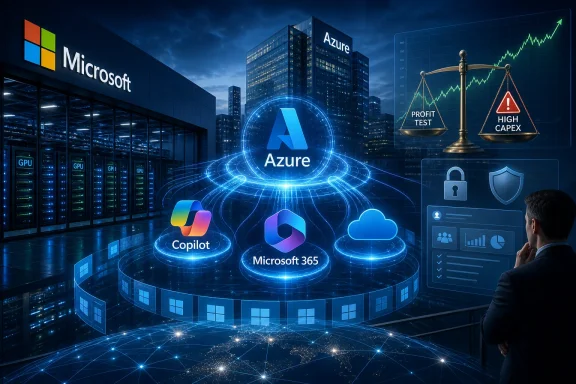 Microsoft Has Become the Index’s AI Infrastructure Proxy
There was a time when Microsoft’s market identity was easy to summarize: Windows on the desktop, Office in the enterprise, and a server business that followed wherever corporate IT went. That version of Microsoft still exists, but it is no longer the version that moves the Nasdaq-100. Today’s Microsoft is a cloud-and-AI infrastructure company with a productivity software empire attached.That distinction matters because Microsoft is not merely another large constituent in a growth index. It is one of the stocks through which millions of investors get indirect exposure to enterprise IT spending, cloud migration, AI adoption, and the broader confidence trade around large-cap technology. When Microsoft rallies, index funds, technology ETFs, retirement accounts, and model portfolios feel it. When Microsoft stumbles, the wobble travels far beyond Redmond.
The company’s current pitch to investors is unusually ambitious. Microsoft is asking the market to believe that Azure, Copilot, GitHub, security products, and AI model services can form a single commercial flywheel: more customers use Microsoft’s software, more workloads move to its cloud, more AI features increase consumption, and more data center spending becomes necessary to feed the loop. That is a compelling story, but also a capital-hungry one.
The risk is that the story sounds cleaner than the economics. AI demand is real, but so are GPU constraints, power costs, depreciation, competitive pricing, and the difficulty of proving that every Copilot seat or AI workload creates lasting enterprise value. Microsoft’s advantage is that it can fund the experiment from a position of enormous strength. Its challenge is that investors are now measuring it against an expectation that strength will translate into near-flawless execution.
The Old Microsoft Paid for the New One
The most important thing about Microsoft’s AI strategy is that it did not begin with AI. It began with the company’s long, methodical conversion from boxed software and perpetual licensing into subscriptions, cloud services, and enterprise platform dependency. Office became Microsoft 365. Server products became cloud gateways. Windows became less of a standalone profit engine and more of an endpoint in a managed ecosystem.That transition gave Microsoft what most AI aspirants lack: recurring revenue, deep enterprise contracts, global distribution, and the ability to bundle new capabilities into products customers already use. A start-up selling an AI assistant has to fight for procurement attention. Microsoft can put Copilot beside Word, Excel, Teams, Outlook, Windows, Dynamics, GitHub, and Azure, then ask CIOs whether they would like the upgrade added to an existing relationship.
This is why Microsoft’s business model remains so resilient even as its investment profile becomes more aggressive. Productivity and Business Processes, Intelligent Cloud, and More Personal Computing are not equal engines, but they are interlocking ones. Productivity subscriptions deepen identity and collaboration dependence. Azure supplies infrastructure. Security, management, and compliance tools make the stack harder to replace. Gaming and Windows are no longer the center of the company, but they still widen the ecosystem.
The recurring revenue base is the financial bridge between yesterday’s Microsoft and tomorrow’s AI platform. It gives the company room to spend heavily without looking speculative in the way a pure-play AI infrastructure company might. Investors may argue about the return on AI capital expenditure, but few doubt Microsoft’s ability to generate the cash required to keep building.
That is the difference between a growth story and a balance-sheet story. Microsoft is both, which is why the market treats it differently from most technology companies chasing the same AI wave.
Azure Is the Fulcrum, Not Just a Product Line
Azure is often described as Microsoft’s cloud platform, but that understates its strategic role. Azure is now the place where Microsoft’s infrastructure ambitions, developer relationships, database products, analytics stack, cybersecurity strategy, and AI services converge. It is not simply renting compute and storage. It is selling the operating environment for modern enterprise software.The cloud business benefits from a structural shift that is still incomplete. Many organizations continue to run hybrid estates, with legacy workloads on-premises, newer workloads in public cloud, and sensitive operations distributed across private, sovereign, or regulated environments. Microsoft has been unusually effective at serving that messy middle because it understands enterprise compromise. It does not need every customer to become cloud-native overnight; it needs them to keep choosing Microsoft as the migration path.
That hybrid credibility is a major advantage against cloud rivals that sometimes speak as if the future arrives all at once. Banks, hospitals, manufacturers, governments, and heavily regulated enterprises rarely move that way. They modernize in stages, protect old systems longer than vendors would like, and buy from companies that can support complexity without making it feel like failure.
AI strengthens Azure’s position because AI workloads are not just another cloud use case. Training, inference, vector search, data governance, model monitoring, and application integration all demand infrastructure and tooling. Microsoft can sell those layers through Azure while also surfacing AI through higher-level products such as Copilot and developer services. The more AI becomes an enterprise architecture problem rather than a novelty feature, the more Microsoft’s full-stack approach makes sense.
Still, Azure’s success brings a harsher test. The market is no longer impressed merely by cloud growth; it wants to know whether that growth is profitable after the next wave of data centers, accelerators, networking gear, and energy contracts is counted. Azure is the fulcrum because it carries both sides of the argument: the clearest evidence of demand and the clearest reason capital spending keeps rising.
AI Has Turned Microsoft’s Strength Into a Spending Obligation
Microsoft’s AI investment cycle is not optional in any practical sense. Once the company positioned itself as a leader in generative AI through OpenAI integration, Copilot branding, Azure AI services, and AI-enhanced developer tools, it committed to a race in which capacity is part of the product. If customers cannot get the performance, availability, and scale they expect, the software story weakens.That is why capital expenditure has become the central tension in Microsoft’s long-term investment case. The company can report strong revenue growth and still face investor skepticism if the cost of enabling that growth climbs faster than expected. AI infrastructure is expensive in ways that traditional software was not. It requires specialized chips, advanced networking, cooling, power availability, data center construction, and long-term supply commitments.
Microsoft is not alone. Amazon, Google, Meta, Oracle, and a constellation of AI cloud providers are all competing for the same broad ingredients: accelerators, power, land, fiber, and engineering talent. The difference is that Microsoft has tied this spending directly to an enterprise software monetization engine. It is not just building capacity in the abstract; it is trying to attach that capacity to Azure consumption, Microsoft 365 upgrades, GitHub usage, Dynamics workflows, and security workloads.
That makes the spending more defensible, but not automatically successful. The most important question is whether AI features become must-have productivity infrastructure or merely premium add-ons that some customers test, trim, and renegotiate. Copilot is the test case. If it becomes a normal line item in enterprise software budgets, Microsoft’s AI economics could look powerful. If adoption is uneven or usage disappoints, the company may still have world-class infrastructure but less pricing leverage than bulls expect.
The company’s advantage is patience. Microsoft can absorb years of elevated investment better than almost anyone in technology. But even for Microsoft, AI capital spending is now the bill that arrives before the proof.
Subscriptions Give Microsoft Its Margin Defense
The strongest counterargument to AI spending anxiety is Microsoft’s subscription machine. Microsoft 365, Dynamics, security services, LinkedIn products, GitHub offerings, and enterprise agreements give the company a recurring revenue base that few competitors can match. This matters because subscription revenue is not just predictable; it is expandable.Microsoft has spent years training customers to accept tiering. Basic productivity tools become premium productivity suites. Security and compliance features move into higher SKUs. Teams, identity, device management, endpoint security, analytics, and now AI all become reasons to upgrade rather than switch. In enterprise software, the best business model is not selling a new product every year. It is making the existing contract broader, stickier, and more expensive because the customer’s operations increasingly depend on it.
That dynamic is visible in how Microsoft packages AI. Copilot is not positioned as a separate curiosity but as an embedded layer across work. In Word, it drafts. In Excel, it analyzes. In Teams, it summarizes. In Outlook, it triages. In GitHub, it codes. In security tools, it investigates. The company’s bet is that AI will be most valuable not as a destination app but as a capability infused into workflows people already inhabit.
This is commercially astute. Enterprises do not want hundreds of disconnected AI pilots forever. They want managed tools, auditability, identity integration, data boundaries, and vendor accountability. Microsoft can offer those comforts in a way many smaller AI firms cannot. That does not guarantee success, but it lowers friction.
The margin defense comes from the fact that software subscriptions can still carry attractive economics if AI usage is priced and managed properly. The concern is that generative AI adds a variable infrastructure cost to products that historically scaled with much higher software margins. Microsoft’s job is to make AI feel like a premium software layer while managing it internally like an industrial-scale compute service.
Windows Is No Longer the Star, but It Still Sets the Stage
For WindowsForum readers, the irony is obvious: Microsoft’s stock-market story has moved beyond Windows, yet Windows remains one of the company’s most important strategic surfaces. The operating system is no longer the company’s dominant growth engine, but it is still where Microsoft can influence user behavior, enterprise device policy, security posture, identity adoption, and AI expectations at massive scale.Windows 11 has increasingly become a vehicle for Microsoft’s broader cloud-and-AI agenda. Account integration, OneDrive defaults, Edge promotion, Microsoft 365 hooks, security baselines, Copilot branding, and device management all reflect the same strategic pattern. Windows is not just an operating system; it is a distribution layer for services.
That has produced a familiar tension. Enthusiasts often want a cleaner, more local, less promotional Windows experience. Microsoft wants Windows to remain relevant in a world where value is captured through cloud identity, subscriptions, AI assistants, and cross-device services. The company’s incentives are not mysterious. If Windows is the front door to Microsoft’s paid ecosystem, every setup screen and taskbar surface becomes commercially meaningful.
For enterprises, the calculus is more practical. Windows remains deeply embedded in endpoint fleets, Active Directory and Entra identity patterns, management tooling, security operations, and application compatibility. Microsoft can use that installed base to bring AI and cloud management deeper into corporate environments, but it must avoid making IT departments feel that the endpoint is becoming an advertising surface or an uncontrolled policy variable.
This is where Microsoft’s investor story intersects with user trust. The more the company relies on monetizing its installed base, the more carefully it must handle defaults, privacy, telemetry, and administrative control. Wall Street may cheer higher ARPU. Sysadmins notice when “helpful integration” looks like another setting to disable.
The Nasdaq-100 Amplifies Every Microsoft Decision
Microsoft’s role in the Nasdaq-100 is not merely symbolic. As one of the index’s largest constituents, it helps shape the performance of widely held funds and ETFs that track large non-financial Nasdaq-listed companies. Investors who never intentionally bought Microsoft as a single stock may still own it through retirement plans, target-date funds, growth funds, and technology allocations.That creates a feedback loop between company fundamentals and market structure. Strong Microsoft earnings can reinforce confidence in megacap technology broadly. Disappointing guidance can pressure not only Microsoft shares but also sentiment toward cloud peers, software names, chip suppliers, and AI infrastructure beneficiaries. The company is both a business and a market signal.
This is why Microsoft’s spending plans attract so much scrutiny. When a smaller software company increases capex, the market reads it as a company-specific decision. When Microsoft does it, investors read it as evidence about the entire AI economy. Are customers demanding more AI capacity than the industry can supply? Are hyperscalers overbuilding? Are chipmakers capturing too much of the value? Are software margins structurally changing?
Microsoft’s scale turns those questions into index-level concerns. The company’s AI buildout affects expectations for Nvidia, AMD, networking vendors, power providers, data center operators, cloud rivals, and enterprise software companies. It also affects the valuation logic of the Nasdaq-100 itself, which has become increasingly concentrated in a small group of companies with the cash and infrastructure to compete in AI.
Concentration is not inherently bad if the leaders keep delivering. But it does mean investors are relying on a narrower set of assumptions than a headline index chart may suggest. One of those assumptions is that Microsoft can keep converting cloud and AI demand into cash flow without surrendering the financial discipline that made it a cornerstone holding in the first place.
Regulators Are Watching the Same Flywheel Investors Admire
Microsoft’s integrated model is attractive to investors precisely because it compounds advantages. The company has operating systems, productivity apps, developer tools, cloud infrastructure, identity services, security products, gaming assets, and AI partnerships. Each layer can reinforce the others. Customers who adopt one Microsoft product often find it easier to adopt the next.That is also why regulators keep watching. The same bundling power that makes Microsoft commercially formidable can raise concerns about competition, self-preferencing, data control, and customer lock-in. Cloud licensing practices, app distribution, Teams integration, AI partnerships, cybersecurity obligations, and digital market rules all sit within a broader regulatory environment that is less forgiving than the one large tech enjoyed a decade ago.
Microsoft has tried to present itself as the responsible enterprise platform company: security-conscious, compliance-friendly, partner-oriented, and more pragmatic than ideological. That posture has real value. CIOs do not buy infrastructure only on features; they buy on trust, supportability, procurement stability, and regulatory defensibility. Microsoft knows how to speak that language.
But the company’s reach makes friction inevitable. Competitors will argue that Microsoft uses its installed base to steer customers toward Azure or Microsoft 365. Regulators will examine whether AI partnerships create hidden control structures. Enterprise customers will ask how portable their data, models, and workflows really are once they standardize on Microsoft’s stack.
For long-term investors, regulation is not a reason to dismiss Microsoft. It is a reason to apply a discount to any story that assumes frictionless platform expansion. The more successful Microsoft becomes at making AI, cloud, and productivity inseparable, the more scrutiny that success invites.
The Competitive Threat Is Not One Rival but Several Kinds of Pressure
Microsoft’s competitive landscape is often reduced to a cloud leaderboard: AWS, Azure, and Google Cloud. That is useful but incomplete. Microsoft faces different kinds of pressure in different parts of its business, and the AI era has made those boundaries more fluid.Amazon remains a formidable infrastructure competitor with deep cloud credibility and a massive installed base. Google brings AI research pedigree, custom silicon, data expertise, and renewed enterprise ambition. Oracle has become more relevant in cloud infrastructure than many expected, particularly around database workloads and AI capacity deals. Specialized AI cloud firms and model providers can pressure pricing and innovation cycles even if they lack Microsoft’s enterprise reach.
In productivity software, Microsoft’s moat remains wide, but not unchallenged. Google Workspace persists, especially in education, smaller organizations, and cloud-native companies. Collaboration tools, workflow platforms, and vertical SaaS vendors can chip away at specific use cases. AI-native applications may not replace Microsoft 365 wholesale, but they can redefine expectations for speed and automation.
In developer tools, GitHub is a powerful asset, but developers are famously willing to experiment. Coding assistants, model APIs, open-source tools, and local development workflows can shift quickly. Microsoft’s advantage is distribution; its vulnerability is complacency. If AI coding tools become a commodity, GitHub Copilot must remain more than a familiar brand.
The deeper competitive issue is value capture. AI may increase demand for compute, but that does not mean every layer earns exceptional returns. Chip suppliers may capture one slice, cloud platforms another, model providers another, and application vendors another. Microsoft is trying to participate across several layers at once. That is strategically wise, but it also exposes the company to margin pressure across the stack.
The Bull Case Is Quality Growth at Unusual Scale
The bullish argument for Microsoft is not subtle. Few companies combine its market position, recurring revenue, cloud growth, enterprise relationships, cash generation, and AI distribution. Even fewer can invest tens of billions in future infrastructure while continuing to return capital to shareholders. Microsoft is not promising reinvention from weakness; it is funding expansion from dominance.The company also benefits from a rare alignment of trends. Enterprises are still modernizing infrastructure. Cybersecurity remains a board-level priority. AI adoption is moving from experimentation into procurement. Developers are embracing assisted coding. Data estates are becoming more complex. Hybrid work has made collaboration software essential rather than optional. Microsoft has credible products in all of these areas.
That breadth makes the company hard to dislodge. A customer may choose another cloud for some workloads, another security vendor for a specific need, or another AI model for a particular application. But Microsoft’s power lies in being good enough, integrated enough, and already approved enough across a wide surface area. In enterprise technology, the default vendor has enormous advantages.
The financial case is similarly straightforward. If Azure continues growing at high rates, if Microsoft 365 upselling remains healthy, if AI features support premium pricing, and if capex moderates relative to revenue over time, Microsoft can sustain a blend of growth and profitability that almost no company of its size can match. That is why it remains a core holding for many investors who want exposure to innovation without abandoning quality.
The bullish case, however, depends on the word if doing a lot of work. Microsoft does not need perfection, but it does need evidence that AI monetization is moving beyond narrative. Investors will tolerate heavy spending when they can see the revenue curve. They become less patient when spending is certain and returns are theoretical.
The Bear Case Is Not That Microsoft Is Weak
The bear case on Microsoft is more sophisticated than “AI is hype.” Microsoft is clearly strong. The question is whether the stock already prices in too much future success, and whether the economics of AI infrastructure will prove less attractive than the economics of traditional software.This is a reasonable concern. Classic software margins were built on near-zero marginal distribution costs. Generative AI changes that equation because every prompt, summary, code completion, and inference workload consumes compute. If customers use AI heavily, infrastructure costs rise. If they do not use it heavily, the value proposition weakens. Microsoft must thread a narrow needle: encourage enough usage to make AI indispensable while pricing it high enough to protect margins.
There is also the risk of enterprise fatigue. CIOs have spent years absorbing cloud migrations, security upgrades, collaboration transformations, compliance mandates, and subscription price increases. AI may be a priority, but priorities still compete for budget. A technology can be strategically important and still face slower adoption if procurement teams demand proof of productivity gains.
Another concern is depreciation. Data centers and accelerators do not remain cutting-edge forever. If AI hardware cycles shorten, hyperscalers may face a faster treadmill than investors expect. Microsoft can manage this better than most, but it cannot escape physics, supply chains, or accounting.
The bear case, then, is not that Microsoft becomes irrelevant. It is that the company remains excellent while the stock’s expectations become too demanding. In megacap technology, that distinction matters. A great company can still produce mediocre returns if investors pay for a future that arrives more slowly than promised.
Enterprise IT Will Judge Microsoft by Control, Not Demos
For administrators and IT professionals, the most important Microsoft AI question is not whether Copilot can generate a clever summary. It is whether Microsoft can make AI manageable, secure, auditable, and worth the operational complexity. Enterprise adoption depends less on keynote demos than on governance.This is where Microsoft has both an advantage and a burden. Its identity, compliance, endpoint management, data protection, and security tooling give it a strong foundation for enterprise AI. If a company already uses Microsoft 365, Entra, Purview, Defender, Intune, and Azure, Microsoft can argue that AI should live inside the same control plane. That argument will land with many CIOs.
But admins will demand clarity. Which data can AI access? How are permissions inherited? What logs exist? How are prompts retained? What happens across tenants, regions, and regulated environments? Can features be disabled cleanly? Are defaults conservative enough for sensitive organizations? These are not side issues. They are the conditions for adoption.
Microsoft’s recent history gives IT departments reasons for both confidence and caution. The company understands enterprise management deeply, but it also has a habit of pushing consumer-like experiences, promotional surfaces, and cloud defaults into products used by highly controlled organizations. AI raises the stakes because a confusing default is no longer merely annoying. It can become a data governance incident.
The company that wins enterprise AI will not be the one with the flashiest assistant. It will be the one that makes AI feel boring enough for regulated operations. Microsoft is well positioned for that role, but it has to earn it in the admin console, not just the earnings call.
Redmond’s Investment Story Now Runs Through the Data Center
Microsoft’s long-term investor story can be reduced to a handful of concrete tests, but those tests are more demanding than the generic “AI and cloud growth” language suggests. The company is no longer being measured only as a software vendor. It is being measured as an operator of global digital infrastructure, an enterprise AI distributor, and a financial steward of one of the market’s most influential balance sheets.- Microsoft’s importance to the Nasdaq-100 means its cloud and AI execution now affects broad index investors, not only direct shareholders.
- Azure remains the central operating asset because it connects Microsoft’s infrastructure spending to enterprise workloads, developer platforms, databases, security, and AI services.
- Copilot monetization is the clearest test of whether Microsoft can turn AI features into durable subscription revenue rather than temporary enthusiasm.
- Elevated capital expenditure is defensible only if Microsoft can show that AI capacity produces high-quality revenue and does not permanently dilute software-like margins.
- Windows may no longer define Microsoft’s valuation, but it remains a strategic distribution layer whose defaults, controls, and AI integration matter deeply to users and administrators.
- Regulation, competition, and enterprise governance will shape the upside because Microsoft’s strongest advantage is also what attracts scrutiny: the power of an integrated platform.
References
- Primary source: AD HOC NEWS
Published: 2026-07-02T19:31:03.607608
Microsoft focuses on AI and cloud growth as a cornerstone of the Nasdaq-100. Long-term investors wat
Microsoft Corporation remains a key pillar of the Nasdaq-100 as it leans into artificial intelligence, cloud services, and recurring software revenue. For investors, the interplay between growth investments and profitability is central to the long-term story.www.ad-hoc-news.de - Official source: microsoft.com
Microsoft Fiscal Year 2026 Third Quarter Earnings Conference Call
www.microsoft.com
- Related coverage: 50pros.com
Nasdaq 100 (2026) | Companies, Weights & Sectors
The complete Nasdaq 100 list for 2026 with each company's index weight, sector, ticker, and market cap. Weights from official Nasdaq-100 ETF holdings. www.50pros.com
- Related coverage: indexes.nasdaq.com
Overview for NDX
indexes.nasdaq.com
- Related coverage: ecmsource.com
Microsoft Q3 FY2026 Earnings Preview: Azure and AI in the Spotlight - Equity Capital Market
Microsoft reports Q3 FY2026 earnings on April 29. Here's what analysts expect from Azure cloud growth, AI Copilot revenue, and the company's evolving competitive position.ecmsource.com - Related coverage: stackfutures.com
Microsoft's AI Business Hits $37B ARR at 123% Growth — Capex Rises to $190B for 2026 | Stack Futures
Q3 FY2026 results show Microsoft's AI revenue run rate at $37 billion, up 123% year-on-year. The company raised its 2026 capex plan to $190 billion, with $25 billion of that attributable to hardware cost inflation alone. stackfutures.com
- Related coverage: doolpa.com
Microsoft Q3 FY26: $82.9B Revenue, Azure +40%, AI Hits $37B Run-Rate | Doolpa
Microsoft posted $82.89B Q3 FY26 revenue April 29 2026: Azure +40%, AI run-rate $37B (+123% YoY), capex $31.9B. Shares slipped 3% despite the beat.doolpa.com - Related coverage: nequitco.com
Nequit V3
NeQuit Wealth equity research brief on Microsoft (NASDAQ: MSFT) Q3 FY2026 earnings. www.nequitco.com
- Related coverage: windowscentral.com
Everyone has an opinion on Microsoft’s spending, but the real story is what the numbers say about its position | Windows Central
Microsoft beat expectations again, but investors want proof that rising AI spending will deliver real profit down the road.www.windowscentral.com - Related coverage: techradar.com
Microsoft forced to up AI spending by $25 billion to cover hardware price rises — says it 'remains confident in the return on these investments' | TechRadar
Microsoft capex is being hit by rising priceswww.techradar.com - Related coverage: tomshardware.com
Microsoft follows Nvidia's lead, surpasses $4 trillion market capitalization on soaring demand for cloud services, multi-front AI endeavors | Tom's Hardware
AI and Azure drive Microsoft's market cap.www.tomshardware.com - Related coverage: nasdaq.com
- Related coverage: balfourcapitalgroup.com
Balfour Capital Group
Balfour Capital Group — Global investment management, advisory, and alternative investment solutions for institutional and private investors worldwide.balfourcapitalgroup.com