
The announcement matters because the hard part of enterprise agents has never been getting a model to summarize a table. It has been getting the agent to understand that “priority customer,” “renewal risk,” “case escalation,” and “field dispatch” are not generic English phrases but operating concepts with rules, exceptions, permissions, and consequences. Microsoft’s new Dataverse push is an attempt to package those concepts into reusable infrastructure.
It is also a land grab. If Dataverse becomes the semantic and procedural substrate for business agents, Microsoft gains a privileged position between Microsoft 365, Dynamics 365, Power Platform, developer tools, partner systems, and custom enterprise workflows. The question for IT is not whether the vision is attractive. It is whether the new architecture makes agents more governable — or just more deeply embedded before organizations have learned how to audit them.
 Microsoft Wants Dataverse to Be the Place Where Agents Learn the Business
Microsoft’s central argument is that enterprise agents have been stuck at the “data access” stage. They can retrieve records, call APIs, and search documents, but they often lack the business map that tells them which relationships matter, which terms are local jargon, and which process step comes next. Dataverse is now being positioned as the answer to that gap.
That framing is deliberate. Dataverse already sits behind many Power Apps and Dynamics 365 implementations, and it has long been sold as a secure, relational, metadata-rich business data platform. What changes in this announcement is the target workload. Microsoft is no longer talking only about apps, forms, flows, and tables. It is talking about agents that reason over the business.
The shift is subtle but important. A traditional low-code application exposes a process through a user interface. An agentic system tries to infer the user’s intent and choose actions dynamically. That makes metadata, naming, relationships, permissions, and process descriptions more important, not less. If an agent is going to operate outside the rigid path of a screen-by-screen app, it needs some other way to stay inside the organization’s operating logic.
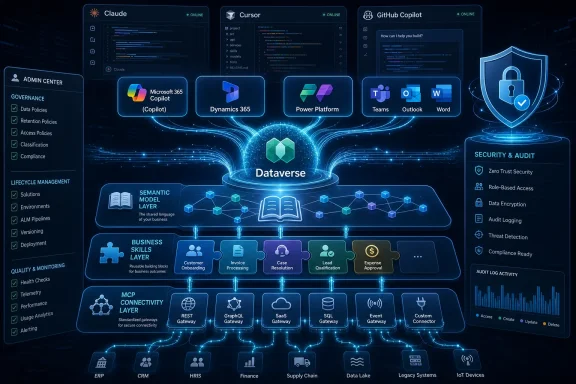
This is where Microsoft’s Dataverse strategy becomes more than a Power Platform feature update. The company is building a layered model: business data in Microsoft 365 Copilot for end users, semantic models and Business Skills for makers, MCP connectivity for extensibility, and coding-agent plugins for developers. It is a full-stack attempt to make Dataverse legible to machines.
For WindowsForum readers who manage Microsoft estates, that should sound familiar. Microsoft has repeatedly turned integration points into platforms: Active Directory for identity, SharePoint for collaboration, Teams for work hubs, Microsoft Graph for productivity context. Dataverse is now being moved toward the same role for agentic business context.
Copilot Finally Gets Closer to the Systems of Record
The headline feature for everyday users is Dataverse in Microsoft 365 Copilot, now in public preview. Microsoft says business data from Dynamics 365 and custom Power Platform apps can be combined with Microsoft 365 signals such as emails, meetings, and documents across Copilot experiences in the desktop Copilot app, Teams, Outlook, and Word.
That is the version of Copilot many organizations thought they were buying in the first place. Users do not want an assistant that knows only their inbox or only a CRM record. They want to ask, “What is going on with this customer?” and get an answer that understands the account history, the open support cases, the renewal email thread, the last Teams meeting, and the internal document that changed the pricing policy.
Until now, that kind of answer has often required custom grounding, connectors, indexing decisions, and a lot of hope. Microsoft’s claim is that Dataverse can supply the missing business layer so Copilot can reconcile enterprise records with work signals. If it works, the user experience becomes less about opening the right application and more about asking a business question in the flow of work.
That is powerful, but it also expands the blast radius of poor data hygiene. If Dataverse data is stale, relationships are wrong, field descriptions are inconsistent, or security roles are too broad, Copilot does not magically fix the underlying mess. It makes the mess conversational. For users, that can feel like intelligence. For admins, it can be a new class of exposure.
Public preview status matters here. Microsoft is not declaring the problem solved for every tenant, every region, and every compliance requirement. The announcement points to a future in which business data is available across Microsoft 365 Copilot surfaces, but administrators should treat this as an architecture to test carefully rather than a switch to flip casually.
Semantic Models Are Microsoft’s Dictionary for the Agent Era
The most strategically important piece of the announcement is Dataverse semantic models, now in public preview. Microsoft describes a semantic model as a curated unit of Dataverse tables enriched with system-inferred signals and human-curated input. In plain terms, it is the layer that tells agents how to interpret the data they are looking at.
That is not a minor addition. Enterprise databases are full of terms that make sense only inside an organization. A column named “status” may mean radically different things across sales, service, finance, and operations. A “case” in one business unit may be a support ticket; in another it may be a legal matter. An agent that treats schema as self-explanatory will eventually make a confident mistake.
Semantic models try to reduce that risk by combining data scope, semantic indexing, system-inferred signals, and maker-supplied glossary entries. Microsoft says the system can infer context from metadata such as relationships, views, forms, descriptions, and sample data. Makers can then add business definitions and exclude specific tables or stale artifacts.
This is a pragmatic design because it admits that neither automation nor human curation is enough on its own. System inference can scale across large Dataverse environments, but it will miss acronyms, political naming conventions, and process-specific meaning. Human input can fix those gaps, but it is expensive and easily neglected. The model Microsoft is proposing is a hybrid: let the platform infer the obvious, then ask makers to correct the business-specific parts.
The admin concern is that semantic context becomes yet another layer that must be governed. A bad glossary entry could be as damaging as a bad prompt. A model that includes sensitive tables could make confidential relationships easier for agents to reason about, even if downstream permissions still apply. A stale semantic model could preserve old assumptions long after the business process changed.
Still, this is the right problem to attack. If agents are going to do more than summarize rows, they need a shared vocabulary. Microsoft is betting that Dataverse can become that vocabulary for the Microsoft business application stack.
Business Skills Turn Process Knowledge Into Reusable Agent Behavior
Business Skills, now generally available, move the idea from data meaning to process execution. Microsoft’s premise is that organizations should not have to stuff every approval path, escalation rule, onboarding step, or dispatch procedure into an agent’s prompt. Instead, makers can define repeatable business processes as skills that agents discover and invoke when needed.
This is a meaningful departure from the early prompt-engineering phase of enterprise AI. Many organizations began by writing long agent instructions that attempted to encode everything the assistant should know. That works for demos and narrow scenarios. It breaks down when processes change, exceptions multiply, and multiple agents need to follow the same policy.
Business Skills introduce a more maintainable pattern. If the customer escalation process changes, a maker updates the skill rather than rewriting every agent. If multiple agents need the same onboarding procedure, they call the same skill. If the organization wants to inspect how a process is represented, it has a defined asset to review instead of a pile of scattered instructions.
That does not eliminate governance problems, but it makes them more tractable. Process knowledge becomes a managed object. It can be reviewed, versioned, published, shared, and retired. For regulated industries, that distinction matters. An undocumented agent prompt that “usually does the right thing” is hard to defend. A governed skill that maps to an approved process is at least auditable in principle.
The risk is that Business Skills could create a false sense of determinism. Agents invoking skills are still operating in probabilistic systems, and natural-language process descriptions are not the same as formally verified workflows. If the action is high-stakes, organizations will still need approvals, logging, constraints, and fallback paths. Skills are a better abstraction, not a substitute for control.
Skill Learning Shows Microsoft Knows the Blank Canvas Is the Enemy
Microsoft’s Business Skill Learning, now in public preview, is aimed at a practical problem: most organizations will not manually author a complete library of agent-ready skills from scratch. Their process knowledge is already buried in Power Platform environments, business process flows, apps, tables, automations, and solution assets. Skill Learning attempts to mine those existing artifacts and suggest skills that makers can review, refine, and publish.
That is exactly the kind of feature Microsoft needs if Business Skills are going to move beyond showcase scenarios. Enterprises already have years of Power Platform sprawl. Some of it is well-designed. Some of it is undocumented departmental machinery built by people who have since changed roles. Asking makers to reconstruct all that knowledge manually would be a recipe for slow adoption.
By discovering patterns from existing artifacts, Microsoft is effectively saying that the estate itself can become training material for the organization’s agent layer. That is clever. It also raises uncomfortable questions about what the system infers from old, messy, or unofficial processes.
Every sysadmin has seen workflows that encode yesterday’s workaround as today’s business rule. A legacy approval flow may exist because a former manager insisted on it. A table relationship may reflect a reporting hack rather than a true domain model. If Skill Learning turns operational sediment into recommended skills, makers will need to distinguish institutional knowledge from institutional clutter.
That review step is therefore not cosmetic. It is the control point. Microsoft can suggest the skill, but the organization has to decide whether the discovered pattern is still valid, compliant, and worth making agent-discoverable. The best implementations will treat Skill Learning as an accelerator for process archaeology, not an autopilot for governance.
MCP Gives Microsoft’s Agent Stack a Standard Doorway
The Model Context Protocol piece of the announcement is Microsoft’s bridge from Dataverse-centered business context to the wider tool ecosystem. Microsoft says its MCP catalog includes more than 60 servers and is designed to work across Microsoft 365 Copilot, Copilot Studio, Azure AI Foundry, GitHub Copilot, and other MCP-compatible experiences. The promise is one standard connection model for agents to discover and use tools.
For enterprises, the attraction is obvious. Agents need to interact with systems beyond Microsoft’s first-party stack. They need to check inventory, file tickets, update records, call internal APIs, and query specialized industry systems. A standardized protocol can reduce the number of bespoke integrations and make tool discovery more consistent.
For Microsoft, MCP is also a strategic hedge. The agent ecosystem is not going to be purely Microsoft-owned. Developers are using Claude, Cursor, GitHub Copilot, custom agents, open-source frameworks, and internal orchestration layers. By supporting MCP while wrapping it in Microsoft governance and certification, Microsoft can participate in the broader ecosystem without surrendering the enterprise control plane.
The certification angle matters for partners and customers. Microsoft says certified MCPs can become easier to discover and adopt, with trust signals around security, governance, and observability. That is the language IT buyers want to hear, especially as agent tools move from experiments to production workflows.
But certification should not be mistaken for risk elimination. An MCP server is a capability surface. If it exposes powerful actions, an agent can potentially misuse those actions unless permissions, approvals, scopes, logging, and tool descriptions are handled carefully. The protocol standardizes the door. It does not decide who should walk through it or what they are allowed to carry out.
Bring Your Own MCP Is Where the Real Enterprise Work Begins
Microsoft’s Bring Your Own MCP story is aimed at organizations with proprietary systems, custom workflows, and internal APIs that will never appear in a public catalog. The idea is to let customers register their own MCP servers and make them discoverable to agents under enterprise controls. This is where the strategy becomes most relevant to large IT shops.
Most businesses are not constrained only by lack of connectors. They are constrained by the weirdness of their own systems. A homegrown logistics API, a regional compliance workflow, an internal pricing engine, or an industry-specific case system may be far more important than a polished SaaS connector. If agents cannot reach those systems, they remain peripheral.
Bring Your Own MCP gives Microsoft a way to say: keep your custom systems, but connect them to the agent layer through a standard pattern. That could be valuable for organizations trying to avoid another generation of one-off bot integrations. Register once, govern centrally, and expose tools to the right agent scenarios.
The hard part will be operational discipline. Internal MCP servers will need lifecycle management, security review, schema documentation, observability, and ownership. Someone has to know when an endpoint changes. Someone has to decide whether an agent can call a destructive action. Someone has to monitor whether tools are being invoked in strange patterns.
In other words, BYO MCP turns agent integration into infrastructure. That is a good thing if infrastructure teams are involved early. It is a bad thing if citizen developers or individual product teams start publishing powerful internal tools without the same rigor applied to APIs, service principals, and automation accounts.
Coding Agents Bring Dataverse Development Into the Prompt Window
The developer-facing announcement is the Dataverse plugin for coding agents, now available across Claude, Cursor, and GitHub Copilot. Microsoft describes it as an open-source plugin that lets developers build and manage Dataverse solutions through natural language. It can route requests through the Dataverse MCP server, Python SDK, Power Platform CLI, or Dataverse CLI.
This is the most visible example of Microsoft adapting to the current developer tool reality. GitHub Copilot is Microsoft’s home turf, but Claude Code and Cursor are part of the modern coding-agent workflow for many developers. By expanding the Dataverse plugin into those marketplaces, Microsoft is meeting developers where they already are rather than insisting that all roads run through one IDE.
The productivity pitch is straightforward. A developer can describe a solution, ask the agent to connect to Dataverse, create tables, set relationships, build views, generate sample data, and query results without constantly jumping between documentation, portals, CLI syntax, and scripts. For Dataverse newcomers, that could flatten a steep learning curve.
For experienced Power Platform developers, the value may be different. The plugin could become an orchestration assistant for repetitive setup work, environment discovery, sample data generation, and solution scaffolding. That does not remove the need to understand Dataverse. It changes where the mechanical effort goes.
The governance claim is more important than the convenience claim. Microsoft says the plugin follows least-privilege patterns, documented authentication, and existing Dataverse role-based access control. That is essential because coding agents are not just autocomplete tools anymore. They can make changes to real environments. If natural language becomes a front end for solution development, permissions and environment boundaries become the safety rails.
The Windows Admin’s Problem Is No Longer Whether AI Is Coming
For Windows and Microsoft 365 administrators, this announcement should be read less as a product update and more as a warning about the next operating model. AI agents are moving from side panels into business process infrastructure. Dataverse is being positioned as the place where those agents find business data, meaning, skills, tools, and development scaffolding.
That shifts the admin burden. It is no longer enough to ask whether Copilot is enabled. IT teams will need to know which Dataverse environments are exposed to Copilot, which semantic models exist, which tables are included, which skills are published, which MCP servers are registered, and which coding agents can modify solutions. The control surface is widening.
This will be especially challenging in organizations where Power Platform governance is already uneven. Many tenants have multiple environments, inconsistent data loss prevention policies, maker-created apps, legacy flows, and unclear ownership. Adding an agent layer on top of that does not create chaos from nothing. It amplifies whatever governance posture already exists.
There is also a cultural issue. Business users will experience these features as convenience: fewer app switches, richer answers, faster process assistance. Makers will experience them as reusable context and process assets. Developers will experience them as natural-language tooling. Admins will experience them as another matrix of permissions, previews, connectors, identities, logs, and policy decisions.
That does not mean the strategy is wrong. It means the boring work matters more than the demo. The organizations that benefit most from Dataverse as an agent data platform will be the ones that already know what their data means, who owns their processes, and how changes move from experiment to production.
Microsoft’s Platform Bet Comes With a Familiar Lock-In Shadow
Every Microsoft platform story has two sides. On one side, integration reduces friction. On the other, integration increases dependence. Dataverse as the agent data platform is no exception.
The benefit is that Microsoft can connect pieces that many enterprises already use: Microsoft 365, Teams, Outlook, Word, Dynamics 365, Power Apps, Power Automate, Copilot Studio, Azure AI Foundry, GitHub Copilot, and Dataverse. If the semantic model and skill layer work across those surfaces, organizations get consistency without stitching everything together themselves.
The cost is that business meaning starts to accumulate inside Microsoft’s architecture. Glossaries, skills, semantic models, MCP registrations, and Dataverse-specific development flows become part of the enterprise’s operational representation. That may be fine for heavily Microsoft-aligned organizations. It may be less comfortable for companies trying to maintain a multi-cloud or vendor-neutral AI strategy.
MCP softens that concern but does not erase it. A standard protocol can make tools more portable, but the management plane, certification route, policy model, and Copilot integration still matter. If the best experience is inside Microsoft’s ecosystem, many customers will follow the path of least resistance.
The more interesting question is whether Microsoft can make this platform feel open enough for developers while controlled enough for CIOs. That balance is difficult. Developers want agent tools that can act. Security teams want those actions constrained. Business units want speed. Compliance teams want evidence. Dataverse is being asked to satisfy all four groups.
The July Dataverse Wave Turns Agent Hype Into Admin Work
Microsoft’s July 2026 Dataverse update is not just another Copilot feature drop; it is a blueprint for making business context a managed platform asset. That makes the announcement more important than its preview labels suggest, and it gives IT teams a concrete checklist for what comes next.
- Dataverse in Microsoft 365 Copilot is in public preview and is intended to bring Dynamics 365 and Power Platform business data into Copilot experiences such as the desktop Copilot app, Teams, Outlook, and Word.
- Dataverse semantic models are in public preview and give agents a curated context layer built from scoped tables, semantic indexing, inferred metadata signals, and maker-supplied glossary definitions.
- Business Skills are generally available and let makers define reusable process knowledge that agents can discover and invoke instead of relying on long, brittle prompt instructions.
- Business Skill Learning is in public preview and can suggest skills from existing Power Platform artifacts, but those suggestions still need human review before they become trusted process assets.
- Microsoft’s MCP catalog, MCP certification, and Bring Your Own MCP support point to a broader agent tool ecosystem where governance, observability, and permissions will matter as much as connectivity.
- The Dataverse plugin for coding agents now targets Claude, Cursor, and GitHub Copilot, pushing Dataverse solution development further into natural-language developer workflows.
The safest reading of Microsoft’s announcement is neither hype nor dismissal. Dataverse is becoming a more serious agent platform because Microsoft is attacking the right enterprise problems: meaning, process, extensibility, and governed development. But those problems do not disappear when they are wrapped in Copilot branding. They become part of the tenant’s architecture.
Microsoft’s bet is that the next phase of enterprise AI will be won not by the agent that speaks most fluently, but by the platform that knows the business well enough to act safely. Dataverse now has the pieces of that platform: semantic models for meaning, skills for process, MCP for tools, and plugins for developers. The next year will show whether customers can govern that stack quickly enough to trust it — and whether Microsoft can keep the agent layer from becoming another place where yesterday’s data problems reappear with a more convincing voice.
