

Microsoft’s June 2026 security update, published June 30, adds agentic vulnerability scanning, local AI-agent protection in Defender, generally available Entra Backup and Recovery, broader AWS and Google Cloud coverage, Purview reporting controls, and a unified identity risk score across Microsoft Security. The connective tissue is not another dashboard or another acronym. It is Microsoft’s attempt to make security follow the same operating model as the AI systems now spreading through enterprise environments: distributed, automated, and increasingly hard to inspect by hand.
That is both the promise and the tension in this month’s announcements. Microsoft is telling customers that the next security perimeter is not a network edge, a device, or even an identity. It is the chain of agents, code, databases, cloud resources, and privileged decisions that increasingly sits between a user’s intent and a real-world action.
The most important word in Microsoft’s June update is not “Defender,” “Entra,” or “Purview.” It is agentic. Microsoft is now designing security products around a world in which AI agents do not merely summarize alerts or draft remediation advice, but inspect code, invoke tools, call services, modify files, and participate in software delivery.
That changes the shape of enterprise risk. A chatbot that answers a question badly is a productivity nuisance. A local coding agent that can read repositories, run commands, interact with MCP servers, and push suggested fixes into an engineering pipeline is a different class of object entirely.
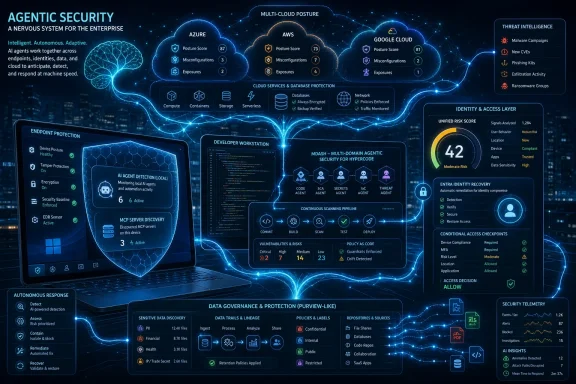
Microsoft’s framing is that security must become “ambient and autonomous,” mirroring the AI it protects. Strip away the marketing varnish and the argument is straightforward: if agents operate across user devices, developer workstations, cloud platforms, identity systems, and data stores, then security products cannot remain organized as isolated control planes. They need shared context, shared telemetry, and faster automation.
That is why this month’s announcements feel less like a random product roundup than a map of Microsoft’s preferred security architecture. Defender watches endpoints, agents, databases, and clouds. Entra protects identity state and recovery. Purview turns data exposure into something measurable. Developer security gets pushed earlier into coding workflows. The bet is that the Microsoft stack can become the fabric through which agent-era risk is discovered, scored, and remediated.
The practical ambition is easy to understand. Traditional scanners are good at known patterns and weak at deep context. Human security researchers are good at context but scarce, expensive, and slow to scale. Microsoft is trying to insert a coordinated group of AI agents into the gap: one model reasons through code paths, another validates exploitability, another maps findings into remediation workflows, and the final output lands somewhere security and engineering teams already work.
The private-preview status matters. MDASH is not being presented as a finished commodity scanner that every Windows admin can turn on tomorrow morning. It is a directional signal: Microsoft wants vulnerability management to become less like scheduled inspection and more like continuous adversarial reasoning.
That will be attractive to large organizations drowning in custom code, internal services, legacy applications, and AI-generated pull requests. It will also demand skepticism. AI-assisted vulnerability discovery has to prove not only that it can find subtle flaws, but that it can avoid flooding teams with plausible nonsense. The hard part is not producing an impressive finding in a demo; it is creating a dependable loop where discovery, validation, prioritization, and remediation all survive contact with production engineering.
The name “MDASH” may be temporary, but the product concept is not. Microsoft is building toward a security model in which AI is both the thing being defended and one of the principal tools used to defend it.
That is a significant expansion of what endpoint protection is expected to understand. For years, EDR products have watched processes, files, scripts, memory behavior, network connections, and user activity. Local AI agents blur those categories because they are ordinary software with extraordinary delegated authority. They may read untrusted content, interpret it as instructions, invoke tools, and operate in a developer’s security context.
Prompt injection is the obvious threat model, but not the only one. A malicious README, issue comment, web page, dependency description, or document can potentially become an instruction source for an agent that has access to files, terminals, credentials, repositories, or cloud tooling. The old distinction between data and command starts to erode.
Defender’s runtime blocking claim is therefore more than another preview feature. It is Microsoft acknowledging that endpoint security must understand agent intent, not merely process behavior. If an AI coding agent is about to execute a destructive command because a poisoned input told it to, the useful control point is before execution, not after the SOC receives an alert saying something strange happened.
The Advanced Hunting angle is equally important. Enterprises will not trust local agents if they cannot inventory them. They need to know which agents exist, which MCP servers are configured, what tools are exposed, and where risky combinations of permissions and content sources appear. Visibility is the first battle; runtime control is the second.
Microsoft’s Defender update should be read against that backdrop. If MCP servers are installed casually by developers, generated by AI tools, pulled from community repositories, or configured without central review, they become a new form of shadow IT. The difference is that this shadow IT may not merely store data or call an API. It may allow an agent to act.
That distinction matters for Windows and macOS endpoint management. A developer workstation has always been a dangerous place because it contains source code, credentials, package managers, terminals, build systems, and access to internal infrastructure. Add local agents and MCP servers, and the workstation becomes a semi-autonomous execution environment.
Microsoft’s answer is to fold agent discovery into Defender rather than treat it as a separate governance problem. That makes sense commercially and technically. Defender already sits close to the device. It already feeds Microsoft’s broader XDR story. It already gives SOC teams a query surface through Advanced Hunting.
But the larger lesson for administrators is that agent inventory is about to join browser extensions, local admin rights, unmanaged scripts, and third-party remote tools on the list of things that cannot be ignored. If an agent can touch code, secrets, tickets, cloud resources, or customer data, it belongs in the asset inventory.
Identity recovery is one of those areas where organizations often discover their weakness only after a crisis begins. Backing up files is familiar. Backing up SaaS configuration, directory objects, policy state, and identity relationships is messier. Yet in Microsoft 365 and Azure environments, the identity layer is the operating system of the enterprise.
The new Entra capability gives teams the ability to back up core directory objects, compare against previous timestamps, restore earlier states, and protect against permanent deletion through Conditional Access controls. The most important word here is “native.” Microsoft is positioning this not as an add-on backup island but as a built-in resilience layer for the tenant itself.
That matters because identity is both a control plane and an attack target. A compromised tenant can produce cascading damage: privilege escalation, policy changes, app consent abuse, account tampering, and lockout conditions that make response harder. Recovery is not merely an administrative convenience; it is part of incident response.
For IT pros, this is the kind of feature that should trigger a runbook review. If Entra state can now be compared and restored more directly, organizations should define who can initiate recovery, which objects are in scope, how often restore procedures are tested, and how recovery interacts with change management. The best backup feature in the world is still only as good as the team’s ability to use it under pressure.
The June update adds support for roughly 90 additional resource types and more than 200 new security recommendations across AWS and Google Cloud. Defender for Cloud also now extends database threat protection to open-source relational databases on AWS RDS, with built-in detection for anomalous access patterns and brute-force attempts, plus automated sensitive data discovery.
This is Microsoft turning Defender into a posture-management and threat-detection layer for infrastructure it does not own. Strategically, that is essential. If Defender only tells a security team what is wrong in Azure, it is incomplete by design. If it correlates exposure, compliance posture, identities, workloads, and data risk across multiple clouds, it becomes harder to replace.
The AWS RDS database protection piece is particularly practical. Open-source relational databases are everywhere, and managed database services can lull teams into a false sense of completion. The cloud provider handles parts of the infrastructure; the customer still owns access patterns, data classification, application behavior, credentials, and abuse detection.
For security teams, the challenge is prioritization. More coverage can mean more recommendations, and more recommendations can mean more ignored dashboards. Microsoft’s pitch is that exposure context and business criticality will help teams focus on what matters. The burden will be on Defender for Cloud to prove that expanded visibility translates into fewer risky blind spots, not just a larger pile of findings.
Data security is rarely blocked by a total lack of telemetry. It is blocked by mismatched incentives, unclear ownership, and arguments over which risks deserve budget and disruption. A security team may care about exposed sensitive data. A business unit may care about workflow continuity. Legal may care about retention and discovery. Executives may care about trend lines and regulatory posture.
Custom reporting matters because different stakeholders need different lenses on the same underlying risk. A CISO wants exposure trends and risk concentration. A data owner wants to know which repositories or teams are creating the problem. An auditor wants evidence of process. A security engineer wants actionable objects and policies.
Purview’s new flexibility gives organizations a way to tailor those views without exporting everything into a separate analytics project. That does not solve data security on its own, but it can reduce the friction between detection and decision. In mature environments, the report is not the end product. It is the artifact that forces a conversation about ownership.
The broader Microsoft strategy is also visible here. Purview tells you where sensitive data lives and how exposed it is. Defender tells you where threats and risky configurations exist. Entra tells you who has access and how risky that identity appears. The more Microsoft can make those products reinforce one another, the more it can argue that security teams should manage risk through one integrated estate rather than stitched-together tools.
Security teams already live with too many risk indicators. Sign-in risk, user risk, device risk, app risk, session anomalies, impossible travel, suspicious inbox rules, token theft signals, privilege changes, and lateral movement indicators all compete for attention. A unified score promises relief by translating many weak and strong signals into a prioritized view.
The danger is over-trust. A single number can clarify, but it can also conceal. If administrators do not understand why a score changed, what signals influenced it, and how automation will respond, the score becomes a black box with policy consequences. Microsoft’s emphasis on explainability is therefore not decorative; it is the difference between useful automation and risky delegation.
The Conditional Access integration is where the score becomes operational. If suspicious behavior can automatically trigger stronger controls at the point of access, Microsoft can compress the time between detection and enforcement. That is the dream of adaptive security: do not wait for a human to triage every anomaly before reducing risk.
But adaptive enforcement must be tuned carefully. False positives can lock out legitimate users, interrupt business processes, or train employees to route around controls. False negatives can provide a comforting score while an attacker advances. The most useful identity risk score will be one that security teams can interrogate, test, and phase into enforcement gradually.
This is the only plausible direction for software security in the AI era. If developers are using Copilot-style tools, local agents, cloud agents, AI-assisted fixes, generated code, and agent-accessible build systems, then security review cannot remain a late-stage gate. It must move into the moment when code is written, changed, explained, tested, and deployed.
The arrival of agentic development makes that more urgent. A human developer may introduce a vulnerability by mistake. An AI coding agent may do so at machine speed, across many files, while confidently explaining why its change is correct. The traditional review bottleneck does not scale well against automated code production.
Microsoft’s strategy is to connect developer tooling with security visibility. If a vulnerability is found, AI-assisted remediation can be proposed. If an agent is risky, Defender can observe it. If a codebase has hidden weaknesses, MDASH may eventually reason through them. If deployment touches cloud resources, Defender for Cloud can assess posture. The desired endpoint is a loop where security findings are not merely reported but routed into the systems where fixes happen.
That is attractive, but it also shifts responsibility. Developers will be asked to trust security tools that intervene earlier. Security teams will be asked to understand developer workflows deeply enough not to break them. Platform teams will be asked to govern agents, repositories, identities, and cloud permissions as one system.
A local AI agent running in a poorly managed developer environment is not magically safer because Defender can detect some prompt-injection attempts. A unified identity risk score will not help if Conditional Access policies are politically impossible to enforce. Multicloud recommendations will not reduce risk if no team owns the backlog. Purview reports will not change behavior if business units are rewarded for speed and punished for delay.
The automation layer also creates a new dependency on Microsoft’s judgment. As more security decisions are expressed through scores, agentic scans, runtime blocks, and integrated workflows, customers need confidence that the system is explainable and controllable. The future Microsoft describes is not a human SOC replaced by machines. It is a human SOC increasingly supervising machine-generated judgments.
That supervision requires skills many organizations are still building. Security teams will need to understand prompt injection, MCP server exposure, agent permissions, AI-assisted development risks, and model-driven remediation. They will also need to preserve the fundamentals: least privilege, inventory, patching, segmentation, backup testing, and incident response.
The June announcements are strongest when they reinforce those fundamentals rather than pretend to replace them. Entra Backup and Recovery is classic resilience. Defender’s agent discovery is asset inventory. Purview reporting is governance. Defender for Cloud recommendations are posture management. MDASH is vulnerability research at scale. The AI layer is new, but the security disciplines underneath are familiar.
That is both the promise and the tension in this month’s announcements. Microsoft is telling customers that the next security perimeter is not a network edge, a device, or even an identity. It is the chain of agents, code, databases, cloud resources, and privileged decisions that increasingly sits between a user’s intent and a real-world action.
 Microsoft Moves the Security Center of Gravity Toward the Agent
The most important word in Microsoft’s June update is not “Defender,” “Entra,” or “Purview.” It is agentic. Microsoft is now designing security products around a world in which AI agents do not merely summarize alerts or draft remediation advice, but inspect code, invoke tools, call services, modify files, and participate in software delivery.That changes the shape of enterprise risk. A chatbot that answers a question badly is a productivity nuisance. A local coding agent that can read repositories, run commands, interact with MCP servers, and push suggested fixes into an engineering pipeline is a different class of object entirely.
Microsoft’s framing is that security must become “ambient and autonomous,” mirroring the AI it protects. Strip away the marketing varnish and the argument is straightforward: if agents operate across user devices, developer workstations, cloud platforms, identity systems, and data stores, then security products cannot remain organized as isolated control planes. They need shared context, shared telemetry, and faster automation.
That is why this month’s announcements feel less like a random product roundup than a map of Microsoft’s preferred security architecture. Defender watches endpoints, agents, databases, and clouds. Entra protects identity state and recovery. Purview turns data exposure into something measurable. Developer security gets pushed earlier into coding workflows. The bet is that the Microsoft stack can become the fabric through which agent-era risk is discovered, scored, and remediated.
MDASH Shows Microsoft Wants AI to Hunt Bugs Before Attackers Do
Codename MDASH is the flashiest announcement in the June bundle because it applies the agent story to vulnerability discovery itself. Microsoft describes it as a multi-model agentic scanning system that coordinates specialized AI agents to discover, validate, and help remediate complex software vulnerabilities across proprietary code and systems.The practical ambition is easy to understand. Traditional scanners are good at known patterns and weak at deep context. Human security researchers are good at context but scarce, expensive, and slow to scale. Microsoft is trying to insert a coordinated group of AI agents into the gap: one model reasons through code paths, another validates exploitability, another maps findings into remediation workflows, and the final output lands somewhere security and engineering teams already work.
The private-preview status matters. MDASH is not being presented as a finished commodity scanner that every Windows admin can turn on tomorrow morning. It is a directional signal: Microsoft wants vulnerability management to become less like scheduled inspection and more like continuous adversarial reasoning.
That will be attractive to large organizations drowning in custom code, internal services, legacy applications, and AI-generated pull requests. It will also demand skepticism. AI-assisted vulnerability discovery has to prove not only that it can find subtle flaws, but that it can avoid flooding teams with plausible nonsense. The hard part is not producing an impressive finding in a demo; it is creating a dependable loop where discovery, validation, prioritization, and remediation all survive contact with production engineering.
The name “MDASH” may be temporary, but the product concept is not. Microsoft is building toward a security model in which AI is both the thing being defended and one of the principal tools used to defend it.
Defender’s New Endpoint Job Is Watching the Tools That Watch Everything Else
Microsoft Defender’s new preview support for local AI agents and MCP servers may prove more immediately relevant to WindowsForum readers than MDASH. Defender can now discover more than 25 types of local AI agents and Model Context Protocol servers across managed Windows and macOS devices, and Microsoft says it can detect and block prompt-injection attempts against developer agents such as GitHub Copilot CLI and Claude Code before malicious actions execute.That is a significant expansion of what endpoint protection is expected to understand. For years, EDR products have watched processes, files, scripts, memory behavior, network connections, and user activity. Local AI agents blur those categories because they are ordinary software with extraordinary delegated authority. They may read untrusted content, interpret it as instructions, invoke tools, and operate in a developer’s security context.
Prompt injection is the obvious threat model, but not the only one. A malicious README, issue comment, web page, dependency description, or document can potentially become an instruction source for an agent that has access to files, terminals, credentials, repositories, or cloud tooling. The old distinction between data and command starts to erode.
Defender’s runtime blocking claim is therefore more than another preview feature. It is Microsoft acknowledging that endpoint security must understand agent intent, not merely process behavior. If an AI coding agent is about to execute a destructive command because a poisoned input told it to, the useful control point is before execution, not after the SOC receives an alert saying something strange happened.
The Advanced Hunting angle is equally important. Enterprises will not trust local agents if they cannot inventory them. They need to know which agents exist, which MCP servers are configured, what tools are exposed, and where risky combinations of permissions and content sources appear. Visibility is the first battle; runtime control is the second.
MCP Servers Are Becoming the New Shadow IT
The Model Context Protocol has quickly become one of the most consequential pieces of plumbing in the AI developer ecosystem. Its purpose is sensible: give AI tools a standardized way to connect to external systems, data, and actions. Its risk is equally obvious: every connector becomes a possible bridge between untrusted instructions and privileged capabilities.Microsoft’s Defender update should be read against that backdrop. If MCP servers are installed casually by developers, generated by AI tools, pulled from community repositories, or configured without central review, they become a new form of shadow IT. The difference is that this shadow IT may not merely store data or call an API. It may allow an agent to act.
That distinction matters for Windows and macOS endpoint management. A developer workstation has always been a dangerous place because it contains source code, credentials, package managers, terminals, build systems, and access to internal infrastructure. Add local agents and MCP servers, and the workstation becomes a semi-autonomous execution environment.
Microsoft’s answer is to fold agent discovery into Defender rather than treat it as a separate governance problem. That makes sense commercially and technically. Defender already sits close to the device. It already feeds Microsoft’s broader XDR story. It already gives SOC teams a query surface through Advanced Hunting.
But the larger lesson for administrators is that agent inventory is about to join browser extensions, local admin rights, unmanaged scripts, and third-party remote tools on the list of things that cannot be ignored. If an agent can touch code, secrets, tickets, cloud resources, or customer data, it belongs in the asset inventory.
Entra Backup and Recovery Is the Boring Feature That May Save the Weekend
Not every important security announcement is glamorous. Microsoft Entra Backup and Recovery, now generally available, is a case in point. Microsoft-managed, always-on backups for critical identity data sound dull until someone deletes the wrong object, misconfigures a tenant, or an attacker tampers with identity infrastructure during a compromise.Identity recovery is one of those areas where organizations often discover their weakness only after a crisis begins. Backing up files is familiar. Backing up SaaS configuration, directory objects, policy state, and identity relationships is messier. Yet in Microsoft 365 and Azure environments, the identity layer is the operating system of the enterprise.
The new Entra capability gives teams the ability to back up core directory objects, compare against previous timestamps, restore earlier states, and protect against permanent deletion through Conditional Access controls. The most important word here is “native.” Microsoft is positioning this not as an add-on backup island but as a built-in resilience layer for the tenant itself.
That matters because identity is both a control plane and an attack target. A compromised tenant can produce cascading damage: privilege escalation, policy changes, app consent abuse, account tampering, and lockout conditions that make response harder. Recovery is not merely an administrative convenience; it is part of incident response.
For IT pros, this is the kind of feature that should trigger a runbook review. If Entra state can now be compared and restored more directly, organizations should define who can initiate recovery, which objects are in scope, how often restore procedures are tested, and how recovery interacts with change management. The best backup feature in the world is still only as good as the team’s ability to use it under pressure.
Microsoft’s Multicloud Message Is Pragmatic, Not Sentimental
Microsoft Defender for Cloud’s expanded support for AWS and Google Cloud is another reminder that Microsoft has accepted the enterprise reality it once fought. Most large organizations are not single-cloud shops. They run Azure because Microsoft is already deeply embedded in identity, productivity, and developer workflows. They also run AWS, Google Cloud, SaaS platforms, private infrastructure, and plenty of services no central team fully controls.The June update adds support for roughly 90 additional resource types and more than 200 new security recommendations across AWS and Google Cloud. Defender for Cloud also now extends database threat protection to open-source relational databases on AWS RDS, with built-in detection for anomalous access patterns and brute-force attempts, plus automated sensitive data discovery.
This is Microsoft turning Defender into a posture-management and threat-detection layer for infrastructure it does not own. Strategically, that is essential. If Defender only tells a security team what is wrong in Azure, it is incomplete by design. If it correlates exposure, compliance posture, identities, workloads, and data risk across multiple clouds, it becomes harder to replace.
The AWS RDS database protection piece is particularly practical. Open-source relational databases are everywhere, and managed database services can lull teams into a false sense of completion. The cloud provider handles parts of the infrastructure; the customer still owns access patterns, data classification, application behavior, credentials, and abuse detection.
For security teams, the challenge is prioritization. More coverage can mean more recommendations, and more recommendations can mean more ignored dashboards. Microsoft’s pitch is that exposure context and business criticality will help teams focus on what matters. The burden will be on Defender for Cloud to prove that expanded visibility translates into fewer risky blind spots, not just a larger pile of findings.
Purview’s Custom Reports Admit That Data Security Is Political
Microsoft Purview’s customizable reports in Data Security Posture Management are now generally available, and that may sound like the least dramatic item in the June update. It is not. Reporting is where security strategy meets organizational politics.Data security is rarely blocked by a total lack of telemetry. It is blocked by mismatched incentives, unclear ownership, and arguments over which risks deserve budget and disruption. A security team may care about exposed sensitive data. A business unit may care about workflow continuity. Legal may care about retention and discovery. Executives may care about trend lines and regulatory posture.
Custom reporting matters because different stakeholders need different lenses on the same underlying risk. A CISO wants exposure trends and risk concentration. A data owner wants to know which repositories or teams are creating the problem. An auditor wants evidence of process. A security engineer wants actionable objects and policies.
Purview’s new flexibility gives organizations a way to tailor those views without exporting everything into a separate analytics project. That does not solve data security on its own, but it can reduce the friction between detection and decision. In mature environments, the report is not the end product. It is the artifact that forces a conversation about ownership.
The broader Microsoft strategy is also visible here. Purview tells you where sensitive data lives and how exposed it is. Defender tells you where threats and risky configurations exist. Entra tells you who has access and how risky that identity appears. The more Microsoft can make those products reinforce one another, the more it can argue that security teams should manage risk through one integrated estate rather than stitched-together tools.
The Unified Identity Risk Score Is Microsoft’s Attempt to Turn Noise Into Authority
The new unified identity risk score may be one of the most consequential announcements in the June update because identity risk is where modern security incidents often become urgent. Microsoft says the score combines signals from across Microsoft Security into a single explainable measure for an identity, bringing together behavior, access patterns, threat intelligence, related accounts, sessions, and applications.Security teams already live with too many risk indicators. Sign-in risk, user risk, device risk, app risk, session anomalies, impossible travel, suspicious inbox rules, token theft signals, privilege changes, and lateral movement indicators all compete for attention. A unified score promises relief by translating many weak and strong signals into a prioritized view.
The danger is over-trust. A single number can clarify, but it can also conceal. If administrators do not understand why a score changed, what signals influenced it, and how automation will respond, the score becomes a black box with policy consequences. Microsoft’s emphasis on explainability is therefore not decorative; it is the difference between useful automation and risky delegation.
The Conditional Access integration is where the score becomes operational. If suspicious behavior can automatically trigger stronger controls at the point of access, Microsoft can compress the time between detection and enforcement. That is the dream of adaptive security: do not wait for a human to triage every anomaly before reducing risk.
But adaptive enforcement must be tuned carefully. False positives can lock out legitimate users, interrupt business processes, or train employees to route around controls. False negatives can provide a comforting score while an attacker advances. The most useful identity risk score will be one that security teams can interrogate, test, and phase into enforcement gradually.
Developer Security Is No Longer a Sidecar
Microsoft’s June roundup points back to its Build 2026 security announcements, where the company emphasized securing code, agents, and models across the development lifecycle. That phrasing is doing a lot of work. Microsoft is not just trying to sell another scanner to security teams; it is trying to embed security controls into the tools developers already use.This is the only plausible direction for software security in the AI era. If developers are using Copilot-style tools, local agents, cloud agents, AI-assisted fixes, generated code, and agent-accessible build systems, then security review cannot remain a late-stage gate. It must move into the moment when code is written, changed, explained, tested, and deployed.
The arrival of agentic development makes that more urgent. A human developer may introduce a vulnerability by mistake. An AI coding agent may do so at machine speed, across many files, while confidently explaining why its change is correct. The traditional review bottleneck does not scale well against automated code production.
Microsoft’s strategy is to connect developer tooling with security visibility. If a vulnerability is found, AI-assisted remediation can be proposed. If an agent is risky, Defender can observe it. If a codebase has hidden weaknesses, MDASH may eventually reason through them. If deployment touches cloud resources, Defender for Cloud can assess posture. The desired endpoint is a loop where security findings are not merely reported but routed into the systems where fixes happen.
That is attractive, but it also shifts responsibility. Developers will be asked to trust security tools that intervene earlier. Security teams will be asked to understand developer workflows deeply enough not to break them. Platform teams will be asked to govern agents, repositories, identities, and cloud permissions as one system.
The New Stack Still Has Old Failure Modes
Microsoft’s June security story is coherent, but coherence should not be mistaken for completion. Agent-era security inherits all the old problems: overprivileged identities, unmanaged endpoints, stale assets, weak logging, fragmented ownership, alert fatigue, and slow remediation. AI does not erase those weaknesses. In some cases, it amplifies them.A local AI agent running in a poorly managed developer environment is not magically safer because Defender can detect some prompt-injection attempts. A unified identity risk score will not help if Conditional Access policies are politically impossible to enforce. Multicloud recommendations will not reduce risk if no team owns the backlog. Purview reports will not change behavior if business units are rewarded for speed and punished for delay.
The automation layer also creates a new dependency on Microsoft’s judgment. As more security decisions are expressed through scores, agentic scans, runtime blocks, and integrated workflows, customers need confidence that the system is explainable and controllable. The future Microsoft describes is not a human SOC replaced by machines. It is a human SOC increasingly supervising machine-generated judgments.
That supervision requires skills many organizations are still building. Security teams will need to understand prompt injection, MCP server exposure, agent permissions, AI-assisted development risks, and model-driven remediation. They will also need to preserve the fundamentals: least privilege, inventory, patching, segmentation, backup testing, and incident response.
The June announcements are strongest when they reinforce those fundamentals rather than pretend to replace them. Entra Backup and Recovery is classic resilience. Defender’s agent discovery is asset inventory. Purview reporting is governance. Defender for Cloud recommendations are posture management. MDASH is vulnerability research at scale. The AI layer is new, but the security disciplines underneath are familiar.
The June Drop Turns AI Security From Slogan Into Operating Model
The most concrete lesson from Microsoft’s June 2026 update is that the company is treating AI security as an operating model, not a feature category. That matters because agent adoption will not wait for perfect governance frameworks. The tools are already landing on developer machines, in cloud environments, and inside business workflows.- Microsoft’s June security update extends protection across AI agents, identity recovery, multicloud posture, data reporting, database threat detection, and developer workflows.
- Codename MDASH signals Microsoft’s push toward AI-assisted vulnerability discovery that can connect findings to remediation pipelines rather than leaving them as static reports.
- Defender’s preview support for local AI agents and MCP servers makes endpoint inventory and runtime prompt-injection protection part of the normal security conversation.
- Entra Backup and Recovery gives identity teams a native resilience tool for restoring critical directory objects after accidental changes or security compromises.
- Defender for Cloud’s expanded AWS and Google Cloud coverage shows Microsoft is competing to be the security control plane for mixed estates, not just Azure tenants.
- The unified identity risk score could become powerful if organizations treat it as explainable decision support rather than an unquestioned automation trigger.
References
- Primary source: Microsoft
Published: 2026-06-30T16:10:12.797165
What’s new in Microsoft Security: June 2026 | Microsoft Security Blog
This month’s updates help security and IT teams strengthen identity and multicloud foundations, protect data wherever it lives, and secure the developer workflows powering AI innovation.www.microsoft.com - Official source: learn.microsoft.com
Microsoft Entra Backup and Recovery overview - Microsoft Entra | Microsoft Learn
Learn how Microsoft Entra Backup and Recovery helps you recover from malicious attacks or accidental changes to tenant objectslearn.microsoft.com - Official source: blogs.microsoft.com
Microsoft Build 2026: Be yourself at work - The Official Microsoft Blog
Platforms shift when developers build. We explore, choose tools, dream, create. This platform shift comes with more information than ever, ready at your fingertips. This shift, it’s about building fast AND THEN: it’s about building, operating, optimizing and observing. Securing your...blogs.microsoft.com - Official source: devblogs.microsoft.com
Build agents you can trust across any framework with open evals and a control standard | Microsoft Foundry Blog
Learn how Microsoft helps developers build trustworthy AI agents with open evaluations, portable runtime controls, production observability, and security workflows that work across frameworks.devblogs.microsoft.com - Official source: news.microsoft.com
Build 2026: 開発ライフサイクル全体でコード、AI エージェント、モデルを保護する - Source Asia
MDASH を中心に、コード、AI エージェント、モデルを包括的に守る最新セキュリティを解説。Build 2026 で発表された開発と安全性を両立する取り組みを紹介します。news.microsoft.com - Official source: blogs.windows.com
Windows platform security for AI agents
Making Windows the trustworthy OS for agents AI agents are no longer just answering questions, they are taking actions across systems with increasing autonomy. As they become persistent participants in how software runs, they introduce new rblogs.windows.com
- Related coverage: tomshardware.com
Microsoft unveils Project Solara AI, a chip-to-cloud platform built to power a new generation of 'agent-first' enterprise devices — hardware designed to run AI agents instead of traditional apps | Tom's Hardware
Microsoft ditches Windows to build OS on Androidwww.tomshardware.com - Related coverage: windowscentral.com
Microsoft outlines its vision for “the next computer” with Project Solara, an agentic platform that exists liminally in your pocket and on your desk | Windows Central
After Windows Phone, Microsoft is eager to get ahead of the next paradigm shift in computing, and it's betting big on an agentic hardware and software future.www.windowscentral.com - Related coverage: techradar.com
Microsoft warns AI agents are being 'AutoJack'-ed to deliver RCE payloads by browsing untrusted websites | TechRadar
Three minor vulnerabilities chained together can cause a lot of troublewww.techradar.com - Related coverage: tomsguide.com
Biggest Microsoft Build 2026 announcements — agentic AI, RTX Spark Dev Box, GitHub Copilot app, new MAI models, and more | Tom's Guide
All the big news from Microsoft's AI-focused eventwww.tomsguide.com - Official source: cdn-dynmedia-1.microsoft.com
Secure Future Initiative
Cybersecurity Strategy, Secure Engineering, AI Security, Cyber Governance, Cloud Resilience, Secure-by-Design Principlescdn-dynmedia-1.microsoft.com
- Related coverage: cyberdefensemagazine.com
