

Microsoft’s placement as a Leader in the 2025 Gartner® Magic Quadrant™ for CRM Customer Engagement Center marks a consequential moment for enterprise customer service: the vendor’s product strategy has moved from incremental AI assistant features to a deliberate, agentic-service play built around autonomous agents, embedded Copilot experiences, and deep Dynamics 365 integrations.
Gartner’s Magic Quadrant for CRM Customer Engagement Center (CRM CEC) evaluates vendors on two axes — Ability to Execute and Completeness of Vision — and places products that combine scale, integration, roadmap clarity, and measurable outcomes into the Leaders quadrant. The 2025 CRM CEC report, authored by Gartner analysts and published in October, identifies a cohort of vendors advancing AI-first service platforms and contact-center capabilities. Microsoft’s announcement frames the placement as recognition of strategic investments across Dynamics 365 Customer Service, Dynamics 365 Contact Center, and the broader Microsoft 365 / Azure stack. The vendor emphasizes a shift it calls agentic service — a mode in which lightweight autonomous agents continuously monitor, analyze, and act across both self-service and human-assisted channels. Those capabilities, Microsoft argues, accelerate case resolution, keep knowledge current, and deliver real-time quality insights.
Other major vendors were also vocal around Gartner’s CRM CEC release: Zendesk positioned its Resolution Platform and AI agent suite as a central reason for Leader placement, and Oracle likewise reiterated AI, orchestration, and end-to-end service capabilities in its communications. These statements confirm that Gartner’s 2025 analysis centers on AI-driven orchestration and agent frameworks as primary differentiators.
That said, real-world success will hinge on disciplined pilots, measurable KPIs, strong model governance, and careful TCO management. Buyers should treat Microsoft’s Leader placement as a strong signal but continue to demand independent verification, reference checks, and contractual protections before scaling agentic service across mission-critical channels. The broader market is now moving decisively toward agentic service; the next 12–24 months will separate proof-of-concept novelty from durable, governed production at scale.
Source: Microsoft Microsoft is named a Leader in 2025 Gartner® Magic Quadrant™ for CRM Customer Engagement Center - Microsoft Dynamics 365 Blog
 Background / Overview
Gartner’s Magic Quadrant for CRM Customer Engagement Center (CRM CEC) evaluates vendors on two axes — Ability to Execute and Completeness of Vision — and places products that combine scale, integration, roadmap clarity, and measurable outcomes into the Leaders quadrant. The 2025 CRM CEC report, authored by Gartner analysts and published in October, identifies a cohort of vendors advancing AI-first service platforms and contact-center capabilities. Microsoft’s announcement frames the placement as recognition of strategic investments across Dynamics 365 Customer Service, Dynamics 365 Contact Center, and the broader Microsoft 365 / Azure stack. The vendor emphasizes a shift it calls agentic service — a mode in which lightweight autonomous agents continuously monitor, analyze, and act across both self-service and human-assisted channels. Those capabilities, Microsoft argues, accelerate case resolution, keep knowledge current, and deliver real-time quality insights.Other major vendors were also vocal around Gartner’s CRM CEC release: Zendesk positioned its Resolution Platform and AI agent suite as a central reason for Leader placement, and Oracle likewise reiterated AI, orchestration, and end-to-end service capabilities in its communications. These statements confirm that Gartner’s 2025 analysis centers on AI-driven orchestration and agent frameworks as primary differentiators.
Why this placement matters
Market validation for an “agentic” roadmap
Being named a Leader in Gartner’s CRM CEC MQ is more than a marketing badge — it provides commercial validation that Microsoft can both execute at scale and articulate a forward-looking roadmap for service automation. For buyers this means:- Faster procurement conversations with reduced vendor evaluation friction.
- Greater expectation of product maturity, enterprise-readiness, and partner ecosystem depth.
- Increased pressure on competitors to deliver comparable agent frameworks, knowledge automation, and observability for AI-driven interactions.
What Gartner’s evaluation implies operationally
Gartner’s MQ evaluates elements such as product capabilities, customer experience, customer references, market responsiveness, and innovation. A Leader placement implies Microsoft meets or exceeds expectations in:- Enterprise-grade omnichannel routing and case management;
- Integration across productivity tools (Teams, Outlook, Microsoft 365);
- Roadmap evidence for Copilot / agentic scenarios and platform extensibility.
What Microsoft is shipping: the agent suite explained
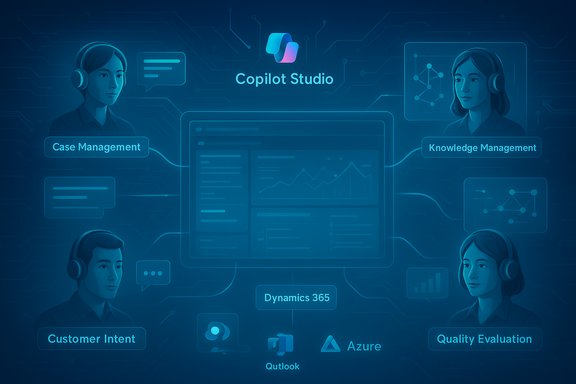
Microsoft’s public announcement lists a set of agents available across the Dynamics 365 service lifecycle. These are framed as the foundational components of “agentic service”:- Case Management Agent — automates case creation, status updates, follow-ups, and timely closures, reducing clerical work for front-line agents.
- Customer Knowledge Management Agent — continuously updates and authors knowledge articles by extracting insights from cases, conversations, emails, and notes.
- Customer Intent Agent — analyzes customer interactions to detect emerging intent and surface resolution paths to enable evergreen self-service and smoother assisted service handoffs.
- Quality Evaluation Agent — supplies supervisors with real-time quality metrics across AI-led and human-assisted interactions, plus prescriptive recommendations for coaching and improvement.
Why these agents matter practically
- Reduced handling time and higher throughput: automating case creation and routine updates reduces busywork and lets agents focus on value-added tasks.
- Continuously fresh knowledge: knowledge drift is a long-standing contact-center problem; automated article creation and revision help keep self-service accurate.
- Data-driven quality control: real-time QA and suggested coaching interventions help preserve experience consistency as AI handles more interactions.
- Scalability with fewer seats: customers that automate routine queries can avoid linear increases in human headcount during peaks.
Customer evidence: real gains — and how to interpret them
Microsoft cites several customer stories to illustrate outcomes:- Rheem Manufacturing: on track for a 14% total improvement in average call-handling time and early signs of improved CSAT scores after deploying Dynamics 365 Customer Service.
- yourtown (charity): reports faster, more empathetic interactions, with agents used to gather information, route contacts, and streamline resolution—helpful where demand exceeds capacity.
- California State University, San Marcos (CSUSM): using agents to enable personalized 24/7 self-service and give staff better continuity information.
- Vera Bradley: a Copilot Studio–built autonomous chat-based self-service agent automates over 2,000 monthly support cases and reduced live chat escalations by 25%, alleviating agent load during peaks.
Caveats and verification
- All the above figures come from Microsoft’s customer narratives and quotes published as part of its announcement. While vendor-case numbers are useful signals, they are typically provided under commercial case-study conditions and are not the same as independently audited outcomes.
- For procurement and program planning, these metrics should be treated as starting points for due diligence rather than guaranteed results. Buyers should request reference checks, data access for pilot validation, and documented KPIs tied to production SLAs and cost models.
Technical anatomy: where agentic service sits in Microsoft’s stack
Microsoft’s agentic features are not a standalone product; they are embedded across the Dynamics 365, Copilot, Power Platform, and Azure ecosystems. Key integration points include:- Microsoft Copilot Studio — used to create bespoke agents and autonomous chat-based self-service experiences that can integrate back into Dynamics 365 workflows.
- Dynamics 365 Customer Service — the CRM/CEC product that acts as the system of record for cases, contacts, and workflow orchestration.
- Azure & Azure OpenAI Service — inference, model-hosting and managed AI services that underpin generative capabilities and agent logic.
- Power Platform (Power Automate, Power Apps) — for workflow automation, custom connectors, and low-code assembly of agent-triggered processes.
Competitive landscape: not the only Leader — but a distinct approach
Gartner’s 2025 CRM CEC Magic Quadrant places multiple vendors in the Leaders quadrant, including Zendesk and Oracle, both of which emphasize AI-first service architectures and orchestration as the rationale for their placements. Zendesk frames its Resolution Platform and AI agent mix as the differentiator, while Oracle highlights AI-driven orchestration and complex-service handling. This illustrates that the market is converging around agentic/AI-first primitives, but vendors differentiate on architecture, integration depth, and vertical specialization.What distinguishes Microsoft
- Ecosystem breadth: Microsoft combines productivity apps (Teams, Outlook), enterprise identity, cloud compute, and business applications into a single procurement friction point.
- Copilot and agent integration: embedding Copilot across business apps and providing Copilot Studio for custom agents is a platform-level play rather than a bolt-on feature set.
- Partner and services network: deep partner channels and managed-service options accelerate pilot-to-scale adoption for large organizations.
Risks, governance, and buyer checklist
Agentic service introduces new governance, operational, and financial risks. Below are key risks and a practical procurement checklist.Key risks
- Model governance & hallucinations: generative agents can produce plausible but incorrect outputs. Without robust validation and human-in-the-loop checks, customer-facing hallucinations risk brand and compliance harms.
- Data residency & compliance: using cloud-based models to process regulated data (financial, health, public sector) requires careful tenancy, encryption, and audit controls.
- Unexpected TCO: inference-heavy agent scenarios can create high Azure/OpenAI consumption costs that compound as adoption grows.
- Vendor lock-in: deep integration with Copilot and proprietary connectors can make future migration costly.
- Operational observability: lack of transparent telemetry for agent decisions makes incident triage and root-cause analysis difficult.
Procurement checklist (recommended steps)
- Require a three-phase pilot: discovery → pilot (with real traffic) → production cutover, each with pre-defined KPIs.
- Demand model governance artifacts: model cards, red-team test results, drift-detection plans, and incident runbooks.
- Insist on data handling documentation: where data is stored, retention policies, and legal model training boundaries.
- Request architecture separability: documented export paths for data and a plan for replacing agent/model layers.
- Negotiate SLAs for AI behavior: targets for response accuracy, maximum tolerated hallucination rates, and remediation procedures.
- Build a full TCO model: include inference cost scenarios, peak-load contingencies, and managed-service fees.
- Verify reference deployments: speak with customers at scale in your industry, and request access to anonymized KPI dashboards from pilot phases.
Integration and operations: practical advice for implementation teams
Start small, instrument heavily
Begin with 1–3 high-volume routine use cases (password resets, shipping queries, simple billing inquiries). Implement agents there first and instrument:- Latency and availability of model calls.
- Escalation rates from autonomous agent to human agent.
- Accuracy against ground-truth resolutions.
- Customer satisfaction (CSAT) by channel.
Build human-in-the-loop pipelines
Never let an autonomous agent be the only gatekeeper for decisions that materially affect customers or compliance obligations. For higher-risk intents, add mandatory human verification before final closure.Prioritize knowledge hygiene
A Knowledge Management Agent is only as good as the inputs. Deduplicate, normalize, and tag knowledge sources before enabling autonomous content synthesis to avoid propagating errors.Plan for multi-cloud / poly-model strategies
If vendor neutrality matters, define clear abstraction layers between your case-management data, the model layer, and UI/agents so you can switch model providers or deploy private models if regulatory needs change.What WindowsForum readers and IT leaders should take away
- Microsoft’s Leader placement confirms it is a safe — and strategically coherent — option for organizations already invested in Microsoft productivity and cloud services. The real differentiator is the company’s integration of agents + Copilot + Dynamics 365 as a unified experience rather than a dozen discrete capabilities.
- The agentic approach offers meaningful operational upside for contact centers and service organizations, but buyers must lock governance, measurement, and exit options into contracts before scaling.
- Competing Leader vendors (Zendesk, Oracle, others) show that viable alternatives exist; the right choice depends on integration needs, vertical complexity, and appetite for single-vendor consolidation.
Critical analysis: strengths, open questions, and the path forward
Strengths
- Platform composition: Microsoft’s integrated stack—Dynamics 365, Copilot Studio, Azure AI, and Power Platform—enables workflows that can cut across productivity, CRM, and operational telemetry in ways that separate vendors find hard to replicate.
- Agent-first roadmap: the explicit framing of Case, Knowledge, Intent, and Quality agents signals a product strategy aligned with practical service operations rather than standalone chatbot novelty.
- Partner & enterprise reach: Microsoft’s global partner ecosystem and procurement relationships reduce go-to-market friction for large-scale pilots.
Uncertainties & risks
- Measurement clarity: vendor-provided outcomes are compelling but require independent verification. Buyers should demand consistent measurement methodologies for claims like “14% reduction in average handling time” or “25% reduction in live chat escalations.”
- Governance maturity: embedding agents into customer-facing workflows raises new regulatory and oversight needs. The market is moving quickly; governance tooling must catch up.
- Economic exposure: the operational economics of agent-heavy deployments (inference costs, premium support, consumption spikes) remain uncertain for many orgs.
Conclusion
Microsoft’s recognition as a Leader in Gartner’s 2025 Magic Quadrant for CRM Customer Engagement Center is an important market milestone: it validates an agentic, Copilot-driven roadmap that ties AI agents into real operational workflows. The vendor’s articulated agent suite — Case Management, Knowledge Management, Customer Intent, and Quality Evaluation — represents a coherent vision for how AI can automate repetitive work, keep knowledge fresh, and surface quality insights in real time.That said, real-world success will hinge on disciplined pilots, measurable KPIs, strong model governance, and careful TCO management. Buyers should treat Microsoft’s Leader placement as a strong signal but continue to demand independent verification, reference checks, and contractual protections before scaling agentic service across mission-critical channels. The broader market is now moving decisively toward agentic service; the next 12–24 months will separate proof-of-concept novelty from durable, governed production at scale.
Source: Microsoft Microsoft is named a Leader in 2025 Gartner® Magic Quadrant™ for CRM Customer Engagement Center - Microsoft Dynamics 365 Blog
