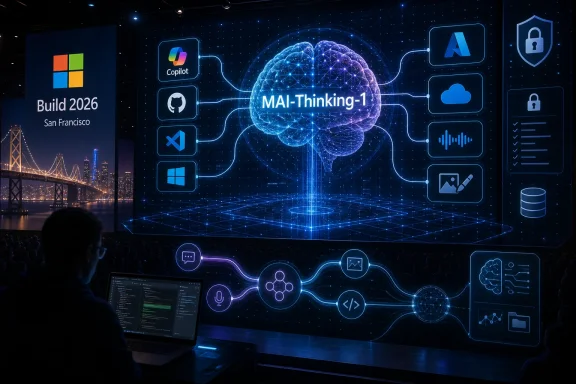
Microsoft used Build 2026 on June 2 in San Francisco to unveil MAI-Thinking-1, its first in-house reasoning model, alongside a broader set of Microsoft AI models for code, image, voice, and transcription workloads. The headline is not merely that Microsoft has another model family. It is that Redmond is trying to prove it can be more than the world’s most successful OpenAI reseller. For Windows users, developers, and enterprise IT shops, this is the beginning of a much more consequential shift: Copilot is becoming a Microsoft-controlled stack.
For the past three years, Microsoft’s AI story has been astonishingly effective and oddly incomplete. It owned the distribution: Windows, Office, Azure, GitHub, Teams, Edge, security tooling, and the enterprise account relationships. But much of the glamour — and much of the technical dependency — sat with OpenAI.
MAI-Thinking-1 is Microsoft’s answer to that imbalance. Microsoft says the model is its first reasoning model, a 35 billion active-parameter system built for multi-step instructions, long-context reasoning, code generation, and lower token cost. That last phrase matters because AI is no longer just a demo-stage feature; it is a margin problem running at hyperscale.
A reasoning model is not simply a chatbot with a more serious name. In current AI marketing, reasoning usually means a model that spends more computation decomposing tasks, planning steps, checking intermediate work, and producing more reliable answers for complex prompts. The pitch is that these models are better suited to agents, coding, research, and enterprise workflows than fast conversational models optimized for short answers.
Microsoft’s claim is narrower than some of the breathless coverage around it. MAI-Thinking-1 is in private preview for select early partners, not something every Windows user can open this afternoon. But that is still a watershed moment, because the company is now putting its own frontier-adjacent model work into the same developer and enterprise channels where Copilot already lives.
Microsoft’s AI leadership is increasingly talking about Anthropic, not just OpenAI or Google, as the company to beat in the markets that matter most to Microsoft. That makes strategic sense. Anthropic has become the darling of enterprise AI buyers and developers who care less about viral consumer assistants and more about code, workflow automation, reliability, and safety posture.
This is Microsoft’s home turf. GitHub Copilot, Visual Studio Code, Azure, Microsoft 365, Teams, Entra, Defender, and Windows are not separate products in this contest. They are the terrain on which AI agents will either become everyday infrastructure or another expensive productivity fad.
Microsoft reportedly positioned MAI-Thinking-1 against Anthropic’s high-end Claude models on software engineering benchmarks and blind preference tests. There is some inconsistency in secondary reporting over whether the comparison was framed around Claude Sonnet 4.6 or Claude Opus 4.6, which is a reminder that vendor benchmark claims should be treated as directional rather than definitive until independent testing catches up. The safer conclusion is that Microsoft wants buyers to see MAI-Thinking-1 as credible in the same enterprise coding and reasoning lane where Claude has been strong.
That framing is more revealing than a leaderboard score. Microsoft is not saying, “We built the friendliest chatbot.” It is saying, “We are building models for the people who already pay us for software development, productivity, identity, cloud, and governance.” That is a much more Microsoft-shaped ambition.
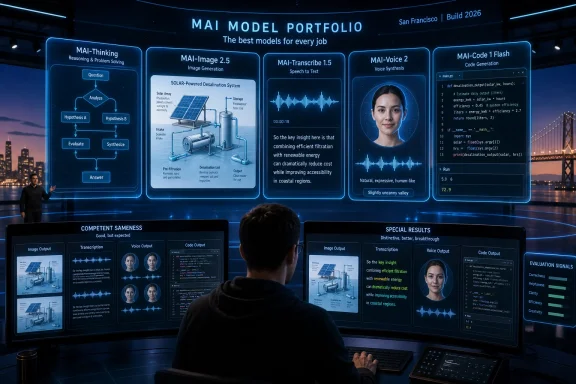
On paper, this looks like the familiar AI conference move: announce a family of models, attach some performance claims, and promise developer availability through the platform. But the portfolio structure matters. Microsoft is not merely filling out a model catalog; it is trying to own the routing layer for AI work.
A Copilot-style product does not need one universal model for every task. It needs a system that can choose between fast, cheap, specialized, private, multimodal, and high-reasoning models depending on the job. A voice request, an image edit, a code refactor, a spreadsheet analysis, and an autonomous agent running inside Teams should not all hit the same expensive general model.
That is where Microsoft’s “hill-climbing machine” language becomes more than branding. The company is signaling that it wants continuous internal model iteration, tuned for product surfaces it already controls. If the strategy works, Microsoft can improve Copilot not by waiting for a partner’s next model drop, but by swapping in its own smaller, cheaper, more specialized systems behind the scenes.
This is also why the announcement belongs in a Windows conversation. Windows is no longer just the client OS in Microsoft’s AI story. It is one endpoint in a distributed AI platform that includes local models, cloud reasoning, browser APIs, Copilot Runtime concepts, developer tools, and enterprise governance.
Developers already live inside controlled environments: repositories, issue trackers, CI systems, IDEs, terminals, pull requests, documentation, and test suites. That gives AI coding tools something many general-purpose assistants lack: a feedback loop. Did the code compile? Did the tests pass? Did the pull request get accepted? Did the bug return? Did the model create a security vulnerability?
Microsoft owns GitHub and VS Code, which gives it a distribution advantage no independent model lab can easily replicate. A 5 billion-parameter coding model that is cheaper to run and deeply integrated into Copilot does not need to beat the largest frontier models on every benchmark to be commercially useful. It needs to be good enough for common development tasks, fast enough for interactive use, and cheap enough to deploy at scale.
That is why “Flash” matters. Inference cost is becoming one of the least glamorous but most decisive questions in AI. If Microsoft can move routine Copilot work from expensive partner models to efficient in-house models, it can protect margins while keeping premium models available for harder tasks.
For enterprise developers, the practical impact may be subtle at first. Copilot might feel a bit faster in some workflows, more consistent in Microsoft-stack projects, or more capable when moving between VS Code, GitHub, Azure, and documentation. The branding of the underlying model may matter less than whether the assistant stops behaving like a clever autocomplete and starts acting like a dependable junior engineer with access to the right context.
At first, the OpenAI relationship gave Microsoft speed. It allowed Redmond to leap ahead of Google in the public AI narrative, inject generative AI across Bing, Office, Windows, GitHub, and Azure, and present itself as the enterprise face of the ChatGPT moment. That was an extraordinary strategic coup.
But speed created dependency. If Copilot’s most important capabilities depend on another company’s models, another company’s roadmap, and another company’s economics, Microsoft’s most important software franchises inherit a structural vulnerability. The more AI becomes the interface to work, the less comfortable that dependency becomes.
The MAI strategy is Microsoft’s hedge becoming productized. A multi-model Microsoft can use OpenAI where OpenAI is best, use its own models where cost or integration matters, and potentially route work to other providers when customers demand choice. That is not disloyalty; it is platform strategy.
It also gives Microsoft leverage. The company does not need to replace OpenAI wholesale for MAI to matter. It only needs enough credible in-house capability to make the rest of the market believe Copilot is not hostage to any single external lab.
That means the important question is not whether MAI-Thinking-1 is “better” than GPT or Claude in the abstract. The question is whether Microsoft can make AI features in Windows feel less bolted on. The company’s recent AI work has often suffered from a mismatch between ambition and trust: impressive demos, uneven utility, and a user base wary of telemetry, forced integration, and cloud dependency.
A Microsoft-controlled model stack could help with some of that. Smaller or specialized models can run closer to the user, support lower-latency experiences, and reduce cost. On-device and browser-integrated AI APIs can give developers capabilities without forcing every feature through a remote chatbot service.
But control cuts both ways. If Microsoft owns more of the model stack, it also owns more of the blame when AI features misfire. Hallucinated summaries, insecure code suggestions, privacy surprises, unwanted UI intrusions, and opaque agent actions cannot be waved away as someone else’s model behavior.
For Windows enthusiasts, that is the tension to watch. Microsoft’s in-house AI push could make Windows feel more capable and context-aware. It could also deepen the sense that the operating system is becoming a delivery mechanism for services users did not explicitly ask for.
Admins will want to know where prompts and outputs are processed, how data boundaries are enforced, which models are available in which tenants, what logging exists, how retention works, whether outputs can be audited, and how model selection interacts with compliance obligations. They will also ask whether Microsoft’s in-house models change contractual commitments around data use and residency.
That is where Microsoft has a natural advantage over model-first rivals. It already sells identity, device management, endpoint security, compliance tooling, data loss prevention, audit logs, and cloud governance. If MAI models are wrapped in the same administrative fabric as Microsoft 365 and Azure, they become easier for large organizations to approve than a standalone AI tool procured by a development team.
But the bar is higher precisely because Microsoft is the incumbent. An independent AI startup can sell experimentation. Microsoft sells operational trust. When it inserts reasoning models into developer workflows and productivity suites, customers will expect policy controls that match the seriousness of the work.
This will be especially important for agents. A chatbot that gives a bad answer is a problem. An agent that files tickets, modifies code, messages coworkers, changes calendar state, or touches files is a governance event. Microsoft’s future AI success depends not just on smarter models, but on making autonomous systems legible to the administrators responsible for cleaning up their mistakes.
A model that performs well on software engineering tests may still fail inside a real company’s monorepo. A model that wins blind preference tests may still be too expensive for routine use. A model that can reason through a hard prompt may still be unsuitable for regulated data. Conversely, a smaller model that looks unimpressive on a leaderboard may be exactly right for a high-volume workflow if it is fast, predictable, and cheap.
Microsoft’s advantage is workflow ownership. It knows where developers type, where documents live, where meetings happen, where identities are managed, where devices are enrolled, and where security teams investigate incidents. The AI model is only one part of that system.
That is why Anthropic is a serious threat despite having a smaller platform footprint. Claude’s reputation among developers and enterprise users has been built on the perception that it is strong at long-context, coding, and careful reasoning tasks. If Anthropic can sit inside tools that knowledge workers use all day, it can attack Microsoft’s software moat from above the application layer.
Microsoft’s response is to collapse the distance between model and workflow. MAI-Code-1-Flash inside GitHub Copilot is not just a model release; it is a claim that the best coding assistant will be the one fused most tightly to the development environment. MAI-Thinking-1 is the higher-level counterpart: a reasoning engine for complex tasks that Microsoft hopes to embed into agentic systems.
The first wave of generative AI was funded by strategic urgency. Companies accepted high compute costs because nobody wanted to miss the platform shift. The next wave will be judged by gross margins, retention, and measurable productivity. That is where smaller, task-specific models become critical.
If Microsoft can use MAI models for routine coding, transcription, image editing, voice, and reasoning tasks, it can reserve more expensive partner models for situations where they are genuinely needed. That routing strategy is invisible to users but essential to the business. Copilot can only become ubiquitous if Microsoft can afford for people to use it constantly.
There is also a licensing and negotiation angle. A company with credible internal models can bargain differently with external labs. It can decide which features require frontier performance and which ones require reliable commodity inference. It can keep sensitive product integrations closer to home.
That does not make MAI a vanity project. It makes it a cost-control mechanism, a bargaining chip, and a strategic insurance policy. In the cloud era, Microsoft learned to monetize infrastructure. In the AI era, it must learn to monetize cognition without letting inference costs eat the product.
For enterprise customers, “clean” is not just an ethical adjective. It is a risk category. Buyers want to know whether a model’s outputs might create intellectual-property problems, whether training data choices could become litigation exposure, and whether a vendor can stand behind its indemnification promises.
The claim also serves a competitive purpose. If Microsoft can say its reasoning model is not merely a derivative of another frontier system, it strengthens the case that MAI is a real internal capability rather than a repackaging exercise. That matters for morale inside Microsoft, for customers evaluating long-term platform bets, and for partners deciding whether to build on Foundry.
Still, clean-data claims deserve scrutiny. The industry has not yet settled on transparent, standardized ways to verify training provenance at the level customers might want. Microsoft’s enterprise credibility gives it a stronger starting position than many AI startups, but trust will depend on documentation, contractual commitments, and independent pressure over time.
For WindowsForum readers, this is one of the places where the AI story intersects with familiar software history. Platform vendors always ask users to trust invisible layers. Drivers, telemetry, update channels, cloud sync, Defender reputation systems, and now AI models all operate below the surface. The question is whether Microsoft can make that trust inspectable enough for serious deployments.
The ambiguity is equally obvious. AI coding tools change the shape of software work before organizations have fully adapted their review practices. More code can be produced faster, but not all of it will be good. Security teams are already dealing with dependency sprawl, generated boilerplate, and developers who may trust a suggestion because it arrived fluently.
Microsoft is trying to move beyond autocomplete toward agentic development. That means tools that can take a task, inspect a codebase, make changes, run tests, and propose a pull request. It is a powerful idea, and it is exactly where reasoning plus coding models could shine.
But agentic coding also requires discipline. Organizations will need policies for what agents can access, what branches they can modify, how secrets are protected, how generated code is labeled, and how accountability works when an AI-authored change breaks production. Microsoft can supply controls, but customers will still have to build habits.
This is where Windows and enterprise development cultures may diverge. Enthusiasts will experiment quickly. Regulated enterprises will move slowly. The successful AI coding platform will need to serve both without pretending they have the same risk tolerance.
That is the real endgame. Microsoft does not want users to think about models any more than they think about database engines when using a business app. It wants agents that can use the right model, call the right tool, respect the right policy, and operate inside the right identity boundary.
This is a very Microsoft vision of AI. It is less romantic than the idea of a single omniscient assistant and more like enterprise middleware with a conversational face. It is also probably closer to how AI will actually be adopted at work.
The challenge is product coherence. Microsoft has a long history of naming sprawl, overlapping admin portals, duplicated features, and previews that feel like strategy fragments. If the company wants MAI to strengthen Copilot, it must make the experience simpler rather than merely broader.
A Windows user should not need to know whether a task was handled by MAI-Thinking-1, MAI-Code-1-Flash, an OpenAI model, a local Edge model, or a third-party provider in Foundry. An administrator, however, absolutely should be able to know. That split — invisible to users, inspectable to admins — is the design problem Microsoft must solve.
The more sober reading is stronger. Microsoft has moved from dependency to optionality. It now has enough in-house model momentum to start filling important product niches itself, while still relying on partners where needed.
That is how platform shifts usually mature. The first phase is about access to breakthrough technology. The second phase is about distribution. The third phase is about integration, cost, governance, and control. Microsoft is entering that third phase.
The risk is that Microsoft confuses owning the stack with improving the experience. Users do not care whether a model is first-party if Copilot is intrusive, inaccurate, or expensive. Developers do not care whether a coding model is efficient if it produces brittle code. Admins do not care whether an agent is visionary if they cannot audit it.
MAI gives Microsoft more control over its AI destiny. It does not automatically give users more reason to trust AI in Windows, Office, or GitHub. That trust has to be earned feature by feature.
 Microsoft Finally Puts Its Own Brain Behind Copilot
For the past three years, Microsoft’s AI story has been astonishingly effective and oddly incomplete. It owned the distribution: Windows, Office, Azure, GitHub, Teams, Edge, security tooling, and the enterprise account relationships. But much of the glamour — and much of the technical dependency — sat with OpenAI.MAI-Thinking-1 is Microsoft’s answer to that imbalance. Microsoft says the model is its first reasoning model, a 35 billion active-parameter system built for multi-step instructions, long-context reasoning, code generation, and lower token cost. That last phrase matters because AI is no longer just a demo-stage feature; it is a margin problem running at hyperscale.
A reasoning model is not simply a chatbot with a more serious name. In current AI marketing, reasoning usually means a model that spends more computation decomposing tasks, planning steps, checking intermediate work, and producing more reliable answers for complex prompts. The pitch is that these models are better suited to agents, coding, research, and enterprise workflows than fast conversational models optimized for short answers.
Microsoft’s claim is narrower than some of the breathless coverage around it. MAI-Thinking-1 is in private preview for select early partners, not something every Windows user can open this afternoon. But that is still a watershed moment, because the company is now putting its own frontier-adjacent model work into the same developer and enterprise channels where Copilot already lives.
The Anthropic Benchmark Is the Real Tell
The most interesting part of the announcement is not the parameter count. It is the target.Microsoft’s AI leadership is increasingly talking about Anthropic, not just OpenAI or Google, as the company to beat in the markets that matter most to Microsoft. That makes strategic sense. Anthropic has become the darling of enterprise AI buyers and developers who care less about viral consumer assistants and more about code, workflow automation, reliability, and safety posture.
This is Microsoft’s home turf. GitHub Copilot, Visual Studio Code, Azure, Microsoft 365, Teams, Entra, Defender, and Windows are not separate products in this contest. They are the terrain on which AI agents will either become everyday infrastructure or another expensive productivity fad.
Microsoft reportedly positioned MAI-Thinking-1 against Anthropic’s high-end Claude models on software engineering benchmarks and blind preference tests. There is some inconsistency in secondary reporting over whether the comparison was framed around Claude Sonnet 4.6 or Claude Opus 4.6, which is a reminder that vendor benchmark claims should be treated as directional rather than definitive until independent testing catches up. The safer conclusion is that Microsoft wants buyers to see MAI-Thinking-1 as credible in the same enterprise coding and reasoning lane where Claude has been strong.
That framing is more revealing than a leaderboard score. Microsoft is not saying, “We built the friendliest chatbot.” It is saying, “We are building models for the people who already pay us for software development, productivity, identity, cloud, and governance.” That is a much more Microsoft-shaped ambition.
Build’s Seven-Model Wave Was About Control, Not Variety
The MAI announcements included more than MAI-Thinking-1. Microsoft also described newer or updated models for code generation, image generation and editing, transcription, voice, and developer workloads. The lineup included MAI-Code-1-Flash, a coding model purpose-built for GitHub Copilot and VS Code, as well as updated image, voice, and transcription models in the Microsoft AI family.On paper, this looks like the familiar AI conference move: announce a family of models, attach some performance claims, and promise developer availability through the platform. But the portfolio structure matters. Microsoft is not merely filling out a model catalog; it is trying to own the routing layer for AI work.
A Copilot-style product does not need one universal model for every task. It needs a system that can choose between fast, cheap, specialized, private, multimodal, and high-reasoning models depending on the job. A voice request, an image edit, a code refactor, a spreadsheet analysis, and an autonomous agent running inside Teams should not all hit the same expensive general model.
That is where Microsoft’s “hill-climbing machine” language becomes more than branding. The company is signaling that it wants continuous internal model iteration, tuned for product surfaces it already controls. If the strategy works, Microsoft can improve Copilot not by waiting for a partner’s next model drop, but by swapping in its own smaller, cheaper, more specialized systems behind the scenes.
This is also why the announcement belongs in a Windows conversation. Windows is no longer just the client OS in Microsoft’s AI story. It is one endpoint in a distributed AI platform that includes local models, cloud reasoning, browser APIs, Copilot Runtime concepts, developer tools, and enterprise governance.
GitHub Is Where the Model War Becomes Measurable
MAI-Code-1-Flash may prove more immediately important than MAI-Thinking-1. Reasoning models make the headlines, but coding assistants are where AI value is easiest to observe, meter, and sell.Developers already live inside controlled environments: repositories, issue trackers, CI systems, IDEs, terminals, pull requests, documentation, and test suites. That gives AI coding tools something many general-purpose assistants lack: a feedback loop. Did the code compile? Did the tests pass? Did the pull request get accepted? Did the bug return? Did the model create a security vulnerability?
Microsoft owns GitHub and VS Code, which gives it a distribution advantage no independent model lab can easily replicate. A 5 billion-parameter coding model that is cheaper to run and deeply integrated into Copilot does not need to beat the largest frontier models on every benchmark to be commercially useful. It needs to be good enough for common development tasks, fast enough for interactive use, and cheap enough to deploy at scale.
That is why “Flash” matters. Inference cost is becoming one of the least glamorous but most decisive questions in AI. If Microsoft can move routine Copilot work from expensive partner models to efficient in-house models, it can protect margins while keeping premium models available for harder tasks.
For enterprise developers, the practical impact may be subtle at first. Copilot might feel a bit faster in some workflows, more consistent in Microsoft-stack projects, or more capable when moving between VS Code, GitHub, Azure, and documentation. The branding of the underlying model may matter less than whether the assistant stops behaving like a clever autocomplete and starts acting like a dependable junior engineer with access to the right context.
OpenAI Remains the Partner Microsoft Can No Longer Depend On Alone
None of this means Microsoft is breaking up with OpenAI. The partnership remains central to Microsoft’s AI business, and Azure’s role as OpenAI’s infrastructure and enterprise channel has been one of the defining advantages of the current AI boom. But Microsoft’s incentives have changed.At first, the OpenAI relationship gave Microsoft speed. It allowed Redmond to leap ahead of Google in the public AI narrative, inject generative AI across Bing, Office, Windows, GitHub, and Azure, and present itself as the enterprise face of the ChatGPT moment. That was an extraordinary strategic coup.
But speed created dependency. If Copilot’s most important capabilities depend on another company’s models, another company’s roadmap, and another company’s economics, Microsoft’s most important software franchises inherit a structural vulnerability. The more AI becomes the interface to work, the less comfortable that dependency becomes.
The MAI strategy is Microsoft’s hedge becoming productized. A multi-model Microsoft can use OpenAI where OpenAI is best, use its own models where cost or integration matters, and potentially route work to other providers when customers demand choice. That is not disloyalty; it is platform strategy.
It also gives Microsoft leverage. The company does not need to replace OpenAI wholesale for MAI to matter. It only needs enough credible in-house capability to make the rest of the market believe Copilot is not hostage to any single external lab.
Windows Users Will Feel This Through Features, Not Model Names
Most Windows users will never choose MAI-Thinking-1 from a drop-down. They will experience Microsoft’s model strategy through the behavior of Copilot, Edge, Office, Photos, Paint, Recall-like memory features, search, and eventually agentic automation across the desktop.That means the important question is not whether MAI-Thinking-1 is “better” than GPT or Claude in the abstract. The question is whether Microsoft can make AI features in Windows feel less bolted on. The company’s recent AI work has often suffered from a mismatch between ambition and trust: impressive demos, uneven utility, and a user base wary of telemetry, forced integration, and cloud dependency.
A Microsoft-controlled model stack could help with some of that. Smaller or specialized models can run closer to the user, support lower-latency experiences, and reduce cost. On-device and browser-integrated AI APIs can give developers capabilities without forcing every feature through a remote chatbot service.
But control cuts both ways. If Microsoft owns more of the model stack, it also owns more of the blame when AI features misfire. Hallucinated summaries, insecure code suggestions, privacy surprises, unwanted UI intrusions, and opaque agent actions cannot be waved away as someone else’s model behavior.
For Windows enthusiasts, that is the tension to watch. Microsoft’s in-house AI push could make Windows feel more capable and context-aware. It could also deepen the sense that the operating system is becoming a delivery mechanism for services users did not explicitly ask for.
Enterprise IT Will Ask the Boring Questions First
The consumer AI market rewards spectacle. Enterprise IT rewards answers.Admins will want to know where prompts and outputs are processed, how data boundaries are enforced, which models are available in which tenants, what logging exists, how retention works, whether outputs can be audited, and how model selection interacts with compliance obligations. They will also ask whether Microsoft’s in-house models change contractual commitments around data use and residency.
That is where Microsoft has a natural advantage over model-first rivals. It already sells identity, device management, endpoint security, compliance tooling, data loss prevention, audit logs, and cloud governance. If MAI models are wrapped in the same administrative fabric as Microsoft 365 and Azure, they become easier for large organizations to approve than a standalone AI tool procured by a development team.
But the bar is higher precisely because Microsoft is the incumbent. An independent AI startup can sell experimentation. Microsoft sells operational trust. When it inserts reasoning models into developer workflows and productivity suites, customers will expect policy controls that match the seriousness of the work.
This will be especially important for agents. A chatbot that gives a bad answer is a problem. An agent that files tickets, modifies code, messages coworkers, changes calendar state, or touches files is a governance event. Microsoft’s future AI success depends not just on smarter models, but on making autonomous systems legible to the administrators responsible for cleaning up their mistakes.
The Benchmark Era Is Giving Way to the Workflow Era
AI vendors still love benchmarks because benchmarks compress complexity into a number. But the MAI announcement shows why benchmark talk is becoming less satisfying.A model that performs well on software engineering tests may still fail inside a real company’s monorepo. A model that wins blind preference tests may still be too expensive for routine use. A model that can reason through a hard prompt may still be unsuitable for regulated data. Conversely, a smaller model that looks unimpressive on a leaderboard may be exactly right for a high-volume workflow if it is fast, predictable, and cheap.
Microsoft’s advantage is workflow ownership. It knows where developers type, where documents live, where meetings happen, where identities are managed, where devices are enrolled, and where security teams investigate incidents. The AI model is only one part of that system.
That is why Anthropic is a serious threat despite having a smaller platform footprint. Claude’s reputation among developers and enterprise users has been built on the perception that it is strong at long-context, coding, and careful reasoning tasks. If Anthropic can sit inside tools that knowledge workers use all day, it can attack Microsoft’s software moat from above the application layer.
Microsoft’s response is to collapse the distance between model and workflow. MAI-Code-1-Flash inside GitHub Copilot is not just a model release; it is a claim that the best coding assistant will be the one fused most tightly to the development environment. MAI-Thinking-1 is the higher-level counterpart: a reasoning engine for complex tasks that Microsoft hopes to embed into agentic systems.
The Autonomy Story Is Also a Margin Story
Microsoft executives have been increasingly explicit that in-house models have financial consequences. That should not surprise anyone. AI features are expensive to serve, and the economics of offering Copilot across huge installed bases are brutal if every interaction depends on premium third-party inference.The first wave of generative AI was funded by strategic urgency. Companies accepted high compute costs because nobody wanted to miss the platform shift. The next wave will be judged by gross margins, retention, and measurable productivity. That is where smaller, task-specific models become critical.
If Microsoft can use MAI models for routine coding, transcription, image editing, voice, and reasoning tasks, it can reserve more expensive partner models for situations where they are genuinely needed. That routing strategy is invisible to users but essential to the business. Copilot can only become ubiquitous if Microsoft can afford for people to use it constantly.
There is also a licensing and negotiation angle. A company with credible internal models can bargain differently with external labs. It can decide which features require frontier performance and which ones require reliable commodity inference. It can keep sensitive product integrations closer to home.
That does not make MAI a vanity project. It makes it a cost-control mechanism, a bargaining chip, and a strategic insurance policy. In the cloud era, Microsoft learned to monetize infrastructure. In the AI era, it must learn to monetize cognition without letting inference costs eat the product.
The Clean-Data Claim Raises the Stakes
Microsoft says MAI-Thinking-1 was built from the ground up on clean data and not distilled from third-party frontier models. That is a notable claim in an industry where training provenance, synthetic data, copyright exposure, and model distillation are increasingly sensitive topics.For enterprise customers, “clean” is not just an ethical adjective. It is a risk category. Buyers want to know whether a model’s outputs might create intellectual-property problems, whether training data choices could become litigation exposure, and whether a vendor can stand behind its indemnification promises.
The claim also serves a competitive purpose. If Microsoft can say its reasoning model is not merely a derivative of another frontier system, it strengthens the case that MAI is a real internal capability rather than a repackaging exercise. That matters for morale inside Microsoft, for customers evaluating long-term platform bets, and for partners deciding whether to build on Foundry.
Still, clean-data claims deserve scrutiny. The industry has not yet settled on transparent, standardized ways to verify training provenance at the level customers might want. Microsoft’s enterprise credibility gives it a stronger starting position than many AI startups, but trust will depend on documentation, contractual commitments, and independent pressure over time.
For WindowsForum readers, this is one of the places where the AI story intersects with familiar software history. Platform vendors always ask users to trust invisible layers. Drivers, telemetry, update channels, cloud sync, Defender reputation systems, and now AI models all operate below the surface. The question is whether Microsoft can make that trust inspectable enough for serious deployments.
Developers Get More Power and More Ambiguity
The developer upside is obvious. If Microsoft can deliver cheaper and more capable coding models inside GitHub Copilot and VS Code, developers will get better assistance in the places they already work. The model does not need to be magical to be useful; it needs to reduce friction across code search, refactoring, test generation, documentation, migration, and review.The ambiguity is equally obvious. AI coding tools change the shape of software work before organizations have fully adapted their review practices. More code can be produced faster, but not all of it will be good. Security teams are already dealing with dependency sprawl, generated boilerplate, and developers who may trust a suggestion because it arrived fluently.
Microsoft is trying to move beyond autocomplete toward agentic development. That means tools that can take a task, inspect a codebase, make changes, run tests, and propose a pull request. It is a powerful idea, and it is exactly where reasoning plus coding models could shine.
But agentic coding also requires discipline. Organizations will need policies for what agents can access, what branches they can modify, how secrets are protected, how generated code is labeled, and how accountability works when an AI-authored change breaks production. Microsoft can supply controls, but customers will still have to build habits.
This is where Windows and enterprise development cultures may diverge. Enthusiasts will experiment quickly. Regulated enterprises will move slowly. The successful AI coding platform will need to serve both without pretending they have the same risk tolerance.
Microsoft Is Rebuilding the Stack Around Agents
The broader Build context matters. Microsoft is not just launching models; it is rearranging its platform around agents. Foundry, Copilot, GitHub, Windows AI APIs, Edge on-device models, Microsoft 365 context, Entra identity, and security tooling are all being pulled into the same gravitational field.That is the real endgame. Microsoft does not want users to think about models any more than they think about database engines when using a business app. It wants agents that can use the right model, call the right tool, respect the right policy, and operate inside the right identity boundary.
This is a very Microsoft vision of AI. It is less romantic than the idea of a single omniscient assistant and more like enterprise middleware with a conversational face. It is also probably closer to how AI will actually be adopted at work.
The challenge is product coherence. Microsoft has a long history of naming sprawl, overlapping admin portals, duplicated features, and previews that feel like strategy fragments. If the company wants MAI to strengthen Copilot, it must make the experience simpler rather than merely broader.
A Windows user should not need to know whether a task was handled by MAI-Thinking-1, MAI-Code-1-Flash, an OpenAI model, a local Edge model, or a third-party provider in Foundry. An administrator, however, absolutely should be able to know. That split — invisible to users, inspectable to admins — is the design problem Microsoft must solve.
The Build Hype Hides a More Sober Reality
It is tempting to treat MAI-Thinking-1 as Microsoft’s declaration of independence. That overstates the case. Microsoft is not suddenly free of OpenAI, and there is no public evidence yet that MAI-Thinking-1 broadly outclasses the best models from OpenAI, Anthropic, or Google.The more sober reading is stronger. Microsoft has moved from dependency to optionality. It now has enough in-house model momentum to start filling important product niches itself, while still relying on partners where needed.
That is how platform shifts usually mature. The first phase is about access to breakthrough technology. The second phase is about distribution. The third phase is about integration, cost, governance, and control. Microsoft is entering that third phase.
The risk is that Microsoft confuses owning the stack with improving the experience. Users do not care whether a model is first-party if Copilot is intrusive, inaccurate, or expensive. Developers do not care whether a coding model is efficient if it produces brittle code. Admins do not care whether an agent is visionary if they cannot audit it.
MAI gives Microsoft more control over its AI destiny. It does not automatically give users more reason to trust AI in Windows, Office, or GitHub. That trust has to be earned feature by feature.
The Signal WindowsForum Readers Should Not Miss
The practical impact of MAI-Thinking-1 will arrive unevenly, but the direction is now clear. Microsoft is building a model portfolio for the parts of computing it already dominates, and it is aiming that portfolio at the enterprise developer market where Anthropic has gained credibility.- Microsoft’s June 2 Build announcements mark a shift from relying primarily on partner models toward a multi-model strategy with more first-party MAI systems.
- MAI-Thinking-1 is Microsoft AI’s first reasoning model and is currently positioned for select early partners rather than broad consumer availability.
- MAI-Code-1-Flash may be the more immediately important product because GitHub Copilot and VS Code give Microsoft a direct path into daily developer workflows.
- The Anthropic comparison matters because Microsoft is prioritizing enterprise, coding, and agentic work over consumer chatbot theater.
- The biggest questions for IT will be governance, data boundaries, auditability, cost, and whether agents can be controlled as rigorously as other enterprise identities.
- Windows users will feel the strategy indirectly through Copilot, Edge, Office, local AI APIs, and future agentic features rather than through model branding.
References
- Primary source: The Verge
Published: Tue, 02 Jun 2026 18:12:44 GMT
Microsoft’s first advanced reasoning AI is here | The Verge
Microsoft announced seven new in-house AI models at Build 2026, including MAI-Thinking-1, its first reasoning model.www.theverge.com
- Independent coverage: Bitget
Published: 2026-06-02T20:39:10.828648
Microsoft Build Releases Seven Models, Launches First Flagship Inferencing to Compete with Anthropic, Creating a "Thinking + Programming" Intelligent Agent Closed Loop | Bitget News
Microsoft has begun a direct assault on Anthropic's stronghold. At the annual developer conference Build, held on Tuesday, June 2nd (Eastern Time), Micro | Bitget crypto news!www.bitget.com - Independent coverage: 富途牛牛
Published: 2026-06-02T19:39:10.839357
- Official source: microsoft.ai
- Official source: techcommunity.microsoft.com
Introducing MAI-Transcribe-1, MAI-Voice-1, and MAI-Image-2 in Microsoft Foundry | Microsoft Community Hub
Another Step Towards a Complete AI Platform Since inception, our goal with Microsoft Foundry has been to deliver the most complete AI and app agent factory;... techcommunity.microsoft.com
- Official source: blogs.microsoft.com
The Official Microsoft Blog
 blogs.microsoft.com

- Related coverage: chatforest.com
MAI-Thinking-1: Microsoft's First Reasoning Model Is Not a Distillation — ChatForest
Microsoft announced MAI-Thinking-1 at Build 2026 — a reasoning model trained from scratch, not distilled from GPT-4 or any other frontier model. It's bundled with GitHub Copilot Enterprise and runs inside Azure Confidential Computing enclaves. Here's what builders need to know.chatforest.com - Official source: news.microsoft.com
Microsoft Build Live
The home for real-time coverage of the news as it is announced from Microsoft Build, June 2-3, 2026.news.microsoft.com - Related coverage: tomsguide.com
Microsoft debuts MAI-Image-1, its first in-house AI image generator | Tom's Guide
Microsoft has launched its first in-house image generation tool, and it's already landed a top spot in the LMArena.www.tomsguide.com - Related coverage: windowscentral.com
MAI‑Image‑1 arrives on Bing — can Microsoft’s custom AI image generator dethrone DALL·E 3?” | Windows Central
You can now create images using Microsoft's first custom image creator directly from its Bing Image Creator app or Copilot Audio Expression.www.windowscentral.com - Related coverage: techradar.com
MAI‑Image‑1 puts Microsoft in the AI art game – this time, with its own brush | TechRadar
The new model promises speed, photorealism, and fewer “AI-style” cliches, all inside Copilot and Bing.www.techradar.com - Related coverage: techcrunch.com
Microsoft takes on AI rivals with three new foundational models | TechCrunch
MAI released models that can transcribe voice into text as well as generate audio and images after the group's formation six months ago.techcrunch.com - Related coverage: theinformation.com
Microsoft Releases AI Models for Transcription, Speech, Image Generation — The Information
Microsoft on Thursday released three new AI models, building on the small but growing catalog of models it has trained internally as it aims to become more self-sufficient in AI. The three models are called MAI-Transcribe-1, MAI-Voice-1, and MAI-Image-2, and are meant to transcribe audio, have...www.theinformation.com - Related coverage: thurrott.com
Build 2026: Microsoft Launches First Flagship Reasoning AI Model and More
Microsoft announced today the release of new in-house MAI models including MAI-Thinking-1, its first flagship reasoning model designed to offer high efficiency at a low-token cost.www.thurrott.com - Official source: blogs.windows.com
Expanding on‑device AI in Microsoft Edge: New models and APIs for the web
At Build 2025, we introduced the Prompt and Writing Assistance APIs in Microsoft Edge with the Phi-4-mini language model. Since then, we'blogs.windows.com - Official source: microsoft.com
- Related coverage: ashgabattimes.com
- Official source: cdn-dynmedia-1.microsoft.com