

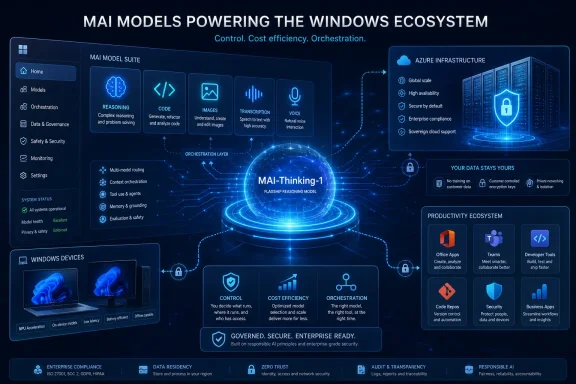
Microsoft unveiled seven in-house MAI artificial intelligence models at Build 2026 in San Francisco on Tuesday, June 2, including its first reasoning model, MAI-Thinking-1, as the company works to lower AI costs, broaden developer options, and reduce dependence on OpenAI. The announcement is not a divorce filing, and Microsoft is not pretending otherwise. It is something more strategically interesting: the world’s most important OpenAI partner is building the escape hatches, pricing leverage, and product control that every platform owner eventually wants. For Windows users and IT departments, the question is no longer whether Microsoft will put AI everywhere, but whose AI will be inside the stack when it does.
For the past several years, Microsoft’s AI story has been inseparable from OpenAI. Copilot, Bing Chat, Azure OpenAI Service, GitHub Copilot, and the broader “AI PC” pitch all leaned heavily on the idea that Microsoft had secured privileged access to the most commercially important model lab in the world. That deal gave Microsoft a head start while Google reorganized itself around Gemini, Amazon tried to make Bedrock a neutral marketplace, and Meta made open-weight models impossible to ignore.
But platform companies do not like being tenants. They like to own the rails, set the defaults, control the margins, and decide how quickly a feature moves from preview to product. Microsoft’s new MAI models should be read in that context: not as an abrupt break with OpenAI, but as the predictable next stage of a company that cannot afford to outsource the core intelligence layer of Windows, Microsoft 365, Azure, GitHub, and security tooling forever.
The headline model, MAI-Thinking-1, is Microsoft AI’s first internally developed reasoning model. Microsoft describes it as a midsize, efficient model built for strong reasoning, math, coding, and general intelligence at a lower token cost than frontier-scale alternatives. That positioning matters. Microsoft is not claiming, at least in this launch cycle, that MAI-Thinking-1 is the largest or most capable model on earth. It is claiming that it can be good enough, cheap enough, and controllable enough to run at Microsoft scale.
That is the more dangerous claim for competitors. In enterprise software, the winning model is not always the one that tops a leaderboard. It is the one that can be bundled, governed, deployed, audited, and billed in ways that make sense to organizations already living inside Microsoft’s ecosystem.
That breadth is the point. Windows, Office, Teams, Edge, GitHub, Defender, Dynamics, and Azure do not need one giant model for every task. They need many models with different latency, cost, modality, privacy, and reliability profiles. A voice model used in real-time meetings is judged differently from a coding model inside VS Code. A transcription model for call-center analytics has a different cost structure from a reasoning model asked to solve a multi-step business workflow.
MAI-Code-1 is especially important because GitHub Copilot has become one of Microsoft’s clearest AI success stories. Developers do not simply want a chatbot bolted onto an IDE; they want fast code completion, repository awareness, test generation, refactoring, and increasingly agentic workflows that can operate across issues, pull requests, and build systems. A model tuned for GitHub and Visual Studio Code gives Microsoft tighter control over latency and cost in one of the highest-frequency AI workloads it runs.
The speech and image models point in the same direction. Microsoft 365 Copilot, Teams, Clipchamp, Designer, PowerPoint, Windows accessibility features, and enterprise content workflows all benefit from native audio and visual models that Microsoft can shape around its own product requirements. If Microsoft wants Copilot to summarize meetings, generate slides, clean up audio, draft visuals, and act across business applications, it cannot depend on a single external model provider for every modality.
The reported amendments to the Microsoft-OpenAI arrangement make that tension visible. Microsoft was once described as OpenAI’s exclusive cloud provider, but OpenAI’s demand for more capacity made exclusivity increasingly hard to maintain. The revised structure gave Microsoft a right of first refusal rather than an absolute lock, allowing OpenAI to seek capacity elsewhere when Microsoft could not meet its needs. Later changes reportedly loosened Microsoft’s exclusive access to OpenAI intellectual property and model distribution, while preserving important commercial ties.
That is not a collapse. It is a maturation. The relationship is moving from dependency to bargaining, and in bargaining, alternatives matter. Microsoft building its own models gives Redmond leverage in pricing, roadmap, availability, and product integration. OpenAI gaining more freedom gives it leverage in compute, distribution, and eventual public-market positioning.
The irony is that both companies may be acting rationally. OpenAI cannot become the AI platform for everyone if it looks permanently captive to Azure and Microsoft product priorities. Microsoft cannot become the AI platform for everyone if its most critical features depend entirely on a partner that also sells directly to Microsoft’s customers and courts Microsoft’s cloud rivals.
AI at Microsoft scale is brutally expensive. Every Copilot prompt, meeting summary, code suggestion, search answer, image generation, and agentic action turns into inference cost somewhere. When a company wants to bake AI into products used by hundreds of millions of people, the difference between a premium frontier model and a cheaper specialized model becomes a margin question, a pricing question, and sometimes a feasibility question.
This is why midsize models matter. A model with 35 billion active parameters, if it performs well enough on targeted workloads, can be far more useful in production than a giant model that is too expensive to call constantly. The market often obsesses over benchmark supremacy, but Microsoft lives in a world of enterprise subscriptions, GPU allocation, service-level agreements, compliance boundaries, and customer support tickets. In that world, the cheapest model that reliably gets the job done is often the one that wins deployment.
That cost pressure also affects Windows. The future Microsoft has been describing — AI agents embedded in the operating system, local and cloud-assisted Copilot features, natural-language settings, contextual search, automated workflows — will not survive if every interaction requires an expensive frontier model call. Microsoft needs a layered model strategy: small models on device, efficient first-party models in the cloud, and top-tier frontier models when the task justifies the cost.
Still, the claims are not meaningless. They suggest Microsoft believes MAI-Thinking-1 is not merely a budget fallback. The company wants developers and enterprise buyers to see it as a credible reasoning option for real workloads, particularly where cost and availability matter as much as raw frontier performance. In cloud AI, perception can become adoption, and adoption can create feedback loops that improve the product.
The more important benchmark may be operational rather than academic. Can the model be made available reliably through Microsoft Foundry and partner platforms? Can it integrate cleanly with Azure identity, logging, governance, and security controls? Can developers switch between OpenAI, Microsoft, Anthropic, Meta, and other models without rewriting their applications? Can procurement teams understand the price?
Microsoft’s advantage is not that it suddenly becomes the world’s most glamorous AI lab. Its advantage is that it owns the enterprise wrapper: Entra ID, Defender, Purview, GitHub, Azure, Windows, Office, Teams, and the admin consoles where corporate technology decisions become policy. If MAI models are merely competitive, Microsoft can make them convenient. In enterprise software, convenient is a weapon.
For Windows users, the MAI launch is unlikely to produce an immediate, obvious change like a new Start menu button. The more likely effect is gradual substitution under the hood. Copilot features that once depended exclusively on OpenAI models may be routed to Microsoft’s own models when the task is narrow, latency-sensitive, or cost-sensitive. A coding task might go to MAI-Code. A meeting transcript might use MAI-Transcribe. A lightweight reasoning step inside an agent might use MAI-Thinking rather than a larger external model.
That routing layer will become increasingly important. Users may not care which model rewrites an email, summarizes a Teams call, or explains a PowerShell error. Administrators will care very much if different models have different data-handling rules, regional availability, audit logs, and contractual terms. Developers will care if model choice affects latency, token cost, context windows, tool calling, and failure modes.
Windows itself is also becoming a hybrid AI client. Microsoft has pushed Copilot+ PCs, neural processing units, and on-device AI features as part of the next era of personal computing. But local models will not replace cloud models for complex reasoning anytime soon. The future is orchestration: small models on the device, specialized models in Microsoft’s cloud, and heavyweight frontier systems when necessary. MAI gives Microsoft more first-party pieces to orchestrate.
Microsoft has been trying to answer that demand with Azure AI Foundry, Microsoft 365 Copilot controls, Purview integration, and security tooling around agentic systems. First-party models strengthen that pitch. If Microsoft owns more of the model layer, it can make stronger claims about supportability, data boundaries, telemetry, abuse monitoring, and compliance integration. Whether customers believe those claims is another matter, but the sales motion becomes simpler.
There is also a procurement angle. Many organizations already have Microsoft enterprise agreements, Azure commitments, GitHub contracts, and Microsoft 365 licensing. If MAI models become available through familiar channels, they may enter companies not because they are beloved by developers, but because they are approved, discounted, logged, and already inside the contract envelope.
That does not mean IT should relax. First-party does not automatically mean safer, and Microsoft’s own AI features have at times arrived faster than administrators would prefer. The Recall controversy around Copilot+ PCs showed how quickly privacy architecture can become a trust problem when local data, screenshots, search, and AI indexing collide. The lesson for Microsoft is that model ownership will not matter if users and administrators do not trust the surrounding controls.
That is good news and bad news. It is good because competition should lower prices and reduce vendor lock-in. It is bad because developers will spend more time dealing with abstraction layers, evaluation suites, prompt portability, and model-specific quirks. A prompt that works beautifully on one reasoning model may become verbose, expensive, or unreliable on another. Tool-calling behavior, refusal patterns, structured output, and coding style can vary sharply.
Microsoft wants Foundry, GitHub, and VS Code to smooth those differences. The ideal Microsoft story is that developers build once, evaluate across models, deploy through Azure, and let policy decide which model handles which task. That is plausible, and it fits the company’s enterprise DNA. But abstraction always leaks, especially in AI, where output quality depends on model behavior that cannot be fully captured by a compatibility layer.
The best developers will treat MAI models as new components to test, not magic replacements to assume. They will build evaluation harnesses around real tickets, real codebases, real documents, and real failure modes. They will measure not just accuracy but cost per completed task, latency under load, hallucination risk, and maintainability. Microsoft’s models may win many of those tests, but they should have to win them.
But the center of gravity is shifting. Microsoft no longer wants the market to believe that its AI future is a wrapper around someone else’s models. OpenAI no longer wants the market to believe that its route to customers and compute runs exclusively through Microsoft. Both companies are preparing for a world in which their interests overlap but do not fully align.
That is healthy in one sense. The AI market is too important to be governed by a single exclusive pipeline between one lab and one cloud provider. More model competition gives customers bargaining power and gives developers more ways to optimize. It may also reduce the systemic risk of one provider outage, policy change, or pricing shift rippling through half the software industry.
Yet the competitive dynamics are awkward. Microsoft is both partner and rival to OpenAI. It sells access to OpenAI models while building alternatives. It integrates OpenAI-powered features while developing its own AI identity under Mustafa Suleyman. It wants OpenAI to thrive, but not so much that Microsoft becomes merely a reseller for the intelligence layer.
MAI models could help close that gap if Microsoft uses them to make AI features more pervasive and less metered. The operating system becomes more compelling when AI can assist with file search, troubleshooting, settings, automation, accessibility, and security without every interaction feeling like a premium cloud event. But that requires a cost structure Microsoft can live with and a trust model users can accept.
Local AI and cloud AI will need to cooperate. A Windows device might use local models for indexing, classification, and privacy-sensitive preprocessing, then call a Microsoft-hosted reasoning model for complex planning. It might use a transcription model for meetings, a coding model for PowerShell or scripting help, and a vision model for screenshots or design tasks. The user sees one Copilot surface; underneath, Microsoft routes the job.
That makes model ownership strategically valuable. If Microsoft controls more of the routing stack and more of the models, it can tune the user experience end to end. It can decide when to optimize for responsiveness, when to optimize for cost, and when to escalate to a more powerful model. That is exactly the kind of invisible platform control Microsoft has always preferred.
Microsoft is extraordinarily good at defaults. Teams benefited from Microsoft 365 bundling. Edge gets Windows placement even in a Chrome-dominated world. OneDrive, Defender, Entra, and SharePoint all draw strength from being part of the Microsoft estate. If MAI models become the default “good enough” choice inside Microsoft tools, they will accumulate usage quickly.
That does not guarantee developer love. Developers can be stubborn, and AI builders are particularly sensitive to model quality. If MAI models underperform, the community will route around them when it can. But enterprise defaults do not need universal enthusiasm to matter. They need enough quality, enough governance, and enough procurement convenience.
OpenAI, Anthropic, Google, Meta, and the rest understand this. Their challenge is not merely to build better models. It is to remain accessible and attractive inside the platforms where work actually happens. Microsoft’s challenge is the inverse: to prove that its platform advantage does not become complacency at the model layer.
That intent matters because AI infrastructure is compounding. Models improve through training runs, user feedback, deployment experience, evaluation data, and engineering discipline. A first-generation Microsoft reasoning model that is merely competitive today could become far more consequential after several product cycles, especially if it is trained and tuned against Microsoft’s enormous enterprise workload surface.
There are risks. Microsoft’s AI branding can drift into abstraction. “Humanist superintelligence” may reassure some audiences, but IT buyers will ask plainer questions: Where is my data processed? What is logged? What can admins disable? What happens when the model is wrong? How do I audit agent actions? Which model touched this file?
Those questions will define whether MAI becomes a serious platform pillar or just another set of models in a crowded catalog. The launch gives Microsoft credibility, but credibility in enterprise AI is earned after deployment, not during a keynote.
The concrete readout is simpler than the strategy deck suggests:
 Microsoft Stops Acting Like a Passenger in Its Own AI Platform
For the past several years, Microsoft’s AI story has been inseparable from OpenAI. Copilot, Bing Chat, Azure OpenAI Service, GitHub Copilot, and the broader “AI PC” pitch all leaned heavily on the idea that Microsoft had secured privileged access to the most commercially important model lab in the world. That deal gave Microsoft a head start while Google reorganized itself around Gemini, Amazon tried to make Bedrock a neutral marketplace, and Meta made open-weight models impossible to ignore.But platform companies do not like being tenants. They like to own the rails, set the defaults, control the margins, and decide how quickly a feature moves from preview to product. Microsoft’s new MAI models should be read in that context: not as an abrupt break with OpenAI, but as the predictable next stage of a company that cannot afford to outsource the core intelligence layer of Windows, Microsoft 365, Azure, GitHub, and security tooling forever.
The headline model, MAI-Thinking-1, is Microsoft AI’s first internally developed reasoning model. Microsoft describes it as a midsize, efficient model built for strong reasoning, math, coding, and general intelligence at a lower token cost than frontier-scale alternatives. That positioning matters. Microsoft is not claiming, at least in this launch cycle, that MAI-Thinking-1 is the largest or most capable model on earth. It is claiming that it can be good enough, cheap enough, and controllable enough to run at Microsoft scale.
That is the more dangerous claim for competitors. In enterprise software, the winning model is not always the one that tops a leaderboard. It is the one that can be bundled, governed, deployed, audited, and billed in ways that make sense to organizations already living inside Microsoft’s ecosystem.
The New MAI Lineup Is About Coverage, Not Just Bragging Rights
The seven-model launch gives Microsoft a first-party family that spans reasoning, coding, image generation, transcription, and voice. The names are unmistakably productized: MAI-Thinking-1, MAI-Code-1, MAI-Image-2.5, MAI-Transcribe-1.5, MAI-Voice-2, and related variants aimed at speed or efficiency. This is not a research lab tossing a single model over the wall. It is Microsoft trying to assemble the pieces of a complete application substrate.That breadth is the point. Windows, Office, Teams, Edge, GitHub, Defender, Dynamics, and Azure do not need one giant model for every task. They need many models with different latency, cost, modality, privacy, and reliability profiles. A voice model used in real-time meetings is judged differently from a coding model inside VS Code. A transcription model for call-center analytics has a different cost structure from a reasoning model asked to solve a multi-step business workflow.
MAI-Code-1 is especially important because GitHub Copilot has become one of Microsoft’s clearest AI success stories. Developers do not simply want a chatbot bolted onto an IDE; they want fast code completion, repository awareness, test generation, refactoring, and increasingly agentic workflows that can operate across issues, pull requests, and build systems. A model tuned for GitHub and Visual Studio Code gives Microsoft tighter control over latency and cost in one of the highest-frequency AI workloads it runs.
The speech and image models point in the same direction. Microsoft 365 Copilot, Teams, Clipchamp, Designer, PowerPoint, Windows accessibility features, and enterprise content workflows all benefit from native audio and visual models that Microsoft can shape around its own product requirements. If Microsoft wants Copilot to summarize meetings, generate slides, clean up audio, draft visuals, and act across business applications, it cannot depend on a single external model provider for every modality.
The OpenAI Partnership Has Moved From Romance to Realpolitik
Microsoft and OpenAI remain deeply intertwined, but the partnership has changed. What began as an unusually tight alliance between a cloud giant and an AI lab has become a more complicated negotiation between two companies with overlapping ambitions. Microsoft wants preferential access to frontier AI and the cloud revenue that comes with running it. OpenAI wants enough compute, distribution freedom, and corporate flexibility to become an enduring platform in its own right.The reported amendments to the Microsoft-OpenAI arrangement make that tension visible. Microsoft was once described as OpenAI’s exclusive cloud provider, but OpenAI’s demand for more capacity made exclusivity increasingly hard to maintain. The revised structure gave Microsoft a right of first refusal rather than an absolute lock, allowing OpenAI to seek capacity elsewhere when Microsoft could not meet its needs. Later changes reportedly loosened Microsoft’s exclusive access to OpenAI intellectual property and model distribution, while preserving important commercial ties.
That is not a collapse. It is a maturation. The relationship is moving from dependency to bargaining, and in bargaining, alternatives matter. Microsoft building its own models gives Redmond leverage in pricing, roadmap, availability, and product integration. OpenAI gaining more freedom gives it leverage in compute, distribution, and eventual public-market positioning.
The irony is that both companies may be acting rationally. OpenAI cannot become the AI platform for everyone if it looks permanently captive to Azure and Microsoft product priorities. Microsoft cannot become the AI platform for everyone if its most critical features depend entirely on a partner that also sells directly to Microsoft’s customers and courts Microsoft’s cloud rivals.
Cost Is the Quiet Word Behind the Superintelligence Branding
Microsoft AI’s public language leans into lofty concepts such as “humanist superintelligence,” a phrase that sounds designed to reassure regulators, customers, and perhaps employees that this is not simply a race to automate everything in sight. But beneath the rhetoric, the practical theme is cost. Microsoft’s pitch for MAI-Thinking-1 emphasizes efficiency and low token expense. That is not a footnote; it is the business model.AI at Microsoft scale is brutally expensive. Every Copilot prompt, meeting summary, code suggestion, search answer, image generation, and agentic action turns into inference cost somewhere. When a company wants to bake AI into products used by hundreds of millions of people, the difference between a premium frontier model and a cheaper specialized model becomes a margin question, a pricing question, and sometimes a feasibility question.
This is why midsize models matter. A model with 35 billion active parameters, if it performs well enough on targeted workloads, can be far more useful in production than a giant model that is too expensive to call constantly. The market often obsesses over benchmark supremacy, but Microsoft lives in a world of enterprise subscriptions, GPU allocation, service-level agreements, compliance boundaries, and customer support tickets. In that world, the cheapest model that reliably gets the job done is often the one that wins deployment.
That cost pressure also affects Windows. The future Microsoft has been describing — AI agents embedded in the operating system, local and cloud-assisted Copilot features, natural-language settings, contextual search, automated workflows — will not survive if every interaction requires an expensive frontier model call. Microsoft needs a layered model strategy: small models on device, efficient first-party models in the cloud, and top-tier frontier models when the task justifies the cost.
Benchmarks Are Useful, but Microsoft Is Selling Trust in the Stack
Microsoft says independent raters preferred MAI-Thinking-1 over Anthropic’s Claude Sonnet 4.6 in some blind evaluations and that the model matched Claude Opus 4.6 on coding ability in a benchmark. Those claims are notable, but they should be treated with the usual caution. Benchmarks are snapshots, test design matters, and model vendors have every incentive to choose comparisons that flatter their own releases.Still, the claims are not meaningless. They suggest Microsoft believes MAI-Thinking-1 is not merely a budget fallback. The company wants developers and enterprise buyers to see it as a credible reasoning option for real workloads, particularly where cost and availability matter as much as raw frontier performance. In cloud AI, perception can become adoption, and adoption can create feedback loops that improve the product.
The more important benchmark may be operational rather than academic. Can the model be made available reliably through Microsoft Foundry and partner platforms? Can it integrate cleanly with Azure identity, logging, governance, and security controls? Can developers switch between OpenAI, Microsoft, Anthropic, Meta, and other models without rewriting their applications? Can procurement teams understand the price?
Microsoft’s advantage is not that it suddenly becomes the world’s most glamorous AI lab. Its advantage is that it owns the enterprise wrapper: Entra ID, Defender, Purview, GitHub, Azure, Windows, Office, Teams, and the admin consoles where corporate technology decisions become policy. If MAI models are merely competitive, Microsoft can make them convenient. In enterprise software, convenient is a weapon.
Windows Becomes the Distribution Layer for Model Choice
WindowsForum readers have seen this movie before. Microsoft has spent decades turning platform control into application gravity. The operating system, the productivity suite, the developer tools, the identity layer, and the management plane all reinforce one another. AI is being folded into that same pattern.For Windows users, the MAI launch is unlikely to produce an immediate, obvious change like a new Start menu button. The more likely effect is gradual substitution under the hood. Copilot features that once depended exclusively on OpenAI models may be routed to Microsoft’s own models when the task is narrow, latency-sensitive, or cost-sensitive. A coding task might go to MAI-Code. A meeting transcript might use MAI-Transcribe. A lightweight reasoning step inside an agent might use MAI-Thinking rather than a larger external model.
That routing layer will become increasingly important. Users may not care which model rewrites an email, summarizes a Teams call, or explains a PowerShell error. Administrators will care very much if different models have different data-handling rules, regional availability, audit logs, and contractual terms. Developers will care if model choice affects latency, token cost, context windows, tool calling, and failure modes.
Windows itself is also becoming a hybrid AI client. Microsoft has pushed Copilot+ PCs, neural processing units, and on-device AI features as part of the next era of personal computing. But local models will not replace cloud models for complex reasoning anytime soon. The future is orchestration: small models on the device, specialized models in Microsoft’s cloud, and heavyweight frontier systems when necessary. MAI gives Microsoft more first-party pieces to orchestrate.
Enterprise IT Will Read This as a Governance Story
For CIOs and sysadmins, the biggest question is not whether MAI-Thinking-1 beats Claude or GPT on a leaderboard. It is whether Microsoft can provide a more governable AI stack than a patchwork of direct vendor integrations. Enterprise buyers want model flexibility, but they also want fewer legal reviews, fewer data-processing exceptions, and fewer places where sensitive content can leak into opaque systems.Microsoft has been trying to answer that demand with Azure AI Foundry, Microsoft 365 Copilot controls, Purview integration, and security tooling around agentic systems. First-party models strengthen that pitch. If Microsoft owns more of the model layer, it can make stronger claims about supportability, data boundaries, telemetry, abuse monitoring, and compliance integration. Whether customers believe those claims is another matter, but the sales motion becomes simpler.
There is also a procurement angle. Many organizations already have Microsoft enterprise agreements, Azure commitments, GitHub contracts, and Microsoft 365 licensing. If MAI models become available through familiar channels, they may enter companies not because they are beloved by developers, but because they are approved, discounted, logged, and already inside the contract envelope.
That does not mean IT should relax. First-party does not automatically mean safer, and Microsoft’s own AI features have at times arrived faster than administrators would prefer. The Recall controversy around Copilot+ PCs showed how quickly privacy architecture can become a trust problem when local data, screenshots, search, and AI indexing collide. The lesson for Microsoft is that model ownership will not matter if users and administrators do not trust the surrounding controls.
Developers Get More Choice, but Also More Abstraction
For developers, Microsoft’s MAI push is another step toward a multi-model world. The early generative AI boom often treated model selection as a brand decision: GPT for this, Claude for that, Gemini for another workload. The next phase looks more like cloud infrastructure. Applications will route tasks across models based on cost, speed, context length, tool support, accuracy, and contractual constraints.That is good news and bad news. It is good because competition should lower prices and reduce vendor lock-in. It is bad because developers will spend more time dealing with abstraction layers, evaluation suites, prompt portability, and model-specific quirks. A prompt that works beautifully on one reasoning model may become verbose, expensive, or unreliable on another. Tool-calling behavior, refusal patterns, structured output, and coding style can vary sharply.
Microsoft wants Foundry, GitHub, and VS Code to smooth those differences. The ideal Microsoft story is that developers build once, evaluate across models, deploy through Azure, and let policy decide which model handles which task. That is plausible, and it fits the company’s enterprise DNA. But abstraction always leaks, especially in AI, where output quality depends on model behavior that cannot be fully captured by a compatibility layer.
The best developers will treat MAI models as new components to test, not magic replacements to assume. They will build evaluation harnesses around real tickets, real codebases, real documents, and real failure modes. They will measure not just accuracy but cost per completed task, latency under load, hallucination risk, and maintainability. Microsoft’s models may win many of those tests, but they should have to win them.
OpenAI Is Still Central, Which Is Why This Move Matters
It would be a mistake to frame Microsoft’s announcement as an OpenAI repudiation. Microsoft still benefits enormously from OpenAI’s model leadership and brand recognition. OpenAI still benefits from Microsoft’s capital, infrastructure, distribution, and enterprise reach. The partnership remains one of the defining alliances of the AI era.But the center of gravity is shifting. Microsoft no longer wants the market to believe that its AI future is a wrapper around someone else’s models. OpenAI no longer wants the market to believe that its route to customers and compute runs exclusively through Microsoft. Both companies are preparing for a world in which their interests overlap but do not fully align.
That is healthy in one sense. The AI market is too important to be governed by a single exclusive pipeline between one lab and one cloud provider. More model competition gives customers bargaining power and gives developers more ways to optimize. It may also reduce the systemic risk of one provider outage, policy change, or pricing shift rippling through half the software industry.
Yet the competitive dynamics are awkward. Microsoft is both partner and rival to OpenAI. It sells access to OpenAI models while building alternatives. It integrates OpenAI-powered features while developing its own AI identity under Mustafa Suleyman. It wants OpenAI to thrive, but not so much that Microsoft becomes merely a reseller for the intelligence layer.
The AI PC Needs Models Microsoft Can Afford to Use
The AI PC narrative has suffered from a mismatch between ambition and daily usefulness. Microsoft and its hardware partners have talked up NPUs, Copilot+ PCs, and local AI acceleration, but many users still ask what these machines do that a conventional laptop cannot. Better webcams, background blur, live captions, and image tools are useful, but they are not yet a generational reason to upgrade.MAI models could help close that gap if Microsoft uses them to make AI features more pervasive and less metered. The operating system becomes more compelling when AI can assist with file search, troubleshooting, settings, automation, accessibility, and security without every interaction feeling like a premium cloud event. But that requires a cost structure Microsoft can live with and a trust model users can accept.
Local AI and cloud AI will need to cooperate. A Windows device might use local models for indexing, classification, and privacy-sensitive preprocessing, then call a Microsoft-hosted reasoning model for complex planning. It might use a transcription model for meetings, a coding model for PowerShell or scripting help, and a vision model for screenshots or design tasks. The user sees one Copilot surface; underneath, Microsoft routes the job.
That makes model ownership strategically valuable. If Microsoft controls more of the routing stack and more of the models, it can tune the user experience end to end. It can decide when to optimize for responsiveness, when to optimize for cost, and when to escalate to a more powerful model. That is exactly the kind of invisible platform control Microsoft has always preferred.
The Real Fight Is Over Defaults
AI model competition often looks like a leaderboard contest, but the real money is in defaults. Which model is preselected in the developer portal? Which one powers the built-in assistant? Which one is included in the enterprise license? Which one appears in the admin template? Which one gets the best integration with logs, identity, and security policy?Microsoft is extraordinarily good at defaults. Teams benefited from Microsoft 365 bundling. Edge gets Windows placement even in a Chrome-dominated world. OneDrive, Defender, Entra, and SharePoint all draw strength from being part of the Microsoft estate. If MAI models become the default “good enough” choice inside Microsoft tools, they will accumulate usage quickly.
That does not guarantee developer love. Developers can be stubborn, and AI builders are particularly sensitive to model quality. If MAI models underperform, the community will route around them when it can. But enterprise defaults do not need universal enthusiasm to matter. They need enough quality, enough governance, and enough procurement convenience.
OpenAI, Anthropic, Google, Meta, and the rest understand this. Their challenge is not merely to build better models. It is to remain accessible and attractive inside the platforms where work actually happens. Microsoft’s challenge is the inverse: to prove that its platform advantage does not become complacency at the model layer.
The Build Announcement Was a Warning Shot, Not a Finish Line
The most important thing about the MAI launch is that it is early. Microsoft is not declaring victory over OpenAI, Anthropic, or Google. It is declaring intent. It now has a visible first-party model family with enough breadth to start replacing, supplementing, and negotiating around external dependencies.That intent matters because AI infrastructure is compounding. Models improve through training runs, user feedback, deployment experience, evaluation data, and engineering discipline. A first-generation Microsoft reasoning model that is merely competitive today could become far more consequential after several product cycles, especially if it is trained and tuned against Microsoft’s enormous enterprise workload surface.
There are risks. Microsoft’s AI branding can drift into abstraction. “Humanist superintelligence” may reassure some audiences, but IT buyers will ask plainer questions: Where is my data processed? What is logged? What can admins disable? What happens when the model is wrong? How do I audit agent actions? Which model touched this file?
Those questions will define whether MAI becomes a serious platform pillar or just another set of models in a crowded catalog. The launch gives Microsoft credibility, but credibility in enterprise AI is earned after deployment, not during a keynote.
The Microsoft Stack Now Has Its Own AI Center of Gravity
Microsoft’s MAI announcement leaves Windows and enterprise customers with a more complicated, and more realistic, map of the AI future. The company will keep using OpenAI where OpenAI is strongest, but it will increasingly use its own models where cost, control, integration, or specialization matter more. That blend is likely to become the default pattern across Copilot, Azure, GitHub, and eventually deeper Windows experiences.The concrete readout is simpler than the strategy deck suggests:
- Microsoft has launched a first-party MAI model family that covers reasoning, coding, image generation, transcription, and voice.
- MAI-Thinking-1 is positioned as an efficient midsize reasoning model rather than a largest-at-any-cost frontier model.
- The OpenAI partnership remains important, but Microsoft is clearly reducing single-provider dependence.
- Developers should expect more model choice inside Microsoft tools, along with more need for workload-specific evaluation.
- Enterprise IT should focus less on benchmark headlines and more on governance, logging, data boundaries, and admin controls.
- Windows users are unlikely to notice a single dramatic switch, but more Copilot and AI PC features may quietly move onto Microsoft-owned models over time.
References
- Primary source: aol.com
Published: 2026-06-07T02:30:09.884756
Microsoft debuts in-house AI models as it looks to ease reliance on OpenAI - AOL
Microsoft launched slew of AI models as it looks to ease dependence on OpenAI.www.aol.com - Related coverage: windowscentral.com
Microsoft launches seven in‑house AI models to cut developer costs and reduce reliance on OpenAI | Windows Central
Microsoft’s new MAI model family includes a flagship reasoning model, zero distillation, and lower developer costs.www.windowscentral.com - Related coverage: axios.com
Microsoft debuts Scout agent, homegrown reasoning model
Microsoft is seeking to show it is a serious player in AI.www.axios.com
- Related coverage: tomsguide.com
Biggest Microsoft Build 2026 announcements — agentic AI, RTX Spark Dev Box, GitHub Copilot app, new MAI models, and more | Tom's Guide
All the big news from Microsoft's AI-focused eventwww.tomsguide.com - Related coverage: techtimes.com
Microsoft Build 2026: MAI-Thinking-1 Is First In-House Reasoning Model, Trained Without OpenAI Data
Microsoft Build 2026 launched MAI-Thinking-1, the company’s first in-house reasoning model, trained without OpenAI data. MAI-Code-1-Flash rolls out to all GitHub Copilot plans today. Independentwww.techtimes.com - Related coverage: notebookcheck.net
MAI-Thinking-1: Microsoft enters the advanced-reasoning AI race with its own from-scratch model - Notebookcheck News
News, Reviews and other Informations about Laptops www.notebookcheck.net
- Official source: news.microsoft.com
Microsoft Foundry (国际版) 推出全新 MAI 模型 - Source Asia
 news.microsoft.com
- Related coverage: ai-tldr.dev
Microsoft Launches Seven New MAI Models at Build… | AI/TLDR
Microsoft AI's biggest first-party launch yet: a reasoner, a coding flash model, image + voice updates, and a speech-to-text engine claimed to be 5x fas…ai-tldr.dev - Related coverage: techradar.com
‘We need an AI that places humanity first’: Microsoft AI CEO outlines hopes to build “humanist superintelligence” - and has seven new models to help him do it | TechRadar
Microsoft unveils seven new AI models to keep developers buildingwww.techradar.com - Official source: microsoft.ai
Microsoft AI
 microsoft.ai
- Related coverage: enterprisedna.co
Microsoft Launches 7 Homegrown AI Models at Build 2026 — Enterprise DNA
Microsoft's MAI family: 7 in-house models at Build 2026, trained without OpenAI data. Here's what enterprise AI buyers need to know.enterprisedna.co - Related coverage: techcrunch.com
Microsoft takes on AI rivals with three new foundational models | TechCrunch
MAI released models that can transcribe voice into text as well as generate audio and images after the group's formation six months ago.techcrunch.com - Related coverage: thelettertwo.com
Microsoft Launches MAI-Thinking-1 Reasoning Model at Build
Microsoft unveiled MAI-Thinking-1, its first reasoning model, plus six other in-house MAI models at its Build 2026 developer conference.thelettertwo.com - Official source: openai.com
The next phase of the Microsoft OpenAI partnership | OpenAI
OpenAI and Microsoft announce an amended agreement that simplifies the partnership, adds long-term clarity, and supports continued AI innovation at scale.openai.com - Related coverage: euronews.com
Microsoft launches its own AI models to take on OpenAI and Anthropic | Euronews
Seven in-house models unveiled at Build 2026 signal Microsoft's push to cut costs and compete directly on the AI frontier as its biggest investees plan to launch record-breaking IPOs.www.euronews.com - Related coverage: omni.se
Microsoft lanserar sju nya modeller i AI-offensiv
Microsoft presenterade sju nya AI-modeller i samband med den årliga utvecklarkonferensen Build i San Francisco på tisdagen. Det rapporterar flera medier.omni.se
- Related coverage: techxplore.com
