

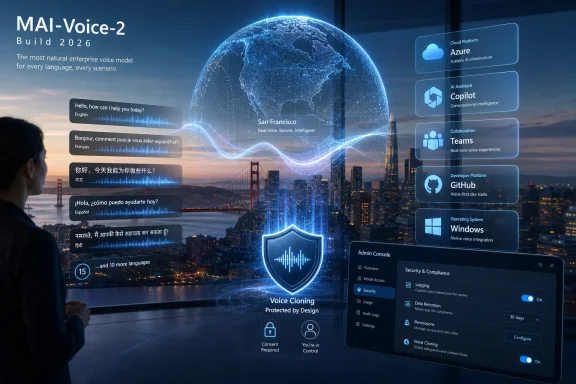
Microsoft announced MAI-Voice-2 on June 2, 2026, at Build in San Francisco as part of a seven-model Microsoft AI release that moves more speech, image, code, transcription, and reasoning capability into Microsoft’s own first-party model stack. The important story is not simply that Microsoft has a new text-to-speech model. It is that the company is trying to make voice a native layer of Azure, Copilot, Teams, GitHub, and business software rather than a feature bolted on from somebody else’s AI lab. For Windows users and enterprise administrators, that shift matters because voice is becoming another interface surface where Microsoft wants to own the model, the safety policy, the deployment path, and the bill.
The supplied marketing pitch frames MAI-Voice-2 as a leap in emotional, multilingual speech synthesis. That is broadly the product claim, but the sharper interpretation is strategic: Microsoft is reducing its dependence on external frontier-model providers in the places where user experience is most visible. Voice is one of those places.
For years, Microsoft’s AI story has been inseparable from OpenAI. Copilot, Bing Chat, Microsoft 365 AI features, and developer-facing services all benefited from that partnership. But a company of Microsoft’s size does not want the most intimate layers of its products — the assistant that speaks to you, the meeting recap that narrates itself, the agent that handles a customer call — to be permanently dependent on another company’s roadmap.
That is why MAI-Voice-2 should be read alongside MAI-Thinking-1, MAI-Code-1-Flash, MAI-Image-2.5, and MAI-Transcribe-1.5. The point is not that every Microsoft-built model will immediately beat every specialist competitor. The point is that Microsoft is building a self-sufficient stack, one modality at a time, and putting those models behind the same cloud, identity, governance, and procurement machinery that already runs much of enterprise IT.
The original article’s details need some tightening. Microsoft’s own announcement describes MAI-Voice-2 as supporting speech generation across 15 languages, not merely ten. It also describes a coming MAI-Voice-2-Flash variant intended to lower cost and improve efficiency. That distinction matters because it shows Microsoft doing what it often does best: turning a capability into a platform tier.
That philosophy is partly values statement and partly product positioning. Microsoft is trying to distinguish its AI work from the “move fast and find out later” reputation that has dogged parts of the generative AI market. For enterprise buyers, the sales pitch is obvious: these are not mysterious black-box toys sprayed into consumer apps, but models trained, documented, governed, and deployed through Microsoft infrastructure.
The MAI launch also reflects a more hard-nosed truth. Microsoft cannot be merely the world’s biggest reseller of other labs’ intelligence. It owns the operating system, the productivity suite, the developer tools, the cloud, the collaboration stack, and a growing fleet of AI agents. If those products are going to gain voice, vision, reasoning, and task execution, Microsoft wants the option to tune and ship them on its own schedule.
That does not mean OpenAI disappears from Microsoft’s ecosystem. It means Microsoft is building leverage. MAI-Voice-2 is one piece of that leverage, and perhaps one of the most user-visible ones because synthetic speech is not hidden behind a benchmark. Users hear the difference immediately.
The new problem is social believability. Does the voice pause in the right place? Does it sound like it understands the emotional temperature of the sentence? Can it switch languages without sounding like two different systems were stitched together in a hurry? Can a brand, teacher, game character, support agent, or accessibility tool preserve a consistent vocal identity across settings?
MAI-Voice-2 is aimed at that second problem. Microsoft describes it as natural-sounding speech generation across 15 languages, with the ability to adapt to a voice from a short sample and safeguards against misuse. That puts it squarely in the same commercial arena as ElevenLabs, OpenAI’s voice APIs, Google’s speech models, Amazon Polly’s newer neural voices, and a growing set of specialist voice-cloning vendors.
The difference is distribution. ElevenLabs may be the cultural reference point for AI voice cloning among creators, but Microsoft has the enterprise channel. If MAI-Voice-2 becomes the default voice layer for Copilot agents, Teams recaps, Dynamics customer workflows, Azure bots, Windows accessibility features, and developer tools, it does not need to win every creator comparison video to matter.
The most consequential capability is not merely that MAI-Voice-2 can produce smoother synthetic speech. It is that Microsoft is making voice synthesis programmable inside a broader application environment. A developer building an Azure-hosted support agent does not just need a nice voice. They need identity, logging, compliance boundaries, content filters, regional deployment options, API stability, and predictable costs.
That is where Microsoft’s advantage becomes boring in the most enterprise-friendly way. A technically dazzling model that requires a separate procurement process, unfamiliar security review, new data flow analysis, and bespoke integration can lose to a merely excellent model already living inside the customer’s Microsoft estate. IT departments do not only buy capability. They buy survivability.
MAI-Voice-2 also sits next to MAI-Transcribe-1.5, which Microsoft positions as a fast, accurate speech-to-text model supporting 43 languages. That pairing matters. Voice applications are rarely one-way. A contact center bot, meeting assistant, classroom tutor, or field-service agent needs to hear, understand, reason, and respond. Microsoft is trying to assemble that loop under its own roof.
Microsoft’s announcement explicitly mentions safeguards against misuse, which is the minimum viable sentence any serious vendor must now include. But for administrators, the operational questions are more concrete. Who is allowed to submit reference audio? How is consent captured? Are generated voices watermarked? What logging is available? Can organizations disable cloning while allowing standard voices? What happens when an employee leaves and their voice has been used in training, demos, or customer-facing workflows?
These are not theoretical concerns for WindowsForum’s audience. Voice phishing has already become a practical security problem, and AI-generated speech lowers the cost of believable impersonation. A synthetic “CFO” asking for an urgent transfer or a synthetic “help desk engineer” walking an employee through a malicious authentication flow is not science fiction. It is the natural endpoint of cheap, convincing voice synthesis combined with leaked audio and weak verification processes.
Microsoft’s enterprise credibility will therefore depend less on whether MAI-Voice-2 sounds wonderful in a demo and more on whether the administrative controls are granular enough. The model has to be good. The policy surface has to be better.
That supply chain framing is important because Microsoft’s customers increasingly want to tune, govern, and account for AI behavior. The company’s Frontier Tuning pitch — training models against customer workflows and reinforcement learning environments — is not just an engineering flourish. It is Microsoft telling large organizations that the next phase of AI will not be generic chatbot prompts pasted into a web box.
For voice, this means organizations may eventually want a sales-support voice tuned to brand guidelines, a medical assistant voice tuned to clinical safety norms, a classroom voice tuned to accessibility needs, or an internal IT agent voice tuned to company policy. The voice model becomes the last mile of an agentic system. It is the part the user hears, but it inherits the decisions made by everything upstream.
That is why the MAI family matters more than MAI-Voice-2 alone. A synthetic voice without transcription, reasoning, code execution, retrieval, and workflow integration is a narrator. A synthetic voice connected to those systems is an agent.
Voice is a natural next step. A Windows assistant that can speak naturally, switch languages, read summaries, walk users through settings, narrate accessibility content, or operate as a hands-free help surface is more compelling than a sidebar that waits for typed prompts. It is also more intrusive if done badly.
Windows users have already shown skepticism toward AI features that feel imposed rather than earned. Recall remains the cautionary tale: technically ambitious, strategically important, and instantly controversial because it touched privacy nerves. MAI-Voice-2 is less obviously invasive, but it still lives in the same trust economy. The more human the interface becomes, the more users will expect clear controls over when it listens, when it speaks, what it stores, and how much of the experience can be disabled.
For administrators, the deployment question is familiar. If voice-powered Copilot features appear in Windows, Teams, or Microsoft 365, organizations will need policy controls before enthusiastic product teams turn them on by default. Microsoft’s best outcome is not merely beautiful synthetic speech. It is speech that admins can govern without opening a dozen support tickets.
OpenAI has voice baked into ChatGPT and its realtime interfaces. Google has deep speech expertise and Android-scale distribution. Amazon has contact center, cloud, and Alexa experience. Specialist vendors have cultural credibility with creators and audio producers. The market is not waiting for Microsoft to define it.
Microsoft’s competitive edge is the enterprise bundle. A company already paying for Azure, Microsoft 365, Teams Phone, Dynamics 365, GitHub Enterprise, Entra ID, Defender, Purview, and Copilot has a strong incentive to keep voice workloads inside the same perimeter. That does not make MAI-Voice-2 automatically superior. It makes it easier to approve.
The risk for Microsoft is that enterprise convenience can breed complacency. If MAI-Voice-2 trails specialist vendors in expressiveness, language nuance, creator tooling, or cloning realism, serious media teams may still go elsewhere. The company can win the default enterprise path while losing the imagination of the creator market. That would still be a commercially meaningful victory, but not the same as category leadership.
That does not make the entire story wrong. It means the credible version of the story should separate confirmed Microsoft positioning from details that require product documentation. Microsoft has confirmed the seven-model release, the MAI team framing, the 15-language speech generation claim, short-sample voice adaptation, and the existence of a coming Flash variant. Those are enough to make MAI-Voice-2 significant without padding the argument.
The stronger article is therefore not “here are 20 things MAI-Voice-2 definitely does.” It is “Microsoft is moving voice into its own first-party AI stack, and that will reshape how enterprises deploy speech interfaces.” That thesis survives even if some feature-level claims change as the documentation matures.
For IT readers, this distinction matters. Vendor announcements are launch-day maps, not terrain. The real evaluation begins when developers can inspect API limits, regional availability, logging behavior, content-safety controls, latency under load, language quality across accents, and pricing at production scale.
Microsoft has a chance to make MAI-Voice-2 boringly manageable. That means tenant-level controls, role-based access, consent workflows for voice adaptation, opt-out mechanisms, retention settings, abuse monitoring, watermarking or provenance signals, and integration with existing Purview and Defender workflows. The more voice becomes an identity-adjacent technology, the more it must behave like one.
There is also a usability challenge. If Microsoft pushes emotionally expressive synthetic voices into Teams or Copilot, users may appreciate the polish but dislike the theatricality. A meeting summary narrated with warmth could be useful. A productivity assistant that sounds like a motivational speaker may quickly become unbearable. Microsoft will need restraint, not just capability.
The best enterprise AI features tend to disappear into the workflow. They save time, reduce friction, and avoid making the user feel trapped inside a keynote demo. MAI-Voice-2 will succeed if it makes spoken AI interfaces feel normal rather than novel.
 Microsoft’s Voice Model Is Really a Control Story
The supplied marketing pitch frames MAI-Voice-2 as a leap in emotional, multilingual speech synthesis. That is broadly the product claim, but the sharper interpretation is strategic: Microsoft is reducing its dependence on external frontier-model providers in the places where user experience is most visible. Voice is one of those places.For years, Microsoft’s AI story has been inseparable from OpenAI. Copilot, Bing Chat, Microsoft 365 AI features, and developer-facing services all benefited from that partnership. But a company of Microsoft’s size does not want the most intimate layers of its products — the assistant that speaks to you, the meeting recap that narrates itself, the agent that handles a customer call — to be permanently dependent on another company’s roadmap.
That is why MAI-Voice-2 should be read alongside MAI-Thinking-1, MAI-Code-1-Flash, MAI-Image-2.5, and MAI-Transcribe-1.5. The point is not that every Microsoft-built model will immediately beat every specialist competitor. The point is that Microsoft is building a self-sufficient stack, one modality at a time, and putting those models behind the same cloud, identity, governance, and procurement machinery that already runs much of enterprise IT.
The original article’s details need some tightening. Microsoft’s own announcement describes MAI-Voice-2 as supporting speech generation across 15 languages, not merely ten. It also describes a coming MAI-Voice-2-Flash variant intended to lower cost and improve efficiency. That distinction matters because it shows Microsoft doing what it often does best: turning a capability into a platform tier.
The MAI Team Is Microsoft’s Answer to the OpenAI Dependency Problem
The organizational backstory is not incidental. Microsoft formed the MAI Superintelligence effort under Mustafa Suleyman, the Microsoft AI chief executive and co-founder of DeepMind and Inflection AI, around a public philosophy it calls Humanist Superintelligence. The language is characteristically lofty: AI systems should serve people and organizations, remain accountable to human oversight, and stay subordinate to human goals.That philosophy is partly values statement and partly product positioning. Microsoft is trying to distinguish its AI work from the “move fast and find out later” reputation that has dogged parts of the generative AI market. For enterprise buyers, the sales pitch is obvious: these are not mysterious black-box toys sprayed into consumer apps, but models trained, documented, governed, and deployed through Microsoft infrastructure.
The MAI launch also reflects a more hard-nosed truth. Microsoft cannot be merely the world’s biggest reseller of other labs’ intelligence. It owns the operating system, the productivity suite, the developer tools, the cloud, the collaboration stack, and a growing fleet of AI agents. If those products are going to gain voice, vision, reasoning, and task execution, Microsoft wants the option to tune and ship them on its own schedule.
That does not mean OpenAI disappears from Microsoft’s ecosystem. It means Microsoft is building leverage. MAI-Voice-2 is one piece of that leverage, and perhaps one of the most user-visible ones because synthetic speech is not hidden behind a benchmark. Users hear the difference immediately.
Speech Synthesis Has Moved Beyond Reading Text Aloud
The old text-to-speech problem was intelligibility. Could the system read a sentence clearly enough to be understood? That bar has mostly been cleared by modern neural TTS systems, including Microsoft’s existing Azure AI Speech voices.The new problem is social believability. Does the voice pause in the right place? Does it sound like it understands the emotional temperature of the sentence? Can it switch languages without sounding like two different systems were stitched together in a hurry? Can a brand, teacher, game character, support agent, or accessibility tool preserve a consistent vocal identity across settings?
MAI-Voice-2 is aimed at that second problem. Microsoft describes it as natural-sounding speech generation across 15 languages, with the ability to adapt to a voice from a short sample and safeguards against misuse. That puts it squarely in the same commercial arena as ElevenLabs, OpenAI’s voice APIs, Google’s speech models, Amazon Polly’s newer neural voices, and a growing set of specialist voice-cloning vendors.
The difference is distribution. ElevenLabs may be the cultural reference point for AI voice cloning among creators, but Microsoft has the enterprise channel. If MAI-Voice-2 becomes the default voice layer for Copilot agents, Teams recaps, Dynamics customer workflows, Azure bots, Windows accessibility features, and developer tools, it does not need to win every creator comparison video to matter.
The Feature List Is Impressive, but the Platform Fit Is the Product
The supplied source emphasizes multilingual output, regional dialect handling, code-switching, zero-shot voice adaptation, emotional styles, personas, and fast generation. Some of those specifics are Microsoft-confirmed at a high level; others are best treated as vendor-adjacent claims until detailed technical documentation and pricing pages settle the record. The direction, however, is clear.The most consequential capability is not merely that MAI-Voice-2 can produce smoother synthetic speech. It is that Microsoft is making voice synthesis programmable inside a broader application environment. A developer building an Azure-hosted support agent does not just need a nice voice. They need identity, logging, compliance boundaries, content filters, regional deployment options, API stability, and predictable costs.
That is where Microsoft’s advantage becomes boring in the most enterprise-friendly way. A technically dazzling model that requires a separate procurement process, unfamiliar security review, new data flow analysis, and bespoke integration can lose to a merely excellent model already living inside the customer’s Microsoft estate. IT departments do not only buy capability. They buy survivability.
MAI-Voice-2 also sits next to MAI-Transcribe-1.5, which Microsoft positions as a fast, accurate speech-to-text model supporting 43 languages. That pairing matters. Voice applications are rarely one-way. A contact center bot, meeting assistant, classroom tutor, or field-service agent needs to hear, understand, reason, and respond. Microsoft is trying to assemble that loop under its own roof.
Voice Cloning Is the Feature That Will Trigger the Hardest Policy Questions
The phrase voice cloning is commercially attractive and socially radioactive. A model that can adapt to a short voice sample can help creators localize narration, preserve a speaker’s identity across languages, generate accessibility aids, or build branded customer experiences. The same basic capability can also be abused for impersonation, fraud, harassment, political deception, and social engineering.Microsoft’s announcement explicitly mentions safeguards against misuse, which is the minimum viable sentence any serious vendor must now include. But for administrators, the operational questions are more concrete. Who is allowed to submit reference audio? How is consent captured? Are generated voices watermarked? What logging is available? Can organizations disable cloning while allowing standard voices? What happens when an employee leaves and their voice has been used in training, demos, or customer-facing workflows?
These are not theoretical concerns for WindowsForum’s audience. Voice phishing has already become a practical security problem, and AI-generated speech lowers the cost of believable impersonation. A synthetic “CFO” asking for an urgent transfer or a synthetic “help desk engineer” walking an employee through a malicious authentication flow is not science fiction. It is the natural endpoint of cheap, convincing voice synthesis combined with leaked audio and weak verification processes.
Microsoft’s enterprise credibility will therefore depend less on whether MAI-Voice-2 sounds wonderful in a demo and more on whether the administrative controls are granular enough. The model has to be good. The policy surface has to be better.
Build 2026 Was Microsoft’s Attempt to Show a Full AI Supply Chain
MAI-Voice-2 arrived as part of a larger Build 2026 model family. Microsoft presented MAI-Thinking-1 as a reasoning model, MAI-Code-1-Flash as an efficient coding model tied into GitHub Copilot and Visual Studio Code, MAI-Image-2.5 as an image generation and editing model, MAI-Transcribe-1.5 as a speech recognition model, and MAI-Voice-2 as the speech generation layer. The release was designed to look less like a collection of demos and more like an AI supply chain.That supply chain framing is important because Microsoft’s customers increasingly want to tune, govern, and account for AI behavior. The company’s Frontier Tuning pitch — training models against customer workflows and reinforcement learning environments — is not just an engineering flourish. It is Microsoft telling large organizations that the next phase of AI will not be generic chatbot prompts pasted into a web box.
For voice, this means organizations may eventually want a sales-support voice tuned to brand guidelines, a medical assistant voice tuned to clinical safety norms, a classroom voice tuned to accessibility needs, or an internal IT agent voice tuned to company policy. The voice model becomes the last mile of an agentic system. It is the part the user hears, but it inherits the decisions made by everything upstream.
That is why the MAI family matters more than MAI-Voice-2 alone. A synthetic voice without transcription, reasoning, code execution, retrieval, and workflow integration is a narrator. A synthetic voice connected to those systems is an agent.
Windows and Copilot Are the Obvious Landing Zones
Microsoft has not needed to say that every new MAI model is a Windows feature for Windows users to understand where this is going. Copilot is now threaded through Windows, Edge, Microsoft 365, GitHub, Teams, and Dynamics. If Microsoft owns more of the model layer behind Copilot, it can change the user experience more aggressively.Voice is a natural next step. A Windows assistant that can speak naturally, switch languages, read summaries, walk users through settings, narrate accessibility content, or operate as a hands-free help surface is more compelling than a sidebar that waits for typed prompts. It is also more intrusive if done badly.
Windows users have already shown skepticism toward AI features that feel imposed rather than earned. Recall remains the cautionary tale: technically ambitious, strategically important, and instantly controversial because it touched privacy nerves. MAI-Voice-2 is less obviously invasive, but it still lives in the same trust economy. The more human the interface becomes, the more users will expect clear controls over when it listens, when it speaks, what it stores, and how much of the experience can be disabled.
For administrators, the deployment question is familiar. If voice-powered Copilot features appear in Windows, Teams, or Microsoft 365, organizations will need policy controls before enthusiastic product teams turn them on by default. Microsoft’s best outcome is not merely beautiful synthetic speech. It is speech that admins can govern without opening a dozen support tickets.
The Competitive Threat Is Not Just ElevenLabs
It is tempting to cast MAI-Voice-2 as Microsoft versus ElevenLabs. That comparison makes sense at the demo layer: synthetic voices, cloning, emotional tone, creator workflows, localization, and audio generation. But Microsoft’s real target is broader.OpenAI has voice baked into ChatGPT and its realtime interfaces. Google has deep speech expertise and Android-scale distribution. Amazon has contact center, cloud, and Alexa experience. Specialist vendors have cultural credibility with creators and audio producers. The market is not waiting for Microsoft to define it.
Microsoft’s competitive edge is the enterprise bundle. A company already paying for Azure, Microsoft 365, Teams Phone, Dynamics 365, GitHub Enterprise, Entra ID, Defender, Purview, and Copilot has a strong incentive to keep voice workloads inside the same perimeter. That does not make MAI-Voice-2 automatically superior. It makes it easier to approve.
The risk for Microsoft is that enterprise convenience can breed complacency. If MAI-Voice-2 trails specialist vendors in expressiveness, language nuance, creator tooling, or cloning realism, serious media teams may still go elsewhere. The company can win the default enterprise path while losing the imagination of the creator market. That would still be a commercially meaningful victory, but not the same as category leadership.
The Original Pitch Oversells Certainty Where Documentation Still Matters
The supplied article makes several claims that should be treated carefully. It lists “ten languages” while also naming more than ten language or regional variants. It asserts specific emotional styles, role personas, preference-test percentages, pricing structure, and product integrations that are not all clearly established in Microsoft’s public announcement. It also folds in promotional language around unrelated certifications, which reads more like search-engine content than technical analysis.That does not make the entire story wrong. It means the credible version of the story should separate confirmed Microsoft positioning from details that require product documentation. Microsoft has confirmed the seven-model release, the MAI team framing, the 15-language speech generation claim, short-sample voice adaptation, and the existence of a coming Flash variant. Those are enough to make MAI-Voice-2 significant without padding the argument.
The stronger article is therefore not “here are 20 things MAI-Voice-2 definitely does.” It is “Microsoft is moving voice into its own first-party AI stack, and that will reshape how enterprises deploy speech interfaces.” That thesis survives even if some feature-level claims change as the documentation matures.
For IT readers, this distinction matters. Vendor announcements are launch-day maps, not terrain. The real evaluation begins when developers can inspect API limits, regional availability, logging behavior, content-safety controls, latency under load, language quality across accents, and pricing at production scale.
The Admin Console Will Decide Whether This Becomes Trusted Infrastructure
A voice model that ships through Microsoft Foundry or Azure AI is not just a developer toy. It enters environments where compliance teams ask whether audio samples are retained, whether outputs are logged, whether personal data crosses regions, and whether generated content can be audited after the fact. These questions are not glamorous, but they determine adoption.Microsoft has a chance to make MAI-Voice-2 boringly manageable. That means tenant-level controls, role-based access, consent workflows for voice adaptation, opt-out mechanisms, retention settings, abuse monitoring, watermarking or provenance signals, and integration with existing Purview and Defender workflows. The more voice becomes an identity-adjacent technology, the more it must behave like one.
There is also a usability challenge. If Microsoft pushes emotionally expressive synthetic voices into Teams or Copilot, users may appreciate the polish but dislike the theatricality. A meeting summary narrated with warmth could be useful. A productivity assistant that sounds like a motivational speaker may quickly become unbearable. Microsoft will need restraint, not just capability.
The best enterprise AI features tend to disappear into the workflow. They save time, reduce friction, and avoid making the user feel trapped inside a keynote demo. MAI-Voice-2 will succeed if it makes spoken AI interfaces feel normal rather than novel.
The Practical Read on Microsoft’s New Voice Bet
MAI-Voice-2 is best understood as a platform move, not a standalone novelty. Microsoft is trying to own the voice layer of its AI ecosystem before that layer becomes as important as chat boxes are today.- Microsoft announced MAI-Voice-2 on June 2, 2026, as part of a seven-model Microsoft AI release spanning reasoning, code, image, transcription, and speech generation.
- Microsoft’s public materials describe MAI-Voice-2 as supporting natural-sounding speech generation across 15 languages, with short-sample voice adaptation and safeguards against misuse.
- The biggest enterprise value is likely integration with Microsoft Foundry, Azure workflows, Copilot surfaces, and the broader Microsoft identity and governance stack.
- Voice cloning and voice adaptation will require serious administrative controls because the same technology that enables personalization also enables impersonation.
- The supplied source contains useful framing but overstates or muddies several details, including language counts and some feature-specific claims that need confirmation in official technical documentation.
- For Windows and Microsoft 365 users, the likely impact will be more natural spoken Copilot experiences, richer accessibility features, and new policy questions for IT departments.
References
- Primary source: Blockchain Council
Published: 2026-06-09T13:50:20.193957
Introducing MAI-Voice-2 - Blockchain Council
Discover MAI-Voice-2, Microsoft's advanced AI voice model designed to deliver more natural, expressive, and human-like speech experiences.www.blockchain-council.org
