

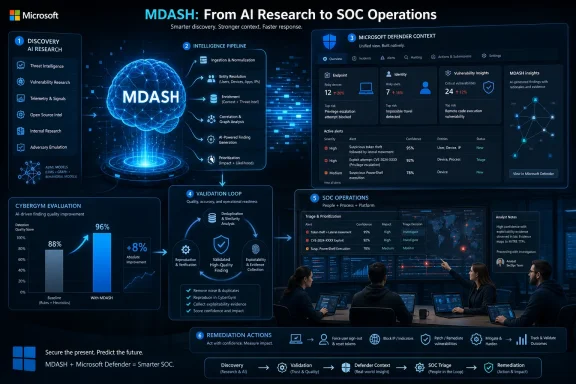
Microsoft has updated its MDASH vulnerability-detection system in June 2026 with improved CyberGym evaluation results, native Microsoft Defender integration for public-preview customers, and broader commercial preview access for organizations that want to test AI-assisted vulnerability discovery inside existing security operations workflows. The move matters because MDASH is not being pitched as another dashboard, scanner, or Copilot wrapper. Microsoft is trying to turn AI vulnerability research into an operational security feed that can survive contact with real SOC queues, patch triage meetings, and skeptical administrators. That is a harder problem than finding bugs in a benchmark, and the Defender integration is where the experiment becomes much more consequential.
When Microsoft first described MDASH, the headline number was easy to grasp: an AI-assisted vulnerability discovery system that could outperform other entries on a public benchmark and help researchers surface real Windows flaws. That made for a clean story about agents, models, and automated bug hunting. But benchmarks do not fix production systems, and discovery alone does not reduce enterprise risk unless the findings enter the machinery that security teams already use.
That is why the Defender integration is the more practical announcement. Microsoft is effectively acknowledging that vulnerability detection is only half the workflow. The rest is routing, prioritization, validation, ownership, remediation, exception handling, and proof that something changed after a patch or mitigation was applied.
Security teams already drown in tools that claim to find more problems. The more interesting promise is finding fewer dubious problems and making the remaining ones easier to act on. If MDASH can place higher-confidence findings into Defender workflows without forcing analysts to pivot into a separate research environment, Microsoft has a chance to reduce the distance between “the model found something” and “the business fixed something.”
That distinction matters because SOC teams have learned to distrust novelty when novelty arrives as a new console. Every additional portal becomes another place where an alert can age, another permissions model to manage, and another integration that breaks during an incident. By bringing MDASH into Defender, Microsoft is betting that the adoption path for AI vulnerability detection runs through familiar operational surfaces rather than through standalone AI security labs.
Cybersecurity is full of technologies that look powerful until they meet the economics of analyst attention. A scanner that finds 10 real issues and 90 speculative ones may be defensible in a research setting, but it becomes toxic in an enterprise backlog. Administrators are not short of vulnerabilities; they are short of validated urgency.
MDASH’s core design is meant to address that problem by using multiple models and agentic workflows to examine, challenge, validate, deduplicate, and prove suspected weaknesses. The point is not simply that many AI agents sound more futuristic than one AI model. The point is that vulnerability discovery requires adversarial reasoning: one component proposes a weakness, another tests whether it is reachable, another checks whether it has already been reported, and another tries to establish exploitability.
That architecture maps neatly onto how human security researchers work when they are being careful. A bug report becomes more valuable as it moves from suspicion to reproduction to exploitability to business impact. Microsoft’s message is that MDASH can automate more of that chain, producing findings that are less likely to waste scarce engineering time.
There is still reason for caution. Benchmarks are controlled environments, and even realistic ones cannot fully capture the weirdness of enterprise software estates, custom code, unsupported dependencies, half-retired services, and undocumented business logic. But the direction of the claim is important: Microsoft is not only saying MDASH can find more. It is saying MDASH can help separate what is plausible from what is actionable.
That comes with advantages. Defender already sits in front of many security teams, especially in Microsoft 365 E5 and Windows-heavy environments. It already understands devices, users, alerts, exposure, recommendations, and remediation state. Feeding MDASH findings into that context could make them more useful than a raw vulnerability report that lands in an inbox.
But it also raises the stakes. Defender is where customers expect signal discipline. A research system can tolerate rough edges, especially in preview. A SOC workflow cannot. Once MDASH findings appear alongside endpoint detections, identity alerts, and vulnerability recommendations, administrators will judge them by the same standard: are these findings timely, explainable, prioritized, and connected to remediation?
That is the right test. AI security systems should not be evaluated only by whether they can produce impressive demonstrations. They should be evaluated by whether they reduce mean time to understand, mean time to remediate, and mean time to verify. Defender gives Microsoft a way to make that case, but it also exposes MDASH to the daily impatience of real-world defenders.
The integration may also help with one of the hardest problems in vulnerability management: context. A vulnerability in a lab is a technical fact. A vulnerability in production is a question of exposure, asset importance, compensating controls, exploit availability, business dependency, and patch feasibility. Defender is where some of that context already lives.
The earliest MDASH examples were especially notable because they involved Windows components and Microsoft’s own vulnerability response process. That gave the announcement more credibility than a generic claim about AI finding hypothetical flaws. It also framed MDASH as an internal engineering capability before it became a customer-facing preview.
That order matters. Security vendors often sell tooling that their own engineering organizations do not meaningfully use. Microsoft is trying to claim the opposite: that MDASH is emerging from internal use, security research, and product hardening, then moving outward toward commercial customers. If true, that gives customers a better reason to pay attention.
It also creates a feedback loop. Microsoft can run MDASH against its own code, learn from the results, improve the harness, and then expose parts of that capability through Defender. Customers can provide preview feedback, which in turn can refine the system’s operational usefulness. The challenge is that each step in that loop requires trust, especially when AI is being asked to reason about exploitability and risk.
Trust will depend on transparency. Enterprises will want to know why MDASH thinks a vulnerability is real, what evidence supports the finding, how confidence is calculated, whether the result was reproduced, and how the system handles uncertainty. “The AI says so” will not be enough for a change advisory board staring at a fragile production service.
Security work is especially unforgiving because plausible language can be dangerous. A model can describe a vulnerability convincingly while being wrong about reachability, exploitability, or the affected code path. It can overfit to familiar bug classes, miss environmental constraints, or mistake a theoretical weakness for a practical attack route.
A harness can reduce those risks by assigning different roles to different agents and forcing evidence through stages. One agent can inspect code, another can generate a test, another can attempt reproduction, another can compare against known issues, and another can construct a proof. This does not eliminate error, but it changes the system from a chat interface into an investigative pipeline.
That pipeline framing is crucial for enterprise acceptance. Security teams do not need AI that merely sounds like a senior researcher. They need AI that leaves behind artifacts: traces, reproductions, severity reasoning, deduplication logic, and remediation hints. The more MDASH behaves like a structured research process rather than a clever assistant, the more useful it becomes.
There is also a vendor-neutral lesson here. The future of AI security tooling may not belong to whichever company has the single best general-purpose model in a given month. It may belong to the vendors that know how to orchestrate models, tools, code analysis, runtime signals, historical vulnerability data, and remediation workflows into a repeatable system.
For early adopters, the appeal is obvious. Security teams with mature vulnerability programs can evaluate whether MDASH produces findings that their existing scanners miss, whether its prioritization is better, and whether Defender integration reduces workflow friction. Organizations with large software estates may be especially interested in whether MDASH can help distinguish exploitable weaknesses from compliance noise.
But preview participation should be deliberate. Administrators should define what success looks like before enabling another AI-driven signal source. Does MDASH reduce triage time? Does it improve fix prioritization? Does it identify vulnerabilities that would otherwise escape review? Does it integrate cleanly with ticketing, ownership, and exception processes?
Without those questions, preview adoption risks becoming theater. A team can proudly say it is testing agentic security while quietly adding another queue no one has time to manage. The best customers for MDASH preview are likely to be organizations disciplined enough to measure it against their current vulnerability management pain, not merely their appetite for AI.
Microsoft also has work to do on packaging. Security buyers will want to understand licensing, data handling, tenant boundaries, retention, model usage, and whether customer code or telemetry contributes to model improvement. These concerns are not secondary. They will determine whether MDASH is seen as a trusted security capability or another opaque cloud dependency.
MDASH is aimed directly at that moment. If it can provide stronger evidence, better validation, and clearer prioritization, it changes the tone of the conversation. Instead of arguing over whether a finding deserves attention, teams can spend more time deciding how quickly to fix it and what compensating controls are acceptable in the meantime.
This is where AI may deliver its most immediate security value. Not by replacing human judgment, but by improving the quality of the evidence that reaches human decision-makers. Security teams do not need every model-generated insight surfaced as an alert. They need the messy middle of vulnerability analysis compressed into something defensible.
That is also where Microsoft’s Defender ecosystem gives MDASH leverage. A vulnerability finding tied to device exposure, identity context, endpoint telemetry, and remediation status is more persuasive than a standalone report. It can become part of a risk narrative rather than another row in a spreadsheet.
The danger is over-automation. If organizations allow AI-generated vulnerability prioritization to become unquestioned policy, they may miss edge cases that matter deeply to their environment. The right model is assisted judgment, not delegated accountability.
That does not mean MDASH will magically make Windows vulnerability-free. It means Microsoft is building machinery to search more aggressively and validate more systematically. If that machinery works, customers may see more vulnerabilities disclosed in the short term, not fewer, because better discovery often increases the visible bug count before it reduces long-term risk.
Administrators should resist the instinct to treat more disclosed bugs as proof that the platform is suddenly less secure. In mature security programs, increased discovery can be a sign of healthier internal scrutiny. The real measure is whether vulnerabilities are found before attackers weaponize them, whether patches arrive with usable guidance, and whether customers can deploy mitigations without chaos.
That is where MDASH’s connection to Defender could matter for patch operations. If Microsoft can link AI-discovered vulnerability evidence to exposure management and remediation workflows, it may help organizations move from monthly patch panic toward more continuous risk reduction. That is the promise, at least.
The less flattering possibility is that MDASH becomes another premium signal available mainly to customers already deep in Microsoft’s licensing stack. If the best vulnerability intelligence increasingly lives inside paid security integrations, smaller organizations may remain dependent on delayed public advisories and generic scanning. Microsoft will need to balance commercial incentives with ecosystem security.
That is attractive to enterprises because vulnerability management is often where expensive security programs become embarrassing. Organizations buy tools, generate mountains of findings, struggle to assign ownership, and then carry the same critical issues month after month. The bottleneck is rarely discovery alone. It is the organizational metabolism required to fix what discovery reveals.
MDASH gives partners a new story to tell: fewer dead-end alerts, richer evidence, faster routing, and better alignment between SOC analysts and engineering teams. Some of that story will be marketing. Some may be real, particularly for customers whose current processes are weighed down by noisy tooling and fragmented Microsoft security deployments.
But buyers should ask hard questions. How will partners validate MDASH output? How will they measure false-positive reduction? How will they prevent AI findings from becoming another unmanaged backlog? How will they integrate with non-Microsoft tools in mixed environments?
The answers will matter because most enterprises are not pure Microsoft shops, even when Microsoft owns the endpoint and productivity layers. They have third-party scanners, cloud platforms, open-source dependencies, custom applications, and business units that resist centralized control. MDASH will be most valuable if it improves that messy reality rather than assuming it away.
Coordinated disclosure, patch development, customer notification, exploit assessment, and regulatory reporting all depend on human and institutional capacity. AI can accelerate discovery faster than organizations can accelerate governance. The result may be a period in which vendors discover more issues than they can comfortably explain, prioritize, or remediate.
Microsoft is unusually positioned here because it controls both a major software platform and a major security operations ecosystem. It can find vulnerabilities, patch products, publish advisories, and surface risk through Defender. That vertical integration is powerful, but it also concentrates responsibility. Customers will expect Microsoft not only to discover faster, but to communicate better.
The communication challenge is especially acute for AI-discovered vulnerabilities. Administrators will want to know whether a finding is theoretical, reproducible, weaponizable, observed in the wild, or blocked by default configurations. They will also want to know whether AI-assisted discovery changes the expected cadence or volume of security updates.
If MDASH succeeds, Microsoft may need to rethink how it narrates vulnerability risk to customers. A future Patch Tuesday influenced by AI discovery could contain more internally found bugs, richer exploitability analysis, and stronger links to exposure management. That would be a meaningful improvement, but only if the guidance remains intelligible.
MDASH deserves that skepticism. It is still in preview for customers, its most impressive numbers come from evaluations that must be interpreted carefully, and Microsoft has every incentive to position AI as the next leap in enterprise security. No responsible administrator should treat the announcement as proof that vulnerability management has been solved.
But the Defender integration makes MDASH more substantial than a research boast. Microsoft is not merely saying it has an AI system that finds bugs. It is trying to put that system into the operational path where enterprises already manage security risk. That is the difference between a capability and a product strategy.
The question now is whether MDASH can preserve research-grade rigor while adapting to enterprise-grade workflow. Those are different disciplines. A tool that impresses vulnerability researchers can still frustrate SOC analysts. A tool that works for Microsoft’s own code may still struggle with customer-specific environments.
If Microsoft gets the balance right, MDASH could become one of the first AI security systems that matters not because it talks to analysts, but because it changes what analysts have to spend time on.
 Microsoft Moves MDASH From Research Trophy to SOC Plumbing
When Microsoft first described MDASH, the headline number was easy to grasp: an AI-assisted vulnerability discovery system that could outperform other entries on a public benchmark and help researchers surface real Windows flaws. That made for a clean story about agents, models, and automated bug hunting. But benchmarks do not fix production systems, and discovery alone does not reduce enterprise risk unless the findings enter the machinery that security teams already use.That is why the Defender integration is the more practical announcement. Microsoft is effectively acknowledging that vulnerability detection is only half the workflow. The rest is routing, prioritization, validation, ownership, remediation, exception handling, and proof that something changed after a patch or mitigation was applied.
Security teams already drown in tools that claim to find more problems. The more interesting promise is finding fewer dubious problems and making the remaining ones easier to act on. If MDASH can place higher-confidence findings into Defender workflows without forcing analysts to pivot into a separate research environment, Microsoft has a chance to reduce the distance between “the model found something” and “the business fixed something.”
That distinction matters because SOC teams have learned to distrust novelty when novelty arrives as a new console. Every additional portal becomes another place where an alert can age, another permissions model to manage, and another integration that breaks during an incident. By bringing MDASH into Defender, Microsoft is betting that the adoption path for AI vulnerability detection runs through familiar operational surfaces rather than through standalone AI security labs.
The Accuracy Claim Is Really a False-Positive Claim
Microsoft says MDASH has improved from roughly 88.45 percent to 96.55 percent in CyberGym evaluations. On paper, that is a dramatic jump. In practice, the important question is not whether the score is impressive but what kind of mistakes the system is making less often.Cybersecurity is full of technologies that look powerful until they meet the economics of analyst attention. A scanner that finds 10 real issues and 90 speculative ones may be defensible in a research setting, but it becomes toxic in an enterprise backlog. Administrators are not short of vulnerabilities; they are short of validated urgency.
MDASH’s core design is meant to address that problem by using multiple models and agentic workflows to examine, challenge, validate, deduplicate, and prove suspected weaknesses. The point is not simply that many AI agents sound more futuristic than one AI model. The point is that vulnerability discovery requires adversarial reasoning: one component proposes a weakness, another tests whether it is reachable, another checks whether it has already been reported, and another tries to establish exploitability.
That architecture maps neatly onto how human security researchers work when they are being careful. A bug report becomes more valuable as it moves from suspicion to reproduction to exploitability to business impact. Microsoft’s message is that MDASH can automate more of that chain, producing findings that are less likely to waste scarce engineering time.
There is still reason for caution. Benchmarks are controlled environments, and even realistic ones cannot fully capture the weirdness of enterprise software estates, custom code, unsupported dependencies, half-retired services, and undocumented business logic. But the direction of the claim is important: Microsoft is not only saying MDASH can find more. It is saying MDASH can help separate what is plausible from what is actionable.
Defender Is the Place Where AI Security Hype Meets Enterprise Gravity
The Defender integration is strategically unsurprising and operationally important. Microsoft Defender has become one of the company’s main consolidation points for endpoint security, identity signals, cloud posture, vulnerability management, and incident response. If Microsoft wants MDASH to matter outside Redmond, Defender is the natural delivery vehicle.That comes with advantages. Defender already sits in front of many security teams, especially in Microsoft 365 E5 and Windows-heavy environments. It already understands devices, users, alerts, exposure, recommendations, and remediation state. Feeding MDASH findings into that context could make them more useful than a raw vulnerability report that lands in an inbox.
But it also raises the stakes. Defender is where customers expect signal discipline. A research system can tolerate rough edges, especially in preview. A SOC workflow cannot. Once MDASH findings appear alongside endpoint detections, identity alerts, and vulnerability recommendations, administrators will judge them by the same standard: are these findings timely, explainable, prioritized, and connected to remediation?
That is the right test. AI security systems should not be evaluated only by whether they can produce impressive demonstrations. They should be evaluated by whether they reduce mean time to understand, mean time to remediate, and mean time to verify. Defender gives Microsoft a way to make that case, but it also exposes MDASH to the daily impatience of real-world defenders.
The integration may also help with one of the hardest problems in vulnerability management: context. A vulnerability in a lab is a technical fact. A vulnerability in production is a question of exposure, asset importance, compensating controls, exploit availability, business dependency, and patch feasibility. Defender is where some of that context already lives.
Microsoft Is Building an AI Security Supply Chain Around Its Own Estate
MDASH is not arriving in a vacuum. Microsoft has been pushing hard to present itself as both an AI platform company and a security company, while also absorbing public criticism over cloud intrusions, identity compromises, and the complexity of its own ecosystem. In that environment, automated vulnerability discovery is not merely a product feature. It is part of a broader argument that Microsoft can use AI to harden Microsoft.The earliest MDASH examples were especially notable because they involved Windows components and Microsoft’s own vulnerability response process. That gave the announcement more credibility than a generic claim about AI finding hypothetical flaws. It also framed MDASH as an internal engineering capability before it became a customer-facing preview.
That order matters. Security vendors often sell tooling that their own engineering organizations do not meaningfully use. Microsoft is trying to claim the opposite: that MDASH is emerging from internal use, security research, and product hardening, then moving outward toward commercial customers. If true, that gives customers a better reason to pay attention.
It also creates a feedback loop. Microsoft can run MDASH against its own code, learn from the results, improve the harness, and then expose parts of that capability through Defender. Customers can provide preview feedback, which in turn can refine the system’s operational usefulness. The challenge is that each step in that loop requires trust, especially when AI is being asked to reason about exploitability and risk.
Trust will depend on transparency. Enterprises will want to know why MDASH thinks a vulnerability is real, what evidence supports the finding, how confidence is calculated, whether the result was reproduced, and how the system handles uncertainty. “The AI says so” will not be enough for a change advisory board staring at a fragile production service.
Multi-Model Security Is a Bet Against the One-Model Miracle
The most interesting technical idea behind MDASH is not that it uses AI, but that it avoids treating one model as the oracle. Microsoft’s multi-model, multi-agent approach reflects a sober lesson from the last two years of AI deployment: models are powerful, inconsistent, and often better when embedded in disciplined workflows than when allowed to improvise freely.Security work is especially unforgiving because plausible language can be dangerous. A model can describe a vulnerability convincingly while being wrong about reachability, exploitability, or the affected code path. It can overfit to familiar bug classes, miss environmental constraints, or mistake a theoretical weakness for a practical attack route.
A harness can reduce those risks by assigning different roles to different agents and forcing evidence through stages. One agent can inspect code, another can generate a test, another can attempt reproduction, another can compare against known issues, and another can construct a proof. This does not eliminate error, but it changes the system from a chat interface into an investigative pipeline.
That pipeline framing is crucial for enterprise acceptance. Security teams do not need AI that merely sounds like a senior researcher. They need AI that leaves behind artifacts: traces, reproductions, severity reasoning, deduplication logic, and remediation hints. The more MDASH behaves like a structured research process rather than a clever assistant, the more useful it becomes.
There is also a vendor-neutral lesson here. The future of AI security tooling may not belong to whichever company has the single best general-purpose model in a given month. It may belong to the vendors that know how to orchestrate models, tools, code analysis, runtime signals, historical vulnerability data, and remediation workflows into a repeatable system.
Preview Expansion Signals Confidence, But Not Maturity
Microsoft is expanding MDASH preview access to more commercial customers, which suggests the company believes the system is ready for broader operational testing. That is not the same thing as general availability, and customers should treat the distinction seriously. Preview software is where Microsoft learns what breaks outside its own assumptions.For early adopters, the appeal is obvious. Security teams with mature vulnerability programs can evaluate whether MDASH produces findings that their existing scanners miss, whether its prioritization is better, and whether Defender integration reduces workflow friction. Organizations with large software estates may be especially interested in whether MDASH can help distinguish exploitable weaknesses from compliance noise.
But preview participation should be deliberate. Administrators should define what success looks like before enabling another AI-driven signal source. Does MDASH reduce triage time? Does it improve fix prioritization? Does it identify vulnerabilities that would otherwise escape review? Does it integrate cleanly with ticketing, ownership, and exception processes?
Without those questions, preview adoption risks becoming theater. A team can proudly say it is testing agentic security while quietly adding another queue no one has time to manage. The best customers for MDASH preview are likely to be organizations disciplined enough to measure it against their current vulnerability management pain, not merely their appetite for AI.
Microsoft also has work to do on packaging. Security buyers will want to understand licensing, data handling, tenant boundaries, retention, model usage, and whether customer code or telemetry contributes to model improvement. These concerns are not secondary. They will determine whether MDASH is seen as a trusted security capability or another opaque cloud dependency.
The Real Customer Is the Overloaded Remediation Meeting
Every vulnerability management program eventually turns into a meeting. Security brings findings. Engineering asks whether they are exploitable. Operations asks whether patching will break something. Business owners ask whether the system is exposed. Someone asks whether the scanner has been wrong before.MDASH is aimed directly at that moment. If it can provide stronger evidence, better validation, and clearer prioritization, it changes the tone of the conversation. Instead of arguing over whether a finding deserves attention, teams can spend more time deciding how quickly to fix it and what compensating controls are acceptable in the meantime.
This is where AI may deliver its most immediate security value. Not by replacing human judgment, but by improving the quality of the evidence that reaches human decision-makers. Security teams do not need every model-generated insight surfaced as an alert. They need the messy middle of vulnerability analysis compressed into something defensible.
That is also where Microsoft’s Defender ecosystem gives MDASH leverage. A vulnerability finding tied to device exposure, identity context, endpoint telemetry, and remediation status is more persuasive than a standalone report. It can become part of a risk narrative rather than another row in a spreadsheet.
The danger is over-automation. If organizations allow AI-generated vulnerability prioritization to become unquestioned policy, they may miss edge cases that matter deeply to their environment. The right model is assisted judgment, not delegated accountability.
The Windows Angle Is Bigger Than Another Security Feature
For Windows administrators, MDASH should be read as part of a larger shift in how Microsoft secures the platform. Windows is too large, too old, and too widely deployed for traditional vulnerability discovery alone to keep pace with the attack surface. The company needs automated ways to inspect legacy components, networking stacks, drivers, authentication paths, and code that has accumulated decades of compatibility obligations.That does not mean MDASH will magically make Windows vulnerability-free. It means Microsoft is building machinery to search more aggressively and validate more systematically. If that machinery works, customers may see more vulnerabilities disclosed in the short term, not fewer, because better discovery often increases the visible bug count before it reduces long-term risk.
Administrators should resist the instinct to treat more disclosed bugs as proof that the platform is suddenly less secure. In mature security programs, increased discovery can be a sign of healthier internal scrutiny. The real measure is whether vulnerabilities are found before attackers weaponize them, whether patches arrive with usable guidance, and whether customers can deploy mitigations without chaos.
That is where MDASH’s connection to Defender could matter for patch operations. If Microsoft can link AI-discovered vulnerability evidence to exposure management and remediation workflows, it may help organizations move from monthly patch panic toward more continuous risk reduction. That is the promise, at least.
The less flattering possibility is that MDASH becomes another premium signal available mainly to customers already deep in Microsoft’s licensing stack. If the best vulnerability intelligence increasingly lives inside paid security integrations, smaller organizations may remain dependent on delayed public advisories and generic scanning. Microsoft will need to balance commercial incentives with ecosystem security.
Partners Are Selling Modernization, Not Just Detection
The reported enthusiasm from partners such as Accenture and Insight is predictable but still revealing. Large integrators see MDASH not merely as a detection engine, but as a way to modernize vulnerability management services. If AI can validate findings and reduce false positives, consultants can reframe security programs around prioritized remediation rather than endless scanner cleanup.That is attractive to enterprises because vulnerability management is often where expensive security programs become embarrassing. Organizations buy tools, generate mountains of findings, struggle to assign ownership, and then carry the same critical issues month after month. The bottleneck is rarely discovery alone. It is the organizational metabolism required to fix what discovery reveals.
MDASH gives partners a new story to tell: fewer dead-end alerts, richer evidence, faster routing, and better alignment between SOC analysts and engineering teams. Some of that story will be marketing. Some may be real, particularly for customers whose current processes are weighed down by noisy tooling and fragmented Microsoft security deployments.
But buyers should ask hard questions. How will partners validate MDASH output? How will they measure false-positive reduction? How will they prevent AI findings from becoming another unmanaged backlog? How will they integrate with non-Microsoft tools in mixed environments?
The answers will matter because most enterprises are not pure Microsoft shops, even when Microsoft owns the endpoint and productivity layers. They have third-party scanners, cloud platforms, open-source dependencies, custom applications, and business units that resist centralized control. MDASH will be most valuable if it improves that messy reality rather than assuming it away.
AI Vulnerability Discovery Will Force a Disclosure Reckoning
There is a broader industry implication beneath the product news. If systems like MDASH become more capable, software vendors will find more vulnerabilities faster. That sounds obviously good until the downstream processes strain under the volume.Coordinated disclosure, patch development, customer notification, exploit assessment, and regulatory reporting all depend on human and institutional capacity. AI can accelerate discovery faster than organizations can accelerate governance. The result may be a period in which vendors discover more issues than they can comfortably explain, prioritize, or remediate.
Microsoft is unusually positioned here because it controls both a major software platform and a major security operations ecosystem. It can find vulnerabilities, patch products, publish advisories, and surface risk through Defender. That vertical integration is powerful, but it also concentrates responsibility. Customers will expect Microsoft not only to discover faster, but to communicate better.
The communication challenge is especially acute for AI-discovered vulnerabilities. Administrators will want to know whether a finding is theoretical, reproducible, weaponizable, observed in the wild, or blocked by default configurations. They will also want to know whether AI-assisted discovery changes the expected cadence or volume of security updates.
If MDASH succeeds, Microsoft may need to rethink how it narrates vulnerability risk to customers. A future Patch Tuesday influenced by AI discovery could contain more internally found bugs, richer exploitability analysis, and stronger links to exposure management. That would be a meaningful improvement, but only if the guidance remains intelligible.
The Defender Integration Makes MDASH Harder to Dismiss
The easy reaction to MDASH is cynicism. AI security announcements arrive weekly, and many are little more than old scanning ideas wrapped in agentic vocabulary. Security professionals have learned to ask whether the demo survives production, whether the product reduces work, and whether the vendor can explain its own claims.MDASH deserves that skepticism. It is still in preview for customers, its most impressive numbers come from evaluations that must be interpreted carefully, and Microsoft has every incentive to position AI as the next leap in enterprise security. No responsible administrator should treat the announcement as proof that vulnerability management has been solved.
But the Defender integration makes MDASH more substantial than a research boast. Microsoft is not merely saying it has an AI system that finds bugs. It is trying to put that system into the operational path where enterprises already manage security risk. That is the difference between a capability and a product strategy.
The question now is whether MDASH can preserve research-grade rigor while adapting to enterprise-grade workflow. Those are different disciplines. A tool that impresses vulnerability researchers can still frustrate SOC analysts. A tool that works for Microsoft’s own code may still struggle with customer-specific environments.
If Microsoft gets the balance right, MDASH could become one of the first AI security systems that matters not because it talks to analysts, but because it changes what analysts have to spend time on.
The Practical Signal Hidden Inside Microsoft’s AI Security Pitch
MDASH is still early enough that administrators should evaluate it with curiosity rather than faith. The strongest reading of the announcement is not that Microsoft has built an autonomous security researcher, but that it is industrializing parts of vulnerability discovery and pushing the results closer to remediation.- MDASH’s improved CyberGym score suggests Microsoft is making measurable progress, but customers should judge the service by operational outcomes rather than benchmark rank.
- The Defender integration is the most important product change because it places AI-assisted vulnerability findings inside workflows many SOC teams already use.
- The multi-model approach is significant because vulnerability validation requires structured disagreement, reproduction, and evidence rather than a single model’s confident answer.
- Preview expansion gives commercial customers a chance to test MDASH against real environments, but it should be measured against triage time, false positives, and remediation impact.
- Windows administrators should expect AI-assisted discovery to increase the visibility of vulnerabilities before it proves that long-term platform risk is falling.
References
- Primary source: Petri IT Knowledgebase
Published: 2026-06-02T17:42:06.446408
Microsoft's MDASH Adds Defender Integration for Smarter Vulnerability Detection
Microsoft updates MDASH with improved vulnerability detection accuracy and native Defender integration to streamline security workflows. petri.com
- Official source: microsoft.com
Defense at AI speed: Microsoft’s new multi-model agentic security system tops leading industry benchmark | Microsoft Security Blog
Today Microsoft is announcing a major step forward in AI-powered cyber defense: a new multi-model agentic scanning harness (codenamed MDASH).www.microsoft.com - Official source: news.microsoft.com
- Related coverage: techradar.com
Microsoft unveils MDASH, its AI agent-driven security platform — and it's already spotted a host of new Windows flaws | TechRadar
100 AI agents worked in unison to discover 16 flawswww.techradar.com - Related coverage: aytac.dev
Microsoft MDASH: A Multi-Agent Swarm for Autonomous Security
Explore Microsoft's MDASH, a multi-model agentic security system that discovered 16 Windows vulnerabilities and outperformed Anthropic's Mythos.aytac.dev - Related coverage: revolutioninai.com
Microsoft MDASH Explained: How 100+ AI Agents Beat Anthropic's Mythos on Cybersecurity
Microsoft's MDASH scored 88.45% on CyberGym — beating Anthropic's Mythos and GPT-5.5 — using no frontier model. Here's exactly how the 100+ agent pipewww.revolutioninai.com

- Related coverage: ciberseguridadtic.es
MDASH: así funciona el sistema multimodelo con el que Microsoft detecta fallos críticos en Windows
Hace unos días Microsoft presentaba MDASH (Multi-Model Agentic Scanning Harness), un sistema multimodelo y multiagente diseñado para localizar vulnerabilidades deciberseguridadtic.es - Related coverage: stack-archive.com
Microsoft MDASH: 100 AI Agents Found 16 Windows Flaws
MDASH found 16 real Windows flaws — 4 critical RCEs — using 100+ AI agents that argue, verify, and prove exploits. Enterprise preview opens June 2026.stack-archive.com
- Related coverage: infoq.com
Microsoft Introduces MDASH for Large-Scale AI Vulnerability Research - InfoQ
Microsoft has introduced a new AI-driven vulnerability discovery system called MDASH, a multi-model agentic security platform designed to automate large-scale code auditing across Windows and other Miwww.infoq.com
- Related coverage: vendordeep.com
Deep Dive: Microsoft MDASH: Engineering-Grade Vulnerabili...
Microsoft unveiled MDASH during May 2026 Patch Tuesday—an end-to-end vulnerability discovery syst.... In-depth analysis of Microsoft MDASH: Engineering-Grade...vendordeep.com - Official source: cdn-dynmedia-1.microsoft.com
