

A new Microsoft-MIT Technology Review analysis, as summarized by Cloud Wars, gives admins a practical starting point for agentic AI: pilot agents first on repeatable, observable work where outputs can be checked, logged, and reversed. For Windows, Microsoft 365, Azure, data, and security teams, that means starting with report drafts, data-quality monitoring, certificate inventory, release-note preparation, and low-risk ticket enrichment. It does not mean handing agents authority over production networking, disaster recovery, schema migrations, modernization programs, or business-critical records.
The headline is not that enterprise agents are suddenly ready to run the business. It is that customers are beginning to separate work that can be delegated from work that still requires human judgment. In the analysis, 300 customers rated confidence across 101 AI, data, and cloud tasks on a 1-100 scale, where 100 meant highest confidence. The highest-scoring examples clustered around tasks that are visible, repeatable, and testable. The lowest-scoring examples clustered around tasks where plausible automation can still be wrong in ways that damage infrastructure, corrupt business logic, or expose gaps in institutional knowledge.
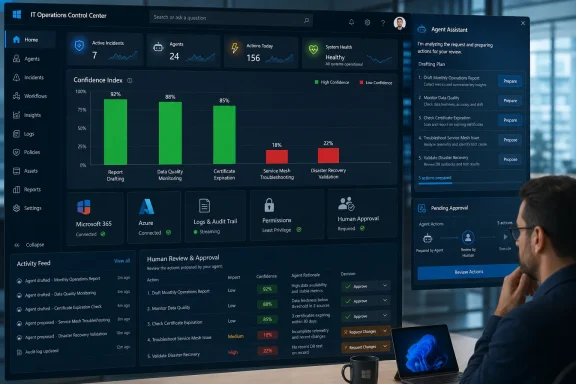
Cloud Wars’ coverage of the Microsoft-MIT work gives the enterprise AI market something more useful than another demo: a confidence index. Automated report generation and distribution led the named examples at 84% confidence, followed by boilerplate code generation for new features at 82.5%, data quality monitoring and anomaly detection at 82%, certificate expiration monitoring and renewal at 82%, and automated data profiling and statistical analysis at 81%. These are not trivial tasks, but they share an operating pattern IT departments understand well: the output can be checked against known schemas, logs, policies, metrics, tests, or human expectations.
The lowest-scoring examples tell the other half of the story. Service mesh configuration and troubleshooting sat at 37.5% confidence, disaster recovery testing and validation at 43%, feature engineering pipeline automation at 44.5%, legacy system data extraction and modernization at 46%, and database schema migration scripting at 46.5%. These are not merely “harder” tasks. They are compound workflows where a technically plausible answer can still be operationally wrong, politically impossible, financially risky, or destructive after it touches production.
For the last two years, the technology industry has used “agent” as both a product category and a magic word. An agent is usually described as software that can plan, call tools, retrieve context, take actions, and complete multi-step work with less human prompting than a chatbot. That definition is broad enough to cover a coding assistant, a Microsoft 365 task runner, a service-desk triage bot, a data-quality monitor, or an infrastructure remediation system wired into cloud APIs.
The Microsoft-MIT analysis matters because it asks a better enterprise question than “Can the model do it?” It asks whether customers are confident enough to let an agent do it. That distinction is the difference between a lab result and a production rollout.
Cloud Wars framed the findings as an emerging picture of where early customers are gaining comfort with AI agents and where they still need more confidence. That realism is the important part. Enterprise AI adoption has been trapped between two false stories: the vendor story that autonomous agents are about to absorb whole departments, and the backlash story that AI pilots mostly disappoint. The confidence data points to a third possibility. Agents may be genuinely useful sooner than skeptics expect, but in narrower, more governed places than marketing often suggests.
The high-confidence tasks are not glamorous. They are report generation, boilerplate code, data-quality checks, certificate monitoring, and statistical profiling. But in enterprise IT, unglamorous work is where reliability compounds. If an agent saves a data team from manually assembling status reports, detects anomalies earlier, drafts repetitive code faster, or flags expiring certificates before an outage, it does not need to be a science-fiction coworker. It needs to be dependable software with a language interface, clear permissions, audit trails, and a rollback model.
That is why the report is more interesting than a benchmark leaderboard. It is not ranking models. It is ranking delegability.
The immediate implication for WindowsForum readers is straightforward: treat agents as workflow participants inside an existing control plane, not as trusted employees who happen to speak natural language. Identity, access, logging, approval, retention, and incident response should be designed before any agent is given access to Microsoft 365 data, Azure resources, Windows management tooling, ticketing systems, source repositories, or production databases.
Data quality monitoring and anomaly detection at 82% confidence follows the same logic. Data teams already use thresholds, validation rules, lineage tools, dashboards, and incident processes. An agent operating in that environment is not being asked to invent the organization’s truth from scratch. It is being asked to monitor signals and escalate deviations in a world where deviations are often mathematically visible.
Automated data profiling and statistical analysis at 81% confidence is similar. Profiling a dataset is a bounded activity: find distributions, missing values, outliers, correlations, duplicate patterns, and shape changes. An agent can produce value even if a human analyst still validates the conclusion, because the tedious first pass is itself meaningful labor.
That is the practical lesson for Microsoft Fabric, Power BI, Azure data shops, SQL Server teams, and anyone maintaining reporting pipelines on Windows infrastructure. Agents become credible where the enterprise has already done the boring foundation work: metadata, naming conventions, access controls, data dictionaries, repeatable queries, versioned reports, and reviewable output. Where that foundation is missing, agents do not magically create trust. They expose the absence of it.
The agent adoption pattern for data teams should therefore be incremental. A safe first workflow might ask an agent to draft a weekly Power BI commentary from approved datasets, flag missing values in a governed lakehouse table, summarize anomalies from an existing data-quality dashboard, or prepare a distribution list and change note for a recurring report. The agent should cite the dataset, refresh time, filters, and assumptions it used. A human owner should approve the final distribution until the organization has enough evidence that the workflow is stable.
A no-go workflow would be very different: allowing an agent to redefine business metrics, change semantic models, alter production ETL logic, merge customer identifiers, delete outliers, or publish executive dashboards without review. Those actions create business truth, not merely summarize it. They belong in human-led change control.
That is why the data workflow scores are not just a data-team story. They are a preview of how agent adoption will probably spread across enterprise IT: not by replacing workflows wholesale, but by taking on the repeatable edges first.
The table’s implication is direct: data and reporting teams can pilot now if the agent is constrained to drafting, monitoring, profiling, and escalation. Platform, networking, and resilience teams should use agents as assistants for evidence gathering and runbook preparation, not as autonomous operators.
But the next figures are more revealing than the top score. Release note generation from commit history came in at 79.5%, and automated code review and style enforcement at 73.5%. Those are still relatively strong scores, but they show where teams are drawing the line. Summarizing commits is useful, but it requires understanding what matters to users. Reviewing style is useful, but it can confuse superficial cleanliness with maintainability.
The report language cited by Cloud Wars is careful on this point. Human engineers and architects are likely to remain heavily involved in AI workflows “for at least the next couple of years,” even as agents execute individual tasks inside them. At the same time, experts foresee agents becoming increasingly capable of managing broader workflows in the AI domain.
That is not a contradiction. It is the likely operating model. Agents will do more of the mechanical work inside software delivery while humans continue to own requirements, design tradeoffs, risk acceptance, release judgment, and accountability. In other words, the developer’s job does not disappear into the agent. It moves up a layer, toward specification, review, integration, and governance.
For Windows developers, .NET teams, Power Platform builders, GitHub shops, and enterprise application groups, that distinction matters. If an organization treats AI-generated boilerplate as free production code, it is building technical debt faster. If it treats AI-generated boilerplate as a draft that must pass tests, code review, security scanning, dependency checks, and human ownership, it can gain speed without pretending the agent is a senior engineer.
Safe first workflows include generating a starter controller from an existing internal pattern, drafting unit tests for a small function, summarizing commits into release-note candidates, converting comments into documentation, or proposing style-only changes that a human reviewer can accept or reject. These workflows are useful because the evidence is visible: the diff, test result, dependency scan, and reviewer comment history.
No-go areas are broader and riskier: letting an agent approve its own pull requests, change authentication logic without security review, select encryption patterns, modify production IaC templates, upgrade critical dependencies without testing, or decide whether a breaking change is acceptable. Those decisions involve security posture, customer impact, and long-term maintainability. They remain human-owned.
The same logic applies to release notes. An agent can summarize commit history, but a product owner still needs to decide which change is user-facing, which bug fix deserves a warning, which breaking change needs migration guidance, and which internal refactor should be omitted. The agent can assemble the clay. The release manager still needs to know what the sculpture is supposed to be.
For security teams, the coding implication is equally clear: treat agent-assisted development as part of the software supply chain. Require normal scanning, normal secrets detection, normal dependency review, normal branch protections, and normal accountability. The agent may accelerate the draft, but it must not become a bypass around engineering discipline.
That makes certificate work an ideal agentic wedge. It combines calendar awareness, inventory, policy, workflow, and escalation. It may require touching sensitive systems, but the task itself is bounded. If admins design the workflow correctly, the agent does not need broad production freedom; it needs the ability to monitor, prepare, notify, request approval, and execute a known renewal path.
A safe first workflow might have an agent inventory certificates across known endpoints, identify certificates expiring within a defined window, compare ownership metadata, create a ticket for the responsible team, draft a renewal plan, and attach evidence. In a more mature environment, the agent might trigger a renewal only for approved certificate types and only after a human confirms the target, window, and rollback plan. Every step should be logged.
Compare that with service mesh configuration and troubleshooting at 37.5% confidence. A service mesh is where networking, identity, certificates, routing, observability, deployment topology, and application behavior meet. Troubleshooting it often requires knowing not only what the configuration says, but what the organization intended, what changed recently, which team owns which service, which exception was granted under pressure, and which temporary workaround has become load-bearing infrastructure.
That is hostile terrain for an agent. A model can parse YAML, read logs, compare policies, and suggest remediation. But giving it authority to reconfigure a production mesh is a very different proposition. The blast radius is too large, and the correct answer is too dependent on context that may live in incident retrospectives, chat history, tribal knowledge, or undocumented architecture decisions.
Disaster recovery testing and validation at 43% confidence falls into the same category. DR is not a single technical action. It is a rehearsal of organizational survival. It touches backups, identity, networking, application dependencies, data consistency, failover procedures, user communications, compliance obligations, and executive risk tolerance. An agent can help prepare runbooks, check backup freshness, compare configurations, and flag missing evidence. But the final validation that the business can survive a real outage is not just a task completion event.
For Azure administrators, Windows Server teams, hybrid identity owners, and Microsoft 365 continuity planners, the lesson is that agentic cloud operations should begin with operational hygiene, not heroic remediation. Let agents inventory certificates, summarize alerts, correlate low-risk telemetry, draft runbook updates, prepare change tickets, and collect evidence for audits. Do not start by giving them authority to rewire production, rewrite routing policy, fail over critical systems, or certify disaster recovery readiness.
The implication for Azure and Windows operations is simple: use agents to reduce toil around known controls before using them near live controls. A useful agent should make the change advisory board better informed, not replace the change advisory board.
That is the heart of the matter. Enterprises do not merely have data problems. They have context debt.
Context debt accumulates when business rules live in people’s heads, when schemas are named after past reorganizations, when runbooks describe last year’s architecture, when “source of truth” depends on which team you ask, and when exceptions outnumber policies. Humans work around this mess by asking around, remembering incidents, reading between the lines, and knowing when not to trust a dashboard. Agents need that context to be explicit, retrievable, current, permissioned, and grounded.
Legacy system data extraction and modernization at 46% confidence is a perfect example. The technical task may sound straightforward: extract data from an old system and move it into a modern platform. But anyone who has done it knows the real work is semantic. Which fields are still used? Which codes were retired but still appear in historical records? Which customer identifiers were merged? Which reports depend on quirks that no one calls quirks because they have become business reality?
Database schema migration scripting at 46.5% confidence has the same problem. A schema migration is not just DDL. It is application compatibility, downtime tolerance, rollback planning, data transformation, permission mapping, reporting impact, test coverage, and stakeholder coordination. An agent can generate a script. The hard question is whether the script represents the business correctly.
Feature engineering pipeline automation at 44.5% confidence extends the issue into machine learning and analytics. Feature engineering is full of implicit assumptions about causality, leakage, sampling, time windows, population shifts, and business definitions. Automating that pipeline without deep context can produce models that look statistically impressive and fail operationally.
For data, security, and platform teams, the implication is that agent readiness is also documentation readiness. Before delegating a workflow, ask whether the policy, owner, data source, approval path, exception process, rollback procedure, and audit evidence are clear enough for a new human employee to follow. If not, the agent will probably be guessing too.
This is where the agent conversation should make executives uncomfortable. Many organizations want agents because they hope AI will compensate for messy process and fragmented data. The confidence data suggests the opposite. Agents reward organizations that have already made work legible. They struggle where the enterprise itself cannot explain how the work gets done.
This is the competitive convergence that matters for WindowsForum readers. Vendors can differ on models, interfaces, pricing, ecosystem strategy, and go-to-market. But enterprise customers still need the same answers: What did the agent do? What data did it read? Which tool did it call? Which identity did it use? What policy constrained it? Who approved the action? How do we roll it back? How do we prove it did not exfiltrate sensitive information or make an unauthorized change?
Those questions are not anti-AI. They are the price of production.
For Microsoft 365 administrators, this means agents should inherit the same seriousness applied to users, applications, service principals, retention policies, sensitivity labels, conditional access, eDiscovery, and audit logging. If an agent can read mail, summarize Teams content, draft documents, create files, update records, or send messages, it can create compliance and privacy consequences. It must be governed accordingly.
For Azure teams, the same logic applies to resource access, managed identities, role-based access control, policy enforcement, monitoring, and change management. An agent that can call cloud APIs is not just a chat experience. It is an actor in the environment. Its permissions should be narrow, its actions should be logged, and its failure modes should be rehearsed.
For security teams, the risk is not that agents are uniquely malicious. The risk is that they combine broad access, natural-language ambiguity, tool use, and user trust. That mix can turn a poorly scoped workflow into a data exposure, unauthorized change, or noisy incident. Guardrails should therefore be designed around least privilege, separation of duties, approval gates, data-loss prevention, monitoring, and incident response.
The agent winners will not simply be the vendors with the most fluent models. They will be the vendors and customers that make autonomy auditable.
Human-in-the-loop is often discussed as if it were a safety tax. In practice, it is a design pattern. The right human checkpoint can make an agent useful sooner by narrowing the consequences of error. It lets teams automate preparation, search, synthesis, drafting, validation, and monitoring while preserving human authority over irreversible or high-impact actions.
The problem is that many organizations implement human review badly. They ask a person to approve an output without giving that person evidence. They flood reviewers with low-value confirmations until approval becomes muscle memory. They put junior staff in charge of accepting agent output they are not qualified to challenge. Or they treat “human in the loop” as a checkbox rather than a workflow design.
A useful human-in-the-loop system tells the reviewer what changed, why the agent recommends it, what evidence supports the recommendation, what alternatives were considered, what the blast radius is, and how rollback would work. It also knows when not to ask. If every agent action requires a human click, the organization has not automated work. It has built a slower user interface.
This is especially important for Windows and Microsoft 365 administrators. Microsoft’s ecosystem already has mature concepts of identity, conditional access, audit logs, role-based access control, approval workflows, sensitivity labels, retention, eDiscovery, and endpoint management. Agent adoption should extend those controls, not bypass them. If an agent can send mail, update records, create files, modify tickets, or call cloud APIs, it must be governed like any other actor with enterprise privileges.
The agent should not be “the AI.” It should be a managed principal, an auditable workflow participant, and a constrained executor.
Ready for pilot now are workflows that are frequent, bounded, observable, and easy to reverse. These include automated report drafts, approved-data summaries, data profiling, anomaly monitoring, certificate expiration tracking, release-note candidates, boilerplate code drafts, test suggestions, documentation updates, and ticket enrichment. These are good fits for Windows, Microsoft 365, Azure, data, and developer teams because the agent can produce a reviewable artifact rather than make an irreversible decision.
Ready for assisted use, not autonomy are workflows where the agent can gather evidence and propose action but should not execute without review. These include certificate renewal, routine runbook updates, alert correlation, code review suggestions, dependency upgrade proposals, access review summaries, backup status checks, and compliance evidence collection. These are useful pilots if the organization defines the approval gate clearly.
Keep human-led for the next 12–24 months are workflows where the blast radius is high, context is incomplete, or success depends on cross-functional judgment. These include service mesh configuration and troubleshooting, disaster recovery validation, legacy modernization, database schema migration, production identity changes, security incident closure, customer-data reconciliation, and feature engineering automation for consequential models. Agents can assist with documentation, comparison, and analysis, but humans should own the decision and execution.
Redesign before delegation describes workflows that are not ready because the process itself is undocumented, ownership is unclear, data definitions conflict, or rollback is unknown. In those cases, an agent pilot will not fix the workflow. It will reveal the mess faster.
This compact sorting exercise is the main operational takeaway. Do not ask whether the organization should “adopt agents.” Ask which workflows are ready for monitored delegation, which are ready for assisted preparation, and which are too risky because the enterprise has not made the work legible.
AI backlash grows when employees are told to use tools that do not fit their work, when executives demand savings before systems are reliable, when customers encounter hallucinated support, when developers inherit unreviewed AI code, or when admins are asked to secure agent behavior after deployment. In that environment, a failed pilot is not merely a failed pilot. It becomes evidence that the entire category is overhyped.
The Microsoft-MIT confidence pattern suggests a way around that trap. Do not begin with the most impressive demo. Begin with the workflow where the organization can measure success, bound failure, and preserve accountability. An agent that reliably produces a weekly report draft may be less exciting than one that promises autonomous disaster recovery, but the former builds trust and the latter may destroy it.
This is also where the economics become clearer. Financial payback is easiest to demonstrate when the task is frequent, labor-intensive, and reviewable. Report generation, data profiling, anomaly detection, certificate monitoring, release-note drafting, documentation updates, and ticket enrichment all fit that pattern. They may not replace entire roles, but they can reduce repetitive work and improve consistency.
For security and compliance leaders, this is a better adoption story than uncontrolled experimentation. A governed agent pilot can produce logs, metrics, reviewer feedback, and risk evidence. An uncontrolled agent rollout produces anecdotes, surprises, and cleanup work. The first builds a case for expansion. The second builds the next backlash cycle.
The timeline is not a prediction that all organizations will advance at the same pace. It is a maturity model. A highly governed data platform may be ready for agentic monitoring now. A poorly documented legacy modernization program may not be ready two years from now. The difference is not model quality alone. It is process quality, data quality, ownership clarity, and control-plane maturity.
That is good news for Windows, Microsoft 365, Azure, data, and security teams. Enterprise IT already knows how to manage identities, permissions, logs, approvals, policies, tickets, and rollback. The agent era does not make those disciplines obsolete. It makes them more important.
The mistake would be to treat agents as a separate AI experiment owned only by innovation teams. Once an agent can read business data, draft communications, create tickets, call APIs, write code, or recommend changes, it belongs inside the same governance conversation as every other privileged system. The question is not whether the interface feels conversational. The question is what authority sits behind the conversation.
The confidence index points to a measured path forward. Start where work is repetitive and observable. Keep humans in charge of judgment, architecture, risk, and accountability. Use agents to prepare, monitor, draft, and explain before allowing them to execute. Invest in context: clean data, current documentation, clear ownership, and explicit policies. Expand only when evidence shows the workflow is reliable.
That may sound less dramatic than the agentic-AI sales pitch. It is also how enterprise technology usually becomes real. The agent breakthrough, if it comes, will not arrive as a sudden handoff from humans to machines. It will arrive as a series of narrow, governed delegations that become boring enough to trust.
The headline is not that enterprise agents are suddenly ready to run the business. It is that customers are beginning to separate work that can be delegated from work that still requires human judgment. In the analysis, 300 customers rated confidence across 101 AI, data, and cloud tasks on a 1-100 scale, where 100 meant highest confidence. The highest-scoring examples clustered around tasks that are visible, repeatable, and testable. The lowest-scoring examples clustered around tasks where plausible automation can still be wrong in ways that damage infrastructure, corrupt business logic, or expose gaps in institutional knowledge.
Cloud Wars’ coverage of the Microsoft-MIT work gives the enterprise AI market something more useful than another demo: a confidence index. Automated report generation and distribution led the named examples at 84% confidence, followed by boilerplate code generation for new features at 82.5%, data quality monitoring and anomaly detection at 82%, certificate expiration monitoring and renewal at 82%, and automated data profiling and statistical analysis at 81%. These are not trivial tasks, but they share an operating pattern IT departments understand well: the output can be checked against known schemas, logs, policies, metrics, tests, or human expectations.
The lowest-scoring examples tell the other half of the story. Service mesh configuration and troubleshooting sat at 37.5% confidence, disaster recovery testing and validation at 43%, feature engineering pipeline automation at 44.5%, legacy system data extraction and modernization at 46%, and database schema migration scripting at 46.5%. These are not merely “harder” tasks. They are compound workflows where a technically plausible answer can still be operationally wrong, politically impossible, financially risky, or destructive after it touches production.
 The Agent Hype Cycle Finally Meets a Control Plane
For the last two years, the technology industry has used “agent” as both a product category and a magic word. An agent is usually described as software that can plan, call tools, retrieve context, take actions, and complete multi-step work with less human prompting than a chatbot. That definition is broad enough to cover a coding assistant, a Microsoft 365 task runner, a service-desk triage bot, a data-quality monitor, or an infrastructure remediation system wired into cloud APIs.The Microsoft-MIT analysis matters because it asks a better enterprise question than “Can the model do it?” It asks whether customers are confident enough to let an agent do it. That distinction is the difference between a lab result and a production rollout.
Cloud Wars framed the findings as an emerging picture of where early customers are gaining comfort with AI agents and where they still need more confidence. That realism is the important part. Enterprise AI adoption has been trapped between two false stories: the vendor story that autonomous agents are about to absorb whole departments, and the backlash story that AI pilots mostly disappoint. The confidence data points to a third possibility. Agents may be genuinely useful sooner than skeptics expect, but in narrower, more governed places than marketing often suggests.
The high-confidence tasks are not glamorous. They are report generation, boilerplate code, data-quality checks, certificate monitoring, and statistical profiling. But in enterprise IT, unglamorous work is where reliability compounds. If an agent saves a data team from manually assembling status reports, detects anomalies earlier, drafts repetitive code faster, or flags expiring certificates before an outage, it does not need to be a science-fiction coworker. It needs to be dependable software with a language interface, clear permissions, audit trails, and a rollback model.
That is why the report is more interesting than a benchmark leaderboard. It is not ranking models. It is ranking delegability.
The immediate implication for WindowsForum readers is straightforward: treat agents as workflow participants inside an existing control plane, not as trusted employees who happen to speak natural language. Identity, access, logging, approval, retention, and incident response should be designed before any agent is given access to Microsoft 365 data, Azure resources, Windows management tooling, ticketing systems, source repositories, or production databases.
Data Workflows Win Because They Already Know How to Be Measured
The clearest signal in the analysis is that data workflows rank highest when the task is structured and feedback is immediate. Automated report generation and distribution at 84% confidence sits at the top of the named list, and it is easy to see why. Reports usually have known audiences, recurring templates, defined metrics, established refresh cycles, and enough human review to catch obvious errors before they become decisions.Data quality monitoring and anomaly detection at 82% confidence follows the same logic. Data teams already use thresholds, validation rules, lineage tools, dashboards, and incident processes. An agent operating in that environment is not being asked to invent the organization’s truth from scratch. It is being asked to monitor signals and escalate deviations in a world where deviations are often mathematically visible.
Automated data profiling and statistical analysis at 81% confidence is similar. Profiling a dataset is a bounded activity: find distributions, missing values, outliers, correlations, duplicate patterns, and shape changes. An agent can produce value even if a human analyst still validates the conclusion, because the tedious first pass is itself meaningful labor.
That is the practical lesson for Microsoft Fabric, Power BI, Azure data shops, SQL Server teams, and anyone maintaining reporting pipelines on Windows infrastructure. Agents become credible where the enterprise has already done the boring foundation work: metadata, naming conventions, access controls, data dictionaries, repeatable queries, versioned reports, and reviewable output. Where that foundation is missing, agents do not magically create trust. They expose the absence of it.
The agent adoption pattern for data teams should therefore be incremental. A safe first workflow might ask an agent to draft a weekly Power BI commentary from approved datasets, flag missing values in a governed lakehouse table, summarize anomalies from an existing data-quality dashboard, or prepare a distribution list and change note for a recurring report. The agent should cite the dataset, refresh time, filters, and assumptions it used. A human owner should approve the final distribution until the organization has enough evidence that the workflow is stable.
A no-go workflow would be very different: allowing an agent to redefine business metrics, change semantic models, alter production ETL logic, merge customer identifiers, delete outliers, or publish executive dashboards without review. Those actions create business truth, not merely summarize it. They belong in human-led change control.
That is why the data workflow scores are not just a data-team story. They are a preview of how agent adoption will probably spread across enterprise IT: not by replacing workflows wholesale, but by taking on the repeatable edges first.
| Task | Domain | Confidence | Confidence band | What the score really says |
|---|---|---|---|---|
| Automated report generation and distribution | Data workflow | 84% | High | Customers trust agents where output is recurring, visible, and easy to review. |
| Boilerplate code generation for new features | AI workflow | 82.5% | High | Developers are comfortable delegating repetitive scaffolding, not architectural ownership. |
| Data quality monitoring and anomaly detection | Data workflow | 82% | High | Agents fit well where thresholds, metrics, and escalation paths already exist. |
| Certificate expiration monitoring and renewal | Cloud workflow | 82% | High | Operational hygiene is a natural early home for agents. |
| Service mesh configuration and troubleshooting | Cloud workflow | 37.5% | Low | Customers do not yet trust agents with tangled production networking logic. |
| Disaster recovery testing and validation | Cloud workflow | 43% | Low | High-stakes resilience work still requires human accountability and contextual judgment. |
Coding Confidence Is Real, but It Stops Short of Ownership
Boilerplate code generation for new features scored 82.5% confidence, making it one of the strongest named AI workflow examples in the analysis. That matches what many developers have already experienced with coding assistants: AI is often useful for scaffolding, pattern completion, test suggestions, documentation drafts, and translating repetitive intent into syntactically valid code. The value is immediate because developers can inspect the diff.But the next figures are more revealing than the top score. Release note generation from commit history came in at 79.5%, and automated code review and style enforcement at 73.5%. Those are still relatively strong scores, but they show where teams are drawing the line. Summarizing commits is useful, but it requires understanding what matters to users. Reviewing style is useful, but it can confuse superficial cleanliness with maintainability.
The report language cited by Cloud Wars is careful on this point. Human engineers and architects are likely to remain heavily involved in AI workflows “for at least the next couple of years,” even as agents execute individual tasks inside them. At the same time, experts foresee agents becoming increasingly capable of managing broader workflows in the AI domain.
That is not a contradiction. It is the likely operating model. Agents will do more of the mechanical work inside software delivery while humans continue to own requirements, design tradeoffs, risk acceptance, release judgment, and accountability. In other words, the developer’s job does not disappear into the agent. It moves up a layer, toward specification, review, integration, and governance.
For Windows developers, .NET teams, Power Platform builders, GitHub shops, and enterprise application groups, that distinction matters. If an organization treats AI-generated boilerplate as free production code, it is building technical debt faster. If it treats AI-generated boilerplate as a draft that must pass tests, code review, security scanning, dependency checks, and human ownership, it can gain speed without pretending the agent is a senior engineer.
Safe first workflows include generating a starter controller from an existing internal pattern, drafting unit tests for a small function, summarizing commits into release-note candidates, converting comments into documentation, or proposing style-only changes that a human reviewer can accept or reject. These workflows are useful because the evidence is visible: the diff, test result, dependency scan, and reviewer comment history.
No-go areas are broader and riskier: letting an agent approve its own pull requests, change authentication logic without security review, select encryption patterns, modify production IaC templates, upgrade critical dependencies without testing, or decide whether a breaking change is acceptable. Those decisions involve security posture, customer impact, and long-term maintainability. They remain human-owned.
The same logic applies to release notes. An agent can summarize commit history, but a product owner still needs to decide which change is user-facing, which bug fix deserves a warning, which breaking change needs migration guidance, and which internal refactor should be omitted. The agent can assemble the clay. The release manager still needs to know what the sculpture is supposed to be.
For security teams, the coding implication is equally clear: treat agent-assisted development as part of the software supply chain. Require normal scanning, normal secrets detection, normal dependency review, normal branch protections, and normal accountability. The agent may accelerate the draft, but it must not become a bypass around engineering discipline.
Cloud Operations Trust Agents for Hygiene, Not for Surgery
Certificate expiration monitoring and renewal at 82% confidence is one of the most important numbers for IT operations. It is also one of the least surprising. Certificate failures are painful, common enough to justify automation, and highly observable. A certificate has an expiration date. A renewal process can be logged. A successful result can be tested.That makes certificate work an ideal agentic wedge. It combines calendar awareness, inventory, policy, workflow, and escalation. It may require touching sensitive systems, but the task itself is bounded. If admins design the workflow correctly, the agent does not need broad production freedom; it needs the ability to monitor, prepare, notify, request approval, and execute a known renewal path.
A safe first workflow might have an agent inventory certificates across known endpoints, identify certificates expiring within a defined window, compare ownership metadata, create a ticket for the responsible team, draft a renewal plan, and attach evidence. In a more mature environment, the agent might trigger a renewal only for approved certificate types and only after a human confirms the target, window, and rollback plan. Every step should be logged.
Compare that with service mesh configuration and troubleshooting at 37.5% confidence. A service mesh is where networking, identity, certificates, routing, observability, deployment topology, and application behavior meet. Troubleshooting it often requires knowing not only what the configuration says, but what the organization intended, what changed recently, which team owns which service, which exception was granted under pressure, and which temporary workaround has become load-bearing infrastructure.
That is hostile terrain for an agent. A model can parse YAML, read logs, compare policies, and suggest remediation. But giving it authority to reconfigure a production mesh is a very different proposition. The blast radius is too large, and the correct answer is too dependent on context that may live in incident retrospectives, chat history, tribal knowledge, or undocumented architecture decisions.
Disaster recovery testing and validation at 43% confidence falls into the same category. DR is not a single technical action. It is a rehearsal of organizational survival. It touches backups, identity, networking, application dependencies, data consistency, failover procedures, user communications, compliance obligations, and executive risk tolerance. An agent can help prepare runbooks, check backup freshness, compare configurations, and flag missing evidence. But the final validation that the business can survive a real outage is not just a task completion event.
For Azure administrators, Windows Server teams, hybrid identity owners, and Microsoft 365 continuity planners, the lesson is that agentic cloud operations should begin with operational hygiene, not heroic remediation. Let agents inventory certificates, summarize alerts, correlate low-risk telemetry, draft runbook updates, prepare change tickets, and collect evidence for audits. Do not start by giving them authority to rewire production, rewrite routing policy, fail over critical systems, or certify disaster recovery readiness.
The implication for Azure and Windows operations is simple: use agents to reduce toil around known controls before using them near live controls. A useful agent should make the change advisory board better informed, not replace the change advisory board.
The Low Scores Are Really About Context Debt
The most useful sentence in the source material is not one of the percentages. It is the report’s explanation of why complex tasks remain hard: “The more complex the task, the more reasoning capability an agent requires and the greater its need for business context.” The report also notes that context-generation capabilities for agents are still early, especially when enterprise data is difficult to wrangle and connect into the agent lifecycle at the speed and quality developers and executives need.That is the heart of the matter. Enterprises do not merely have data problems. They have context debt.
Context debt accumulates when business rules live in people’s heads, when schemas are named after past reorganizations, when runbooks describe last year’s architecture, when “source of truth” depends on which team you ask, and when exceptions outnumber policies. Humans work around this mess by asking around, remembering incidents, reading between the lines, and knowing when not to trust a dashboard. Agents need that context to be explicit, retrievable, current, permissioned, and grounded.
Legacy system data extraction and modernization at 46% confidence is a perfect example. The technical task may sound straightforward: extract data from an old system and move it into a modern platform. But anyone who has done it knows the real work is semantic. Which fields are still used? Which codes were retired but still appear in historical records? Which customer identifiers were merged? Which reports depend on quirks that no one calls quirks because they have become business reality?
Database schema migration scripting at 46.5% confidence has the same problem. A schema migration is not just DDL. It is application compatibility, downtime tolerance, rollback planning, data transformation, permission mapping, reporting impact, test coverage, and stakeholder coordination. An agent can generate a script. The hard question is whether the script represents the business correctly.
Feature engineering pipeline automation at 44.5% confidence extends the issue into machine learning and analytics. Feature engineering is full of implicit assumptions about causality, leakage, sampling, time windows, population shifts, and business definitions. Automating that pipeline without deep context can produce models that look statistically impressive and fail operationally.
For data, security, and platform teams, the implication is that agent readiness is also documentation readiness. Before delegating a workflow, ask whether the policy, owner, data source, approval path, exception process, rollback procedure, and audit evidence are clear enough for a new human employee to follow. If not, the agent will probably be guessing too.
This is where the agent conversation should make executives uncomfortable. Many organizations want agents because they hope AI will compensate for messy process and fragmented data. The confidence data suggests the opposite. Agents reward organizations that have already made work legible. They struggle where the enterprise itself cannot explain how the work gets done.
Autonomy Still Needs Guardrails
The market is moving quickly toward more agentic products, including assistants that can act across productivity suites, developer tools, cloud services, and business applications. That product direction should not be confused with permission to remove controls. The confidence scores show that enterprise buyers are most comfortable when the agent’s task is bounded, evidence-based, and reviewable.This is the competitive convergence that matters for WindowsForum readers. Vendors can differ on models, interfaces, pricing, ecosystem strategy, and go-to-market. But enterprise customers still need the same answers: What did the agent do? What data did it read? Which tool did it call? Which identity did it use? What policy constrained it? Who approved the action? How do we roll it back? How do we prove it did not exfiltrate sensitive information or make an unauthorized change?
Those questions are not anti-AI. They are the price of production.
For Microsoft 365 administrators, this means agents should inherit the same seriousness applied to users, applications, service principals, retention policies, sensitivity labels, conditional access, eDiscovery, and audit logging. If an agent can read mail, summarize Teams content, draft documents, create files, update records, or send messages, it can create compliance and privacy consequences. It must be governed accordingly.
For Azure teams, the same logic applies to resource access, managed identities, role-based access control, policy enforcement, monitoring, and change management. An agent that can call cloud APIs is not just a chat experience. It is an actor in the environment. Its permissions should be narrow, its actions should be logged, and its failure modes should be rehearsed.
For security teams, the risk is not that agents are uniquely malicious. The risk is that they combine broad access, natural-language ambiguity, tool use, and user trust. That mix can turn a poorly scoped workflow into a data exposure, unauthorized change, or noisy incident. Guardrails should therefore be designed around least privilege, separation of duties, approval gates, data-loss prevention, monitoring, and incident response.
The agent winners will not simply be the vendors with the most fluent models. They will be the vendors and customers that make autonomy auditable.
The Human-in-the-Loop Era Is Not a Retreat
The report language that humans will remain heavily involved for at least the next couple of years may be tempting to read as a disappointment. It is not. It is the phase in which enterprises learn which parts of work can be delegated safely and which parts need redesign before delegation is possible.Human-in-the-loop is often discussed as if it were a safety tax. In practice, it is a design pattern. The right human checkpoint can make an agent useful sooner by narrowing the consequences of error. It lets teams automate preparation, search, synthesis, drafting, validation, and monitoring while preserving human authority over irreversible or high-impact actions.
The problem is that many organizations implement human review badly. They ask a person to approve an output without giving that person evidence. They flood reviewers with low-value confirmations until approval becomes muscle memory. They put junior staff in charge of accepting agent output they are not qualified to challenge. Or they treat “human in the loop” as a checkbox rather than a workflow design.
A useful human-in-the-loop system tells the reviewer what changed, why the agent recommends it, what evidence supports the recommendation, what alternatives were considered, what the blast radius is, and how rollback would work. It also knows when not to ask. If every agent action requires a human click, the organization has not automated work. It has built a slower user interface.
This is especially important for Windows and Microsoft 365 administrators. Microsoft’s ecosystem already has mature concepts of identity, conditional access, audit logs, role-based access control, approval workflows, sensitivity labels, retention, eDiscovery, and endpoint management. Agent adoption should extend those controls, not bypass them. If an agent can send mail, update records, create files, modify tickets, or call cloud APIs, it must be governed like any other actor with enterprise privileges.
The agent should not be “the AI.” It should be a managed principal, an auditable workflow participant, and a constrained executor.
Action checklist for admins
- Inventory where agents are already being used, including browser-based AI tools, developer assistants, Microsoft 365-connected experiences, help-desk experiments, and unofficial automation built by power users.
- Start with repeatable, observable workflows such as weekly report drafts, Power BI commentary, data-quality exception summaries, certificate expiration inventories, release-note drafts, test-case suggestions, documentation updates, and low-risk ticket enrichment.
- Use agents first in “prepare and propose” mode: gather evidence, draft the change, identify the owner, summarize risk, and create the ticket before any production action is allowed.
- Require human approval for sensitive actions such as sending external communications, changing production configuration, modifying identity or access settings, updating records of authority, executing infrastructure changes, deleting data, or publishing executive-facing reports.
- Define agent identities, permissions, logging, retention, and rollback paths before granting access to Microsoft 365 data, Azure APIs, source repositories, endpoint management systems, ticketing platforms, or databases.
- Apply least privilege. An agent that drafts release notes does not need production deployment rights. An agent that monitors certificates does not need broad subscription-owner access. An agent that summarizes tickets does not need permission to close incidents automatically.
- Create review standards that require agents to show evidence, assumptions, source data, proposed action, owner, confidence level, affected systems, and blast radius for every high-impact recommendation.
- Separate drafting from execution. The same agent workflow should not generate a change, approve it, execute it, and mark the ticket resolved without independent review.
- Pilot with measurable success criteria: time saved, error rate, reviewer override rate, incident reduction, mean time to detect, audit completeness, and user satisfaction.
- Treat low-confidence areas such as service mesh troubleshooting, disaster recovery validation, modernization, feature engineering automation, and schema migration as assisted workflows, not autonomous workflows.
- Create explicit no-go areas for early pilots: production network changes, identity policy changes, backup deletion, DR failover decisions, schema changes, financial records, legal records, HR records, customer master data, and security incident closure.
- Review agent logs as part of normal operations. If the organization cannot reconstruct what the agent read, recommended, changed, and escalated, the workflow is not ready for production.
So What: Pilot Now, Keep Human-Led, or Redesign First
The confidence scores are useful because they let IT leaders sort workflows into practical categories instead of arguing about whether “agents” are good or bad in the abstract.Ready for pilot now are workflows that are frequent, bounded, observable, and easy to reverse. These include automated report drafts, approved-data summaries, data profiling, anomaly monitoring, certificate expiration tracking, release-note candidates, boilerplate code drafts, test suggestions, documentation updates, and ticket enrichment. These are good fits for Windows, Microsoft 365, Azure, data, and developer teams because the agent can produce a reviewable artifact rather than make an irreversible decision.
Ready for assisted use, not autonomy are workflows where the agent can gather evidence and propose action but should not execute without review. These include certificate renewal, routine runbook updates, alert correlation, code review suggestions, dependency upgrade proposals, access review summaries, backup status checks, and compliance evidence collection. These are useful pilots if the organization defines the approval gate clearly.
Keep human-led for the next 12–24 months are workflows where the blast radius is high, context is incomplete, or success depends on cross-functional judgment. These include service mesh configuration and troubleshooting, disaster recovery validation, legacy modernization, database schema migration, production identity changes, security incident closure, customer-data reconciliation, and feature engineering automation for consequential models. Agents can assist with documentation, comparison, and analysis, but humans should own the decision and execution.
Redesign before delegation describes workflows that are not ready because the process itself is undocumented, ownership is unclear, data definitions conflict, or rollback is unknown. In those cases, an agent pilot will not fix the workflow. It will reveal the mess faster.
This compact sorting exercise is the main operational takeaway. Do not ask whether the organization should “adopt agents.” Ask which workflows are ready for monitored delegation, which are ready for assisted preparation, and which are too risky because the enterprise has not made the work legible.
The Backlash Risk Is Misplaced Trust, Not Slow Adoption
The source material notes that customer confidence, along with financial payback, is key to achieving adoption and combating backlash against AI technology. That framing is important because the backlash is not just cultural. It is operational.AI backlash grows when employees are told to use tools that do not fit their work, when executives demand savings before systems are reliable, when customers encounter hallucinated support, when developers inherit unreviewed AI code, or when admins are asked to secure agent behavior after deployment. In that environment, a failed pilot is not merely a failed pilot. It becomes evidence that the entire category is overhyped.
The Microsoft-MIT confidence pattern suggests a way around that trap. Do not begin with the most impressive demo. Begin with the workflow where the organization can measure success, bound failure, and preserve accountability. An agent that reliably produces a weekly report draft may be less exciting than one that promises autonomous disaster recovery, but the former builds trust and the latter may destroy it.
This is also where the economics become clearer. Financial payback is easiest to demonstrate when the task is frequent, labor-intensive, and reviewable. Report generation, data profiling, anomaly detection, certificate monitoring, release-note drafting, documentation updates, and ticket enrichment all fit that pattern. They may not replace entire roles, but they can reduce repetitive work and improve consistency.
For security and compliance leaders, this is a better adoption story than uncontrolled experimentation. A governed agent pilot can produce logs, metrics, reviewer feedback, and risk evidence. An uncontrolled agent rollout produces anecdotes, surprises, and cleanup work. The first builds a case for expansion. The second builds the next backlash cycle.
A Practical Timeline for Enterprise Agent Adoption
| Timeframe | Best-fit agent work | Human role | IT implication |
|---|---|---|---|
| Now | Drafting, summarizing, profiling, monitoring, ticket enrichment, report preparation | Review, approve, correct, measure | Start pilots in Microsoft 365, data, developer, and operations workflows with narrow permissions. |
| 6–12 months | Evidence gathering, routine change preparation, controlled renewal workflows, code and documentation assistance | Validate blast radius, approve execution, tune policies | Expand where logs show low override rates and clear productivity gains. |
| 12–24 months | More complex workflow orchestration in bounded domains | Own exceptions, architecture, risk acceptance, escalation | Use agents as governed coordinators, not unsupervised owners. |
| Beyond 24 months | Selective autonomy where process, data, rollback, and audit are mature | Govern policy, review exceptions, handle high-impact decisions | Autonomy becomes credible only where the control plane is mature. |
Admin Checklist: What To Change This Quarter
For WindowsForum’s core audience, the next step is not to wait for the agent market to settle. It is to prepare the environment so safe delegation is possible.- Create an agent inventory. Track every approved and unofficial agent-like tool in use across Microsoft 365, development, service desk, cloud operations, data, and security teams.
- Classify workflows by risk. Use categories such as draft-only, recommend-only, approval-required, execution-limited, and no-go. Do not classify by vendor branding; classify by what the agent can actually do.
- Define identity and access. Decide whether agents operate through user delegation, application identities, service principals, managed identities, or workflow-specific accounts. Avoid shared credentials and broad standing privilege.
- Require evidence for recommendations. Every high-impact recommendation should include source data, assumptions, affected systems, proposed change, expected result, and rollback path.
- Start with safe examples. Good first pilots include a weekly operations summary from approved logs, stale-ticket clustering, certificate expiration reporting, Power BI narrative drafts, data-quality exception summaries, release-note candidates, or documentation refreshes from approved repositories.
- Ban risky examples from early pilots. Do not begin with production firewall changes, service mesh rewrites, identity policy updates, disaster recovery failover decisions, schema migrations, customer master-data changes, legal record updates, HR decisions, or autonomous security incident closure.
- Measure reviewer behavior. Track how often humans accept, edit, reject, or escalate agent output. A high edit or rejection rate means the workflow needs better context, narrower scope, or no automation.
- Design rollback before execution. If an agent can change something, the team must know how to reverse it, who owns reversal, and how reversal will be audited.
- Integrate with existing governance. Agent workflows should flow through existing ticketing, change control, data governance, security monitoring, and compliance processes rather than creating a parallel shadow process.
- Review logs like production telemetry. Agent activity should be searchable, retained, and reviewable. If admins cannot answer what the agent did during an incident, the agent is part of the problem.
The Real Enterprise Agent Story Is Boring, and That Is Good
The Microsoft-MIT confidence scores push the agent conversation away from fantasy and toward operations. The first durable wave of enterprise agents will not look like autonomous digital employees taking over messy business processes end to end. It will look like controlled delegation inside workflows that already have structure.That is good news for Windows, Microsoft 365, Azure, data, and security teams. Enterprise IT already knows how to manage identities, permissions, logs, approvals, policies, tickets, and rollback. The agent era does not make those disciplines obsolete. It makes them more important.
The mistake would be to treat agents as a separate AI experiment owned only by innovation teams. Once an agent can read business data, draft communications, create tickets, call APIs, write code, or recommend changes, it belongs inside the same governance conversation as every other privileged system. The question is not whether the interface feels conversational. The question is what authority sits behind the conversation.
The confidence index points to a measured path forward. Start where work is repetitive and observable. Keep humans in charge of judgment, architecture, risk, and accountability. Use agents to prepare, monitor, draft, and explain before allowing them to execute. Invest in context: clean data, current documentation, clear ownership, and explicit policies. Expand only when evidence shows the workflow is reliable.
That may sound less dramatic than the agentic-AI sales pitch. It is also how enterprise technology usually becomes real. The agent breakthrough, if it comes, will not arrive as a sudden handoff from humans to machines. It will arrive as a series of narrow, governed delegations that become boring enough to trust.
References
- Primary source: Cloud Wars
Published: 2026-07-09T15:50:08.224035
Loading…
cloudwars.com - Related coverage: itpro.com
Loading…
www.itpro.com - Related coverage: forbes.com
Loading…
www.forbes.com - Related coverage: the-agent-report.com
Loading…
the-agent-report.com - Related coverage: linkedin.com
Loading…
www.linkedin.com - Related coverage: windowsforum.com
Loading…
windowsforum.com
- Related coverage: streamlinefeed.co.ke
Loading…
streamlinefeed.co.ke