

Microsoft Research has presented an object-centric residual reinforcement learning method that trains a lightweight corrective robot policy entirely in simulation, adds it to a frozen vision-language-action model, and reports zero-shot real-robot gains across five manipulation tasks from 42 percent to 76 percent average success. The claim is not that Microsoft has solved household robotics, or even that VLAs are suddenly production-ready. It is narrower and more interesting: the company’s researchers are attacking the messy middle between impressive robot demos and reliable robot execution. Their bet is that the next jump in embodied AI may come less from making one giant model smarter and more from giving that model a small, disciplined correction layer.
The robotics field has spent the last two years importing the language of large AI models into the physical world. Vision-language-action models promise a robot that can see a scene, parse an instruction, and produce actions without every behavior being hand-coded. The pitch is seductive: if language models generalized from internet-scale text, perhaps robot policies can generalize from video, demonstrations, and multimodal pretraining.
But a robot is not a chatbot with grippers. A slightly wrong word in a generated paragraph can be corrected by the next sentence; a slightly wrong end-effector motion can move a cube out of reach, knock over a cup, or wedge a drawer at the wrong angle. Robotics punishes drift in a way software often hides.
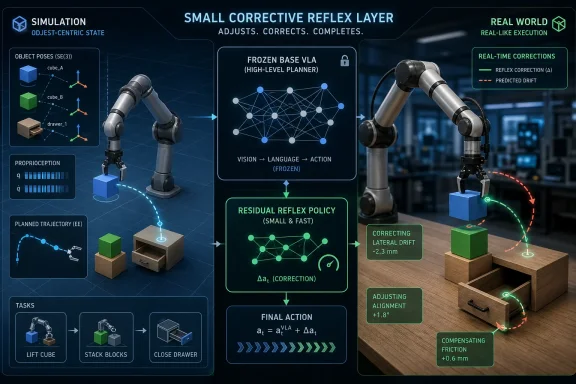
That is the practical problem Microsoft’s object-centric residual RL work targets. A base VLA can know broadly what “pick up the cube” means and still make tiny execution errors that compound over time. The residual policy acts like a corrective reflex: it does not replace the VLA’s plan, but nudges its action at every timestep when the model’s command starts to diverge from what the task physically requires.
The important design choice is that the residual does not learn from raw camera images. It learns from a compact state representation: task-relevant object poses, the robot’s proprioception, and the base VLA’s proposed action. In robotics terms, Microsoft is not trying to bridge the visual sim-to-real gap with ever more realistic rendering; it is trying to step around much of that gap by giving the corrective policy the kind of structured information that can exist in both simulation and reality.
Microsoft’s method leans hard into that distinction. The residual policy is deliberately deprived of images, which means the simulation does not have to win a photorealism contest. The policy only needs object-centric state to be good enough: where the cube is, where the cup is, where the drawer handle is, and how the robot is positioned relative to the task.
That is a clever narrowing of the problem. If a VLA already handles the messy visual front end and produces a plausible action, the residual policy can specialize in the last-mile correction problem. It can ask, in effect, whether the action points in the right direction, whether the gripper is drifting away from the goal, and whether a modest action offset would recover the trajectory.
This is also why the result matters beyond the headline percentage. The research does not merely report that a simulator-trained policy worked on a real robot; it proposes a division of labor between large pretrained models and smaller reinforcement learning modules. The VLA brings broad semantic competence. The residual brings task-level physical discipline.
Microsoft’s framework keeps the base VLA frozen during residual training. The researchers train a simulation counterpart using paired teleoperation replay, then train the residual in simulation against that base behavior. At deployment, the real VLA supplies the base action, and the residual adds its correction.
That architecture matters because it avoids turning every real robot into a test subject for online RL. The residual can be trained at scale in simulation, perturbed with pose noise and dropout, and then deployed without additional real-world policy optimization. If the system fails, the blast radius is smaller: the base VLA has not been rewritten, and the residual is a compact component whose inputs and outputs are easier to inspect than a giant end-to-end model.
The phrase frozen base model sounds mundane, but it is doing a lot of work here. It preserves the generalist capabilities of the VLA while allowing a smaller policy to learn corrective behavior. In a field where the default reflex is often “train the whole thing harder,” Microsoft is arguing for modularity.
The weakest result is also the most useful reality check. Stand Cup Up improves from 5 successes to 8 out of 20, which is still a gain but not a transformation. That suggests the residual is not magic dust sprinkled over a shaky policy. Some tasks remain difficult, likely because contact-rich manipulation and object pose sensitivity can make small errors more consequential.
This is where the work is more credible than a one-task robot demo. The researchers tested five manipulation tasks, and the improvements are uneven in a way that looks like robotics rather than marketing. Some tasks benefit dramatically from corrective action. Others still expose the limits of the representation, the base model, the residual training regime, or the real-world perception stack.
The simulation numbers show a similar story at a higher success level. The residual pushes simulated average performance from 7.6 out of 20 to 17.2 out of 20. That is a large gain, but the real robot still lags the simulator slightly on average. The gap did not vanish; it became manageable enough to make the method useful.
Object-centric state is an old idea made newly relevant by the VLA moment. Instead of forcing the residual policy to infer the world from images, Microsoft’s approach tells it where the relevant objects are in six degrees of freedom. That does not solve perception, but it moves perception into a separate interface and gives the residual a stable language for action correction.
This is a trade-off, not a free lunch. The system depends on obtaining accurate object poses in the real world, and the researchers address that by injecting pose noise and pose dropout during simulation training. That makes the residual more robust to estimation errors, but it also underscores the dependency: if object tracking fails badly, the corrective layer can be misled.
Still, the trade-off is attractive for enterprise and lab robotics. Many controlled manipulation environments already rely on fiducials, depth cameras, calibrated workcells, known objects, or perception systems that can produce object poses. In those settings, demanding perfect visual realism from simulation may be less practical than building a robust object-state interface.
The action correction visualization is conceptually simple: the base VLA proposes an action, the residual proposes an adjustment, and the combined action steers closer to the intended outcome. When the base action is already reasonable, the residual can stay modest. When the base action drifts, the residual becomes more assertive.
That is very different from replacing the whole policy with a new end-to-end network. A residual architecture creates a built-in comparison: what the generalist model wanted to do, what the corrective policy changed, and what the robot actually executed. For debugging, safety review, and incremental deployment, that visibility has real value.
It also reframes what “alignment” means for robot actions. The base VLA may be aligned with the instruction at a semantic level, while misaligned with the physical state at a motion level. The residual is not correcting intent; it is correcting execution.
That idea is powerful because teleoperation is one of the bottlenecks in robot learning. Human demonstrations are expensive, slow, and constrained by the number of robots and operators available. If a residual-augmented policy can generate higher-quality real-world trajectories without extra teleoperation, it can produce training material that moves the base VLA closer to competent standalone behavior.
There is a subtle risk here as well. Self-generated data can amplify the biases and blind spots of the system that produced it. If the residual only corrects within a narrow task family, retraining the base model on those rollouts may improve certain behaviors while leaving broader weaknesses untouched. The loop is promising, but it will need careful curation, failure filtering, and diversity if it is to become more than a local optimization trick.
For Microsoft, the broader implication is clear. The path to better embodied AI may involve systems that use simulation to produce corrective modules, use those modules to improve real-world rollouts, and use the rollouts to refine the base model. That is not autonomous robot learning in the grand science-fiction sense, but it is a credible step toward reducing human demonstration dependence.
The relevant theme is not “robots are coming to your desktop.” It is the modularization of AI systems. A large pretrained model handles broad understanding; a smaller specialized model corrects execution; structured interfaces constrain the problem; simulation or synthetic environments generate cheaper training signals. That pattern is already visible across software agents, security copilots, code assistants, and autonomous workflow tools.
Robotics simply makes the stakes impossible to ignore. When an AI agent clicks the wrong button in a browser, the damage may be reversible. When a robot arm moves the wrong way, physics imposes discipline. The design patterns that survive robotics often matter because they have passed through a harsher filter.
For enterprise IT, the lesson is also about deployment boundaries. Microsoft’s residual policy does not require live real-world RL to improve the robot at deployment time. That is analogous to a broader enterprise preference: do risky adaptation in controlled environments, then deploy constrained components into production. The buzzword may be robotics, but the governance instinct is familiar.
Vision-language-action models are one route from digital intelligence to physical agency. They connect perception, instruction following, and control. The challenge is that generality and reliability are still in tension: a broad model can understand many tasks but struggle with precise execution, while a specialized controller can be reliable but narrow.
The residual RL framework is a bid to soften that trade-off. It allows a generalist VLA to remain intact while a task-trained residual handles the physical corrections that imitation learning missed. That is a pragmatic architecture for an era when fully end-to-end robot intelligence remains more aspiration than infrastructure.
It also fits Microsoft’s institutional strengths. The company does not need to build consumer humanoids tomorrow for this research to matter. It needs credible ways to combine large models, simulation, structured state, developer tooling, and enterprise-grade deployment practices. Object-centric residual RL is squarely in that lane.
The researchers acknowledge this by pointing to future work on cluttered scenes, broader task families, and more autonomous ways to identify which objects should condition the residual policy. That last point is crucial. A human can say that the relevant object is the cube, cup, drawer, or target receptacle. A general-purpose robot has to infer relevance under ambiguity.
There is also a scaling question. A residual trained for one task family may not transfer cleanly to another. If each new manipulation category requires careful object selection, reward design, simulation setup, and real-world validation, the approach remains useful but operationally heavy. The dream is a pipeline; the danger is a collection of impressive one-off recipes.
Still, robotics advances often arrive through exactly this kind of narrowing. A system that works reliably in constrained domains can be expanded, abstracted, and generalized. The question is not whether object-centric residual RL solves open-world robotics. It does not. The question is whether it offers a repeatable way to turn simulated correction into real-world reliability.
That should be read as a strength. The field does not need another declaration that general-purpose robots are imminent. It needs methods that convert partial competence into higher reliability under explicit assumptions. This is one of those methods.
The phrase “zero-shot sim-to-real” can sound grandiose, but in this case it has a specific meaning. The residual is trained in simulation and deployed on the real robot without real-world RL, distillation, or residual fine-tuning. The real VLA replaces the simulated VLA at deployment, and the same residual correction scheme is applied.
That specificity matters. It gives researchers and practitioners something to test: whether paired sim/real VLA alignment is sufficient, whether object-centric state can be obtained reliably, whether pose noise training covers real perception errors, and whether the residual remains useful as tasks become less tidy.
That recovery problem is central to automation. In software, exception handling is where many systems prove their maturity. In robotics, the equivalent is correcting when the gripper is slightly off, the object shifts, the drawer catches, or the base action is directionally wrong. The residual policy is, in effect, an exception handler for physical execution.
The completion-time gains reported for successful residual-augmented episodes also matter. If a corrected policy is both more successful and faster by meaningful margins, it is not only rescuing failures; it is making execution more efficient. In production robotics, shaving time from successful cycles can matter nearly as much as raising the success rate.
But the limitations remain visible. A 76 percent average success rate is impressive for a research comparison and still far below what many industrial users would require. The path from paper to deployment runs through redundancy, monitoring, safety envelopes, better perception, broader validation, and boring reliability engineering.
Robotics forces a useful discipline: do not ask one model to be omniscient. Use structured state when possible. Keep the generalist model from being overwritten too casually. Add small corrective modules whose behavior can be measured. Train in controlled environments before deployment. Use successful corrected rollouts to improve the base system, but do not pretend self-improvement is automatically safe.
That pattern should sound familiar to anyone watching Microsoft build Copilot into developer tools, productivity software, endpoint management, and cloud operations. The hard part is no longer generating plausible next steps. The hard part is making action reliable enough that organizations trust the system with real workflows.
Robotics may be where the consequences are easiest to film, but the architecture is broader. A general model proposes; a specialized policy corrects; a structured interface limits ambiguity; feedback creates better training data. If Microsoft can make that pattern work in physical manipulation, it will be tempted to reuse it everywhere.
 Microsoft’s Robot Trick Is Not a Bigger Brain, but a Better Reflex
The robotics field has spent the last two years importing the language of large AI models into the physical world. Vision-language-action models promise a robot that can see a scene, parse an instruction, and produce actions without every behavior being hand-coded. The pitch is seductive: if language models generalized from internet-scale text, perhaps robot policies can generalize from video, demonstrations, and multimodal pretraining.But a robot is not a chatbot with grippers. A slightly wrong word in a generated paragraph can be corrected by the next sentence; a slightly wrong end-effector motion can move a cube out of reach, knock over a cup, or wedge a drawer at the wrong angle. Robotics punishes drift in a way software often hides.
That is the practical problem Microsoft’s object-centric residual RL work targets. A base VLA can know broadly what “pick up the cube” means and still make tiny execution errors that compound over time. The residual policy acts like a corrective reflex: it does not replace the VLA’s plan, but nudges its action at every timestep when the model’s command starts to diverge from what the task physically requires.
The important design choice is that the residual does not learn from raw camera images. It learns from a compact state representation: task-relevant object poses, the robot’s proprioception, and the base VLA’s proposed action. In robotics terms, Microsoft is not trying to bridge the visual sim-to-real gap with ever more realistic rendering; it is trying to step around much of that gap by giving the corrective policy the kind of structured information that can exist in both simulation and reality.
The Sim-to-Real Gap Has Always Been Two Problems Wearing One Coat
“Sim-to-real” is often discussed as though it were one problem: make the simulator sufficiently like the world, and the policy trained there will work outside the lab. In practice, it is at least two problems. One is visual realism: whether the camera feed in simulation resembles what the robot’s sensors see under real lighting, with real texture, shadows, lens artifacts, clutter, and occlusion. The other is physical and behavioral alignment: whether actions that work in the simulator are still useful when motors, friction, contact dynamics, object mass, calibration, and perception noise enter the scene.Microsoft’s method leans hard into that distinction. The residual policy is deliberately deprived of images, which means the simulation does not have to win a photorealism contest. The policy only needs object-centric state to be good enough: where the cube is, where the cup is, where the drawer handle is, and how the robot is positioned relative to the task.
That is a clever narrowing of the problem. If a VLA already handles the messy visual front end and produces a plausible action, the residual policy can specialize in the last-mile correction problem. It can ask, in effect, whether the action points in the right direction, whether the gripper is drifting away from the goal, and whether a modest action offset would recover the trajectory.
This is also why the result matters beyond the headline percentage. The research does not merely report that a simulator-trained policy worked on a real robot; it proposes a division of labor between large pretrained models and smaller reinforcement learning modules. The VLA brings broad semantic competence. The residual brings task-level physical discipline.
Freezing the VLA Is the Quietly Radical Part
Many AI systems improve by fine-tuning the main model. That is natural in software and uncomfortable in robotics. Real-world reinforcement learning can be slow, expensive, unsafe, and hard to reproduce. Every failed rollout is not just a bad sample; it can be a dropped object, a damaged fixture, or a reset that requires human intervention.Microsoft’s framework keeps the base VLA frozen during residual training. The researchers train a simulation counterpart using paired teleoperation replay, then train the residual in simulation against that base behavior. At deployment, the real VLA supplies the base action, and the residual adds its correction.
That architecture matters because it avoids turning every real robot into a test subject for online RL. The residual can be trained at scale in simulation, perturbed with pose noise and dropout, and then deployed without additional real-world policy optimization. If the system fails, the blast radius is smaller: the base VLA has not been rewritten, and the residual is a compact component whose inputs and outputs are easier to inspect than a giant end-to-end model.
The phrase frozen base model sounds mundane, but it is doing a lot of work here. It preserves the generalist capabilities of the VLA while allowing a smaller policy to learn corrective behavior. In a field where the default reflex is often “train the whole thing harder,” Microsoft is arguing for modularity.
The Numbers Are Strong, but the Task List Keeps Them Honest
The reported results are the sort that will travel well in slide decks: average real-robot success rises from 8.4 out of 20 trials to 15.2 out of 20, or from 42 percent to 76 percent. On Close Drawer, the residual-augmented system reaches 20 successes out of 20, compared with 14 for the base VLA. Cube Lift jumps from 7 to 17, Pick-and-Place from 9 to 16, and Stack Cube from 7 to 15.The weakest result is also the most useful reality check. Stand Cup Up improves from 5 successes to 8 out of 20, which is still a gain but not a transformation. That suggests the residual is not magic dust sprinkled over a shaky policy. Some tasks remain difficult, likely because contact-rich manipulation and object pose sensitivity can make small errors more consequential.
This is where the work is more credible than a one-task robot demo. The researchers tested five manipulation tasks, and the improvements are uneven in a way that looks like robotics rather than marketing. Some tasks benefit dramatically from corrective action. Others still expose the limits of the representation, the base model, the residual training regime, or the real-world perception stack.
The simulation numbers show a similar story at a higher success level. The residual pushes simulated average performance from 7.6 out of 20 to 17.2 out of 20. That is a large gain, but the real robot still lags the simulator slightly on average. The gap did not vanish; it became manageable enough to make the method useful.
Object-Centric State Is a Bet Against Raw Pixels
The fashionable instinct in AI is to feed models more raw data and let scale sort out the abstractions. Robotics keeps rediscovering why that can be a punishing strategy. Raw pixels contain everything, including all the irrelevant things: background textures, lighting shifts, camera noise, distractor objects, reflections, and simulator artifacts that do not transfer cleanly.Object-centric state is an old idea made newly relevant by the VLA moment. Instead of forcing the residual policy to infer the world from images, Microsoft’s approach tells it where the relevant objects are in six degrees of freedom. That does not solve perception, but it moves perception into a separate interface and gives the residual a stable language for action correction.
This is a trade-off, not a free lunch. The system depends on obtaining accurate object poses in the real world, and the researchers address that by injecting pose noise and pose dropout during simulation training. That makes the residual more robust to estimation errors, but it also underscores the dependency: if object tracking fails badly, the corrective layer can be misled.
Still, the trade-off is attractive for enterprise and lab robotics. Many controlled manipulation environments already rely on fiducials, depth cameras, calibrated workcells, known objects, or perception systems that can produce object poses. In those settings, demanding perfect visual realism from simulation may be less practical than building a robust object-state interface.
Residual Learning Makes Failure More Legible
One reason residual policies are appealing is that their behavior can be inspected relative to the base policy. Microsoft’s analysis shows the residual correcting more strongly when the base action deviates from the goal direction. That is the sort of evidence robotics practitioners care about because it suggests the residual is not merely adding noise that happens to help on average.The action correction visualization is conceptually simple: the base VLA proposes an action, the residual proposes an adjustment, and the combined action steers closer to the intended outcome. When the base action is already reasonable, the residual can stay modest. When the base action drifts, the residual becomes more assertive.
That is very different from replacing the whole policy with a new end-to-end network. A residual architecture creates a built-in comparison: what the generalist model wanted to do, what the corrective policy changed, and what the robot actually executed. For debugging, safety review, and incremental deployment, that visibility has real value.
It also reframes what “alignment” means for robot actions. The base VLA may be aligned with the instruction at a semantic level, while misaligned with the physical state at a motion level. The residual is not correcting intent; it is correcting execution.
The Self-Improvement Loop Is the Most Ambitious Claim
The most forward-looking part of the work is not the 76 percent success rate. It is the claim that successful residual-corrected rollouts can be used to retrain the base VLA, turning inference-time fixes into new supervised learning data. In other words, the residual is not only a crutch; it can become a data generator.That idea is powerful because teleoperation is one of the bottlenecks in robot learning. Human demonstrations are expensive, slow, and constrained by the number of robots and operators available. If a residual-augmented policy can generate higher-quality real-world trajectories without extra teleoperation, it can produce training material that moves the base VLA closer to competent standalone behavior.
There is a subtle risk here as well. Self-generated data can amplify the biases and blind spots of the system that produced it. If the residual only corrects within a narrow task family, retraining the base model on those rollouts may improve certain behaviors while leaving broader weaknesses untouched. The loop is promising, but it will need careful curation, failure filtering, and diversity if it is to become more than a local optimization trick.
For Microsoft, the broader implication is clear. The path to better embodied AI may involve systems that use simulation to produce corrective modules, use those modules to improve real-world rollouts, and use the rollouts to refine the base model. That is not autonomous robot learning in the grand science-fiction sense, but it is a credible step toward reducing human demonstration dependence.
Why WindowsForum Readers Should Care About a Robot Arm
At first glance, this may look far removed from the concerns of Windows users, sysadmins, and IT pros. It is not a Windows feature, not a Copilot button, and not a new Azure SKU. But Microsoft Research often previews the architectural ideas that later show up in products, platforms, developer tools, and enterprise automation.The relevant theme is not “robots are coming to your desktop.” It is the modularization of AI systems. A large pretrained model handles broad understanding; a smaller specialized model corrects execution; structured interfaces constrain the problem; simulation or synthetic environments generate cheaper training signals. That pattern is already visible across software agents, security copilots, code assistants, and autonomous workflow tools.
Robotics simply makes the stakes impossible to ignore. When an AI agent clicks the wrong button in a browser, the damage may be reversible. When a robot arm moves the wrong way, physics imposes discipline. The design patterns that survive robotics often matter because they have passed through a harsher filter.
For enterprise IT, the lesson is also about deployment boundaries. Microsoft’s residual policy does not require live real-world RL to improve the robot at deployment time. That is analogous to a broader enterprise preference: do risky adaptation in controlled environments, then deploy constrained components into production. The buzzword may be robotics, but the governance instinct is familiar.
Microsoft Is Positioning Itself for Embodied AI Without Saying the Quiet Part Too Loudly
Microsoft’s AI strategy is often viewed through the OpenAI partnership, Copilot integration, and Azure infrastructure. Robotics sits at the edge of that story, but it is increasingly relevant. A company that wants AI to act in the world cannot stop at text generation and office automation.Vision-language-action models are one route from digital intelligence to physical agency. They connect perception, instruction following, and control. The challenge is that generality and reliability are still in tension: a broad model can understand many tasks but struggle with precise execution, while a specialized controller can be reliable but narrow.
The residual RL framework is a bid to soften that trade-off. It allows a generalist VLA to remain intact while a task-trained residual handles the physical corrections that imitation learning missed. That is a pragmatic architecture for an era when fully end-to-end robot intelligence remains more aspiration than infrastructure.
It also fits Microsoft’s institutional strengths. The company does not need to build consumer humanoids tomorrow for this research to matter. It needs credible ways to combine large models, simulation, structured state, developer tooling, and enterprise-grade deployment practices. Object-centric residual RL is squarely in that lane.
The Catch Is That Object-Centric Interfaces Need a World Model the Real World Will Respect
The cleanest part of Microsoft’s setup is also the part that may become hardest outside the lab. Object-centric residual learning assumes the system can identify task-relevant objects and estimate their poses well enough for control. In structured manipulation tasks, that is plausible. In cluttered kitchens, warehouses with damaged packaging, hospitals, or homes, it becomes much harder.The researchers acknowledge this by pointing to future work on cluttered scenes, broader task families, and more autonomous ways to identify which objects should condition the residual policy. That last point is crucial. A human can say that the relevant object is the cube, cup, drawer, or target receptacle. A general-purpose robot has to infer relevance under ambiguity.
There is also a scaling question. A residual trained for one task family may not transfer cleanly to another. If each new manipulation category requires careful object selection, reward design, simulation setup, and real-world validation, the approach remains useful but operationally heavy. The dream is a pipeline; the danger is a collection of impressive one-off recipes.
Still, robotics advances often arrive through exactly this kind of narrowing. A system that works reliably in constrained domains can be expanded, abstracted, and generalized. The question is not whether object-centric residual RL solves open-world robotics. It does not. The question is whether it offers a repeatable way to turn simulated correction into real-world reliability.
The Real Advance Is Smaller Than the Hype and Bigger Than the Demo
The danger with any robotics result is over-reading the video. A robot succeeds, the clip loops, and the viewer fills in the missing generality. Microsoft’s numbers are more valuable than the videos because they show repeated trials and task-by-task variation. They also show that the residual layer improves performance without eliminating all failure.That should be read as a strength. The field does not need another declaration that general-purpose robots are imminent. It needs methods that convert partial competence into higher reliability under explicit assumptions. This is one of those methods.
The phrase “zero-shot sim-to-real” can sound grandiose, but in this case it has a specific meaning. The residual is trained in simulation and deployed on the real robot without real-world RL, distillation, or residual fine-tuning. The real VLA replaces the simulated VLA at deployment, and the same residual correction scheme is applied.
That specificity matters. It gives researchers and practitioners something to test: whether paired sim/real VLA alignment is sufficient, whether object-centric state can be obtained reliably, whether pose noise training covers real perception errors, and whether the residual remains useful as tasks become less tidy.
The Practical Reading Is Written in the Failure Cases
The most concrete lesson from Microsoft’s work is not that every robot policy should use residual RL. It is that imitation-learned VLAs are likely to need correction mechanisms if they are to operate reliably outside demonstration distributions. Humans demonstrate successful trajectories; robots must also recover from near-misses.That recovery problem is central to automation. In software, exception handling is where many systems prove their maturity. In robotics, the equivalent is correcting when the gripper is slightly off, the object shifts, the drawer catches, or the base action is directionally wrong. The residual policy is, in effect, an exception handler for physical execution.
The completion-time gains reported for successful residual-augmented episodes also matter. If a corrected policy is both more successful and faster by meaningful margins, it is not only rescuing failures; it is making execution more efficient. In production robotics, shaving time from successful cycles can matter nearly as much as raising the success rate.
But the limitations remain visible. A 76 percent average success rate is impressive for a research comparison and still far below what many industrial users would require. The path from paper to deployment runs through redundancy, monitoring, safety envelopes, better perception, broader validation, and boring reliability engineering.
The Robotics Lesson Microsoft Should Export Back Into AI Software
The residual architecture has implications outside robot arms. Modern AI agents increasingly operate by chaining model outputs into actions: click here, write this file, update that ticket, run this command, escalate this alert. Those agents also suffer from compounding errors. A slightly wrong intermediate action can push the system into a state the training data did not cover.Robotics forces a useful discipline: do not ask one model to be omniscient. Use structured state when possible. Keep the generalist model from being overwritten too casually. Add small corrective modules whose behavior can be measured. Train in controlled environments before deployment. Use successful corrected rollouts to improve the base system, but do not pretend self-improvement is automatically safe.
That pattern should sound familiar to anyone watching Microsoft build Copilot into developer tools, productivity software, endpoint management, and cloud operations. The hard part is no longer generating plausible next steps. The hard part is making action reliable enough that organizations trust the system with real workflows.
Robotics may be where the consequences are easiest to film, but the architecture is broader. A general model proposes; a specialized policy corrects; a structured interface limits ambiguity; feedback creates better training data. If Microsoft can make that pattern work in physical manipulation, it will be tempted to reuse it everywhere.
Five Details That Make This More Than Another Robot Demo
The research is easy to summarize as “simulation-trained residual improves a robot VLA,” but the details are where the seriousness lies. This is the compact version worth keeping in view.- Microsoft’s reported real-robot average rises from 8.4 successes out of 20 trials to 15.2 out of 20 across five manipulation tasks.
- The residual policy is trained entirely in simulation and deployed without real-world reinforcement learning, residual fine-tuning, or distillation.
- The corrective policy observes object poses, proprioception, and the base VLA action rather than raw images, reducing exposure to the visual sim-to-real gap.
- The base VLA remains frozen while the residual learns to adjust its actions, preserving the generalist model while adding task-specific correction.
- The strongest future-facing claim is that residual-corrected rollouts can become better supervised data for retraining the base VLA.
- The method still depends on reliable object-centric state and remains to be proven in more cluttered, diverse, and less controlled environments.
References
- Primary source: Microsoft
Published: Wed, 17 Jun 2026 10:16:12 GMT
Object-Centric Residual RL for Zero-Shot Sim-to-Real VLA Enhancement - Microsoft Research
By Kinam Kim, Namiko Saito, Heecheol Kim, Katsushi Ikeuchi, Jaegul Choo and Yasuyuki Matsushita Vision-Language-Action (VLA) models enable broad manipulation capabilities by leveraging large-scale pretraining and robot demonstrations. However, imitation learning can cause small execution errors...www.microsoft.com - Related coverage: researchgate.net
- Related coverage: deeplearn.org
Scaling Sim-to-Real Reinforcement Learning for Robot VLAs with Generative 3D Worlds - Paper Detail
Things happening in deep learning: arxiv, twitter, redditdeeplearn.org - Related coverage: research.nvidia.com

