

Microsoft has open-sourced Comic Chat, its mid-1990s IRC client that rendered chat conversations as comic-book panels with avatars, speech bubbles, and expressions. The release arrives ahead of the software’s 30th anniversary: Comic Chat originally launched on August 13, 1996.
As reported by Windows Central, Microsoft’s Scott Hanselman announced that the original source code is now available on GitHub. Comic Chat began as a Microsoft Research project by David Kurlander, then evolved into Microsoft Chat and became the default chat client for MSN.
Comic Chat was an unusual answer to the text-heavy Internet Relay Chat experience of the era. Rather than showing a conventional scrolling transcript, it assigned illustrated characters to participants and laid messages out as a sequence of comic panels. Users could select characters, poses, and emotional expressions, giving otherwise basic IRC exchanges a visual layer.
Its legacy is tied closely to Comic Sans. Microsoft designed the typeface for Comic Chat’s speech bubbles, though the font became far more widely known after appearing in other Windows software and eventually turning into one of computing’s most debated default fonts.
Comic Chat was released during the transition from text-oriented online services, Usenet, and IRC toward the graphical web. It never remade online messaging, but it remains a distinctive example of Microsoft experimenting with consumer-facing interfaces before modern instant messaging and social platforms settled on more conventional chat layouts.
That distinction matters for anyone considering running it on current systems. The original application predates modern Windows security expectations, contemporary build environments, and today’s IRC ecosystem by decades. A successful build or port will likely require community work, and users should not assume the original client is suitable for use against public IRC networks without review and hardening.
For Windows enthusiasts, the practical value is historical as much as technical. Source availability can help document how a late-1990s Windows networking application was structured, preserve a quirky piece of Microsoft interface history, and make it easier to adapt the concept for modern IRC clients or retro projects.
The repository is now available for inspection and experimentation, while any usable modern revival will depend on outside contributors.
As reported by Windows Central, Microsoft’s Scott Hanselman announced that the original source code is now available on GitHub. Comic Chat began as a Microsoft Research project by David Kurlander, then evolved into Microsoft Chat and became the default chat client for MSN.
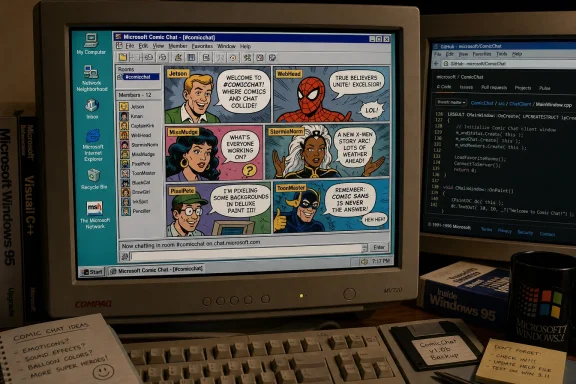 A graphical detour for IRC
Comic Chat was an unusual answer to the text-heavy Internet Relay Chat experience of the era. Rather than showing a conventional scrolling transcript, it assigned illustrated characters to participants and laid messages out as a sequence of comic panels. Users could select characters, poses, and emotional expressions, giving otherwise basic IRC exchanges a visual layer.Its legacy is tied closely to Comic Sans. Microsoft designed the typeface for Comic Chat’s speech bubbles, though the font became far more widely known after appearing in other Windows software and eventually turning into one of computing’s most debated default fonts.
Comic Chat was released during the transition from text-oriented online services, Usenet, and IRC toward the graphical web. It never remade online messaging, but it remains a distinctive example of Microsoft experimenting with consumer-facing interfaces before modern instant messaging and social platforms settled on more conventional chat layouts.
Source code, not a modern relaunch
The open-source release does not turn Comic Chat into a supported Windows product or a new Microsoft chat platform. It instead gives developers, preservationists, and retro-computing enthusiasts access to the historical codebase for study, modification, and potentially rebuilding the client with modern tooling.That distinction matters for anyone considering running it on current systems. The original application predates modern Windows security expectations, contemporary build environments, and today’s IRC ecosystem by decades. A successful build or port will likely require community work, and users should not assume the original client is suitable for use against public IRC networks without review and hardening.
For Windows enthusiasts, the practical value is historical as much as technical. Source availability can help document how a late-1990s Windows networking application was structured, preserve a quirky piece of Microsoft interface history, and make it easier to adapt the concept for modern IRC clients or retro projects.
The repository is now available for inspection and experimentation, while any usable modern revival will depend on outside contributors.
References
- Primary source: Windows Central
Published: 2026-07-16T17:46:51+00:00
Microsoft Comic Chat, an IRC client from 30 years ago that helped popularize Comic Sans, is going open source | Windows Central
The source code behind Microsoft's 30 year old Comic Chat IRC client is now available on Github for the first time.www.windowscentral.com