

It started as one of the most consequential alliances in modern tech: Microsoft supplied the money, cloud, and distribution muscle, while OpenAI supplied the model breakthroughs that made generative AI feel inevitable. By 2026, that partnership had not collapsed, but it had clearly mutated into something more complicated: a mix of exclusivity, dependency, hedging, and legal brinkmanship. What went wrong was not one betrayal but a steady accumulation of strategic misalignments, governance shocks, and commercial tensions that turned a once-symbiotic relationship into a high-stakes balancing act.
The original logic was straightforward. Microsoft needed an answer to Google’s AI advantage, and OpenAI needed industrial-scale compute and capital to train frontier models. In 2019, the companies began their formal partnership, and by 2023 Microsoft had doubled down on the bet with deeper Azure integration and exclusive cloud rights for OpenAI’s workloads under the terms then publicly described by both firms. That arrangement made Microsoft central to OpenAI’s growth story and made OpenAI central to Microsoft’s AI strategy.
At the same time, the relationship contained structural friction from the start. OpenAI was built around a mission-first governance model, including nonprofit control, while Microsoft was a public company that wanted predictable returns, defensible product rights, and platform leverage. Those goals aligned while the market was young and the models were still scarce, but alignment got harder as OpenAI grew into a multibillion-dollar company with its own platform ambitions.
The public drama around Sam Altman’s firing in November 2023 exposed that fault line in full view. OpenAI’s board acted independently, Microsoft was blindsided, and Altman briefly appeared headed to Microsoft before being reinstated at OpenAI days later. The episode did not sever the partnership, but it permanently changed its tone: after that, both sides behaved less like co-builders and more like parties preparing for future negotiation and, if needed, litigation.
By 2025 and 2026, the dispute had broadened beyond personalities into hard infrastructure and IP questions. OpenAI signed substantial compute deals with other providers, while Microsoft expanded and clarified its rights in a new agreement that still preserved Azure exclusivity for key APIs and Microsoft’s licensing rights through AGI-related milestones. The result was not a clean breakup, but a deliberate diversification by OpenAI and a parallel hedging strategy by Microsoft.
The bargain was also attractive because it gave Microsoft early access to a likely platform shift. Microsoft could tie OpenAI’s models into Azure, Office, GitHub, and search, effectively turning a research relationship into a product ecosystem. OpenAI, meanwhile, got access to the compute footprint needed to train larger models and serve explosive consumer demand after ChatGPT took off. That was the good times phase, when both firms could credibly claim they were helping each other win.
That matters because product deployment is where research partnerships become brand liabilities. A model can be brilliant in a lab and still embarrass its partner in a search box, a customer service flow, or an enterprise app. Microsoft’s urgency was understandable; it was trying to regain ground in search and show investors that AI could become a revenue engine. But that urgency also made OpenAI nervous that its models would be treated like features instead of high-risk systems.
The episode mattered because it exposed a mismatch between governance and dependence. OpenAI’s board still had formal power, but Microsoft had become too important to ignore. When the board acted unilaterally, it created the impression that OpenAI could make existential decisions affecting a multi-billion-dollar partner without warning. That is the sort of event that changes how boards, executives, and lawyers model future risk.
For OpenAI, the lesson was equally stark. The company learned that its largest partner had influence, expectations, and perhaps implicit veto power in the court of public opinion, even if not on paper. That changes bargaining behavior on both sides. A business relationship can survive disagreement; it struggles to survive when each side begins planning for the other side’s worst-case scenario. That is when every conversation acquires a second meaning.
This is where public reporting and official disclosures paint a clear picture: by October 2025, Microsoft said it held a 32.5 percent stake on an as-converted basis in the OpenAI for-profit, while the agreement also preserved exclusive IP rights and Azure API exclusivity until AGI, with revenue-share arrangements extending until AGI verification by an independent expert panel. That is not the language of a casual partnership; it is the language of a negotiated control framework designed to survive scale and friction.
By November 2025 and February 2026, the diversification had become impossible to ignore. OpenAI announced a multi-year strategic partnership with AWS that it said would provide massive compute access, and then in February 2026 it described AWS as the exclusive third-party cloud distribution provider for OpenAI Frontier. Whatever the exact contractual interpretation of Microsoft’s rights, the strategic message was unmistakable: OpenAI wanted a broader infrastructure portfolio and a wider commercial footprint.
The tension here is obvious. OpenAI wants to be a platform, a developer ecosystem, and a product company all at once. Microsoft wants to ensure that the value created by OpenAI still feeds Copilot, Azure, and the broader Microsoft stack. If either side loses the ability to define the commercial interpretation of the model layer, the economics of the whole partnership change.
There is also a subtle competitive angle. Microsoft does not want to be locked into a future where OpenAI becomes the AI equivalent of a runaway supplier. OpenAI does not want to be trapped as a model vendor whose best ideas are monetized elsewhere. That is why the IP battle is so consequential: it is a fight over whether the partnership creates mutual platform growth or turns into a toll road. Those are very different futures.
This clause matters because AGI is not just a technical concept; it is a contractual trigger. If one side can argue that the threshold has been reached, the rights landscape could shift materially. That gives both companies a reason to debate definitions that would otherwise be academic. When the definition of intelligence affects cloud rights, revenue share, and IP scope, philosophy becomes corporate strategy.
That is what mature platform companies do when a key supplier gets too powerful. They invest in internal substitutes, alternative partners, and product architectures that reduce dependency. Microsoft still values OpenAI, but it has clearly learned not to confuse “strategic partnership” with “strategic captivity.” That distinction matters more in AI than in most markets because the underlying technology is both fast-moving and deeply integrated into enterprise software.
The Amazon and other cloud relationships fit that logic. So do OpenAI’s enterprise pushes and its broader ecosystem-building efforts. The company is no longer just trying to build the best model; it is trying to build the strongest commercial system around the model. That requires partners, but not a master.
For consumers, the impact is more visible in product experience than in contract language. ChatGPT, Copilot, Bing, and other AI tools are all shaped by the economics and politics of the partnership underneath them. When infrastructure is in flux, product roadmaps can change, pricing can shift, and model access can become more fragmented. That can be healthy competition, but it can also create confusion for buyers trying to understand which AI system is actually powering what.
The next phase will probably be decided less by one headline than by a series of operational choices: which workloads stay on Azure, which products can launch through third parties, how the revenue share is handled, and whether AGI remains a live contractual trigger or becomes a symbolic relic. The companies can continue working together, but the relationship will be judged by how much control each side is willing to surrender. That is the real test now, not the rhetoric around partnership.
Source: digit.in OpenAI and Microsoft: From friends to enemies, what went wrong?
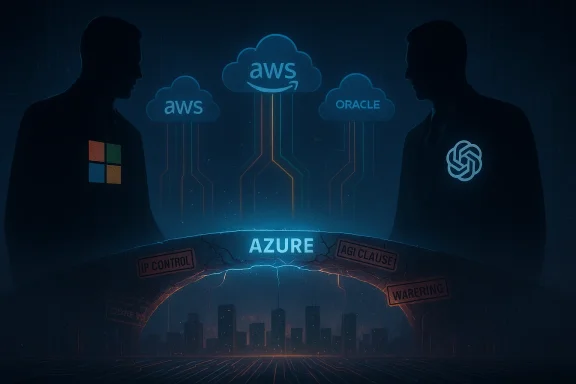 Overview
The original logic was straightforward. Microsoft needed an answer to Google’s AI advantage, and OpenAI needed industrial-scale compute and capital to train frontier models. In 2019, the companies began their formal partnership, and by 2023 Microsoft had doubled down on the bet with deeper Azure integration and exclusive cloud rights for OpenAI’s workloads under the terms then publicly described by both firms. That arrangement made Microsoft central to OpenAI’s growth story and made OpenAI central to Microsoft’s AI strategy.At the same time, the relationship contained structural friction from the start. OpenAI was built around a mission-first governance model, including nonprofit control, while Microsoft was a public company that wanted predictable returns, defensible product rights, and platform leverage. Those goals aligned while the market was young and the models were still scarce, but alignment got harder as OpenAI grew into a multibillion-dollar company with its own platform ambitions.
The public drama around Sam Altman’s firing in November 2023 exposed that fault line in full view. OpenAI’s board acted independently, Microsoft was blindsided, and Altman briefly appeared headed to Microsoft before being reinstated at OpenAI days later. The episode did not sever the partnership, but it permanently changed its tone: after that, both sides behaved less like co-builders and more like parties preparing for future negotiation and, if needed, litigation.
By 2025 and 2026, the dispute had broadened beyond personalities into hard infrastructure and IP questions. OpenAI signed substantial compute deals with other providers, while Microsoft expanded and clarified its rights in a new agreement that still preserved Azure exclusivity for key APIs and Microsoft’s licensing rights through AGI-related milestones. The result was not a clean breakup, but a deliberate diversification by OpenAI and a parallel hedging strategy by Microsoft.
The Original Bargain
The Microsoft-OpenAI deal worked because each side lacked what the other had. OpenAI had the talent and the research momentum, but not the capital intensity to train frontier models at scale. Microsoft had the capital, cloud infrastructure, enterprise reach, and willingness to embed AI into products like Copilot and Bing. That is the classic platform-and-innovation trade: one party creates the model, the other industrializes and distributes it.The bargain was also attractive because it gave Microsoft early access to a likely platform shift. Microsoft could tie OpenAI’s models into Azure, Office, GitHub, and search, effectively turning a research relationship into a product ecosystem. OpenAI, meanwhile, got access to the compute footprint needed to train larger models and serve explosive consumer demand after ChatGPT took off. That was the good times phase, when both firms could credibly claim they were helping each other win.
Why the partnership made sense
The deal made strategic sense for three reasons. First, it solved a bottleneck: compute. Second, it solved a distribution problem: Microsoft could bring OpenAI into enterprise and consumer products at speed. Third, it solved a credibility problem: Microsoft’s backing signaled to the market that OpenAI was not just a lab, but a commercial force. Those advantages created a powerful flywheel, and for a while it looked like the partnership might define the entire AI era.- OpenAI gained access to hyperscale infrastructure.
- Microsoft gained a frontier-model partner.
- Both companies gained market momentum.
- Both companies could claim a leadership position in AI.
- Neither company had to build the entire stack alone.
The Bing Flashpoint
The first obvious crack came when Microsoft pushed OpenAI technology into Bing at speed. Reporting at the time suggested OpenAI had concerns about rushing GPT-4 integration, and the episode exposed a recurring tension: Microsoft wanted product velocity, while OpenAI wanted model discipline and safety caution. Even if both companies were still aligned on the larger goal, they were already disagreeing on the acceptable pace of commercialization.That matters because product deployment is where research partnerships become brand liabilities. A model can be brilliant in a lab and still embarrass its partner in a search box, a customer service flow, or an enterprise app. Microsoft’s urgency was understandable; it was trying to regain ground in search and show investors that AI could become a revenue engine. But that urgency also made OpenAI nervous that its models would be treated like features instead of high-risk systems.
Speed versus safety
The Bing episode was not just about one launch. It was a preview of the deeper philosophical split between a product company and a research-and-mission company. Microsoft wanted to ship. OpenAI wanted to control sequencing, framing, and limits. Those tensions tend to intensify when the underlying technology is not just valuable, but potentially market-making.- Microsoft prioritized speed to market.
- OpenAI prioritized rollout discipline.
- Safety and brand risk became commercial issues.
- The companies learned they did not always agree on escalation.
- The AI race rewarded urgency, but punished carelessness.
The Altman Shock
If Bing revealed friction, the November 2023 boardroom coup revealed fragility. OpenAI’s board abruptly removed Sam Altman, saying it no longer had confidence in him. Microsoft was not part of that decision, and the company’s shock was immediate and visible. Altman quickly became the center of a rescue effort that involved OpenAI employees, investors, and Microsoft itself, which briefly offered him a role leading a new advanced AI effort.The episode mattered because it exposed a mismatch between governance and dependence. OpenAI’s board still had formal power, but Microsoft had become too important to ignore. When the board acted unilaterally, it created the impression that OpenAI could make existential decisions affecting a multi-billion-dollar partner without warning. That is the sort of event that changes how boards, executives, and lawyers model future risk.
Governance as a business risk
For Microsoft, the lesson was simple: dependence on a partner’s nonprofit-style governance could not be treated as a trivial detail. If OpenAI’s board could fire the CEO of the company that powered Microsoft’s AI ambitions, then Microsoft’s strategy had a governance vulnerability baked into it. That did not mean Microsoft could abandon OpenAI, but it did mean Microsoft had to hedge against governance surprise.For OpenAI, the lesson was equally stark. The company learned that its largest partner had influence, expectations, and perhaps implicit veto power in the court of public opinion, even if not on paper. That changes bargaining behavior on both sides. A business relationship can survive disagreement; it struggles to survive when each side begins planning for the other side’s worst-case scenario. That is when every conversation acquires a second meaning.
The Money Problem
The financial side of the story is where the relationship turned from strategic alliance into hard bargaining. OpenAI’s restructuring efforts and new fundraising demands increased the need to define ownership, revenue participation, and long-term economics more precisely. Microsoft, for its part, had already committed enormous capital and infrastructure, so it wanted a structure that preserved upside and protected the value of its prior investments.This is where public reporting and official disclosures paint a clear picture: by October 2025, Microsoft said it held a 32.5 percent stake on an as-converted basis in the OpenAI for-profit, while the agreement also preserved exclusive IP rights and Azure API exclusivity until AGI, with revenue-share arrangements extending until AGI verification by an independent expert panel. That is not the language of a casual partnership; it is the language of a negotiated control framework designed to survive scale and friction.
Why renegotiation got so hard
As OpenAI became more valuable, every percentage point mattered. OpenAI wanted more room to raise capital, diversify compute, and reduce Microsoft’s leverage. Microsoft wanted to avoid becoming merely a financing source for a competitor’s eventual autonomy. Both positions were rational, which is precisely why they were so hard to reconcile. Rationality on both sides often produces deadlock rather than compromise.- OpenAI wanted more independence.
- Microsoft wanted more certainty.
- OpenAI needed more compute partners.
- Microsoft wanted to protect cloud economics.
- OpenAI needed flexibility to grow like a platform.
- Microsoft needed returns that justified the original bet.
The Cloud Diversification Strategy
OpenAI’s moves across CoreWeave, Oracle, Google Cloud via CoreWeave, and later AWS show a company intent on reducing single-vendor dependence. In March 2025, CoreWeave said it expanded its agreement with OpenAI, with the initial March contract described as up to $11.9 billion and later additions increasing the total commitment further. OpenAI also publicly announced an Oracle-based extension to Azure AI infrastructure in 2024, indicating that even before the 2025–2026 spate of deals, diversification had already begun.By November 2025 and February 2026, the diversification had become impossible to ignore. OpenAI announced a multi-year strategic partnership with AWS that it said would provide massive compute access, and then in February 2026 it described AWS as the exclusive third-party cloud distribution provider for OpenAI Frontier. Whatever the exact contractual interpretation of Microsoft’s rights, the strategic message was unmistakable: OpenAI wanted a broader infrastructure portfolio and a wider commercial footprint.
What diversification really means
Compute diversification is not just about cost. It is about resilience, leverage, and bargaining power. If one provider owns too much of your future, it can shape your roadmap, your product cadence, and your negotiating position. By spreading workloads across multiple providers, OpenAI reduces the chance that any single partner can effectively hold the company hostage.- It lowers concentration risk.
- It improves negotiating leverage.
- It can reduce bottlenecks in deployment.
- It gives OpenAI more room to experiment with product form factors.
- It weakens the perception of exclusive dependence on Microsoft.
The IP and Control Battle
If the cloud issue is about where OpenAI runs, the IP issue is about who owns the right to profit from what it builds. Microsoft’s public disclosures in 2025 said it retained exclusive IP rights to OpenAI models and products within specific limits, while OpenAI would be able to pursue some third-party collaborations and, in certain cases, release open-weight models that meet capability criteria. Those details show a relationship moving from total dependence toward carefully bounded autonomy.The tension here is obvious. OpenAI wants to be a platform, a developer ecosystem, and a product company all at once. Microsoft wants to ensure that the value created by OpenAI still feeds Copilot, Azure, and the broader Microsoft stack. If either side loses the ability to define the commercial interpretation of the model layer, the economics of the whole partnership change.
Control is the real prize
The deeper issue is not simply who trains the models. It is who controls the interfaces, distribution channels, and derivative products that turn models into cash flows. Microsoft’s rights matter because they let the company package OpenAI’s intelligence into enterprise software. OpenAI’s independence matters because it lets the company sell directly, partner broadly, and define its own product identity.There is also a subtle competitive angle. Microsoft does not want to be locked into a future where OpenAI becomes the AI equivalent of a runaway supplier. OpenAI does not want to be trapped as a model vendor whose best ideas are monetized elsewhere. That is why the IP battle is so consequential: it is a fight over whether the partnership creates mutual platform growth or turns into a toll road. Those are very different futures.
The AGI Clause and the Legal Chessboard
The strangest part of the relationship may be the one most people can’t see: the AGI milestone. Microsoft’s 2025 disclosure said its exclusive rights continue until AGI is verified, and that verification would involve an independent expert panel under the new agreement. OpenAI’s own statements in 2025 and 2026 maintained that the contractual definition and process around AGI remained unchanged. That means the companies are still operating under a legal structure built around a highly contested and potentially transformative threshold.This clause matters because AGI is not just a technical concept; it is a contractual trigger. If one side can argue that the threshold has been reached, the rights landscape could shift materially. That gives both companies a reason to debate definitions that would otherwise be academic. When the definition of intelligence affects cloud rights, revenue share, and IP scope, philosophy becomes corporate strategy.
Why AGI is a bargaining weapon
A lot of the public rhetoric around AGI sounds like futurism, but inside this partnership it functions like leverage. OpenAI can point to progress and signal that the old constraints may be nearing expiration. Microsoft can point to skepticism and insist that the practical obligations of the contract remain intact. Both positions can be simultaneously sincere and self-serving, which is why the dispute is so hard to unwind.- AGI creates a possible contractual reset point.
- It gives OpenAI a path to greater autonomy.
- It gives Microsoft a reason to scrutinize definitions closely.
- It introduces expert-panel verification into a commercial dispute.
- It turns a scientific milestone into a legal trigger.
Microsoft’s Hedge Strategy
Microsoft has not been passive in all this. The company has steadily built out its own AI capabilities, people, and product stack, reducing the risk that it becomes permanently tethered to OpenAI. The hiring of Mustafa Suleyman and the formation of a stronger internal AI organization in 2024 signaled that Microsoft was preparing for a world in which it could continue innovating even if the OpenAI relationship became less favorable.That is what mature platform companies do when a key supplier gets too powerful. They invest in internal substitutes, alternative partners, and product architectures that reduce dependency. Microsoft still values OpenAI, but it has clearly learned not to confuse “strategic partnership” with “strategic captivity.” That distinction matters more in AI than in most markets because the underlying technology is both fast-moving and deeply integrated into enterprise software.
Copilot changes the calculus
Microsoft’s Copilot strategy gives the company another reason to maintain leverage. If OpenAI models power a large portion of Copilot’s value, then Microsoft has a commercial incentive to preserve access while also protecting itself against future pricing or exclusivity shocks. The more Copilot becomes a Microsoft brand, the less Microsoft can allow OpenAI to define the customer relationship by itself.- Microsoft is building fallback options.
- It is expanding internal AI teams.
- It is protecting enterprise product continuity.
- It is preserving partner optionality.
- It is reducing the risk of single-source dependency.
OpenAI’s Independence Push
OpenAI’s side of the story is equally understandable. Once a company becomes the symbol of a technological era, it starts to outgrow the terms that helped it get there. OpenAI needs enough autonomy to raise money, enter new markets, sign infrastructure deals, and shape products without waiting for a single partner’s approval. Its 2025 nonprofit/PBC statements and later partnership announcements show a company trying to reframe itself as a broader AI platform rather than a Microsoft-dependent lab.The Amazon and other cloud relationships fit that logic. So do OpenAI’s enterprise pushes and its broader ecosystem-building efforts. The company is no longer just trying to build the best model; it is trying to build the strongest commercial system around the model. That requires partners, but not a master.
From lab to platform company
OpenAI’s transition is the key to understanding why tension is inevitable. A lab can live inside a sponsorship model. A platform company wants optionality, distribution, and leverage across multiple counterparties. Once OpenAI began acting like a platform, Microsoft stopped being just a patron and started becoming a constraint.- OpenAI needs broader capital access.
- OpenAI needs cloud optionality.
- OpenAI needs product independence.
- OpenAI needs its own brand identity.
- OpenAI needs room to negotiate from strength.
Enterprise, Consumer, and the Market Implications
The Microsoft-OpenAI relationship matters far beyond those two companies because it helped set expectations for the entire AI industry. If a flagship partnership like this can be renegotiated, diversified, and partially unbundled, then every cloud provider, model vendor, and enterprise software company has to plan for similar volatility. This is especially true in the enterprise market, where customers want stability but the underlying vendor stack is still fluid.For consumers, the impact is more visible in product experience than in contract language. ChatGPT, Copilot, Bing, and other AI tools are all shaped by the economics and politics of the partnership underneath them. When infrastructure is in flux, product roadmaps can change, pricing can shift, and model access can become more fragmented. That can be healthy competition, but it can also create confusion for buyers trying to understand which AI system is actually powering what.
Why rivals care
Google, Amazon, Anthropic, CoreWeave, Oracle, and a growing number of infrastructure players all benefit when the Microsoft-OpenAI bond becomes less exclusive. A looser relationship gives rivals more room to compete for compute, distribution, and developer loyalty. At the same time, it pressures everyone to prove that they can offer not just model quality, but dependable commercial terms.- Enterprises want multi-cloud resilience.
- Consumers want product consistency.
- Rivals want to exploit any partnership friction.
- Infrastructure vendors want a share of the AI stack.
- Software companies want to avoid being locked into one model supplier.
Strengths and Opportunities
Despite all the tension, this partnership still has genuine strengths. The companies retain deep technical interdependence, enormous installed reach, and a shared incentive to keep advancing frontier AI. They also have room to reshape the relationship in ways that preserve value without pretending the old model can last forever.- Microsoft still has unmatched enterprise distribution.
- OpenAI still has major brand momentum and model leadership.
- The two companies can still co-sell at massive scale.
- Both firms benefit from ongoing model commercialization.
- The partnership can evolve toward a cleaner, more explicit operating model.
- Diversification can reduce single-point failure risk for both sides.
- The market still rewards credible AI leadership, especially in enterprise.
Risks and Concerns
The danger is that the relationship becomes too legally complex to function smoothly. When both sides keep building in public while negotiating in private, every new deal can create another layer of ambiguity. The bigger the AI market gets, the more expensive ambiguity becomes.- Contract interpretation could become a recurring battle.
- Cloud diversification may collide with old exclusivity language.
- IP rights could slow innovation if they are too tightly defined.
- AGI-related triggers are inherently controversial and hard to verify.
- Governance surprises could reappear in a new form.
- Enterprise customers may worry about long-term platform stability.
- Public disputes could damage trust with developers and partners.
Looking Ahead
The most likely future is not a dramatic breakup but a slow redefinition. Microsoft and OpenAI still need each other enough to avoid an immediate rupture, yet they now have enough alternatives to make dependency less comfortable. That usually produces a period of careful coexistence, where both sides keep expanding while lawyers quietly redraw the borders.The next phase will probably be decided less by one headline than by a series of operational choices: which workloads stay on Azure, which products can launch through third parties, how the revenue share is handled, and whether AGI remains a live contractual trigger or becomes a symbolic relic. The companies can continue working together, but the relationship will be judged by how much control each side is willing to surrender. That is the real test now, not the rhetoric around partnership.
- Watch for additional cloud-routing announcements.
- Watch for changes in Microsoft’s internal AI buildout.
- Watch for any new public language around AGI verification.
- Watch for product launches that test IP boundaries.
- Watch for enterprise contracts that reveal how flexible the relationship has become.
Source: digit.in OpenAI and Microsoft: From friends to enemies, what went wrong?
