

Microsoft reportedly paused fresh hiring in parts of Azure Core and North American sales in March 2026, with managers told not to advance candidates lacking signed offers as the company tried to protect margins before its June fiscal year-end. The move is narrower than a companywide freeze, but it lands in the one place Microsoft has spent years telling investors is the engine of its future. That is what makes the story bigger than a recruiting memo. Azure is not slowing because cloud no longer matters; it is slowing hiring because AI has made cloud both more important and more expensive.
The reported freeze is easy to misread as a conventional late-fiscal-year austerity maneuver. Microsoft often tightens hiring as June approaches, and large companies routinely pull back open requisitions before the next budget cycle. But the language attributed to Azure Core leadership — that the group no longer had room or approval to continue hiring — points to something more specific than ordinary calendar discipline.
Azure Core is not an experimental side project. It is the engineering foundation beneath Microsoft’s cloud platform, the layer that keeps compute, storage, networking, reliability, capacity planning, and infrastructure services functioning at global scale. If Microsoft is telling managers there that hiring must pause until margins improve, it is acknowledging that the infrastructure boom behind AI has a cost structure that even a cloud giant has to actively manage.
For years, the cloud story was relatively clean. Customers moved workloads from their own data centers into hyperscale platforms, and Microsoft, Amazon, and Google converted that demand into recurring revenue with attractive economics. AI complicates that model because the most strategically important workloads are also among the most capital-intensive. Training and serving large models require specialized chips, dense data centers, expensive power arrangements, advanced networking, and a tolerance for depreciation schedules that do not look like yesterday’s enterprise SaaS business.
That is the pressure behind the hiring pause. Microsoft is not retreating from Azure; it is trying to squeeze more profit from the machinery it already has while it keeps pouring money into the machinery it believes it cannot afford not to build.
Still, targeted does not mean trivial. The affected divisions reportedly include tens of thousands of employees, and Azure Core alone is described as an organization of roughly 11,000 people under Girish Bablani. A pause inside an organization of that size can reshape project timelines, internal transfers, backfill decisions, contractor reliance, and the willingness of teams to take on new commitments.
In practical terms, a hiring freeze rarely means every team stops moving. It means managers become more selective, budget owners regain veto power, and internal candidates often become more attractive than external hires. It also means work that was supposed to be absorbed by a new hire may be redistributed to existing staff, postponed, automated, or quietly killed.
For WindowsForum readers, that internal accounting matters because Azure is no longer just “Microsoft’s cloud business.” It is the substrate under Microsoft 365, GitHub, Windows cloud services, Copilot, Azure Virtual Desktop, Intune, Defender, Entra, and a long list of enterprise plumbing that administrators now treat as production infrastructure. A margin push in Azure is therefore not just a Wall Street story. It is a signal about how Microsoft intends to balance product ambition, reliability, support, and cost.
Now the biggest spending line is not merely people. It is infrastructure. Microsoft’s AI strategy depends on data centers, accelerators, power, cooling, networking, model partnerships, and the operational expertise to turn that capital into services customers will actually pay for. When that kind of spending expands, every other cost center gets examined more harshly.
That is why a hiring pause in Azure and sales is revealing. Engineering headcount builds capability, but it also adds long-term operating expense. Sales headcount can drive consumption, but Microsoft is already deeply embedded in large enterprise accounts, and the company may believe it can lean harder on existing relationships, partners, automation, and bundled offerings rather than adding more people at the same pace.
The phrase “improve margins” is doing a lot of work here. It does not mean Azure is weak. It means Azure is being judged not just by growth but by the profitability of that growth. In the AI era, cloud revenue can rise while investors still worry about whether the underlying compute economics are good enough.
But the calendar explanation only gets Microsoft part of the way out of the story. Routine budget discipline usually does not become a headline unless it intersects with a larger strategic pressure. In this case, it intersects with the AI investment cycle, the post-pandemic tech labor reset, and Wall Street’s impatience with companies that promise enormous future AI revenue while spending enormous present-day cash to chase it.
The better reading is that the fiscal calendar provided the moment, while AI economics provided the reason. Microsoft can credibly say it slows hiring near year-end. It can also be true that this year’s slowdown carries more weight because the company is trying to keep Azure’s margin profile from being dragged down by the infrastructure demands of the very AI services it wants customers to adopt.
This is what mature platform companies do when growth markets become capital battles. They do not abandon the market. They ration resources, centralize approvals, and force teams to prove that each additional hire or project contributes to the strategic center of gravity.
That breadth gives Microsoft a formidable advantage, but it also creates a management burden. Every new service increases expectations for reliability, regional availability, compliance, documentation, support, billing accuracy, and security response. Every Copilot pitch depends on customers believing Microsoft can safely process enterprise data at scale. Every AI feature added to Windows or Microsoft 365 ultimately leans on cloud infrastructure somewhere.
The hiring pause therefore raises a fair operational question: can Microsoft keep expanding cloud commitments while slowing the addition of people in the groups responsible for delivering them? The answer may be yes, but only if the company extracts more efficiency from internal tooling, automation, platform consolidation, and AI-assisted engineering. That is the promise Microsoft sells to customers, and now it has to live by it internally.
There is a certain symmetry in that. Microsoft is telling enterprises that AI will help them do more with less. Its own hiring posture suggests it is applying the same assumption to itself.
Microsoft’s sales challenge in 2026 is not simply convincing customers that Azure exists. The company is trying to persuade enterprises to adopt Copilot, modernize workloads, commit to AI infrastructure, consolidate security spending, and trust Microsoft with sensitive data flows. That requires technical sales, solution architecture, partner coordination, and post-sale adoption work.
A freeze in sales hiring may suggest Microsoft believes the next phase of growth will come less from adding more sellers and more from increasing productivity per seller. That could mean heavier use of telemetry, customer scoring, AI-assisted account planning, partner channels, self-service procurement, and bundled licensing motions. It could also mean Microsoft is prioritizing the largest and most profitable opportunities while letting smaller or slower-moving accounts wait.
For customers, the risk is uneven attention. Large enterprises with strategic AI budgets will still get Microsoft’s best people. Smaller organizations may find it harder to reach the right specialist, get nuanced licensing guidance, or receive hands-on help with complicated cloud migrations.
That pairing can sound contradictory. If AI is the future, why are the companies building it cutting or freezing jobs? The answer is that AI is not a single line item. It is a reallocation of capital from some roles and projects into compute infrastructure, model development, data center capacity, and a smaller number of highly leveraged engineering and product bets.
This is why the current tech labor reset feels different from the dot-com crash or the 2008 downturn. Demand for digital services has not vanished. Microsoft is not a distressed company. The issue is that the industry is repricing labor in the presence of expensive AI infrastructure and tools that executives believe can increase output per employee.
That belief may prove partly right and partly self-serving. AI coding assistants, support copilots, sales automation, and internal knowledge tools can reduce friction. But they do not automatically replace institutional knowledge, incident response judgment, customer trust, or the boring operational labor that keeps global platforms stable.
That means Azure economics can shape Windows in indirect but meaningful ways. If Microsoft is under pressure to protect cloud margins, it may become more aggressive about bundling, upselling, retiring underused services, changing licensing incentives, or steering customers toward higher-value cloud subscriptions. Windows may remain the familiar endpoint, but the business model around it keeps moving toward cloud attachment.
Administrators have already lived through this shift. Managing Windows fleets now often means understanding Entra ID, Intune, Conditional Access, Defender for Endpoint, Windows Autopatch, Azure Monitor integrations, and Microsoft 365 licensing tiers. A staffing or margin shift inside Microsoft’s cloud organization can affect documentation quality, support responsiveness, feature rollout discipline, and the cadence of deprecations.
The Windows desktop is not going away. But the center of gravity has moved. When Microsoft tightens hiring in Azure, Windows customers should read it as a sign that the platform behind their management stack is being optimized for efficiency as much as expansion.
A preview feature may take longer to reach general availability. A regional capacity issue may take longer to resolve. Documentation may lag behind product behavior. Support queues may become more tiered. Account teams may push standardized architectures rather than bespoke guidance. Product groups may emphasize features that drive consumption and margin over features that merely satisfy edge-case requests.
None of this is guaranteed, and Microsoft may manage the transition smoothly. But administrators should understand the incentive structure. When a company is trying to improve margins in a capital-intensive cloud buildout, it will favor scale, standardization, automation, and repeatability. Customers with unusual environments may find that the service works best when they conform to Microsoft’s preferred patterns.
That is not unique to Microsoft. It is the hyperscaler model. The difference is that Microsoft’s enterprise reach makes the consequences especially visible. Azure is not just another cloud option for many organizations; it is bundled into the identity, productivity, endpoint, and security stack they already use.
That is the optimistic version. The colder version is that Microsoft is spending so heavily on AI infrastructure that it must trim or pause elsewhere to keep the financial model attractive. In that reading, the hiring freeze is not a sign of weakness in demand but a sign that the AI race is absorbing oxygen from everything around it.
Investors have been willing to reward AI ambition, but not blindly. They want evidence that capital expenditure turns into revenue, revenue turns into margin, and margin turns into durable earnings. Microsoft has earned more patience than most companies because Azure, Microsoft 365, and its enterprise relationships are real businesses rather than speculative AI wrappers. But patience is not infinite.
This is why the reported pause lands at an awkward moment. Microsoft wants to convince the market that AI is both a growth accelerator and a productivity multiplier. A hiring freeze supports the productivity story, but it also reminds everyone that the growth accelerator is expensive.
That creates uncertainty for candidates and employees alike. External applicants may wait weeks for budget decisions that have little to do with their performance. Internal teams may hesitate to backfill attrition. Managers may become reluctant to open roles unless they are certain the requisition will survive finance review.
It also changes the prestige calculus around cloud jobs. Azure remains one of the most important engineering organizations in the world, but importance does not guarantee unlimited hiring. The most strategic groups may be under the tightest scrutiny precisely because their budgets are largest and their margin impact is most visible.
The new grammar of big-tech work is leverage. Companies want fewer people supporting more revenue, more customers, more infrastructure, and more product surface area. AI is both the tool used to justify that ambition and the expense that makes it feel necessary.
This is not just about code generation. Microsoft can apply AI to incident triage, log analysis, customer support, documentation drafting, sales forecasting, security operations, compliance mapping, migration planning, and internal finance workflows. In theory, those tools should allow a company with 228,000 employees to increase output without returning to pandemic-era hiring growth.
But “in theory” is carrying a heavy load. AI systems can accelerate routine work, but they also create review burdens, quality risks, security concerns, and new classes of failure. A hallucinated internal answer can be annoying in a document draft; in cloud operations, a mistaken recommendation can become expensive. The more Microsoft relies on AI to reduce the need for hiring, the more it must prove that its own governance is mature enough to handle that reliance.
That may be the real test of the reported Azure pause. It is not whether Microsoft can stop hiring for a quarter. It is whether Microsoft can keep shipping, supporting, securing, and scaling Azure while making headcount grow more slowly than demand.
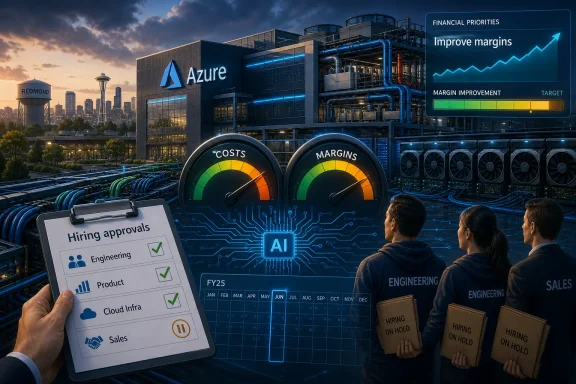 Microsoft’s Cloud Engine Is Being Asked to Pay for the AI Era
The reported freeze is easy to misread as a conventional late-fiscal-year austerity maneuver. Microsoft often tightens hiring as June approaches, and large companies routinely pull back open requisitions before the next budget cycle. But the language attributed to Azure Core leadership — that the group no longer had room or approval to continue hiring — points to something more specific than ordinary calendar discipline.Azure Core is not an experimental side project. It is the engineering foundation beneath Microsoft’s cloud platform, the layer that keeps compute, storage, networking, reliability, capacity planning, and infrastructure services functioning at global scale. If Microsoft is telling managers there that hiring must pause until margins improve, it is acknowledging that the infrastructure boom behind AI has a cost structure that even a cloud giant has to actively manage.
For years, the cloud story was relatively clean. Customers moved workloads from their own data centers into hyperscale platforms, and Microsoft, Amazon, and Google converted that demand into recurring revenue with attractive economics. AI complicates that model because the most strategically important workloads are also among the most capital-intensive. Training and serving large models require specialized chips, dense data centers, expensive power arrangements, advanced networking, and a tolerance for depreciation schedules that do not look like yesterday’s enterprise SaaS business.
That is the pressure behind the hiring pause. Microsoft is not retreating from Azure; it is trying to squeeze more profit from the machinery it already has while it keeps pouring money into the machinery it believes it cannot afford not to build.
The Freeze Is Narrow, but the Signal Is Broad
The important caveat is that Microsoft’s reported pause is not companywide. The Information’s reporting, echoed by market outlets, described affected groups including Azure cloud and North American sales, while noting that other areas continued to hire. That distinction matters because it separates a targeted margin action from a panic move.Still, targeted does not mean trivial. The affected divisions reportedly include tens of thousands of employees, and Azure Core alone is described as an organization of roughly 11,000 people under Girish Bablani. A pause inside an organization of that size can reshape project timelines, internal transfers, backfill decisions, contractor reliance, and the willingness of teams to take on new commitments.
In practical terms, a hiring freeze rarely means every team stops moving. It means managers become more selective, budget owners regain veto power, and internal candidates often become more attractive than external hires. It also means work that was supposed to be absorbed by a new hire may be redistributed to existing staff, postponed, automated, or quietly killed.
For WindowsForum readers, that internal accounting matters because Azure is no longer just “Microsoft’s cloud business.” It is the substrate under Microsoft 365, GitHub, Windows cloud services, Copilot, Azure Virtual Desktop, Intune, Defender, Entra, and a long list of enterprise plumbing that administrators now treat as production infrastructure. A margin push in Azure is therefore not just a Wall Street story. It is a signal about how Microsoft intends to balance product ambition, reliability, support, and cost.
AI Has Turned Headcount Into a Margin Question
The old tech-industry playbook treated headcount as a proxy for growth. Big companies hired aggressively when demand was strong, and investors accepted swelling payrolls because new engineers and sellers were expected to generate new products, new accounts, and new lines of revenue. The AI cycle has changed the math.Now the biggest spending line is not merely people. It is infrastructure. Microsoft’s AI strategy depends on data centers, accelerators, power, cooling, networking, model partnerships, and the operational expertise to turn that capital into services customers will actually pay for. When that kind of spending expands, every other cost center gets examined more harshly.
That is why a hiring pause in Azure and sales is revealing. Engineering headcount builds capability, but it also adds long-term operating expense. Sales headcount can drive consumption, but Microsoft is already deeply embedded in large enterprise accounts, and the company may believe it can lean harder on existing relationships, partners, automation, and bundled offerings rather than adding more people at the same pace.
The phrase “improve margins” is doing a lot of work here. It does not mean Azure is weak. It means Azure is being judged not just by growth but by the profitability of that growth. In the AI era, cloud revenue can rise while investors still worry about whether the underlying compute economics are good enough.
The Fiscal-Year Excuse Is True, but Incomplete
Microsoft’s fiscal year ends in June, and that timing is central to the story. Late-year hiring slowdowns are common across large enterprises, especially when finance teams are closing budgets, reconciling forecasts, and deciding which open roles roll into the next year. A freeze in March can be temporary, administrative, and reversible.But the calendar explanation only gets Microsoft part of the way out of the story. Routine budget discipline usually does not become a headline unless it intersects with a larger strategic pressure. In this case, it intersects with the AI investment cycle, the post-pandemic tech labor reset, and Wall Street’s impatience with companies that promise enormous future AI revenue while spending enormous present-day cash to chase it.
The better reading is that the fiscal calendar provided the moment, while AI economics provided the reason. Microsoft can credibly say it slows hiring near year-end. It can also be true that this year’s slowdown carries more weight because the company is trying to keep Azure’s margin profile from being dragged down by the infrastructure demands of the very AI services it wants customers to adopt.
This is what mature platform companies do when growth markets become capital battles. They do not abandon the market. They ration resources, centralize approvals, and force teams to prove that each additional hire or project contributes to the strategic center of gravity.
Azure’s Success Has Made It Harder to Manage
Azure’s problem, if it can be called that, is that Microsoft has successfully made it the answer to almost every enterprise technology question. Need cloud infrastructure? Azure. Need identity? Entra. Need endpoint management? Intune. Need security telemetry? Defender. Need productivity AI? Copilot, backed by Microsoft’s cloud. Need developer infrastructure? GitHub and Azure services. Need hybrid management? Arc.That breadth gives Microsoft a formidable advantage, but it also creates a management burden. Every new service increases expectations for reliability, regional availability, compliance, documentation, support, billing accuracy, and security response. Every Copilot pitch depends on customers believing Microsoft can safely process enterprise data at scale. Every AI feature added to Windows or Microsoft 365 ultimately leans on cloud infrastructure somewhere.
The hiring pause therefore raises a fair operational question: can Microsoft keep expanding cloud commitments while slowing the addition of people in the groups responsible for delivering them? The answer may be yes, but only if the company extracts more efficiency from internal tooling, automation, platform consolidation, and AI-assisted engineering. That is the promise Microsoft sells to customers, and now it has to live by it internally.
There is a certain symmetry in that. Microsoft is telling enterprises that AI will help them do more with less. Its own hiring posture suggests it is applying the same assumption to itself.
Sales Freezes Tell a Different Story Than Engineering Freezes
The reported pause in North American sales deserves as much attention as the Azure Core angle. Sales organizations are often the first place executives look when they want to slow expense without appearing to cut product investment. But in a consumption-based cloud business, sales capacity is not merely overhead; it is part of the revenue engine.Microsoft’s sales challenge in 2026 is not simply convincing customers that Azure exists. The company is trying to persuade enterprises to adopt Copilot, modernize workloads, commit to AI infrastructure, consolidate security spending, and trust Microsoft with sensitive data flows. That requires technical sales, solution architecture, partner coordination, and post-sale adoption work.
A freeze in sales hiring may suggest Microsoft believes the next phase of growth will come less from adding more sellers and more from increasing productivity per seller. That could mean heavier use of telemetry, customer scoring, AI-assisted account planning, partner channels, self-service procurement, and bundled licensing motions. It could also mean Microsoft is prioritizing the largest and most profitable opportunities while letting smaller or slower-moving accounts wait.
For customers, the risk is uneven attention. Large enterprises with strategic AI budgets will still get Microsoft’s best people. Smaller organizations may find it harder to reach the right specialist, get nuanced licensing guidance, or receive hands-on help with complicated cloud migrations.
The Layoffs Trend Is Not Just About Cutting People
The Stocktwits item frames Microsoft’s hiring pause against a broader tech layoff trend, and that framing is broadly right even if individual layoff figures in fast-moving market chatter should be treated carefully. Across the sector, companies have spent the last several years undoing pandemic-era hiring, flattening management layers, and redirecting spending toward AI. The result is a labor market where “AI investment” and “workforce reduction” increasingly appear in the same paragraph.That pairing can sound contradictory. If AI is the future, why are the companies building it cutting or freezing jobs? The answer is that AI is not a single line item. It is a reallocation of capital from some roles and projects into compute infrastructure, model development, data center capacity, and a smaller number of highly leveraged engineering and product bets.
This is why the current tech labor reset feels different from the dot-com crash or the 2008 downturn. Demand for digital services has not vanished. Microsoft is not a distressed company. The issue is that the industry is repricing labor in the presence of expensive AI infrastructure and tools that executives believe can increase output per employee.
That belief may prove partly right and partly self-serving. AI coding assistants, support copilots, sales automation, and internal knowledge tools can reduce friction. But they do not automatically replace institutional knowledge, incident response judgment, customer trust, or the boring operational labor that keeps global platforms stable.
Windows Users Should Watch the Cloud Budget, Not Just the Windows Roadmap
For traditional Windows enthusiasts, an Azure hiring freeze might appear distant from the desktop. It is not. Modern Windows is increasingly tied to cloud identity, cloud policy, cloud security, cloud backup, cloud device management, and cloud-delivered AI features. Even features that run locally are often licensed, configured, monitored, or enhanced through Microsoft’s online services.That means Azure economics can shape Windows in indirect but meaningful ways. If Microsoft is under pressure to protect cloud margins, it may become more aggressive about bundling, upselling, retiring underused services, changing licensing incentives, or steering customers toward higher-value cloud subscriptions. Windows may remain the familiar endpoint, but the business model around it keeps moving toward cloud attachment.
Administrators have already lived through this shift. Managing Windows fleets now often means understanding Entra ID, Intune, Conditional Access, Defender for Endpoint, Windows Autopatch, Azure Monitor integrations, and Microsoft 365 licensing tiers. A staffing or margin shift inside Microsoft’s cloud organization can affect documentation quality, support responsiveness, feature rollout discipline, and the cadence of deprecations.
The Windows desktop is not going away. But the center of gravity has moved. When Microsoft tightens hiring in Azure, Windows customers should read it as a sign that the platform behind their management stack is being optimized for efficiency as much as expansion.
Enterprise IT Will Feel the Effects in Small Places First
The most likely customer impact is not a dramatic outage or a sudden halt to Azure development. Hyperscale cloud platforms do not turn on a dime, and Microsoft has enormous operational depth. The effects of hiring restraint usually show up in smaller, more ambiguous ways.A preview feature may take longer to reach general availability. A regional capacity issue may take longer to resolve. Documentation may lag behind product behavior. Support queues may become more tiered. Account teams may push standardized architectures rather than bespoke guidance. Product groups may emphasize features that drive consumption and margin over features that merely satisfy edge-case requests.
None of this is guaranteed, and Microsoft may manage the transition smoothly. But administrators should understand the incentive structure. When a company is trying to improve margins in a capital-intensive cloud buildout, it will favor scale, standardization, automation, and repeatability. Customers with unusual environments may find that the service works best when they conform to Microsoft’s preferred patterns.
That is not unique to Microsoft. It is the hyperscaler model. The difference is that Microsoft’s enterprise reach makes the consequences especially visible. Azure is not just another cloud option for many organizations; it is bundled into the identity, productivity, endpoint, and security stack they already use.
The Investor Read Is Colder Than the Product Read
Retail sentiment around Microsoft may swing bullish or bearish on headlines like this, but the investor logic is fairly straightforward. A hiring freeze can be read as a sign of discipline. If Microsoft can keep revenue growing while holding headcount flat, margins benefit. If AI tools allow existing employees to produce more, the company’s long-term cost structure improves.That is the optimistic version. The colder version is that Microsoft is spending so heavily on AI infrastructure that it must trim or pause elsewhere to keep the financial model attractive. In that reading, the hiring freeze is not a sign of weakness in demand but a sign that the AI race is absorbing oxygen from everything around it.
Investors have been willing to reward AI ambition, but not blindly. They want evidence that capital expenditure turns into revenue, revenue turns into margin, and margin turns into durable earnings. Microsoft has earned more patience than most companies because Azure, Microsoft 365, and its enterprise relationships are real businesses rather than speculative AI wrappers. But patience is not infinite.
This is why the reported pause lands at an awkward moment. Microsoft wants to convince the market that AI is both a growth accelerator and a productivity multiplier. A hiring freeze supports the productivity story, but it also reminds everyone that the growth accelerator is expensive.
The Labor Market Is Learning Microsoft’s New Grammar
For engineers, sellers, program managers, and technical specialists, the reported freeze reinforces a harsh lesson: big-tech hiring is no longer a smooth escalator. A candidate can clear interviews and still be stopped by headcount approval. A role can exist in a portal and still be functionally frozen. A team can have work and still lack permission to hire.That creates uncertainty for candidates and employees alike. External applicants may wait weeks for budget decisions that have little to do with their performance. Internal teams may hesitate to backfill attrition. Managers may become reluctant to open roles unless they are certain the requisition will survive finance review.
It also changes the prestige calculus around cloud jobs. Azure remains one of the most important engineering organizations in the world, but importance does not guarantee unlimited hiring. The most strategic groups may be under the tightest scrutiny precisely because their budgets are largest and their margin impact is most visible.
The new grammar of big-tech work is leverage. Companies want fewer people supporting more revenue, more customers, more infrastructure, and more product surface area. AI is both the tool used to justify that ambition and the expense that makes it feel necessary.
Microsoft’s Real Bet Is That AI Can Make Microsoft Leaner
There is an internal contradiction Microsoft now has to resolve. The company is selling AI as a productivity revolution while operating one of the most complex software and cloud businesses on the planet. If AI really can change the economics of work, Microsoft should be among the first to benefit. If it cannot, then hiring freezes will eventually collide with product commitments.This is not just about code generation. Microsoft can apply AI to incident triage, log analysis, customer support, documentation drafting, sales forecasting, security operations, compliance mapping, migration planning, and internal finance workflows. In theory, those tools should allow a company with 228,000 employees to increase output without returning to pandemic-era hiring growth.
But “in theory” is carrying a heavy load. AI systems can accelerate routine work, but they also create review burdens, quality risks, security concerns, and new classes of failure. A hallucinated internal answer can be annoying in a document draft; in cloud operations, a mistaken recommendation can become expensive. The more Microsoft relies on AI to reduce the need for hiring, the more it must prove that its own governance is mature enough to handle that reliance.
That may be the real test of the reported Azure pause. It is not whether Microsoft can stop hiring for a quarter. It is whether Microsoft can keep shipping, supporting, securing, and scaling Azure while making headcount grow more slowly than demand.
Redmond’s Margin Memo Has a Message for Every Admin
The immediate lesson is not that Azure is in trouble. The immediate lesson is that Microsoft’s cloud platform is entering a more disciplined phase, where growth will be judged by efficiency as much as speed. For IT pros, that changes how to read Microsoft’s roadmap and how to plan around it.- Microsoft’s reported hiring pause appears targeted at major Azure and North American sales groups, not a blanket companywide freeze.
- The timing near Microsoft’s June fiscal year-end makes the move easier to explain, but AI infrastructure costs make it more strategically significant.
- Azure customers should expect Microsoft to prioritize standardized, scalable, consumption-driving services over bespoke or low-margin requests.
- Windows administrators should treat Azure staffing and margin pressure as relevant because modern Windows management increasingly depends on Microsoft cloud services.
- Candidates and employees should assume that headcount approval, not team demand, is now the decisive gate in many big-tech hiring processes.
- The long-term question is whether Microsoft can use AI internally to maintain product velocity and service quality with slower headcount growth.
References
- Primary source: Stocktwits
Published: 2026-06-20T09:30:08.683979
Microsoft Reportedly Pauses Fresh Hiring For Azure Cloud Segment Amid Broader Tech Layoffs Trend
The Information reported on Thursday, citing employees familiar with the matter, that company executives told managers to suspend new hiring in its North American sales groups as well.stocktwits.com - Related coverage: winbuzzer.com
Microsoft Freezes Hiring in Azure Cloud Division, Sales Units as AI Costs Bite
Microsoft has halted hiring across its Azure cloud and North American sales divisions as AI infrastructure costs squeeze margins ahead of June fiscal year-end. winbuzzer.com
- Official source: microsoft.com
Microsoft 2025 Annual Report
www.microsoft.com - Related coverage: tipranks.com
- Related coverage: geekwire.com
Microsoft cut product R&D jobs, added operations roles over the past year, new filing confirms – GeekWire
Microsoft’s global headcount remained steady at 228,000 employees over the past year, but the mix of roles changed notably, reflecting ongoing shifts inwww.geekwire.com - Related coverage: newsquawk.com
Microsoft (MSFT) freezes hiring in major cloud and sales group; Azure Core pausing hiring to address gross margin gap, The Information reports | Newsquawk
Microsoft (MSFT) freezes hiring in major cloud and sales group; Azure Core pausing hiring to address gross margin gap, The Information reportswww.newsquawk.com
- Related coverage: zerohedge.com
Microsoft Freezes Hiring In Cloud And Sales As Stock Suffers Worst Start To Year On Record<!-- --> | ZeroHedge
ZeroHedge - On a long enough timeline, the survival rate for everyone drops to zero www.zerohedge.com
- Related coverage: theinformation.com
Microsoft Freezes Hiring at Key Cloud, Sales Groups to Improve Margins — The Information
Microsoft recently suspended new hiring across major divisions, including its Azure cloud and North American sales groups, as the company seeks to offset its investments in artificial intelligence infrastructure, The Information reported . Executives have instructed managers in these sprawling...www.theinformation.com - Related coverage: techrights.org
- Official source: news.microsoft.com
Facts About Microsoft - Stories
Microsoft creates platforms and tools powered by AI to deliver innovative solutions that meet the evolving needs of our customers. The technology company is committed to making AI available broadly and doing so responsibly, with a mission to empower every person and every organization on the... news.microsoft.com
- Related coverage: sightsinplus.com
Microsoft Hiring Freeze: Key Azure and Sales Units Hit as AI Costs Surge | SightsIn Plus
Microsoft instructed managers across its revenue-generating divisions, including Azure Cloud and North American Sales, to stop new hiring.www.sightsinplus.com - Related coverage: bizfortune.com
Microsoft Freezes Cloud Sales Hiring - Business Fortune
Business Fortune reports Microsoft halts hiring in key cloud and sales teams amid AI spending pressure.bizfortune.com
