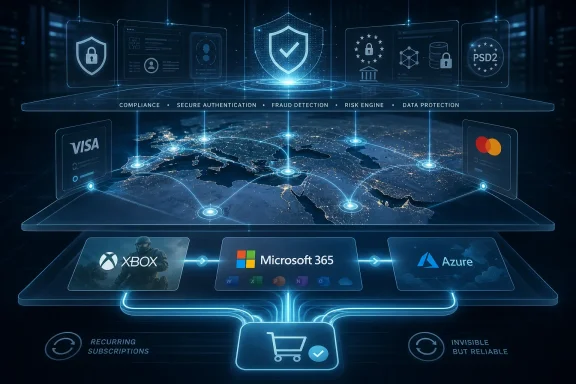
Microsoft has chosen Checkout.com to handle card acceptance for major Microsoft products including Xbox, Microsoft 365, and Azure across Europe, the Middle East, and Africa, using Microsoft’s Payments API and Checkout.com’s Intelligent Acceptance platform to route transactions through a unified payments layer. The announcement looks, at first glance, like procurement plumbing. It is not. It is a reminder that the next phase of Big Tech competition is being fought not only in AI models and cloud capacity, but in the invisible commerce rails that decide whether a subscription renews, a game purchase clears, or an Azure invoice gets paid on time.
For most users, payments are supposed to be boring. A card is entered, a receipt appears, and the software keeps working. But for a company the size of Microsoft, “boring” is a hard engineering target: payments cross borders, currencies, banks, card networks, fraud filters, local regulations, subscription rules, and increasingly aggressive authentication requirements.
That is why this Checkout.com deal matters beyond the fintech trade press. Microsoft is not merely adding another processor in EMEA. It is standardizing part of the commerce layer behind some of its most important recurring-revenue businesses, from Xbox subscriptions and digital purchases to Microsoft 365 seats and Azure consumption.
The stated goal is consistency: one route into Microsoft’s payments infrastructure, better acceptance performance, and fewer avoidable failures. The practical goal is sharper. Microsoft wants fewer moments where a customer is ready to pay and the system, somewhere between issuer, acquirer, gateway, network, and fraud engine, says no.
That kind of failure is not cosmetic. In consumer gaming, it can mean a lost purchase. In Microsoft 365, it can mean subscription churn or administrative hassle. In Azure, payment friction can become an enterprise support incident, especially for smaller businesses buying directly rather than through a large procurement channel.
That is the appeal of Checkout.com’s pitch. The company sells itself as a high-performance payments platform for large digital merchants, with acquiring, processing, routing, optimization, and local-market expertise under one roof. Microsoft’s endorsement gives that pitch a marquee customer in the most literal sense: a company whose commerce stack touches consumers, developers, small businesses, governments, and multinationals.
For Microsoft, EMEA is also strategically awkward in a way the United States is not. Europe in particular has become a regulatory center of gravity for digital markets, privacy, competition policy, AI, cloud sovereignty, and payments. A more unified acquiring and routing layer gives Microsoft another lever to manage reliability and compliance without forcing each product group to solve the same local problems separately.
The inclusion of Xbox, Microsoft 365, and Azure is telling. These are not peripheral stores. They represent three faces of modern Microsoft: consumer entertainment, productivity subscriptions, and cloud infrastructure. A payments partner that can serve all three is being asked to support a commerce model that ranges from a teenager buying digital content to an enterprise paying for compute capacity.
Centralization does not mean simplicity for customers. Ideally, it means the opposite: customers see less of the machinery because Microsoft sees more of it internally. Failed authorization patterns, issuer-specific behavior, local acceptance rates, dispute trends, and routing decisions become data that can be analyzed across products instead of trapped inside separate business units.
This matters because Microsoft’s commercial reality has changed. The company is not just selling boxed software or enterprise agreements negotiated once every few years. It is running a sprawling subscription and consumption marketplace where billing events happen constantly. Every renewal, upgrade, seat expansion, game purchase, marketplace transaction, and cloud charge depends on payments infrastructure behaving as expected.
There is also a control story here. A unified payments layer gives Microsoft more room to switch routing strategies, test payment methods, negotiate acquiring performance, and impose internal standards. For administrators and finance teams, that may eventually show up as fewer strange billing inconsistencies across Microsoft properties. For Microsoft, it means commerce becomes more programmable.
This is one of the more practical uses of AI in enterprise infrastructure because the feedback loop is immediate. A model can observe authorization outcomes, network behavior, issuer responses, transaction types, and historical patterns, then recommend a better path next time. The goal is not to write poetry or summarize a meeting; it is to increase the probability that a legitimate customer’s payment succeeds.
For Microsoft, that is particularly valuable because its payment events are so varied. An Xbox purchase may look very different from a Microsoft 365 renewal or an Azure invoice. Risk, fraud signals, customer history, geography, and transaction size all change the calculus. A blunt payments stack treats those as isolated events; an optimized one can learn across patterns.
Still, the language deserves some skepticism. “AI-powered” is now attached to nearly every layer of commerce infrastructure, sometimes meaning little more than rules plus analytics plus a new marketing page. The important question is not whether AI is involved, but whether Microsoft sees measurable improvements in authorization rates, reduced false declines, and lower operational friction.
The timing is also notable because Xbox has been under pressure to make purchases more flexible and accessible. Reports of buy-now-pay-later options appearing in Xbox-related code point to a broader direction: Microsoft is looking for ways to reduce sticker shock without lowering list prices outright. Whether that comes through installment providers, wallet integrations, or better card acceptance, the checkout experience becomes part of Xbox strategy.
That may make some users uneasy, and not without reason. The gaming industry has already normalized subscriptions, virtual currencies, microtransactions, and seasonal content economies. Smoother payments can be customer-friendly when they prevent false declines; they can be more troubling when they make spending too frictionless.
Microsoft will have to walk that line carefully. Reliability is good. Predatory ease is not. A better payments stack should help legitimate purchases go through, not obscure cost, debt, or renewal obligations from users who would benefit from clearer friction.
For small organizations, payment problems can be disproportionately painful. They may not have a dedicated procurement department, reseller relationship, or enterprise account team. They may buy directly with a card and expect the same reliability from Microsoft that they expect from a utility bill. When that experience fails, the brand damage lands on Microsoft, not on an issuing bank or payment gateway.
A better acceptance layer can also reduce unnecessary churn. Subscription businesses obsess over product engagement, pricing, and retention campaigns, but involuntary churn from failed payments is a quiet leak in the bucket. If Checkout.com can help Microsoft recover even a small percentage of otherwise failed renewals across EMEA, the financial effect could be meaningful.
The administrative angle matters, too. Microsoft’s billing ecosystem can already feel labyrinthine, especially when users move between direct purchases, partner-managed subscriptions, regional storefronts, and organizational accounts. A more consistent payments backend will not magically simplify licensing, but it could remove one source of avoidable chaos.
When that front door fails, the consequences can be larger than a missed purchase. Cloud resources may be tied to billing status, spending limits, subscription health, and account verification. A payment failure can become an operations event, particularly for teams without mature billing controls.
This is where Microsoft’s choice of partner intersects with its broader cloud ambitions. Azure is competing in a market where reliability is measured not only in uptime zones and service-level agreements, but in the predictability of the entire customer lifecycle. Billing, identity, support, compliance, and cost management are all part of the cloud product now.
For IT pros, the message is simple: payments are another dependency. If your organization relies on direct Azure billing, especially across multiple countries or subsidiaries, the quality of Microsoft’s acquiring and routing relationships can affect operational continuity. That does not mean administrators should panic; it means they should treat billing configuration as part of cloud hygiene.
The company has spent the last several years trying to position itself not merely as a payment gateway, but as infrastructure for large digital merchants. Its earlier technology collaboration with Microsoft, its partnership with Spotify, its Intelligent Acceptance product, and its push into stablecoin-related capabilities all point in the same direction. Checkout.com wants to be the payments layer for companies that think of payment performance as a competitive advantage.
That ambition is not risk-free. Serving giant merchants raises expectations. A local processor can have a bad day and annoy a subset of customers; a platform serving Microsoft product lines across EMEA will be judged against enterprise resilience standards. Performance claims become measurable, and outages become reputational events.
Microsoft’s endorsement may also sharpen competition with other global payment firms. Stripe, Adyen, Worldpay, PayPal, and traditional acquiring banks all want pieces of the enterprise commerce stack. The Microsoft deal signals that Checkout.com remains in that conversation, particularly where large merchants want optimization, acquiring reach, and direct control.
There is no evidence in the announcement that Microsoft is about to accept euro stablecoins for Xbox subscriptions or Azure bills in EMEA. The deal described is about card acceptance, routing, and payment optimization. But Checkout.com’s broader strategy matters because Microsoft is choosing a partner that is actively building beyond traditional card rails.
That is sensible. Cards remain dominant in many online payment flows, but they are expensive, failure-prone, and not always ideal for cross-border settlement. Stablecoins, for all their regulatory baggage and market volatility concerns around the broader crypto sector, have become more interesting to enterprises when framed as settlement infrastructure rather than speculative assets.
The near-term takeaway is not that Microsoft is going crypto. It is that Microsoft wants payment partners with optionality. In a market where regulation, customer preference, and settlement technology are all shifting, optionality is a form of resilience.
This is where the “single system” language becomes more important. Centralized routing and processing can help Microsoft enforce consistent controls, observe anomalies, and adapt to regulatory changes across markets. It can also reduce the temptation for each business unit to solve local payment headaches with bespoke integrations that become difficult to govern.
But consolidation has its own risks. A unified layer can become a point of dependency, and a major partner relationship can concentrate operational exposure. Microsoft will need redundancy, clear failover paths, and strong internal visibility into Checkout.com’s performance. Enterprise IT readers know the lesson well: simplification often moves complexity rather than eliminating it.
There is also a user-trust issue. Payment optimization should not become a black box that makes unexplained decisions about legitimate customers. False declines are frustrating, but opaque fraud controls and inconsistent authentication prompts are frustrating too. The best version of this partnership will be one where users notice fewer failures without feeling more surveilled.
The reason is recurring revenue. Microsoft’s modern business depends on millions of repeated commercial interactions. A one-time software sale could tolerate a certain amount of friction because the transaction was episodic. A subscription-and-consumption model cannot. It needs payments to be reliable, observable, optimizable, and adaptable.
That is why checkout performance now belongs in the same conversation as product experience. If a Microsoft 365 renewal fails, the user does not care that the problem may involve issuer behavior or routing logic. If an Xbox purchase is declined incorrectly, the player blames Xbox. If an Azure account encounters billing trouble, the developer blames Azure. The platform owns the experience, even when the failure occurs outside its walls.
Microsoft’s selection of Checkout.com is therefore an admission of platform responsibility. The company is saying that payments performance is important enough to standardize, optimize, and integrate deeply. That is a quiet but meaningful shift in how software giants think about selling software.
For IT administrators, the practical advice is to keep billing processes boring on purpose. Make sure payment methods are current, backup payment options are configured where available, billing contacts are not tied to departed employees, and Azure subscription ownership is understood. Vendor-side optimization helps, but it does not replace basic account hygiene.
For consumers, the watch item is different. As Microsoft improves payment acceptance and experiments with more flexible purchasing models, users should expect checkout to become smoother and perhaps more varied. That is convenient, but it also makes spending controls, family settings, subscription reminders, and refund visibility more important.
For Microsoft watchers, the larger pattern is unmistakable. The company is continuing to build a unified commercial substrate beneath products that once lived in separate business worlds. Xbox, Microsoft 365, and Azure are different businesses, but they increasingly depend on common identity, billing, payments, compliance, and data infrastructure.
 Microsoft Turns Payment Failure Into a Product Problem
For most users, payments are supposed to be boring. A card is entered, a receipt appears, and the software keeps working. But for a company the size of Microsoft, “boring” is a hard engineering target: payments cross borders, currencies, banks, card networks, fraud filters, local regulations, subscription rules, and increasingly aggressive authentication requirements.That is why this Checkout.com deal matters beyond the fintech trade press. Microsoft is not merely adding another processor in EMEA. It is standardizing part of the commerce layer behind some of its most important recurring-revenue businesses, from Xbox subscriptions and digital purchases to Microsoft 365 seats and Azure consumption.
The stated goal is consistency: one route into Microsoft’s payments infrastructure, better acceptance performance, and fewer avoidable failures. The practical goal is sharper. Microsoft wants fewer moments where a customer is ready to pay and the system, somewhere between issuer, acquirer, gateway, network, and fraud engine, says no.
That kind of failure is not cosmetic. In consumer gaming, it can mean a lost purchase. In Microsoft 365, it can mean subscription churn or administrative hassle. In Azure, payment friction can become an enterprise support incident, especially for smaller businesses buying directly rather than through a large procurement channel.
The EMEA Map Makes This More Than a Regional Deal
Europe, the Middle East, and Africa are not a tidy payments market. The acronym EMEA compresses mature card markets, fast-growing digital economies, multiple regulatory regimes, local acquiring quirks, strong customer authentication, currency fragmentation, and uneven banking modernization into one corporate region. Any vendor promising a “consistent” experience across that territory is really promising to absorb a lot of complexity.That is the appeal of Checkout.com’s pitch. The company sells itself as a high-performance payments platform for large digital merchants, with acquiring, processing, routing, optimization, and local-market expertise under one roof. Microsoft’s endorsement gives that pitch a marquee customer in the most literal sense: a company whose commerce stack touches consumers, developers, small businesses, governments, and multinationals.
For Microsoft, EMEA is also strategically awkward in a way the United States is not. Europe in particular has become a regulatory center of gravity for digital markets, privacy, competition policy, AI, cloud sovereignty, and payments. A more unified acquiring and routing layer gives Microsoft another lever to manage reliability and compliance without forcing each product group to solve the same local problems separately.
The inclusion of Xbox, Microsoft 365, and Azure is telling. These are not peripheral stores. They represent three faces of modern Microsoft: consumer entertainment, productivity subscriptions, and cloud infrastructure. A payments partner that can serve all three is being asked to support a commerce model that ranges from a teenager buying digital content to an enterprise paying for compute capacity.
The Payments API Is the Real Center of Gravity
The phrase “Microsoft Payments API” sounds like the kind of detail only a billing engineer could love, but it is the operational heart of the announcement. Microsoft is connecting Checkout.com through a single system, rather than treating each product line as a separate payments island. That architecture is where the cost savings, reliability gains, and governance benefits are likely to emerge.Centralization does not mean simplicity for customers. Ideally, it means the opposite: customers see less of the machinery because Microsoft sees more of it internally. Failed authorization patterns, issuer-specific behavior, local acceptance rates, dispute trends, and routing decisions become data that can be analyzed across products instead of trapped inside separate business units.
This matters because Microsoft’s commercial reality has changed. The company is not just selling boxed software or enterprise agreements negotiated once every few years. It is running a sprawling subscription and consumption marketplace where billing events happen constantly. Every renewal, upgrade, seat expansion, game purchase, marketplace transaction, and cloud charge depends on payments infrastructure behaving as expected.
There is also a control story here. A unified payments layer gives Microsoft more room to switch routing strategies, test payment methods, negotiate acquiring performance, and impose internal standards. For administrators and finance teams, that may eventually show up as fewer strange billing inconsistencies across Microsoft properties. For Microsoft, it means commerce becomes more programmable.
AI Comes for the Card Decline
Checkout.com’s Intelligent Acceptance product is the flashiest technical element in the deal. The company describes it as an AI-powered optimization tool that uses real-time network data to route transactions and reduce payment failures. The basic premise is straightforward: not every failed payment is truly a bad payment, and better routing or retry logic can turn some declines into approvals.This is one of the more practical uses of AI in enterprise infrastructure because the feedback loop is immediate. A model can observe authorization outcomes, network behavior, issuer responses, transaction types, and historical patterns, then recommend a better path next time. The goal is not to write poetry or summarize a meeting; it is to increase the probability that a legitimate customer’s payment succeeds.
For Microsoft, that is particularly valuable because its payment events are so varied. An Xbox purchase may look very different from a Microsoft 365 renewal or an Azure invoice. Risk, fraud signals, customer history, geography, and transaction size all change the calculus. A blunt payments stack treats those as isolated events; an optimized one can learn across patterns.
Still, the language deserves some skepticism. “AI-powered” is now attached to nearly every layer of commerce infrastructure, sometimes meaning little more than rules plus analytics plus a new marketing page. The important question is not whether AI is involved, but whether Microsoft sees measurable improvements in authorization rates, reduced false declines, and lower operational friction.
Xbox Shows Why Checkout Is Now Part of the Platform
Xbox is the consumer-facing proof point for why payments are no longer back-office plumbing. Microsoft’s gaming business increasingly depends on digital storefronts, subscriptions, downloadable content, in-game purchases, and recurring services. In that world, a failed card transaction is not just a billing problem; it is a broken part of the entertainment experience.The timing is also notable because Xbox has been under pressure to make purchases more flexible and accessible. Reports of buy-now-pay-later options appearing in Xbox-related code point to a broader direction: Microsoft is looking for ways to reduce sticker shock without lowering list prices outright. Whether that comes through installment providers, wallet integrations, or better card acceptance, the checkout experience becomes part of Xbox strategy.
That may make some users uneasy, and not without reason. The gaming industry has already normalized subscriptions, virtual currencies, microtransactions, and seasonal content economies. Smoother payments can be customer-friendly when they prevent false declines; they can be more troubling when they make spending too frictionless.
Microsoft will have to walk that line carefully. Reliability is good. Predatory ease is not. A better payments stack should help legitimate purchases go through, not obscure cost, debt, or renewal obligations from users who would benefit from clearer friction.
Microsoft 365 Makes the Stakes Mundane and Massive
Microsoft 365 is where the deal’s implications become less flashy but more important. Unlike an Xbox purchase, a productivity subscription often sits at the center of a household, small business, school, or nonprofit. Failed billing can mean degraded service, admin warnings, support tickets, or interrupted access to tools people depend on daily.For small organizations, payment problems can be disproportionately painful. They may not have a dedicated procurement department, reseller relationship, or enterprise account team. They may buy directly with a card and expect the same reliability from Microsoft that they expect from a utility bill. When that experience fails, the brand damage lands on Microsoft, not on an issuing bank or payment gateway.
A better acceptance layer can also reduce unnecessary churn. Subscription businesses obsess over product engagement, pricing, and retention campaigns, but involuntary churn from failed payments is a quiet leak in the bucket. If Checkout.com can help Microsoft recover even a small percentage of otherwise failed renewals across EMEA, the financial effect could be meaningful.
The administrative angle matters, too. Microsoft’s billing ecosystem can already feel labyrinthine, especially when users move between direct purchases, partner-managed subscriptions, regional storefronts, and organizational accounts. A more consistent payments backend will not magically simplify licensing, but it could remove one source of avoidable chaos.
Azure Turns Card Acceptance Into Cloud Reliability
Azure is the most consequential product named in the announcement because cloud billing is not just commerce; it is infrastructure governance. Azure customers may pay through enterprise agreements, partners, invoicing, marketplaces, or direct card-based channels. For startups, developers, and smaller businesses, the card-on-file model is often the front door.When that front door fails, the consequences can be larger than a missed purchase. Cloud resources may be tied to billing status, spending limits, subscription health, and account verification. A payment failure can become an operations event, particularly for teams without mature billing controls.
This is where Microsoft’s choice of partner intersects with its broader cloud ambitions. Azure is competing in a market where reliability is measured not only in uptime zones and service-level agreements, but in the predictability of the entire customer lifecycle. Billing, identity, support, compliance, and cost management are all part of the cloud product now.
For IT pros, the message is simple: payments are another dependency. If your organization relies on direct Azure billing, especially across multiple countries or subsidiaries, the quality of Microsoft’s acquiring and routing relationships can affect operational continuity. That does not mean administrators should panic; it means they should treat billing configuration as part of cloud hygiene.
Checkout.com Gets the Validation It Wanted
For Checkout.com, Microsoft is the kind of customer that validates a platform narrative. Payments companies often describe themselves as enterprise-grade, scalable, resilient, global, and AI-optimized. Landing Microsoft for key EMEA product lines gives those words a real-world anchor.The company has spent the last several years trying to position itself not merely as a payment gateway, but as infrastructure for large digital merchants. Its earlier technology collaboration with Microsoft, its partnership with Spotify, its Intelligent Acceptance product, and its push into stablecoin-related capabilities all point in the same direction. Checkout.com wants to be the payments layer for companies that think of payment performance as a competitive advantage.
That ambition is not risk-free. Serving giant merchants raises expectations. A local processor can have a bad day and annoy a subset of customers; a platform serving Microsoft product lines across EMEA will be judged against enterprise resilience standards. Performance claims become measurable, and outages become reputational events.
Microsoft’s endorsement may also sharpen competition with other global payment firms. Stripe, Adyen, Worldpay, PayPal, and traditional acquiring banks all want pieces of the enterprise commerce stack. The Microsoft deal signals that Checkout.com remains in that conversation, particularly where large merchants want optimization, acquiring reach, and direct control.
Stablecoins Hover at the Edge of the Story
The article’s final detail — Checkout.com’s acquisition of Blue EMI, a regulated electronic money institution authorized to issue euro-backed stablecoins — is not incidental, even if it is not the center of the Microsoft arrangement. It points to where enterprise payments are heading: a hybrid world where cards, bank transfers, wallets, local methods, and digital settlement rails coexist.There is no evidence in the announcement that Microsoft is about to accept euro stablecoins for Xbox subscriptions or Azure bills in EMEA. The deal described is about card acceptance, routing, and payment optimization. But Checkout.com’s broader strategy matters because Microsoft is choosing a partner that is actively building beyond traditional card rails.
That is sensible. Cards remain dominant in many online payment flows, but they are expensive, failure-prone, and not always ideal for cross-border settlement. Stablecoins, for all their regulatory baggage and market volatility concerns around the broader crypto sector, have become more interesting to enterprises when framed as settlement infrastructure rather than speculative assets.
The near-term takeaway is not that Microsoft is going crypto. It is that Microsoft wants payment partners with optionality. In a market where regulation, customer preference, and settlement technology are all shifting, optionality is a form of resilience.
The Regulatory Weather Is Part of the Architecture
EMEA also makes the regulatory dimension unavoidable. Strong customer authentication, payment services regulation, data protection rules, anti-money-laundering controls, sanctions screening, local acquiring requirements, and emerging digital asset frameworks all shape how payments actually work. A high-performing payment experience is partly a compliance achievement.This is where the “single system” language becomes more important. Centralized routing and processing can help Microsoft enforce consistent controls, observe anomalies, and adapt to regulatory changes across markets. It can also reduce the temptation for each business unit to solve local payment headaches with bespoke integrations that become difficult to govern.
But consolidation has its own risks. A unified layer can become a point of dependency, and a major partner relationship can concentrate operational exposure. Microsoft will need redundancy, clear failover paths, and strong internal visibility into Checkout.com’s performance. Enterprise IT readers know the lesson well: simplification often moves complexity rather than eliminating it.
There is also a user-trust issue. Payment optimization should not become a black box that makes unexplained decisions about legitimate customers. False declines are frustrating, but opaque fraud controls and inconsistent authentication prompts are frustrating too. The best version of this partnership will be one where users notice fewer failures without feeling more surveilled.
The Commerce Layer Is Now Strategic Infrastructure
The most interesting thing about this deal is how uninteresting it would have sounded a decade ago. Microsoft picks a card acceptance partner in EMEA: fine, file it under vendor management. In 2026, that framing is too small. Commerce infrastructure now sits alongside identity, cloud, AI, and security as a strategic layer for platform companies.The reason is recurring revenue. Microsoft’s modern business depends on millions of repeated commercial interactions. A one-time software sale could tolerate a certain amount of friction because the transaction was episodic. A subscription-and-consumption model cannot. It needs payments to be reliable, observable, optimizable, and adaptable.
That is why checkout performance now belongs in the same conversation as product experience. If a Microsoft 365 renewal fails, the user does not care that the problem may involve issuer behavior or routing logic. If an Xbox purchase is declined incorrectly, the player blames Xbox. If an Azure account encounters billing trouble, the developer blames Azure. The platform owns the experience, even when the failure occurs outside its walls.
Microsoft’s selection of Checkout.com is therefore an admission of platform responsibility. The company is saying that payments performance is important enough to standardize, optimize, and integrate deeply. That is a quiet but meaningful shift in how software giants think about selling software.
Where WindowsForum Readers Should Pay Attention
This deal will not require most users to change anything tomorrow. Cards will still be cards, subscriptions will still renew, and Azure bills will still arrive. The significance is in what may improve gradually: fewer failed renewals, better regional acceptance, more consistent checkout behavior, and a payments architecture that gives Microsoft more room to add options later.For IT administrators, the practical advice is to keep billing processes boring on purpose. Make sure payment methods are current, backup payment options are configured where available, billing contacts are not tied to departed employees, and Azure subscription ownership is understood. Vendor-side optimization helps, but it does not replace basic account hygiene.
For consumers, the watch item is different. As Microsoft improves payment acceptance and experiments with more flexible purchasing models, users should expect checkout to become smoother and perhaps more varied. That is convenient, but it also makes spending controls, family settings, subscription reminders, and refund visibility more important.
For Microsoft watchers, the larger pattern is unmistakable. The company is continuing to build a unified commercial substrate beneath products that once lived in separate business worlds. Xbox, Microsoft 365, and Azure are different businesses, but they increasingly depend on common identity, billing, payments, compliance, and data infrastructure.
The Checkout Deal Says More Than the Press Release Admits
The concrete takeaways are narrow, but the implications are broad. Microsoft is not announcing a new app, a new AI assistant, or a new Windows feature. It is tightening the machinery that turns product demand into revenue across a complicated region.- Microsoft has selected Checkout.com for card acceptance across key EMEA product lines including Xbox, Microsoft 365, and Azure.
- The integration will run through Microsoft’s Payments API, which suggests a centralized approach rather than isolated product-by-product payment plumbing.
- Checkout.com’s Intelligent Acceptance product is meant to reduce failed transactions by using real-time payment-network data and optimized routing.
- The deal is especially relevant for subscription and consumption businesses, where failed payments can translate into churn, support burden, or service disruption.
- Checkout.com’s stablecoin moves do not mean Microsoft is adopting crypto payments here, but they do show Microsoft choosing a partner with ambitions beyond traditional card processing.
- Administrators should still treat billing hygiene as operational hygiene, because better payment rails cannot compensate for neglected accounts, expired cards, or unclear ownership.
References
- Primary source: Electronic Payments International
Published: Fri, 19 Jun 2026 10:50:34 GMT
- Related coverage: windowscentral.com
Microsoft is gearing up to let you spread the cost of Xbox purchases — partnering with Klarna and PayPal | Windows Central
Microsoft is exploring ways to help Xbox customers manage the cost of living crisis, adding the ability to split costs in over weeks or even monthly instalment payments "interest free."www.windowscentral.com - Related coverage: checkout.com
Checkout.com acquires Blue EMI, a licensed issuer of euro stablecoins, and establishes Lithuania Technology Centre
Checkout.com www.checkout.com
- Official source: learn.microsoft.com
June 2026 announcements - Partner Center announcements | Microsoft Learn
June 2026 announcements for Microsoft Partner Center including new capabilities, promotions, offers, markets, or changes to existing offers.learn.microsoft.com - Related coverage: support.checkout.com
Supported payment methods and currencies in the US – Checkout.com
As a business selling through a platform or marketplace with Checkout.com in the US, you can accept the following payment methods from...support.checkout.com - Related coverage: cryptotimes.io
Checkout.com Adds USDC, USDT Payments via Coinbase Service
Checkout.com integrated Coinbase Payments, enabling merchants to accept USDC and USDT while receiving settlements directly in U.S. dollars.www.cryptotimes.io
- Related coverage: jiangximediacorporation.com
Checkout.com acquires Blue EMI for euro stablecoin issuance capabilities | Jiangxi Media Corporation Blog | Jiangxi Media Corporation
Checkout.com, a leading global digital payment provider, announced the acquisition of Blue EMI, a registered electronic money institution for euro stablecoins. This acquisition positions Checkout.com as the leaders in regulated digital money and accelerated the evolution of payment modes for...www.jiangximediacorporation.com - Related coverage: financefeeds.com
Checkout.com Buys Blue EMI, Gaining Access to Euro-Backed Stablecoins - FinanceFeeds
UK-based payments firm Checkout.com has acquired Blue EMI, a regulated electronic money institution authorised to issue euro-denominated stablecoins, givingfinancefeeds.com - Related coverage: defi-planet.com
Checkout.com Partners With Coinbase to Bring Stablecoin Payments to Enterprise Merchants
Checkout.com enables stablecoin payments for enterprise merchants via Coinbase infrastructure, linking traditional payment networks with blockchain settlement.defi-planet.com - Related coverage: docs-backend.checkout.com
Checkout.com Partner Technical Accreditation Guide - Google Docs
PDF documentdocs-backend.checkout.com
- Related coverage: sacra-pdfs.s3.us-east-2.amazonaws.com