

Checkout.com has been selected to process card payments for Microsoft across key EMEA products, including Xbox, Microsoft 365, and Azure, in a regional payments arrangement reported on June 18, 2026. The announcement sounds like back-office plumbing, but it is really about something more consequential: Microsoft is treating payments as performance infrastructure. For WindowsForum readers, the story is not just who processes a card charge. It is how Microsoft is tightening the commercial layer underneath the subscriptions, cloud accounts, games, and services that now define its ecosystem.
The most important sentence in the announcement is not the one naming Xbox, Microsoft 365, or Azure. It is the one saying Checkout.com is connecting directly into Microsoft’s Payments API, allowing payments to move through a single, adaptable system. That is the language of infrastructure consolidation, not a mere vendor win.
Microsoft sells software, cloud capacity, identity, productivity, security, gaming, and increasingly AI services across a dizzying spread of customers. A failed payment for an Xbox game is annoying. A failed renewal for a Microsoft 365 tenant or a blocked Azure billing transaction can become an operational incident. The payment layer is no longer a clerical afterthought sitting somewhere after the product experience; it is part of whether the product experience completes at all.
That is why Checkout.com’s selection across EMEA matters beyond fintech trade circles. The region is fragmented by card schemes, banking rules, authentication requirements, currencies, fraud patterns, and consumer expectations. Microsoft needs fewer brittle edges between the customer clicking “buy” and the service being provisioned, renewed, upgraded, or restored.
The move also reflects a broader shift in enterprise software. The largest platforms are beginning to look less like sellers of discrete products and more like operating environments for recurring economic activity. If Windows once made Microsoft unavoidable by sitting under the application layer, Microsoft 365 and Azure now make billing continuity unavoidable by sitting under the business process layer.
That invisibility is expensive. EMEA is not a single market in any practical payments sense. Strong Customer Authentication rules, local issuer behavior, cross-border acquiring, currency conversion, card tokenization, and subscription renewals all create tiny points of friction that can compound into meaningful revenue leakage.
A one-percentage-point improvement in acceptance can be trivial for a small merchant and enormous for a company selling subscriptions and cloud consumption across millions of accounts. The effect is especially sharp for recurring billing, where customers may not be actively present to fix a failed transaction. If a renewal fails because of an issuer decline, expired credentials, a mistimed authentication request, or poor routing, the damage can include churn, support tickets, and service disruption.
That explains why the announcement emphasizes performance, scalability, and resilience. These are the same words Microsoft uses when describing cloud systems, and for good reason. A payments stack serving Xbox, Microsoft 365, and Azure has to behave like a distributed system under load, because that is what it is.
The company’s Intelligent Acceptance product is central to that pitch. According to Checkout.com, the system uses real-time data from its global network to route transactions, reduce failures, and improve authorization performance. The announcement says the product has unlocked more than $20 billion in merchant revenue and runs 26,000 optimizations per minute.
Those figures should be read carefully. “Unlocked revenue” is payments-industry language, and it generally means transactions that might otherwise have failed were improved through optimization. It is not the same as saying Checkout.com created new demand for Microsoft’s products. But for a company with Microsoft’s scale, converting more legitimate payment attempts into successful transactions is valuable enough without needing marketing embellishment.
The AI angle is also worth separating from the hype cycle. This is not Copilot writing a spreadsheet formula or a chatbot summarizing a meeting. It is a machine-learning system making small, high-frequency decisions about how a transaction should be presented, authenticated, retried, or routed. In payments, AI is less a magic interface than a statistical bet on issuer behavior.
Europe alone brings PSD2-era authentication expectations and aggressive regulatory scrutiny around consumer protection, data, competition, and financial services. The Middle East includes fast-scaling digital commerce markets with their own local rails and banking relationships. Africa adds enormous variation in card penetration, mobile money adoption, currency realities, and infrastructure maturity.
For Microsoft, this means the same branded purchase flow may sit on top of very different payment realities. An Xbox customer in one country, a small business buying Microsoft 365 in another, and an Azure customer scaling cloud spend in a third may all see the Microsoft logo, but the transaction paths behind the scenes can diverge significantly.
That is where a direct acquiring and optimization partner can matter. Local acquiring can improve authorization rates because transactions may be processed in ways that look more familiar and lower-risk to local issuers. Better routing can reduce unnecessary declines. Smarter authentication handling can prevent legitimate users from being pushed into dead ends.
A failed card payment on Xbox is not just a fintech metric. It can mean a missed sale during a promotion, a subscription lapse, or a frustrated parent trying to approve a purchase. In gaming, checkout failure competes directly with attention span. If the store cannot complete the transaction quickly, the user may simply leave.
Microsoft has spent years pushing Xbox away from being a console-only business and toward an ecosystem business built around accounts, subscriptions, cloud gaming, PC integration, and cross-device access. That strategy makes payment reliability more important, not less. The more Xbox becomes a service layer, the more recurring payment health becomes part of the product.
It also puts Microsoft in a delicate position. Better acceptance is good when it prevents false declines. But users are increasingly sensitive to subscription sprawl, accidental renewals, children’s purchases, and confusing billing descriptors. A more effective payment engine must still be paired with transparent account controls, clear receipts, and predictable cancellation flows.
That means a billing failure is not just a failed sale. It can become a continuity problem. Small businesses in particular often run Microsoft 365 with limited administrative oversight, saved cards, and little tolerance for billing surprises. When payment methods expire or banks decline recurring charges, the result can be urgent support escalation rather than orderly procurement.
Large enterprises usually handle Microsoft through contracts, invoicing, resellers, or enterprise agreements. But the long tail of Microsoft 365 commerce is far messier. Small businesses, freelancers, nonprofits, regional companies, and departmental buyers may all interact with card-based digital purchasing in ways that resemble consumer commerce more than traditional enterprise procurement.
Checkout.com’s role, then, is partly about reducing friction for these edge cases. The technical promise is that more legitimate payments survive the journey through issuer checks and authentication rules. The business promise is that fewer customers fall out of the paid ecosystem because a bank, a card credential, or a retry rule got in the way.
Anyone who has worked around cloud billing knows the tension. Microsoft wants legitimate developers, startups, and IT departments to spin up resources quickly. It also has to prevent fraud, stolen cards, fake accounts, crypto-mining abuse, and other misuse. Payments sit directly in that conflict.
An overly conservative system blocks good customers and creates onboarding pain. An overly permissive system invites abuse and chargebacks. The ideal system is one that can distinguish between a real startup adding Azure capacity and a bad actor testing stolen credentials. That is easy to describe and difficult to execute.
This is where Checkout.com’s optimization and acquiring infrastructure may help, though it will not replace Microsoft’s own risk systems. Payments data is one signal among many. Account history, identity verification, device signals, usage patterns, and Microsoft’s internal fraud models still matter. But improving the card acceptance layer can reduce the number of legitimate customers incorrectly treated as suspicious.
That distinction matters. Large platforms increasingly want payment orchestration rather than vendor dependency. They want the ability to route by geography, product, cost, performance, risk, or regulatory requirement. A payments API lets Microsoft normalize internal commerce flows while swapping, adding, or tuning providers behind the scenes.
This is the same architecture logic that cloud teams apply elsewhere. Abstract the service, keep the policy layer close, and avoid hard-coding the business into one vendor’s assumptions. Checkout.com may be a key partner in EMEA, but Microsoft’s internal architecture likely remains designed for flexibility.
For IT pros, this is familiar. Nobody serious builds mission-critical infrastructure around a single opaque component without control points. The surprise is only that the same thinking now applies to checkout buttons, subscription renewals, and digital storefronts.
The timing also fits the company’s recent positioning. Checkout.com has been pushing Intelligent Acceptance, enterprise partnerships, and platform integrations as it competes with Stripe, Adyen, Worldpay, PayPal/Braintree, and other heavyweights. Payments is a market where scale is both a commercial asset and a technical moat.
But prestige customers also bring pressure. Microsoft users will not care which acquirer is behind a failed payment. They will blame Microsoft. Microsoft, in turn, will expect its partners to hit demanding performance, uptime, compliance, and reporting standards. Winning the account is not the same as keeping it healthy.
There is also the regulatory dimension. Payments providers operating across EMEA must navigate anti-money laundering rules, card-network requirements, data protection expectations, and local financial services oversight. The larger the merchant and the more sensitive the transaction patterns, the less room there is for improvisation.
That does not mean there will be no visible effects. Over time, users may see fewer false declines, smoother card updates, better handling of recurring transactions, or more consistent checkout behavior across Microsoft products in supported EMEA markets. They may also see more sophisticated fraud checks or authentication prompts when risk signals demand them.
The risk is that optimization can feel opaque. If a payment succeeds because a system intelligently routed it, nobody complains. If a payment fails because a risk model, issuer decision, regional rule, or authentication step intervenes, the user sees only rejection. Better infrastructure can reduce failure rates, but it cannot make the banking system coherent.
For WindowsForum’s audience, the practical advice remains boring but useful. Keep billing details current, watch renewal dates, use administrative billing contacts that are monitored, and avoid relying on a single card for critical tenant or cloud subscriptions. Better acquiring infrastructure is not a substitute for sane account hygiene.
This is especially true for smaller organizations that buy directly with cards rather than through enterprise agreements. Their Microsoft stack may be mission-critical, but their payment setup may be a single saved card belonging to an office manager, founder, or former employee. That mismatch is common, and it is dangerous.
Checkout.com’s involvement may improve the odds that legitimate payments go through. It does not solve governance problems inside customer organizations. Admins still need clear ownership of billing accounts, backup payment methods where available, and documented procedures for responding to billing alerts.
The lesson is that digital resilience now includes payment resilience. A company can have excellent endpoint security and still suffer avoidable disruption because nobody noticed a card expired. That is not a glamorous failure mode, but it is exactly the kind of mundane dependency that defines modern IT.
That matters because Microsoft’s future growth depends heavily on packaging. Copilot add-ons, cloud security products, Game Pass tiers, Azure consumption, storage upgrades, and productivity subscriptions all require commercial flexibility. If the billing and payment layer is fragmented, the product strategy slows down.
A unified payments infrastructure helps Microsoft experiment. It can support localized offers, reduce failed renewals, manage regional requirements, and improve reporting across product lines. Those capabilities are not exciting in a keynote, but they are exactly what make recurring revenue models work at scale.
The danger is complexity hidden behind simplicity. Customers want one Microsoft account, one tenant, one admin center, one predictable bill, and one place to fix problems. The more Microsoft integrates commerce across products, the more important it becomes that support, transparency, and controls keep pace.
That network effect is the real commercial prize. A payments provider with enough volume can learn issuer behavior, authentication outcomes, retry patterns, and routing performance across merchants and markets. Those lessons can then be applied to new transactions faster than any single merchant could manage alone.
For Microsoft, that offers a way to benefit from payments intelligence beyond its own transaction base. For Checkout.com, Microsoft adds more high-value transaction volume to the network. The relationship is therefore mutually reinforcing, assuming the performance claims hold up in production.
But AI also raises accountability questions. If an optimization system changes how a transaction is routed or retried, merchants and customers still need auditability, compliance, and dispute handling. Enterprise customers will increasingly ask not only whether AI improves acceptance, but how those decisions are monitored, governed, and explained.
Stripe has enormous developer mindshare and broad platform reach. Adyen has long been strong with large global merchants and unified commerce. Worldpay remains deeply embedded in high-volume acquiring. PayPal continues to matter in consumer-facing checkout. Checkout.com is arguing that it belongs in that same top tier for large digital enterprises.
Microsoft’s selection in EMEA gives Checkout.com a strong proof point, particularly because the product mix spans consumer gaming, productivity subscriptions, and cloud services. That is a harder story than powering a single retailer or app. It suggests the platform can handle different transaction patterns under one enterprise relationship.
Still, this is not a winner-take-all market. Large merchants often use multiple providers, both for resilience and optimization. Microsoft’s own Payments API language suggests it wants the ability to orchestrate rather than depend. Checkout.com may have won a major lane, but the race is the architecture around the lane.
In EMEA, that invites scrutiny. Regulators care about data flows, consumer rights, authentication, fraud prevention, market access, and resilience. When a hyperscale software platform relies on a payments partner across major products, the arrangement sits at the intersection of technology regulation and financial supervision.
The practical implications may be subtle. Microsoft and Checkout.com will need to ensure that routing, fraud screening, authentication, and data handling comply with regional expectations. Customers will expect local rules to be respected even when the product brand is global. Payment failure, fraud disputes, and refund processes must make sense in the customer’s jurisdiction.
This is another reason the “single adaptable system” language matters. Adaptability is not just a performance feature. It is a compliance feature. In fragmented markets, the ability to adjust payment behavior by region can be the difference between smooth expansion and regulatory drag.
For Windows users, this may feel distant until the day a subscription renewal fails or a purchase will not complete. For admins, it matters because billing is part of service continuity. For developers and startups, it matters because cloud onboarding and scaling often depend on payment trust. For Microsoft, it matters because revenue growth is increasingly tied to recurring commercial motion.
The clearest lesson is not that Checkout.com is suddenly part of the Microsoft experience in a way users will recognize. It is that the Microsoft experience has become inseparable from a hidden network of financial technology decisions. The customer sees a button. Behind it sits acquiring, routing, authentication, fraud scoring, retry logic, regional compliance, and platform strategy.
The companies that make this invisible layer work will shape how smoothly the next generation of digital services is bought and renewed. Microsoft’s decision in EMEA is a reminder that platform power is not only won in operating systems, cloud regions, or AI models. Sometimes it is won at the exact moment the card either goes through or does not.
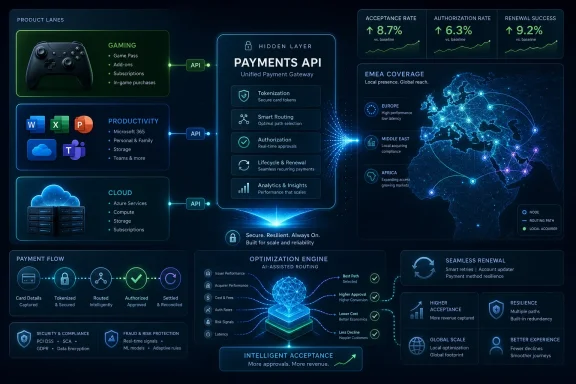 Microsoft Moves the Checkout Lane Into the Platform War
The most important sentence in the announcement is not the one naming Xbox, Microsoft 365, or Azure. It is the one saying Checkout.com is connecting directly into Microsoft’s Payments API, allowing payments to move through a single, adaptable system. That is the language of infrastructure consolidation, not a mere vendor win.Microsoft sells software, cloud capacity, identity, productivity, security, gaming, and increasingly AI services across a dizzying spread of customers. A failed payment for an Xbox game is annoying. A failed renewal for a Microsoft 365 tenant or a blocked Azure billing transaction can become an operational incident. The payment layer is no longer a clerical afterthought sitting somewhere after the product experience; it is part of whether the product experience completes at all.
That is why Checkout.com’s selection across EMEA matters beyond fintech trade circles. The region is fragmented by card schemes, banking rules, authentication requirements, currencies, fraud patterns, and consumer expectations. Microsoft needs fewer brittle edges between the customer clicking “buy” and the service being provisioned, renewed, upgraded, or restored.
The move also reflects a broader shift in enterprise software. The largest platforms are beginning to look less like sellers of discrete products and more like operating environments for recurring economic activity. If Windows once made Microsoft unavoidable by sitting under the application layer, Microsoft 365 and Azure now make billing continuity unavoidable by sitting under the business process layer.
The Boring Layer Is Where the Money Leaks
Payments are often discussed in consumer terms: a checkout page, a saved card, a bank prompt, a receipt. At Microsoft scale, the real story is authorization performance, routing logic, fraud controls, retry behavior, and how many legitimate payments quietly fail before a customer ever reaches support. The company does not need payments to be glamorous. It needs them to be invisible.That invisibility is expensive. EMEA is not a single market in any practical payments sense. Strong Customer Authentication rules, local issuer behavior, cross-border acquiring, currency conversion, card tokenization, and subscription renewals all create tiny points of friction that can compound into meaningful revenue leakage.
A one-percentage-point improvement in acceptance can be trivial for a small merchant and enormous for a company selling subscriptions and cloud consumption across millions of accounts. The effect is especially sharp for recurring billing, where customers may not be actively present to fix a failed transaction. If a renewal fails because of an issuer decline, expired credentials, a mistimed authentication request, or poor routing, the damage can include churn, support tickets, and service disruption.
That explains why the announcement emphasizes performance, scalability, and resilience. These are the same words Microsoft uses when describing cloud systems, and for good reason. A payments stack serving Xbox, Microsoft 365, and Azure has to behave like a distributed system under load, because that is what it is.
Checkout.com Is Selling Optimization, Not Just Processing
Checkout.com’s pitch to Microsoft is not merely that it can accept cards. Many companies can do that. Its strategic argument is that payment acceptance can be optimized in real time using network data, machine learning, routing decisions, and issuer-specific behavior.The company’s Intelligent Acceptance product is central to that pitch. According to Checkout.com, the system uses real-time data from its global network to route transactions, reduce failures, and improve authorization performance. The announcement says the product has unlocked more than $20 billion in merchant revenue and runs 26,000 optimizations per minute.
Those figures should be read carefully. “Unlocked revenue” is payments-industry language, and it generally means transactions that might otherwise have failed were improved through optimization. It is not the same as saying Checkout.com created new demand for Microsoft’s products. But for a company with Microsoft’s scale, converting more legitimate payment attempts into successful transactions is valuable enough without needing marketing embellishment.
The AI angle is also worth separating from the hype cycle. This is not Copilot writing a spreadsheet formula or a chatbot summarizing a meeting. It is a machine-learning system making small, high-frequency decisions about how a transaction should be presented, authenticated, retried, or routed. In payments, AI is less a magic interface than a statistical bet on issuer behavior.
EMEA Is the Right Region for a Payments Stress Test
If Microsoft wanted a region where payments complexity could justify a specialist partner, EMEA is the obvious candidate. Europe, the Middle East, and Africa combine mature card markets, fast-growing digital economies, varied regulatory environments, and sharply different consumer payment habits. A one-size-fits-all checkout strategy is a liability there.Europe alone brings PSD2-era authentication expectations and aggressive regulatory scrutiny around consumer protection, data, competition, and financial services. The Middle East includes fast-scaling digital commerce markets with their own local rails and banking relationships. Africa adds enormous variation in card penetration, mobile money adoption, currency realities, and infrastructure maturity.
For Microsoft, this means the same branded purchase flow may sit on top of very different payment realities. An Xbox customer in one country, a small business buying Microsoft 365 in another, and an Azure customer scaling cloud spend in a third may all see the Microsoft logo, but the transaction paths behind the scenes can diverge significantly.
That is where a direct acquiring and optimization partner can matter. Local acquiring can improve authorization rates because transactions may be processed in ways that look more familiar and lower-risk to local issuers. Better routing can reduce unnecessary declines. Smarter authentication handling can prevent legitimate users from being pushed into dead ends.
Xbox Makes the Consumer Stakes Visible
Xbox is the most visible part of this arrangement for ordinary users. It is also the part most likely to generate community chatter when something goes wrong. Console purchases, digital games, Game Pass subscriptions, add-ons, and in-game content all depend on low-friction payments that work across devices, accounts, family settings, and regional stores.A failed card payment on Xbox is not just a fintech metric. It can mean a missed sale during a promotion, a subscription lapse, or a frustrated parent trying to approve a purchase. In gaming, checkout failure competes directly with attention span. If the store cannot complete the transaction quickly, the user may simply leave.
Microsoft has spent years pushing Xbox away from being a console-only business and toward an ecosystem business built around accounts, subscriptions, cloud gaming, PC integration, and cross-device access. That strategy makes payment reliability more important, not less. The more Xbox becomes a service layer, the more recurring payment health becomes part of the product.
It also puts Microsoft in a delicate position. Better acceptance is good when it prevents false declines. But users are increasingly sensitive to subscription sprawl, accidental renewals, children’s purchases, and confusing billing descriptors. A more effective payment engine must still be paired with transparent account controls, clear receipts, and predictable cancellation flows.
Microsoft 365 Turns Failed Payments Into Business Risk
Microsoft 365 gives the story a different kind of weight. For consumers, it is Office apps, OneDrive storage, Outlook, and family subscriptions. For businesses, it is identity, email, Teams, SharePoint, compliance tooling, endpoint management, and the documents that keep an organization moving.That means a billing failure is not just a failed sale. It can become a continuity problem. Small businesses in particular often run Microsoft 365 with limited administrative oversight, saved cards, and little tolerance for billing surprises. When payment methods expire or banks decline recurring charges, the result can be urgent support escalation rather than orderly procurement.
Large enterprises usually handle Microsoft through contracts, invoicing, resellers, or enterprise agreements. But the long tail of Microsoft 365 commerce is far messier. Small businesses, freelancers, nonprofits, regional companies, and departmental buyers may all interact with card-based digital purchasing in ways that resemble consumer commerce more than traditional enterprise procurement.
Checkout.com’s role, then, is partly about reducing friction for these edge cases. The technical promise is that more legitimate payments survive the journey through issuer checks and authentication rules. The business promise is that fewer customers fall out of the paid ecosystem because a bank, a card credential, or a retry rule got in the way.
Azure Makes Payments Part of Cloud Reliability
Azure adds the most interesting strategic angle because cloud consumption is elastic. A customer can start small, scale up quickly, and create billing patterns that look unusual to card issuers or fraud systems. Cloud accounts also attract abuse, which means payment systems must balance acceptance against risk.Anyone who has worked around cloud billing knows the tension. Microsoft wants legitimate developers, startups, and IT departments to spin up resources quickly. It also has to prevent fraud, stolen cards, fake accounts, crypto-mining abuse, and other misuse. Payments sit directly in that conflict.
An overly conservative system blocks good customers and creates onboarding pain. An overly permissive system invites abuse and chargebacks. The ideal system is one that can distinguish between a real startup adding Azure capacity and a bad actor testing stolen credentials. That is easy to describe and difficult to execute.
This is where Checkout.com’s optimization and acquiring infrastructure may help, though it will not replace Microsoft’s own risk systems. Payments data is one signal among many. Account history, identity verification, device signals, usage patterns, and Microsoft’s internal fraud models still matter. But improving the card acceptance layer can reduce the number of legitimate customers incorrectly treated as suspicious.
The Payments API Detail Says Microsoft Wants Control
The announcement’s reference to Microsoft’s Payments API deserves attention. It suggests Microsoft is not handing its checkout destiny wholesale to a single external processor. Instead, it is plugging Checkout.com into a Microsoft-controlled abstraction layer.That distinction matters. Large platforms increasingly want payment orchestration rather than vendor dependency. They want the ability to route by geography, product, cost, performance, risk, or regulatory requirement. A payments API lets Microsoft normalize internal commerce flows while swapping, adding, or tuning providers behind the scenes.
This is the same architecture logic that cloud teams apply elsewhere. Abstract the service, keep the policy layer close, and avoid hard-coding the business into one vendor’s assumptions. Checkout.com may be a key partner in EMEA, but Microsoft’s internal architecture likely remains designed for flexibility.
For IT pros, this is familiar. Nobody serious builds mission-critical infrastructure around a single opaque component without control points. The surprise is only that the same thinking now applies to checkout buttons, subscription renewals, and digital storefronts.
The Fintech Winner Gets Scale, Credibility, and Scrutiny
For Checkout.com, landing Microsoft across major EMEA product lines is a credibility win. The company already sells itself as an enterprise-grade payments provider, but Microsoft is the kind of reference customer that changes the conversation. It signals that Checkout.com can support high-volume, multi-product, globally recognized digital commerce.The timing also fits the company’s recent positioning. Checkout.com has been pushing Intelligent Acceptance, enterprise partnerships, and platform integrations as it competes with Stripe, Adyen, Worldpay, PayPal/Braintree, and other heavyweights. Payments is a market where scale is both a commercial asset and a technical moat.
But prestige customers also bring pressure. Microsoft users will not care which acquirer is behind a failed payment. They will blame Microsoft. Microsoft, in turn, will expect its partners to hit demanding performance, uptime, compliance, and reporting standards. Winning the account is not the same as keeping it healthy.
There is also the regulatory dimension. Payments providers operating across EMEA must navigate anti-money laundering rules, card-network requirements, data protection expectations, and local financial services oversight. The larger the merchant and the more sensitive the transaction patterns, the less room there is for improvisation.
Users Will Notice Only If Something Breaks
The paradox of a successful payments partnership is that most users should never notice it. Xbox players should not see “Checkout.com” as the story. Microsoft 365 admins should not have to learn a new payment flow. Azure customers should not need to care how card acceptance is routed.That does not mean there will be no visible effects. Over time, users may see fewer false declines, smoother card updates, better handling of recurring transactions, or more consistent checkout behavior across Microsoft products in supported EMEA markets. They may also see more sophisticated fraud checks or authentication prompts when risk signals demand them.
The risk is that optimization can feel opaque. If a payment succeeds because a system intelligently routed it, nobody complains. If a payment fails because a risk model, issuer decision, regional rule, or authentication step intervenes, the user sees only rejection. Better infrastructure can reduce failure rates, but it cannot make the banking system coherent.
For WindowsForum’s audience, the practical advice remains boring but useful. Keep billing details current, watch renewal dates, use administrative billing contacts that are monitored, and avoid relying on a single card for critical tenant or cloud subscriptions. Better acquiring infrastructure is not a substitute for sane account hygiene.
Enterprise IT Should Read This as a Resilience Story
IT departments often separate “technical operations” from “commercial operations,” but Microsoft’s product model keeps erasing that boundary. The identity tenant, the cloud subscription, the endpoint management license, the Teams environment, and the billing relationship are all part of the same operational surface. If one fails, the others can be affected.This is especially true for smaller organizations that buy directly with cards rather than through enterprise agreements. Their Microsoft stack may be mission-critical, but their payment setup may be a single saved card belonging to an office manager, founder, or former employee. That mismatch is common, and it is dangerous.
Checkout.com’s involvement may improve the odds that legitimate payments go through. It does not solve governance problems inside customer organizations. Admins still need clear ownership of billing accounts, backup payment methods where available, and documented procedures for responding to billing alerts.
The lesson is that digital resilience now includes payment resilience. A company can have excellent endpoint security and still suffer avoidable disruption because nobody noticed a card expired. That is not a glamorous failure mode, but it is exactly the kind of mundane dependency that defines modern IT.
Microsoft Is Quietly Standardizing the Business End of Its Stack
This partnership also fits a larger Microsoft pattern: standardize the layer users do not see so the company can move faster in the layer they do. Whether the product is Copilot, Azure, Microsoft 365, or Xbox, Microsoft wants a common commerce foundation that can support bundling, upgrades, trials, renewals, regional pricing, and cross-product account management.That matters because Microsoft’s future growth depends heavily on packaging. Copilot add-ons, cloud security products, Game Pass tiers, Azure consumption, storage upgrades, and productivity subscriptions all require commercial flexibility. If the billing and payment layer is fragmented, the product strategy slows down.
A unified payments infrastructure helps Microsoft experiment. It can support localized offers, reduce failed renewals, manage regional requirements, and improve reporting across product lines. Those capabilities are not exciting in a keynote, but they are exactly what make recurring revenue models work at scale.
The danger is complexity hidden behind simplicity. Customers want one Microsoft account, one tenant, one admin center, one predictable bill, and one place to fix problems. The more Microsoft integrates commerce across products, the more important it becomes that support, transparency, and controls keep pace.
The AI Label Is Less Important Than the Feedback Loop
Intelligent Acceptance will inevitably be described as AI-powered, because everything in 2026 is described as AI-powered. The more useful way to understand it is as a feedback loop. Every transaction produces signals, and those signals can be used to improve future attempts across the network.That network effect is the real commercial prize. A payments provider with enough volume can learn issuer behavior, authentication outcomes, retry patterns, and routing performance across merchants and markets. Those lessons can then be applied to new transactions faster than any single merchant could manage alone.
For Microsoft, that offers a way to benefit from payments intelligence beyond its own transaction base. For Checkout.com, Microsoft adds more high-value transaction volume to the network. The relationship is therefore mutually reinforcing, assuming the performance claims hold up in production.
But AI also raises accountability questions. If an optimization system changes how a transaction is routed or retried, merchants and customers still need auditability, compliance, and dispute handling. Enterprise customers will increasingly ask not only whether AI improves acceptance, but how those decisions are monitored, governed, and explained.
The Competitive Subtext Is Stripe, Adyen, and the Battle for Enterprise Commerce
The Microsoft win should be read against the competitive landscape. Enterprise payments is no longer just about low fees or a checkout widget. It is a contest over orchestration, global acquiring, fraud tooling, alternative payment methods, compliance, developer experience, and data-driven optimization.Stripe has enormous developer mindshare and broad platform reach. Adyen has long been strong with large global merchants and unified commerce. Worldpay remains deeply embedded in high-volume acquiring. PayPal continues to matter in consumer-facing checkout. Checkout.com is arguing that it belongs in that same top tier for large digital enterprises.
Microsoft’s selection in EMEA gives Checkout.com a strong proof point, particularly because the product mix spans consumer gaming, productivity subscriptions, and cloud services. That is a harder story than powering a single retailer or app. It suggests the platform can handle different transaction patterns under one enterprise relationship.
Still, this is not a winner-take-all market. Large merchants often use multiple providers, both for resilience and optimization. Microsoft’s own Payments API language suggests it wants the ability to orchestrate rather than depend. Checkout.com may have won a major lane, but the race is the architecture around the lane.
For Regulators, Payments Infrastructure Is Becoming Platform Infrastructure
There is a policy angle here that should not be ignored. As major technology companies consolidate commerce through large payment providers, the boundary between software platforms and financial infrastructure becomes thinner. Microsoft is not becoming a bank in this announcement, but its services increasingly depend on payment systems behaving like critical digital infrastructure.In EMEA, that invites scrutiny. Regulators care about data flows, consumer rights, authentication, fraud prevention, market access, and resilience. When a hyperscale software platform relies on a payments partner across major products, the arrangement sits at the intersection of technology regulation and financial supervision.
The practical implications may be subtle. Microsoft and Checkout.com will need to ensure that routing, fraud screening, authentication, and data handling comply with regional expectations. Customers will expect local rules to be respected even when the product brand is global. Payment failure, fraud disputes, and refund processes must make sense in the customer’s jurisdiction.
This is another reason the “single adaptable system” language matters. Adaptability is not just a performance feature. It is a compliance feature. In fragmented markets, the ability to adjust payment behavior by region can be the difference between smooth expansion and regulatory drag.
The Checkout Button Now Carries the Weight of the Subscription Economy
The announcement looks narrow because it names a payments provider and a region. It is broader because it shows how much weight the checkout button now carries in Microsoft’s business. Subscriptions, cloud consumption, gaming content, storage, AI add-ons, and productivity software all depend on customers being able to pay reliably.For Windows users, this may feel distant until the day a subscription renewal fails or a purchase will not complete. For admins, it matters because billing is part of service continuity. For developers and startups, it matters because cloud onboarding and scaling often depend on payment trust. For Microsoft, it matters because revenue growth is increasingly tied to recurring commercial motion.
The clearest lesson is not that Checkout.com is suddenly part of the Microsoft experience in a way users will recognize. It is that the Microsoft experience has become inseparable from a hidden network of financial technology decisions. The customer sees a button. Behind it sits acquiring, routing, authentication, fraud scoring, retry logic, regional compliance, and platform strategy.
The companies that make this invisible layer work will shape how smoothly the next generation of digital services is bought and renewed. Microsoft’s decision in EMEA is a reminder that platform power is not only won in operating systems, cloud regions, or AI models. Sometimes it is won at the exact moment the card either goes through or does not.
The Signal Buried in Microsoft’s Payments Plumbing
This deal is easy to underestimate because the user-facing product names are familiar and the infrastructure details are intentionally quiet. But for anyone running, buying, or administering Microsoft services, the operational message is concrete.- Microsoft is using Checkout.com to process card payments across key EMEA product lines, including Xbox, Microsoft 365, and Azure.
- The arrangement is framed around performance, scalability, resilience, and direct integration into Microsoft’s Payments API.
- Checkout.com’s Intelligent Acceptance system is intended to improve authorization performance by optimizing payment routing and reducing avoidable failures.
- The biggest practical gains are likely to appear as fewer false declines, smoother renewals, and more consistent payment handling rather than visible interface changes.
- IT administrators should still treat billing governance as part of service resilience, especially for Microsoft 365 and Azure accounts purchased directly by card.
- The partnership strengthens Checkout.com’s enterprise credentials while reinforcing Microsoft’s push to standardize the commerce layer beneath its cloud, productivity, and gaming businesses.
References
- Primary source: TechAfrica News
Published: Thu, 18 Jun 2026 14:52:48 GMT
Checkout.com Selected by Microsoft to Power Digital Payments Across EMEA Products - TechAfrica News
The collaboration gives Microsoft access to Checkout.com’s digital payments platform, selected for the performance, scalability and resilience required by a company operating at global enterprise scale.techafricanews.com - Related coverage: checkout.com
Payment services to power your performance | Checkout.com
Boost your acceptance rate, cut processing costs, fight fraud, and create extraordinary customer experiences with Checkout.com's payment solutions.www.checkout.com - Related coverage: support.checkout.com
Extract Intelligent Acceptance (IA) saved transactions – Checkout.com
Once a transaction is optimized by Intelligent Acceptance (IA), it goes to the issuer for authorization. We cannot provide an extract of...support.checkout.com - Related coverage: financialit.net
Checkout Adopts ACP, Backed by OpenAI, to Power Agentic Commerce for Enterprise Merchants
Checkout.com, a leading global digital payments company, today announced its support for the Agentic Commerce Protocol (ACP), an open standard for AI commerce that lets AI agents, people, and businesses work together to complete purchases, powering agentic commerce for enterprise merchants... financialit.net
- Related coverage: globalrecognitionawards.org
Checkout.com Wins a 2026 Global Recognition Award
Checkout.com wins a 2026 Global Recognition Award for its innovative approach to global payments and unified infrastructure.globalrecognitionawards.org - Related coverage: businessexpert.co.uk
Checkout.com Review 2026: API-First, 150+ Currencies
Independent review of Checkout.com payment processing for UK businesses in 2026. API capabilities, fees, fraud tools, and who Checkout.com suits compared to Stripe and Adyen.www.businessexpert.co.uk
- Related coverage: sacra-pdfs.s3.us-east-2.amazonaws.com
- Related coverage: ecommpay.com

