
Microsoft selected Checkout.com in June 2026 to handle digital card payments across key EMEA products including Xbox, Microsoft 365, and Azure, extending the relationship between the two companies from cloud infrastructure cooperation into Microsoft’s own regional payments stack. The move is easy to underestimate because payments usually disappear when they work. But for a company selling subscriptions, cloud capacity, games, storage, developer services, and add-ons across dozens of markets, the payment layer is not plumbing so much as a revenue control plane. Microsoft is making a familiar enterprise calculation: the checkout experience has become too strategic, too regulated, and too performance-sensitive to be treated as a commodity.
Microsoft’s consumer and commercial businesses do not look alike from the outside. Xbox sells games, subscriptions, virtual currency, and hardware-adjacent services to consumers. Microsoft 365 sells productivity subscriptions to individuals, families, small businesses, and enterprises. Azure sells metered infrastructure in a model where account creation, billing continuity, fraud checks, payment failures, and regional acceptance all shape whether a customer becomes a long-term cloud user.
The common denominator is that each of these businesses depends on a payment event that must be fast, compliant, reliable, and boring. A failed transaction on Xbox may look like a customer annoyance. A failed renewal for Microsoft 365 can become a support ticket, a productivity interruption, or a churn event. A bad payment experience around Azure can slow a developer’s first deployment or complicate an organization’s move from trial to production.
That is why the Checkout.com deal matters. The announcement is not about a new Microsoft app, a new Windows build, or a new Copilot feature. It is about the machinery underneath the purchase, renewal, and expansion moments that make those products commercially viable at scale.
In EMEA, that machinery is unusually difficult. Europe, the Middle East, and Africa are not a single payments market in any practical sense. The region combines mature card markets, strong customer authentication rules, country-by-country banking habits, currency complexity, variable issuer behavior, and markets where local acquiring strategy can materially change approval rates.
For Microsoft, the partnership is a bet that a specialist payments platform can improve performance in places where generic global card processing is no longer good enough. For Checkout.com, it is a marquee enterprise win at the exact layer of commerce where fintech companies have been trying to prove they are not merely checkout widgets, but critical infrastructure.
Even inside Europe, digital commerce is not just a matter of accepting Visa and Mastercard. Strong Customer Authentication under PSD2 changed how merchants think about step-up authentication, exemptions, fraud liability, and conversion. Local acquiring can affect whether an issuer treats a transaction as familiar or suspicious. Currency handling, interchange economics, data residency expectations, and card network rules all create operational drag.
The stakes are higher for Microsoft because its product surface is broad. A payments provider supporting Xbox might have to manage high-volume consumer purchases, subscription renewals, seasonal spikes around game launches, and fraud patterns around digital goods. A provider supporting Microsoft 365 needs to deal with renewal continuity and small-business billing expectations. A provider touching Azure must work in a more enterprise-heavy environment where payment failures can interrupt infrastructure adoption or complicate account management.
That diversity makes the deal more interesting than a conventional merchant-processing announcement. Microsoft is not merely swapping a terminal behind a web store. It is aligning a regional payments stack across businesses that have different risk profiles, different customer behaviors, and different tolerance for friction.
This is where Checkout.com’s pitch fits. The company has long marketed itself around direct acquiring, payment performance, and optimization rather than simply gateway connectivity. Its Intelligent Acceptance product uses transaction data and machine-learning techniques to improve routing and authorization outcomes. In plain English, the promise is that fewer legitimate transactions should fail for avoidable reasons.
That promise is attractive to any subscription business. It is especially attractive to a company like Microsoft, where recurring revenue depends on quiet continuity. Most customers do not know who processes the payment when their Microsoft 365 subscription renews. They absolutely notice when the renewal breaks.
Now the relationship runs in the other direction as well. Checkout.com is not just a fintech using Microsoft’s cloud; it is a payments provider supporting Microsoft’s commerce operations in EMEA. That reciprocity is the story. Microsoft gets a payments partner with enterprise-scale acquiring ambitions, while Checkout.com gets both cloud infrastructure and a high-profile validation of its payment-performance claims.
It is a neat example of modern enterprise dependency. Cloud providers increasingly sell not just compute but industry infrastructure. Payment companies increasingly sell not just transaction processing but intelligence, fraud management, optimization, and reliability. The two categories are converging because both are ultimately in the business of keeping digital systems available under pressure.
For Microsoft, the earlier Azure collaboration helped position Checkout.com as a fintech building on Microsoft’s platform. The new EMEA payments selection makes Checkout.com part of Microsoft’s own customer-facing revenue path. That is a more consequential endorsement than a co-marketing quote because it puts the payments provider in the blast radius of Microsoft’s own operational expectations.
This also complicates the usual vendor hierarchy. Microsoft is the cloud giant, but it is also a merchant. Checkout.com is the payments specialist, but it is also a cloud customer. Each company becomes infrastructure for the other. That circular dependency is increasingly normal in enterprise technology, where the biggest companies buy from, sell to, and integrate with one another in overlapping layers.
The timing is also notable. Payments vendors are trying to differentiate in a crowded market shaped by Stripe, Adyen, PayPal, Worldpay, local acquirers, bank-owned processors, and newer orchestration players. A Microsoft deployment across major EMEA product lines gives Checkout.com something more valuable than a generic logo slide: evidence that its platform can support one of the world’s most complex digital merchants.
That is why authorization rates matter. A small improvement can translate into meaningful revenue for a high-volume merchant. A small decline can create a user-experience problem that product teams may misdiagnose as pricing sensitivity, weak demand, or account friction. Payments performance is one of the few infrastructure metrics that directly touches both customer satisfaction and revenue recognition.
Microsoft’s EMEA portfolio makes this particularly important. Xbox customers expect instant gratification. If a game, add-on, or subscription purchase fails, the user may not wait patiently while the payment stack sorts itself out. Microsoft 365 customers expect renewals to happen without drama. Azure customers expect the billing layer to stay out of the way while they build, deploy, and scale.
The problem is that payment failures are not always visible to the business in a clean way. A customer whose card is incorrectly declined may abandon the purchase without filing a support ticket. A small business whose renewal fails may blame Microsoft, the bank, or its own admin processes. A developer blocked by payment verification may go to another cloud trial.
That makes payments optimization a form of user-experience work. It is not as glamorous as a redesigned Windows Settings app or a new Copilot pane, but it can have a more immediate effect on revenue. The best checkout experience is the one users never remember because nothing went wrong.
Checkout.com’s Intelligent Acceptance offering is designed for this exact argument. By learning from transaction outcomes and applying optimizations across merchants, the platform promises to reduce unnecessary declines and improve acceptance. Whether the real-world gains are large or modest will depend on Microsoft’s traffic mix, issuer relationships, implementation details, and market-by-market behavior. But the strategic direction is clear: the checkout layer is becoming adaptive, not static.
Xbox is a digital goods business with recurring subscriptions, impulse purchases, promotional pricing, and fraud exposure. Gaming ecosystems are attractive targets because accounts, gift cards, and digital entitlements can be abused or resold. A payments stack serving Xbox has to approve legitimate purchases quickly while stopping behavior that can become expensive at scale.
Microsoft 365 is more renewal-driven. The pain point is often continuity. If a subscription lapses because of a failed card, expired credential, authentication hiccup, or bank-side decline, the customer’s anger lands on Microsoft even when the root cause is distributed across the payments chain.
Azure adds another layer. Cloud billing is tightly connected to identity, fraud prevention, quota management, free trials, enterprise agreements, marketplace procurement, and usage-based charges. Payment friction at the wrong moment can discourage experimentation, especially for smaller customers and independent developers who do not have procurement departments or enterprise billing arrangements.
This product sprawl means Microsoft cannot optimize payments for a single shopping-cart pattern. It needs infrastructure that can handle different business models while maintaining consistent controls. That is harder in EMEA because the same product can be sold into countries with different payment behavior, different issuer practices, and different regulatory expectations.
The Checkout.com deal suggests Microsoft wants more regional specificity without building every acquiring and optimization capability alone. That is a pragmatic choice. Even the largest technology companies outsource specialized layers when the external market has developed expertise faster than an internal platform can justify.
Enterprise merchants do not buy payments purely on feature lists. They buy resiliency, reporting, authorization performance, compliance posture, support quality, geographic reach, and the ability to troubleshoot failures that may involve multiple banks, networks, and internal systems. The sale is as much operational as it is technical.
That is why the Microsoft win lands differently from a startup customer announcement. Microsoft’s scale creates scrutiny. Its product breadth creates complexity. Its regional footprint creates edge cases. If Checkout.com can support Microsoft’s EMEA card acceptance across Xbox, Microsoft 365, and Azure, it strengthens the company’s claim to be a serious enterprise infrastructure provider.
The deal also arrives in a market where payment companies are under pressure to justify their valuations and growth narratives. The easy story of digital-commerce expansion has matured. Investors and customers now want to know which providers can improve measurable payment outcomes, manage risk, and serve global platforms profitably.
Checkout.com’s public customer roster already includes major digital companies, but Microsoft gives it a different kind of credibility. It is not merely another online merchant. It is a platform company whose own products form part of the infrastructure used by businesses, developers, schools, governments, and consumers. Supporting payments for that ecosystem is a consequential assignment.
Still, the partnership should not be read as a magic wand. Payment performance is measurable, but not universally transferable. What works in one market, card type, or product line may not work in another. The proof will be in authorization rates, failure reductions, dispute handling, operational resilience, and whether Microsoft customers notice fewer interruptions without noticing the provider behind the curtain.
But the core challenge is not new. Merchants have always wanted legitimate customers approved, fraud blocked, costs controlled, and disputes minimized. What changes now is the scale, speed, and complexity of those decisions. A modern payment attempt is a small negotiation among merchant systems, fraud engines, acquirers, networks, issuers, authentication services, and regulators.
AI can help optimize that negotiation, but it does not repeal the fundamentals. A model that routes transactions more intelligently still depends on quality data, strong compliance, reliable integrations, and careful governance. A system that reduces false declines must avoid opening the door to fraud. A payments provider promising adaptive optimization must also explain how decisions are monitored, audited, and corrected.
For Microsoft, this is where the rhetoric around agentic commerce becomes more than a buzzword. If AI agents eventually initiate purchases, renew services, compare subscriptions, or manage cloud procurement on behalf of users and organizations, the payment layer will need stronger identity, trust, authorization, and consent mechanisms. A checkout designed for a human clicking a button may not be enough for a world where software agents transact within defined permissions.
That future is not fully here, and vendors should be challenged when they talk as if it is already mainstream. But Microsoft has reason to prepare for it. The company is weaving Copilot into Windows, Microsoft 365, developer tools, security products, and business applications. If agent-like workflows become part of enterprise software, payments and procurement will eventually be pulled into that orbit.
Checkout.com benefits from attaching itself to that narrative. Microsoft benefits from presenting payments as part of a broader trust architecture rather than a back-office function. The interesting question is whether the partnership produces concrete improvements before the agentic-commerce storyline becomes real enough to matter.
The places where users could feel the change are more mundane. A card that previously failed may go through. A renewal may complete without extra authentication friction. A purchase made while traveling in EMEA may look less suspicious. A small business admin may spend less time untangling a billing issue that should never have become a ticket.
That invisibility makes the story easy to ignore, but Windows users live inside Microsoft’s commerce systems more than they may realize. Microsoft accounts, Xbox profiles, Game Pass subscriptions, OneDrive storage upgrades, Microsoft 365 plans, Azure trials, developer subscriptions, and marketplace purchases all sit adjacent to billing infrastructure. The operating system increasingly points users toward cloud-connected services, and those services eventually meet a payment rail.
This is one of the quiet consequences of Windows becoming a service-connected platform. The health of the user experience is no longer limited to local performance, driver quality, or Start menu behavior. It also depends on identity systems, subscription status, regional compliance, account recovery, fraud controls, and billing continuity.
That does not mean every Windows user should care which acquirer Microsoft uses. It does mean the purchasing layer has become part of the platform experience. When Microsoft promotes cloud storage, gaming subscriptions, AI features, or productivity bundles, the transaction path has to be as reliable as the service itself.
For IT admins, the lesson is slightly different. Billing failures are operational failures. A subscription that cannot renew, an Azure payment method that cannot be validated, or a procurement workflow that stalls can create real work for administrators. Better payments infrastructure is not glamorous, but it can reduce avoidable friction at the boundary between technology and finance.
For a global merchant, compliance is not just a legal department concern. It changes product design. It affects the number of steps a customer sees. It determines when a transaction needs additional verification. It influences where data can be processed and how disputes are managed.
A specialist payments provider can help absorb some of that complexity, but outsourcing does not remove accountability. Microsoft remains the brand customers see and the company regulators can scrutinize. If a payment experience breaks, customers will not care which vendor sat behind the API. They will say Microsoft billing failed.
That creates a governance challenge. Microsoft needs the benefits of Checkout.com’s regional payments capabilities without losing visibility into performance, risk, and compliance. The integration will have to support monitoring, incident response, reporting, and escalation. In enterprise payments, the contract is only the beginning; the operating model is where the partnership succeeds or disappoints.
This also explains why cloud infrastructure and payments infrastructure are increasingly discussed together. Security, availability, observability, encryption, identity, and compliance certifications matter in both domains. A payments platform that cannot prove operational discipline will struggle to win the most demanding merchants, no matter how clever its optimization engine is.
Microsoft’s own reputation raises the bar. The company can tolerate experimentation in many product areas, but payments require a lower appetite for visible failure. The checkout layer handles money, trust, and continuity. Customers may forgive a confusing UI more readily than a broken renewal or a mistaken decline.
Cloud providers compete on compute, AI accelerators, developer tooling, ecosystem, pricing, compliance, and geographic availability. Productivity platforms compete on features, collaboration, security, and licensing. Gaming platforms compete on content, subscriptions, hardware, and community. In all three cases, checkout and billing are not the headline, but they can be the point where demand converts into revenue.
This is especially relevant as Microsoft pushes more of its business toward recurring and consumption-based models. The old software world sold boxes, licenses, and long upgrade cycles. The new one sells subscriptions, metered usage, add-ons, storage expansions, AI credits, game catalogs, and marketplace services. Payments are not episodic anymore. They are continuous.
Continuous commerce requires continuous trust. Customers need confidence that they can subscribe, renew, upgrade, downgrade, and manage payment methods without surprises. Microsoft needs confidence that legitimate transactions will be approved and risky transactions will be challenged. Both sides need the system to work across borders.
The Checkout.com partnership is one piece of that architecture. It does not remake Microsoft’s commerce strategy by itself. But it fits a broader pattern in which the company treats every layer of the customer lifecycle — identity, billing, security, cloud delivery, support, telemetry, and compliance — as infrastructure to be optimized.
That is the same mentality Microsoft has applied to Windows update delivery, Azure regional expansion, Microsoft 365 admin tooling, and security operations. The difference is that payments expose the business outcome immediately. A slow service can irritate a user. A failed payment can lose the sale.
The payment provider’s challenge is not merely to process transactions. It must prove that its platform can improve outcomes across products with different rhythms. Gaming spikes are not the same as Microsoft 365 renewals. Azure account flows are not the same as consumer entertainment purchases. EMEA markets do not behave like a single domestic acquiring environment.
If Checkout.com performs well, it strengthens the argument that enterprise merchants should care about payment architecture as much as they care about cloud architecture. If it performs poorly, the Microsoft name will magnify the scrutiny. Infrastructure vendors want invisible success; they fear visible failure.
The company’s broader strategy appears to be aimed at precisely these high-scale, high-complexity merchants. Partnerships with major digital platforms allow Checkout.com to argue that its value is not just payment acceptance, but payment performance. That is a more durable pitch than simply promising another API.
The risk is that every payments company now speaks the language of optimization, AI, and global reach. Differentiation must show up in hard metrics: acceptance improvements, lower false declines, reduced latency, better dispute outcomes, stronger uptime, and cleaner operational support. Marketing language will not be enough.
Microsoft’s selection gives Checkout.com a chance to make that case in a highly visible way. It also gives the payments industry another example of how large technology companies are willing to entrust critical revenue paths to specialist providers when the economics and regional capabilities make sense.
That industrialization is particularly visible in subscription businesses. The customer relationship no longer ends at purchase. It repeats monthly, annually, or whenever usage crosses a billing threshold. The payment system must support retries, account updates, plan changes, taxes, invoices, authentication challenges, chargebacks, and customer support workflows.
Microsoft’s portfolio is a case study in that transition. Windows may still be the emotional center for many users, but Microsoft’s growth engine increasingly depends on cloud services, subscriptions, and digital ecosystems. Those businesses need payments infrastructure that can scale across regions and product lines without turning every local market into a custom project.
This is also why the deal should be read as part of Microsoft’s platform strategy rather than as a narrow fintech procurement decision. The company wants users to move fluidly among devices, accounts, subscriptions, cloud services, games, AI features, and business tools. Payment friction interrupts that motion.
The more Microsoft bundles AI into paid tiers and consumption-based services, the more important this becomes. Copilot subscriptions, Azure AI services, developer tools, and enterprise add-ons all depend on purchase and renewal flows that feel trustworthy. If AI becomes another metered utility, payments performance becomes part of the AI business model.
The irony is that the most important improvements may be the least visible. A better authorization path does not generate a keynote demo. A cleaner acquiring setup does not trend on social media. But at Microsoft’s scale, small reductions in friction can matter more than many visible product tweaks.
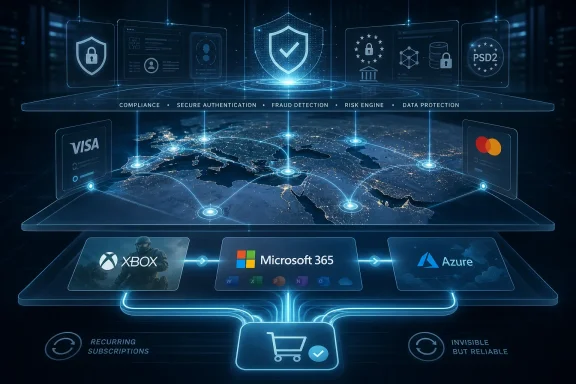 Microsoft Moves the Checkout Layer Closer to the Business
Microsoft’s consumer and commercial businesses do not look alike from the outside. Xbox sells games, subscriptions, virtual currency, and hardware-adjacent services to consumers. Microsoft 365 sells productivity subscriptions to individuals, families, small businesses, and enterprises. Azure sells metered infrastructure in a model where account creation, billing continuity, fraud checks, payment failures, and regional acceptance all shape whether a customer becomes a long-term cloud user.The common denominator is that each of these businesses depends on a payment event that must be fast, compliant, reliable, and boring. A failed transaction on Xbox may look like a customer annoyance. A failed renewal for Microsoft 365 can become a support ticket, a productivity interruption, or a churn event. A bad payment experience around Azure can slow a developer’s first deployment or complicate an organization’s move from trial to production.
That is why the Checkout.com deal matters. The announcement is not about a new Microsoft app, a new Windows build, or a new Copilot feature. It is about the machinery underneath the purchase, renewal, and expansion moments that make those products commercially viable at scale.
In EMEA, that machinery is unusually difficult. Europe, the Middle East, and Africa are not a single payments market in any practical sense. The region combines mature card markets, strong customer authentication rules, country-by-country banking habits, currency complexity, variable issuer behavior, and markets where local acquiring strategy can materially change approval rates.
For Microsoft, the partnership is a bet that a specialist payments platform can improve performance in places where generic global card processing is no longer good enough. For Checkout.com, it is a marquee enterprise win at the exact layer of commerce where fintech companies have been trying to prove they are not merely checkout widgets, but critical infrastructure.
EMEA Turns Payments Into a Systems Problem
The phrase EMEA payments sounds tidy in a press release and messy in production. A platform serving the region has to deal with customers in the European Union, the United Kingdom, the Gulf, South Africa, and many other markets whose payments rails, banking expectations, consumer protections, and fraud patterns differ sharply.Even inside Europe, digital commerce is not just a matter of accepting Visa and Mastercard. Strong Customer Authentication under PSD2 changed how merchants think about step-up authentication, exemptions, fraud liability, and conversion. Local acquiring can affect whether an issuer treats a transaction as familiar or suspicious. Currency handling, interchange economics, data residency expectations, and card network rules all create operational drag.
The stakes are higher for Microsoft because its product surface is broad. A payments provider supporting Xbox might have to manage high-volume consumer purchases, subscription renewals, seasonal spikes around game launches, and fraud patterns around digital goods. A provider supporting Microsoft 365 needs to deal with renewal continuity and small-business billing expectations. A provider touching Azure must work in a more enterprise-heavy environment where payment failures can interrupt infrastructure adoption or complicate account management.
That diversity makes the deal more interesting than a conventional merchant-processing announcement. Microsoft is not merely swapping a terminal behind a web store. It is aligning a regional payments stack across businesses that have different risk profiles, different customer behaviors, and different tolerance for friction.
This is where Checkout.com’s pitch fits. The company has long marketed itself around direct acquiring, payment performance, and optimization rather than simply gateway connectivity. Its Intelligent Acceptance product uses transaction data and machine-learning techniques to improve routing and authorization outcomes. In plain English, the promise is that fewer legitimate transactions should fail for avoidable reasons.
That promise is attractive to any subscription business. It is especially attractive to a company like Microsoft, where recurring revenue depends on quiet continuity. Most customers do not know who processes the payment when their Microsoft 365 subscription renews. They absolutely notice when the renewal breaks.
The Cloud Partnership Was the Prelude, Not the Ending
The most revealing part of the Microsoft-Checkout.com relationship is that the payments announcement did not emerge from nowhere. In October 2025, the companies announced a multi-year technology collaboration in which Checkout.com would adopt Microsoft Azure infrastructure to improve the performance and scale of its own payments platform. That earlier deal framed Azure as an operating foundation for Checkout.com’s enterprise merchant business.Now the relationship runs in the other direction as well. Checkout.com is not just a fintech using Microsoft’s cloud; it is a payments provider supporting Microsoft’s commerce operations in EMEA. That reciprocity is the story. Microsoft gets a payments partner with enterprise-scale acquiring ambitions, while Checkout.com gets both cloud infrastructure and a high-profile validation of its payment-performance claims.
It is a neat example of modern enterprise dependency. Cloud providers increasingly sell not just compute but industry infrastructure. Payment companies increasingly sell not just transaction processing but intelligence, fraud management, optimization, and reliability. The two categories are converging because both are ultimately in the business of keeping digital systems available under pressure.
For Microsoft, the earlier Azure collaboration helped position Checkout.com as a fintech building on Microsoft’s platform. The new EMEA payments selection makes Checkout.com part of Microsoft’s own customer-facing revenue path. That is a more consequential endorsement than a co-marketing quote because it puts the payments provider in the blast radius of Microsoft’s own operational expectations.
This also complicates the usual vendor hierarchy. Microsoft is the cloud giant, but it is also a merchant. Checkout.com is the payments specialist, but it is also a cloud customer. Each company becomes infrastructure for the other. That circular dependency is increasingly normal in enterprise technology, where the biggest companies buy from, sell to, and integrate with one another in overlapping layers.
The timing is also notable. Payments vendors are trying to differentiate in a crowded market shaped by Stripe, Adyen, PayPal, Worldpay, local acquirers, bank-owned processors, and newer orchestration players. A Microsoft deployment across major EMEA product lines gives Checkout.com something more valuable than a generic logo slide: evidence that its platform can support one of the world’s most complex digital merchants.
Authorization Rates Are the Hidden UX Metric
Most users think of checkout as a web form. Payment teams think of it as a probability engine. The difference between a completed transaction and a failed one may depend on issuer behavior, routing, risk scoring, authentication design, tokenization, merchant category handling, retry logic, and whether the transaction looks local enough to be trusted.That is why authorization rates matter. A small improvement can translate into meaningful revenue for a high-volume merchant. A small decline can create a user-experience problem that product teams may misdiagnose as pricing sensitivity, weak demand, or account friction. Payments performance is one of the few infrastructure metrics that directly touches both customer satisfaction and revenue recognition.
Microsoft’s EMEA portfolio makes this particularly important. Xbox customers expect instant gratification. If a game, add-on, or subscription purchase fails, the user may not wait patiently while the payment stack sorts itself out. Microsoft 365 customers expect renewals to happen without drama. Azure customers expect the billing layer to stay out of the way while they build, deploy, and scale.
The problem is that payment failures are not always visible to the business in a clean way. A customer whose card is incorrectly declined may abandon the purchase without filing a support ticket. A small business whose renewal fails may blame Microsoft, the bank, or its own admin processes. A developer blocked by payment verification may go to another cloud trial.
That makes payments optimization a form of user-experience work. It is not as glamorous as a redesigned Windows Settings app or a new Copilot pane, but it can have a more immediate effect on revenue. The best checkout experience is the one users never remember because nothing went wrong.
Checkout.com’s Intelligent Acceptance offering is designed for this exact argument. By learning from transaction outcomes and applying optimizations across merchants, the platform promises to reduce unnecessary declines and improve acceptance. Whether the real-world gains are large or modest will depend on Microsoft’s traffic mix, issuer relationships, implementation details, and market-by-market behavior. But the strategic direction is clear: the checkout layer is becoming adaptive, not static.
Microsoft’s Product Sprawl Makes Payments Harder Than They Look
Microsoft sells to almost everyone, which is a nice problem until the billing systems have to reflect it. A teenager buying a game, a family renewing Microsoft 365, a small business adding seats, and a developer spinning up an Azure subscription all exist somewhere inside Microsoft’s commerce universe. They do not behave like the same customer, and they do not carry the same risk.Xbox is a digital goods business with recurring subscriptions, impulse purchases, promotional pricing, and fraud exposure. Gaming ecosystems are attractive targets because accounts, gift cards, and digital entitlements can be abused or resold. A payments stack serving Xbox has to approve legitimate purchases quickly while stopping behavior that can become expensive at scale.
Microsoft 365 is more renewal-driven. The pain point is often continuity. If a subscription lapses because of a failed card, expired credential, authentication hiccup, or bank-side decline, the customer’s anger lands on Microsoft even when the root cause is distributed across the payments chain.
Azure adds another layer. Cloud billing is tightly connected to identity, fraud prevention, quota management, free trials, enterprise agreements, marketplace procurement, and usage-based charges. Payment friction at the wrong moment can discourage experimentation, especially for smaller customers and independent developers who do not have procurement departments or enterprise billing arrangements.
This product sprawl means Microsoft cannot optimize payments for a single shopping-cart pattern. It needs infrastructure that can handle different business models while maintaining consistent controls. That is harder in EMEA because the same product can be sold into countries with different payment behavior, different issuer practices, and different regulatory expectations.
The Checkout.com deal suggests Microsoft wants more regional specificity without building every acquiring and optimization capability alone. That is a pragmatic choice. Even the largest technology companies outsource specialized layers when the external market has developed expertise faster than an internal platform can justify.
The Enterprise Fintech Pitch Gets a Microsoft-Sized Test
Checkout.com has spent years trying to occupy a specific position in the payments market: more sophisticated than a generic processor, more enterprise-focused than a small-business checkout tool, and more globally ambitious than a local acquirer. Microsoft is exactly the sort of customer that tests whether that positioning holds up.Enterprise merchants do not buy payments purely on feature lists. They buy resiliency, reporting, authorization performance, compliance posture, support quality, geographic reach, and the ability to troubleshoot failures that may involve multiple banks, networks, and internal systems. The sale is as much operational as it is technical.
That is why the Microsoft win lands differently from a startup customer announcement. Microsoft’s scale creates scrutiny. Its product breadth creates complexity. Its regional footprint creates edge cases. If Checkout.com can support Microsoft’s EMEA card acceptance across Xbox, Microsoft 365, and Azure, it strengthens the company’s claim to be a serious enterprise infrastructure provider.
The deal also arrives in a market where payment companies are under pressure to justify their valuations and growth narratives. The easy story of digital-commerce expansion has matured. Investors and customers now want to know which providers can improve measurable payment outcomes, manage risk, and serve global platforms profitably.
Checkout.com’s public customer roster already includes major digital companies, but Microsoft gives it a different kind of credibility. It is not merely another online merchant. It is a platform company whose own products form part of the infrastructure used by businesses, developers, schools, governments, and consumers. Supporting payments for that ecosystem is a consequential assignment.
Still, the partnership should not be read as a magic wand. Payment performance is measurable, but not universally transferable. What works in one market, card type, or product line may not work in another. The proof will be in authorization rates, failure reductions, dispute handling, operational resilience, and whether Microsoft customers notice fewer interruptions without noticing the provider behind the curtain.
The AI Language Is Real, but the Payments Work Is Older Than the Hype
Both Microsoft and Checkout.com have framed parts of their collaboration around AI-powered innovation and the future of agentic commerce. That language is fashionable, and some of it is justified. Payments systems generate vast streams of structured signals, and machine-learning models can help identify patterns that static rules miss.But the core challenge is not new. Merchants have always wanted legitimate customers approved, fraud blocked, costs controlled, and disputes minimized. What changes now is the scale, speed, and complexity of those decisions. A modern payment attempt is a small negotiation among merchant systems, fraud engines, acquirers, networks, issuers, authentication services, and regulators.
AI can help optimize that negotiation, but it does not repeal the fundamentals. A model that routes transactions more intelligently still depends on quality data, strong compliance, reliable integrations, and careful governance. A system that reduces false declines must avoid opening the door to fraud. A payments provider promising adaptive optimization must also explain how decisions are monitored, audited, and corrected.
For Microsoft, this is where the rhetoric around agentic commerce becomes more than a buzzword. If AI agents eventually initiate purchases, renew services, compare subscriptions, or manage cloud procurement on behalf of users and organizations, the payment layer will need stronger identity, trust, authorization, and consent mechanisms. A checkout designed for a human clicking a button may not be enough for a world where software agents transact within defined permissions.
That future is not fully here, and vendors should be challenged when they talk as if it is already mainstream. But Microsoft has reason to prepare for it. The company is weaving Copilot into Windows, Microsoft 365, developer tools, security products, and business applications. If agent-like workflows become part of enterprise software, payments and procurement will eventually be pulled into that orbit.
Checkout.com benefits from attaching itself to that narrative. Microsoft benefits from presenting payments as part of a broader trust architecture rather than a back-office function. The interesting question is whether the partnership produces concrete improvements before the agentic-commerce storyline becomes real enough to matter.
Windows Users May Never See the Change, Which Is the Point
For WindowsForum readers, the immediate effect of this deal will probably not be a visible checkout redesign. There may be no splash screen, no new payment logo, and no settings toggle in Windows. The point is precisely that successful payment infrastructure hides itself.The places where users could feel the change are more mundane. A card that previously failed may go through. A renewal may complete without extra authentication friction. A purchase made while traveling in EMEA may look less suspicious. A small business admin may spend less time untangling a billing issue that should never have become a ticket.
That invisibility makes the story easy to ignore, but Windows users live inside Microsoft’s commerce systems more than they may realize. Microsoft accounts, Xbox profiles, Game Pass subscriptions, OneDrive storage upgrades, Microsoft 365 plans, Azure trials, developer subscriptions, and marketplace purchases all sit adjacent to billing infrastructure. The operating system increasingly points users toward cloud-connected services, and those services eventually meet a payment rail.
This is one of the quiet consequences of Windows becoming a service-connected platform. The health of the user experience is no longer limited to local performance, driver quality, or Start menu behavior. It also depends on identity systems, subscription status, regional compliance, account recovery, fraud controls, and billing continuity.
That does not mean every Windows user should care which acquirer Microsoft uses. It does mean the purchasing layer has become part of the platform experience. When Microsoft promotes cloud storage, gaming subscriptions, AI features, or productivity bundles, the transaction path has to be as reliable as the service itself.
For IT admins, the lesson is slightly different. Billing failures are operational failures. A subscription that cannot renew, an Azure payment method that cannot be validated, or a procurement workflow that stalls can create real work for administrators. Better payments infrastructure is not glamorous, but it can reduce avoidable friction at the boundary between technology and finance.
Regulation Makes the Checkout Stack a Compliance Surface
Payments in EMEA are inseparable from regulation. Europe’s strong customer authentication rules, data-protection expectations, anti-money-laundering controls, sanctions screening, and local financial regulations all shape how digital commerce is built. The Middle East and Africa add further variation, with fast-changing fintech rules, local licensing considerations, and market-specific payment behavior.For a global merchant, compliance is not just a legal department concern. It changes product design. It affects the number of steps a customer sees. It determines when a transaction needs additional verification. It influences where data can be processed and how disputes are managed.
A specialist payments provider can help absorb some of that complexity, but outsourcing does not remove accountability. Microsoft remains the brand customers see and the company regulators can scrutinize. If a payment experience breaks, customers will not care which vendor sat behind the API. They will say Microsoft billing failed.
That creates a governance challenge. Microsoft needs the benefits of Checkout.com’s regional payments capabilities without losing visibility into performance, risk, and compliance. The integration will have to support monitoring, incident response, reporting, and escalation. In enterprise payments, the contract is only the beginning; the operating model is where the partnership succeeds or disappoints.
This also explains why cloud infrastructure and payments infrastructure are increasingly discussed together. Security, availability, observability, encryption, identity, and compliance certifications matter in both domains. A payments platform that cannot prove operational discipline will struggle to win the most demanding merchants, no matter how clever its optimization engine is.
Microsoft’s own reputation raises the bar. The company can tolerate experimentation in many product areas, but payments require a lower appetite for visible failure. The checkout layer handles money, trust, and continuity. Customers may forgive a confusing UI more readily than a broken renewal or a mistaken decline.
The Deal Says More About Microsoft Than a Press Release Admits
Microsoft’s public framing emphasizes performance, trust, and digital payment optimization. That is true as far as it goes. But the deeper signal is that Microsoft recognizes payments as a competitive surface across its product portfolio.Cloud providers compete on compute, AI accelerators, developer tooling, ecosystem, pricing, compliance, and geographic availability. Productivity platforms compete on features, collaboration, security, and licensing. Gaming platforms compete on content, subscriptions, hardware, and community. In all three cases, checkout and billing are not the headline, but they can be the point where demand converts into revenue.
This is especially relevant as Microsoft pushes more of its business toward recurring and consumption-based models. The old software world sold boxes, licenses, and long upgrade cycles. The new one sells subscriptions, metered usage, add-ons, storage expansions, AI credits, game catalogs, and marketplace services. Payments are not episodic anymore. They are continuous.
Continuous commerce requires continuous trust. Customers need confidence that they can subscribe, renew, upgrade, downgrade, and manage payment methods without surprises. Microsoft needs confidence that legitimate transactions will be approved and risky transactions will be challenged. Both sides need the system to work across borders.
The Checkout.com partnership is one piece of that architecture. It does not remake Microsoft’s commerce strategy by itself. But it fits a broader pattern in which the company treats every layer of the customer lifecycle — identity, billing, security, cloud delivery, support, telemetry, and compliance — as infrastructure to be optimized.
That is the same mentality Microsoft has applied to Windows update delivery, Azure regional expansion, Microsoft 365 admin tooling, and security operations. The difference is that payments expose the business outcome immediately. A slow service can irritate a user. A failed payment can lose the sale.
Checkout.com Wins a Reference Customer With No Room for Theater
For Checkout.com, Microsoft is a prestige customer and a demanding test bed. The company gains a reference point that few fintech providers would decline. But it also inherits expectations that come with serving one of the largest digital ecosystems in the world.The payment provider’s challenge is not merely to process transactions. It must prove that its platform can improve outcomes across products with different rhythms. Gaming spikes are not the same as Microsoft 365 renewals. Azure account flows are not the same as consumer entertainment purchases. EMEA markets do not behave like a single domestic acquiring environment.
If Checkout.com performs well, it strengthens the argument that enterprise merchants should care about payment architecture as much as they care about cloud architecture. If it performs poorly, the Microsoft name will magnify the scrutiny. Infrastructure vendors want invisible success; they fear visible failure.
The company’s broader strategy appears to be aimed at precisely these high-scale, high-complexity merchants. Partnerships with major digital platforms allow Checkout.com to argue that its value is not just payment acceptance, but payment performance. That is a more durable pitch than simply promising another API.
The risk is that every payments company now speaks the language of optimization, AI, and global reach. Differentiation must show up in hard metrics: acceptance improvements, lower false declines, reduced latency, better dispute outcomes, stronger uptime, and cleaner operational support. Marketing language will not be enough.
Microsoft’s selection gives Checkout.com a chance to make that case in a highly visible way. It also gives the payments industry another example of how large technology companies are willing to entrust critical revenue paths to specialist providers when the economics and regional capabilities make sense.
The Real Story Is the Industrialization of Digital Commerce
The Microsoft-Checkout.com agreement belongs to a broader shift: digital commerce is becoming industrial infrastructure. The early web trained users to think of online checkout as a simple form at the end of a shopping session. Modern platforms treat it as a distributed system involving risk models, identity, authentication, regional acquiring, tokenization, observability, and regulatory controls.That industrialization is particularly visible in subscription businesses. The customer relationship no longer ends at purchase. It repeats monthly, annually, or whenever usage crosses a billing threshold. The payment system must support retries, account updates, plan changes, taxes, invoices, authentication challenges, chargebacks, and customer support workflows.
Microsoft’s portfolio is a case study in that transition. Windows may still be the emotional center for many users, but Microsoft’s growth engine increasingly depends on cloud services, subscriptions, and digital ecosystems. Those businesses need payments infrastructure that can scale across regions and product lines without turning every local market into a custom project.
This is also why the deal should be read as part of Microsoft’s platform strategy rather than as a narrow fintech procurement decision. The company wants users to move fluidly among devices, accounts, subscriptions, cloud services, games, AI features, and business tools. Payment friction interrupts that motion.
The more Microsoft bundles AI into paid tiers and consumption-based services, the more important this becomes. Copilot subscriptions, Azure AI services, developer tools, and enterprise add-ons all depend on purchase and renewal flows that feel trustworthy. If AI becomes another metered utility, payments performance becomes part of the AI business model.
The irony is that the most important improvements may be the least visible. A better authorization path does not generate a keynote demo. A cleaner acquiring setup does not trend on social media. But at Microsoft’s scale, small reductions in friction can matter more than many visible product tweaks.
The Microsoft Checkout Deal Redraws the Map Under the Buy Button
The practical lesson from this deal is that Microsoft is hardening a commercial layer most users never see. The partnership is not about making checkout more exciting. It is about making it more dependable across a region where dependable is difficult.- Microsoft has selected Checkout.com to provide card acceptance for major EMEA product lines including Xbox, Microsoft 365, and Azure.
- The deal extends a relationship that already included Checkout.com adopting Microsoft Azure infrastructure under a multi-year technology collaboration announced in 2025.
- The strategic value lies in improving payment authorization, resilience, fraud controls, and regional acquiring performance rather than changing the visible product experience.
- EMEA is a demanding test because it combines many regulatory regimes, issuer behaviors, currencies, and customer payment habits under one regional label.
- Windows users and IT admins are most likely to notice the partnership only when fewer purchases, renewals, or account setup flows fail at inconvenient moments.
- Checkout.com gains a major enterprise proof point, but Microsoft’s scale also turns the deployment into a high-pressure test of the fintech company’s infrastructure claims.
References
- Primary source: FinTech Magazine
Published: 2026-06-20T11:12:07.321760
Loading…
fintechmagazine.com - Related coverage: checkout.com
Loading…
www.checkout.com - Related coverage: finextra.com
Loading…
www.finextra.com - Related coverage: ecommercenews.uk
Loading…
ecommercenews.uk - Related coverage: 25h.app
Loading…
25h.app - Related coverage: fintech.global
Loading…
fintech.global
- Related coverage: glenbrook.com
Loading…
glenbrook.com - Related coverage: techcrunch.com
Loading…
techcrunch.com - Related coverage: ad-hoc-news.de
Loading…
www.ad-hoc-news.de - Official source: download.microsoft.com
Loading…
download.microsoft.com - Official source: news.microsoft.com
Loading…
news.microsoft.com - Related coverage: s205.q4cdn.com
Loading…
s205.q4cdn.com - Official source: techcommunity.microsoft.com
Loading…
techcommunity.microsoft.com
