

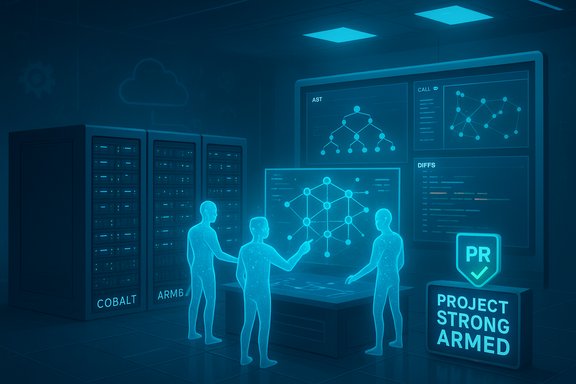
Microsoft appears to be quietly funding an ambitious effort — codenamed “Project Strong ARMed” in recent hiring adverts — to accelerate the migration of large x64 codebases to Arm64 across some parts of the company using AI-powered software engineering agents. The public fragments (job listings and community reporting) and internal analysis fragments show a coherent technical vision: combine large-scale program analysis, generative models, and automated verification pipelines to find, refactor, test and submit real pull requests that convert x64-first services and tools to AnyCPU/Arm64 targets. This is pitched as an efficiency and strategic play to enable Microsoft’s first-party Arm silicon (Cobalt) and to reduce long-term platform risk, but the plan collides with real-world engineering complexity, ABI constraints, and verification hurdles that will shape how fast — and how far — any automation can go.
Background
Why ARM64 matters to Microsoft now
Microsoft’s cloud and device roadmaps have shifted noticeably toward Arm-based silicon in the last two years. The company’s custom Azure Cobalt family (Cobalt 100 and announced Cobalt 200) is already running in production VMs and positioned as a high-efficiency option for cloud workloads, delivering concrete price-performance and power-efficiency gains over older Arm VMs and competing x86 instances. Those deployments are being used to justify further Arm investments across services and server-side workloads. At the same time, Microsoft’s broader software estate — from internal microservices to first-party platform components — remains overwhelmingly optimized for x64 (Intel/AMD) by historical development patterns. Porting existing code to a new ISA is not simply “recompile and run”: it often requires reworking ABI-dependent code, drivers, build tooling, test harnesses, and performance-critical hotspots. The scale of Microsoft’s codebase magnifies those obstacles. Internal commentary and hiring language make clear the company is treating those migrations as a strategic priority in places where Arm delivers measurable value.The public hint: a job listing and repeated job postings
A Senior Software Engineer job advert in Microsoft’s Experiences & Devices (E+D) division in Reading, UK — repeated across corporate job boards and LinkedIn mirrors — explicitly names Project Strong ARMed and asks candidates to build “AI-powered software engineering agents” that can automatically port codebases from x64 to AnyCPU and from Windows to Linux, and to drive adoption of Cobalt 100/200 processors. The same adverts mention agent names (for example, Chronicle and Bandish) as examples of agentic tooling to generate pull requests for porting work. These adverts are real, and they provide the clearest public evidence that Microsoft is assembling an organized engineering effort around this idea.What Project Strong ARMed is proposing
The advertised capability: AI agents that behave like junior engineers
The job description frames the desired system as a set of automated “software engineering agents” that can:- Scan repositories to find non-portable code and architecture-dependent hotspots.
- Modify source and build files to produce Arm64/AnyCPU variants or Arm64EC-compatible builds.
- Replace unsupported APIs and suggest or implement equivalent Arm64-safe libraries or shims.
- Update CI pipelines so that Arm64 builds are part of continuous validation.
- Generate pull requests with diffs, explanations and tests.
- Run tests and iterate autonomously where feasible before human review.
The technical stack the adverts hint at
The hiring language and internal roadmaps suggest three technical pillars:- Algorithmic program analysis — build whole-program graphs (ASTs, call graphs, data-flow graphs) so transformations are informed by compiler-grade analysis rather than only text-level substitution.
- Generative AI agents — use large models for synthesis, refactoring, specification inference, and test generation, operating under algorithmic guardrails. These agents propose edits, scaffold changes, and generate explanatory diffs.
- Human-in-the-loop verification and staged rollout — integrate fuzzing, equivalence testing, performance benchmarking and staged canaries so that automated PRs don’t get merged without human sign-off for risky code. This minimizes the chance of introducing regressions into critical services.
Why Microsoft would do this (benefits and strategic drivers)
Cost, performance and vendor diversification
- Arm servers (Cobalt series) promise better price‑performance and lower power consumption for many cloud-native workloads. If a large portion of services can run natively on Arm, Azure can lower operational TCO and increase hardware supply leverage. Public Azure materials highlight real performance and cost gains on Cobalt VMs.
Faster productization of first‑party silicon
- First-party silicon needs software to be available to be useful. Automated porting would accelerate the availability of native Arm builds for internal services (and eventually third-party ISVs), smoothing Cobalt adoption for internal services such as Azure backends and Microsoft 365 components. The job adverts explicitly frame the work as enabling Cobalt adoption.
Security and long-term engineering posture
- Microsoft has publicly experimented with Rust and has argued that moving system‑level code toward memory-safe languages reduces certain classes of vulnerabilities. Automated translation tools that produce idiomatic memory-safe code (Rust being a commonly cited example) could have security and maintenance benefits in the long run — if done correctly. Internal discussion documents show Rust is frequently used as a demonstrator target for memory-safety gains.
The engineering reality: why automated porting is hard
1) Undefined behavior, ABI and platform contracts
C and C++ ecosystems contain code that depends on subtle, sometimes undocumented platform behavior or on precise memory/layout/ABI expectations. Automated translation tools must preserve those contracts perfectly, or provide validated shims — a nontrivial task. For kernel modules and drivers, these contracts are especially strict and often cannot be emulated. A mechanical rewrite that does not preserve ABI or timing semantics can break interoperability.2) Performance-critical hotspots and inline assembly
Low-level kernels, cryptographic primitives, SIMD intrinsics and assembly blocks are tuned to particular microarchitectures. Automated systems must either preserve generated code semantics or replace hotspots with hand-verified idiomatic equivalents. Performance regressions here are costly and visible.3) Toolchains, build systems and test harnesses
Microsoft’s build fabric (MSBuild, internal CI, debug symbol management, telemetry) is deeply integrated with x64 assumptions. Converting a repo requires portable build scripts, cross-compilation strategies, dependency packaging, and long-term integration with telemetry and crash reporting systems. This rewiring is large-scale engineering work beyond pure code translation.4) The “last 1%” of correctness
Automated translation may succeed for large swathes of code, but the remaining edge cases that handle error paths, hardware quirks, or unusual concurrency patterns will require manual attention. These are the parts where silent correctness failures are most dangerous and costly. Tools need a staged rollout that isolates those cases for human review.How AI agents might realistically be used (practical patterns)
AI can be most effective when it augments deterministic analysis and human engineers rather than replacing them. Practical, high-value agent tasks include:- Finding porting targets and ranking them by risk and value.
- Rewriting high-level, idiomatic code patterns (string handling, container use, high-level APIs) into Arm-safe or language-migrated equivalents.
- Generating scaffolding tests and property-based test harnesses to validate behavior post-translation.
- Updating CI/CD scripts, packaging metadata, and creating pull requests that wrap the change with a clear PR description and test results.
Cobalt, cloud focus, and the consumer question
Cobalt 100 and Cobalt 200: clearly cloud-focused
Microsoft’s Cobalt 100 is promoted as an Azure-first Arm CPU powering server VMs, with customers such as Databricks and Snowflake already testing or adopting those VMs. Cobalt 200 is announced as a successor designed for broader data center use and higher efficiency. Microsoft’s public cloud blog posts and industry reporting confirm Cobalt’s role in cloud infrastructure rather than consumer PCs. This strongly suggests that initial Project Strong ARMed efforts are cloud- and service-focused, not aimed at converting the Windows client OS itself.Will client Windows and consumer Arm64 benefit?
Improvements in server-side Arm support, better tooling and cross-platform libraries will indirectly help client scenarios: more Arm-native libraries, improved tooling for Arm64 builds, and better emulation strategies (Prism/Arm64EC) lower friction for ISVs to ship native Arm builds for Windows clients. But porting the Windows client and its driver ecosystem is a different, higher‑risk effort that would require OEM coordination and driver vendor support. The job adverts and follow-on analysis indicate the immediate focus is cloud/service work; any consumer benefit would follow later and indirectly.Security, governance and trust concerns
Agentic automation opens new attack surfaces
Agentic systems that can edit code, update CI, and submit PRs create unique security concerns: compromised agents, supply-chain signing misuse, and prompt-injection-style manipulation of agent behavior. Microsoft’s internal documents and public discussion emphasize built-in guardrails, attestation, digital signing and human verification loops — but those controls must be mature before wide adoption inside high-stakes services. Enterprises and security teams should demand clear vetting and revocation procedures for agent tooling.Verification discipline is essential
Automated translations must come with heavy testing: unit, integration, fuzzing, property-based checks, and hardware-in-the-loop validation. Equivalence testing and staged canary deployments reduce blast radius, but these require extensive orchestration, telemetry, and rollbacks that are expensive at scale. The cost of testing is the primary reason this migration will be incremental and conservative.Timescales and realism: don’t confuse aspiration with a roadmap
A widely-circulated “North Star” metric — phrased in some Microsoft discussion as “1 engineer, 1 month, 1 million lines” — and public references to a 2030 objective to reduce C/C++ usage across the company are aspirational throughput targets, not guarantees that full migration will finish by a given date. Translating vast, mission-critical systems requires deliberate human verification and long testing cycles. Internal analyses point out that AI + algorithms can accelerate many tasks, but the most delicate components will always need domain experts and careful rollout plans. Treat productivity targets as engineering goals, not fixed release dates.What this means for developers, ISVs and IT teams
For ISVs and third-party developers
- Prioritize shipping Arm64 or Arm64EC-native builds for critical components (drivers, kernel-mode modules, EDR).
- Invest in CI that covers cross-architecture builds and automated tests.
- Track vendor roadmaps for Cobalt/Arm deployments if you target cloud customers running on Microsoft’s first-party silicon.
For enterprise IT and platform teams
- Pilot Arm64 in non-critical workloads first; validate EDR, management agents, and driver stacks on representative hardware.
- Keep fallback x64 capacity during initial rollouts; driver parity and kernel-mode dependencies will be the most common blockers.
Practical steps for individual engineers
- Inventory code paths that are ABI-sensitive or that use inline assembly.
- Add architecture-conditional tests early.
- Make build and packaging scripts portable (AnyCPU, multi-platform cross-compilation).
- Learn Arm64EC and Prism compatibility strategies for gradual migration if your app must interoperate with emulated x64 binaries.
Strengths and potential risks — balanced assessment
Strengths
- Scale & resources: Microsoft has the compute, telemetry and manpower to run large-scale migration experiments and staged rollouts that smaller organizations cannot.
- Better performance-per-TCO: Native Arm support for cloud services running on Cobalt could reduce costs and environmental footprint.
- Tooling advances: Combining program graphs with AI proposals is a practical architecture for safe augmentation of developer workflows.
Risks
- Unverifiable immediacy: Job adverts and aspirational metrics are not the same as operational guarantees; progress will be uneven and selective.
- Security and supply chain: Agentic automation that touches CI/CD and repo operations requires rigorous signing, vetting, and revocation infrastructure — gaps here are high risk.
- Driver and kernel constraints: Kernel-mode components will remain a hard stop until vendors ship Arm64 drivers or acceptable shims are produced.
Bottom line: pragmatic optimism, guarded expectations
Project Strong ARMed — as revealed by hiring adverts and corroborating internal analysis snippets — represents a logical, well-resourced attempt to make Arm64 adoption cheaper and faster using a pragmatic hybrid of program analysis, agentic AI, and human verification. If successful, it will accelerate the pace at which cloud services and internal tooling can run natively on Microsoft’s Cobalt silicon and push the broader ecosystem toward more Arm-first builds. However, the effort will be uneven and gradual: ABI constraints, drivers, assembly-heavy hotspots, and safety-critical subsystems will demand manual engineering and cautious rollouts. Stakeholders should expect incremental gains first in cloud-native servers and services, with consumer-facing benefits emerging more slowly and indirectly.For developers and IT teams, the actionable advice is to invest in cross-architecture CI, prioritize porting of kernel and driver dependencies when possible, and treat agentic automation as a helpful assistant — not a one-click migration button. Microsoft’s investment in tooling and agentic workflows is real, but so are the fundamental engineering limits; the practical outcome will be determined by the company’s verification discipline and how conservatively it applies automation to mission-critical code.
Conclusion
Project Strong ARMed surfaces a compelling engineering thesis: combine program graphs, deterministic analysis and generative AI to multiply developer productivity for cross‑architecture migrations. Public job postings and internal analysis fragments confirm Microsoft is investing in this direction, primarily to accelerate adoption of Cobalt-class Arm silicon in Azure and internal services. The technical approach is sensible and promising in targeted domains, but the real-world constraints of ABI compatibility, driver ecosystems, performance hotspots, and security governance mean this will be a careful, multi-year engineering program rather than an overnight conversion. The most realistic expectation is measurable Arm-first gains in cloud services and developer tooling first, with consumer-side improvements following later as the ecosystem matures.Source: Windows Latest Microsoft’s Project Strong ARMed wants AI agents that auto-port x64 codebases to Arm64 on Windows (likely not client for now)
